Topological phase and its effective tuning in a ladder lattice
Pith reviewed 2026-06-30 08:53 UTC · model grok-4.3
The pith
Coupling a trivial tight-binding leg to an SSH chain expands the topological phase and creates zero-energy edge modes even in the SSH-trivial regime.
A machine-rendered reading of the paper's core claim, the machinery that carries it, and where it could break.
Core claim
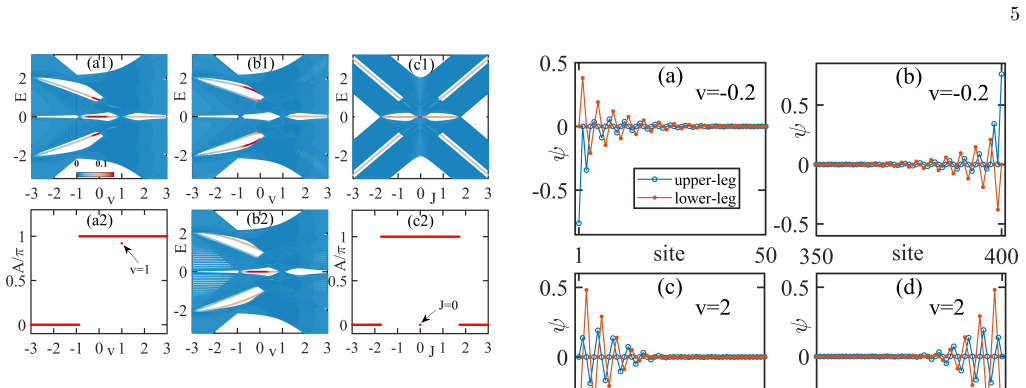
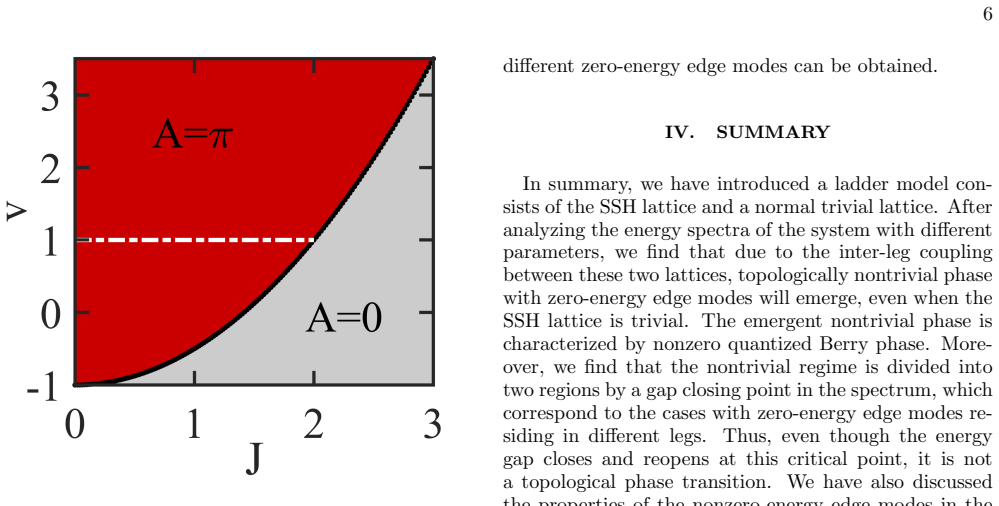
In the ladder model consisting of an SSH leg and a normal tight-binding leg, varying the inter-leg coupling induces a topologically nontrivial phase with zero-energy edge modes even when the SSH leg is in its trivial regime. The nontrivial region is significantly expanded, with phase boundaries determined analytically via quantized Berry phase. The zero modes' distributions allow dividing the nontrivial regime into two subregions separated by a gap closing.
What carries the argument
Inter-leg coupling strength, which mixes the SSH and uniform legs to produce an expanded topological phase and protected zero-energy edge modes.
If this is right
- The topological phase and edge modes can be tuned by manipulations performed only on the trivial lattice leg.
- The nontrivial regime splits into two subregions separated by a gap-closing point, with edge modes residing on different legs in each subregion.
- Phase boundaries are located analytically and the phase is diagnosed by a quantized Berry phase.
- The ladder geometry enlarges the parameter window for nontrivial topology relative to the isolated SSH chain.
Where Pith is reading between the lines
- Similar ladder constructions might enlarge topological regions in other one-dimensional models that are otherwise confined to narrow parameter windows.
- The two-leg geometry offers a route to move edge-mode localization between legs by crossing the gap-closing line inside the nontrivial phase.
- If the inter-leg coupling can be made spatially varying, the same mechanism could create interfaces between topologically distinct regions along the ladder.
Load-bearing premise
The analysis assumes an ideal non-interacting tight-binding Hamiltonian with uniform inter-leg coupling that can be varied independently while keeping intra-leg parameters fixed.
What would settle it
Measure the energy spectrum and edge-state localization in a physical ladder realization while sweeping inter-leg coupling strength with the SSH leg fixed in its single-chain trivial regime; absence of zero-energy modes or loss of Berry-phase quantization would falsify the claim.
Figures

read the original abstract
We study a two-leg ladder model consists of a one-dimensional (1D) Su-Schrieffer-Heeger (SSH) lattice with staggered nearest-neighboring hopping amplitudes and a normal 1D tight-binding lattice with uniform hopping. By varying the strength of inter-leg coupling, we find that topologically nontrivial phase with zero-energy edge modes will emerge, even when the SSH leg is in the trivial regime. Compared with the single SSH model, the nontrivial region in the parameter space is significantly expanded in the ladder. The topological phase is characterized by quantized Berry phase, and the phase boundaries are determined analytically. We also analyze the distributions of topological zero modes in the ladder, and find that the nontrivial regime can be further divided into two regions, which are separated by a gap closing point in the energy spectrum and correspond to the cases with edge modes residing in different legs. These results indicate that the topological phase and edge modes can be effectively tuned through the manipulations in the trivial lattice. Our work unveils the emergence of nontrivial topology in the ladder lattices and provides a new platform for studying topological phases.
Editorial analysis
A structured set of objections, weighed in public.
Referee Report
Summary. The paper studies a two-leg ladder Hamiltonian consisting of an SSH chain (staggered intra-leg hoppings) coupled to a uniform tight-binding chain via inter-leg hopping of tunable strength. The central claim is that increasing the inter-leg coupling induces a topologically nontrivial phase supporting zero-energy edge modes even when the isolated SSH leg lies in its trivial regime, thereby expanding the nontrivial region of parameter space relative to the single-chain SSH model. The phase is diagnosed by a quantized Berry phase, with analytically derived phase boundaries; the nontrivial regime is further subdivided into two sub-regimes distinguished by the leg on which the edge modes localize, separated by an additional gap-closing point.
Significance. If the derivations are correct, the result supplies a simple, analytically tractable mechanism for enlarging the topological phase diagram of an SSH chain by coupling it to a trivial lattice. The explicit analytical boundaries and the identification of two distinct edge-mode localization regimes constitute concrete, falsifiable predictions that could guide cold-atom or photonic-ladder experiments. The approach illustrates how inter-leg coupling can serve as an effective tuning knob for topology without altering the intra-leg parameters.
major comments (2)
- [§4] §4 (Berry-phase calculation): the manuscript states that the Berry phase is quantized to 0 or π but does not specify whether the invariant is computed as the sum over the two lowest bands of the 4×4 Bloch Hamiltonian or via a different projection; an explicit formula or reference to the standard multi-band Zak-phase definition is needed to confirm that the reported quantization is not an artifact of band selection.
- [§3.2] §3.2 (analytical phase boundaries): the gap-closing condition used to obtain the critical inter-leg coupling strength is stated to be independent of the intra-leg parameters in the trivial SSH regime, yet the explicit algebraic steps that eliminate the staggered hopping from the characteristic equation are not shown; without this intermediate algebra the claim that the boundary is parameter-free cannot be verified.
minor comments (3)
- [Figure 2] Figure 2: the color scale for the edge-mode probability density is not labeled, making it impossible to distinguish the two sub-regimes quantitatively.
- Notation: the inter-leg coupling is denoted both as t_⊥ and as γ in different sections; a single consistent symbol should be adopted throughout.
- [Abstract] The abstract claims the nontrivial region is 'significantly expanded,' but no quantitative comparison (e.g., area in parameter space) is provided in the main text or supplementary material.
Simulated Author's Rebuttal
We thank the referee for the positive evaluation of our work and for the constructive comments that will improve the clarity of the manuscript. We address each major comment below and will revise the manuscript to incorporate the requested details.
read point-by-point responses
-
Referee: [§4] §4 (Berry-phase calculation): the manuscript states that the Berry phase is quantized to 0 or π but does not specify whether the invariant is computed as the sum over the two lowest bands of the 4×4 Bloch Hamiltonian or via a different projection; an explicit formula or reference to the standard multi-band Zak-phase definition is needed to confirm that the reported quantization is not an artifact of band selection.
Authors: We appreciate the referee highlighting this omission. The Berry phase reported in the manuscript is the sum of the Zak phases over the two lowest (occupied) bands of the 4×4 Bloch Hamiltonian, evaluated using the standard multi-band definition of the Zak phase in one dimension. This choice is required for the topological invariant of the gapped ladder system. We will add the explicit summation formula together with a reference to the multi-band Zak-phase definition in the revised §4. revision: yes
-
Referee: [§3.2] §3.2 (analytical phase boundaries): the gap-closing condition used to obtain the critical inter-leg coupling strength is stated to be independent of the intra-leg parameters in the trivial SSH regime, yet the explicit algebraic steps that eliminate the staggered hopping from the characteristic equation are not shown; without this intermediate algebra the claim that the boundary is parameter-free cannot be verified.
Authors: We agree that the intermediate algebra should be shown for full transparency. The gap-closing condition is obtained by setting the determinant of the 4×4 Hamiltonian to zero at the relevant momentum point; after substitution of the trivial-regime parameters, the staggered-hopping terms cancel identically in the characteristic equation, yielding a critical inter-leg coupling that is independent of those parameters. We will insert the explicit algebraic steps in the revised §3.2. revision: yes
Circularity Check
No significant circularity
full rationale
The derivation starts from an explicit four-band tight-binding Hamiltonian for the SSH-plus-normal ladder, computes the Bloch matrix, solves its characteristic equation for gap-closing loci, and obtains the Berry phase and edge-mode localization directly from the eigenvectors. All phase boundaries and the two sub-regimes are therefore algebraic consequences of the stated Hamiltonian parameters; no fitted quantities are relabeled as predictions, no self-citation supplies a uniqueness theorem, and no ansatz is smuggled in. The central claim that inter-leg coupling enlarges the nontrivial region is therefore an independent calculation, not a re-expression of the input model.
Axiom & Free-Parameter Ledger
free parameters (1)
- inter-leg coupling strength
axioms (2)
- domain assumption Non-interacting tight-binding Hamiltonian on a ladder geometry
- domain assumption Periodic or open boundary conditions allowing edge-mode analysis
Reference graph
Works this paper leans on
-
[1]
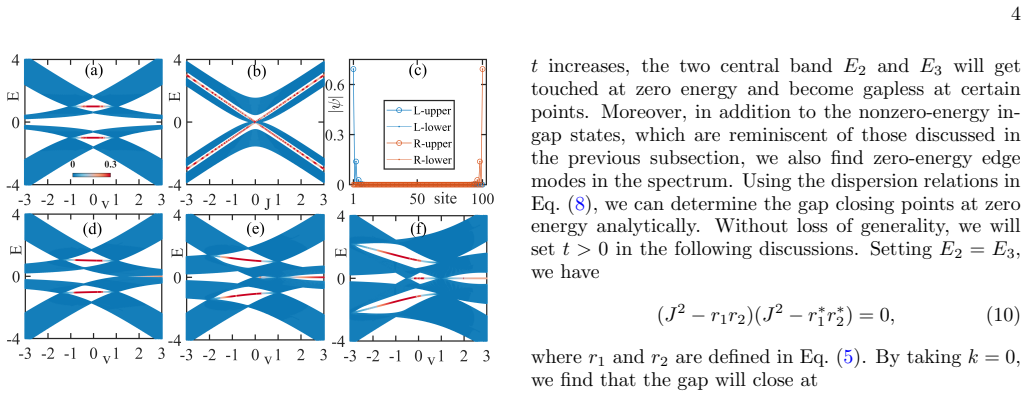
= 0,(10) wherer 1 andr 2 are defined in Eq. (5). By takingk= 0, we find that the gap will close at vc1 = J 2 2t −w.(11) Whentis small, there will be only this one gap closing point, see Fig. 2(d). And we can observe zero-energy edge modes in the regimev > v c1. However, whent > J 2/2w, another gap closing point will emerge at vc2 =w.(12) And the region wi...
-
[2]
M. Z. Hasan and C. L. Kane, Colloquium: Topological insulators, Rev. Mod. Phys.82,3045 (2010)
2010
-
[3]
X. L. Qi and S. C. Zhang, Topological insulators and superconductors, Rev. Mod. Phys.83,1057 (2011)
2011
-
[4]
Ando and L
Y. Ando and L. Fu, Topological crystalline insulators and topological superconductors: from concepts to materials, Annu. Rev. Condens. Matter Phys.6,361 (2015)
2015
-
[5]
S. R. Elliott and M. Franz, Colloquium: Majorana fermions in nuclear, particle, and solid-state physics, Rev. Mod. Phys.87,137 (2015)
2015
-
[6]
B. A. Bernevig, T. L. Hughes, and S. C. Zhang, Quantum spin Hall effect and topological phase transition in HgTe quantum wells, Science314,1757 (2006)
2006
-
[7]
M. Z. Hasan, S.-Y. Xu, I. Belopolsi, and S.-M. Huang, Discovery of Weyl fermion semimetals and topological Fermi arc states, Annu. Rev. Condens. Matter Phys.8, 289 (2017)
2017
-
[8]
Yan and C
B. Yan and C. Felser, Topological materials: Weyl semimetals, Annu. Rev. Condens. Matter Phys.8,337 (2017)
2017
-
[9]
N. P. Armitage, E. J. Mele, and A. Vishwanath, Weyl and Dirac semimetals in three-dimensional solids, Rev. Mod. Phys.90,015001 (2018)
2018
-
[10]
Sitte, A
M. Sitte, A. Rosch, E. Altman, and L. Fritz, Topological insulators in magnetic fields: quantum Hall effect and edge channels with a nonquantizedθterm, Phys. Rev. Lett.108,126807 (2012)
2012
-
[11]
Zhang, C
F. Zhang, C. L. Kane, and E. J. Mele, Surface state mag- netization and chiral edge states on topological insula- tors, Phys. Rev. Lett.110,046404 (2013)
2013
-
[12]
W. A. Benalcazar, B. A. Bernevig, and T. L. Hughes, Quantized electric multipole insulators, Science357,61 (2017)
2017
-
[13]
W. P. Su, J. R. Schrieffer, and A. J. Heeger, Solitons in polyacetylene, Phys. Rev. Lett.42,1698 (1979)
1979
-
[14]
A. J. Heeger, S. Kivelson, J. R. Schrieffer, and W. P. Su, Solitons in conducting polymers, Rev. Mod. Phys.60, 781 (1988)
1988
-
[15]
A. Y. Kitaev, Unpaired Majorana fermions in quantum wires, Phys. Usp.44,131 (2001)
2001
-
[16]
F. D. M. Haldane, Model for a quantum Hall effect with- out Landau levels: condensed-matter realization of the ”parity anomaly”, Phys. Rev. Lett.61,2015 (1988)
2015
-
[17]
C. L. Kane and E. J. Mele, Quantum spin Hall effect in graphene, Phys. Rev. Lett.95,226801 (2005)
2005
-
[18]
Atala, M
M. Atala, M. Aidelsburger, J. T. Barreiro, D. Abanin, T. Kitagawa, E. Demler, and I. Bloch, Direct measure- ment of the Zak phase in topological Bloch bands, Nature Phys.9,795 (2013)
2013
-
[19]
Lohse, C
M. Lohse, C. Schweizer, O. Zilberberg, M. Aidelsburger, and I. Bloch, A Thouless quantum pump with ultracold bosonic atoms in an optical superlattice, Nature Phys. 12,350 (2016)
2016
-
[20]
Nakajima, T
S. Nakajima, T. Tomita, S. Taie, T. Ichinose, H. Ozawa, L. Wang, M. Troyer, and Y. Takahashi, Topological Thouless pumping of ultracold fermions, Nature Phys. 12,296 (2016)
2016
-
[21]
Z. Wang, Y. Chong, J. D. Joannopoulos, and M. Soljaˇ ci´ c, Observation of unidirectional backscattering- immune topological electromagnetic states, Nature (Lon- don)461,772 (2009)
2009
-
[22]
S¨ usstrunk and S
R. S¨ usstrunk and S. D. Huber, Observation of phononic helical edge states in a mechanical topological insulator, Science349,47 (2015)
2015
-
[23]
C. W. Peterson, W. A. Benalcazar, T. L. Hughes, and G. Bahl, A quantized microwave quadrupole insulator with topologically protected corner states, Nature555,346 (2018)
2018
-
[24]
Chaunsali, E
R. Chaunsali, E. Kim, A. Thakkar, P. G. Kevrekidis, and J. Yang, Demonstrating an in situ yopological band transition in cylindrical granular chains, Phys. Rev. Lett. 119,024301 (2017)
2017
-
[25]
Liu, Z.-B
Z.-X. Liu, Z.-B. Yang, Y.-J. Han, W. Yi, and X.-G. Wen, Symmetry-protected topological phases in spin ladders with two-body interactions, Phys. Rev. B86,195122 (2012)
2012
-
[26]
X. Li, E. Zhao, and W. Vincent Liu, Topological states in a ladder-like optical lattice containing ultracold atoms in higher orbital bands, Nat. Commun.4,1523 (2013)
2013
-
[27]
Sun, Topological phases of fermionic ladders with pe- riodic magnetic fields, Phys
G. Sun, Topological phases of fermionic ladders with pe- riodic magnetic fields, Phys. Rev. A93,023608 (2016)
2016
-
[28]
Ogino, S
T. Ogino, S. Furukawa, R. Kaneko, S. Morita, and N. Kawashima, Symmetry protected topological phases and competing orders in a spin-1/2 XXZ ladder with a four- spin interaction, Phys. Rev. B104,075135 (2021)
2021
-
[29]
Ogino, R
T. Ogino, R. Kaneko, S. Morita, and S. Furukawa, Ground-state phase diagram of a spin-1/2 frustrated XXZ ladder, Phys. Rev. B106,155106 (2022)
2022
-
[30]
Mondal, A
S. Mondal, A. Agarwala, T. Mishra, and A. Prakash, Symmetry-enriched criticality in a coupled spin ladder, Phys. Rev. B108,245135 (2023)
2023
-
[31]
Parida, A
R. Parida, A. Padhan, and T. Mishra, Interaction driven topological phase transitions of hardcore bosons on a two- leg ladder, Phys. Rev. B110,165110 (2024)
2024
-
[32]
C A Downing, L Mart´ ın-Moreno and O I R Fox, Uncon- ventional edge states in a two-leg ladder, New J. Phys. 26,073014 (2024)
2024
-
[33]
Sara Aghtouman and Mir Vahid Hosseini, Dimerized hof- stadter model in two-leg ladder quasi-crystals, Scientific Reports 14, 8782 (2024)
2024
-
[34]
Jo˜ ao Pedro Gama D’Elia and Thereza Paiva, Topological phase transition in the two-leg Hubbard model: emer- gence of the Haldane phase via diagonal hopping and strong interactions, Phys. Rev. B112,035169 (2025)
2025
-
[35]
Lu and S
J. Lu and S. Wang, Tight-binding investigation of the metallic proximity effect of semiconductor metal double- wall carbon nanotubes, Phys. Rev. B76,233103 (2007)
2007
-
[36]
Shoman, A
T. Shoman, A. Takayama, T. Sato, S. Souma, T. Taka- hashi, T. Oguchi, K. Segawa, and Y. Ando, Topological proximity effect in a topological insulator hybrid, Nat. Commun.6,6547 (2015)
2015
-
[37]
T. H. Hsieh, H. Ishizuka, L. Balents, and T. L. Hughes, Bulk topological proximity effect, Phys. Rev. Lett.116, 086802 (2016)
2016
-
[38]
Cheng, P
P. Cheng, P. W. Klein, K. Plekhanov, K. Sengstock, M. Aidelsburger, C. Weitenberg, and K. Le Hur, Topological proximity effects in a Haldane graphene bilayer system, Phys. Rev. B100,081107(R) (2019)
2019
-
[39]
Jun-Hui Zheng and Walter Hofstetter, Topological invari- ant for two-dimensional open systems, Phys. Rev. B97, 195434 (2018)
2018
-
[40]
Sun and L.-K
N. Sun and L.-K. Lim, Quantum charge pumps with 8 topological phases in a Creutz ladder, Phys. Rev. B96, 035139 (2017)
2017
-
[41]
Y. Kuno, T. Orito, and I. Ichinose, Flat-band many-body localization and ergodicity breaking in the Creutz ladder, New J. Phys.22,013032 (2020)
2020
-
[42]
Orito, Y
T. Orito, Y. Kuno, and I. Ichinose, Interplay and com- petition between disorder and flat band in an interacting Creutz ladder, Phys. Rev. B104,094202 (2021)
2021
-
[43]
Mukherjee, A
A. Mukherjee, A. Nandy, S. Sil, and A. Chakrabarti, Tai- loring flat bands and topological phases in a multistrand Creutz network, Phys. Rev. B105,035428 (2022)
2022
-
[44]
Pelegr´ ı, S
G. Pelegr´ ı, S. Flannigan, and A. J. Daley, Few-body bound topological and flat-band states in a Creutz lad- der, Phys. Rev. B109,235412 (2024)
2024
-
[45]
A. A. Nersesyan, Phase diagram of an interacting stag- gered Su-Schrieffer-Heeger two-chain ladder close to a quantum critical point, Phys. Rev. B102,045108 (2020)
2020
-
[46]
Zhang and Q
S.-L. Zhang and Q. Zhou, Two-leg Su-Schrieffer-Heeger chain with glide reflection symmetry, Phys. Rev. A95, 061601 (2017)
2017
-
[47]
C. Li, S. Lin, G. Zhang, and Z. Song, Topological nodal points in two coupled Su-Schrieffer-Heeger chains, Phys. Rev. B96,125418 (2017)
2017
-
[48]
Padavi´ c, S
K. Padavi´ c, S. S. Hegde, W. DeGottardi, and S. Vishveshwara, Topological phases, edge modes, and the Hofstadter butterfly in coupled Su-Schrieffer-Heeger sys- tems, Phys. Rev. B98,024205 (2018)
2018
-
[49]
Jangjan and M
M. Jangjan and M. V. Hosseini, Floquet engineering of topological metal states and hybridization of edge states with bulk states in dimerized two-leg ladders, Scientific Reports10,14256 (2020)
2020
-
[50]
Jangjan and M
M. Jangjan and M. V. Hosseini, Topological proper- ties of subsystem-symmetry-protected edge states in an extended quasi-one-dimensional dimerized lattice, Phys. Rev. B106,205111 (2022)
2022
-
[51]
Padhan, S
A. Padhan, S. Mondal, S. Vishveshwara, and T. Mishra, Interacting bosons on a Su-Schrieffer-Heeger ladder: Topological phases and thouless pumping, Phys. Rev. B 109,085120 (2024)
2024
-
[52]
Zhou, Z.-C
Z. Zhou, Z.-C. Xu, and L.-J. Lang, Non-Abelian ge- ometry, topology, and dynamics of a nonreciprocal Su- Schrieffer-Heeger ladder, Phys. Rev. B112,094305 (2025)
2025
-
[53]
DeGottardi, D
W. DeGottardi, D. Sen and S. Vishveshwara, New J. Phys.13,065028 (2011)
2011
-
[54]
Wu, Topological phases of the two-leg Kitaev ladder, Phys
N. Wu, Topological phases of the two-leg Kitaev ladder, Phys. Lett. A376,3530 (2012)
2012
-
[55]
Maiellaro, F
A. Maiellaro, F. Romeo, and R. Citro, Topological phase diagram of a Kitaev ladder, Eur. Phys. J. Spec. Top.227, 1397 (2018)
2018
-
[56]
Shibata and H
N. Shibata and H. Katsura, Dissipative spin chain as a non-Hermitian Kitaev ladder, Phys. Rev. B99,174303 (2019)
2019
-
[57]
Nehra, D
R. Nehra, D. S. Bhakuni, A. Ramachandran, and A. Sharma, Flat bands and entanglement in the Kitaev lad- der, Phys. Rev. Res.2,013175 (2020)
2020
-
[58]
Xu and H.-Y
H. Xu and H.-Y. Kee, Reviving Majorana zero modes in the spin-1/2 Kitaev ladder model, Phys. Rev. B110, 195133 (2024)
2024
-
[59]
M. V. Berry, Quantal phase factors accompanying adia- batic changes, Proc. Roy. Soc. London A392,45 (1984)
1984
-
[60]
Zak, Berry’s phase for energy bands in solids, Phys
J. Zak, Berry’s phase for energy bands in solids, Phys. Rev. Lett.62,2747 (1989)
1989
-
[61]
C. H. Lee, S. Imhof, C. Berger, F. Bayer, J. Brehm, L. W. Molenkamp, T. Kiessling, and R. Thomale, Topolectrical circuits, Commun. Phys.1,39 (2018)
2018
-
[62]
Hofmann, T
T. Hofmann, T. Helbig, C. H. Lee, M. Greiter, and R. Thomale, Chiral voltage propagation and calibration in a topolectrical Chern circuit, Phys. Rev. Lett.122,247702 (2019)
2019
-
[63]
Zhang, C
X. Zhang, C. Wu, M. Yan, and G. Chen, Observation of non-Hermitian pseudo-mobility-edge in a coupled electric circuit ladder, Phys. Rev. B111,014304 (2025)
2025
-
[64]
W.-W Jin, J. Liu, X. Wang, Y.-R. Zhang, X. Huang, X. Wei, W. Ju, Z. Yang, T. Liu, and Franco Nori, An- derson delocalization in strongly coupled disordered non- Hermitian chains, Phys. Rev. Lett.135,076602 (2025)
2025
discussion (0)
Sign in with ORCID, Apple, or X to comment. Anyone can read and Pith papers without signing in.