Cosmological structure growth in energy-momentum squared gravity
Pith reviewed 2026-06-30 08:37 UTC · model grok-4.3
The pith
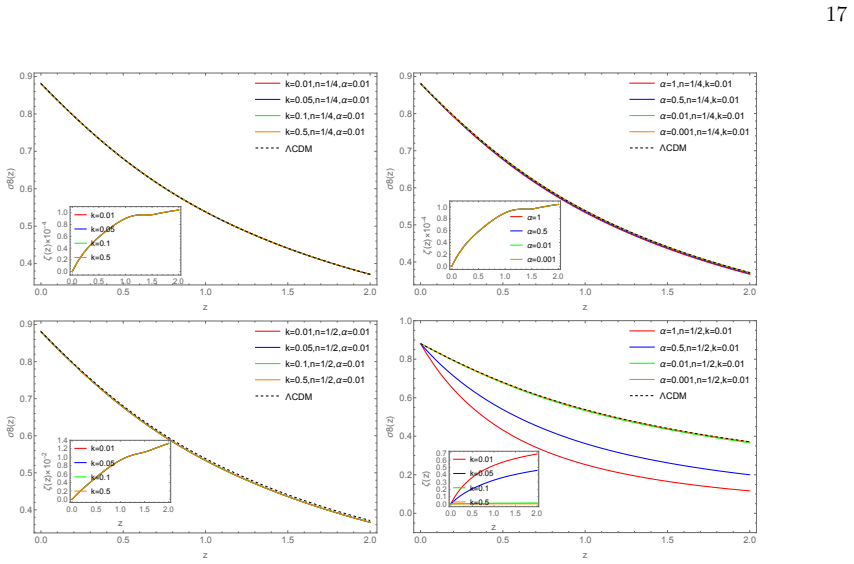
In f(R,T²) gravity the matter density contrast evolves with a growth index that decreases at late times but stays consistent with current fσ8 data for suitable coupling strengths.
A machine-rendered reading of the paper's core claim, the machinery that carries it, and where it could break.
Core claim
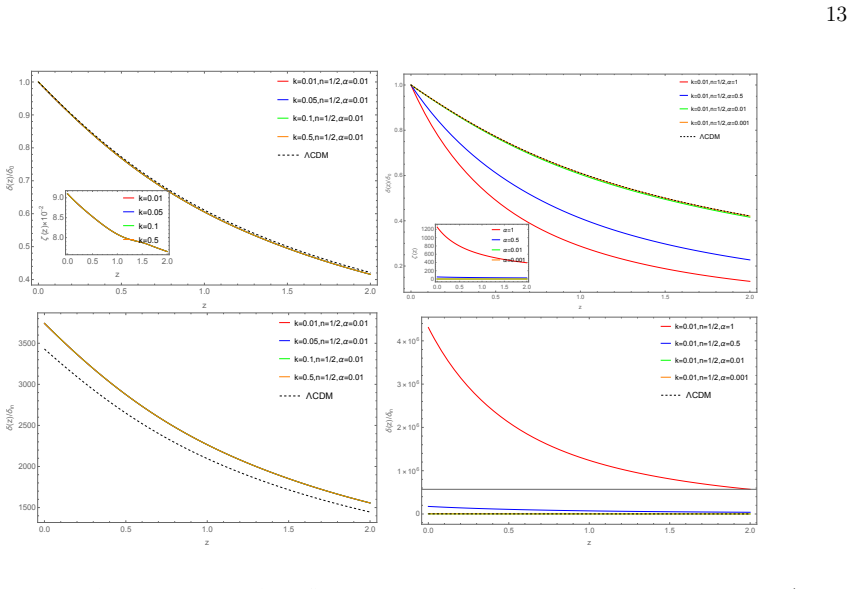
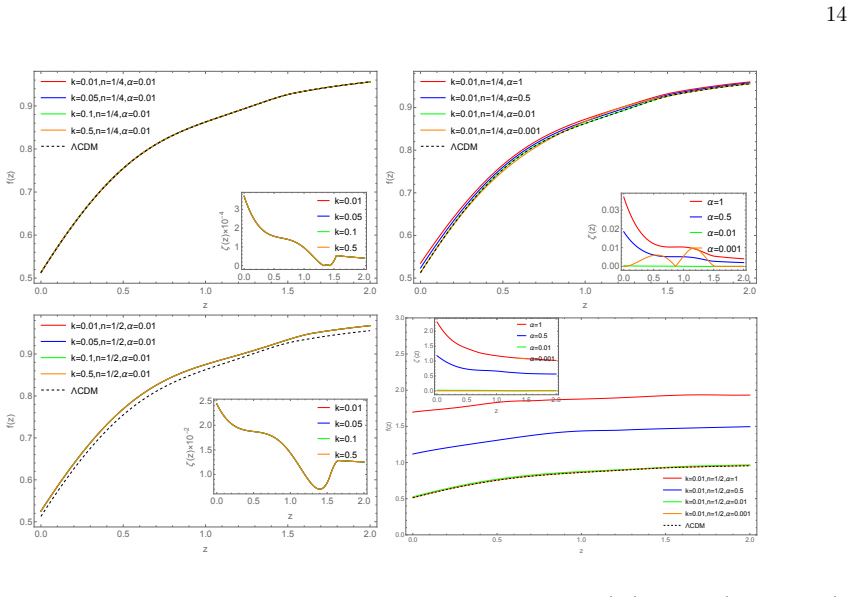
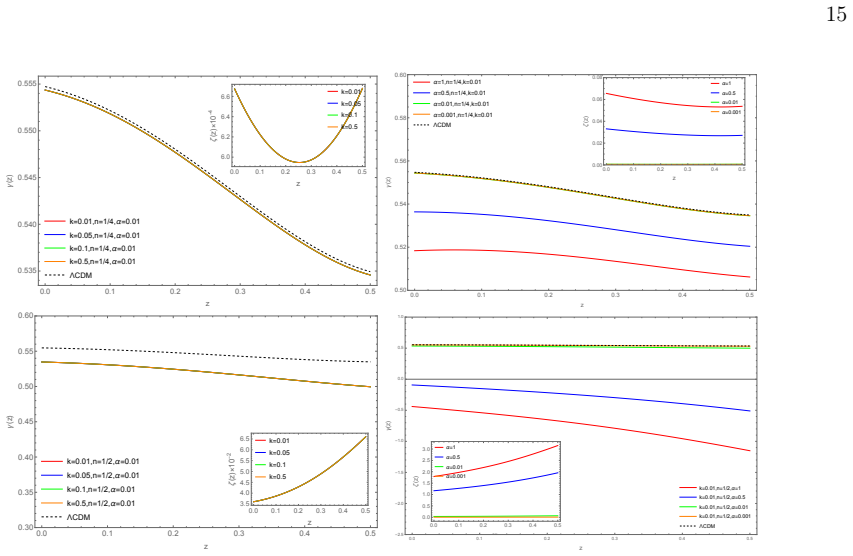
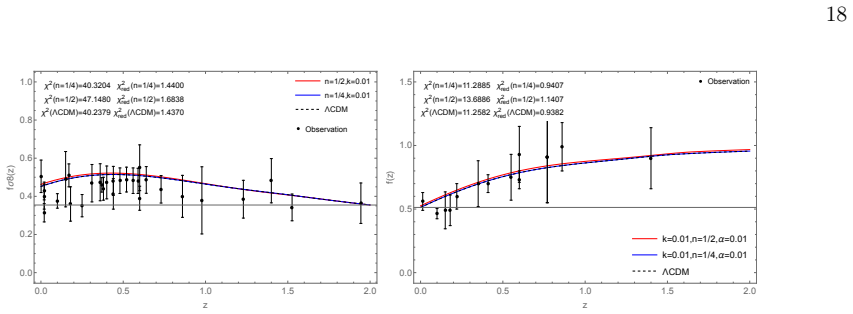
The central claim on the paper's own terms is that f(R,T²) gravity supplies a viable description of both late-time cosmic acceleration and large-scale structure formation: the growth index decreases with redshift and approaches standard matter-dominated behavior at early times, mild scale-dependent departures from ΛCDM appear at late times, and viable parameter choices for n=1/2 and n=1/4 keep the predicted fσ8 within the observational ±2σ bounds.
What carries the argument
The gauge-invariant 1+3 covariant formalism used to obtain the evolution equations for the matter density contrast in the presence of the T² term.
If this is right
- The growth index decreases with increasing redshift and recovers the standard matter-dominated limit at early times.
- Mild scale-dependent deviations from the ΛCDM growth rate appear only at late times.
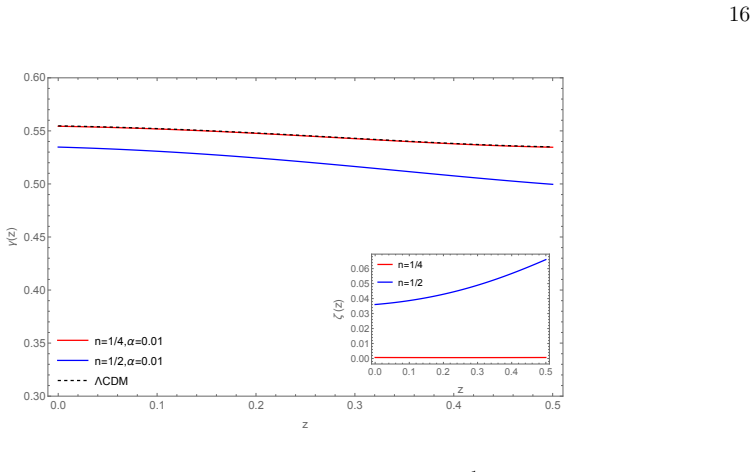
- For n=1/4 the departures from general relativity remain small; for n=1/2 and larger α they become stronger.
- Viable parameter choices keep the model's fσ8 predictions inside the current observational ±2σ interval.
Where Pith is reading between the lines
- If the coupling works as described, the same term that drives acceleration could also modify the growth rate enough to ease the σ8 tension without new fields.
- Scale-dependent signatures at low redshift could be searched for with future surveys that bin galaxies by scale and redshift.
- The same formalism might be applied to other quadratic scalars built from the energy-momentum tensor to generate different expansion histories.
- Consistency with supernova distances or CMB lensing would provide an independent test not performed in this work.
Load-bearing premise
That the standard 1+3 covariant equations for density perturbations carry over to f(R,T²) without extra source terms generated by the direct matter-geometry coupling.
What would settle it
A future measurement of fσ8 at redshift z approximately 0.8 that lies outside the model's predicted band for the α values already compatible with present data.
Figures

read the original abstract
We investigate the cosmological evolution of matter perturbations in the modified gravity model $f(R,T^2)$, where $T^2=T_{\mu\nu}T^{\mu\nu}$ denotes the quadratic contraction of the energy--momentum tensor. Using the gauge-invariant 1+3 covariant formalism, we study the evolution of the matter density contrast and analyze several growth observables, including the growth factor, the growth index, and the weighted growth rate $f\sigma_8$. We consider representative values $n=1/2$ and $n=1/4$, which probe different regimes of the matter--geometry coupling. We show that the growth index decreases with increasing redshift and approaches the standard matter-dominated behavior at early times, while mild scale-dependent deviations from the $\Lambda$CDM model emerge at late times. The model predicts small departures from General Relativity for $n=1/4$, whereas stronger deviations appear for $n=1/2$ and larger values of the coupling parameter $\alpha$. We further compare the theoretical predictions for $f\sigma_8$ with current observational data and find that viable parameter choices remain within the observational $\pm2\sigma$ bounds. These results indicate that $f(R,T^2)$ gravity can provide a viable description of late-time cosmic acceleration and large-scale structure formation while remaining consistent with current growth observations.
Editorial analysis
A structured set of objections, weighed in public.
Referee Report
Summary. The paper studies the evolution of matter density perturbations in f(R,T²) gravity (with T² = T_μν T^μν) using the gauge-invariant 1+3 covariant formalism. For representative exponents n=1/2 and n=1/4 it computes the growth factor, growth index, and fσ8, reports mild scale-dependent deviations from ΛCDM at late times, and states that viable choices of the coupling α keep the predicted fσ8 within current observational ±2σ bounds, concluding that the model remains consistent with large-scale structure data while accommodating late-time acceleration.
Significance. If the linearized perturbation equations are shown to be complete, the work would supply a concrete, observationally testable extension of energy-momentum-squared gravity to the growth sector, complementing existing background analyses and offering a falsifiable alternative to ΛCDM at the level of fσ8 and the growth index.
major comments (2)
- [§3 (perturbation equations) and §4 (growth observables)] The central fσ8 and growth-index results rest on the numerical integration of the density-contrast equation derived in the 1+3 formalism. The abstract and §3 (perturbation equations) state that the standard gauge-invariant formalism is applied directly, yet the action contains an explicit α f(T²) term whose variation produces additional contributions to the effective stress-energy tensor and to the linearized Raychaudhuri and momentum constraints. These extra source terms, proportional to f'(T²) and to first-order perturbations of T_μν T^μν, are not shown to have been re-derived and inserted; their omission would render the reported scale-dependent deviations and data comparison unreliable.
- [§4 and Table 1] Table 1 and the accompanying text select n=1/2 and n=1/4 as “representative” values after noting that they keep predictions inside observational bounds. This post-selection of parameters undermines the claim of a parameter-free or robust prediction; the manuscript should instead present the full α–n parameter space and the exclusion criteria used to define “viable” choices.
minor comments (2)
- [Abstract and §4] The abstract and §2 refer to “mild deviations” and “small departures” without quantifying the redshift or scale at which these become statistically distinguishable from ΛCDM; explicit Δfσ8(z) curves with error bands would clarify the claim.
- [§2] Notation for the coupling function f(T²) and the exponent n is introduced without an explicit functional form (e.g., whether f(T²) = (T²)^n or another power); this should be stated once in §2 for reproducibility.
Simulated Author's Rebuttal
We thank the referee for the careful reading and constructive comments on our manuscript. We respond to each major comment below, indicating the revisions that will be made.
read point-by-point responses
-
Referee: [§3 (perturbation equations) and §4 (growth observables)] The central fσ8 and growth-index results rest on the numerical integration of the density-contrast equation derived in the 1+3 formalism. The abstract and §3 (perturbation equations) state that the standard gauge-invariant formalism is applied directly, yet the action contains an explicit α f(T²) term whose variation produces additional contributions to the effective stress-energy tensor and to the linearized Raychaudhuri and momentum constraints. These extra source terms, proportional to f'(T²) and to first-order perturbations of T_μν T^μν, are not shown to have been re-derived and inserted; their omission would render the reported scale-dependent deviations and data comparison unreliable.
Authors: We agree that the additional source terms arising from the variation of the α f(T²) term must be explicitly derived and shown. Although the 1+3 covariant formalism was used to obtain the density-contrast equation, the manuscript did not display the modified linearized Raychaudhuri and momentum constraints with the extra contributions. In the revised version we will add the full derivation of these terms in §3 and confirm that they are included in the numerical integration of the growth observables. revision: yes
-
Referee: [§4 and Table 1] Table 1 and the accompanying text select n=1/2 and n=1/4 as “representative” values after noting that they keep predictions inside observational bounds. This post-selection of parameters undermines the claim of a parameter-free or robust prediction; the manuscript should instead present the full α–n parameter space and the exclusion criteria used to define “viable” choices.
Authors: The manuscript presents results for representative values of n that satisfy the observational bounds rather than claiming a parameter-free prediction. To strengthen the presentation we will revise §4 to explicitly state the exclusion criteria (consistency with background expansion history and fσ8 data) and add a figure or table showing the viable region in the α–n plane together with fσ8 predictions for a wider range of parameters. revision: partial
Circularity Check
No circularity; derivation uses standard formalism and external data benchmarks
full rationale
The provided abstract and context show the paper applies the gauge-invariant 1+3 covariant formalism to derive matter density contrast evolution equations, selects representative n values, and compares fσ8 to external observational data for viability within ±2σ bounds. No quoted equations or steps reduce by construction to fitted inputs, self-citations, or self-definitions. The consistency claim rests on external benchmarks rather than internal parameter forcing, satisfying the criteria for a self-contained result.
Axiom & Free-Parameter Ledger
free parameters (2)
- coupling parameter α
- exponent n
axioms (1)
- domain assumption The gauge-invariant 1+3 covariant formalism applies without modification to the perturbation equations of f(R,T²)
Reference graph
Works this paper leans on
-
[1]
A. A. Starobinsky, A New Type of Isotropic Cosmological Models Without Singularity, Phys. Lett. B 91, 99 (1980)
1980
-
[2]
A. H. Guth, The Inflationary Universe: A Possible Solution to the Horizon and Flatness Problems, Phys. Rev. D23, 347 (1981)
1981
-
[3]
A. D. Linde, Scalar Field Fluctuations in Expanding Universe and the New Inflationary Universe Scenario, Phys. Lett. B116, 335 (1982)
1982
-
[4]
A. G. Riesset al., Observational Evidence from Supernovae for an Accelerating Universe and a Cos- mological Constant, Astrophysical Journal116, 1009 (1998), arXiv:astro-ph/9805201 [astro-ph]
work page internal anchor Pith review Pith/arXiv arXiv 1998
-
[5]
E. W. Kolb and M. S. Turner,The Early Universe, Vol. 69 (Taylor and Francis, 2019)
2019
-
[6]
N. J. Cornish, D. N. Spergel, G. D. Starkman, and E. Komatsu, Constraining the topology of the universe, Phys. Rev. Lett.92, 201302 (2004)
2004
-
[7]
Aghanimet al.(Planck), Planck 2018 results
N. Aghanimet al.(Planck), Planck 2018 results. VIII. Gravitational lensing, Astron. Astrophys.641, A8 (2020), arXiv:1807.06210 [astro-ph.CO]
-
[8]
Hinsawet al.(WMAP), Nine-year wilkinson microwave anisotropy probe wmap observations: Cosmo- logical parameter results, The Astrophysical Journal Supplement Series 10.1088/0067-0049/208/2/19 (2013)
work page internal anchor Pith review doi:10.1088/0067-0049/208/2/19 2013
-
[9]
L. Andersonet al.(BOSS), The clustering of galaxies in the SDSS-III Baryon Oscillation Spectroscopic Survey: Baryon Acoustic Oscillations in the Data Release 9 Spectroscopic Galaxy Sample, Mon. Not. Roy. Astron. Soc.427, 3435 (2013), arXiv:1203.6594 [astro-ph.CO]
work page internal anchor Pith review Pith/arXiv arXiv 2013
- [10]
-
[11]
U.-L. L., Scalar fields in cosmology: dark matter and inflation, Journal of Physics: Conference Series 761, 10.1088/1742-6596/761/1/012076 (2016)
-
[12]
Sahni and A
V. Sahni and A. Starobinsky, The case for a positive cosmologicalλ-term, Int. J. Mod. Phys. D09, 0218 (2000)
2000
-
[13]
P. J. E. Peebles and B. Ratra, The cosmological constant and dark energy, Rev. Mod. Phys.75, 559 (2003)
2003
-
[14]
S. M. Carroll, The cosmological constant, Living Reviews in Relativity4, 10.12942/lrr-2001-1 (2001)
-
[15]
M. S. Turner and D. Huterer, Cosmic acceleration, dark energy, and fundamental physics, ournal of the Physical Society of Japan76, 11015 (2007)
2007
-
[16]
Weinberg, The Cosmological Constant Problem, Rev
S. Weinberg, The Cosmological Constant Problem, Rev. Mod. Phys.61, 1 (1989). 21
1989
-
[17]
Quintessence, Cosmic Coincidence, and the Cosmological Constant
I. Zlatev, L.-M. Wang, and P. J. Steinhardt, Quintessence, cosmic coincidence, and the cosmological constant, Phys. Rev. Lett.82, 896 (1999), arXiv:astro-ph/9807002
work page internal anchor Pith review Pith/arXiv arXiv 1999
-
[18]
S. Nojiri and S. D. Odintsov, Modified gravity with negative and positive powers of the curvature: Unification of the inflation and of the cosmic acceleration, Phys. Rev. D68, 123512 (2003), arXiv:hep- th/0307288
-
[19]
G. C. Samanta and N. Godani, Physical parameters for stablef(R)models, Indian Journal of Physics 94, 1303–1310 (2019)
2019
-
[20]
H. A. Buchdahl, Non-linear lagrangians and cosmological theory, Monthly Notices of the Royal Astro- nomical Society150, 10.1093/mnras/150.1.1 (1970)
-
[21]
S. Capozziello and M. De Laurentis, Extended Theories of Gravity, Phys. Rept.509, 167 (2011), arXiv:1108.6266 [gr-qc]
work page internal anchor Pith review Pith/arXiv arXiv 2011
-
[22]
Modified Gravity and Cosmology
T. Clifton, P. G. Ferreira, A. Padilla, and C. Skordis, Modified Gravity and Cosmology, Phys. Rept. 513, 1 (2012), arXiv:1106.2476 [astro-ph.CO]
work page internal anchor Pith review Pith/arXiv arXiv 2012
-
[23]
Introduction to Modified Gravity and Gravitational Alternative for Dark Energy
S. Nojiri and S. D. Odintsov, Introduction to modified gravity and gravitational alternative for dark energy, eConfC0602061, 06 (2006), arXiv:hep-th/0601213
work page internal anchor Pith review Pith/arXiv arXiv 2006
-
[24]
Unified cosmic history in modified gravity: from F(R) theory to Lorentz non-invariant models
S. Nojiri and S. D. Odintsov, Unified cosmic history in modified gravity: fromF(R)theory to Lorentz non-invariant models, Phys. Rept.505, 59 (2011), arXiv:1011.0544 [gr-qc]
work page internal anchor Pith review Pith/arXiv arXiv 2011
-
[25]
Modified Gravity Theories on a Nutshell: Inflation, Bounce and Late-time Evolution
S. Nojiri, S. D. Odintsov, and V. K. Oikonomou, Modified Gravity Theories on a Nutshell: Inflation, Bounce and Late-time Evolution, Phys. Rept.692, 1 (2017), arXiv:1705.11098 [gr-qc]
work page internal anchor Pith review Pith/arXiv arXiv 2017
-
[26]
Oikonomou, Power-lawf(R)gravity corrected canonical scalar field inflation, Annals of Physics 432, 168576 (2021)
V. Oikonomou, Power-lawf(R)gravity corrected canonical scalar field inflation, Annals of Physics 432, 168576 (2021)
2021
-
[27]
Oikonomou and I
V. Oikonomou and I. Giannakoudi,R2 quantum corrected scalar field inflation, Nuclear Physics B978, 115779 (2022)
2022
-
[28]
Brans and R
C. Brans and R. H. Dicke, Mach’s principle and a relativistic theory of gravitation, Phys. Rev.124, 925 (1961)
1961
-
[29]
Singh and T
T. Singh and T. Singh, General Class of Scalar - Tensor Theories: A Review, Int. J. Mod. Phys. A2, 645 (1987)
1987
-
[30]
P. G. S. Fernandes, P. Carrilho, T. Clifton, and D. J. Mulryne, The 4d einstein–gauss–bonnet theory of gravity: a review, Classical and Quantum Gravity39, 063001 (2022)
2022
-
[31]
T. Harko, F. S. N. Lobo, S. Nojiri, and S. D. Odintsov,f(R,T)gravity, Phys. Rev. D84, 024020 (2011), arXiv:1104.2669 [gr-qc]
work page internal anchor Pith review Pith/arXiv arXiv 2011
-
[32]
S. C. Singh V., Modifiedf(R,T)gravity theory and scalar field cosmology, Astrophysics and Space Science356, 10.1007/s10509-014-2183-5 (2014)
-
[33]
M. Jamil, D. Momeni, M. Raza, and R. Myrzakulov, Reconstruction of some cosmological models in f(R,T)cosmology, The European Physical Journal C72, 10.1140/epjc/s10052-012-1999-9 (2012)
-
[34]
M. J. S. Houndjo, Reconstruction off(R,T)gravity describing matter dominated and accelerated phases, Int. J. Mod. Phys. D21, 1250003 (2012), arXiv:1107.3887 [astro-ph.CO]. 22
work page internal anchor Pith review Pith/arXiv arXiv 2012
-
[35]
R. Myrzakulov, Frw cosmology inf(R,T)gravity, The European Physical Journal C72, 10.1140/epjc/s10052-012-2203-y (2012)
-
[36]
Ashmita, P. Sarkar, and P. K. Das, Inflationary cosmology in the modifiedf(R, T)gravity, Int. J. Mod. Phys. D31, 2250120 (2022), arXiv:2208.11042 [gr-qc]
-
[37]
F. G. Alvarenga, A. de la Cruz-Dombriz, M. J. S. Houndjo, M. E. Rodrigues, and D. Sáez-Gómez, Dynamics of scalar perturbations inf(R, T)gravity, Phys. Rev. D87, 103526 (2013), arXiv:1302.1866 [gr-qc]
work page internal anchor Pith review Pith/arXiv arXiv 2013
-
[38]
C. V. R. Board and J. D. Barrow, Cosmological Models in Energy-Momentum-Squared Gravity, Phys. Rev. D96, 123517 (2017), arXiv:1709.09501 [gr-qc]
work page internal anchor Pith review Pith/arXiv arXiv 2017
-
[39]
P. K. S. Dunsby, M. A. Caldis, and E. Bittencourt, Cosmological perturbations in energy-momentum squared gravity, Gen. Rel. Grav.58, 64 (2026), arXiv:2511.05166 [gr-qc]
work page internal anchor Pith review Pith/arXiv arXiv 2026
-
[40]
I. Ayuso, J. Beltrán, and A. de la Cruz-Dombriz, Consistency of universally nonminimally coupled f(R,T,R µνT µν)theories, Physical Review D91, 10.1103/physrevd.91.104003 (2015)
-
[41]
Akarsu, N
O. Akarsu, N. Katırc ı, S. Kumar, R. C. Nunes, and M. Sami, Cosmological implications of scale- independent energy-momentum squared gravity: Pseudo nonminimal interactions in dark matter and relativistic relics, Phys. Rev. D98, 063522 (2018)
2018
-
[42]
$f(R,{T_{\mu\nu} T^{\mu\nu}})$ gravity and Cardassian-like expansion as one of its consequences
N. Katırcı and M. Kavuk,f(R, TµνT µν)gravity and Cardassian-like expansion as one of its conse- quences, Eur. Phys. J. Plus129, 163 (2014), arXiv:1302.4300 [gr-qc]
work page internal anchor Pith review Pith/arXiv arXiv 2014
-
[43]
Energy-Momentum Squared Gravity
M. Roshan and F. Shojai, Energy-Momentum Squared Gravity, Phys. Rev. D94, 044002 (2016), arXiv:1607.06049 [gr-qc]
work page internal anchor Pith review Pith/arXiv arXiv 2016
- [44]
-
[45]
R. A. C. Cipriano, N. Ganiyeva, T. Harko, F. S. N. Lobo, M. A. S. Pinto, and J. L. Rosa, Energy- momentum squared gravity: A brief overview, Universe10, 339 (2024)
2024
-
[46]
J. M. Stewart and M. Walker, Perturbations of spacetimes in general relativity, Proc. Roy. Soc. Lond. A341, 49 (1974)
1974
-
[47]
G. F. R. Ellis and M. Bruni, Covariant and gauge-invariant approach to cosmological density fluctua- tions, Phys. Rev. D40, 1804 (1989)
1989
-
[48]
G. F. R. Ellis, J. Hwang, and M. Bruni, Covariant and gauge-independent perfect-fluid robertson-walker perturbations, Phys. Rev. D40, 1819 (1989)
1989
-
[49]
G. F. R. Ellis, M. Bruni, and J. Hwang, Density-gradient-vorticity relation in perfect-fluid robertson- walker perturbations, Phys. Rev. D42, 1035 (1990)
1990
-
[50]
G. F. R. Ellis, Relativistic Cosmology: Its Nature, Aims and Problems, Fundam. Theor. Phys.9, 215 (1984)
1984
-
[51]
Bruni, P
M. Bruni, P. K. S. Dunsby, and G. F. R. Ellis, Cosmological perturbations and the physical meaning of gauge invariant variables, Astrophys. J.395, 34 (1992). 23
1992
-
[52]
P. K. S. Dunsby, M. Bruni, and G. F. R. Ellis, Covariant Perturbations in a multifluid cosmological medium, Astrophys. J.395, 54 (1992)
1992
-
[53]
Tsagas, A
C. Tsagas, A. Challinor, and R. Maartens, Relativistic cosmology and large-scale structure, Physics Reports465, 61–147 (2008)
2008
-
[54]
The coupling constantαcarries dimensions[Length] 4n−2. While it is dimensionless forn= 1 2, for other choices ofn, includingn= 1 4 case studied in this work, we define a dimensionless coupling by normalizingαwith the appropriate power of the Hubble scaleH0
-
[55]
J. M. Bardeen, Gauge Invariant Cosmological Perturbations, Phys. Rev. D22, 1882 (1980)
1980
-
[56]
Gong, Growth factor parametrization and modified gravity, Phys
Y. Gong, Growth factor parametrization and modified gravity, Phys. Rev. D78, 123010 (2008)
2008
-
[57]
Zheng and Q
R. Zheng and Q. Huang, Growth factor inf(T)gravity, Journal of Cosmology and Astroparticle Physics 2011(03), 002–002
2011
-
[58]
C. P. Ma and E. Bertschinger, Cosmological perturbation theory in the synchronous and conformal Newtonian gauges, Astrophys. J.455, 7 (1995), arXiv:astro-ph/9506072
work page internal anchor Pith review Pith/arXiv arXiv 1995
-
[59]
The relative difference for a cosmological quantityxwith respect to itsΛCDM prediction can be defined asζ(z) =| xΛCDM(z)−x(z) xΛCDM(z) |
- [60]
-
[61]
Adameet al., Desi 2024 vi: cosmological constraints from the measurements of baryon acoustic oscillations, Journal of Cosmology and Astroparticle Physics2025(02), 021
A. Adameet al., Desi 2024 vi: cosmological constraints from the measurements of baryon acoustic oscillations, Journal of Cosmology and Astroparticle Physics2025(02), 021
2024
-
[62]
Fumagalliet al., Euclid: Modelling observational effects in cluster counts and cluster clustering, Astronomy & Astrophysics709, A102 (2026)
A. Fumagalliet al., Euclid: Modelling observational effects in cluster counts and cluster clustering, Astronomy & Astrophysics709, A102 (2026)
2026
-
[63]
V. C. R. O. Teamet al., Rtn-095: The vera c. rubin observatory data preview 1, The Astrophysical Journal171, 10.71929/RUBIN/2570536 (2025)
-
[64]
Wanget al., The high latitude spectroscopic survey on the nancy grace roman space telescope, The Astrophysical Journal928, 1 (2022)
Y. Wanget al., The high latitude spectroscopic survey on the nancy grace roman space telescope, The Astrophysical Journal928, 1 (2022)
2022
discussion (0)
Sign in with ORCID, Apple, or X to comment. Anyone can read and Pith papers without signing in.