Reply to Comment on "Scaling and universality at noisy quench dynamical quantum phase transitions"
Pith reviewed 2026-06-30 08:19 UTC · model grok-4.3
The pith
The reported nonanalyticities in noisy dynamical quantum phase transitions arise from a distinct operational definition of the Loschmidt echo, not the Uhlmann-Bures fidelity.
A machine-rendered reading of the paper's core claim, the machinery that carries it, and where it could break.
Core claim
There is therefore no direct contradiction between the theorem established for the Uhlmann-Bures return rate and the conclusions obtained for the different operational protocol studied in the original publication. The nonanalyticities concern the two-stage protocol and should not be identified with zeros of the Uhlmann-Bures fidelity.
What carries the argument
The two-stage operational protocol of first computing noise-averaged transition probabilities and then performing coherent pure-state evolution to obtain the logarithm of the Loschmidt echo.
If this is right
- DQPTs can appear in the operational protocol even with noise.
- The Uhlmann-Bures theorem applies only to the fidelity-based return rate.
- Different definitions of mixed-state Loschmidt echo lead to different conclusions about phase transitions.
- The operational quantity is defined through an explicit assumption about the measurement process.
Where Pith is reading between the lines
- Experimental implementations in quantum simulators might realize the operational protocol through specific preparation and measurement sequences.
- Comparing the two definitions could reveal which one better captures real noisy dynamics in many-body systems.
- The distinction highlights the need to specify the physical observable when discussing universality in noisy quenches.
Load-bearing premise
The two quantities—the operational Loschmidt echo from averaged probabilities and the Uhlmann-Bures fidelity of the averaged density matrix—are physically distinct observables.
What would settle it
Direct computation or measurement of both the Uhlmann-Bures return rate and the operational echo for the same noisy quench protocol to check if nonanalyticities persist only in the operational version.
Figures
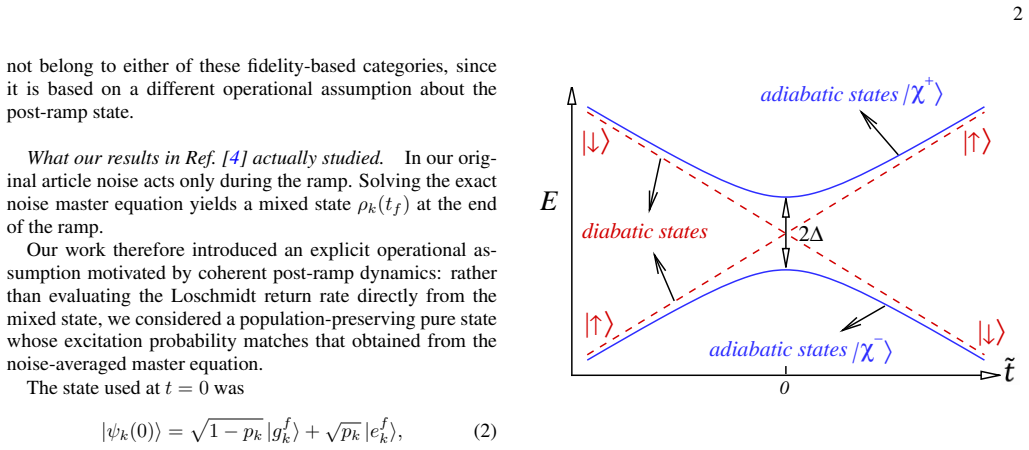
read the original abstract
The Comment by J. Sirker [arXiv:2511.16509] raises an important issue concerning dynamical quantum phase transitions (DQPTs) in noisy and mixed-state dynamics, namely that the extension of the Loschmidt echo from pure to mixed states is not unique and different extensions preserve different physical properties. The Comment examines a noise-averaged mixed-state fidelity and shows that DQPTs cannot occur for any nonzero noise when the return rate is defined through the Uhlmann-Bures fidelity of the noise-averaged density matrix. This conclusion is valid for the mixed-state fidelity observable discussed in the Comment and is consistent with prior studies [https://doi.org/10.1103/PhysRevB.109.L180303, arXiv:2504.03005]. Our article [https://doi.org/10.1103/mkll-nd46] investigated a different operationally defined quantity: the logarithm of the Loschmidt echo obtained by first determining the noise-averaged excitation probabilities generated during the noisy ramp and then performing a coherent post-ramp evolution of a pure state constructed from these noise-averaged transition probabilities. As emphasized explicitly in our original publication, this observable is defined through an operational assumption and is not the same quantity as the mixed-state fidelity. The nonanalyticities reported in Ref. [https://doi.org/10.1103/mkll-nd46] therefore concern this two-stage operational protocol and should not be identified with zeros of the Uhlmann-Bures fidelity. There is therefore no direct contradiction between the theorem established for the Uhlmann-Bures return rate and the conclusions obtained for the different operational protocol studied in Ref. [https://doi.org/10.1103/mkll-nd46].
Editorial analysis
A structured set of objections, weighed in public.
Referee Report
Summary. This manuscript is a reply to Comment arXiv:2511.16509 by J. Sirker. It asserts that the nonanalyticities reported in the authors' prior work (doi:10.1103/mkll-nd46) concern a distinct two-stage operational protocol—noise-averaged transition probabilities followed by coherent pure-state evolution—rather than the Uhlmann-Bures fidelity of the noise-averaged density matrix for which the Comment proves the absence of DQPTs at any nonzero noise. The reply concludes there is therefore no direct contradiction between the theorem and the original conclusions.
Significance. If the asserted distinction between observables holds, the reply usefully delimits the scope of the Comment's theorem and preserves the applicability of the original results to their specific operational definition. The manuscript supplies no new derivations or numerical checks but rests on an explicit definitional separation already stated in the cited prior publication.
minor comments (1)
- The abstract refers to the original work via the placeholder DOI https://doi.org/10.1103/mkll-nd46; the published reference should be inserted if the manuscript is to appear in final form.
Simulated Author's Rebuttal
We thank the referee for the careful reading and the recommendation to accept the manuscript. The report accurately summarizes our central point that the nonanalyticities concern a distinct two-stage operational Loschmidt echo rather than the Uhlmann-Bures return rate of the noise-averaged density matrix.
Circularity Check
No circularity: definitional clarification without derivation
full rationale
The reply contains no equations, derivations, or predictions. Its central claim—that the original work studied a distinct two-stage operational protocol (noise-averaged transition probabilities followed by coherent pure-state evolution) rather than Uhlmann-Bures fidelity of the noise-averaged density matrix—is presented as a restatement of an explicit definitional distinction already asserted in the cited prior publication by the same authors. No load-bearing step reduces a result to a fit, self-citation theorem, or ansatz by construction; the text simply notes consistency with the comment's theorem applying to a different observable. This is a normal, non-circular clarification of protocol differences.
Axiom & Free-Parameter Ledger
Reference graph
Works this paper leans on
-
[1]
Apply the noisy ramp, solve the master equation, and measure the mode-resolved excitation probabilitiesp k att= 0
-
[2]
The return rate in our paper is precisely the interferometric signal generated by this second, fully coherent stage
Prepare for eachka pure state with noise-averaged pop- 4 ulations(1−pk,pk)and let it evolve coherently under the fixed HamiltonianHf . The return rate in our paper is precisely the interferometric signal generated by this second, fully coherent stage. As noted in the revised Comment, this protocol may be viewed as an interferometric protocol rather than a...
-
[3]
Comment on: "Scaling and Universality at Noisy Quench Dynamical Quantum Phase Transitions"
J. Sirker, Comment on: "scaling and universality at noisy quench dynamical quantum phase transitions" (2025), arXiv:2511.16509 [cond-mat.stat-mech]
work page internal anchor Pith review Pith/arXiv arXiv 2025
-
[4]
Jafari, A
R. Jafari, A. Langari, S. Eggert, and H. Johannesson, Dynami- cal quantum phase transitions following a noisy quench, Phys. Rev. B109, L180303 (2024)
2024
- [5]
-
[6]
Ansari, R
S. Ansari, R. Jafari, A. Akbari, and M. Abdi, Scaling and uni- versality at noisy quench dynamical quantum phase transitions, Phys. Rev. B112, 054304 (2025)
2025
-
[7]
Jafari, J
R. Jafari, J. Naji, A. Langari, V . Karimipour, and H. Johannes- son, Entanglement generation and scaling from noisy quenches across a quantum critical point, Phys. Rev. Res.7, 043087 (2025)
2025
-
[8]
J. Naji, R. Jafari, A. Akbari, and M. Abdi, Dynamics of quan- tum fisher and wigner-yanase skew information following a noisy quench, Phys. Rev. B112, 144312 (2025)
2025
-
[10]
K. Yang, L. Zhou, W. Ma, X. Kong, P. Wang, X. Qin, X. Rong, Y . Wang, F. Shi, J. Gong, and J. Du, Floquet dynamical quantum phase transitions, Phys. Rev. B100, 085308 (2019)
2019
-
[11]
W. Ma, L. Zhou, Q. Zhang, M. Li, C. Cheng, J. Geng, X. Rong, F. Shi, J. Gong, and J. Du, Experimental observation of a gen- eralized thouless pump with a single spin, Phys. Rev. Lett.120, 120501 (2018)
2018
-
[12]
B. Chen, X. Hou, F. Zhou, P. Qian, H. Shen, and N. Xu, De- tecting the out-of-time-order correlations of dynamical quan- tum phase transitions in a solid-state quantum simulator, Ap- plied Physics Letters116, 194002 (2020)
2020
-
[14]
Sadeghizade, R
S. Sadeghizade, R. Jafari, and A. Langari, Anti-kibble-zurek behavior in the quantum xy spin- 1 2 chain driven by correlated noisy magnetic field and anisotropy, Phys. Rev. B111, 104310 (2025)
2025
-
[15]
Gao, D.-W
Z.-P. Gao, D.-W. Zhang, Y . Yu, and S.-L. Zhu, Anti-kibble- zurek behavior of a noisy transverse-fieldXYchain and its quantum simulation with two-level systems, Phys. Rev. B95, 224303 (2017)
2017
-
[16]
N. V . Vitanov, Transition times in the landau-zener model, Phys. Rev. A59, 988 (1999)
1999
-
[17]
Dutta, A
A. Dutta, A. Rahmani, and A. del Campo, Anti-kibble-zurek behavior in crossing the quantum critical point of a thermally isolated system driven by a noisy control field, Phys. Rev. Lett. 117, 080402 (2016)
2016
-
[18]
Singh and S
M. Singh and S. Gangadharaiah, Driven quantum spin chain in the presence of noise: Anti-kibble-zurek behavior, Phys. Rev. B104, 064313 (2021)
2021
-
[19]
Ai, J.-M
M.-Z. Ai, J.-M. Cui, R. He, Z.-H. Qian, X.-X. Gao, Y .-F. Huang, C.-F. Li, and G.-C. Guo, Experimental verification of anti–kibble-zurek behavior in a quantum system under a noisy control field, Phys. Rev. A103, 012608 (2021)
2021
-
[20]
S. M. Griffin, M. Lilienblum, K. T. Delaney, Y . Kumagai, M. Fiebig, and N. A. Spaldin, Scaling behavior and beyond equilibrium in the hexagonal manganites, Phys. Rev. X2, 041022 (2012)
2012
-
[21]
Jafari and A
R. Jafari and A. Akbari, Scaling and universality at noise- affected nonequilibrium spin correlation functions, Phys. Rev. B113, L220302 (2026)
2026
-
[22]
Parez and V
G. Parez and V . Alba, Smearing of dynamical quantum phase transitions in dissipative free-fermion systems, Phys. Rev. B 113, 144310 (2026)
2026
-
[23]
Parez and V
G. Parez and V . Alba, Reduced fidelities for free fermions out of equilibrium: from dynamical quantum phase transitions to mpemba effect, Journal of Statistical Mechanics: Theory and Experiment2026, 013103 (2026)
2026
discussion (0)
Sign in with ORCID, Apple, or X to comment. Anyone can read and Pith papers without signing in.