Revisiting identified-particle p_(T) spectra using the Boltzmann-Gibbs blast-wave model in a Bayesian inference framework
Pith reviewed 2026-06-30 02:30 UTC · model grok-4.3
The pith
Bayesian analysis shows the blast-wave model can fit pion, kaon, and proton pT spectra simultaneously without species-dependent ranges.
A machine-rendered reading of the paper's core claim, the machinery that carries it, and where it could break.
Core claim
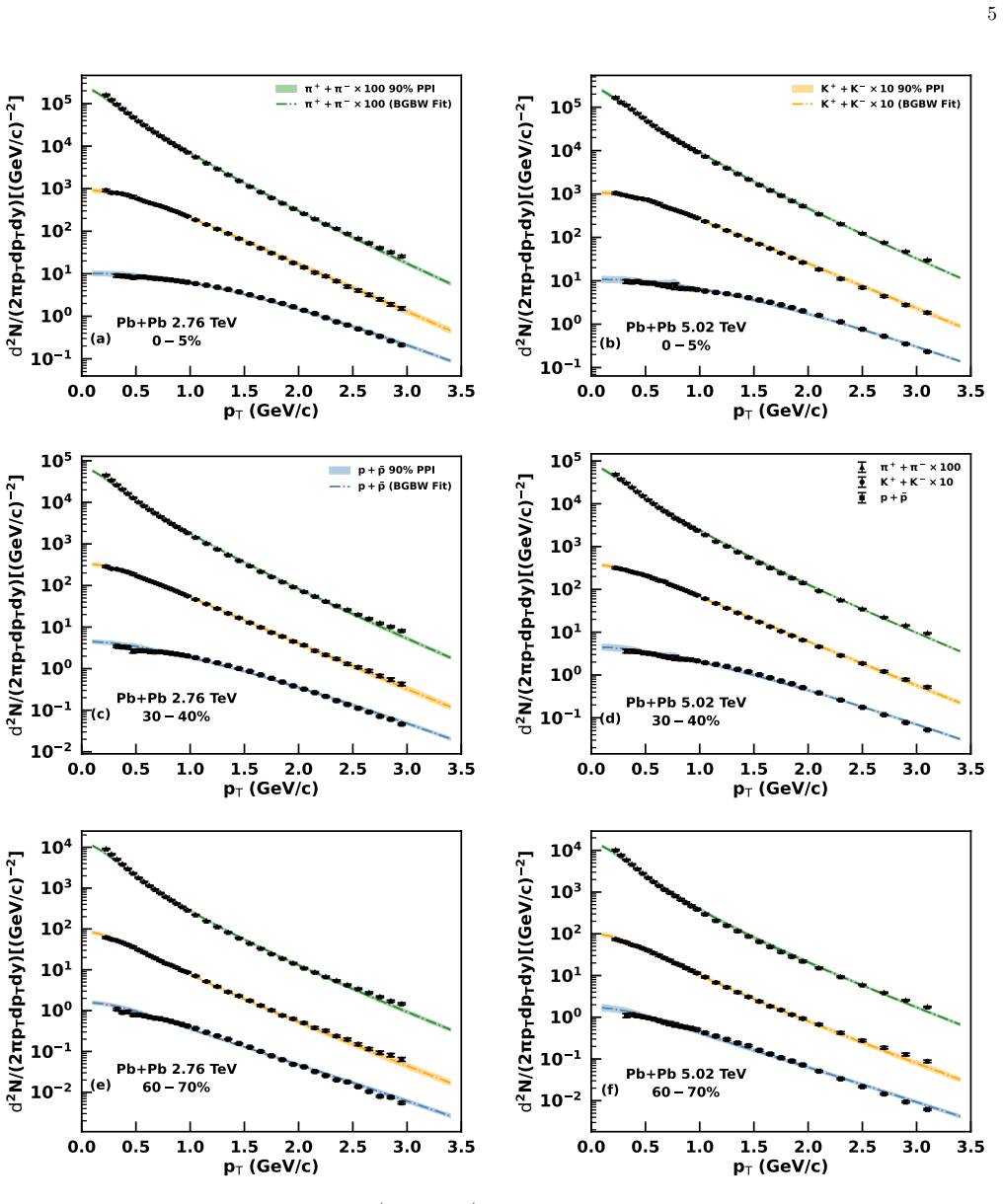
Using Bayesian analysis of the Boltzmann-Gibbs blast-wave model, a simultaneous description of the pT spectra of pions, kaons, and protons is feasible without imposing the particle species-dependent pT fit ranges, for Au+Au collisions up to the available data (~2 GeV/c) and for Pb+Pb collisions up to 3 GeV/c. The extracted parameters remain broadly consistent with those obtained from conventional BGBW simultaneous fits, while the extension of the fit range leads to moderate changes in some parameters. Furthermore, Bayesian analysis yields well-constrained posterior distributions for the kinetic freeze-out temperature T_kin, the average transverse flow velocity <β_T>, and the exponent of the
What carries the argument
The Boltzmann-Gibbs blast-wave model in a Bayesian inference framework, which extracts and correlates the kinetic freeze-out temperature T_kin, average transverse flow velocity <β_T>, and velocity profile exponent n from pT spectra.
If this is right
- Simultaneous fits to multiple identified-particle spectra succeed without particle-specific pT restrictions.
- Moderate shifts occur in some extracted parameters when the fit range is extended.
- Posterior distributions for T_kin, <β_T>, and n stay well-constrained with visible correlations.
- The Bayesian BGBW framework can be used in future analyses to describe spectra and extract collision-system information.
Where Pith is reading between the lines
- The method could be tested on additional collision systems or energies to check consistency of the extracted parameters.
- Revealed correlations among parameters may help link the blast-wave description to hydrodynamic evolution models.
- Removing fit-range choices could reduce one source of systematic uncertainty when comparing results across experiments.
- Extending the same Bayesian treatment to higher-pT data or resonance contributions would test the model's robustness.
Load-bearing premise
The BGBW functional form remains an adequate description of the spectra when the fit range is extended to the full available data without additional resonance or non-equilibrium contributions.
What would settle it
No single set of BGBW parameters simultaneously reproduces the measured pion, kaon, and proton spectra across the full pT range, or the resulting posterior distributions become broad and inconsistent with the data yields.
Figures


read the original abstract
We perform a Bayesian analysis of transverse momentum ($p_{\mathrm{T}}$) spectra of identified particles, i.e., pions, kaons, and protons, at midrapidity in Au+Au collisions and Pb+Pb collisions using the Boltzmann-Gibbs blast-wave (BGBW) model. We investigate whether it is possible to simultaneously describe the $p_{\mathrm{T}}$ spectra of identified particles without imposing the particle species-dependent $p_{\mathrm{T}}$ fit ranges -- a practice that was followed in conventional blast-wave model studies to achieve reasonable simultaneous fits. Using Bayesian analysis, our results indicate that a simultaneous description of the $p_{\mathrm{T}}$ spectra of pions, kaons, and protons is feasible without imposing the particle species-dependent $p_{\mathrm{T}}$ fit ranges, for Au+Au collisions up to the available data ($\sim$2 GeV/c) and for Pb+Pb collisions up to 3 GeV/c. The extracted parameters remain broadly consistent with those obtained from conventional BGBW simultaneous fits, while the extension of the fit range leads to moderate changes in some parameters. Furthermore, Bayesian analysis yields well-constrained posterior distributions for the kinetic freeze-out temperature $T_{kin}$, the average transverse flow velocity $\langle \beta_{\mathrm{T}}\rangle$, and the exponent of the velocity profile $n$ and shows their correlations transparently. We suggest that the BGBW model in a Bayesian inference framework proposed can be applied in future data analyses to simultaneously describe the $p_{\mathrm{T}}$ spectra of identified particles and extract the relevant information about the collision system.
Editorial analysis
A structured set of objections, weighed in public.
Referee Report
Summary. The manuscript applies Bayesian inference to the Boltzmann-Gibbs blast-wave (BGBW) model to analyze identified-particle pT spectra (pions, kaons, protons) in Au+Au and Pb+Pb collisions. It claims that simultaneous fits without species-dependent pT ranges are feasible up to the full available data (~2 GeV/c for Au+Au, 3 GeV/c for Pb+Pb), that the extracted parameters (T_kin, <β_T>, n) remain broadly consistent with conventional restricted-range fits, and that the posteriors are well-constrained with transparent correlations.
Significance. If the central claim is substantiated, the work shows that Bayesian methods can relax arbitrary species-dependent fit-range choices while still yielding usable constraints on kinetic freeze-out parameters. The explicit reporting of posterior distributions and correlations is a methodological strength that improves transparency over traditional χ² minimization.
major comments (2)
- [Results (implied by abstract statement on simultaneous description)] The headline claim that the four-parameter BGBW form simultaneously describes the spectra up to 3 GeV/c rests on the untested premise that the functional form remains adequate once the high-pT points are included. No quantitative measure of fit quality (e.g., χ²/dof, residuals, or posterior-predictive checks) for the newly added high-pT region is reported, so it is unclear whether the posterior is actually reproducing those data points or merely finding some parameter values.
- [Methods / Bayesian framework] The likelihood construction and prior choices are not specified in sufficient detail to verify that the reported well-constrained posteriors are data-driven rather than prior-dominated. In particular, the treatment of normalization parameters per species and any covariance between data points is not described.
minor comments (2)
- [Introduction / Model] Notation for the velocity-profile exponent n and the average flow velocity <β_T> should be defined explicitly on first use, and the exact functional form of the BGBW spectrum (including the normalization factor) should be written out.
- [Abstract] The abstract states that parameters 'remain broadly consistent' with prior fits; a quantitative comparison (e.g., overlap of credible intervals) would strengthen this statement.
Simulated Author's Rebuttal
We thank the referee for the detailed and constructive report. We address each major comment below and indicate the revisions that will be incorporated.
read point-by-point responses
-
Referee: [Results (implied by abstract statement on simultaneous description)] The headline claim that the four-parameter BGBW form simultaneously describes the spectra up to 3 GeV/c rests on the untested premise that the functional form remains adequate once the high-pT points are included. No quantitative measure of fit quality (e.g., χ²/dof, residuals, or posterior-predictive checks) for the newly added high-pT region is reported, so it is unclear whether the posterior is actually reproducing those data points or merely finding some parameter values.
Authors: We agree that explicit quantitative validation of the model in the extended pT range strengthens the central claim. Although the Bayesian posterior is obtained from the full dataset and yields parameters consistent with restricted-range fits, the revised manuscript will add posterior-predictive checks, residual distributions, and effective goodness-of-fit metrics focused on the high-pT region (above the conventional species-dependent cutoffs) to demonstrate that the BGBW form remains adequate up to the reported limits. revision: yes
-
Referee: [Methods / Bayesian framework] The likelihood construction and prior choices are not specified in sufficient detail to verify that the reported well-constrained posteriors are data-driven rather than prior-dominated. In particular, the treatment of normalization parameters per species and any covariance between data points is not described.
Authors: We accept that additional methodological detail is required for reproducibility and to confirm the data-driven character of the posteriors. The revised manuscript will expand the Bayesian framework section to specify the exact likelihood (including normalization nuisance parameters per species and their priors), the functional forms and ranges of all priors on T_kin, ⟨β_T⟩, and n, and the treatment of experimental uncertainties (diagonal covariance matrix, as is standard for these spectra). revision: yes
Circularity Check
No significant circularity; derivation is data-driven and self-contained
full rationale
The paper applies the standard BGBW functional form (with parameters T_kin, <β_T>, n, normalization) inside a Bayesian likelihood constructed directly from external experimental pT spectra. The central claim—that simultaneous fits remain feasible over extended pT ranges without species-dependent cuts—is a statement about posterior support against those independent data points, not a reduction of any extracted quantity to a definition or prior fit of itself. No equation equates a prediction to its own input, no self-citation is invoked as a uniqueness theorem or load-bearing premise, and the model form is not smuggled in via the authors' prior work. The result is therefore externally falsifiable and does not collapse by construction.
Axiom & Free-Parameter Ledger
free parameters (4)
- kinetic freeze-out temperature T_kin
- average transverse flow velocity <beta_T>
- velocity profile exponent n
- Bayesian priors on T_kin, <beta_T>, n
axioms (2)
- domain assumption The BGBW functional form is an adequate description of the measured spectra over the chosen pT ranges.
- domain assumption The experimental pT spectra are statistically independent and correctly normalized for the likelihood.
Reference graph
Works this paper leans on
-
[1]
Huovinen and P
P. Huovinen and P. V. Ruuskanen, Hydrodynamic Mod- els for Heavy Ion Collisions, Ann. Rev. Nucl. Part. Sci. 56, 163 (2006)
2006
-
[2]
Muller and J
B. Muller and J. L. Nagle, Results from the relativis- tic heavy ion collider, Ann. Rev. Nucl. Part. Sci.56, 93 (2006)
2006
-
[3]
Adamset al.(STAR Collaboration), Identified particle distributions in pp and Au+Au collisions at √sN N = 200 GeV, Phys
J. Adamset al.(STAR Collaboration), Identified particle distributions in pp and Au+Au collisions at √sN N = 200 GeV, Phys. Rev. Lett.92, 112301 (2004)
2004
-
[4]
B. I. Abelevet al.(STAR Collaboration), Systematic Measurements of Identified Particle Spectra inpp, d + Au and Au+Au Collisions from STAR, Phys. Rev. C79, 034909 (2009)
2009
-
[5]
Adamczyket al.(STAR Collaboration), Bulk Proper- ties of the Medium Produced in Relativistic Heavy-Ion Collisions from the Beam Energy Scan Program, Phys
L. Adamczyket al.(STAR Collaboration), Bulk Proper- ties of the Medium Produced in Relativistic Heavy-Ion Collisions from the Beam Energy Scan Program, Phys. Rev. C96, 044904 (2017)
2017
-
[6]
Adamet al.(STAR Collaboration), Bulk properties of the system formed inAu+Aucollisions at √sNN =14.5 GeV at the BNL STAR detector, Phys
J. Adamet al.(STAR Collaboration), Bulk properties of the system formed inAu+Aucollisions at √sNN =14.5 GeV at the BNL STAR detector, Phys. Rev. C 101, 024905 (2020)
2020
-
[7]
Adamet al.(STAR Collaboration), Strange hadron production in Au+Au collisions at √sNN = 7.7, 11.5, 19.6, 27, and 39 GeV, Phys
J. Adamet al.(STAR Collaboration), Strange hadron production in Au+Au collisions at √sNN = 7.7, 11.5, 19.6, 27, and 39 GeV, Phys. Rev. C102, 034909 (2020)
2020
-
[8]
Adamset al.(STAR Collaboration), Identified hadron spectra at large transverse momentum in p+p and d+Au collisions at √sN N = 200-GeV, Phys
J. Adamset al.(STAR Collaboration), Identified hadron spectra at large transverse momentum in p+p and d+Au collisions at √sN N = 200-GeV, Phys. Lett. B637, 161 (2006)
2006
-
[9]
B. I. Abelevet al.(STAR Collaboration), Strange parti- cle production in p+p collisions at √s= 200-GeV, Phys. Rev. C75, 064901 (2007)
2007
-
[10]
B. B. Abelevet al.(ALICE Collaboration), Production of charged pions, kaons and protons at large transverse momenta in pp and Pb–Pb collisions at√sNN =2.76 TeV, Phys. Lett. B736, 196 (2014)
2014
-
[11]
Adamet al.(ALICE Collaboration), Measurement of pion, kaon and proton production in proton–proton col- lisions at √s= 7 TeV, Eur
J. Adamet al.(ALICE Collaboration), Measurement of pion, kaon and proton production in proton–proton col- lisions at √s= 7 TeV, Eur. Phys. J. C75, 226 (2015)
2015
-
[12]
Adamet al.(ALICE Collaboration), Pseudorapidity and transverse-momentum distributions of charged par- ticles in proton–proton collisions at √s= 13 TeV, Phys
J. Adamet al.(ALICE Collaboration), Pseudorapidity and transverse-momentum distributions of charged par- ticles in proton–proton collisions at √s= 13 TeV, Phys. Lett. B753, 319 (2016)
2016
-
[13]
Aamodtet al.(ALICE Collaboration), Production of pions, kaons and protons inppcollisions at √s= 900 GeV with ALICE at the LHC, Eur
K. Aamodtet al.(ALICE Collaboration), Production of pions, kaons and protons inppcollisions at √s= 900 GeV with ALICE at the LHC, Eur. Phys. J. C71, 1655 (2011)
2011
-
[14]
Acharyaet al.(ALICE Collaboration), Pseudorapidity densities of charged particles with transverse momentum thresholds in pp collisions at √s=5.02 and 13 TeV, Phys
S. Acharyaet al.(ALICE Collaboration), Pseudorapidity densities of charged particles with transverse momentum thresholds in pp collisions at √s=5.02 and 13 TeV, Phys. Rev. D108, 072008 (2023)
2023
-
[15]
Abelevet al.(ALICE Collaboration), Centrality de- pendence ofπ, K, p production in Pb-Pb collisions at√sN N = 2.76 TeV, Phys
B. Abelevet al.(ALICE Collaboration), Centrality de- pendence ofπ, K, p production in Pb-Pb collisions at√sN N = 2.76 TeV, Phys. Rev. C88, 044910 (2013)
2013
-
[16]
B. B. Abelevet al.(ALICE Collaboration),K 0 S and Λ production in Pb-Pb collisions at √sN N = 2.76 TeV, Phys. Rev. Lett.111, 222301 (2013)
2013
-
[17]
Acharyaet al.(ALICE Collaboration), Production of charged pions, kaons, and (anti-)protons in Pb-Pb and inelasticppcollisions at √sN N = 5.02 TeV, Phys
S. Acharyaet al.(ALICE Collaboration), Production of charged pions, kaons, and (anti-)protons in Pb-Pb and inelasticppcollisions at √sN N = 5.02 TeV, Phys. Rev. C101, 044907 (2020)
2020
-
[18]
Osada and G
T. Osada and G. Wilk, Nonextensive hydrodynamics for relativistic heavy-ion collisions, Phys. Rev. C77, 044903 (2008), [Erratum: Phys.Rev.C 78, 069903 (2008)]
2008
-
[19]
Kyan and A
K. Kyan and A. Monnai, QCD equation of state with Tsallis statistics for heavy-ion collisions, Phys. Rev. D 106, 054004 (2022)
2022
-
[20]
Shi, Z.-Y
J.-H. Shi, Z.-Y. Qin, J.-P. Zhang, J. Cao, Z.-F. Jiang, W.-C. Zhang, and H. Zheng, Nonextensive (3+1)- dimensional hydrodynamics for relativistic heavy-ion col- lisions, Phys. Rev. D111, 036010 (2025)
2025
-
[21]
Schnedermann, J
E. Schnedermann, J. Sollfrank, and U. W. Heinz, Ther- mal phenomenology of hadrons from 200-A/GeV S+S collisions, Phys. Rev. C48, 2462 (1993)
1993
-
[22]
Schnedermann and U
E. Schnedermann and U. W. Heinz, A Hydrodynamical assessment of 200-A/GeV collisions, Phys. Rev. C50, 1675 (1994)
1994
-
[23]
J. Chen, J. Deng, Z. Tang, Z. Xu, and L. Yi, Nonequi- librium kinetic freeze-out properties in relativistic heavy ion collisions from energies employed at the RHIC beam energy scan to those available at the LHC, Phys. Rev. C 104, 034901 (2021)
2021
-
[24]
Z. Tang, Y. Xu, L. Ruan, G. van Buren, F. Wang, and Z. Xu, Spectra and radial flow at RHIC with Tsallis statistics in a Blast-Wave description, Phys. Rev. C79, 051901 (2009)
2009
-
[25]
M. Shao, L. Yi, Z. Tang, H. Chen, C. Li, and Z. Xu, Ex- amine the species and beam-energy dependence of parti- cle spectra using Tsallis Statistics, J. Phys. G37, 085104 (2010)
2010
-
[26]
Z. Tang, L. Yi, L. Ruan, M. Shao, H. Chen, C. Li, B. Mo- hanty, P. Sorensen, A. Tang, and Z. Xu, Statistical Origin of Constituent-Quark Scaling in the QGP hadronization, 9 Chin. Phys. Lett.30, 031201 (2013)
2013
-
[27]
Ristea, A
O. Ristea, A. Jipa, C. Ristea, T. Esanu, M. Calin, A. Barzu, A. Scurtu, and I. Abu-Quoad, Study of the freeze-out process in heavy ion collisions at relativistic energies, J. Phys. Conf. Ser.420, 012041 (2013)
2013
-
[28]
Zheng and L
H. Zheng and L. Zhu, Can Tsallis Distribution Fit All the Particle Spectra Produced at RHIC and LHC?, Adv. High Energy Phys.2015, 180491 (2015)
2015
-
[29]
G. Che, J. Gu, W. Zhang, and H. Zheng, Identified parti- cle spectra in Pb–Pb, Xe–Xe and p–Pb collisions with the Tsallis blast-wave model, J. Phys. G48, 095103 (2021)
2021
-
[30]
J. Gu, C. Li, Q. Wang, W. Zhang, and H. Zheng, Collec- tive expansion in pp collisions using the Tsallis statistics, J. Phys. G49, 115101 (2022)
2022
-
[31]
Werner, J
K. Werner, J. Jahan, I. Karpenko, T. Pierog, M. Stefa- niak, and D. Vintache, Heavy ion collisions from √sN N of 62.4 GeV down to 7.7 GeV in the EPOS4 framework, Phys. Rev. C111, 014903 (2025)
2025
-
[32]
Waqas, G
M. Waqas, G. X. Peng, M. Ajaz, A. M. Khubrani, E. A. Dawi, M. A. Khan, and A. Tawfik, Pseudorapidity de- pendence of the transverse momentum distribution of charged particles in pp collisions at 0.9, 2.36, and 7 TeV, Results Phys.42, 105989 (2022)
2022
-
[33]
J. Tao, W. Wu, M. Wang, H. Zheng, W. Zhang, L. Zhu, and A. Bonasera, The novel scaling of Tsallis parame- ters from the transverse momentum spectra of charged particles in heavy-ion collisions, Particles5, 146 (2022)
2022
-
[34]
L.-L. Zhu, B. Wang, M. Wang, and H. Zheng, Energy and centrality dependence of light nuclei production in relativistic heavy-ion collisions, Nucl. Sci. Technol.33, 45 (2022)
2022
-
[35]
L. Zhu, H. Zheng, K. Da, H. Gong, Z. Ye, G. Liu, and R. C. Hwa, Universal energy dependence of measured temperatures for baryons produced in heavy-ion colli- sions, Phys. Rev. C107, 064907 (2023)
2023
-
[36]
L. Zhu, H. Zheng, and R. C. Hwa, Centrality and transverse-momentum dependence of hadrons in Pb+Pb collisions at energies available at the CERN Large Hadron Collider, Phys. Rev. C104, 014902 (2021)
2021
-
[37]
L. Zhu, H. Zheng, and R. Kong, Centrality and transverse momentum dependencies of hadrons in Pb+Pb collisions at √sN N = 5.02 TeV and Xe+Xe collisions at √sN N = 5.44 TeV from a multi-phase transport model, Eur. Phys. J. A55, 205 (2019)
2019
-
[38]
Zheng, L
H. Zheng, L. Zhu, and A. Bonasera, Systematic analysis of hadron spectra in p+p collisions using Tsallis distri- butions, Phys. Rev. D92, 074009 (2015)
2015
-
[39]
C.-Y. Wong, G. Wilk, L. J. L. Cirto, and C. Tsallis, From QCD-based hard-scattering to nonextensive sta- tistical mechanical descriptions of transverse momentum spectra in high-energyppandp¯pcollisions, Phys. Rev. D 91, 114027 (2015)
2015
-
[40]
R. Rath, A. Khuntia, R. Sahoo, and J. Cleymans, Event multiplicity, transverse momentum and energy depen- dence of charged particle production, and system thermo- dynamics inppcollisions at the Large Hadron Collider, J. Phys. G47, 055111 (2020)
2020
-
[41]
Xu and C
J. Xu and C. M. Ko, Chemical freeze-out in relativistic heavy-ion collisions, Phys. Lett. B772, 290 (2017)
2017
-
[42]
Adareet al.(PHENIX), Spectra and ratios of identi- fied particles in Au+Au andd+Au collisions at √sN N = 200 GeV, Phys
A. Adareet al.(PHENIX), Spectra and ratios of identi- fied particles in Au+Au andd+Au collisions at √sN N = 200 GeV, Phys. Rev. C88, 024906 (2013)
2013
-
[43]
Tariq, M
J. Tariq, M. U. Ashraf, and G. Nigmatkulov, Estima- tion of kinetic temperature and radial flow velocity us- ing identified hadrons and light (anti-)nuclei produced in relativistic heavy-ion collisions at energies available at BNL RHIC and CERN LHC, Phys. Rev. C110, 014903 (2024)
2024
-
[44]
B. I. Abelevet al.(STAR), Energy dependence of pi+-, p and anti-p transverse momentum spectra for Au+Au collisions at √sNN = 62.4 and 200-GeV, Phys. Lett. B 655, 104 (2007)
2007
-
[45]
B. B. Abelevet al.(ALICE Collaboration), Multiplicity Dependence of Pion, Kaon, Proton and Lambda Produc- tion in p-Pb Collisions at √sN N = 5.02 TeV, Phys. Lett. B728, 25 (2014)
2014
-
[46]
Ghosh, S
P. Ghosh, S. Muhuri, J. K. Nayak, and R. Varma, Indi- cation of transverse radial flow in high-multiplicity pro- ton–proton collisions at the Large Hadron Collider, J. Phys. G41, 035106 (2014)
2014
-
[47]
S. Saha, R. Singh, and B. Mohanty,p T -differential radial flow in a blast-wave model, Phys. Rev. C112, 024902 (2025)
2025
-
[48]
Vitiuk, D
O. Vitiuk, D. Blaschke, B. D¨ onigus, and G. R¨ opke, Nonequilibrium phenomenology of identified particle spectra in heavy-ion collisions at energies available at the CERN Large Hadron Collider, Phys. Rev. C113, 044902 (2026)
2026
-
[49]
M¨ antysaari, H
H. M¨ antysaari, H. Roch, F. Salazar, B. Schenke, C. Shen, and W. Zhao, Global Bayesian analysis of J/ψphotopro- duction on proton and lead targets, Phys. Rev. D113, 014038 (2026)
2026
-
[50]
Foreman-Mackey, D
D. Foreman-Mackey, D. W. Hogg, D. Lang, and J. Good- man, emcee: The MCMC Hammer, Publ. Astron. Soc. Pac.125, 306 (2013)
2013
discussion (0)
Sign in with ORCID, Apple, or X to comment. Anyone can read and Pith papers without signing in.