A Holistic Link Budget Analysis for mmWave and THz Communications in Non-Terrestrial Networks
Pith reviewed 2026-06-30 02:46 UTC · model grok-4.3
The pith
NTN multi-layer architecture offsets mmWave and THz losses to levels tolerable by high-gain antennas for multi-gigabit 6G links.
A machine-rendered reading of the paper's core claim, the machinery that carries it, and where it could break.
Core claim
By summing all listed propagation and system impairments the study finds that the multi-layer NTN architecture reduces the total loss to a level that high-gain directional antennas can overcome, thereby enabling multi-gigabit links and establishing the technical feasibility of mmWave and THz NTNs for 6G systems.
What carries the argument
The comprehensive link budget summation that incorporates free-space loss, atmospheric absorption, weather-induced effects, ionospheric disturbances, polarization mismatches, feeder losses, antenna and circuitry constraints, fading, pointing errors, and non-white noise.
If this is right
- High-gain directional antennas can support multi-gigabit data rates in these bands over NTN paths.
- mmWave and THz frequencies become practical choices for non-terrestrial 6G deployments.
- The multi-layer structure is the element that keeps total losses within antenna compensation range.
- Standard loss models are sufficient to demonstrate feasibility under the examined conditions.
Where Pith is reading between the lines
- Designers could adjust the number and spacing of NTN layers to minimize losses at particular frequencies or latitudes.
- The same budgeting method might expose viability limits when extended to optical frequencies or extreme weather zones.
- Hybrid terrestrial-NTN links could be assessed by adding ground-segment impairments to the existing budget.
Load-bearing premise
The conventional formulas for each loss component remain valid and complete when applied to the frequency ranges, altitudes, and geometries typical of NTN scenarios.
What would settle it
Direct measurement of end-to-end received signal strength for a THz link from a low-Earth-orbit satellite to a ground terminal under clear and rainy conditions, compared against the paper's predicted total loss.
Figures




read the original abstract
The non-terrestrial network (NTN) architecture has gained significant interest from the academia owing to its versatility and the ability to provide worldwide service. To achieve extremely high data rates in NTNs, as intended in the sixth-generation (6G) communication systems, millimeter wave (mmWave) and terahertz (THz) frequencies can be considered, enabling substantial bandwidth and data transmission capacity, which makes them highly suitable for NTN applications. However, these high-frequency signals suffer from significant propagation challenges, including atmospheric attenuation, pointing errors, and various environmental effects. Therefore, a comprehensive link budget analysis is essential to accurately assess the feasibility of mmWave/THz-based NTN systems. Existing studies in the literature often fail to fully capture certain frequency-, altitude-, and direction-dependent effects observed in mmWave/THz transmission or possible communication scenarios within the NTN architecture. In particular, while most prior works primarily focus on free-space loss or atmospheric attenuation, this study adopts a much more comprehensive approach. In this work, a detailed link budget analysis is conducted for mmWave/THz NTNs, considering free-space loss, atmospheric absorption, weather-induced effects, ionospheric disturbances, polarization mismatches, feeder losses, antenna and circuitry constraints, fading, pointing errors, and non-white noise characteristics. The results have revealed that the multi-layer structure of the NTN architecture can help reducing the excessive loss levels to a certain level that can be tolerated by high-gain directional antennas/arrays, providing multi-gigabit links and making mmWave/THz NTNs feasible for 6G communication systems.
Editorial analysis
A structured set of objections, weighed in public.
Referee Report
Summary. The manuscript presents a comprehensive link budget analysis for mmWave and THz communications in non-terrestrial networks (NTNs). It incorporates effects including free-space loss, atmospheric absorption, weather-induced effects, ionospheric disturbances, polarization mismatches, feeder losses, antenna and circuitry constraints, fading, pointing errors, and non-white noise. The central claim is that the multi-layer NTN architecture reduces excessive loss levels to a range tolerable by high-gain directional antennas/arrays, enabling multi-gigabit links and making mmWave/THz NTNs feasible for 6G systems.
Significance. If the model applications and numerical results hold, the work is significant for providing a more complete propagation assessment than prior NTN studies that focus on fewer effects. This could inform 6G NTN feasibility studies. The inclusion of a broad set of frequency-, altitude-, and direction-dependent effects is a strength relative to narrower analyses, though the paper does not appear to introduce new models or machine-checked elements.
major comments (2)
- [Methodology/Propagation Models] The feasibility conclusion that losses are 'tolerable' by high-gain arrays depends on the accuracy of the summed loss terms. The manuscript adopts 'standard models' for atmospheric absorption and weather effects, yet these (e.g., ITU-R type models) were calibrated primarily for terrestrial/low-altitude paths; no validation, sensitivity analysis to altitude-dependent pressure/temperature profiles, or comparison against measured THz NTN slant-range data is described. This is load-bearing for the multi-layer NTN tolerability claim.
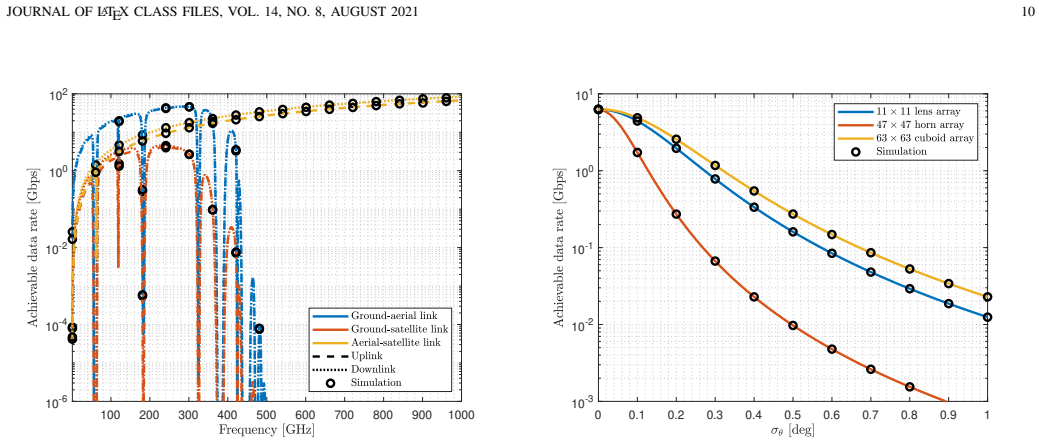
- [Results] The abstract states that results 'have revealed' the multi-layer structure reduces losses sufficiently, but without referenced tables, figures, or equations showing explicit link-margin calculations, loss breakdowns per NTN layer (e.g., LEO vs. HAPS), or margin values under realistic antenna gains, the central claim cannot be verified.
minor comments (1)
- Define all acronyms (e.g., NTN, HAPS) on first use and ensure consistent notation for loss terms across sections.
Simulated Author's Rebuttal
We thank the referee for the constructive and detailed feedback. The comments highlight important aspects of model applicability and result presentation that we will address to strengthen the manuscript. Below we respond point-by-point to the major comments.
read point-by-point responses
-
Referee: [Methodology/Propagation Models] The feasibility conclusion that losses are 'tolerable' by high-gain arrays depends on the accuracy of the summed loss terms. The manuscript adopts 'standard models' for atmospheric absorption and weather effects, yet these (e.g., ITU-R type models) were calibrated primarily for terrestrial/low-altitude paths; no validation, sensitivity analysis to altitude-dependent pressure/temperature profiles, or comparison against measured THz NTN slant-range data is described. This is load-bearing for the multi-layer NTN tolerability claim.
Authors: We acknowledge that ITU-R models for atmospheric absorption and weather effects were developed primarily from terrestrial data. In the manuscript we apply these with available altitude and elevation-angle corrections from the satellite-communication literature. To directly address the concern we will add (i) an explicit sensitivity analysis varying pressure/temperature/humidity profiles along the slant path, (ii) a dedicated limitations subsection discussing the extrapolation to NTN altitudes, and (iii) references to any existing lower-frequency NTN validation campaigns. While new THz NTN measurements are not available to us, the added discussion will qualify the tolerability claim more carefully. revision: yes
-
Referee: [Results] The abstract states that results 'have revealed' the multi-layer structure reduces losses sufficiently, but without referenced tables, figures, or equations showing explicit link-margin calculations, loss breakdowns per NTN layer (e.g., LEO vs. HAPS), or margin values under realistic antenna gains, the central claim cannot be verified.
Authors: The full manuscript already contains per-layer loss breakdowns, explicit link-margin calculations, and margin values versus antenna gain in the numerical-results section, supported by tables and figures. However, the abstract does not cross-reference these elements. We will revise the abstract (and, if needed, the introduction) to include direct pointers to the relevant tables/figures that display the layer-specific loss components and resulting margins, thereby making the central claim immediately verifiable. revision: yes
Circularity Check
No circularity: analysis applies standard external models to compute link margins
full rationale
The paper's central result is obtained by summing loss terms drawn from established ITU-R and similar propagation models (free-space, absorption, weather, ionospheric, pointing, fading, etc.) and comparing the aggregate to the margin available from high-gain arrays. No parameter is fitted to the NTN feasibility outcome, no equation is defined in terms of its own prediction, and no load-bearing premise rests on a self-citation whose validity is internal to the present work. The derivation therefore remains independent of its conclusion.
Axiom & Free-Parameter Ledger
axioms (1)
- domain assumption Standard models for free-space loss, atmospheric absorption, weather-induced effects, ionospheric disturbances, polarization mismatches, feeder losses, antenna and circuitry constraints, fading, pointing errors, and non-white noise accurately represent mmWave/THz propagation in NTN environments.
Reference graph
Works this paper leans on
-
[1]
Toward 6G-enabled mo bile vision analytics for immersive extended reality,
M. Zhang, L. Shen, X. Ma, and J. Liu, “Toward 6G-enabled mo bile vision analytics for immersive extended reality,” IEEE Wireless Com- munications, vol. 30, no. 3, pp. 132–138, 2023
2023
-
[2]
Emerging 6G/B6G wireless communication for the power infrastructure in smart cities : Innovations, challenges, and future perspectives,
A. Al Amin, J. Hong, V .-H. Bui, and W. Su, “Emerging 6G/B6G wireless communication for the power infrastructure in smart cities : Innovations, challenges, and future perspectives,” Algorithms, vol. 16, no. 10, p. 474, 2023
2023
-
[3]
6G Internet of Things: A comprehens ive survey,
D. C. Nguyen, M. Ding, P . N. Pathirana, A. Seneviratne, J. Li, D. Niyato, O. Dobre, and H. V . Poor, “6G Internet of Things: A comprehens ive survey,” IEEE Internet of Things Journal , vol. 9, no. 1, pp. 359–383, 2022
2022
-
[4]
Survey on 6G frontiers: Trends, applicati ons, re- quirements, technologies and future research,
C. D. Alwis, A. Kalla, Q.-V . Pham, P . Kumar, K. Dev, W.-J. H wang, and M. Liyanage, “Survey on 6G frontiers: Trends, applicati ons, re- quirements, technologies and future research,” IEEE Open Journal of the Communications Society , vol. 2, pp. 836–886, 2021
2021
-
[5]
Swarm of UA Vs for network management in 6G: A technical review,
M. A. Khan, N. Kumar, S. A. H. Mohsan, W. U. Khan, M. M. Nasra lla, M. H. Alsharif, J. ˙Zywiołek, and I. Ullah, “Swarm of UA Vs for network management in 6G: A technical review,” IEEE Transactions on Network and Service Management , vol. 20, no. 1, pp. 741–761, 2023
2023
-
[6]
A vision and framework for the high altitude platform station (HAPS) networks of the future,
G. Karabulut Kurt, M. G. Khoshkholgh, S. Alfattani, A. Ib rahim, T. S. J. Darwish, M. S. Alam, H. Y anikomeroglu, and A. Y ongacoglu, “A vision and framework for the high altitude platform station (HAPS) networks of the future,” IEEE Communications Surveys & Tutorials, vol. 23, no. 2, pp. 729–779, 2021
2021
-
[7]
Airborne communication networks: A survey,
X. Cao, P . Y ang, M. Alzenad, X. Xi, D. Wu, and H. Y anikomero glu, “Airborne communication networks: A survey,” IEEE Journal on Se- lected Areas in Communications , vol. 36, no. 9, pp. 1907–1926, 2018
1907
-
[8]
Non-terrestrial networks in 5G & beyond: A survey,
F. Rinaldi, H.-L. Maattanen, J. Torsner, S. Pizzi, S. And reev, A. Iera, Y . Koucheryavy, and G. Araniti, “Non-terrestrial networks in 5G & beyond: A survey,” IEEE Access , vol. 8, pp. 165 178–165 200, 2020
2020
-
[9]
A tutorial on non-terre strial networks: Towards global and ubiquitous 6G connectivity,
M. A. Jamshed, A. Kaushik, S. Manzoor, M. Z. Shakir, J. Seo ng, M. Toka, W. Shin, and M. Schellmann, “A tutorial on non-terre strial networks: Towards global and ubiquitous 6G connectivity,” F oundations and Trends in Networking , vol. 14, no. 3, pp. 160–253, 2025
2025
-
[10]
Evolution of non -terrestrial networks from 5G to 6G: A survey,
M. M. Azari, S. Solanki, S. Chatzinotas, O. Kodheli, H. S allouha, A. Colpaert, J. F. Mendoza Montoya, S. Pollin, A. Haqiqatnej ad, A. Mostaani, E. Lagunas, and B. Ottersten, “Evolution of non -terrestrial networks from 5G to 6G: A survey,” IEEE Communications Surveys & Tutorials, vol. 24, no. 4, pp. 2633–2672, 2022
2022
-
[11]
Seven defining features of terahertz (THz) wirel ess sys- tems: A fellowship of communication and sensing,
C. Chaccour, M. N. Soorki, W. Saad, M. Bennis, P . Popovsk i, and M. Debbah, “Seven defining features of terahertz (THz) wirel ess sys- tems: A fellowship of communication and sensing,” IEEE Communica- tions Surveys & Tutorials , vol. 24, no. 2, pp. 967–993, 2022
2022
-
[12]
Massive MIMO in sub-6 GHz and mmWave: Physical, practical, and use-c ase differences,
E. Bjornson, L. V an der Perre, S. Buzzi, and E. G. Larsson , “Massive MIMO in sub-6 GHz and mmWave: Physical, practical, and use-c ase differences,” IEEE Wireless Communications , vol. 26, no. 2, pp. 100– 108, 2019
2019
-
[13]
Terahertz terabit wireless co mmunication,
K.-c. Huang and Z. Wang, “Terahertz terabit wireless co mmunication,” IEEE Microwave Magazine , vol. 12, no. 4, pp. 108–116, 2011
2011
-
[14]
A survey on terahertz communications,
Z. Chen, X. Ma, B. Zhang, Y . Zhang, Z. Niu, N. Kuang, W. Che n, L. Li, and S. Li, “A survey on terahertz communications,” China Communications, vol. 16, no. 2, pp. 1–35, 2019
2019
-
[15]
Channel modeling and ca pacity analysis for electromagnetic wireless nanonetworks in the Terahert z band,
J. M. Jornet and I. F. Akyildiz, “Channel modeling and ca pacity analysis for electromagnetic wireless nanonetworks in the Terahert z band,” IEEE Trans. Wireless Commun. , vol. 10, no. 10, pp. 3211–3221, 2011
2011
-
[16]
Simplifie d molecular absorption loss model for 275–400 gigahertz frequency band ,
J. Kokkoniemi, J. Lehtom¨ aki, and M. Juntti, “Simplifie d molecular absorption loss model for 275–400 gigahertz frequency band ,” in 12th European Conference on Antennas and Propagation (EuCAP 201 8), 2018, pp. 1–5
2018
-
[17]
Rain attenuation at millime ter wave and low-THz frequencies,
F. Norouzian, E. Marchetti, M. Gashinova, E. Hoare, C. C onstantinou, P . Gardner, and M. Cherniakov, “Rain attenuation at millime ter wave and low-THz frequencies,” IEEE Transactions on Antennas and Propa- gation, vol. 68, no. 1, pp. 421–431, 2020
2020
-
[19]
Channel modeling and analysi s of inter-small- satellite links in terahertz band space networks,
S. Nie and I. F. Akyildiz, “Channel modeling and analysi s of inter-small- satellite links in terahertz band space networks,” IEEE Transactions on Communications, vol. 69, no. 12, pp. 8585–8599, 2021
2021
-
[20]
The evolution of applications, hardwa re design, and channel modeling for Terahertz (THz) band communicatio ns and sensing: Ready for 6G?
J. M. Jornet, V . Petrov, H. Wang, Z. Popovi´ c, D. Shakya, J. V . Siles, and T. S. Rappaport, “The evolution of applications, hardwa re design, and channel modeling for Terahertz (THz) band communicatio ns and sensing: Ready for 6G?” Proceedings of the IEEE , pp. 1–32, 2024
2024
-
[21]
A general model for pointing error of high frequency directio nal antennas,
M. T. Dabiri, M. Hasna, N. Zorba, T. Khattab, and K. A. Qar aqe, “A general model for pointing error of high frequency directio nal antennas,” IEEE Open Journal of the Communications Society , vol. 3, pp. 1978– 1990, 2022
1978
-
[22]
An experimentally validated fading mo del for THz wireless systems,
E. N. Papasotiriou, A.-A. A. Boulogeorgos, K. Haneda, M . F. de Guz- man, and A. Alexiou, “An experimentally validated fading mo del for THz wireless systems,” Scientific Reports , vol. 11, no. 1, p. 18717, 2021
2021
-
[23]
ITU-R P .676-13, International Telecommunication Union, Geneva, Switzerland, 2022
Attenuation by Atmospheric Gases and Related Effects , Rec. ITU-R P .676-13, International Telecommunication Union, Geneva, Switzerland, 2022
2022
-
[24]
ITU-R P .838-3, International Telecommunication Unio n, Geneva, Switzerland, 2005
Specific Attenuation Model for Rain for Use in Prediction Met hods, Rec. ITU-R P .838-3, International Telecommunication Unio n, Geneva, Switzerland, 2005
2005
-
[25]
ITU-R P .840-6, International Telecommunication Union, Geneva, Switzerland, 2013
Attenuation due to Clouds and F og , Rec. ITU-R P .840-6, International Telecommunication Union, Geneva, Switzerland, 2013
2013
-
[26]
ITU-R P .618-12, Inter- national Telecommunication Union, Geneva, Switzerland, 2 015
Propagation Data and Prediction Methods Required for the De sign of Earth-Space Telecommunication Systems , Rec. ITU-R P .618-12, Inter- national Telecommunication Union, Geneva, Switzerland, 2 015
-
[27]
Link budget analysis for terahertz fixed wireless links,
T. Schneider, A. Wiatrek, S. Preussler, M. Grigat, and R .-P . Braun, “Link budget analysis for terahertz fixed wireless links,” IEEE Transactions on Terahertz Science and Technology , vol. 2, no. 2, pp. 250–256, 2012
2012
-
[28]
THz cha nnel model for 6G communications,
Z. Hossain, Q. C. Li, D. Ying, G. Wu, and C. Xiong, “THz cha nnel model for 6G communications,” in 2021 IEEE 32nd Annual Interna- tional Symposium on Personal, Indoor and Mobile Radio Commu nica- tions (PIMRC) , 2021, pp. 1–7
2021
-
[29]
Millimeter-wave and terahertz fixed wireless link budget evaluation for extreme weather co nditions,
Z.-K. Weng, A. Kanno, P . T. Dat, K. Inagaki, K. Tanabe, E. Sasaki, T. K¨ urner, B. K. Jung, and T. Kawanishi, “Millimeter-wave and terahertz fixed wireless link budget evaluation for extreme weather co nditions,” IEEE Access , vol. 9, pp. 163 476–163 491, 2021
2021
-
[30]
THz radio communication: Link budget analysis toward 6G,
K. Rikkinen, P . Kyosti, M. E. Leinonen, M. Berg, and A. Pa rssinen, “THz radio communication: Link budget analysis toward 6G,” IEEE Communications Magazine, vol. 58, no. 11, pp. 22–27, 2020
2020
-
[31]
Link budget analysis for massive-an tenna- array-enabled terahertz satellite communications,
R. Zhen and C. Han, “Link budget analysis for massive-an tenna- array-enabled terahertz satellite communications,” Journal of Shanghai Jiaotong University (Science) , vol. 23, pp. 20–27, 2018
2018
-
[32]
Analysis of THz communication in satellite constellation ,
S. Song, H. Zhang, R. Song, J. Li, W. Duan, X. Zheng, and J. Cai, “Analysis of THz communication in satellite constellation ,” in 2023 IEEE 3rd International Conference on Information Technology, Big Data and Artificial Intelligence (ICIBA) , vol. 3, 2023, pp. 184–187
2023
-
[33]
C. A. Balanis, Antenna Theory: Analysis and Design . John Wiley & Sons, 2016
2016
-
[34]
ITU-R P .835-6, International Telecommunication Union, Geneva, Switzerland, 2017
Reference Standard Atmospheres , Rec. ITU-R P .835-6, International Telecommunication Union, Geneva, Switzerland, 2017
2017
-
[35]
Analysis of clouds and rain l osses on terahertz band for non-terrestrial networks,
B. Khan and J. Kokkoniemi, “Analysis of clouds and rain l osses on terahertz band for non-terrestrial networks,” in 2025 19th European Conference on Antennas and Propagation (EuCAP) , 2025, pp. 1–5
2025
-
[36]
Attenuation characterization of terahertz waves in foggy and rainy conditions at 0.1–1 THz frequencies,
X. Liao, L. Fan, Y . Wang, Z. Y u, G. Wang, X. Li, and J. Zhang , “Attenuation characterization of terahertz waves in foggy and rainy conditions at 0.1–1 THz frequencies,” Electronics, vol. 12, no. 7, p. 1684, 2023
2023
-
[37]
The effect of the ionosphere o n remote sensing of sea surface salinity from space: absorption and e mission at L band,
D. Le Vine and S. Abraham, “The effect of the ionosphere o n remote sensing of sea surface salinity from space: absorption and e mission at L band,” IEEE Transactions on Geoscience and Remote Sensing , vol. 40, no. 4, pp. 771–782, 2002. JOURNAL OF LATEX CLASS FILES, VOL. 14, NO. 8, AUGUST 2021 14
2002
-
[38]
IRI the international standard for the ion osphere,
D. Bilitza, “IRI the international standard for the ion osphere,” Advances in Radio Science , vol. 16, pp. 1–11, 2018
2018
-
[39]
M. C. Kelley, The Earth’s Ionosphere: Plasma Physics and Electrody- namics. Academic press, 2009, vol. 96
2009
-
[40]
ITU-R P .531-15, International Telecommunication Union, Geneva, Switzerl and, 2023
Ionospheric Propagation Data and Prediction Methods Requi red for the Design of Satellite Networks and Systems , Rec. ITU-R P .531-15, International Telecommunication Union, Geneva, Switzerl and, 2023
2023
-
[41]
SOCEM: Sub-orbital CubeSat experimental mission,
J. E. Lumpp, A. K. Karam, D. M. Erb, J. R. Bratcher, S. A. Ra washdeh, T. Clements, N. Fite, J. Kruth, B. Malphrus, I. Bland, R. Muna kata, R. Coelho, J. Puig-Suari, J. Reese, C. Brodell, and S. Schair e, “SOCEM: Sub-orbital CubeSat experimental mission,” in 2010 IEEE Aerospace Conference, 2010, pp. 1–9
2010
-
[42]
An improved pointing error model for mmWave and THz links: A n- tenna and array design impact,
E. S. Ahrazoglu, A. C. Gul, M. N. Akinci, I. Altunbas, and E. Erdogan, “An improved pointing error model for mmWave and THz links: A n- tenna and array design impact,” IEEE Communications Letters , vol. 29, no. 3, pp. 532–536, 2025
2025
-
[43]
Models, methods, and solutions for multicasting in 5G/6G m mWave and sub-THz systems,
N. Chukhno, O. Chukhno, D. Moltchanov, S. Pizzi, A. Gayd amaka, A. Samuylov, A. Molinaro, Y . Koucheryavy, A. Iera, and G. Ara niti, “Models, methods, and solutions for multicasting in 5G/6G m mWave and sub-THz systems,” IEEE Communications Surveys & Tutorials , vol. 26, no. 1, pp. 119–159, 2024
2024
-
[44]
The α -µ distribution: A physical fading model for the Stacy distribution,
M. D. Y acoub, “The α -µ distribution: A physical fading model for the Stacy distribution,” IEEE Transactions on V ehicular Technology, vol. 56, no. 1, pp. 27–34, 2007
2007
-
[45]
V aughan and J
R. V aughan and J. B. Andersen, Channels, Propagation and Antennas for Mobile Communications . IET, 2003
2003
-
[46]
Density tapering of line ar arrays radiating pencil beams: A new extremely fast Gaussian appro ach,
G. Buttazzoni and R. V escovo, “Density tapering of line ar arrays radiating pencil beams: A new extremely fast Gaussian appro ach,” IEEE Transactions on Antennas and Propagation , vol. 65, no. 12, pp. 7372– 7377, 2017
2017
-
[47]
Analytical performance assessment of THz wireless systems,
A.-A. A. Boulogeorgos, E. N. Papasotiriou, and A. Alexi ou, “Analytical performance assessment of THz wireless systems,” IEEE Access, vol. 7, pp. 11 436–11 453, 2019
2019
-
[48]
A 150-GHz transmitter with 12-dBm peak output power using 1 30-nm SiGe:C BiCMOS process,
P . Zhou, J. Chen, P . Y an, J. Y u, H. Li, D. Hou, H. Gao, and W. Hong, “A 150-GHz transmitter with 12-dBm peak output power using 1 30-nm SiGe:C BiCMOS process,” IEEE Transactions on Microwave Theory and Techniques, vol. 68, no. 7, pp. 3056–3067, 2020
2020
-
[49]
A four-way series Doherty digital polar transmi tter at mm- Wave frequencies,
M. Mortazavi, Y . Shen, D. Mul, L. C. N. de Vreede, M. Spiri to, and M. Babaie, “A four-way series Doherty digital polar transmi tter at mm- Wave frequencies,” IEEE Journal of Solid-State Circuits , vol. 57, no. 3, pp. 803–817, 2022
2022
-
[50]
Prospects for hig h- efficiency silicon and III-V power amplifiers and transmitte rs in 100- 300 GHz bands,
J. F. Buckwalter, M. J. W. Rodwell, K. Ning, A. Ahmed, A. A rias- Purdue, J. Chien, E. O’Malley, and E. Lam, “Prospects for hig h- efficiency silicon and III-V power amplifiers and transmitte rs in 100- 300 GHz bands,” in 2021 IEEE Custom Integrated Circuits Conference (CICC), 2021, pp. 1–7
2021
-
[51]
A 102–129-GHz 39-dB gain 8.4-dB noise figure I/Q receiver frontend in 28-nm CMOS,
T. Heller, E. Cohen, and E. Socher, “A 102–129-GHz 39-dB gain 8.4-dB noise figure I/Q receiver frontend in 28-nm CMOS,” IEEE Transactions on Microwave Theory and Techniques , vol. 64, no. 5, pp. 1535–1543, 2016
2016
-
[52]
Nanoscale CMOS transceiver design in the 90–170-GHz range,
E. Laskin, M. Khanpour, S. T. Nicolson, A. Tomkins, P . Ga rcia, A. Cathelin, D. Belot, and S. P . V oinigescu, “Nanoscale CMOS transceiver design in the 90–170-GHz range,” IEEE Transactions on Microwave Theory and Techniques , vol. 57, no. 12, pp. 3477–3490, 2009
2009
-
[53]
A low-power 670-GHz InP HEMT receiver,
W. R. Deal, K. Leong, A. Zamora, W. Y oshida, M. Lange, B. G orospe, K. Nguyen, and G. X. B. Mei, “A low-power 670-GHz InP HEMT receiver,” IEEE Transactions on Terahertz Science and Technology , vol. 6, no. 6, pp. 862–864, 2016
2016
-
[54]
Study of radio frequency (RF) and electromagnetic compatib ility (EMC) requirements for active antenna array system (AAS) base sta tion, 3GPP Standard TR 37.840, 2014
2014
-
[55]
Broadb and LEO satellite communications: Architectures and key technolo gies,
Y . Su, Y . Liu, Y . Zhou, J. Y uan, H. Cao, and J. Shi, “Broadb and LEO satellite communications: Architectures and key technolo gies,” IEEE Wireless Communications, vol. 26, no. 2, pp. 55–61, 2019
2019
-
[56]
Telecommun
Radio Regulations, Int. Telecommun. Union, Geneva, Switzerland, 2024. [Online]. Available: http://www.itu.int/pub/R-REG-RR-2024
2024
-
[57]
2 × 2 lens array antenna using square-bottom concave-convex lens in 300-GHz band,
B. Baharom, Y . Sugimoto, B. Rohani, K. Sakakibara, N. Ki kuma, Y . Y amada, and N. H. A. Rahman, “ 2 × 2 lens array antenna using square-bottom concave-convex lens in 300-GHz band,” IEEE Open Journal of Antennas and Propagation , vol. 4, pp. 1074–1086, 2023
2023
-
[58]
A 300-GHz step- profiled corrugated horn antenna array,
Z.-Y . Zheng, Z.-J. Shao, and J.-F. Mao, “A 300-GHz step- profiled corrugated horn antenna array,” in 2018 IEEE International Symposium on Antennas and Propagation & USNC/URSI National Radio Scie nce Meeting, 2018, pp. 1037–1038
2018
-
[59]
Phased array of diel ectric cuboid antenna at 300 GHz band,
T. Ohno, R. Sakai, and S. Hisatake, “Phased array of diel ectric cuboid antenna at 300 GHz band,” in 2022 International Symposium on Anten- nas and Propagation (ISAP) , 2022, pp. 363–364
2022
discussion (0)
Sign in with ORCID, Apple, or X to comment. Anyone can read and Pith papers without signing in.