Unconventional Superconductivity in the Chiral Topological Semimetal Ag2Pd3S
Pith reviewed 2026-06-30 04:23 UTC · model grok-4.3
The pith
Ag₂Pd₃S exhibits superconductivity at 1.1 K while spontaneously breaking time-reversal symmetry.
A machine-rendered reading of the paper's core claim, the machinery that carries it, and where it could break.
Core claim
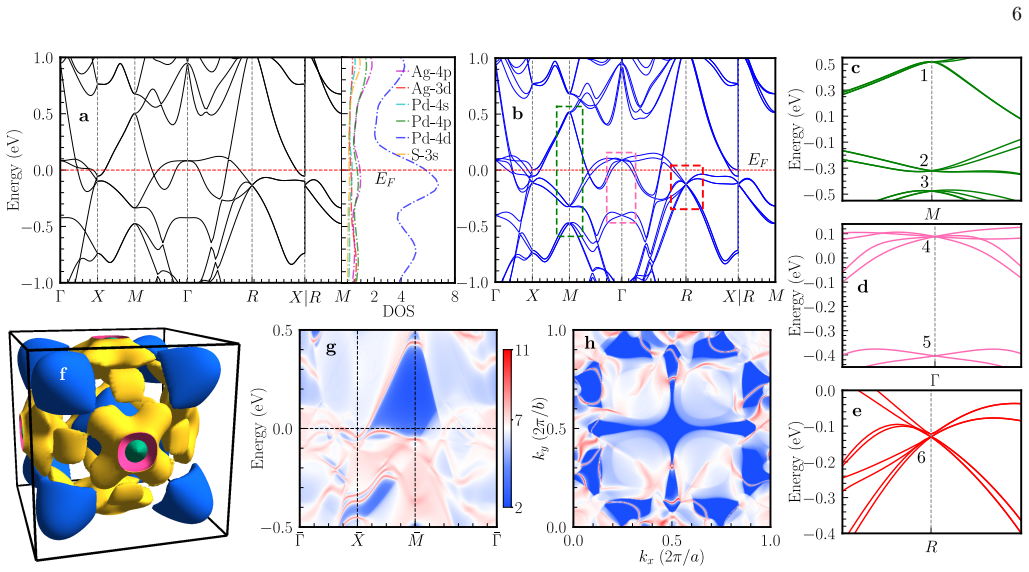
Ag₂Pd₃S crystallizes in the right-handed chiral space group P4₁32 and displays bulk superconductivity with Tc = 1.1 K. Muon spin rotation experiments show a fully gapped state accompanied by spontaneous time-reversal symmetry breaking. First-principles calculations identify multiple multifold fermions near the Fermi level, and symmetry analysis based on Ginzburg-Landau theory indicates that a loop-supercurrent-ordered superconducting state accounts for both the full gap and the observed TRS breaking.
What carries the argument
Muon spin rotation and relaxation measurements that detect spontaneous internal magnetic fields in the superconducting state of the chiral crystal.
If this is right
- Symmetry-protected topological surface states exist in the normal state due to the multifold band crossings.
- The loop-supercurrent order produces both a full superconducting gap and spontaneous TRS breaking.
- The material supplies a platform for intrinsic superconducting diode effects.
- Chirality-induced spin selectivity becomes accessible in a superconducting setting.
Where Pith is reading between the lines
- Search for the superconducting diode effect in oriented samples would test the loop-supercurrent state directly.
- Similar chiral topological semimetals with multifold fermions may host analogous TRS-breaking superconductivity.
- The normal-state topology could be probed by surface-sensitive spectroscopies to confirm the predicted surface states.
Load-bearing premise
The muon spin rotation signals arise from intrinsic spontaneous time-reversal symmetry breaking rather than from sample inhomogeneity or experimental artifacts.
What would settle it
Zero spontaneous internal magnetic field detected by muon spin rotation on clean single crystals of Ag₂Pd₃S would falsify the claim of intrinsic TRS breaking.
Figures


read the original abstract
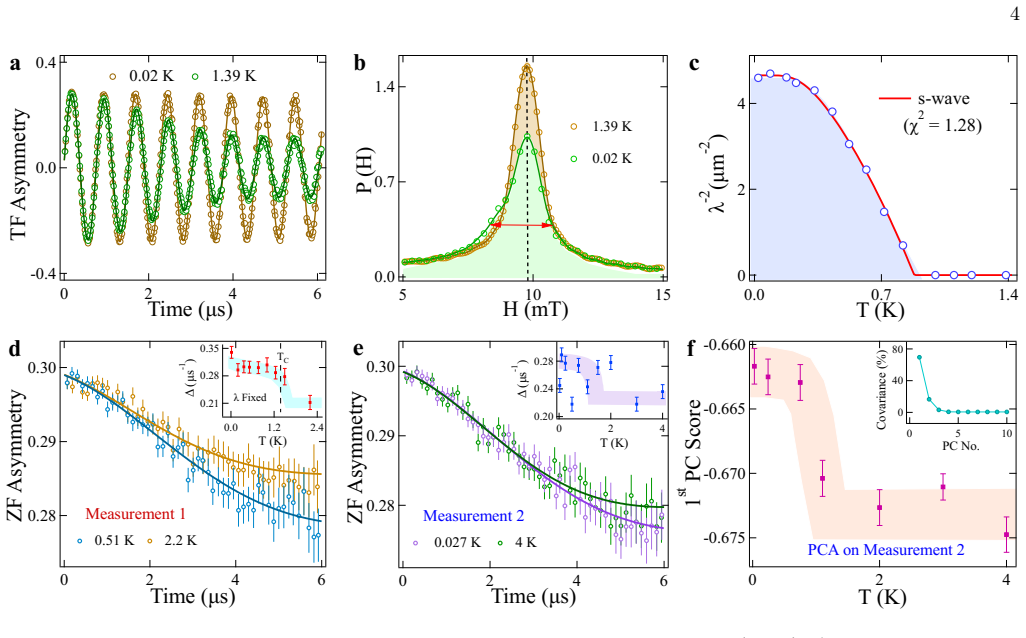
Chiral crystals provide a unique setting where broken inversion symmetry, strong spin-orbit coupling, and electronic topology intertwine, yet superconductivity in intrinsically chiral materials remains rare. Here, we report unconventional superconductivity in the chiral topological semimetal Ag$_2$Pd$_3$S, an enantiomorphic analog of natural mineral coldwellite, crystallizing in the right-handed space group $P4_132$. Bulk superconductivity with a transition temperature $T_C = 1.1(2)$ K is confirmed by electrical resistivity, magnetization, and specific-heat measurements. Muon spin rotation and relaxation ($\mu$SR) experiments reveal a fully gapped superconducting state that spontaneously time-reversal symmetry (TRS) breaking establishing Ag$_2$Pd$_3$S as the first chiral topological semimetal superconductor exhibiting intrinsic TRS breaking. First-principles calculations uncover multiple multifold band crossings near the Fermi level, hosting Kramers-Weyl, double spin-1, and spin-3/2 quasiparticles with large topological charges. These unconventional fermions generate symmetry-protected topological surface states and underscore the nontrivial topology of the normal state. Symmetry analysis based on the Ginzburg-Landau theory suggests a loop-supercurrent-ordered superconducting state, yielding a full gap alongside spontaneous TRS breaking. The coexistence of TRS-breaking superconductivity and chiral multifold fermions identifies Ag$_2$Pd$_3$S as a platform for realizing intrinsic superconducting diode effects and chirality-induced spin selectivity, offering a transformative pathway toward dissipationless topological quantum technologies.
Editorial analysis
A structured set of objections, weighed in public.
Referee Report
Summary. The manuscript reports bulk superconductivity at Tc=1.1(2) K in the chiral topological semimetal Ag₂Pd₃S (space group P4₁32), established via resistivity, magnetization, and specific-heat data. μSR measurements are presented as evidence for a fully gapped state with spontaneous TRS breaking. DFT calculations identify multifold band crossings (Kramers-Weyl, double spin-1, spin-3/2 fermions) near EF, and Ginzburg-Landau symmetry analysis is used to propose a loop-supercurrent-ordered state that simultaneously produces a full gap and TRS breaking. The work positions Ag₂Pd₃S as the first chiral topological semimetal superconductor exhibiting intrinsic TRS breaking.
Significance. If the μSR evidence for intrinsic spontaneous TRS breaking is robust, the result would be significant: it would establish a rare platform combining chiral crystal symmetry, multifold topological fermions, and TRS-breaking superconductivity, with potential implications for superconducting diode effects and chirality-induced spin selectivity. The DFT characterization of the normal-state topology is standard but provides useful context; the experimental claims on the superconducting state are the load-bearing element.
major comments (1)
- [μSR experiments paragraph and associated figures] The central claim of intrinsic TRS breaking (abstract and μSR section) rests on the zero-field relaxation rate increasing below Tc while remaining temperature-independent above Tc, with the extracted internal field attributed solely to the superconducting state. In the chiral P4₁32 structure, which can host defects or trace magnetic impurities, the same signature can arise from extrinsic sources; the manuscript does not supply the quantitative controls (impurity concentration bounds, comparison to non-SC analogs, or field-dependent spectra) needed to exclude them. This is load-bearing for the headline claim.
minor comments (2)
- The abstract states Tc = 1.1(2) K but does not specify how the uncertainty was obtained from the resistivity, magnetization, or specific-heat data; a brief statement on the fitting procedure would improve clarity.
- Notation for the space group is given as P4_132 in the abstract; consistency with standard crystallographic notation (P4₁32) should be checked throughout.
Simulated Author's Rebuttal
We thank the referee for their careful reading of the manuscript and for highlighting the importance of rigorously excluding extrinsic sources in the μSR data. We address the single major comment below.
read point-by-point responses
-
Referee: The central claim of intrinsic TRS breaking (abstract and μSR section) rests on the zero-field relaxation rate increasing below Tc while remaining temperature-independent above Tc, with the extracted internal field attributed solely to the superconducting state. In the chiral P4₁32 structure, which can host defects or trace magnetic impurities, the same signature can arise from extrinsic sources; the manuscript does not supply the quantitative controls (impurity concentration bounds, comparison to non-SC analogs, or field-dependent spectra) needed to exclude them. This is load-bearing for the headline claim.
Authors: We agree that quantitative exclusion of extrinsic contributions is essential for a robust claim of intrinsic TRS breaking. The observed temperature dependence (temperature-independent above Tc, onset of additional relaxation precisely at Tc) follows the standard signature used to identify spontaneous fields in the literature on TRS-breaking superconductors. The manuscript reports high sample purity via powder XRD and EDX, but we acknowledge that explicit impurity concentration bounds (e.g., from low-temperature susceptibility) and field-dependent μSR spectra in the normal state were not presented. We will revise the manuscript to include these controls drawn from our existing data, specifically an upper bound on magnetic impurity moments and normal-state μSR spectra confirming the absence of static internal fields above Tc. This addition will directly address the concern while preserving the central interpretation. revision: yes
Circularity Check
No circularity; experimental claims rest on independent data and standard analysis
full rationale
The manuscript is an experimental report of superconductivity in Ag2Pd3S, supported by resistivity, magnetization, specific-heat, and μSR measurements plus first-principles DFT band-structure calculations. The central claim of intrinsic TRS breaking is tied directly to the observed temperature-dependent zero-field μSR relaxation rate below Tc, not to any fitted parameter or self-referential equation. The Ginzburg-Landau symmetry discussion invokes standard group-theory arguments without self-citation chains or ansatzes that collapse back to the input data. No load-bearing step reduces a prediction to a fit or renames a known result; the derivation chain is self-contained against external benchmarks.
Axiom & Free-Parameter Ledger
Reference graph
Works this paper leans on
-
[1]
G. H. Fecher, J. Kübler, C. Felser,Materials2022,15, 17
-
[2]
Sohncke,Entwickelung einer Theorie der Krystall- struktur, BG Teubner,1879
L. Sohncke,Entwickelung einer Theorie der Krystall- struktur, BG Teubner,1879
-
[3]
Multunas, A
C. Multunas, A. Grieder, J. Xu, Y. Ping, R. Sundarara- man,Phys. Rev. Mater.2023,7, 12 123801
2023
-
[4]
Ideue, K
T. Ideue, K. Hamamoto, S. Koshikawa, M. Ezawa, S. Shimizu, Y. Kaneko, Y. Tokura, N. Nagaosa, Y. Iwasa, Nat. Phys.2017,13, 6 578
2017
-
[5]
Bradlyn, J
B. Bradlyn, J. Cano, Z. Wang, M. Vergniory, C. Felser, R. J. Cava, B. A. Bernevig,Science2016,353, 6299 aaf5037
-
[6]
Menichetti, L
G. Menichetti, L. Cavicchi, L. Lucchesi, F. Taddei, G. Iannaccone, P. Jarillo-Herrero, C. Felser, F. H. Kop- pens, M. Polini,Newton2025,1, 1
-
[7]
Mardanya, M
S. Mardanya, M. Kargarian, R. Verma, T.-R. Chang, S. Chowdhury, H. Lin, A. Bansil, A. Agarwal, B. Singh, Phys. Rev. Mater.2024,8L091801
2024
-
[8]
Smidman, M
M. Smidman, M. Salamon, H. Yuan, D. Agterberg,Rep. Prog. Phys.2017,80, 3 036501
2017
-
[9]
Bauer, M
E. Bauer, M. Sigrist,Non-centrosymmetric superconduc- tors: Introduction and overview, volume 847, Springer Science & Business Media,2012
2012
-
[10]
L. P. Gor’kov, E. I. Rashba,Phys. Rev. Lett.2001,87 037004
2001
-
[11]
Bauer, G
E. Bauer, G. Hilscher, H. Michor, C. Paul, E. W. Scheidt, A. Gribanov, Y. Seropegin, H. Noël, M. Sigrist, P. Rogl, Phys. Rev. Lett.2004,92027003
2004
-
[12]
Nagaosa, Y
N. Nagaosa, Y. Yanase,Annu. Rev. Condens. Matter Phys.2024,15, 1 63
2024
-
[13]
S. K. Ghosh, M. Smidman, T. Shang, J. F. Annett, A. D. Hillier, J. Quintanilla, H. Yuan,J. Phys.: Condens. Mat- ter2020,33, 3 033001
-
[14]
Barker, D
J. Barker, D. Singh, A. Thamizhavel, A. Hillier, M. Lees, G. Balakrishnan, D. M. Paul, R. Singh,Phys. Rev. Lett. 2015,115, 26 267001
2015
-
[15]
Singh, M
D. Singh, M. Scheurer, A. Hillier, D. Adroja, R. Singh, Phys. Rev. B2020,102, 13 134511
-
[16]
Singh, A
Arushi, D. Singh, A. Hillier, M. Scheurer, R. Singh,Phys. Rev. B2021,103, 17 174502
-
[17]
Shang, S
T. Shang, S. K. Ghosh, M. Smidman, D. J. Gawryluk, C. Baines, A. Wang, W. Xie, Y. Chen, M. O. Ajeesh, M. Nicklas, et al.,npj Quantum Mater.2022,7, 1 35
2022
-
[18]
R. P. Singh, A. D. Hillier, B. Mazidian, J. Quintanilla, J. Annett, D. M. Paul, G. Balakrishnan, M. R. Lees, 10 Phys. Rev. Lett.2014,112, 10 107002
2014
-
[19]
Singh, J
D. Singh, J. Barker, A. Thamizhavel, D. M. Paul, A. Hillier, R. Singh,Phys. Rev. B2017,96, 18 180501
-
[20]
Singh, S
D. Singh, S. KP, J. Barker, D. M. Paul, A. Hillier, R. Singh,Phys. Rev. B2018,97, 10 100505
-
[21]
A. D. Hillier, J. Quintanilla, R. Cywinski,Phys. Rev. Lett.2009,102, 11 117007
2009
-
[22]
Shang, S
T. Shang, S. K. Ghosh, J. Z. Zhao, L.-J. Chang, C. Baines, M. K. Lee, D. J. Gawryluk, M. Shi, M. Medarde, J. Quintanilla, T. Shiroka,Phys. Rev. B 2020,102020503
2020
-
[23]
Shang, M
T. Shang, M. Smidman, S. K. Ghosh, C. Baines, L. J. Chang, D. J. Gawryluk, J. A. T. Barker, R. P. Singh, D. M. Paul, G. Balakrishnan, E. Pomjakushina, M. Shi, M. Medarde, A. D. Hillier, H. Q. Yuan, J. Quintanilla, J. Mesot, T. Shiroka,Phys. Rev. Lett.2018,121257002
2018
-
[24]
Shang, M
T. Shang, M. Smidman, A. Wang, L.-J. Chang, C. Baines, M.-K. Lee, Z. Nie, G. Pang, W. Xie, W. Jiang, et al.,Phys. Rev. Lett.2020,124, 20 207001
2020
-
[25]
Sharma, S
S. Sharma, S. Kp, A. Richards, J. Gautreau, M. Pula, J. Beare, K. Kojima, S. Yoon, Y. Cai, R. Kushwaha, et al.,Phys. Rev. B2023,108, 14 144510
-
[26]
K. P. Sajilesh, R. K. Kushwaha, D. Samanta, T. Tula, P. K. Meena, S. Srivastava, D. Singh, P. K. Biswas, A. Kanigel, A. D. Hillier, S. K. Ghosh, R. P. Singh,Adv. Mater.2024,372415721
2024
-
[27]
Z.S.Gao, X.-J.Gao, W.-Y.He, X.Y.Xu, T.Ng, K.Law, Quantum Front.2022,1, 1 3
2022
-
[28]
S. Srivastava, D. Samanta, P. K. Meena, P. Manna, P. Mishra, S. Sharma, P. K. Naik, R. Stewart, A. D. Hillier, S. K. Ghosh, et al.,arXiv preprint arXiv:2602.227932026
-
[29]
P. K. Meena, D. Samanta, S. Jangid, R. K. Kushwaha, R. Stewart, A. D. Hillier, S. K. Ghosh, R. P. Singh,Adv. Sci.2025,12, 43 e12434
2025
-
[30]
P. K. Meena, D. Samanta, S. Srivastava, P. Manna, S. K. Ghosh, R. P. Singh,Phys. Rev. B2025,112144515
-
[31]
A. Kataria, S. Srivastava, D. Samanta, P. Yadav, P. Manna, S. Sharma, P. Mishra, J. Barker, A. D. Hillier, A. Agarwal, et al.,arXiv preprint arXiv:2601.07460 2026
-
[32]
J. R. Badger, Y. Quan, M. C. Staab, S. Sumita, A. Rossi, K. P. Devlin, K. Neubauer, D. S. Shulman, J. C. Fet- tinger, P. Klavins, M. K. Susan, D. Aoki, I. M. Vishik, W. E. Pickett, V. Taufour,Commun. Phys2022,5, 1 22
-
[33]
S. K. Ghosh, B. Li, C. Xu, A. D. Hillier, P. K. Biswas, X. Xu, T. Shiroka,Front. Phys.2023,111256166
2023
-
[34]
S. K. Ghosh, G. Csire, P. Whittlesea, J. F. Annett, M. Gradhand, B. Újfalussy, J. Quintanilla,Phys. Rev. B2020,101100506
-
[35]
C. S. Yadav, S. K. Ghosh, P. Kumar, A. Thamizhavel, P. L. Paulose,Phys. Rev. B2024,110054515
-
[36]
S. K. Ghosh, P. K. Biswas, C. Xu, B. Li, J. Z. Zhao, A. D. Hillier, X. Xu,Phys. Rev. Res.2022,4L012031
2022
-
[37]
A. M. McDonald, L. J. Cabri, C. J. Stanley, D. J. Good, J. Redpath, G. Lane, J. Spratt, D. E. Ames,Can. Min- eral.2015,53, 5 845
2015
-
[38]
Yoshida, H
H. Yoshida, H. Okabe, Y. Matsushita, M. Isobe, E. Takayama-Muromachi,Phys. Rev. B2017,95 184514
-
[39]
R. E. Schaak, A. K. Sra, B. M. Leonard, R. E. Cable, J. C. Bauer, Y.-F. Han, J. Means, W. Teizer, Y. Vasquez, E. S. Funck,Journal of the American Chemical Society 2005,127, 10 3506, pMID: 15755172
2005
-
[40]
H. Khan, H. Trunk, C. Raub, W. Fertig, A. Lawson,J. Less-Common Met.1973,30, 1 167
1973
-
[41]
J. Ma, R. Zhan, X. Lin,Adv. Phys. Res.2025,4, 6 2400180
2025
-
[42]
Nadeem, M
M. Nadeem, M. S. Fuhrer, X. Wang,Nat. Rev. Phys. 2023,5, 10 558
2023
-
[43]
B. P. Bloom, M. Lingenfelder, R. Naaman, D. Sun, D. H. Waldeck,Nat. Rev. Mater.2025, 1–13
2025
-
[44]
W. L. McMillan,Phys. Rev.1968,167331
1968
-
[45]
E. H. Brandt,Phys. Rev. B2003,68054506
-
[46]
Panda, A
K. Panda, A. Bhattacharyya, D. T. Adroja, N. Kase, P. K. Biswas, S. Saha, T. Das, M. R. Lees, A. D. Hillier, Phys. Rev. B2019,99174513
-
[47]
V.K.Anand, A.Bhattacharyya, D.T.Adroja, K.Panda, P. K. Biswas, A. D. Hillier, B. Lake,Phys. Rev. B2023, 108224519
-
[48]
R. S. Hayano, Y. J. Uemura, J. Imazato, N. Nishida, T. Yamazaki, R. Kubo,Phys. Rev. B1979,20850
-
[49]
O’Reilly Media, Inc
A. Géron,Hands-on machine learning with Scikit-Learn, Keras, and TensorFlow, " O’Reilly Media, Inc.",2022
2022
-
[50]
T. Tula, G. Möller, J. Quintanilla, S. R. Giblin, A. D. Hillier, E. E. McCabe, S. Ramos, D. S. Barker, S. Gibson, J. Phys.: Condens. Matter2021,33, 19 194002
-
[51]
P. G. et al.,J. Phys. Condens. Matter2009,21, 39 395502
-
[52]
P. G. et al.,J. Phys. Condens. Matter2017,29, 46 465901
-
[53]
Giannozzi, O
P. Giannozzi, O. Baseggio, P. Bonfà , D. Brunato, R. Car, I. Carnimeo, C. Cavazzoni, S. de Gironcoli, P. Delugas, F. Ferrari Ruffino, A. Ferretti, N. Marzari, I. Timrov, A. Urru, S. Baroni,J. Chem. Phys.2020, 152, 15 154105
2020
-
[54]
J. P. Perdew, K. Burke, M. Ernzerhof,Phys. Rev. Lett. 1996,773865
1996
-
[55]
J. F. Annett,Adv. Phys.1990,39, 2 83
1990
-
[56]
Sigrist, K
M. Sigrist, K. Ueda,Rev. Mod. Phys.1991,63, 2 239
1991
-
[57]
A. D. Hillier, J. Quintanilla, B. Mazidian, J. F. Annett, R. Cywinski,Phys. Rev. Lett.2012,109, 9 097001
2012
-
[58]
S. K. Ghosh, J. F. Annett, J. Quintanilla,New J. Phys. 2021,23, 8 083018
2021
-
[59]
Chang, S.-Y
G. Chang, S.-Y. Xu, B. J. Wieder, D. S. Sanchez, S.-M. Huang, I. Belopolski, T.-R. Chang, S. Zhang, A. Bansil, H. Lin, M. Z. Hasan,Phys. Rev. Lett.2017,119206401
2017
-
[60]
N. B. Schröter, D. Pei, M. G. Vergniory, Y. Sun, K. Manna, F. De Juan, J. A. Krieger, V. Süss, M. Schmidt, P. Dudin, et al.,Nat. Phys.2019,15, 8 759
2019
-
[61]
P. Tang, Q. Zhou, S.-C. Zhang,Phys. Rev. Lett.2017, 119206402
2017
-
[62]
B: Condens
J.RodrÃguez-Carvajal,Phys. B: Condens. Matter1993, 192, 1 55
-
[63]
Morris, R
G. Morris, R. Heffner,Phys. B: Condens. Matter2003, 326, 1-4 252
-
[64]
Suter, B
A. Suter, B. Wojek,Phys. Procedia2012,3069
-
[65]
G. P. et al.,J. Phys.: Condens. Matter2020,32, 16 165902
-
[66]
Q. Wu, S. Zhang, H.-F. Song, M. Troyer, A. A. Soluyanov,Computer Physics Communications2018, 224405
-
[67]
Helfand, N
E. Helfand, N. R. Werthamer,Phys. Rev.1966,147288
1966
-
[68]
N. R. Werthamer, E. Helfand, P. C. Hohenberg,Phys. Rev.1966,147295
1966
-
[69]
A. B. Karki, Y. M. Xiong, I. Vekhter, D. Browne, P. W. Adams, D. P. Young, K. R. Thomas, J. Y. Chan, H. Kim, R. Prozorov,Phys. Rev. B2010,82064512. 11
-
[70]
Bao, J.-Y
J.-K. Bao, J.-Y. Liu, C.-W. Ma, Z.-H. Meng, Z.-T. Tang, Y.-L. Sun, H.-F. Zhai, H. Jiang, H. Bai, C.-M. Feng, Z.- A. Xu, G.-H. Cao,Phys. Rev. X2015,5011013
-
[71]
Klimczuk, F
T. Klimczuk, F. Ronning, V. Sidorov, R. J. Cava, J. D. Thompson,Phys. Rev. Lett.2007,99257004
2007
-
[72]
Tinkham,Introduction to superconductivity, vol- ume 1, Courier Corporation,2004
M. Tinkham,Introduction to superconductivity, vol- ume 1, Courier Corporation,2004
2004
-
[73]
Carrington, F
A. Carrington, F. Manzano,Phys. C: Superconductivity 2003,385, 1 205
2003
-
[74]
Gupta, T
R. Gupta, T. Ying, Y. Qi, H. Hosono, R. Khasanov, Phys. Rev. B2021,103, 17 174511
-
[75]
Unconventional Superconductivity in the Chiral Topological Semimetal Ag2Pd3S
T. Shang, J. Zhao, L.-H. Hu, W. Wu, K. Xia, M. O. Ajeesh, M. Nicklas, Y. Xu, Q. Zhan, D. J. Gawryluk, et al.,Adv. Mater.2025, e11385. 12 Supplementary information to "Unconventional Superconductivity in the Chiral Topological Semimetal Ag2Pd3S" SAMPLE CHARACTERIZATION The Rietveld-refined lattice parameters and the Wyckoff positions are listed in Table S1...
2025
-
[76]
Clearly, if the TRS breaking instability is realized in the two-fold degenerate channel, thesuperconducting groundstatefor Ag2Pd3S will have finite loop supercurrents
discussion (0)
Sign in with ORCID, Apple, or X to comment. Anyone can read and Pith papers without signing in.