Coherent Control of Quantum and Classical Correlations in Photoionization
Pith reviewed 2026-06-30 06:18 UTC · model grok-4.3
The pith
Phase-locked pulse sequences enable attosecond control of electron-ion entanglement in photoionization.
A machine-rendered reading of the paper's core claim, the machinery that carries it, and where it could break.
Core claim
We demonstrate phase-resolved control of electron-ion correlations using phase-locked pulse sequences in the strong-coupling regime. Entanglement can be halted and reshaped with attosecond precision, and phase-dependent correlations can be redistributed into population-based correlations, leading to entanglement that is directly reflected in joint observables. These results establish a route to coherently shape entanglement in photoionization and open new possibilities for accessing and controlling quantum correlations in systems where measurements are intrinsically basis constrained.
What carries the argument
Phase-locked pulse sequences in the strong-coupling regime, which shift the relative phase between pulses to steer the generation, halting, and redistribution of electron-ion entanglement.
Load-bearing premise
The strong-coupling regime together with phase-locked pulse sequences can be maintained without decoherence or imperfections that erase the attosecond-scale control over correlations.
What would settle it
An experiment that applies phase-locked pulse sequences to strong-coupling photoionization and finds no measurable attosecond-scale variation in the joint electron-ion observables or in the extracted correlations.
Figures



read the original abstract
The ability to control quantum correlations in strongly driven systems is a central challenge across quantum science, with implications for ultrafast dynamics, quantum control, and information processing. In photoionization, the emitted electron and residual ion may form an entangled system whose correlations encode the underlying light-matter interaction, yet control of their generation and observable manifestation in continuum systems remains largely unexplored. Here we demonstrate phase-resolved control of electron-ion correlations using phase-locked pulse sequences in the strong-coupling regime. We show that entanglement can be halted and reshaped with attosecond precision, and that phase-dependent correlations can be redistributed into population-based correlations, leading to entanglement that is directly reflected in joint observables. These results establish a route to coherently shape entanglement in photoionization and open new possibilities for accessing and controlling quantum correlations in systems where measurements are intrinsically basis constrained.
Editorial analysis
A structured set of objections, weighed in public.
Referee Report
Summary. The manuscript claims a theoretical demonstration of phase-resolved coherent control over electron-ion quantum and classical correlations in photoionization. Using phase-locked pulse sequences in the strong-coupling regime, it asserts that entanglement can be halted, reshaped, and redistributed into population-based correlations with attosecond precision, such that the resulting entanglement is directly observable in joint measurements. This is positioned as establishing a route to shape entanglement in continuum systems under basis-constrained measurements.
Significance. If the central claims hold under realistic conditions, the work would address an open challenge in ultrafast quantum control by showing how phase-locked driving can manipulate entanglement in photoionization without requiring direct access to the full Hilbert space. It could open avenues for controlling correlations in strongly driven light-matter systems relevant to quantum information and ultrafast dynamics. No machine-checked proofs, reproducible code, or parameter-free derivations are evident from the provided material.
major comments (1)
- [Abstract and Results] The central claim of attosecond-precision control and redistribution of entanglement (abstract and results) rests on the assumption that phase coherence is preserved over the pulse-sequence duration in the strong-coupling regime. No analysis, bounds, or inclusion of decoherence channels (e.g., continuum coupling, spontaneous emission, or environmental interactions) is provided to justify this; any loss of off-diagonal coherences would erase the claimed phase-dependent effects. This is load-bearing for the demonstration.
minor comments (2)
- [Theory] Notation for joint observables and correlation measures should be defined explicitly with reference to the underlying Hilbert space or density matrix to avoid ambiguity in how 'population-based correlations' are distinguished from quantum ones.
- [Abstract] The abstract states results are 'directly reflected in joint observables' but does not clarify which specific observables (e.g., coincidence detection probabilities) are used; this should be stated in the main text with an example calculation.
Simulated Author's Rebuttal
We are grateful to the referee for their detailed comments. The primary concern raised pertains to the lack of decoherence analysis in our theoretical demonstration. We respond to this point below and indicate our willingness to revise the manuscript accordingly.
read point-by-point responses
-
Referee: The central claim of attosecond-precision control and redistribution of entanglement (abstract and results) rests on the assumption that phase coherence is preserved over the pulse-sequence duration in the strong-coupling regime. No analysis, bounds, or inclusion of decoherence channels (e.g., continuum coupling, spontaneous emission, or environmental interactions) is provided to justify this; any loss of off-diagonal coherences would erase the claimed phase-dependent effects. This is load-bearing for the demonstration.
Authors: We acknowledge that the central claims rely on the preservation of phase coherence during the pulse sequence. The manuscript presents a theoretical model in the coherent strong-coupling regime, where phase-locked pulses enable control through quantum interference. We did not include an analysis of decoherence channels or provide bounds on coherence times, as the focus was on demonstrating the coherent control mechanism itself. This omission limits the direct applicability to experimental conditions where decoherence may be present. In the revised manuscript, we will add a new subsection discussing the assumptions regarding coherence preservation, including estimates of relevant timescales for typical photoionization systems and potential decoherence sources. This will clarify the regime of validity of our results without altering the core theoretical findings. revision: yes
Circularity Check
No circularity: demonstration claim with no self-referential derivation or fitted predictions visible
full rationale
The provided abstract and context present the work as a demonstration of phase-resolved control in photoionization using phase-locked pulses in the strong-coupling regime. No equations, derivations, or parameter-fitting steps are shown that reduce a claimed prediction back to its own inputs by construction. No self-citations are invoked as load-bearing uniqueness theorems, and no ansatz or renaming of known results is described. The central claim is framed as an experimental/theoretical demonstration rather than a closed mathematical loop, satisfying the criteria for a self-contained result with no detectable circularity.
Axiom & Free-Parameter Ledger
Reference graph
Works this paper leans on
-
[1]
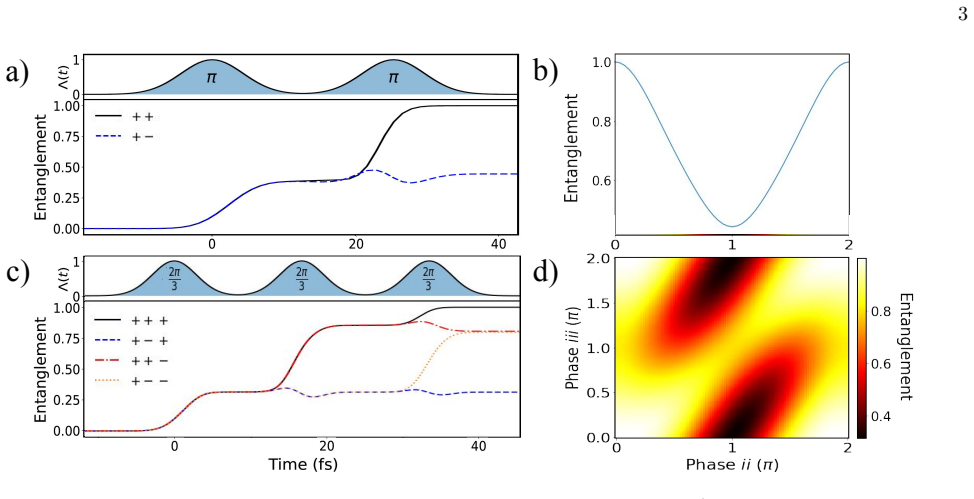
2a), we show the build-up of entanglement by a pair of pulses, each with areaπ
Twoπ-pulses In Fig. 2a), we show the build-up of entanglement by a pair of pulses, each with areaπ. We find that if the pulse pair is in phase,(++)black line, full entanglement is generated between the ion and the electron,SvN ≈1, in agreement with the single pulse case [9]. Surprisingly, if the pulse pair is out of phase,(+−)blue dashed line, we see that...
-
[2]
Three 2π 3 -pulses In Fig. 2c), we present the case of a field containing three pulses, each with area2π/3. We find that three pulses that are in phase,(+++)black line, yield a fully entangled electron-ion system, as expected for a total2π pulse area. Interestingly, we find that more entanglement is generated by the second pulse than by the other two puls...
-
[3]
Pabst, L
S. Pabst, L. Greenman, P. J. Ho, D. A. Mazziotti, and R. Santra, Decoherence in attosecond photoionization, Physical Review Letters106, 053003 (2011)
2011
-
[4]
D.Bustoet al.,Probingelectronicdecoherencewithhigh- resolution attosecond photoelectron interferometry, Eu- ropean Physical Journal D76, 112 (2022)
2022
-
[5]
Mehmood, E
S. Mehmood, E. Lindroth, and L. Argenti, Ionic coher- ence in resonant above-threshold attosecond ionization spectroscopy, Physical Review A107, 033103 (2023)
2023
-
[6]
K. L. Ishikawa, K. C. Prince, and K. Ueda, Control of Ion-Photoelectron Entanglement and Coherence Via Rabi Oscillations, The Journal of Physical Chemistry A 127, 10638 (2023)
2023
-
[7]
M. J. J. Vrakking, Control of Attosecond Entanglement and Coherence, Physical Review Letters126, 113203 (2021)
2021
-
[8]
L.-M. Koll, L. Maikowski, L. Drescher, T. Witting, and M. J. J. Vrakking, Experimental Control of Quantum- Mechanical Entanglement in an Attosecond Pump- Probe Experiment, Physical Review Letters128, 043201 (2022)
2022
-
[9]
Ruberti, S
M. Ruberti, S. Patchkovskii, and V. Averbukh, Quantum coherence in molecular photoionization, Phys. Chem. Chem. Phys.24, 19673 (2022)
2022
-
[10]
Shobeiry, P
F. Shobeiry, P. Fross, H. Srinivas, T. Pfeifer, R. Mosham- mer, and A. Harth, Emission control of entangled elec- trons in photoionisation of a hydrogen molecule, Scien- tific Reports14, 19630 (2024)
2024
-
[11]
Nandiet al., Generation of entanglement using a short-wavelength seeded free-electron laser, Sci
S. Nandiet al., Generation of entanglement using a short-wavelength seeded free-electron laser, Sci. Adv.10, eado0668 (2024)
2024
-
[12]
Jiang, M.-C
W.-C. Jiang, M.-C. Zhong, Y.-K. Fang, S. Donsa, I. Březinová, L.-Y. Peng, and J. Burgdörfer, Time De- 10 lays as Attosecond Probe of Interelectronic Coherence and Entanglement, Physical Review Letters133, 163201 (2024)
2024
-
[13]
Makoset al., Entanglement in photoionisation reveals the effect of ionic coupling in attosecond time delays, Nat Commun16, 8554 (2025)
I. Makoset al., Entanglement in photoionisation reveals the effect of ionic coupling in attosecond time delays, Nat Commun16, 8554 (2025)
2025
-
[14]
Goulielmakiset al., Real-time observation of valence electron motion, Nature466, 739 (2010)
E. Goulielmakiset al., Real-time observation of valence electron motion, Nature466, 739 (2010)
2010
-
[15]
H. Laurellet al., Measuring the quantum state of photo- electrons, Nature Photonics 10.1038/s41566-024-01607-8 (2025)
-
[16]
Berkane, R
M. Berkane, R. Taïeb, G. Granveau, P. Salières, C. Bourassin-Bouchet, C. Lévêque, and J. Caillat, Com- pleteretrievalofattosecondphotoelectrondynamicsfrom partially coherent states in entangled photoemission, Physical Review A111, L041101 (2025)
2025
-
[17]
Ruberti, V
M. Ruberti, V. Averbukh, and F. Mintert, Bell Test of Quantum Entanglement in Attosecond Photoionization, Physical Review X14, 041042 (2024)
2024
-
[18]
Henderson and V
L. Henderson and V. Vedral, Classical, quantum and to- tal correlations, J. Phys. A: Math. Gen.34, 6899 (2001)
2001
-
[19]
Maziero, L
J. Maziero, L. C. Céleri, R. M. Serra, and V. Vedral, Classical and quantum correlations under decoherence, Phys. Rev. A80, 044102 (2009)
2009
-
[20]
Haroche and J.-M
S. Haroche and J.-M. Raimond,Exploring the quantum: atoms, cavities and photons, Oxford graduate texts (Ox- ford University Press, Oxford ; New York, 2006) oCLC: ocm68770236
2006
-
[21]
Cruz-Rodriguez, D
L. Cruz-Rodriguez, D. Dey, A. Freibert, and P. Stam- mer, Quantum phenomena in attosecond science, Nature Review Physics6, 691 (2024)
2024
-
[22]
M. C. Tichy, F. Mintert, and A. Buchleitner, Essential entanglement for atomic and molecular physics, Journal of Physics B: Atomic, Molecular and Optical Physics44, 192001 (2011)
2011
-
[23]
W. H. Zurek, Decoherence, einselection, and the quan- tum origins of the classical, Rev. Mod. Phys.75, 715 (2003)
2003
-
[24]
Yu and J
T. Yu and J. H. Eberly, Sudden Death of Entanglement, Science323, 598 (2009)
2009
-
[25]
Stenquist, J
A. Stenquist, J. N. Bruhnke, F. Zapata, and J. M. Dahlström, Entanglement transfer in a composite elec- tron–ion–photon system, Rep. Prog. Phys.88, 080502 (2025)
2025
-
[26]
Vedral, Classical Correlations and Entanglement in Quantum Measurements, Phys
V. Vedral, Classical Correlations and Entanglement in Quantum Measurements, Phys. Rev. Lett.90, 050401 (2003)
2003
-
[27]
Groisman, S
B. Groisman, S. Popescu, and A. Winter, Quantum, clas- sical, and total amount of correlations in a quantum state, Phys. Rev. A72, 032317 (2005)
2005
-
[28]
Xu, X.-Y
J.-S. Xu, X.-Y. Xu, C.-F. Li, C.-J. Zhang, X.-B. Zou, and G.-C. Guo, Experimental investigation of classical and quantum correlations under decoherence, Nat Commun 1, 7 (2010)
2010
-
[29]
K. Modi, A. Brodutch, H. Cable, T. Paterek, and V. Ve- dral, The classical-quantum boundary for correlations: Discord and related measures, Rev. Mod. Phys.84, 1655 (2012)
2012
-
[30]
Stenquist and J
A. Stenquist and J. M. Dahlström, Harnessing time sym- metry to fundamentally alter entanglement in photoion- ization, Phys. Rev. Research7, 013270 (2025)
2025
-
[31]
Grobe and J
R. Grobe and J. H. Eberly, Observation of coherence transfer by electron-electron correlation, Phys. Rev. A 48, 623 (1993)
1993
-
[32]
L.Younget al.,Femtosecondelectronicresponseofatoms to ultra-intense X-rays, Nature466, 56 (2010)
2010
-
[33]
Allariaet al., Highly coherent and stable pulses from the FERMI seeded free-electron laser in the extreme ul- traviolet, Nature Photon6, 699 (2012)
E. Allariaet al., Highly coherent and stable pulses from the FERMI seeded free-electron laser in the extreme ul- traviolet, Nature Photon6, 699 (2012)
2012
-
[34]
Fushitaniet al., Femtosecond two-photon Rabi oscil- lations in excited He driven by ultrashort intense laser fields, Nature Photon10, 102 (2016)
M. Fushitaniet al., Femtosecond two-photon Rabi oscil- lations in excited He driven by ultrashort intense laser fields, Nature Photon10, 102 (2016)
2016
-
[35]
K. C. Princeet al., Coherent control with a short- wavelength free-electron laser, Nature Photon10, 176 (2016)
2016
-
[36]
Rudenkoet al., Femtosecond response of polyatomic molecules to ultra-intense hard X-rays, Nature546, 129 (2017)
A. Rudenkoet al., Femtosecond response of polyatomic molecules to ultra-intense hard X-rays, Nature546, 129 (2017)
2017
-
[37]
Younget al., Roadmap of ultrafast x-ray atomic and molecular physics, J
L. Younget al., Roadmap of ultrafast x-ray atomic and molecular physics, J. Phys. B: At. Mol. Opt. Phys.51, 032003 (2018)
2018
-
[38]
Lindroth, F
E. Lindroth, F. Calegari, L. Young, M. Harmand, N. Du- dovich, N. Berrah, and O. Smirnova, Challenges and op- portunities in attosecond and XFEL science, Nat Rev Phys1, 107 (2019)
2019
-
[39]
E. P. Kanteret al., Unveiling and Driving Hidden Reso- nances with High-Fluence, High-Intensity X-Ray Pulses, Phys. Rev. Lett.107, 233001 (2011)
2011
-
[40]
Nandiet al., Observation of Rabi dynamics with a short-wavelength free-electron laser, Nature608, 488 (2022)
S. Nandiet al., Observation of Rabi dynamics with a short-wavelength free-electron laser, Nature608, 488 (2022)
2022
-
[41]
P. K. Marojuet al., Attosecond coherent control of elec- tronic wave packets in two-colour photoionization using a novel timing tool for seeded free-electron laser, Nat. Photon.17, 200 (2023)
2023
-
[42]
Dumergueet al., Wave-packet manipulation of He Rydberg states by a seeded free-electron laser, Phys
M. Dumergueet al., Wave-packet manipulation of He Rydberg states by a seeded free-electron laser, Phys. Rev. Research6, 043323 (2024)
2024
-
[43]
Liet al., Imaging a light-induced molecular elimina- tion reaction with an X-ray free-electron laser, Nat Com- mun16, 7006 (2025)
X. Liet al., Imaging a light-induced molecular elimina- tion reaction with an X-ray free-electron laser, Nat Com- mun16, 7006 (2025)
2025
-
[44]
Gauthier, P
D. Gauthier, P. R. Ribič, G. De Ninno, E. Allaria, P. Cin- quegrana, M. B. Danailov, A. Demidovich, E. Ferrari, and L. Giannessi, Generation of Phase-Locked Pulses from a Seeded Free-Electron Laser, Phys. Rev. Lett.116, 024801 (2016)
2016
-
[45]
Ardiniet al., Generation of interferometrically sta- ble pulse pairs from a free-electron laser using a birefrin- gent interferometer, J
B. Ardiniet al., Generation of interferometrically sta- ble pulse pairs from a free-electron laser using a birefrin- gent interferometer, J. Phys. B: At. Mol. Opt. Phys.57, 075402 (2024)
2024
-
[46]
See Supplemental Material [url],
-
[47]
Yu and L
C. Yu and L. B. Madsen, Core-resonant ionization of he- lium by intense XUV pulses: Analytical and numerical studies on channel-resolved spectral features, Phys. Rev. A98, 033404 (2018)
2018
-
[48]
Ossianderet al., Attosecond correlation dynamics, Nature Phys13, 280 (2017)
M. Ossianderet al., Attosecond correlation dynamics, Nature Phys13, 280 (2017)
2017
-
[49]
S. B. Zhang and N. Rohringer, Photoemission spec- troscopy with high-intensity short-wavelength lasers, Physical Review A89, 013407 (2014)
2014
-
[50]
Ollivier and W
H. Ollivier and W. H. Zurek, Quantum Discord: A Mea- sure of the Quantumness of Correlations, Phys. Rev. Lett.88, 017901 (2001)
2001
discussion (0)
Sign in with ORCID, Apple, or X to comment. Anyone can read and Pith papers without signing in.