Provably Efficient Learning of Fermionic Correlations under Particle-Number Symmetry
Pith reviewed 2026-06-30 05:50 UTC · model grok-4.3
The pith
Particle-number symmetry allows all k-body fermionic correlations of an η-particle state to be estimated from O(η^k/ε²) samples independent of total modes N.
A machine-rendered reading of the paper's core claim, the machinery that carries it, and where it could break.
Core claim
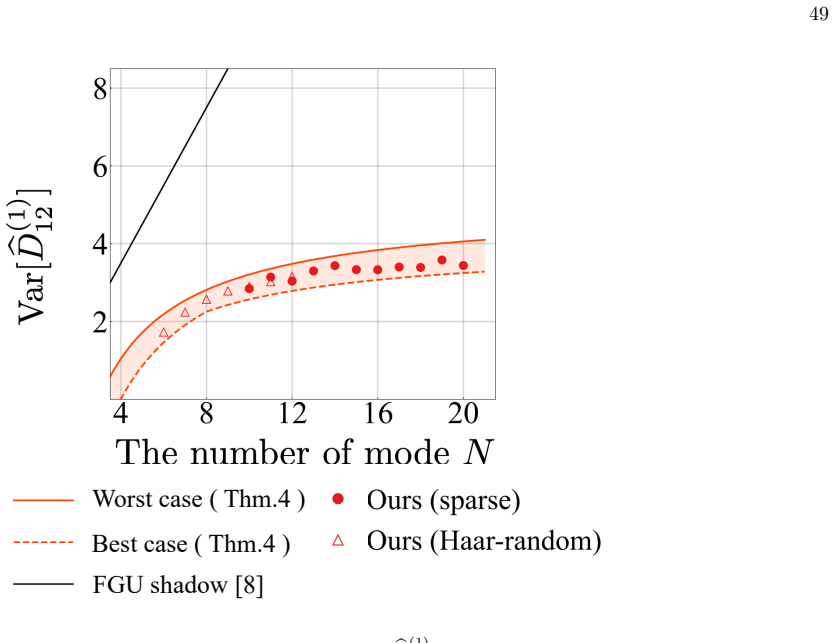
We develop a framework of number-conserving fermionic-shadow tomography based on random orbital rotations. For every given order k we prove that all k-body fermionic correlations of an N-mode η-particle state can be estimated simultaneously to variance ε² with only O_k(η^k/ε²) samples independent of N. We also prove a matching information-theoretic lower bound Ω_k(η^k/ε²) that applies to any adaptive protocol using single-copy measurements, showing the scaling in η and ε is optimal up to constants depending only on k.
What carries the argument
number-conserving fermionic-shadow tomography based on random orbital rotations, which enforces particle-number conservation during the measurement process
If this is right
- All k-body correlations can be learned at once with sample cost independent of system size N.
- The scaling with η^k and 1/ε² is information-theoretically optimal for single-copy adaptive protocols.
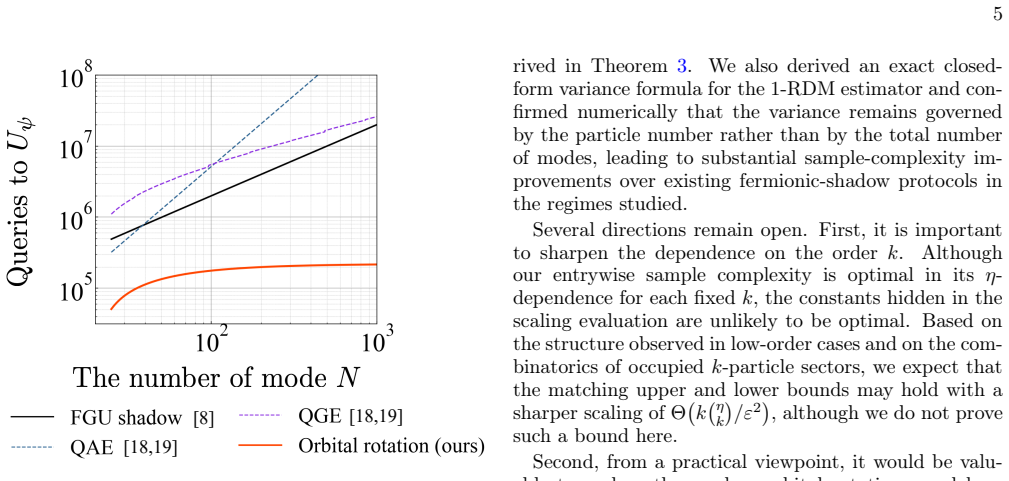
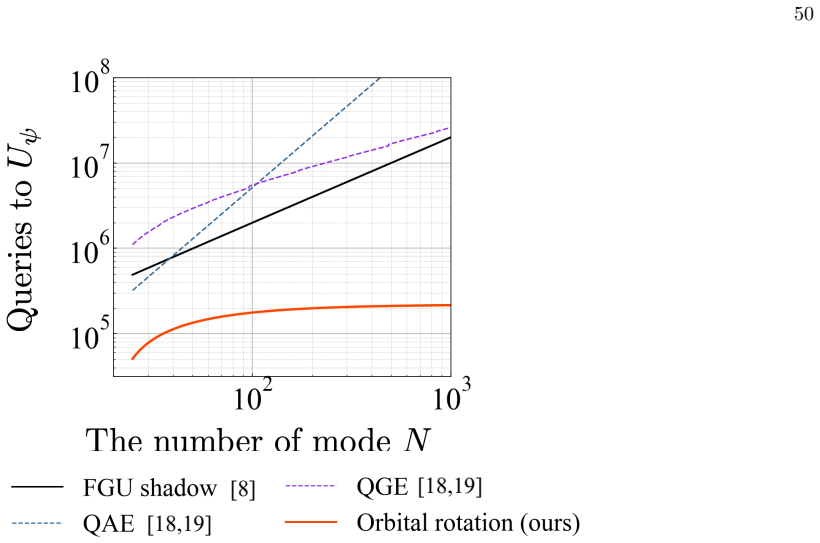
- For k=1 the method reduces the required queries by roughly an order of magnitude relative to prior approaches in a 100-mode, 20-particle system at 1 percent error.
- The k-dependent prefactors remain the only source of overhead once the particle number and target precision are fixed.
Where Pith is reading between the lines
- If random orbital rotations can be realized with low overhead on near-term hardware, the method could become practical for systems whose mode count greatly exceeds the particle count.
- The lower bound shows that any further improvement for single-copy measurements would require either multi-copy access or additional symmetry assumptions beyond particle number.
- The same construction may serve as a building block for learning other observables that are invariant under particle-number conservation.
Load-bearing premise
The quantum state has an exactly fixed particle number η and the protocol can apply random orbital rotations to single copies of the state.
What would settle it
Run the protocol on a known η-particle fermionic state, measure the actual number of samples needed to reach variance ε² for a chosen k, and check whether that number grows linearly with η^k when N is held fixed.
Figures

read the original abstract
Predicting local fermionic correlations is a central task in quantum many-body physics, as these correlations encode many physically relevant local observables. The ubiquitous particle-number symmetry imposes strong structural constraints on quantum states, suggesting that local correlations should be learned with fewer samples than by symmetry-agnostic approaches. However, it has remained unclear whether such a provable advantage exists in collective learning of local correlations. Here, we develop a framework of number-conserving fermionic-shadow tomography based on random orbital rotations. We prove that, for every given order $k$, we can simultaneously estimate {\it all} $k$-body fermionic correlations of an $N$-mode $\eta$-particle state with a given variance $\varepsilon^2$ using only $O_k(\eta^k/\varepsilon^2)$ samples, which are independent of the system size $N$. We further establish a matching information-theoretic lower bound $\Omega_k(\eta^k/\varepsilon^2)$ for any adaptive protocol based on single-copy measurements, showing that the $(\eta^k,\varepsilon)$-dependence is optimal up to constants depending only on $k$. Furthermore, our numerical calculation shows that the proposal reduces the query count by roughly an order of magnitude compared with state-of-the-art methods for one-body correlation estimation in a system of $N=100$, $\eta=20$ at $\varepsilon=10^{-2}$. This work establishes a provably efficient advantage of particle-number symmetry for fermionic observables estimation.
Editorial analysis
A structured set of objections, weighed in public.
Referee Report
Summary. The paper develops a number-conserving fermionic-shadow tomography protocol based on random orbital rotations. It claims that, for any fixed k, all k-body fermionic correlations of an N-mode η-particle state can be simultaneously estimated to variance ε² with O_k(η^k/ε²) single-copy samples independent of N, supported by an explicit upper-bound construction and a matching information-theoretic lower bound Ω_k(η^k/ε²) that holds for any adaptive single-copy protocol. Numerical experiments are reported to show roughly an order-of-magnitude reduction in query count relative to prior methods for the k=1 case with N=100, η=20, ε=10^{-2}.
Significance. If the stated bounds hold, the result supplies the first rigorous demonstration that exact particle-number symmetry yields a sample-complexity advantage for collective estimation of all k-body fermionic observables, with optimal (η^k, ε) scaling. The matching upper and lower bounds, together with the explicit construction via orbital rotations, constitute a concrete, falsifiable improvement over symmetry-agnostic shadow tomography.
major comments (2)
- [§4] §4 (upper-bound proof): the variance analysis of the rotated shadow estimators must explicitly show that the N-dependent binomial factors cancel after averaging over the orbital-rotation group; without the explicit cancellation step or the resulting k-dependent constant, the claimed independence of N cannot be verified as load-bearing for the O_k(η^k/ε²) statement.
- [Theorem 3] Theorem 3 (lower bound): the information-theoretic argument relies on a reduction to distinguishing η-particle states; the reduction must be checked to ensure it applies to simultaneous estimation of all k-body correlators rather than to a single observable, as the latter would not establish the claimed Ω_k(η^k/ε²) for the full set.
minor comments (2)
- [Numerical results] The numerical section should report the precise implementation of the random orbital rotations (e.g., whether they are drawn from the Haar measure on U(N) or a discrete approximation) and the number of independent trials used to estimate the empirical variance.
- [Abstract and §2] Notation: the symbol O_k should be defined explicitly as hiding only k-dependent factors; the current usage leaves open whether poly(k) or exp(k) factors are absorbed.
Simulated Author's Rebuttal
We thank the referee for their careful reading and constructive feedback on our manuscript. The comments have prompted us to clarify key steps in the proofs, and we address each major comment below.
read point-by-point responses
-
Referee: [§4] §4 (upper-bound proof): the variance analysis of the rotated shadow estimators must explicitly show that the N-dependent binomial factors cancel after averaging over the orbital-rotation group; without the explicit cancellation step or the resulting k-dependent constant, the claimed independence of N cannot be verified as load-bearing for the O_k(η^k/ε²) statement.
Authors: We agree that an explicit cancellation step will make the N-independence fully transparent. In the revised manuscript we have expanded the variance calculation in Section 4 to include the full averaging over the orbital-rotation group, showing that all N-dependent binomial coefficients cancel identically and that the resulting prefactor depends only on k. This confirms that the O_k(η^k/ε²) bound is independent of N. revision: yes
-
Referee: [Theorem 3] Theorem 3 (lower bound): the information-theoretic argument relies on a reduction to distinguishing η-particle states; the reduction must be checked to ensure it applies to simultaneous estimation of all k-body correlators rather than to a single observable, as the latter would not establish the claimed Ω_k(η^k/ε²) for the full set.
Authors: The reduction in Theorem 3 is constructed precisely for the simultaneous-estimation task: we exhibit a family of η-particle states whose k-body correlators differ by Ω(ε) in at least one entry, so that any protocol returning all k-body correlators to additive error ε must distinguish the states. We have added an explicit paragraph in the revised proof clarifying that the lower bound therefore applies to collective estimation of the entire set rather than to any single observable. revision: yes
Circularity Check
No significant circularity identified
full rationale
The derivation establishes an upper bound on sample complexity via a number-conserving fermionic-shadow tomography protocol using random orbital rotations, together with a matching information-theoretic lower bound for single-copy adaptive measurements. Both bounds are obtained from explicit protocol construction and standard concentration / minimax arguments that do not reduce to fitted parameters, self-referential definitions, or load-bearing self-citations. The claimed O_k(η^k/ε²) scaling is derived from the symmetry-constrained measurement model rather than presupposed; numerical comparisons are presented only as validation, not as part of the proof. The chain is therefore self-contained against external benchmarks.
Axiom & Free-Parameter Ledger
axioms (1)
- domain assumption The quantum state is an exact η-particle state in N modes with particle-number symmetry.
Reference graph
Works this paper leans on
-
[1]
\ L \"o wdin ,\ title title Quantum theory of many-particle systems
author author P.-O. \ L \"o wdin ,\ title title Quantum theory of many-particle systems. i. physical interpretations by means of density matrices, natural spin-orbitals, and convergence problems in the method of configurational interaction ,\ @noop journal journal Physical Review \ volume 97 ,\ pages 1474 ( year 1955 ) NoStop
1955
-
[2]
Yalouz , author E
author author S. Yalouz , author E. Koridon , author B. Senjean , author B. Lasorne , author F. Buda ,\ and\ author L. Visscher ,\ title title Analytical nonadiabatic couplings and gradients within the state-averaged orbital-optimized variational quantum eigensolver ,\ @noop journal journal Journal of chemical theory and computation \ volume 18 ,\ pages 7...
2022
-
[3]
\ Cheong \ and\ author C
author author S.-A. \ Cheong \ and\ author C. L. \ Henley ,\ title title Many-body density matrices for free fermions ,\ @noop journal journal Physical Review B \ volume 69 ,\ pages 075111 ( year 2004 ) NoStop
2004
-
[4]
author author M. J. \ Gullans \ and\ author D. A. \ Huse ,\ title title Entanglement structure of current-driven diffusive fermion systems ,\ https://doi.org/10.1103/PhysRevX.9.021007 journal journal Phys. Rev. X \ volume 9 ,\ pages 021007 ( year 2019 ) NoStop
-
[5]
author author T. Grover ,\ title title Entanglement of interacting fermions in quantum monte carlo calculations ,\ https://doi.org/10.1103/PhysRevLett.111.130402 journal journal Phys. Rev. Lett. \ volume 111 ,\ pages 130402 ( year 2013 ) NoStop
-
[6]
Bonet-Monroig , author R
author author X. Bonet-Monroig , author R. Babbush ,\ and\ author T. E. \ O’Brien ,\ title title Nearly optimal measurement scheduling for partial tomography of quantum states ,\ @noop journal journal Physical Review X \ volume 10 ,\ pages 031064 ( year 2020 ) NoStop
2020
-
[7]
Jiang , author A
author author Z. Jiang , author A. Kalev , author W. Mruczkiewicz ,\ and\ author H. Neven ,\ title title Optimal fermion-to-qubit mapping via ternary trees with applications to reduced quantum states learning ,\ @noop journal journal Quantum \ volume 4 ,\ pages 276 ( year 2020 ) NoStop
2020
-
[8]
author author A. Zhao , author N. C. \ Rubin ,\ and\ author A. Miyake ,\ title title Fermionic partial tomography via classical shadows ,\ https://doi.org/10.1103/PhysRevLett.127.110504 journal journal Phys. Rev. Lett. \ volume 127 ,\ pages 110504 ( year 2021 ) ,\ https://arxiv.org/abs/2010.16094 arXiv:2010.16094 [quant-ph] NoStop
-
[9]
Wan , author W
author author K. Wan , author W. J. \ Huggins , author J. Lee ,\ and\ author R. Babbush ,\ title title Matchgate shadows for fermionic quantum simulation ,\ @noop journal journal Communications in Mathematical Physics \ volume 404 ,\ pages 629 ( year 2023 ) NoStop
2023
-
[10]
author author B. O'Gorman ,\ title title Fermionic tomography and learning ,\ @noop journal journal arXiv preprint arXiv:2207.14787 \ ( year 2022 ) NoStop
-
[11]
King , author D
author author R. King , author D. Gosset , author R. Kothari ,\ and\ author R. Babbush ,\ title title Triply efficient shadow tomography ,\ in\ @noop booktitle Proceedings of the 2025 Annual ACM-SIAM Symposium on Discrete Algorithms (SODA) \ ( organization SIAM ,\ year 2025 )\ pp.\ pages 914--946 NoStop
2025
-
[12]
Yoshioka , author M
author author N. Yoshioka , author M. Amico , author W. Kirby , author P. Jurcevic , author A. Dutt , author B. Fuller , author S. Garion , author H. Haas , author I. Hamamura , author A. Ivrii , et al. ,\ title title Krylov diagonalization of large many-body hamiltonians on a quantum processor ,\ @noop journal journal Nature Communications \ volume 16 ,\...
2025
-
[13]
author author M. Xu , author L. H. \ Kendrick , author A. Kale , author Y. Gang , author C. Feng , author S. Zhang , author A. W. \ Young , author M. Lebrat ,\ and\ author M. Greiner ,\ title title A neutral-atom Hubbard quantum simulator in the cryogenic regime ,\ https://doi.org/10.1038/s41586-025-09112-w journal journal Nature \ volume 642 ,\ pages 909...
-
[14]
author author G. S. \ Hartnett , author K. S. \ Najafi , author A. Khindanov , author H. Liao , author M. Schutzman , author M. R. \ Hush , author M. J. \ Biercuk ,\ and\ author Y. Baum ,\ title title Fast, accurate, high-resolution simulation of large-scale fermi-hubbard models on a digital quantum processor ,\ @noop journal journal arXiv preprint arXiv:...
work page internal anchor Pith review Pith/arXiv arXiv 2026
-
[15]
Gong , author S
author author M. Gong , author S. Wang , author C. Zha , author M.-C. \ Chen , author H.-L. \ Huang , author Y. Wu , author Q. Zhu , author Y. Zhao , author S. Li , author S. Guo , et al. ,\ title title Quantum walks on a programmable two-dimensional 62-qubit superconducting processor ,\ @noop journal journal Science \ volume 372 ,\ pages 948 ( year 2021 ) NoStop
2021
-
[16]
Babbush , author D
author author R. Babbush , author D. W. \ Berry , author Y. R. \ Sanders , author I. D. \ Kivlichan , author A. Scherer , author A. Y. \ Wei , author P. J. \ Love ,\ and\ author A. Aspuru-Guzik ,\ title title Exponentially more precise quantum simulation of fermions in the configuration interaction representation ,\ @noop journal journal Quantum Science a...
2018
-
[17]
Babbush , author D
author author R. Babbush , author D. W. \ Berry , author J. R. \ McClean ,\ and\ author H. Neven ,\ title title Quantum simulation of chemistry with sublinear scaling in basis size ,\ @noop journal journal npj Quantum Information \ volume 5 ,\ pages 92 ( year 2019 ) NoStop
2019
-
[18]
author author Y. Koizumi , author K. Wada , author W. Mizukami ,\ and\ author N. Yoshioka ,\ title title Faster quantum algorithm for multiple observables estimation ,\ https://doi.org/10.1103/4c6g-zx6c journal journal Phys. Rev. Lett. \ volume 136 ,\ pages 080605 ( year 2026 a ) NoStop
-
[19]
author author Y. Koizumi , author K. Wada , author W. Mizukami ,\ and\ author N. Yoshioka ,\ title title Heisenberg-limited quantum algorithms for multiple observables estimation ,\ https://doi.org/10.1103/wrkp-qd33 journal journal Phys. Rev. A \ volume 113 ,\ pages 022447 ( year 2026 b ) NoStop
-
[20]
author author S. N. \ Hearth , author M. O. \ Flynn , author A. Chandran ,\ and\ author C. R. \ Laumann ,\ title title Efficient local classical shadow tomography with number conservation ,\ @noop journal journal Physical Review Letters \ volume 133 ,\ pages 060802 ( year 2024 ) NoStop
2024
-
[21]
Zhao \ and\ author A
author author A. Zhao \ and\ author A. Miyake ,\ title title Group-theoretic error mitigation enabled by classical shadows and symmetries ,\ @noop journal journal npj Quantum Information \ volume 10 ,\ pages 57 ( year 2024 ) NoStop
2024
- [22]
-
[23]
author author A. Christensen \ and\ author A. Zhao ,\ title title Learning fermionic linear optics with heisenberg scaling and physical operations ,\ @noop journal journal arXiv preprint arXiv:2602.05058 \ ( year 2026 ) NoStop
-
[24]
Particle-preserving fermionic shadows with mode-independent sample complexity
author author M. West , author M. Cerezo ,\ and\ author M. Larocca ,\ title title Particle-preserving fermionic shadows with mode-independent sample complexity ,\ @noop journal journal arXiv preprint arXiv:2606.27254 \ ( year 2026 ) NoStop
work page internal anchor Pith review Pith/arXiv arXiv 2026
-
[25]
author author I. D. \ Kivlichan , author J. McClean , author N. Wiebe , author C. Gidney , author A. Aspuru-Guzik , author G. K.-L. \ Chan ,\ and\ author R. Babbush ,\ title title Quantum simulation of electronic structure with linear depth and connectivity ,\ @noop journal journal Physical review letters \ volume 120 ,\ pages 110501 ( year 2018 ) NoStop
2018
-
[26]
author author J. W. \ Milnor \ and\ author J. D. \ Stasheff ,\ @noop title Characteristic classes ,\ number 76 \ ( publisher Princeton university press ,\ year 1974 ) NoStop
1974
-
[27]
Chen , author J
author author S. Chen , author J. Cotler , author H.-Y. \ Huang ,\ and\ author J. Li ,\ title title Exponential separations between learning with and without quantum memory ,\ in\ @noop booktitle 2021 IEEE 62nd Annual Symposium on Foundations of Computer Science (FOCS) \ ( organization IEEE ,\ year 2022 )\ pp.\ pages 574--585 NoStop
2021
-
[28]
author author M. R. \ Christiansen ,\ title title Hilbert--schmidt estimates for fermionic 2-body operators: Mr christiansen ,\ @noop journal journal Communications in Mathematical Physics \ volume 405 ,\ pages 18 ( year 2024 ) NoStop
2024
-
[29]
author author F. L. \ Visconti ,\ title title Hilbert--schmidt norm estimates for fermionic reduced density matrices: Fla visconti ,\ in\ @noop booktitle Annales Henri Poincar \'e \ ( organization Springer ,\ year 2026 )\ pp.\ pages 1--24 NoStop
2026
-
[30]
Coulter , author N
author author X. Coulter , author N. Do ,\ and\ author E. Moskovsky ,\ title title Integration on complex grassmannians, deformed monotone hurwitz numbers, and interlacing phenomena ,\ @noop journal journal Canadian Journal of Mathematics \ ,\ pages 1 ( year 2025 ) NoStop
2025
-
[31]
author author T. Helgaker , author P. J rgensen ,\ and\ author J. Olsen ,\ https://doi.org/10.1002/9781119019572 title Molecular Electronic-Structure Theory \ ( publisher Wiley ,\ year 2000 ) NoStop
-
[32]
author author W. J. \ Huggins , author K. Wan , author J. McClean , author T. E. \ O’Brien , author N. Wiebe ,\ and\ author R. Babbush ,\ title title Nearly optimal quantum algorithm for estimating multiple expectation values ,\ @noop journal journal Physical Review Letters \ volume 129 ,\ pages 240501 ( year 2022 ) NoStop
2022
-
[33]
Gupta , author W
author author M. Gupta , author W. He ,\ and\ author R. O'Donnell ,\ title title Few single-qubit measurements suffice to certify any quantum state ,\ in\ @noop booktitle Proceedings of the 58th Annual ACM Symposium on Theory of Computing \ ( year 2026 )\ pp.\ pages 54--60 NoStop
2026
-
[34]
note More precisely, the creation operator a_z^ : ^0 C ^N C C ^N acts as a_z^ vac = z . Stop
-
[35]
author author A. J. \ Coleman ,\ title title Structure of fermion density matrices ,\ https://doi.org/10.1103/RevModPhys.35.668 journal journal Reviews of Modern Physics \ volume 35 ,\ pages 668 ( year 1963 ) NoStop
-
[36]
author author C. Garrod \ and\ author J. K. \ Percus ,\ title title Reduction of the \(n\)-particle variational problem ,\ https://doi.org/10.1063/1.1704098 journal journal Journal of Mathematical Physics \ volume 5 ,\ pages 1756 ( year 1964 ) NoStop
-
[37]
author author D. A. \ Mazziotti ,\ title title Realization of quantum chemistry without wave functions through first-order semidefinite programming ,\ https://doi.org/10.1103/PhysRevLett.93.213001 journal journal Physical Review Letters \ volume 93 ,\ pages 213001 ( year 2004 ) NoStop
-
[38]
author author D. A. \ Mazziotti ,\ title title Variational two-electron reduced density matrix theory for many-electron atoms and molecules: Implementation of the \(t_2\) condition ,\ https://doi.org/10.1103/PhysRevA.72.032510 journal journal Physical Review A \ volume 72 ,\ pages 032510 ( year 2005 ) NoStop
-
[39]
author author D. A. \ Mazziotti ,\ title title Quantum many-body theory from a solution of the \(n\)-representability problem ,\ https://doi.org/10.1103/PhysRevLett.130.153001 journal journal Physical Review Letters \ volume 130 ,\ pages 153001 ( year 2023 ) ,\ https://arxiv.org/abs/2304.08570 arXiv:2304.08570 [quant-ph] NoStop
-
[40]
editor D. A. \ Mazziotti ,\ ed.,\ https://doi.org/10.1002/0470106603 title Reduced-Density-Matrix Mechanics: With Application to Many-Electron Atoms and Molecules ,\ series Advances in Chemical Physics , Vol.\ volume 134 \ ( publisher Wiley-Interscience ,\ year 2007 ) NoStop
-
[41]
author author H.-Y. \ Huang , author R. Kueng ,\ and\ author J. Preskill ,\ title title Predicting many properties of a quantum system from very few measurements ,\ https://doi.org/10.1038/s41567-020-0932-7 journal journal Nature Phys. \ volume 16 ,\ pages 1050 ( year 2020 ) ,\ https://arxiv.org/abs/2002.08953 arXiv:2002.08953 [quant-ph] NoStop
-
[42]
Elben , author S
author author A. Elben , author S. T. \ Flammia , author H.-Y. \ Huang , author R. Kueng , author J. Preskill , author B. Vermersch ,\ and\ author P. Zoller ,\ title title The randomized measurement toolbox ,\ @noop journal journal Nature Reviews Physics \ volume 5 ,\ pages 9 ( year 2023 ) NoStop
2023
-
[43]
author author S. B. \ Bravyi \ and\ author A. Y. \ Kitaev ,\ title title Fermionic quantum computation ,\ @noop journal journal Annals of Physics \ volume 298 ,\ pages 210 ( year 2002 ) NoStop
2002
-
[44]
d’Ariano , author P
author author G. d’Ariano , author P. Perinotti ,\ and\ author M. Sacchi ,\ title title Informationally complete measurements and group representation ,\ @noop journal journal Journal of Optics B: Quantum and Semiclassical Optics \ volume 6 ,\ pages S487 ( year 2004 ) NoStop
2004
-
[45]
Eckert , author J
author author K. Eckert , author J. Schliemann , author D. Bru ,\ and\ author M. Lewenstein ,\ title title Quantum correlations in systems of indistinguishable particles ,\ @noop journal journal Annals of physics \ volume 299 ,\ pages 88 ( year 2002 ) NoStop
2002
-
[46]
author author G. B. \ Folland ,\ @noop title Real Analysis: Modern Techniques and Their Applications ,\ edition 2nd \ ed.\ ( publisher Wiley-Interscience ,\ year 1999 ) NoStop
1999
-
[47]
Killip \ and\ author R
author author R. Killip \ and\ author R. Kozhan ,\ title title Matrix models and eigenvalue statistics for truncations of classical ensembles of random unitary matrices ,\ @noop journal journal Communications in Mathematical Physics \ volume 349 ,\ pages 991 ( year 2017 ) NoStop
2017
-
[48]
Krishnamoorthy ,\ @noop title Handbook of Statistical Distributions with Applications \ ( publisher Chapman and Hall/CRC ,\ year 2006 ) NoStop
author author K. Krishnamoorthy ,\ @noop title Handbook of Statistical Distributions with Applications \ ( publisher Chapman and Hall/CRC ,\ year 2006 ) NoStop
2006
-
[49]
note Equivalently, one may work with ordered pairs ( p, q) ; the resulting identifications X_ p, q =X_ q, p and Y_ p, q =-Y_ q, p change the count only by a constant factor and do not affect the asymptotic scaling. Stop
-
[50]
author author J. M. \ Lee ,\ title title Smooth manifolds ,\ in\ @noop booktitle Introduction to smooth manifolds \ ( publisher Springer ,\ year 2003 )\ pp.\ pages 1--29 NoStop
2003
-
[51]
note Such a unitary w_ z always exists because of the surjectivity of the map eq:adjoint-P0 . Stop
-
[52]
author author W. Fulton ,\ https://doi.org/10.1017/CBO9780511626241 title Young Tableaux: With Applications to Representation Theory and Geometry ,\ series London Mathematical Society Student Texts \ No. number 35 \ ( publisher Cambridge University Press ,\ year 1997 ) NoStop
-
[53]
author author A. W. \ Knapp ,\ https://doi.org/10.3792/euclid/9798989504206 title Lie Groups Beyond an Introduction ,\ edition digital second edition \ ed.\ ( publisher Published by the Author ,\ address East Setauket, NY ,\ year 2023 )\ note distributed by Project Euclid NoStop
-
[54]
author author H. Georgi ,\ https://doi.org/10.1201/9780429499210 title Lie Algebras in Particle Physics: From Isospin to Unified Theories \ ( publisher CRC Press ,\ address Boca Raton ,\ year 2000 ) NoStop
-
[55]
Ceccherini-Silberstein , author F
author author T. Ceccherini-Silberstein , author F. Scarabotti ,\ and\ author F. Tolli ,\ https://doi.org/10.1017/CBO9781139192361 title Representation Theory of the Symmetric Groups: The Okounkov--Vershik Approach, Character Formulas, and Partition Algebras ,\ series Encyclopedia of Mathematics and its Applications , Vol.\ volume 121 \ ( publisher Cambri...
-
[56]
author author R. P. \ Stanley ,\ https://doi.org/10.1017/CBO9780511609589 title Enumerative Combinatorics, Volume 2 ,\ series Cambridge Studies in Advanced Mathematics , Vol. volume 62 \ ( publisher Cambridge University Press ,\ year 1999 ) NoStop
discussion (0)
Sign in with ORCID, Apple, or X to comment. Anyone can read and Pith papers without signing in.