Primordial Black Holes in a Radiation-Dominated Universe
Pith reviewed 2026-06-30 04:28 UTC · model grok-4.3
The pith
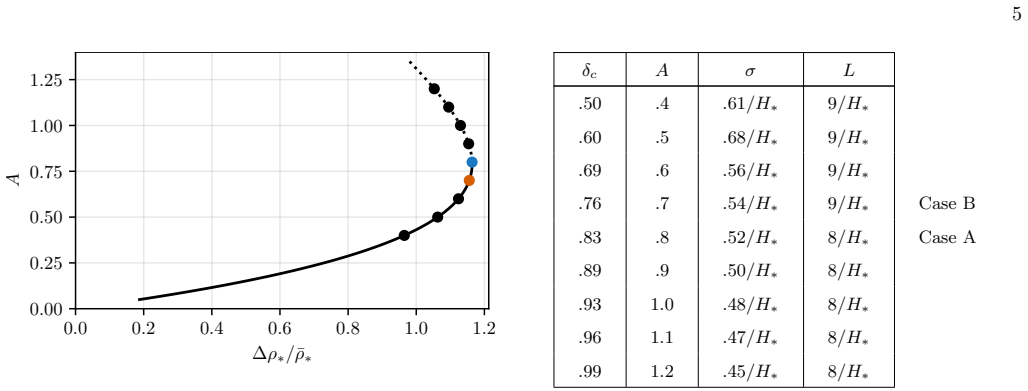
Numerical simulations establish that over-densities above a threshold between 0.77 and 0.83 collapse to form primordial black holes in a radiation-dominated universe.
A machine-rendered reading of the paper's core claim, the machinery that carries it, and where it could break.
Core claim
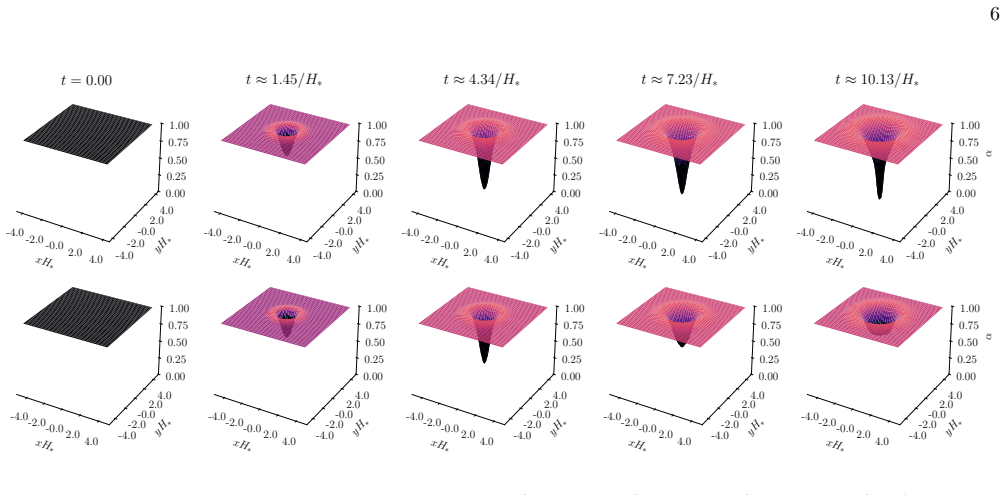
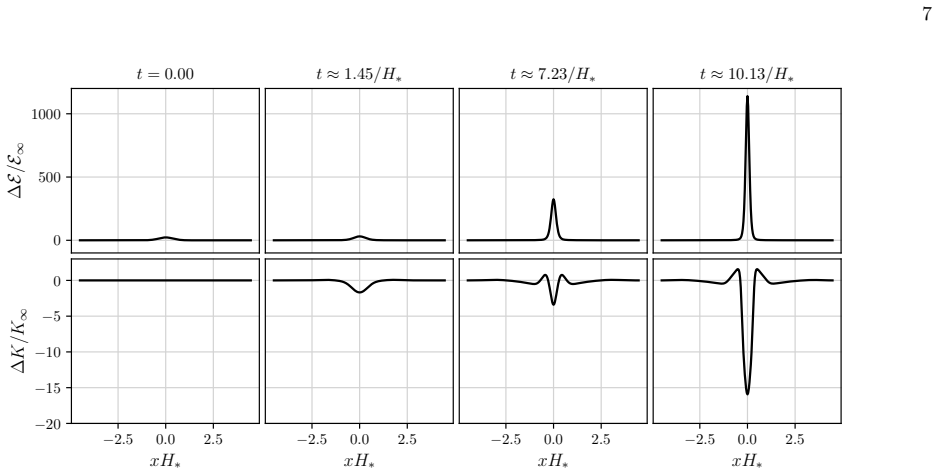
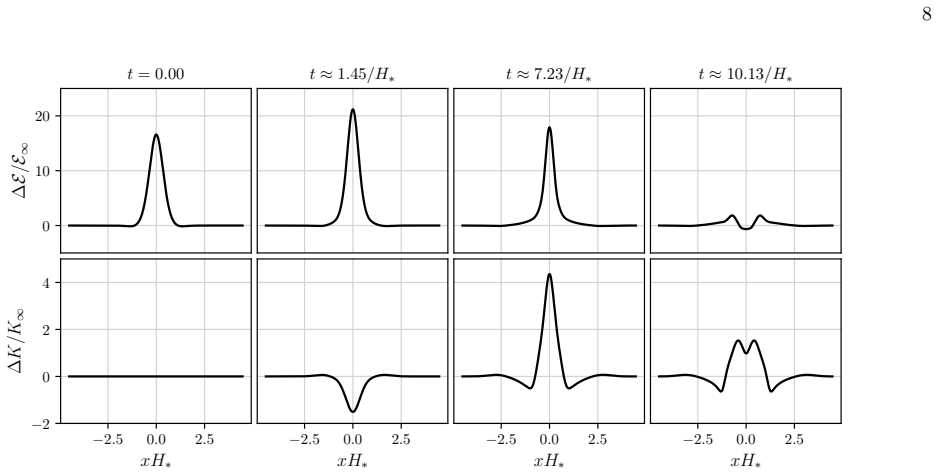
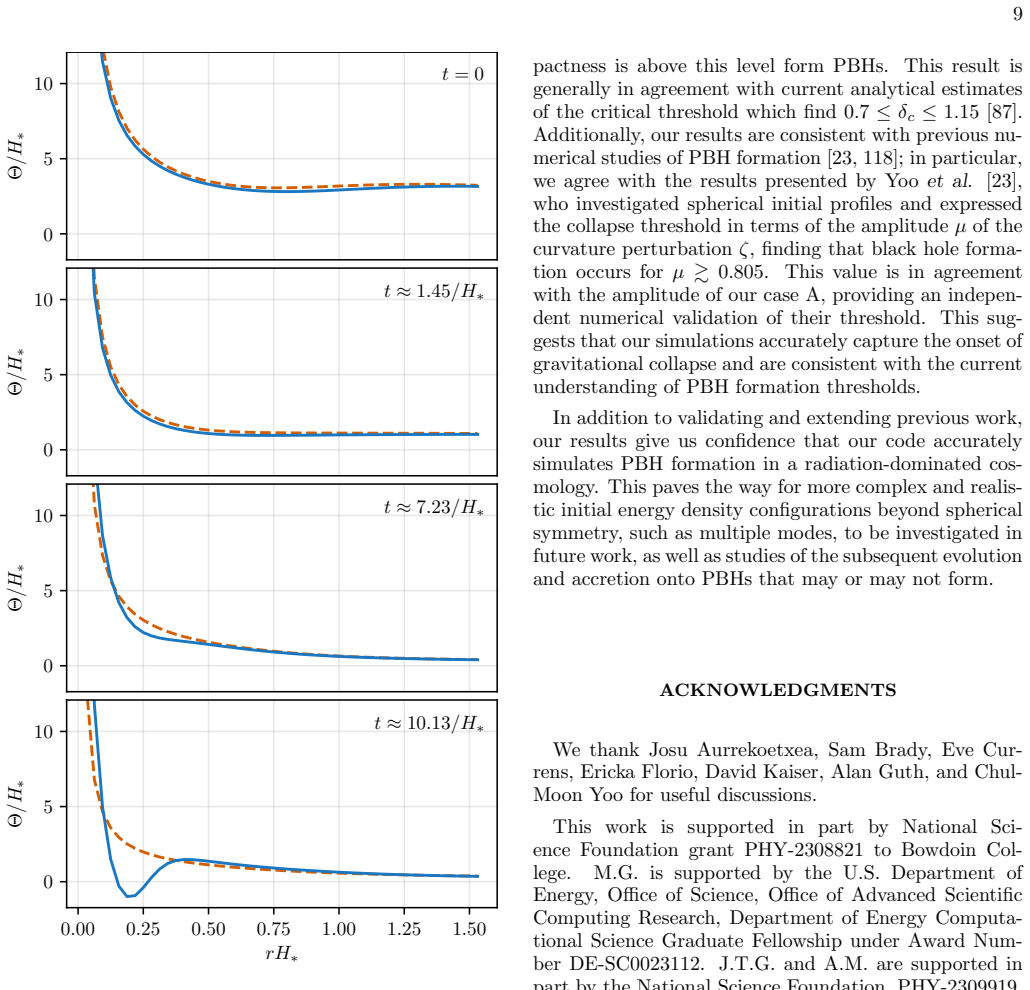
We perform simulations of the direct collapse of over-dense regions re-entering the horizon during a radiation-dominated epoch, using full 3+1 general relativistic simulations with the BSSN formalism. Building on previous studies, we impose periodic boundary conditions and allow the matter content of the Universe to self-consistently drive its dynamics. We analyze the evolution of over-densities in both the collapse and dispersal regimes and find a threshold, 0.77<δ_c<0.83, above which over-densities collapse and form primordial black holes. Our findings are consistent with previous analytic predictions as well as numerical studies that use different formalisms and computational approaches.
What carries the argument
BSSN 3+1 evolution of horizon-reentering over-densities under periodic boundaries with self-consistent matter-driven dynamics, used to bracket the collapse threshold δ_c.
If this is right
- Over-densities with contrast below 0.77 disperse without forming black holes.
- The same threshold emerges from simulations that employ distinct numerical formalisms.
- The value can be used to convert an initial fluctuation spectrum into a predicted primordial-black-hole mass function in the radiation era.
- Analytic estimates of the threshold are confirmed to lie inside the numerically bracketed interval.
Where Pith is reading between the lines
- The reported threshold supplies a fixed number that can be inserted into semi-analytic calculations of the primordial black hole dark-matter fraction without further tuning.
- Changing the equation of state away from pure radiation would require a new set of runs to determine whether the same numerical interval still holds.
- The periodic-box setup implicitly assumes that neighboring patches do not exert net tidal influence on the collapsing region.
- If the threshold remains stable under mesh refinement, it becomes a standard input for forecasts of gravitational-wave signals from primordial black hole binaries.
Load-bearing premise
The numerical evolution with periodic boundary conditions and self-consistent matter-driven dynamics accurately captures the threshold behavior without significant artifacts from the chosen gauge, resolution, or boundary implementation.
What would settle it
A higher-resolution run or an evolution in a different gauge that places the threshold outside the interval 0.77–0.83 would falsify the reported range.
Figures

read the original abstract
Primordial fluctuations frozen out during inflation re-enter the cosmological horizon and can collapse, leading to the formation of primordial black holes. We perform simulations of the direct collapse of over-dense regions re-entering the horizon during a radiation-dominated epoch, using full 3+1 general relativistic simulations with the BSSN formalism. Building on previous studies, we impose periodic boundary conditions and allow the matter content of the Universe to self-consistently drive its dynamics. We analyze the evolution of over-densities in both the collapse and dispersal regimes and find a threshold, $0.77<\delta_c<0.83$, above which over-densities collapse and form primordial black holes. Our findings are consistent with previous analytic predictions as well as numerical studies that use different formalisms and computational approaches, and hence provide independent validation of those results.
Editorial analysis
A structured set of objections, weighed in public.
Referee Report
Summary. The paper performs 3+1 BSSN simulations of horizon re-entry of over-dense regions in a radiation-dominated universe, imposing periodic boundary conditions and allowing the radiation fluid to drive the dynamics self-consistently. From the evolution of collapse versus dispersal cases the authors report a threshold interval 0.77 < δ_c < 0.83 above which primordial black holes form, stating consistency with prior analytic and numerical results obtained with different formalisms.
Significance. If the quoted threshold interval is shown to be robust, the work supplies an independent numerical confirmation of the PBH collapse criterion using the BSSN 3+1 approach with periodic boundaries, strengthening the foundation for calculations of PBH abundance from inflationary fluctuations.
major comments (2)
- [Abstract] Abstract (results paragraph): the central claim is the numerically bracketed threshold 0.77 < δ_c < 0.83, yet the manuscript supplies no convergence tests, resolution studies, or error bars on the bounds, nor any description of the diagnostic used to decide collapse versus dispersal; this information is required to establish that the interval is not an artifact of the chosen resolution, gauge, or boundary implementation.
- [Methods] Methods description (numerical setup): the weakest assumption—that periodic boundaries and the self-consistent radiation fluid evolution introduce no significant artifacts—is stated without supporting tests (e.g., comparison runs at multiple resolutions or with different gauges), leaving the load-bearing threshold result without demonstrated numerical control.
Simulated Author's Rebuttal
We thank the referee for the constructive report. The major comments correctly note the absence of explicit numerical validation details in the current manuscript. We respond point-by-point below and will revise the manuscript to address these issues.
read point-by-point responses
-
Referee: [Abstract] Abstract (results paragraph): the central claim is the numerically bracketed threshold 0.77 < δ_c < 0.83, yet the manuscript supplies no convergence tests, resolution studies, or error bars on the bounds, nor any description of the diagnostic used to decide collapse versus dispersal; this information is required to establish that the interval is not an artifact of the chosen resolution, gauge, or boundary implementation.
Authors: We agree that the manuscript as submitted lacks an explicit description of the collapse diagnostic and supporting convergence information. In the revised version we will add a dedicated subsection detailing the diagnostic (apparent-horizon formation together with the central value of the 3-Ricci scalar exceeding a fixed threshold) and will present a resolution study performed at three different grid spacings. The threshold interval will be reported with an estimated uncertainty derived from the variation across those resolutions. revision: yes
-
Referee: [Methods] Methods description (numerical setup): the weakest assumption—that periodic boundaries and the self-consistent radiation fluid evolution introduce no significant artifacts—is stated without supporting tests (e.g., comparison runs at multiple resolutions or with different gauges), leaving the load-bearing threshold result without demonstrated numerical control.
Authors: We acknowledge that the current text does not contain explicit tests of the periodic-boundary implementation or gauge sensitivity. The revised manuscript will include a short numerical-validation subsection that reports (i) the maximum constraint violation as a function of resolution and (ii) a comparison of the threshold obtained with the default 1+log slicing against a limited set of runs using harmonic slicing. These tests will be used to argue that the quoted interval is not an artifact of the chosen setup. revision: yes
Circularity Check
No significant circularity
full rationale
The central result is a numerically bracketed threshold 0.77 < δ_c < 0.83 obtained from direct 3+1 BSSN evolution of the Einstein equations with self-consistent radiation fluid and periodic boundaries. This threshold is not defined in terms of any fitted parameter, self-referential quantity, or ansatz within the paper; it emerges from the simulation outcomes in the collapse versus dispersal regimes. The paper cites prior analytic and numerical work only for consistency checks, not as load-bearing justification for the threshold itself. No self-definitional, fitted-input, or uniqueness-imported steps appear in the derivation chain.
Axiom & Free-Parameter Ledger
axioms (2)
- domain assumption The cosmological background is radiation-dominated during the epoch studied.
- standard math The BSSN formulation with the chosen gauge and boundary conditions faithfully evolves the Einstein equations for this problem.
Reference graph
Works this paper leans on
-
[1]
Bona-Mass´ o
formalisms that have been employed in the majority of PBH formation simulations), which allows departures from spherical symmetry, has the potential to provide a more stable long-term evolution beyond horizon forma- tion, and allows us to check the slicing dependence of the threshold for collapse. In future work we will use this to study the subsequent bl...
-
[2]
Source T ensor and Scalar The stress energy tensor for a relativistic, perfect fluid with constant equation of state parameterw= 1/3, i.e. a radiation fluid withp=ρ 0/3, is given by T µν = 4 3 ρ0U µU ν + ρ0 3 gµν,(A1) whereρ 0 is the rest-frame energy density of the fluid (where we use the subscript zero to distinguishρ 0 from the ADM energy densityρdefin...
-
[3]
Here we use the subscript “pr” to refer to theseprogramvariables used in our code
Dimensionless Units As with all numerical implementations, it is necessary to define dimensionless versions of our dynamical degrees of freedom. Here we use the subscript “pr” to refer to theseprogramvariables used in our code. We start by defining dimensionless spacetime intervals, dxµ pr =B dx µ,(A25) whereBcarries units of mass. Since energy density ha...
-
[4]
Ya. B. Zel’dovich and I. D. Novikov. The Hypothesis of Cores Retarded during Expansion and the Hot Cosmo- logical Model.Sov. Astron., 10:602, 1967
1967
-
[5]
Gravitationally collapsed objects of very low mass.Mon
Stephen Hawking. Gravitationally collapsed objects of very low mass.Mon. Not. Roy. Astron. Soc., 152:75,
-
[6]
doi:10.1093/mnras/152.1.75
-
[7]
Bernard J. Carr. The Primordial black hole mass spectrum.Astrophys. J., 201:1–19, 1975. doi: 10.1086/153853
-
[8]
Matthew W. Choptuik. Universality and scaling in grav- itational collapse of a massless scalar field.Phys. Rev. Lett., 70:9–12, 1993. doi:10.1103/PhysRevLett.70.9
-
[9]
Charles R. Evans and Jason S. Coleman. Observation of critical phenomena and selfsimilarity in the gravita- tional collapse of radiation fluid.Phys. Rev. Lett., 72: 1782–1785, 1994. doi:10.1103/PhysRevLett.72.1782
-
[10]
Jens C. Niemeyer and K. Jedamzik. Near-critical gravi- tational collapse and the initial mass function of primor- dial black holes.Phys. Rev. Lett., 80:5481–5484, 1998. doi:10.1103/PhysRevLett.80.5481
-
[11]
Niemeyer and K
Jens C. Niemeyer and K. Jedamzik. Dynamics of pri- mordial black hole formation.Phys. Rev. D, 59:124013,
-
[12]
doi:10.1103/PhysRevD.59.124013
-
[13]
Anne M. Green and Andrew R. Liddle. Critical collapse and the primordial black hole initial mass function.Phys. Rev. D, 60:063509, 1999. doi: 10.1103/PhysRevD.60.063509
-
[14]
Ilia Musco and John C. Miller. Primordial black hole formation in the early universe: critical behaviour and self-similarity.Class. Quant. Grav., 30:145009, 2013. doi:10.1088/0264-9381/30/14/145009
-
[15]
Eloy de Jong, Josu C. Aurrekoetxea, and Eugene A. Lim. Primordial black hole formation with full nu- merical relativity.JCAP, 03(03):029, 2022. doi: 10.1088/1475-7516/2022/03/029
-
[16]
Simulation of primordial black holes with large negative non-Gaussianity.JCAP, 05 (05):012, 2022
Albert Escriv` a, Yuichiro Tada, Shuichiro Yokoyama, and Chul-Moon Yoo. Simulation of primordial black holes with large negative non-Gaussianity.JCAP, 05 (05):012, 2022. doi:10.1088/1475-7516/2022/05/012
-
[17]
Aurrekoetxea, Eugene A
Eloy de Jong, Josu C. Aurrekoetxea, Eugene A. Lim, and Tiago Fran¸ ca. Spinning primordial black holes formed during a matter-dominated era.JCAP, 10:067,
-
[18]
doi:10.1088/1475-7516/2023/10/067
-
[19]
Simula- tions of ellipsoidal primordial black hole forma- tion.Phys
Albert Escriv` a and Chul-Moon Yoo. Simula- tions of ellipsoidal primordial black hole forma- tion.Phys. Rev. D, 112(8):083518, 2025. doi: 10.1103/PhysRevD.112.083518
-
[20]
Ethan Milligan, Luis E. Padilla, David J. Mulryne, and Juan Carlos Hidalgo. Primordial black hole formation in a scalar field dominated universe.JCAP, 10:025, 2025. doi:10.1088/1475-7516/2025/10/025
-
[21]
H. M. Hodges and G. R. Blumenthal. Arbitrariness of inflationary fluctuation spectra.Phys. Rev. D, 42:3329– 3333, 1990. doi:10.1103/PhysRevD.42.3329
-
[22]
Bernard J. Carr and James E. Lidsey. Primordial black holes and generalized constraints on chaotic inflation.Phys. Rev. D, 48:543–553, 1993. doi: 10.1103/PhysRevD.48.543
-
[23]
Bernard J. Carr, J. H. Gilbert, and James E. Lidsey. Black hole relics and inflation: Limits on blue pertur- bation spectra.Phys. Rev. D, 50:4853–4867, 1994. doi: 10.1103/PhysRevD.50.4853
-
[24]
P. Ivanov, P. Naselsky, and I. Novikov. Inflation and primordial black holes as dark matter.Phys. Rev. D, 50:7173–7178, 1994. doi:10.1103/PhysRevD.50.7173
-
[25]
Lisa Randall, Marin Soljacic, and Alan H. Guth. Super- natural inflation: Inflation from supersymmetry with no (very) small parameters.Nucl. Phys. B, 472:377–408,
-
[26]
doi:10.1016/0550-3213(96)00174-5
-
[27]
Linde, and David Wands
Juan Garcia-Bellido, Andrei D. Linde, and David Wands. Density perturbations and black hole forma- tion in hybrid inflation.Phys. Rev. D, 54:6040–6058,
-
[28]
doi:10.1103/PhysRevD.54.6040
-
[29]
A. Taruya. Parametric amplification of density pertur- bation in the oscillating inflation.Phys. Rev. D, 59: 103505, 1999. doi:10.1103/PhysRevD.59.103505
-
[30]
Bruce A. Bassett and Shinji Tsujikawa. Inflationary preheating and primordial black holes.Phys. Rev. D, 63:123503, 2001. doi:10.1103/PhysRevD.63.123503
-
[31]
Threshold of Primordial Black Hole Forma- tion in Nonspherical Collapse.Phys
Chul-Moon Yoo, Tomohiro Harada, and Hirotada Okawa. Threshold of Primordial Black Hole Forma- tion in Nonspherical Collapse.Phys. Rev. D, 102(4): 043526, 2020. doi:10.1103/PhysRevD.102.043526. [Er- ratum: Phys.Rev.D 107, 049901 (2023)]. 13
-
[32]
Black hole formation in the Friedmann universe: Formulation and computa- tion in numerical relativity.Phys
Masaru Shibata and Misao Sasaki. Black hole formation in the Friedmann universe: Formulation and computa- tion in numerical relativity.Phys. Rev. D, 60:084002,
-
[33]
doi:10.1103/PhysRevD.60.084002
-
[34]
I. Hawke and J. M. Stewart. The dynamics of primordial black hole formation.Class. Quant. Grav., 19:3687– 3707, 2002. doi:10.1088/0264-9381/19/14/310
-
[36]
Gravitational Collapse of a Massless Scalar Field in a Periodic Box.Class
Chul-Moon Yoo, Taishi Ikeda, and Hirotada Okawa. Gravitational Collapse of a Massless Scalar Field in a Periodic Box.Class. Quant. Grav., 36(7):075004, 2019. doi:10.1088/1361-6382/ab06e2
-
[37]
Numerical simula- tion of type II primordial black hole formation.JCAP, 01:003, 2025
Koichiro Uehara, Albert Escriv` a, Tomohiro Harada, Daiki Saito, and Chul-Moon Yoo. Numerical simula- tion of type II primordial black hole formation.JCAP, 01:003, 2025. doi:10.1088/1475-7516/2025/01/003
-
[38]
Primordial black hole formation in matter domination
Ehsan Ebrahimian, Ali Akbar Abolhasani, and Mehrdad Mirbabayi. Primordial black hole formation in matter domination. 7 2025
2025
-
[39]
Primordial black hole formation and spin in mat- ter domination revisited.Phys
Weitao Ye, Yungui Gong, Tomohiro Harada, Zhaofeng Kang, Kazunori Kohri, Daiki Saito, and Chul-Moon Yoo. Primordial black hole formation and spin in mat- ter domination revisited.Phys. Rev. D, 112(10):103524,
-
[40]
doi:10.1103/qg7j-vg7v
-
[41]
Padilla, Ethan Milligan, David J
Luis E. Padilla, Ethan Milligan, David J. Mulryne, and Juan Carlos Hidalgo. Primordial Black Hole formation in a scalar field dominated Universe: Investigation of the critical nature of the collapse.JCAP, 04:049, 2026. doi:10.1088/1475-7516/2026/04/049
-
[42]
Albert Escriv` a. PBH Formation from Spherically Sym- metric Hydrodynamical Perturbations: A Review.Uni- verse, 8(2):66, 2022. doi:10.3390/universe8020066
-
[43]
Chul-Moon Yoo. Primordial black hole formation from a nonspherical density profile with a misaligned defor- mation tensor.Phys. Rev. D, 110(4):043526, 2024. doi: 10.1103/PhysRevD.110.043526
-
[44]
Spin of Primordial Black Holes.JCAP, 03: 017, 2020
Mehrdad Mirbabayi, Andrei Gruzinov, and Jorge Nore˜ na. Spin of Primordial Black Holes.JCAP, 03: 017, 2020. doi:10.1088/1475-7516/2020/03/017
-
[45]
Spinning primordial black holes from first order phase transition
Indra Kumar Banerjee and Ujjal Kumar Dey. Spinning primordial black holes from first order phase transition. JHEP, 07:006, 2024. doi:10.1007/JHEP07(2024)006. [Erratum: JHEP 08, 054 (2024)]
-
[46]
Spinning Primordial Black Holes and Scalar In- duced Gravitational Waves from Single Field Inflation
Abolhassan Mohammadi, Yogesh, Qiang Wu, and Tao Zhu. Spinning Primordial Black Holes and Scalar In- duced Gravitational Waves from Single Field Inflation. Astrophys. J., 1000(1):101, 2026. doi:10.3847/1538- 4357/ae47ed
-
[47]
James M. Bardeen, J. R. Bond, Nick Kaiser, and A. S. Szalay. The Statistics of Peaks of Gaussian Random Fields.Astrophys. J., 304:15–61, 1986. doi: 10.1086/164143
-
[48]
Formalism for Primordial Black Hole Formation in Spherical Symmetry
Jolyon Bloomfield, Daniel Bulhosa, and Stephen Face. Formalism for Primordial Black Hole Formation in Spherical Symmetry. 4 2015
2015
-
[49]
S´ ebastien Clesse and Juan Garc´ ıa-Bellido. Massive Pri- mordial Black Holes from Hybrid Inflation as Dark Mat- ter and the seeds of Galaxies.Phys. Rev. D, 92(2): 023524, 2015. doi:10.1103/PhysRevD.92.023524
-
[50]
Keisuke Inomata, Masahiro Kawasaki, Kyohei Mukaida, Yuichiro Tada, and Tsutomu T. Yanagida. Infla- tionary Primordial Black Holes as All Dark Mat- ter.Phys. Rev. D, 96(4):043504, 2017. doi: 10.1103/PhysRevD.96.043504
-
[51]
Pri- mordial black holes from single field models of in- flation.Phys
Juan Garcia-Bellido and Ester Ruiz Morales. Pri- mordial black holes from single field models of in- flation.Phys. Dark Univ., 18:47–54, 2017. doi: 10.1016/j.dark.2017.09.007
-
[52]
Primordial Black Hole production in Crit- ical Higgs Inflation.Phys
Jose Maria Ezquiaga, Juan Garcia-Bellido, and Ester Ruiz Morales. Primordial Black Hole production in Crit- ical Higgs Inflation.Phys. Lett. B, 776:345–349, 2018. doi:10.1016/j.physletb.2017.11.039
-
[53]
Peter Adshead, Eve Currens, and John T. Giblin. Pri- mordial Black Holes from Kinetic Preheating. 11 2025
2025
-
[54]
Matt Crawford and David N. Schramm. Sponta- neous Generation of Density Perturbations in the Early Universe.Nature, 298:538–540, 1982. doi: 10.1038/298538a0
-
[55]
S. W. Hawking, I. G. Moss, and J. M. Stewart. Bubble Collisions in the Very Early Universe.Phys. Rev. D, 26: 2681, 1982. doi:10.1103/PhysRevD.26.2681
-
[56]
Abundance of Primordial Holes Produced by Cosmolog- ical First Order Phase Transition.Prog
Hideo Kodama, Misao Sasaki, and Katsuhiko Sato. Abundance of Primordial Holes Produced by Cosmolog- ical First Order Phase Transition.Prog. Theor. Phys., 68:1979, 1982. doi:10.1143/PTP.68.1979
-
[57]
I. G. Moss. Singularity formation from colliding bubbles.Phys. Rev. D, 50:676–681, 1994. doi: 10.1103/PhysRevD.50.676
-
[58]
M. Yu. Khlopov, R. V. Konoplich, S. G. Rubin, and A. S. Sakharov. Formation of black holes in first order phase transitions. 7 1998
1998
-
[59]
M. Yu. Khlopov, R. V. Konoplich, S. G. Rubin, and A. S. Sakharov. First order phase transitions as a source of black holes in the early universe.Grav. Cosmol., 2: S1, 1999
1999
-
[60]
Samuel M. Leach, Ian J. Grivell, and Andrew R. Lid- dle. Black hole constraints on the running mass in- flation model.Phys. Rev. D, 62:043516, 2000. doi: 10.1103/PhysRevD.62.043516
-
[61]
M. Yu. Khlopov, R. V. Konoplich, S. G. Rubin, and A. S. Sakharov. First-order phase transitions as a source of black holes in the early universe.Grav. Cosmol., 6: 153–156, 2000
2000
-
[62]
Primordial Black Holes from QCD Axion Bubbles.JCAP, 11:060,
Naoya Kitajima and Fuminobu Takahashi. Primordial Black Holes from QCD Axion Bubbles.JCAP, 11:060,
-
[63]
doi:10.1088/1475-7516/2020/11/060
-
[64]
Primordial black holes from a cosmic phase transition: The collapse of Fermi-balls.Phys
Kiyoharu Kawana and Ke-Pan Xie. Primordial black holes from a cosmic phase transition: The collapse of Fermi-balls.Phys. Lett. B, 824:136791, 2022. doi: 10.1016/j.physletb.2021.136791
-
[65]
Ilia Musco, Karsten Jedamzik, and Sam Young. Pri- mordial black hole formation during the QCD phase transition: Threshold, mass distribution, and abun- dance.Phys. Rev. D, 109(8):083506, 2024. doi: 10.1103/PhysRevD.109.083506
-
[66]
Numerical simulations of primordial black hole formation via delayed first-order phase transitions
Zhuan Ning, Xiang-Xi Zeng, Rong-Gen Cai, and Shao- Jiang Wang. Numerical simulations of primordial black hole formation via delayed first-order phase transitions. 1 2026
2026
-
[67]
T. W. B. Kibble. Topology of Cosmic Domains and Strings.J. Phys. A, 9:1387–1398, 1976. doi: 10.1088/0305-4470/9/8/029
-
[68]
C. J. Hogan. MASSIVE BLACK HOLES GENER- ATED BY COSMIC STRINGS.Phys. Lett. B, 143: 87–91, 1984. doi:10.1016/0370-2693(84)90810-4. 14
-
[70]
Formation of Primordial Black Holes by Cosmic Strings.Phys
Alexander Polnarev and Robert Zembowicz. Formation of Primordial Black Holes by Cosmic Strings.Phys. Rev. D, 43:1106–1109, 1991. doi:10.1103/PhysRevD.43.1106
-
[71]
Effects of fric- tion on cosmic strings.Phys
Jaume Garriga and Maria Sakellariadou. Effects of fric- tion on cosmic strings.Phys. Rev. D, 48:2502–2515,
-
[72]
doi:10.1103/PhysRevD.48.2502
-
[73]
R. R. Caldwell and Paul Casper. Formation of black holes from collapsed cosmic string loops.Phys. Rev. D, 53:3002–3010, 1996. doi:10.1103/PhysRevD.53.3002
-
[74]
Jane H. MacGibbon, Robert H. Brandenberger, and U. F. Wichoski. Limits on black hole formation from cosmic string loops.Phys. Rev. D, 57:2158–2165, 1998. doi:10.1103/PhysRevD.57.2158
-
[75]
Ubi F. Wichoski, Jane H. MacGibbon, and Robert H. Brandenberger. Astrophysical constraints on primor- dial black hole formation from collapsing cosmic strings. Phys. Rept., 307:191–196, 1998. doi:10.1016/S0370- 1573(98)00070-2
-
[76]
R. N. Hansen, M. Christensen, and A. L. Larsen. Cosmic string loops collapsing to black holes.Int. J. Mod. Phys. A, 15:4433–4446, 2000. doi: 10.1142/S0217751X00001450
-
[77]
M. Nagasawa. Primordial black hole formation by sta- bilized embedded strings in the early universe.Gen. Rel. Grav., 37:1635–1649, 2005. doi:10.1007/s10714- 005-0141-9
-
[78]
Sebastian F. Bramberger, Robert H. Brandenberger, Paul Jreidini, and Jerome Quintin. Cosmic String Loops as the Seeds of Super-Massive Black Holes.JCAP, 06: 007, 2015. doi:10.1088/1475-7516/2015/06/007
-
[79]
Thomas Helfer, Josu C. Aurrekoetxea, and Eugene A. Lim. Cosmic String Loop Collapse in Full General Relativity.Phys. Rev. D, 99(10):104028, 2019. doi: 10.1103/PhysRevD.99.104028
-
[80]
Chloe James-Turner, Danton P. B. Weil, Anne M. Green, and Edmund J. Copeland. Constraints on the cosmic string loop collapse fraction from primordial black holes.Phys. Rev. D, 101(12):123526, 2020. doi: 10.1103/PhysRevD.101.123526
-
[81]
Gravitational wave probes of dark matter: challenges and opportu- nities.SciPost Phys
Gianfranco Bertone et al. Gravitational wave probes of dark matter: challenges and opportu- nities.SciPost Phys. Core, 3:007, 2020. doi: 10.21468/SciPostPhysCore.3.2.007
-
[82]
Jenkins and Mairi Sakellariadou
Alexander C. Jenkins and Mairi Sakellariadou. Primor- dial black holes from cusp collapse on cosmic strings. 6 2020
2020
discussion (0)
Sign in with ORCID, Apple, or X to comment. Anyone can read and Pith papers without signing in.