Spin-Squeezing-Enhanced Charging for Quantum Dicke Batteries
Pith reviewed 2026-07-01 00:45 UTC · model grok-4.3
The pith
Transverse interactions in Dicke quantum batteries can be controlled to induce spin squeezing and nonlinear torque that boost charging power and capacity.
A machine-rendered reading of the paper's core claim, the machinery that carries it, and where it could break.
Core claim
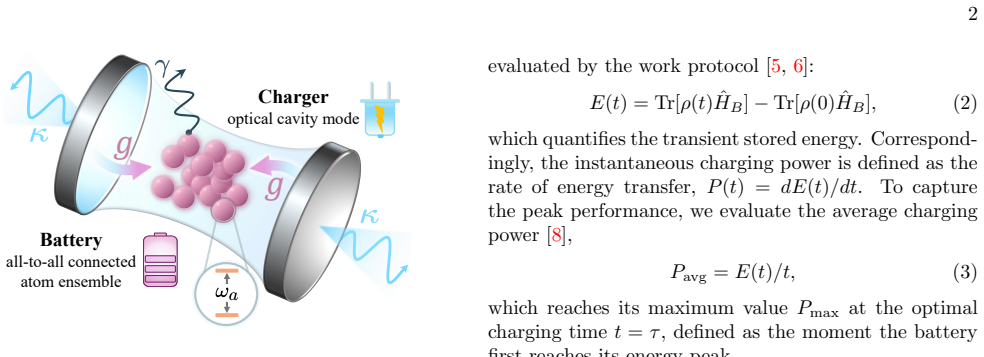
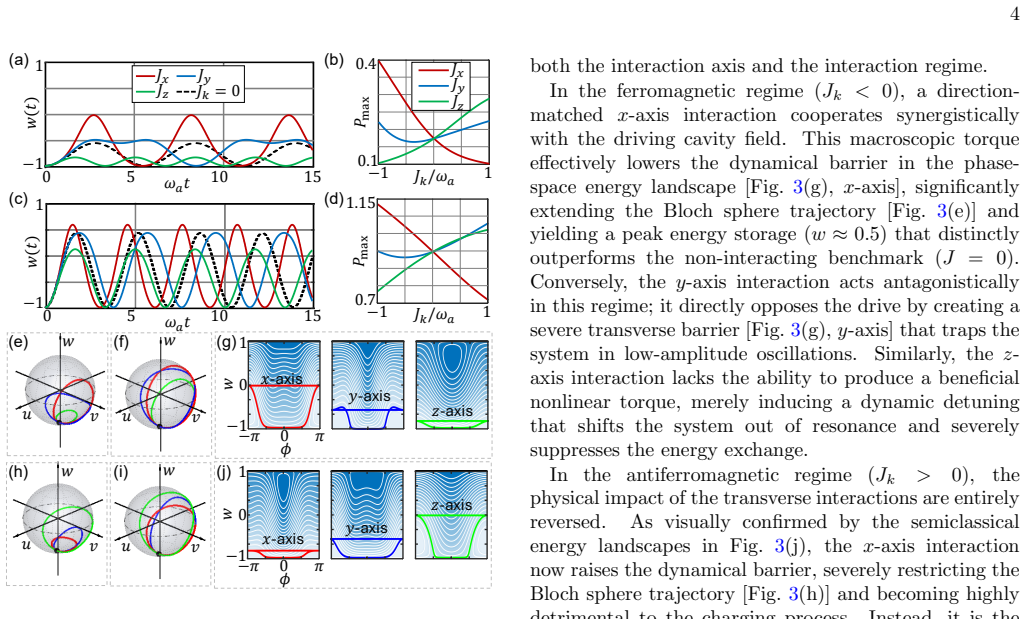
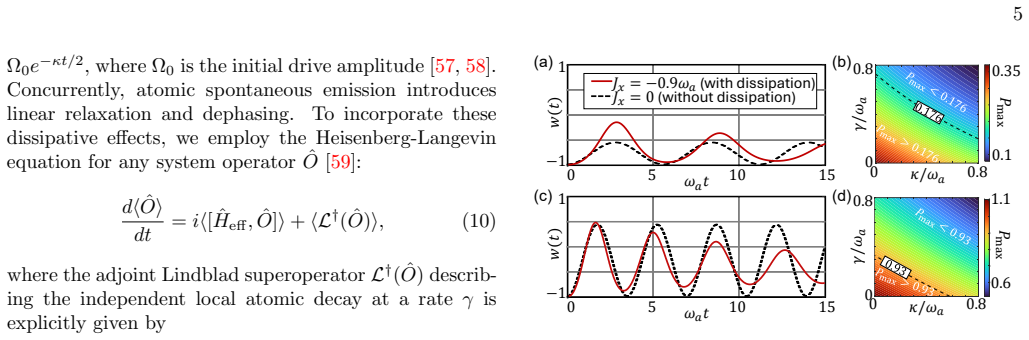
In the low-excitation limit, transverse interactions induce collective spin squeezing, causing critical mode softening and an exponential enhancement of effective coupling, which significantly boosts charging power. At higher excitations, these interactions act as a macroscopic nonlinear torque. By appropriately aligning this torque, we effectively lower phase-space dynamical barriers, guiding the system along optimal rapid-charging paths. Importantly, this cooperative enhancement remains highly robust under realistic dissipation, outperforming ideal, dissipationless Dicke QBs in specific regimes.
What carries the argument
Transverse interactions repurposed to generate collective spin squeezing (low excitation) and aligned macroscopic nonlinear torque (higher excitation) within the Dicke model.
If this is right
- Charging power receives an exponential boost from the softened mode and enhanced coupling in the low-excitation regime.
- Alignment of the nonlinear torque steers the dynamics onto faster, lower-barrier charging trajectories.
- The performance advantage survives realistic dissipation and can surpass ideal non-dissipative Dicke batteries in targeted parameter ranges.
- The approach supplies a concrete blueprint for building dissipation-resistant, high-performance many-body quantum batteries.
Where Pith is reading between the lines
- The same interaction-repurposing strategy could be tested in other collective spin or cavity systems where transverse couplings are tunable.
- Experimental implementations would need precise control over the relative phase and strength of transverse terms to realize the claimed torque alignment.
- The identified optimal paths may intersect with existing quantum optimal-control methods for accelerating state transfer in open systems.
- Robustness against dissipation hints at possible operation in warm environments where perfect isolation is impractical.
Load-bearing premise
Transverse interactions can be controlled and aligned to produce the described spin squeezing and nonlinear torque effects without introducing competing detrimental processes.
What would settle it
Direct measurement showing whether charging power exhibits exponential growth with transverse coupling strength in the low-excitation regime, or whether a dissipative battery with aligned interactions exceeds the charging speed of an ideal dissipationless reference battery.
Figures
read the original abstract
High-power Dicke quantum batteries (QBs) typically exploit collective superradiance, whereas intrinsic matter-matter interactions are conventionally considered detrimental. Here, we propose a counterintuitive paradigm: these interactions can be controlled and repurposed as a synergistic resource to enhance charging power and capacity. In the low-excitation limit, transverse interactions induce collective spin squeezing, causing critical mode softening and an exponential enhancement of effective coupling, which significantly boosts charging power. At higher excitations, these interactions act as a macroscopic nonlinear torque. By appropriately aligning this torque, we effectively lower phase-space dynamical barriers, guiding the system along optimal rapid-charging paths. Importantly, this cooperative enhancement remains highly robust under realistic dissipation, outperforming ideal, dissipationless Dicke QBs in specific regimes. Our results provide a blueprint for exploiting matter interactions to design dissipation-resistant, high-performance many-body QBs.
Editorial analysis
A structured set of objections, weighed in public.
Referee Report
Summary. The paper claims that transverse matter-matter interactions in Dicke quantum batteries, conventionally viewed as detrimental, can be controlled and repurposed as a synergistic resource. In the low-excitation regime, these interactions induce collective spin squeezing that causes critical mode softening and an exponential boost to the effective coupling, enhancing charging power. At higher excitations, the interactions manifest as a macroscopic nonlinear torque that, when appropriately aligned, lowers phase-space dynamical barriers to enable faster charging paths. The resulting cooperative enhancement is asserted to remain robust under realistic dissipation and to outperform ideal, dissipationless Dicke quantum batteries in specific regimes.
Significance. If the central claims are substantiated, the work offers a new design paradigm for many-body quantum batteries that turns intrinsic interactions into an asset rather than a liability, with particular value in the demonstrated robustness to dissipation. This could inform practical implementations of high-power, dissipation-resistant quantum energy storage devices.
major comments (2)
- [Model section (likely §2 or §3)] The load-bearing premise that transverse interactions can be tuned and aligned to produce spin squeezing and a synergistic nonlinear torque without introducing competing noise channels or shifting the system away from optimal paths is stated in the abstract but lacks an explicit protocol, bound, or derivation showing that the required control does not itself generate additional dissipation; this directly underpins the outperformance claim over ideal Dicke QBs.
- [Low-excitation analysis (likely §4)] The exponential enhancement of effective coupling via mode softening in the low-excitation limit is asserted but requires a concrete derivation or scaling relation (e.g., how the squeezing parameter enters the effective Hamiltonian or charging power) to confirm it follows from the transverse interaction term without additional assumptions.
minor comments (2)
- [Results and figures] Quantitative comparisons to the ideal dissipationless case should be presented with explicit parameter values and error bars in the relevant figures to delineate the 'specific regimes' of outperformance.
- [Throughout] Notation for the transverse interaction strength and the alignment angle of the nonlinear torque should be introduced consistently and defined at first use.
Simulated Author's Rebuttal
We thank the referee for the careful reading and constructive feedback. The comments highlight areas where additional detail will strengthen the manuscript. We address each major comment below and indicate the revisions made.
read point-by-point responses
-
Referee: The load-bearing premise that transverse interactions can be tuned and aligned to produce spin squeezing and a synergistic nonlinear torque without introducing competing noise channels or shifting the system away from optimal paths is stated in the abstract but lacks an explicit protocol, bound, or derivation showing that the required control does not itself generate additional dissipation; this directly underpins the outperformance claim over ideal Dicke QBs.
Authors: We agree that an explicit protocol and bounds are needed to substantiate the tuning of transverse interactions. In the revised manuscript, we add a dedicated subsection to the model section that specifies the control protocol via external driving fields, derives bounds ensuring no additional dissipation channels are introduced beyond those already modeled, and shows that the alignment does not shift the system from the identified optimal paths. This directly supports the outperformance claim. revision: yes
-
Referee: The exponential enhancement of effective coupling via mode softening in the low-excitation limit is asserted but requires a concrete derivation or scaling relation (e.g., how the squeezing parameter enters the effective Hamiltonian or charging power) to confirm it follows from the transverse interaction term without additional assumptions.
Authors: We appreciate this observation. The revised low-excitation analysis section now includes a step-by-step derivation starting from the transverse interaction term, showing how it generates the collective squeezing parameter, induces critical mode softening, and enters the effective Hamiltonian. We explicitly derive the exponential scaling of the effective coupling with the squeezing parameter and the resulting enhancement in charging power, confirming it follows directly without further assumptions. revision: yes
Circularity Check
No circularity: derivation remains self-contained from the Dicke model
full rationale
The provided abstract and description present a theoretical proposal that starts from the standard Dicke Hamiltonian, adds transverse interactions, and derives their effects on squeezing, mode softening, and torque alignment through standard many-body analysis. No equations, fitting procedures, or self-citations are shown that would reduce any claimed prediction or enhancement to an input by construction. The central claims rest on the model's dynamics rather than on renamed fits or load-bearing self-references, making the derivation independent of its own outputs.
Axiom & Free-Parameter Ledger
Reference graph
Works this paper leans on
-
[1]
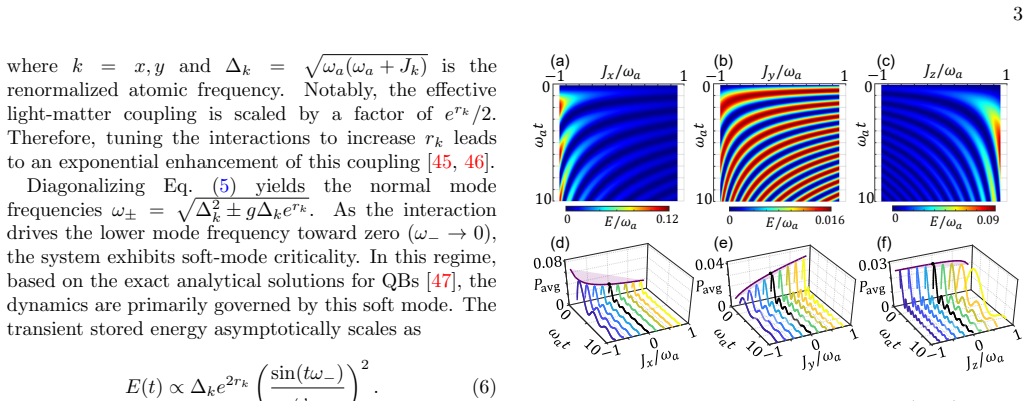
Consequently, only 𝜔𝑎𝑡 𝐽𝑥/𝜔𝑎 0 10 −1 1 0 0.12 𝐸/𝜔𝑎 0 0.016𝐸/𝜔𝑎 0.09 0 𝐸/𝜔𝑎 𝜔𝑎𝑡 𝐽𝑦/𝜔𝑎 0 10 −1 1 𝜔𝑎𝑡 𝐽𝑧/𝜔𝑎 0 10 −1 1 (a) (b) (c) (d) (e) (f) Figure 2
generates no spin squeezing in either regime and purely modifies the effective detuning ∆ z. Consequently, only 𝜔𝑎𝑡 𝐽𝑥/𝜔𝑎 0 10 −1 1 0 0.12 𝐸/𝜔𝑎 0 0.016𝐸/𝜔𝑎 0.09 0 𝐸/𝜔𝑎 𝜔𝑎𝑡 𝐽𝑦/𝜔𝑎 0 10 −1 1 𝜔𝑎𝑡 𝐽𝑧/𝜔𝑎 0 10 −1 1 (a) (b) (c) (d) (e) (f) Figure 2. HP-regime charging dynamics. (a,b,c) Stored energyE/ω a and (d,e,f) average powerP avg vs interaction strengthJ k/ω...
-
[2]
H. T. Quan, Quantum thermodynamic cycles and quantum heat engines, Phys. Rev. E79, 041129 (2009)
2009
-
[3]
Alicki and M
R. Alicki and M. Fannes, Entanglement boost for extractable work from ensembles of quantum batteries, Phys. Rev. E87, 042123 (2013). 6
2013
-
[4]
Kosloff, Quantum thermodynamics: A dynamical viewpoint, Entropy15, 2100–2128 (2013)
R. Kosloff, Quantum thermodynamics: A dynamical viewpoint, Entropy15, 2100–2128 (2013)
2013
-
[5]
Goold, M
J. Goold, M. Huber, A. Riera, L. d. Rio, and P. Skrzypczyk, The role of quantum information in thermodynamics—a topical review, J. Phys. A: Math. Theor.49, 143001 (2016)
2016
-
[6]
G. M. Andolina, M. Keck, A. Mari, M. Campisi, V. Giovannetti, and M. Polini, Extractable work, the role of correlations, and asymptotic freedom in quantum batteries, Phys. Rev. Lett.122, 047702 (2019)
2019
-
[7]
Francica, F
G. Francica, F. C. Binder, G. Guarnieri, M. T. Mitchison, J. Goold, and F. Plastina, Quantum coherence and ergotropy, Phys. Rev. Lett.125, 180603 (2020)
2020
-
[8]
Kurizki and A
G. Kurizki and A. G. Kofman,Thermodynamics and Control of Open Quantum Systems(Cambridge University Press, 2022)
2022
-
[9]
Campaioli, S
F. Campaioli, S. Gherardini, J. Q. Quach, M. Polini, and G. M. Andolina, Colloquium: Quantum batteries, Rev. Mod. Phys.96, 031001 (2024)
2024
-
[10]
K.-X. Yan, Y. Liu, Y. Xiao, J.-H. Lin, J. Song, Y.- H. Chen, F. Nori, and Y. Xia, Giant-atom quantum batteries: Lossless energy transfer via interference engineering, Phys. Rev. Lett.136, 180401 (2026)
2026
-
[11]
Campaioli, F
F. Campaioli, F. A. Pollock, F. C. Binder, L. C´ eleri, J. Goold, S. Vinjanampathy, and K. Modi, Enhancing the charging power of quantum batteries, Phys. Rev. Lett. 118, 150601 (2017)
2017
-
[12]
Ferraro, M
D. Ferraro, M. Campisi, G. M. Andolina, V. Pellegrini, and M. Polini, High-power collective charging of a solid- state quantum battery, Phys. Rev. Lett.120, 117702 (2018)
2018
-
[13]
J. Chen, L. Zhan, L. Shao, X. Zhang, Y. Zhang, and X. Wang, Charging quantum batteries with a general harmonic driving field, Ann. Phys.532(2020)
2020
-
[14]
Peng, W.-B
L. Peng, W.-B. He, S. Chesi, H.-Q. Lin, and X.-W. Guan, Lower and upper bounds of quantum battery power in multiple central spin systems, Phys. Rev. A103, 052220 (2021)
2021
-
[15]
J. Dias, H. Wang, K. Nemoto, F. Nori, and W. J. Munro, Efficient charging of multiple open quantum batteries through dissipation and pumping, Phys. Rev. A113, 012617 (2026)
2026
-
[16]
F. C. Binder, S. Vinjanampathy, K. Modi, and J. Goold, Quantacell: powerful charging of quantum batteries, New J. Phys.17, 075015 (2015)
2015
-
[17]
Juli` a-Farr´ e, T
S. Juli` a-Farr´ e, T. Salamon, A. Riera, M. N. Bera, and M. Lewenstein, Bounds on the capacity and power of quantum batteries, Phys. Rev. Res.2, 023113 (2020)
2020
-
[18]
Rossini, G
D. Rossini, G. M. Andolina, D. Rosa, M. Carrega, and M. Polini, Quantum advantage in the charging process of Sachdev-Ye-Kitaev batteries, Phys. Rev. Lett.125, 236402 (2020)
2020
-
[19]
Pokhrel and J
S. Pokhrel and J. Gea-Banacloche, Large collective power enhancement in dissipative charging of a quantum battery, Phys. Rev. Lett.134, 130401 (2025)
2025
-
[20]
R. H. Dicke, Coherence in spontaneous radiation processes, Phys. Rev.93, 99 (1954)
1954
-
[21]
Gross and S
M. Gross and S. Haroche, Superradiance: An essay on the theory of collective spontaneous emission, Phys. Rep. 93, 301–396 (1982)
1982
-
[22]
Garziano, A
L. Garziano, A. Settineri, O. Di Stefano, S. Savasta, and F. Nori, Gauge invariance of the Dicke and Hopfield models, Phys. Rev. A102, 023718 (2020)
2020
-
[23]
Brange, N
F. Brange, N. Lambert, F. Nori, and C. Flindt, Lee-Yang theory of the superradiant phase transition in the open Dicke model, Phys. Rev. Res.6, 033181 (2024)
2024
-
[24]
Yang, F.-M
D.-L. Yang, F.-M. Yang, and F.-Q. Dou, Three-level Dicke quantum battery, Phys. Rev. B109, 235432 (2024)
2024
-
[25]
Crescente, M
A. Crescente, M. Carrega, M. Sassetti, and D. Ferraro, Ultrafast charging in a two-photon Dicke quantum battery, Phys. Rev. B102, 245407 (2020)
2020
-
[26]
Delmonte, A
A. Delmonte, A. Crescente, M. Carrega, D. Ferraro, and M. Sassetti, Characterization of a two-photon quantum battery: Initial conditions, stability and work extraction, Entropy23, 612 (2021)
2021
-
[27]
J. P. Mendon¸ ca, K. Jachymski, and Y. Wang, Role of matter interactions in superradiant phenomena, Phys. Rev. Lett.135, 133601 (2025)
2025
-
[28]
S. J. Roof, K. J. Kemp, M. D. Havey, and I. M. Sokolov, Observation of single-photon superradiance and the cooperative Lamb shift in an extended sample of cold atoms, Phys. Rev. Lett.117, 073003 (2016)
2016
-
[29]
B. M. Garraway, The Dicke model in quantum optics: Dicke model revisited, Phil. Trans. R. Soc. A369, 1137–1155 (2011)
2011
-
[30]
Krantz, M
P. Krantz, M. Kjaergaard, F. Yan, T. P. Orlando, S. Gustavsson, and W. D. Oliver, A quantum engineer’s guide to superconducting qubits, Appl. Phys. Rev.6 (2019)
2019
-
[31]
J. Q. Quach, K. E. McGhee, L. Ganzer, D. M. Rouse, B. W. Lovett, E. M. Gauger, J. Keeling, G. Cerullo, D. G. Lidzey, and T. Virgili, Superabsorption in an organic microcavity: Toward a quantum battery, Sci. Adv.8, 10.1126/sciadv.abk3160 (2022)
-
[32]
Dou, Y.-Q
F.-Q. Dou, Y.-Q. Lu, Y.-J. Wang, and J.-A. Sun, Extended Dicke quantum battery with interatomic interactions and driving field, Phys. Rev. B105, 115405 (2022)
2022
-
[33]
Zhang, S
W. Zhang, S. Wang, C. Wu, and G. Wang, Quantum battery based on dipole-dipole interaction and external driving field, Phys. Rev. E107, 054125 (2023)
2023
-
[34]
Kitagawa and M
M. Kitagawa and M. Ueda, Squeezed spin states, Phys. Rev. A47, 5138 (1993)
1993
-
[35]
C. Luo, H. Zhang, A. Chu, C. Maruko, A. M. Rey, and J. K. Thompson, Hamiltonian engineering of collective XYZ spin models in an optical cavity, Nat. Phys.21, 916–923 (2025)
2025
-
[36]
D. C. Mattis, Ferromagnetism and spin waves in the band theory, Phys. Rev.132, 2521 (1963)
1963
-
[37]
Kirton, M
P. Kirton, M. M. Roses, J. Keeling, and E. G. Dalla Torre, Introduction to the Dicke model: From equilibrium to nonequilibrium, and vice versa, Adv. Quantum Technol.2(2019)
2019
-
[38]
Akbari, W
K. Akbari, W. Salmon, F. Nori, and S. Hughes, Generalized dicke model and gauge-invariant master equations for two atoms in ultrastrongly-coupled cavity quantum electrodynamics, Phys. Rev. Res.5, 033002 (2023)
2023
-
[39]
J. Ma, X. G. Wang, C. P. Sun, and F. Nori, Quantum spin squeezing, Phys. Rep.509, 89–165 (2011)
2011
-
[40]
M. O. Scully and M. S. Zubairy,Quantum Optics, 1st ed. (Cambridge University Press, 1997)
1997
-
[41]
Emary and T
C. Emary and T. Brandes, Chaos and the quantum phase transition in the Dicke model, Phys. Rev. E67, 066203 (2003)
2003
-
[42]
G. S. Agarwal,Quantum Optics(Cambridge University Press, 2012). 7 [42]https://link.aps.org/supplemental/XXXXXXX, see Supplemental Material for a detailed derivation and possible experimiental implementation
2012
-
[43]
Holstein and H
T. Holstein and H. Primakoff, Field dependence of the intrinsic domain magnetization of a ferromagnet, Phys. Rev.58, 1098 (1940)
1940
-
[44]
Wang and B
X. Wang and B. C. Sanders, Relations between bosonic quadrature squeezing and atomic spin squeezing, Phys. Rev. A68, 033821 (2003)
2003
-
[45]
W. Qin, A. Miranowicz, P.-B. Li, X.-Y. L¨ u, J. Q. You, and F. Nori, Exponentially enhanced light- matter interaction, cooperativities, and steady-state entanglement using parametric amplification, Phys. Rev. Lett.120, 093601 (2018)
2018
-
[46]
W. Qin, A. F. Kockum, C. S. Mu˜ noz, A. Miranowicz, and F. Nori, Quantum amplification and simulation of strong and ultrastrong coupling of light and matter, Phys. Rep. 1078, 1–59 (2024)
2024
-
[47]
G. M. Andolina, D. Farina, A. Mari, V. Pellegrini, V. Giovannetti, and M. Polini, Charger-mediated energy transfer in exactly solvable models for quantum batteries, Phys. Rev. B98, 205423 (2018)
2018
-
[48]
Ashhab, J
S. Ashhab, J. R. Johansson, and F. Nori, Rabi oscillations in a qubit coupled to a quantum two-level system, New J. Phys.8, 103–103 (2006)
2006
-
[49]
A. N. Omelyanchouk, S. N. Shevchenko, A. M. Zagoskin, E. Il’ichev, and F. Nori, Pseudo-Rabi oscillations in superconducting flux qubits in the classical regime, Phys. Rev. B78, 054512 (2008)
2008
-
[50]
A. N. Omelyanchouk, S. Savel’ev, A. M. Zagoskin, E. Il’ichev, and F. Nori, Noise-induced quantum coherence and persistent Rabi oscillations in a Josephson flux qubit, Phys. Rev. B80, 212503 (2009)
2009
-
[51]
Garziano, R
L. Garziano, R. Stassi, V. Macr` ı, A. F. Kockum, S. Savasta, and F. Nori, Multiphoton quantum Rabi oscillations in ultrastrong cavity QED, Phys. Rev. A92, 063830 (2015)
2015
-
[52]
Y.-H. Chen, W. Qin, X. Wang, A. Miranowicz, and F. Nori, Shortcuts to adiabaticity for the quantum Rabi model: Efficient generation of giant entangled cat states via parametric amplification, Phys. Rev. Lett.126, 023602 (2021)
2021
-
[53]
Chen, Z.-C
Y.-H. Chen, Z.-C. Shi, F. Nori, and Y. Xia, Error-tolerant amplification and simulation of the ultrastrong-coupling quantum Rabi model, Phys. Rev. Lett.133, 033603 (2024)
2024
-
[54]
F. T. Arecchi, E. Courtens, R. Gilmore, and H. Thomas, Atomic coherent states in quantum optics, Phys. Rev. A 6, 2211 (1972)
1972
-
[55]
C.-K. Hu, J. Qiu, P. J. P. Souza, J. Yuan, Y. Zhou, L. Zhang, J. Chu, X. Pan, L. Hu, J. Li, Y. Xu, Y. Zhong, S. Liu, F. Yan, D. Tan, R. Bachelard, C. J. Villas- Boas, A. C. Santos, and D. Yu, Optimal charging of a superconducting quantum battery, Quantum Sci. and Technol.7, 045018 (2022)
2022
-
[56]
Camposeo, T
A. Camposeo, T. Virgili, F. Lombardi, G. Cerullo, D. Pisignano, and M. Polini, Quantum batteries: A materials science perspective, Adv. Mater.37(2025)
2025
-
[57]
Carmichael,An Open Systems Approach to Quantum Optics: Lectures Presented at the Universit´ e Libre de Bruxelles October 28 to November 4, 1991(Springer Berlin Heidelberg, 1993)
H. Carmichael,An Open Systems Approach to Quantum Optics: Lectures Presented at the Universit´ e Libre de Bruxelles October 28 to November 4, 1991(Springer Berlin Heidelberg, 1993)
1991
-
[58]
D. F. Walls and G. J. Milburn,Quantum Optics (Springer Nature Switzerland, 2025)
2025
-
[59]
J. C. Louw, J. N. Kriel, and M. Kastner, Thermalization of a Lipkin-Meshkov-Glick model coupled to a bosonic bath, Phys. Rev. A100, 022115 (2019)
2019
discussion (0)
Sign in with ORCID, Apple, or X to comment. Anyone can read and Pith papers without signing in.