Thermal rectification due to phonon confinement in nanoparticles
Pith reviewed 2026-07-01 04:24 UTC · model grok-4.3
The pith
Thermal rectification arises between same-material nanoparticles of different sizes due to phonon confinement.
A machine-rendered reading of the paper's core claim, the machinery that carries it, and where it could break.
Core claim
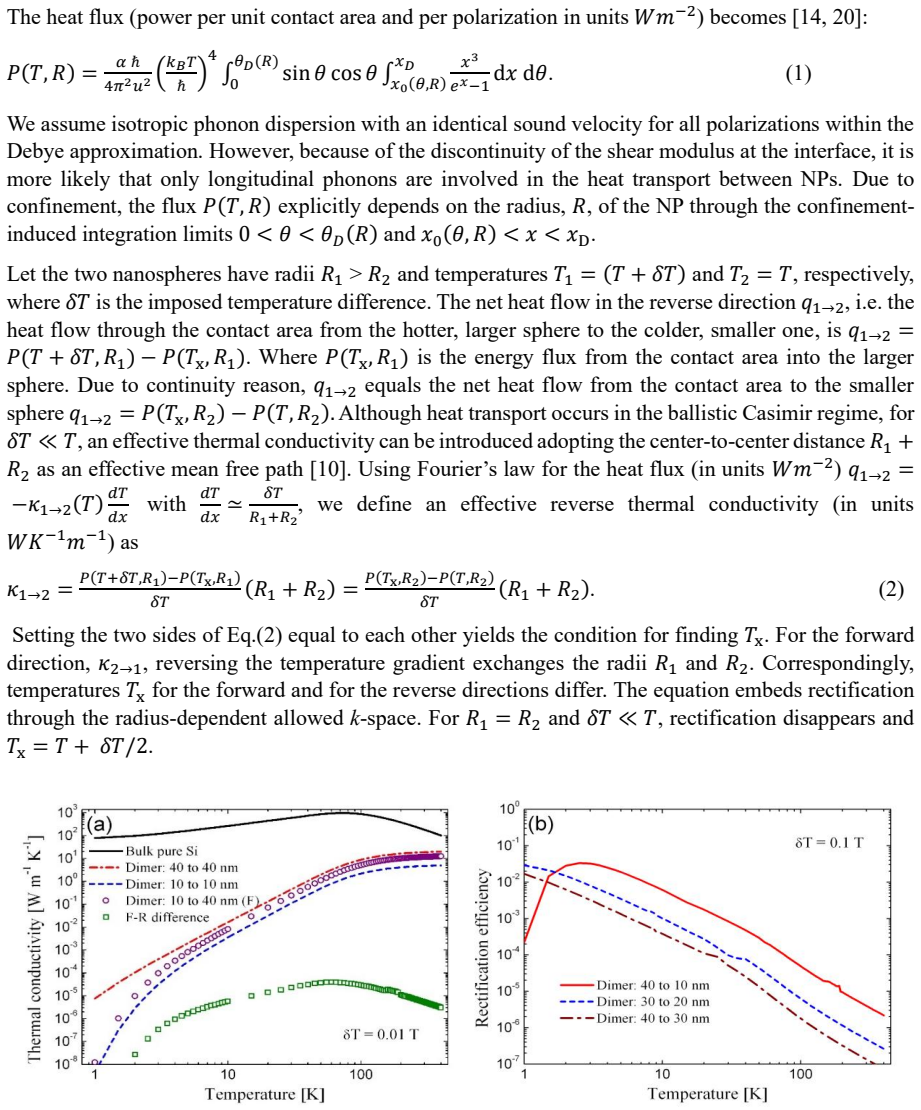
Thermal rectification can arise at the contact between two spherical nanoparticles of identical material but different size due to the geometric confinement of phonons. This confinement suppresses long-wavelength phonons differently in differently sized particles and creates a size-dependent gap in the phonon density of states. This gives rise to direction-dependent heat transport even in perfectly homogeneous materials. The model predicts measurable rectification efficiencies for nanoparticles with radii of a few tens of nanometers, reaching a fraction of a percent at room temperature and much larger values at low temperatures.
What carries the argument
Analytical model of phonon confinement combined with phonon ray-tracing in the Casimir regime, which produces size-dependent gaps in the density of states and direction-dependent contact heat fluxes.
If this is right
- Rectification efficiency increases as temperature is lowered.
- Measurable effects appear for particles with radii of a few tens of nanometers.
- Direction-dependent transport occurs without material heterogeneity or strong nonlinearities.
- The mechanism supplies a scalable route to thermal rectification in granular nanomaterials.
Where Pith is reading between the lines
- The same confinement mechanism could produce rectification in other nanoscale contacts such as between a sphere and a flat surface.
- Assemblies of size-mismatched nanoparticles might exhibit macroscopic thermal diode behavior if the single-contact effect survives averaging.
- Varying temperature while holding particle sizes fixed would isolate the contribution of the density-of-states gap from other temperature-dependent scattering processes.
Load-bearing premise
Phonon confinement creates a size-dependent gap in the density of states whose effect on contact heat transport is captured by a ray-tracing model in the Casimir regime without additional scattering or interface resistance.
What would settle it
Measure the ratio of heat currents in both directions between two nanoparticles of different radii at low temperature and check whether the ratio matches the predicted value from the size-dependent density-of-states gap.
Figures

read the original abstract
We demonstrate that thermal rectification can arise at the contact between two spherical nanoparticles of identical material but different size due to the geometric confinement of phonons. This confinement suppresses long-wavelength phonons differently in differently sized particles and creates a size-dependent gap in the phonon density of states. This gives rise to direction-dependent heat transport even in perfectly homogeneous materials. We develop an analytical model based on phonon confinement and phonon ray-tracing in the Casimir regime and derive expressions for heat fluxes and rectification efficiency as functions of particle sizes and temperatures. The model predicts measurable rectification efficiencies for nanoparticles with radii of a few tens of nanometers, reaching fraction of percent at room temperature and much larger values at low temperatures. The proposed mechanism provides a straightforward and scalable route to thermal rectification in granular nanomaterials without requiring material heterogeneity or strong nonlinearities.
Editorial analysis
A structured set of objections, weighed in public.
Referee Report
Summary. The manuscript claims that thermal rectification can arise at the contact between two spherical nanoparticles of identical material but different sizes due to geometric phonon confinement, which suppresses long-wavelength modes differently and creates a size-dependent gap in the phonon density of states. This asymmetry enables direction-dependent heat transport. An analytical model is developed based on phonon confinement combined with phonon ray-tracing in the Casimir regime; expressions for heat fluxes and rectification efficiency are derived as functions of particle radii and temperature. The model predicts measurable rectification (fraction of a percent at room temperature, larger at low T) for radii of tens of nanometers, offering a route to rectification in granular nanomaterials without material heterogeneity or strong nonlinearities.
Significance. If the central mechanism holds, the result identifies a purely geometric origin for thermal rectification in homogeneous systems, which could enable scalable designs in nanoparticle assemblies. The analytical, parameter-free character of the derivation (no fitted quantities) and the explicit temperature and size dependence are strengths that would allow direct experimental tests. However, the significance is conditional on the validity of the Casimir-regime assumption for real contacts.
major comments (2)
- [abstract (analytical model description)] Abstract (paragraph describing the analytical model): the derivation assumes that heat transport is governed by bulk Casimir-regime ray-tracing inside each particle, with the size-dependent DOS gap producing asymmetric fluxes. No quantitative estimate is given showing that this channel dominates over the nanoscale junction resistance (Kapitza/interface resistance), which is typically the rate-limiting and symmetric term for point contacts between nanoparticles of tens of nm radius.
- [abstract (model predictions)] Abstract (model predictions): the claimed rectification efficiencies (fraction of a percent at 300 K) rest on the DOS-overlap asymmetry being the dominant effect. Inclusion of a temperature-independent, symmetric interface term would reduce the relative contribution of the confinement-induced asymmetry; the manuscript provides no calculation demonstrating that the interface contribution remains negligible for the stated radii and temperatures.
Simulated Author's Rebuttal
We thank the referee for the detailed and constructive report. The comments correctly highlight the need to quantify the relative importance of internal Casimir-regime transport versus symmetric interface resistance. We address both points below and will revise the manuscript to include the requested estimates and discussion.
read point-by-point responses
-
Referee: [abstract (analytical model description)] Abstract (paragraph describing the analytical model): the derivation assumes that heat transport is governed by bulk Casimir-regime ray-tracing inside each particle, with the size-dependent DOS gap producing asymmetric fluxes. No quantitative estimate is given showing that this channel dominates over the nanoscale junction resistance (Kapitza/interface resistance), which is typically the rate-limiting and symmetric term for point contacts between nanoparticles of tens of nm radius.
Authors: We agree that the manuscript does not presently contain a quantitative comparison between the ballistic conductance inside the particles and the Kapitza resistance at the contact. In the revised version we will add a dedicated paragraph (and supporting estimate) that places the two resistances in series for radii 10–50 nm, using standard values for acoustic-mismatch transmission probabilities. This addition will delineate the temperature and size window in which the DOS-overlap asymmetry remains the leading source of rectification. revision: yes
-
Referee: [abstract (model predictions)] Abstract (model predictions): the claimed rectification efficiencies (fraction of a percent at 300 K) rest on the DOS-overlap asymmetry being the dominant effect. Inclusion of a temperature-independent, symmetric interface term would reduce the relative contribution of the confinement-induced asymmetry; the manuscript provides no calculation demonstrating that the interface contribution remains negligible for the stated radii and temperatures.
Authors: The referee is correct that a symmetric series resistance lowers the observed rectification ratio. We will therefore augment the revised manuscript with an explicit calculation that inserts a temperature-independent interface conductance in series with the two particle conductances and recomputes the rectification efficiency as a function of the interface-to-particle resistance ratio. The resulting curves will show the minimum interface transmission required for the predicted efficiencies (fraction of a percent at 300 K, larger at low T) to remain experimentally accessible. revision: yes
Circularity Check
No circularity: analytical model derives rectification from confinement and Casimir ray-tracing without reduction to fitted inputs or self-citations
full rationale
The paper presents an analytical derivation of heat fluxes and rectification efficiency from phonon confinement (size-dependent DOS gaps) combined with ray-tracing in the Casimir regime. No equations or claims in the abstract or model description reduce the rectification ratio to a fitted parameter defined by the same data, nor do they rely on load-bearing self-citations or imported uniqueness theorems. The derivation chain is self-contained against external benchmarks (phonon DOS from confinement, Casimir transport), with predictions stated as functions of sizes and temperatures rather than tautological outputs. This matches the default expectation of no significant circularity.
Axiom & Free-Parameter Ledger
axioms (2)
- domain assumption Geometric confinement in spherical nanoparticles suppresses long-wavelength phonons in a size-dependent manner, producing a gap in the phonon density of states.
- domain assumption Phonon transport across the nanoparticle contact in the Casimir regime can be modeled by ray-tracing.
Reference graph
Works this paper leans on
-
[1]
Starr, The copper oxide rectifier, Physics 7 (1) (1936) 15–19, https://doi.org/ 10.1063/1.1745338
C. Starr, The copper oxide rectifier, Physics 7 (1) (1936) 15–19, https://doi.org/ 10.1063/1.1745338
-
[2]
Dames, Solid-state thermal rectification with existing bulk materials, J
C. Dames, Solid-state thermal rectification with existing bulk materials, J. Heat Tran. 131 (6) (2009): 061301, https://doi.org/10.1115/1.3089552
-
[3]
Haibo Zhao, Xiao Yang, Chunyang Wang, Rui Lu, Ting Zhang, Haisheng Chen, and Xinghua Zheng, Progress in thermal rectification due to heat conduction in micro/ nano solids, Materials Today Physics 30 (2023) 100941, https://doi.org/10.1016/j.mtphys.2022.100941
-
[4]
M. Kasprzak, M. Sledzinska, K. Zaleski, I. Iatsunskyi, F. Alzina, et al., Hightemperature silicon thermal diode and switch, Nano Energy 78 (2020): 105261, https://doi.org/10.1016/j.nanoen.2020.105261
-
[5]
X. Yang, S. Wang, C. Wang, R. Liu, X. Zheng, et al., Thermal rectifier and thermal transistor of 1T/2H MoS2 for heat flow management, Appl. Mater. Interfaces 14 (3) (2022) 4434–4442, https://doi.org/10.1021/acsami.1c21226
-
[6]
M. Nahum, T. M. Eiles, and John M. Martinis, Electronic microrefrigerator based on a normal‐ insulator‐superconductor tunnel junction, Appl. Phys. Lett. 65, 3123–3125 (1994), https://doi.org/10.1063/1.112456
-
[7]
A. V . Gordeeva, A. L. Pankratov, N. G. Pugach, A. S. Vasenko, V . O. Zbrozhek, A. V . Blagodatkin, D. A. Pimanov, and L. S. Kuzmin, Record electron self-cooling in cold-electron bolometers with a hybrid superconductor-ferromagnetic nanoabsorber and traps, Scientific Reports 10, 21961 (2020), https://doi.org/10.1038/s41598-020-78869-z
-
[8]
Chuan-Yong Zhub and Zeng-Yao Li, Modeling of the Conductive Heat Transfer between Two Touching Nanoparticles in Nanoparticle-Based Materials, International Journal of Heat and Mass Transfer 167 (2021) 120723, https://doi.org/10.1016/j.ijheatmasstransfer.2020.120723
-
[9]
Batchelor and R.W
G.K. Batchelor and R.W. O’Brien, Thermal or electrical conduction through a granular material, Proc. R. Soc. Lond. A. 355, 313-333 (1977)
1977
-
[10]
Maris and Shin-ichiro Tamura, Heat flow in nanostructures in the Casimir regime, Phys
Humphrey J. Maris and Shin-ichiro Tamura, Heat flow in nanostructures in the Casimir regime, Phys. Rev. B 85, 054304 (2012), https://doi.org/10.1103/PhysRevB.85.054304
-
[11]
Christophe Blanc; Ali Rajabpour; Sebastian V olz; Thierry Fournier; Olivier Bourgeois, Phonon heat conduction in corrugated silicon nanowires below the Casimir limit, Appl. Phys. Lett. 103, 043109 (2013), https://doi.org/10.1063/1.4816590
-
[12]
The CMS experiment at the CERN LHC
Prafulla K Jha, Low frequency phonons in nanoparticles, Indian Journal of Pure & Applied Physics 44, pp. 87-92 (February 2006), https://nopr.niscpr.res.in/handle/123456789/8241
-
[13]
Zaccone, Quantum confinement theory of the heat capacity of thin films, Phys
A. Zaccone, Quantum confinement theory of the heat capacity of thin films, Phys. Rev. Mater. 8, 056001 (2024), https://doi.org/10.1103/PhysRevMaterials.8.056001
-
[14]
M. Sidorova, A. D. Semenov, A. Zaccone, I. Charaev, M. Gonzalez, A. Schilling, S. Gyger, and S. Steinhauer, Low-temperature heat transport under phonon confinement in nanostructures, Phys. Rev. B 110, 134513 (11 October, 2024), https://doi.org/10.1103/PhysRevB.110.134513
-
[15]
Encyclopedia of Nanoscience and Nanotechnology
Akhilesh K. Arora, M. Rajalakshmi, T. R. Ravindran, Phonon Confinement in Nanostructured Materials, In “Encyclopedia of Nanoscience and Nanotechnology” Edited by H. S. Nalwa, V olume 8, Pages (499–512), © 2004 by American Scientific Publishers, ISBN: 1-58883-064-0/$35.00
2004
-
[16]
2015, 15, 8255−8259, https://doi.org/10.1021/acs.nanolett.5b03781
Xavier Cartoixa,̀ Luciano Colombo, and Riccardo Rurali, Thermal Rectification by Design in Telescopic Si Nanowires, Nano Lett. 2015, 15, 8255−8259, https://doi.org/10.1021/acs.nanolett.5b03781
-
[17]
W. Eisenmenger, K. Laßmann, H. J. Trumpp, and R. Krauß, Quasiparticle recombination and 2D- phonon-trapping in superconducting tunneling junctions, Appl. Phys. 11, pp. 307-320 (1976), https://doi.org/10.1007/BF00919359; Yingru Song and Geoff Wehmeyer, Phonon ray tracing calculations of ballistic temperature and heat flux profiles in nanostructures, Materi...
-
[18]
Farrington, David J
Megan J. Farrington, David J. Wasserman, Eden R. Josza, Alessandro Podestà, Alessio Zaccone, Mariia Sidorova, Alexej D. Semenov, Nicola Ludwig and Marcel Di Vece, Thermal Rectification from Size-Dependent Phonon Confinement in Nanoparticle Assemblies, Submitted to PRL
-
[19]
Jacob M Schliesser and Brian F Woodfield, Development of a Debye heat capacity model for vibrational modes with a gap in the density of states, J. Phys.: Condens. Matter 27, 285402 (2015), https://doi.org/10.1088/0953-8984/27/28/285402
-
[20]
Little, the transport of heat between dissimilar solids at low temperature, Can
W.A. Little, the transport of heat between dissimilar solids at low temperature, Can. J. Phys. 37, 334-349 (1959)
1959
-
[21]
G. K. White and S. B. Woods, Thermal Conductivity of Germanium and Silicon at Low Temperatures, Phys. Rev.103 (3), pp. 569-571 (1956), https://doi.org/10.1103/PhysRev.103.569
-
[22]
lJ. Biazar and M. Eslami, Analytic solution for Telegraph equation by differential transform method, Physics Letters A 374 (29), pp. 2904-2906 (2010), https://doi.org/10.1016/j.physleta.2010.05.012
-
[23]
P. Flubacher, A. J. Leadbetter and J. A. Morisson, The Heat Capacity of Pure Silicon and Germanium and Properties of their Vibrational Frequency Spectra, The Philosophical Magazine: A Journal of Theoretical Experimental and Applied Physics 4 (39), pp. 273-294 (1959), https://doi.org/10.1080/14786435908233340
-
[24]
Saeed, Chuanbao Cao, Muhammad Rizwan, Elastic, electronic and optical properties of anatase TiO2 under pressure: A DFT approach, Chinese Journal of Physics 55, pp
Tariq Mahmood, Humma Malik, Rahat Batool, Zahida Perveen, Farhat Saleemi, Haris Rasheed, M.A. Saeed, Chuanbao Cao, Muhammad Rizwan, Elastic, electronic and optical properties of anatase TiO2 under pressure: A DFT approach, Chinese Journal of Physics 55, pp. 1252–1263 (2017)
2017
-
[25]
Phys.: Condens
E Shojaee and M R Mohammadi Zadeh, First-principles elastic and thermal properties of TiO2: a phonon approach, J. Phys.: Condens. Matter 22, 015401 (2010)
2010
-
[26]
Liu Qi-Jun, Zhang Ning-Chao, Liu Fu-Sheng, and Liu Zheng-Tang, Structural, electronic, optical, elastic properties and Born effective charges of monoclinic HfO2 from first-principles calculations, Chin. Phys. B 23, No. 4, 047101 (2014). Appendix A: Material Parameters used for computations All numerical results presented in the main text are computed for ...
2014
discussion (0)
Sign in with ORCID, Apple, or X to comment. Anyone can read and Pith papers without signing in.