Scattering of wobbling vortices
Pith reviewed 2026-07-01 04:33 UTC · model grok-4.3
The pith
Internal vibrational modes cause non-adiabatic vortex scattering with super-elastic collisions and fractal diagrams in the Abelian Higgs model.
A machine-rendered reading of the paper's core claim, the machinery that carries it, and where it could break.
Core claim
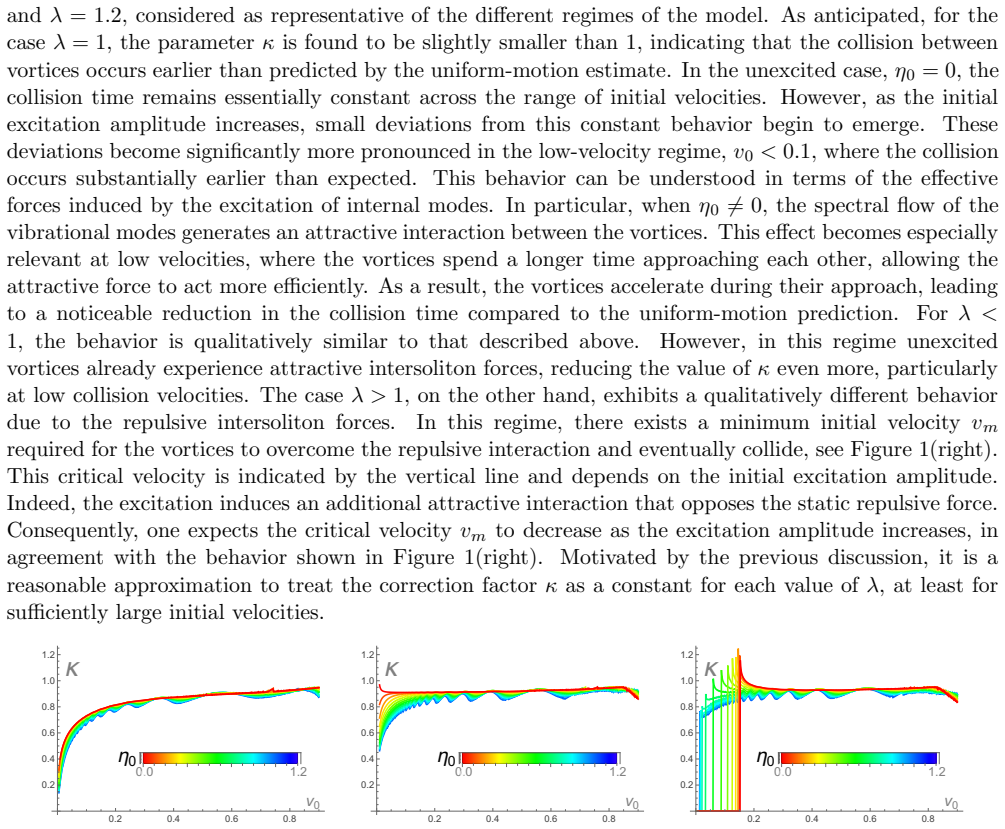
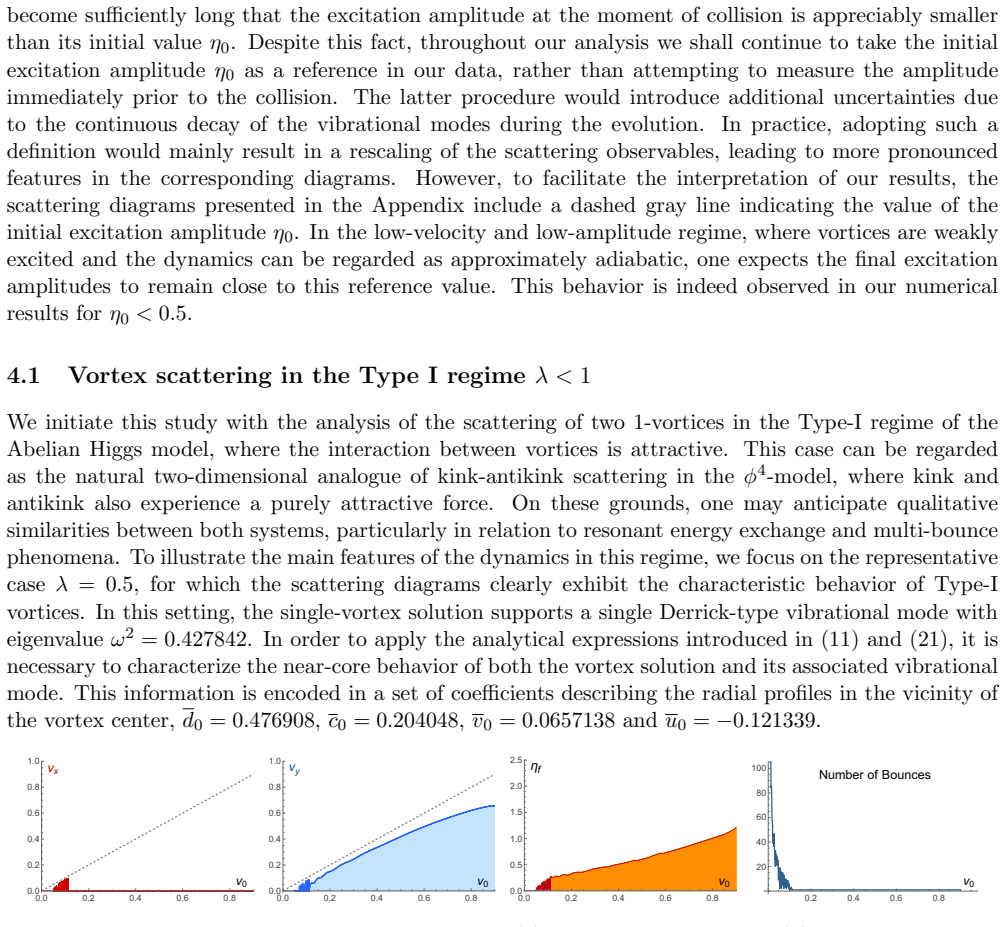
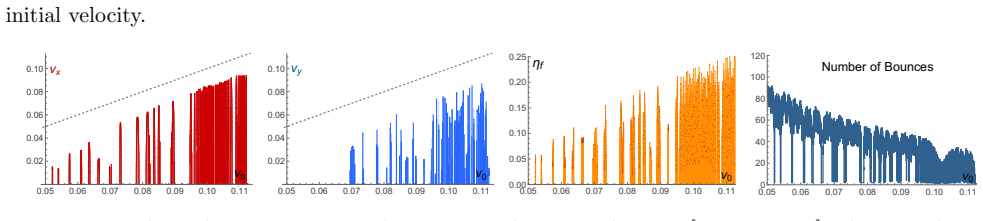
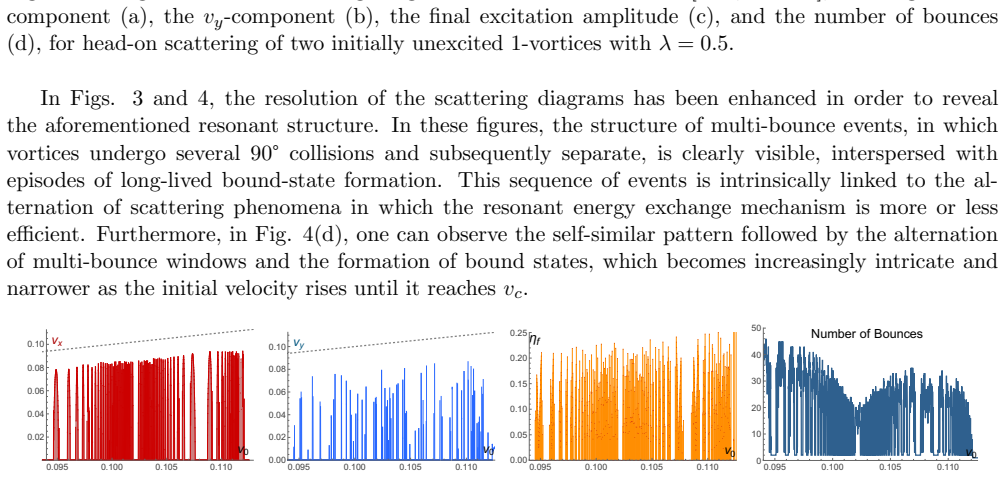
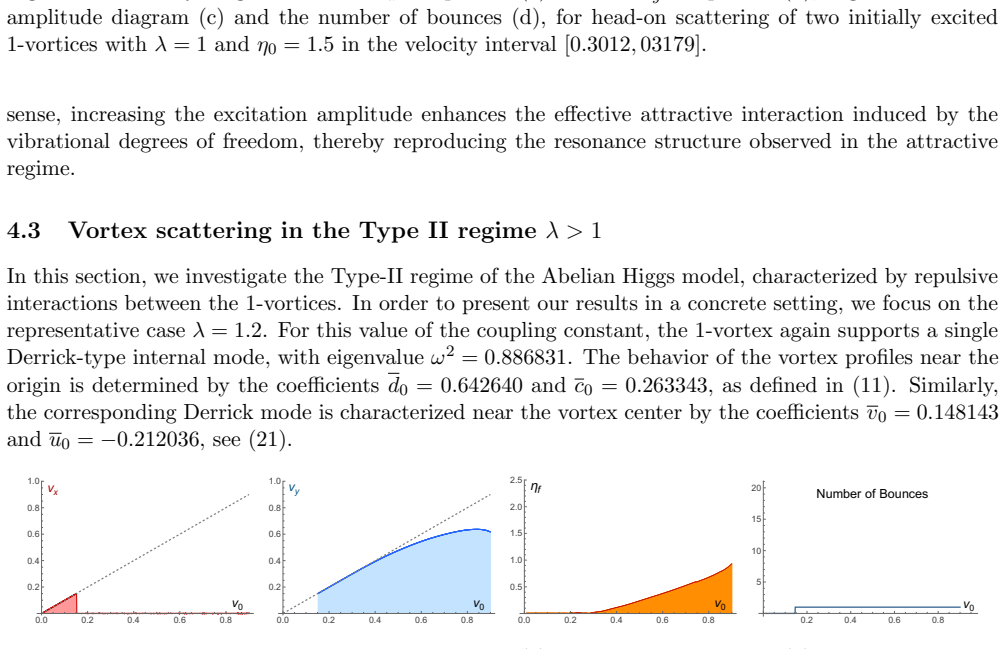
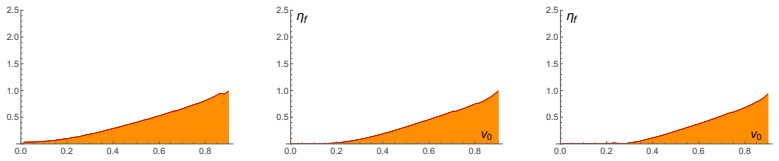
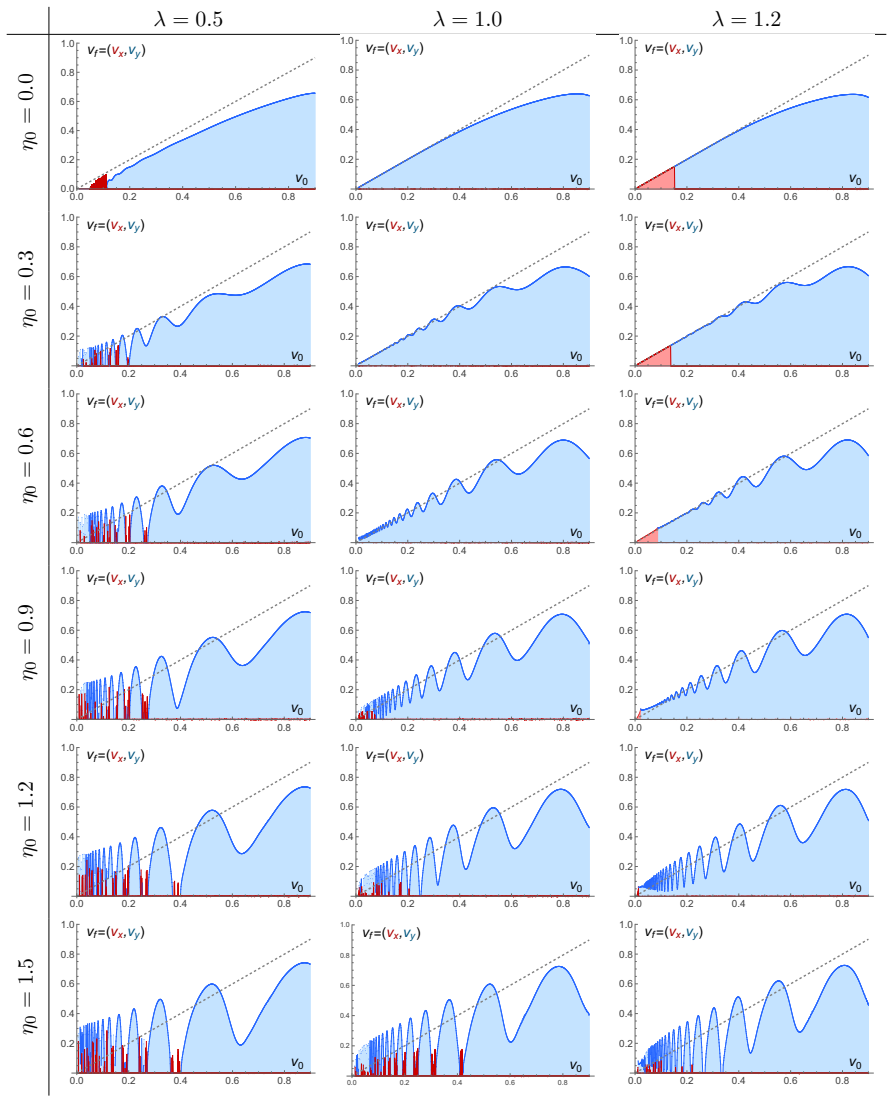
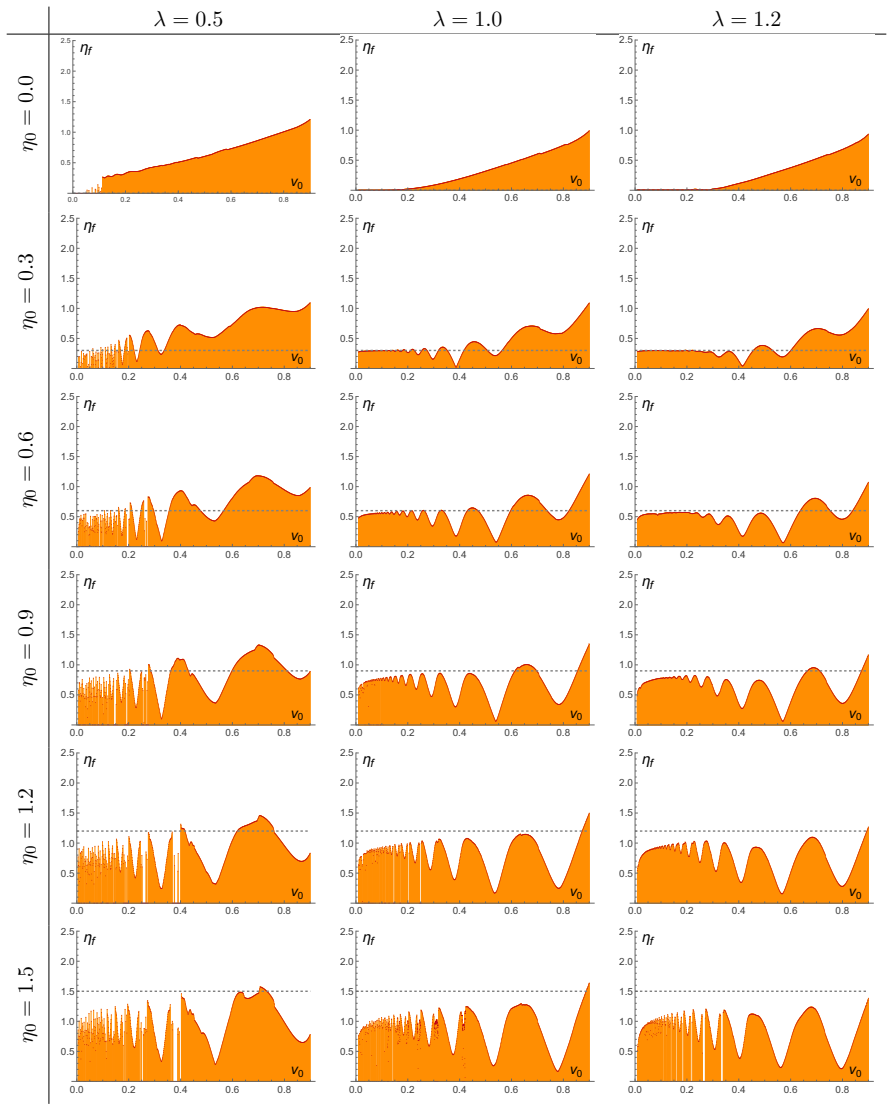
We demonstrate that the interplay between spectral flow and mode excitation generates effective forces and enables resonant energy transfer between translational and internal degrees of freedom. As a result, vortex dynamics become strongly non-adiabatic, exhibiting super-elastic collisions, oscillatory dependence of the final state on initial conditions, and the emergence of fractal structures in scattering diagrams. Internal vibrational modes therefore play a fundamental role in vortex interactions, going beyond the standard moduli space approximation.
What carries the argument
the interplay between spectral flow and mode excitation, which generates effective forces and resonant energy transfer between translational and internal degrees of freedom
If this is right
- Vortex scattering becomes strongly non-adiabatic instead of following adiabatic moduli-space motion.
- Super-elastic collisions appear because energy is transferred from internal modes back to translation.
- The final scattering state varies oscillatorily with small changes in initial velocity or impact parameter.
- Fractal structures form in the scattering diagrams as a direct consequence of the resonant energy exchange.
Where Pith is reading between the lines
- The same mode-excitation mechanism may produce analogous non-adiabatic effects in other soliton systems that possess internal vibrational modes.
- High-resolution numerical scans of initial-condition space could directly map the predicted fractal boundaries in scattering outcomes.
- The reported phenomenology suggests that effective low-energy descriptions of vortices in condensed-matter or cosmological settings must retain at least the lowest internal modes when velocities are not small.
Load-bearing premise
Internal vibrational modes remain well-defined and can be selectively excited during scattering without being destroyed or strongly coupled to radiation modes.
What would settle it
Numerical evolution of two vortices with one internal mode excited that produces only elastic or inelastic scattering without super-elastic outcomes or fractal dependence on impact parameter would falsify the central claim.
Figures

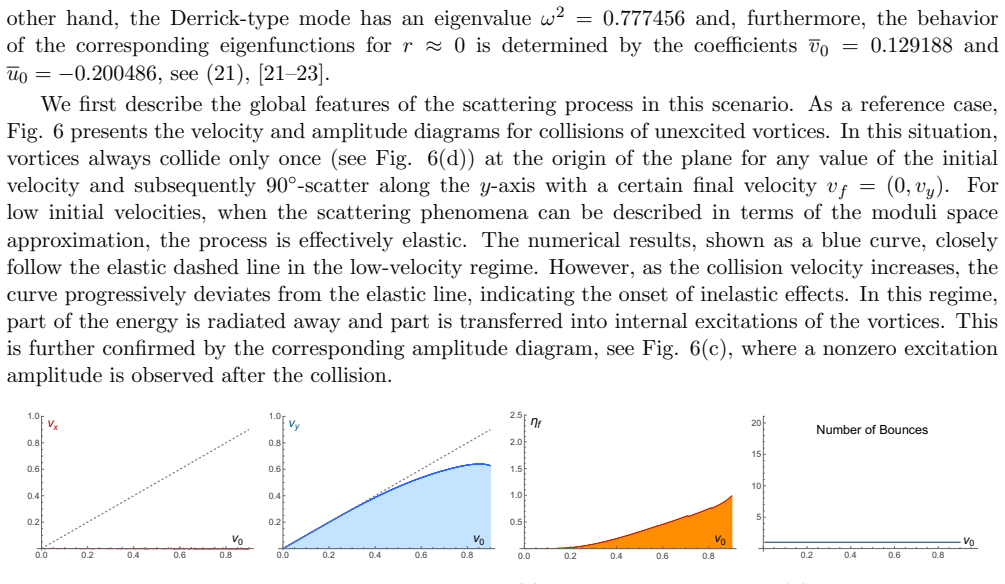
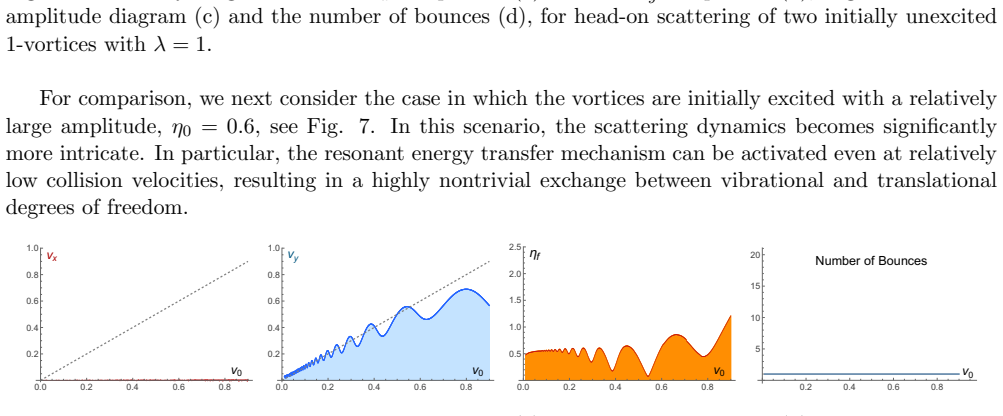
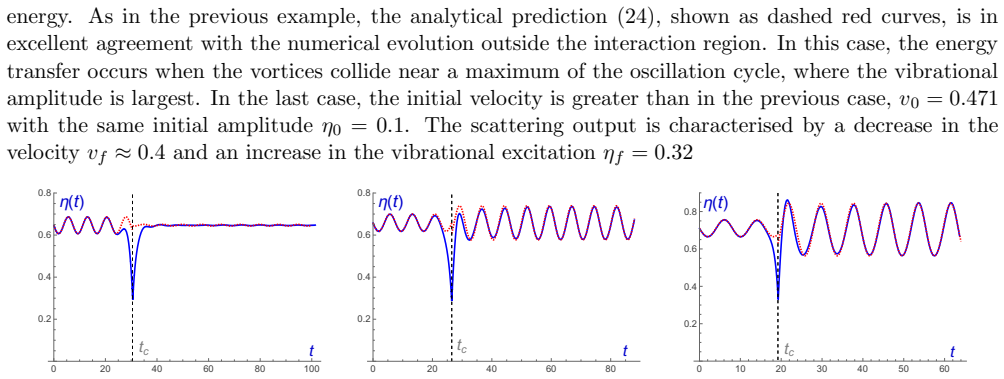
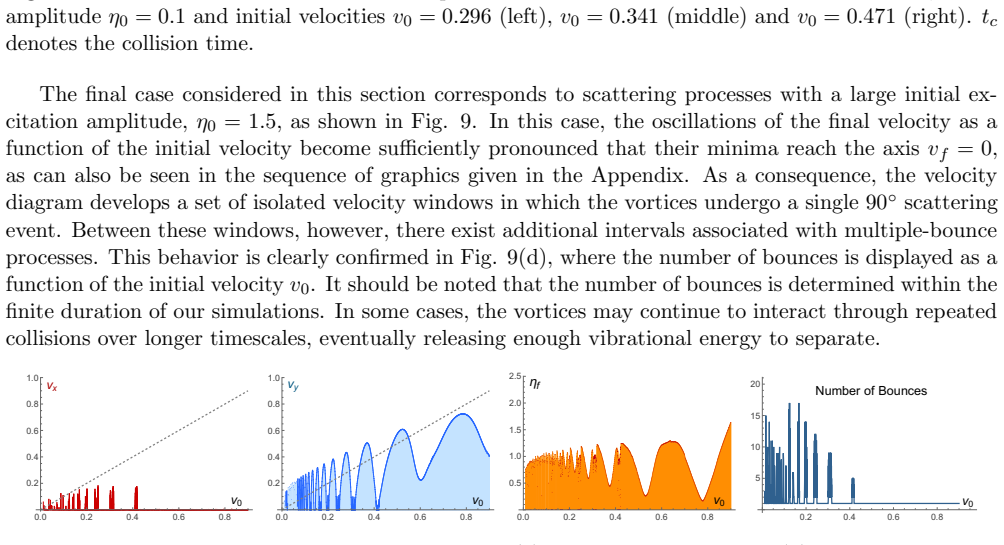



read the original abstract
We investigate the dynamical role of internal vibrational modes in the Abelian Higgs model, focusing on how Derrick-type excitations modify vortex dynamics and scattering processes. We study the scattering of excited vortices and show that the interplay between spectral flow and mode excitation generates effective forces and enables resonant energy transfer between translational and internal degrees of freedom. As a result, vortex dynamics become strongly non-adiabatic, exhibiting super-elastic collisions, oscillatory dependence of the final state on initial conditions, and the emergence of fractal structures in scattering diagrams. Our results demonstrate that internal vibrational modes play a fundamental role in vortex interactions, going beyond the standard moduli space approximation and revealing a rich phenomenology driven by mode dynamics.
Editorial analysis
A structured set of objections, weighed in public.
Referee Report
Summary. The manuscript examines the scattering of wobbling vortices in the Abelian Higgs model. It claims that the interplay between spectral flow and excitation of Derrick-type internal vibrational modes produces effective forces and resonant energy transfer between translational and internal degrees of freedom. This leads to strongly non-adiabatic dynamics, including super-elastic collisions, oscillatory dependence of the final state on initial conditions, and fractal structures in scattering diagrams, going beyond the moduli-space approximation.
Significance. If the reported phenomenology is robustly demonstrated with controlled numerics or analytic estimates that survive radiation effects, the work would be significant for soliton dynamics: it would establish a concrete mechanism by which internal modes invalidate the adiabatic approximation in vortex scattering and generate rich, non-integrable behavior.
major comments (2)
- [Abstract] Abstract and §1: The central claims of resonant energy transfer, super-elasticity, and fractal scattering diagrams presuppose that the discrete internal modes remain coherent and selectively excitable over the collision timescale. No estimate of radiation damping rates, imaginary parts of the mode frequencies, or comparison between mode lifetime and collision duration is provided; without this, the reported effects cannot be distinguished from radiation or numerical artifacts.
- The manuscript does not report any computation of the continuous spectrum of the fluctuation operator or the coupling of discrete modes to outgoing radiation; this omission is load-bearing for the assertion that mode dynamics dominate the scattering.
minor comments (1)
- Notation for the internal-mode amplitudes and the definition of 'spectral flow' should be introduced explicitly in the introduction rather than assumed from prior literature.
Simulated Author's Rebuttal
We thank the referee for the careful reading and for emphasizing the need to address radiation effects when claiming mode-driven non-adiabatic scattering. We respond point-by-point to the major comments below.
read point-by-point responses
-
Referee: [Abstract] Abstract and §1: The central claims of resonant energy transfer, super-elasticity, and fractal scattering diagrams presuppose that the discrete internal modes remain coherent and selectively excitable over the collision timescale. No estimate of radiation damping rates, imaginary parts of the mode frequencies, or comparison between mode lifetime and collision duration is provided; without this, the reported effects cannot be distinguished from radiation or numerical artifacts.
Authors: The referee is correct that the manuscript contains no explicit calculation of radiation damping rates or imaginary parts of the frequencies. Our evidence instead comes from direct numerical integration of the full nonlinear equations of motion, which already incorporates radiation losses and continuum coupling. The reported super-elastic collisions and fractal scattering diagrams are reproducible across independent runs with different resolutions and initial data. In the revised manuscript we will add a new paragraph that extracts collision durations from the simulations and compares them with the observed periods of translational and internal oscillations, thereby providing an indirect but quantitative check on mode coherence during the interaction. revision: partial
-
Referee: The manuscript does not report any computation of the continuous spectrum of the fluctuation operator or the coupling of discrete modes to outgoing radiation; this omission is load-bearing for the assertion that mode dynamics dominate the scattering.
Authors: We acknowledge that a linear spectral decomposition of the fluctuation operator around the vortex background, including the continuous spectrum and radiation couplings, is not performed. Such an analysis is technically substantial and lies outside the scope of the present work, which focuses on the phenomenology revealed by nonlinear scattering simulations. We will insert a brief statement in the conclusions section noting this limitation and identifying the spectral calculation as a natural direction for follow-up work. revision: no
Circularity Check
No circularity: derivation relies on dynamical analysis of modes without self-referential reduction
full rationale
The provided abstract and description contain no equations, fitted parameters, or self-citations that reduce any claimed prediction or result to an input by construction. Claims about spectral flow, mode excitation, and non-adiabatic scattering are presented as outcomes of the model's dynamics rather than tautological redefinitions or renamed fits. No load-bearing uniqueness theorems or ansatze imported via self-citation are visible. The central phenomenology is therefore not forced by the paper's own inputs; external benchmarks or explicit computations would be needed to assess validity, but no circularity pattern is exhibited.
Axiom & Free-Parameter Ledger
Reference graph
Works this paper leans on
-
[1]
Manton, N.; Sutcliffe, P.;Topological solitonsCambridge University Press 2004
2004
-
[2]
Vilenkin, A.; Shellard, P.;Cosmic strings and other topological defects, Cambridge University Press, 1994
1994
-
[3]
Weinberg, E.J.;Classical solutions in quantum field theory: Solitons and Instantons in High Energy Physics, Cambridge University Press, 2012
2012
-
[4]
3, 454-477
Gross, E.P.;Structure of a quantized vortex in boson systems, Il Nuovo Cimento (1955-1965)20 (1961), no. 3, 454-477
1955
-
[5]
Pitaevskii, L.P.;Vortex lines in an imperfect Bose gas, Sov. Phys. JETP13(1961), no. 2, 451-454
1961
-
[6]
Fetter, A.L.;Vortices in an imperfect Bose gas. I. The condensate, Physical Review138(1965), no. 2A, A429
1965
-
[7]
Hindmarsh M.B.; Kibble T.W.B.;Cosmic strings, Rept. Prog. Phys.58(1995) 477-562
1995
-
[8]
Blanco-Pillado, J.J.; Cui, Y.; Kuroyanagi, S.; Lewicki, M.; Nardini, G.; Pieroni, M.; Rybak, I.Y.; Sousa, L.; Wachter, J.M.; LISA Cosmology Working Group;Gravitational waves from cosmic strings in LISA: reconstruction pipeline and physics interpretation, Journal of Cosmology and Astroparticle Physics (2025), no. 05, 006
2025
-
[9]
Abrikosov, A.A.,On the magnetic properties of superconductors of the second group, Soviet Physics JETP5(1957) 1174-1182
1957
-
[10]
Nielsen, H.B.; Olesen, P.;Vortex-line models for dual strings, Nuclear Physics B61(1973) 45-61
1973
-
[11]
Fiz.24(1976) 861-870
Bogomolny, E.B.;The stability of classical solutions, Yad. Fiz.24(1976) 861-870
1976
-
[12]
Prasad, M.K.; Sommerfield, C.M.;Exact classical solution for the’t Hooft monopole and the Julia-Zee dyon, Physical Review Letters35(1975), no. 12, 760
1975
-
[13]
10, 3008
Weinberg, E.J.;Multivortex solutions of the Ginzburg-Landau equations, Physical Review D19 (1979), no. 10, 3008. 21
1979
-
[14]
3, 277-292
Taubes, C.H.;Arbitrary N-vortex solutions to the first order Ginzburg-Landau equations, Communi- cations in Mathematical Physics72(1980), no. 3, 277-292
1980
-
[15]
Jaffe, A.; Taubes, C.H.;Vortices and Monopoles, Birkhduser, Boston, 1980, MR 82m,81051
1980
-
[16]
1, 149- 179
Samols, T.M.;Vortex scattering, Communications in Mathematical Physics145(1992), no. 1, 149- 179
1992
-
[17]
2-3, 262-270
Shellard, E.P.S.; Ruback, P.J.;Vortex scattering in two dimensions, Physics Letters B209(1988), no. 2-3, 262-270
1988
-
[18]
3, 669-678
Ruback, P.J.;Vortex string motion in the Abelian Higgs model, Nuclear Physics B296(1988), no. 3, 669-678
1988
-
[19]
Rebbi, C.; Strilka, R.; Myers, E.;Vortex scattering in the Abelian Higgs model, Nuclear Physics B-Proceedings Supplements26(1992) 240-246
1992
-
[20]
Arod´ z, H.;Bound states of the vector field with a vortex in the Abelian Higgs model, Acta Phys. Polon. B 22 (1991) 511
1991
-
[21]
Goodband, M.; Hindmarsh, M.;Bound states and instabilities of vortices, Physical Review D52 (1995), no. 8, 4621
1995
-
[22]
Alonso-Izquierdo, A.; Garcia-Fuertes, W.; Mateos-Guilarte, J.;Dissecting zero modes and bound states on BPS vortices in Ginzburg-Landau superconductors, Journal of High Energy Physics5 (2016) 1-36
2016
-
[23]
Alonso-Izquierdo, A.; Garcia-Fuertes, W.; Mateos-Guilarte, J.;A note on BPS vortex bound states, Physics Letters B,753, (2016) 29-33
2016
-
[24]
12, 125026
Alonso-Izquierdo, A.; Miguelez-Caballero, D.;Dissecting normal modes of vibration on vortices in Ginzburg-Landau superconductors, Physical Review D110(2024), no. 12, 125026
2024
-
[25]
Alonso-Izquierdo, A.; Miguelez-Caballero, D.; Queiruga, J.;Spectral structure of fluctuations around n-vortices in the Abelian-Higgs model, Physica D: Nonlinear Phenomena (2026) 135235
2026
- [26]
-
[27]
Alonso-Izquierdo, A.; Garcia-Fuertes, W.; Manton, N.S.; Mateos-Guilarte, J.;Spectral flow of vortex shape modes over the BPS 2-vortex moduli space, Journal of High Energy Physics1(2024) 20
2024
-
[28]
5, 056050
Krusch, S.; Rees, M.; Winyard, T.;Scattering of vortices with excited normal modes, Physical Review D110(2024), no. 5, 056050
2024
-
[29]
8, 085006
Alonso-Izquierdo, A.; Manton, N.S.; Mateos Guilarte, J.; Wereszczynski, A.;Collective coordinate models for 2-vortex shape mode dynamics, Physical Review D110, (2024) no. 8, 085006
2024
-
[30]
Miguelez-Caballero, D; Navarro-Obregon, S; Wereszczynski, A.;Moduli space metric of the excited vortex, Physical Review D111, (2025) 105008
2025
-
[31]
6, 065004
Alonso-Izquierdo, A.; Mateos Guilarte, J.; Rees, M.; Wereszczy´ nski, A.;Spectral wall in collisions of excited Abelian Higgs vortices, Physical Review D110(2024), no. 6, 065004
2024
-
[32]
24, 241601
Adam, C.; Oles, K.; Romanczukiewicz, T.; Wereszczynski, A.,Spectral walls in soliton collisions, Physical Review Letters 122 (2019) no. 24, 241601. 22
2019
-
[33]
Alonso-Izquierdo, A.; Manton, N.S.; Mateos-Guilarte, J.; Rees, M.; Wereszczynski, A.;Dynamics of excited BPS three-vortices, Physical Review D111, (2025), no. 10
2025
- [34]
-
[35]
1-2, 1-32
Campbell, D.K.; Schonfeld, J.F.; Wingate, C.A.;Resonance structure in kink-antikink interactions inφ 4 theory, Physica D: Nonlinear Phenomena9(1983), no. 1-2, 1-32
1983
-
[36]
5, 1550-1563
Sugiyama, T.;Kink-antikink collisions in the two-dimensionalφ 4 model, Progress of Theoretical Physics61(1979), no. 5, 1550-1563
1979
-
[37]
4, 045003
Alonso-Izquierdo, A.; Queiroga-Nunes, J.; Nieto, L.M.;Scattering between wobbling kinks, Physical Review D103(2021), no. 4, 045003
2021
-
[38]
Alonso-Izquierdo, A.; Nieto, L.M.; Queiroga-Nunes, J.;Asymmetric scattering between kinks and wobblers, Communications in Nonlinear Science and Numerical Simulation107(2022) 106183
2022
-
[39]
7, 071601
Manton, N.S.; Ole´ s, K.; Roma´ nczukiewicz, T.; Wereszczy´ nski, A.;Collective coordinate model of kink-antikink collisions inϕ 4 theory, Physical Review Letters127(2021), no. 7, 071601
2021
-
[40]
Campos J.G.F.; Mohammadi A.;Wobbling double sine-Gordon kinks, JHEP09(2021) 067
2021
-
[41]
Karpisek O.N.; Rafaj L.; Blaschke F.;Scattering of kinks in coreless potentials, PTEP 2024 (11) (2024) 113A01
2024
-
[42]
Bachmaier, M.; Wereszczynski, A.;Resonance phenomena in vortex-antivortex collisions, Phys. Lett. B875(2026) 140324
2026
-
[43]
6, 065009
Alonso-Izquierdo, A.; Blanco-Pillado, J.J.; Migu´ elez-Caballero, D.; Navarro-Obreg´ on, S.; Queiruga, J.;Excited Abelian-Higgs vortices: Decay rate and radiation emission, Physical Review D110(2024), no. 6, 065009
2024
-
[44]
Arod´ z, H.; Hadasz, L.;Radiation from an excited vortex in the Abelian Higgs model, Physical Review D54(1996), no. 6, 4004
1996
-
[45]
Speight, J.M.,Static intervortex forces, Phys. Rev. D55(1997) 3830–3835
1997
-
[46]
M.; Urrestilla, J.;Internal excitations of global vortices, JCAP10(2021) 047
Blanco-Pillado, J.J.; Jimenez-Aguilar, D.; Queiruga, J. M.; Urrestilla, J.;Internal excitations of global vortices, JCAP10(2021) 047
2021
-
[47]
Manton, N.;Statistical mechanics of vortices, Nucl. Phys. B400(1993) 624
1993
-
[48]
B.;Vortices in holomorphic line bundles over closed Kahler manifolds, Commun
Bradlow, S. B.;Vortices in holomorphic line bundles over closed Kahler manifolds, Commun. Math. Phys.135(1990) 1
1990
-
[49]
Manton, N.;Quantum Statistical Mechanics of Vortices, J. Phys. A55(2022) 325001
2022
-
[50]
Blaschke, F.; Romanczukiewicz, T.; Slawinska, K.; Wereszczynski, A.;Unified theory of oscillons and modes, arXiv:2606.22680
work page internal anchor Pith review Pith/arXiv arXiv
-
[51]
5, 055024
Speight, M.; Winyard, T.;Short-range intervortex forces, Physical Review D112(2025), no. 5, 055024
2025
-
[52]
9, 095203
Speight, M.; Winyard, T.;Vortex lattices and critical fields in anisotropic superconductors, Journal of Physics A: Mathematical and Theoretical58(2025), no. 9, 095203. 23 λ= 0.5λ= 1.0λ= 1.2 η0 = 0.0 v0 vf =(vx,vy ) 0.0 0.2 0.4 0.6 0.80.0 0.2 0.4 0.6 0.8 1.0 v0 vf =(vx,vy ) 0.0 0.2 0.4 0.6 0.8 0.2 0.4 0.6 0.8 1.0 v0 vf =(vx,vy ) 0.0 0.2 0.4 0.6 0.8 0.2 0.4...
2025
discussion (0)
Sign in with ORCID, Apple, or X to comment. Anyone can read and Pith papers without signing in.