Certifying quantum states without independence assumptions
Pith reviewed 2026-07-01 05:01 UTC · model grok-4.3
The pith
A framework gives rigorous confidence intervals for time-averaged quantum observables without requiring independent state preparations.
A machine-rendered reading of the paper's core claim, the machinery that carries it, and where it could break.
Core claim
The central claim is that rigorous confidence intervals can be obtained for the time-averaged expectation value of any fixed observable even when each prepared state may depend on the previous experimental history, with a spot-checking protocol that randomly certifies a subset to bound the average target property of the remaining states.
What carries the argument
The spot-checking protocol, which randomly selects a subset of states for certification to bound an average target property of the remaining states used for a parallel task.
If this is right
- For full verification the method recovers the standard sample-complexity scaling of i.i.d. protocols.
- The bounds remain valid for energy estimation when states exhibit temporal drift.
- The bounds remain valid for entanglement witnessing when states exhibit temporal drift.
- The protocol enables Bell-state certification on a quantum processor without i.i.d. assumptions.
Where Pith is reading between the lines
- The same bounds could be used to certify average performance in adaptive algorithms where later states depend on earlier measurement outcomes.
- The framework suggests that overestimation of device performance in long-running experiments with feedback can be quantified and corrected.
- Extending the spot-checking fraction analysis to different dependence strengths would give practical guidance on the overhead required for a target .
Load-bearing premise
Random selection of states for certification does not itself introduce bias or dependence that invalidates the bound on the average property of the uncertified states.
What would settle it
In a controlled experiment with known history dependence, the fraction of trials in which the true time-averaged expectation value lies outside the reported confidence interval exceeds the nominal error probability.
Figures
read the original abstract
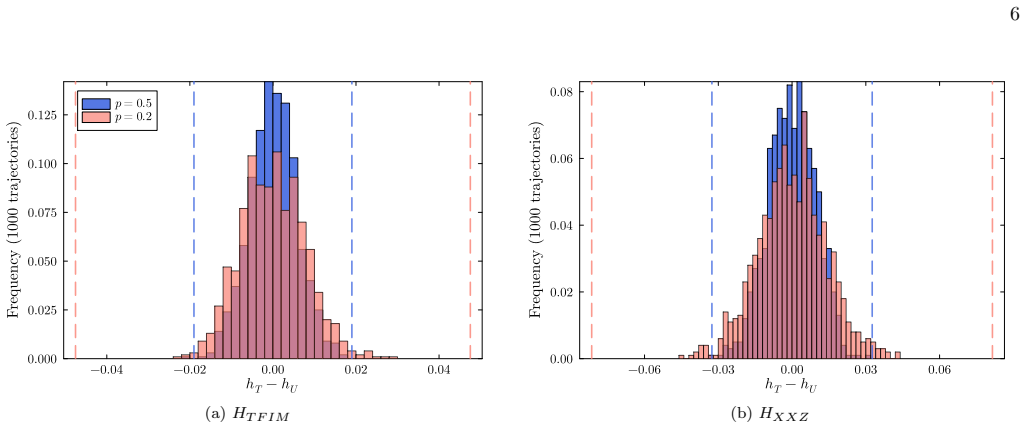
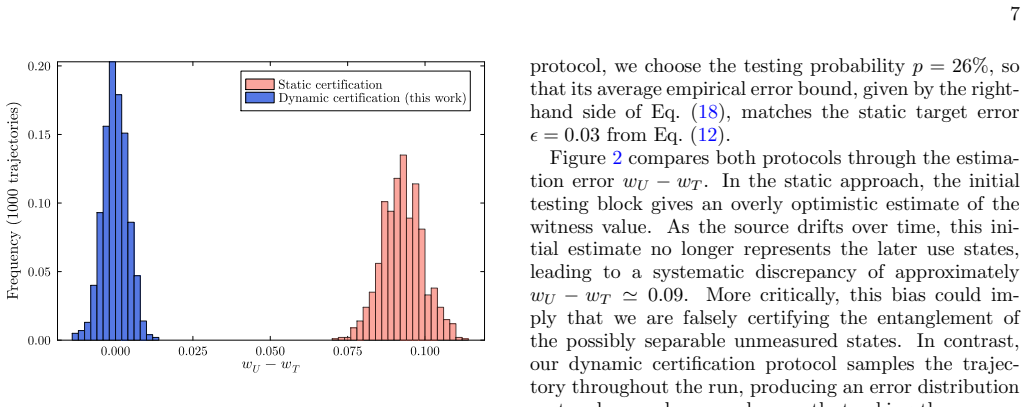
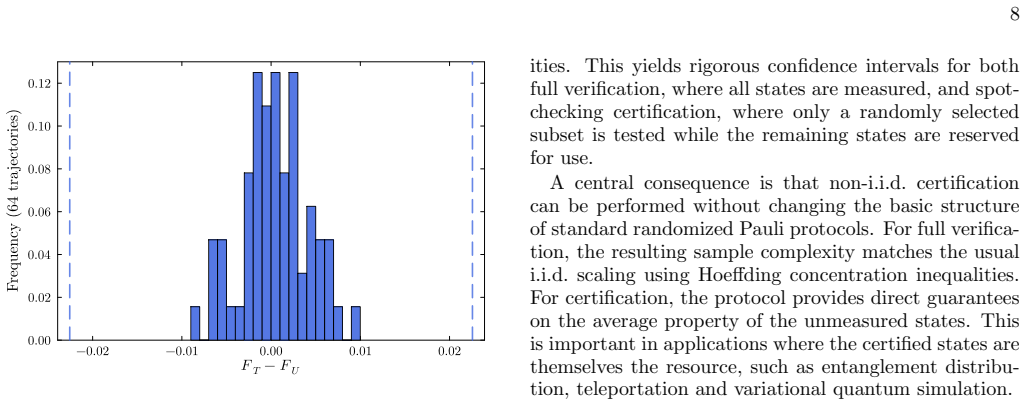
Standard quantum verification and certification protocols often assume that experimental sources emit independent and identically distributed (i.i.d.) states. In realistic scenarios, however, temporal drift, memory effects, feedback, and correlated noise can violate this assumption, causing standard analyses to underestimate uncertainty and overestimate device performance. Here, we introduce a framework for quantum verification and certification that remains valid without independence assumptions. Our method gives rigorous confidence intervals for the time-averaged expectation value of any fixed observable, even when each prepared state may depend on the previous experimental history. For full verification, we recover the standard i.i.d. sample-complexity scaling. For certification, we develop a spot-checking protocol that randomly selects a subset of states to certify an average target property of the remaining states, which are used for a parallel quantum task. We demonstrate the framework numerically for energy estimation and entanglement witnessing under drift, and experimentally for Bell-state certification on a quantum processor.
Editorial analysis
A structured set of objections, weighed in public.
Referee Report
Summary. The paper introduces a framework for quantum verification and certification that avoids i.i.d. assumptions on prepared states. It claims to deliver rigorous confidence intervals on the time-averaged expectation value of any fixed observable under arbitrary history dependence (including drift, memory, and feedback). For full verification the method recovers standard i.i.d. sample-complexity scaling; for certification it proposes a spot-checking protocol that randomly selects a subset of states for certification in order to bound an average target property of the remaining states used for a parallel task. Numerical demonstrations for energy estimation and entanglement witnessing under drift, plus an experimental Bell-state certification, are included.
Significance. If the central claims are correct, the work would be significant for experimental quantum information: it directly tackles the mismatch between theoretical i.i.d. analyses and realistic devices that exhibit temporal correlations. The ability to certify time averages without independence assumptions, while recovering optimal scaling when independence holds, would strengthen the reliability of verification protocols on current hardware.
major comments (2)
- [spot-checking protocol] The spot-checking protocol (described in the abstract and presumably detailed in the main text) asserts that randomly selecting a subset for certification rigorously bounds the time-averaged observable on the remaining states. Under fully arbitrary history dependence, however, the selection indicators are functions of the same history that determines the states; this can introduce correlations that invalidate standard martingale or concentration arguments. No explicit construction is supplied in the abstract showing that conditional expectations remain controlled after selection, and the skeptic note correctly flags this as a potential load-bearing gap.
- The abstract states that rigorous bounds exist and that the method works for any fixed observable, yet supplies no derivation, proof sketch, or error analysis. Without these, the central claim that the intervals remain valid and non-vacuous under history dependence cannot be verified from the provided text.
minor comments (1)
- The abstract mentions numerical demonstrations for energy estimation and entanglement witnessing; the main text should clarify whether these simulations include the full history-dependent selection process or only simplified drift models.
Simulated Author's Rebuttal
We thank the referee for their careful reading and constructive comments on our manuscript. We address the major comments point by point below, noting that the full constructions and proofs appear in the main text as is conventional.
read point-by-point responses
-
Referee: [spot-checking protocol] The spot-checking protocol (described in the abstract and presumably detailed in the main text) asserts that randomly selecting a subset for certification rigorously bounds the time-averaged observable on the remaining states. Under fully arbitrary history dependence, however, the selection indicators are functions of the same history that determines the states; this can introduce correlations that invalidate standard martingale or concentration arguments. No explicit construction is supplied in the abstract showing that conditional expectations remain controlled after selection, and the skeptic note correctly flags this as a potential load-bearing gap.
Authors: The manuscript supplies the explicit construction of the spot-checking protocol in the main text. It employs a martingale analysis that explicitly accounts for history dependence, ensuring that conditional expectations of the observable remain controlled after random selection. The protocol is designed so that the concentration bounds on the time average for the uncertified states hold rigorously, even when selection indicators depend on the same history; the correlations do not invalidate the argument because the differences are adapted to the filtration. The full proof and error analysis are given in the relevant sections. revision: no
-
Referee: The abstract states that rigorous bounds exist and that the method works for any fixed observable, yet supplies no derivation, proof sketch, or error analysis. Without these, the central claim that the intervals remain valid and non-vacuous under history dependence cannot be verified from the provided text.
Authors: The abstract is a high-level summary of the results and claims. The derivations, proof sketches, and error analyses establishing that the intervals remain valid and non-vacuous for any fixed observable under arbitrary history dependence are contained in the main body of the manuscript, where the martingale concentration inequalities and spot-checking analysis are developed in detail. revision: no
Circularity Check
No significant circularity; derivation remains self-contained.
full rationale
The provided abstract and description introduce a spot-checking protocol for bounding time-averaged observables under arbitrary history dependence, without quoting any equations that reduce the claimed bounds to fitted parameters, self-definitions, or load-bearing self-citations. No self-citation chain or ansatz smuggling is exhibited in the given text. The framework is presented as supplying independent rigorous intervals, consistent with the reader's assessment of score 2.0 (minor at most). The skeptic concern addresses potential correctness under dependence but does not identify a definitional or fitted-input reduction.
Axiom & Free-Parameter Ledger
axioms (2)
- domain assumption Quantum mechanics governs the prepared states and measurements
- domain assumption The target quantity is the time average of a fixed observable
Reference graph
Works this paper leans on
-
[1]
Following the convention of Section IV, the randomized measurement protocol is applied to the traceless part W=|ϕ +⟩⟨ϕ+| − 1 4 1= 1 4 (XX−Y Y+ZZ).(44) ThusW min =−1/4,W max = 3/4, and∥α∥ 1 = 3/4. To maximize data collection, we simultaneously pre- pare Bell states on 64 disjoint connected physical qubit pairs of the IBM quantum processor ibm fez, treating...
-
[2]
Brunner, D
N. Brunner, D. Cavalcanti, S. Pironio, V. Scarani, and S. Wehner, Bell nonlocality, Rev. Mod. Phys.86, 419 (2014)
2014
-
[3]
Eisert, D
J. Eisert, D. Hangleiter, N. Walk, I. Roth, D. Markham, R. Parekh, U. Chabaud, and E. Kashefi, Quantum certifi- cation and benchmarking, Nat. Rev. Phys.2, 382 (2020)
2020
-
[4]
Pirandola, U
S. Pirandola, U. L. Andersen, L. Banchi, M. Berta, D. Bunandar, R. Colbeck, D. Englund, T. Gehring, C. Lupo, C. Ottaviani,et al., Advances in quantum cryp- tography, Adv. Opt. Photonics12, 1012 (2020)
2020
-
[5]
Cramer, M
M. Cramer, M. B. Plenio, S. T. Flammia, R. Somma, D. Gross, S. D. Bartlett, O. Landon-Cardinal, D. Poulin, and Y.-K. Liu, Efficient quantum state tomography, Nat. Commun.1, 149 (2010)
2010
-
[6]
I. M. Georgescu, S. Ashhab, and F. Nori, Quantum sim- ulation, Rev. Mod. Phys.86, 153 (2014)
2014
-
[7]
A Quantum Approximate Optimization Algorithm
E. Farhi, J. Goldstone, and S. Gutmann, A quantum approximate optimization algorithm, arXiv:1411.4028 (2014)
work page internal anchor Pith review Pith/arXiv arXiv 2014
-
[8]
Hradil, Quantum-state estimation, Phys
Z. Hradil, Quantum-state estimation, Phys. Rev. A55, R1561 (1997)
1997
-
[9]
Gut ¸˘ a, J
M. Gut ¸˘ a, J. Kahn, R. Kueng, and J. A. Tropp, Fast state tomography with optimal error bounds, J. Phys. A: Math. Theor53, 204001 (2020)
2020
-
[10]
Anshu and S
A. Anshu and S. Arunachalam, A survey on the com- plexity of learning quantum states, Nat. Rev. Phys.6, 59 (2024)
2024
-
[11]
Huang, R
H.-Y. Huang, R. Kueng, and J. Preskill, Predicting many properties of a quantum system from very few measure- ments, Nat. Phys.16, 1050 (2020)
2020
-
[12]
S. T. Flammia and Y.-K. Liu, Direct fidelity estima- tion from few Pauli measurements, Phys. Rev. Lett.106, 230501 (2011)
2011
-
[13]
M. P. da Silva, O. Landon-Cardinal, and D. Poulin, Prac- tical characterization of quantum devices without tomog- raphy, Phys. Rev. Lett.107, 210404 (2011)
2011
-
[14]
Miguel-Ramiro, F
J. Miguel-Ramiro, F. Riera-S` abat, and W. D¨ ur, Collec- tive operations can exponentially enhance quantum state verification, Phys. Rev. Lett.129, 190504 (2022)
2022
-
[15]
Riera-S` abat, J
F. Riera-S` abat, J. Miguel-Ramiro, and W. D¨ ur, Nonde- structive verification of entangled states via fidelity wit- nessing, Phys. Rev. A107, 022414 (2023)
2023
-
[16]
Barber` a-Rodr´ ıguez, M
J. Barber` a-Rodr´ ıguez, M. Navarro, and L. Zambrano, Sampling groups of Pauli operators to enhance direct fi- delity estimation, Quantum9, 1784 (2025)
2025
-
[17]
Fawzi, A
O. Fawzi, A. Oufkir, and R. Salzmann, Optimal fidelity estimation from binary measurements for discrete and continuous variable systems, PRX Quantum7, 010309 (2026)
2026
-
[18]
Vershynin,High-Dimensional Probability: An Intro- duction with Applications in Data Science(Cambridge University Press, 2018)
R. Vershynin,High-Dimensional Probability: An Intro- duction with Applications in Data Science(Cambridge University Press, 2018)
2018
-
[19]
Schwonnek, K
R. Schwonnek, K. T. Goh, I. W. Primaatmaja, E. Y.-Z. Tan, R. Wolf, V. Scarani, and C. C.-W. Lim, Device- independent quantum key distribution with random key basis, Nat. Commun.12, 2880 (2021)
2021
-
[20]
Xu, Y.-Z
F. Xu, Y.-Z. Zhang, Q. Zhang, and J.-W. Pan, Device- independent quantum key distribution with random postselection, Phys. Rev. Lett.128, 110506 (2022)
2022
-
[21]
White, F
G. White, F. Pollock, L. Hollenberg, K. Modi, and C. Hill, Non-Markovian quantum process tomography, PRX Quantum3, 020344 (2022)
2022
-
[22]
H. M. Wiseman and G. J. Milburn,Quantum measure- ment and control(Cambridge university press, 2009)
2009
-
[23]
Pichler, S
H. Pichler, S. Choi, P. Zoller, and M. D. Lukin, Univer- sal photonic quantum computation via time-delayed feed- back, Proc. Natl. Acad. Sci. U.S.A.114, 11362 (2017)
2017
-
[24]
P. V. Klimov, J. Kelly, Z. Chen, M. Neeley, A. Megrant, B. Burkett, R. Barends, K. Arya, B. Chiaro, Y. Chen, et al., Fluctuations of energy-relaxation times in super- conducting qubits, Phys. Rev. Lett.121, 090502 (2018)
2018
-
[25]
S. J. van Enk and R. Blume-Kohout, When quantum tomography goes wrong: drift of quantum sources and other errors, New J. Phys.15, 025024 (2013)
2013
-
[26]
Bavaresco, N
J. Bavaresco, N. Herrera Valencia, C. Kl¨ ockl, M. Pivo- luska, P. Erker, N. Friis, M. Malik, and M. Huber, Mea- surements in two bases are sufficient for certifying high- dimensional entanglement, Nat. Phys.14, 1032 (2018)
2018
-
[27]
Mannalath, V
V. Mannalath, V. Zapatero, and M. Curty, Sharp finite statistics for quantum key distribution, Phys. Rev. Lett. 135, 020803 (2025)
2025
-
[28]
Fawzi, R
O. Fawzi, R. Kueng, D. Markham, and A. Oufkir, Learn- ing properties of quantum states without the iid assump- tion, Nat. Commun.15, 9677 (2024)
2024
-
[29]
Zambrano, Quantum tomography for non-iid sources, arXiv:2602.22057 (2026)
L. Zambrano, Quantum tomography for non-iid sources, arXiv:2602.22057 (2026)
-
[30]
Zambrano, Classical shadows for non-iid quantum sources, arXiv:2603.05137 (2026)
L. Zambrano, Classical shadows for non-iid quantum sources, arXiv:2603.05137 (2026)
-
[31]
Neven, J
A. Neven, J. Carrasco, V. Vitale, C. Kokail, A. Elben, M. Dalmonte, P. Calabrese, P. Zoller, B. Vermersch, R. Kueng,et al., Symmetry-resolved entanglement de- tection using partial transpose moments, npj Quantum Inf.7, 152 (2021)
2021
-
[32]
Goˇ canin, I
A. Goˇ canin, I. ˇSupi´ c, and B. Daki´ c, Sample-efficient device-independent quantum state verification and cer- tification, PRX Quantum3, 010317 (2022)
2022
-
[33]
Antesberger, M
M. Antesberger, M. M. Schmid, H. Cao, B. Daki´ c, L. A. Rozema, and P. Walther, Experimental quantum state certification by actively sampling photonic entan- gled states, Sci. Adv.12, eaea4144 (2026)
2026
-
[34]
Knill, Y
E. Knill, Y. Zhang, and P. Bierhorst, Generation of quan- tum randomness by probability estimation with classical side information, Phys. Rev. Res.2, 033465 (2020)
2020
- [35]
-
[36]
Williams,Probability with martingales(Cambridge university press, 1991)
D. Williams,Probability with martingales(Cambridge university press, 1991)
1991
-
[37]
Shah, Introduction to martingales, arXiv:2407.11914 (2024)
R. Shah, Introduction to martingales, arXiv:2407.11914 (2024)
-
[38]
M. Raginsky and I. Sason, Concentration of measure inequalities in information theory, communications and coding (second edition), arXiv:1212.4663 (2012)
work page internal anchor Pith review Pith/arXiv arXiv 2012
-
[39]
D. G. Horvitz and D. J. Thompson, A generalization of sampling without replacement from a finite universe, J. Am. Stat. Assoc.47, 663 (1952)
1952
-
[40]
Harper, B
B. Harper, B. Tonekaboni, B. Goldozian, M. Sevior, and M. Usman, Crosstalk attacks and defence in a shared quantum computing environment, Adv. Quantum Tech- nol.8, e2500009 (2025)
2025
-
[41]
Certifying quantum states without independence as- sumptions - Github repository (2026)
2026
discussion (0)
Sign in with ORCID, Apple, or X to comment. Anyone can read and Pith papers without signing in.