Hierarchy of hidden nonlocality: A genuine activation of Incompletability
Pith reviewed 2026-07-02 11:52 UTC · model grok-4.3
The pith
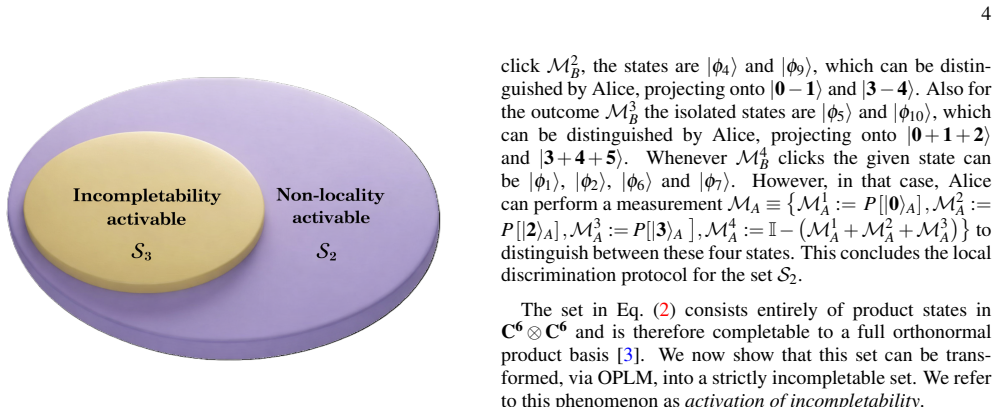
Activation of incompletability in orthogonal quantum states necessarily implies activation of nonlocality, but the converse does not hold.
A machine-rendered reading of the paper's core claim, the machinery that carries it, and where it could break.
Core claim
We demonstrate the existence of orthogonal sets that are initially perfectly distinguishable by LOCC and free from local redundancy, but which can be transformed via LOCC into strictly incompletable sets. We prove that activation of incompletability necessarily implies activation of nonlocality, whereas the converse fails in general, thereby establishing a hierarchy between the two activation phenomena. Furthermore, within the framework of local incoherent operations and classical communication (LICC), we show that any set whose incompletability can be activated can nevertheless be extended to a complete orthonormal basis of the Hilbert space, although the resulting completed basis is no lon
What carries the argument
Activation of incompletability via LOCC transformations from LOCC-distinguishable, redundancy-free orthogonal sets to strictly incompletable sets.
Load-bearing premise
There exist orthogonal sets that are initially perfectly distinguishable by LOCC, free from local redundancy, and can be transformed via LOCC into strictly incompletable sets.
What would settle it
An explicit example of an orthogonal set where LOCC activates incompletability but does not activate nonlocality would falsify the claimed necessary implication.
Figures

read the original abstract
Quantum nonlocality admits several operational manifestations, one of which emerges from sets of orthogonal quantum states that cannot be perfectly distinguished by local operations and classical communication (LOCC). Such sets are regarded as nonlocal because their perfect discrimination requires global measurements. In contrast, sets that are perfectly distinguishable by LOCC are generally considered locally accessible and operationally classical. In this work, we investigate the role of incompletability in local state discrimination and introduce the notion of \emph{activation of incompletability}. Specifically, we demonstrate the existence of orthogonal sets that are initially perfectly distinguishable by LOCC and free from local redundancy, but which can be transformed via LOCC into strictly incompletable sets. We prove that activation of incompletability necessarily implies activation of nonlocality, whereas the converse fails in general, thereby establishing a hierarchy between the two activation phenomena. Furthermore, within the framework of local incoherent operations and classical communication (LICC), we show that any set whose incompletability can be activated can nevertheless be extended to a complete orthonormal basis of the Hilbert space, although the resulting completed basis is no longer perfectly distinguishable by LOCC. Our results uncover a fundamental interplay among local distinguishability, incompletability, coherence, and nonlocality, and provide new insight into the structure of locally accessible quantum information.
Editorial analysis
A structured set of objections, weighed in public.
Referee Report
Summary. The paper introduces the notion of activation of incompletability for sets of orthogonal quantum states in local state discrimination. It demonstrates the existence of orthogonal sets that are initially perfectly distinguishable by LOCC, free from local redundancy, yet admit an LOCC transformation into strictly incompletable sets. The central result is a proof that activation of incompletability necessarily implies activation of nonlocality, while the converse fails in general, establishing a hierarchy. It further shows that, under LICC, such sets can be extended to a complete orthonormal basis, although the completed basis is no longer perfectly LOCC-distinguishable.
Significance. If the explicit constructions and proofs hold, the work establishes a strict hierarchy between two activation phenomena in quantum nonlocality, clarifying the interplay among local distinguishability, incompletability, coherence, and nonlocality. This provides new structural insight into locally accessible quantum information and hidden nonlocality.
major comments (1)
- [Main existence demonstration (likely §3 or Theorem 1)] The load-bearing step is the explicit construction of the activating sets (initially LOCC-distinguishable and redundancy-free, mapped by LOCC to strictly incompletable sets). The implication proof and the counter-example for the converse both rest on verifying that the post-transformation set satisfies strict incompletability while the initial set satisfies the free-of-redundancy condition; any gap here would leave the hierarchy unestablished.
minor comments (2)
- [Introduction/Definitions] Clarify the precise definition of 'strictly incompletable' versus 'incompletable' early in the manuscript to avoid ambiguity in the hierarchy statement.
- [LICC section] The LICC extension result would benefit from an explicit example showing the completed basis is not LOCC-distinguishable.
Simulated Author's Rebuttal
We thank the referee for their detailed reading and for identifying the central role of the explicit construction in establishing the hierarchy. We address the concern below and clarify that the constructions and verifications are fully explicit in the manuscript.
read point-by-point responses
-
Referee: [Main existence demonstration (likely §3 or Theorem 1)] The load-bearing step is the explicit construction of the activating sets (initially LOCC-distinguishable and redundancy-free, mapped by LOCC to strictly incompletable sets). The implication proof and the counter-example for the converse both rest on verifying that the post-transformation set satisfies strict incompletability while the initial set satisfies the free-of-redundancy condition; any gap here would leave the hierarchy unestablished.
Authors: We agree that the explicit construction is load-bearing. In §3 we give concrete orthogonal sets in a 3⊗3 system that are initially perfectly LOCC-distinguishable and free of local redundancy (verified by exhaustive enumeration of all possible local measurements and the absence of any redundant state that can be eliminated without affecting distinguishability). An explicit LOCC protocol (a sequence of local projective measurements and classical communication) is then applied, after which the resulting set is shown to be strictly incompletable by proving that every possible local measurement leaves at least one pair of states indistinguishable. The implication “activation of incompletability ⇒ activation of nonlocality” follows directly from the definitions, since strict incompletability already precludes perfect LOCC discrimination. The converse counter-example appears in §4 with a different pair of sets whose nonlocality is activated but incompletability is not; both sets are again given explicitly and the relevant LOCC properties are checked by direct computation. If the referee finds any verification step insufficiently detailed, we are prepared to expand the supplementary calculations in a revised version. revision: no
Circularity Check
No circularity: proofs rest on explicit orthogonal-set constructions and standard LOCC definitions
full rationale
The paper's central claims are established by (i) exhibiting concrete orthogonal sets that begin LOCC-distinguishable and redundancy-free, (ii) applying an LOCC map to produce a strictly incompletable set, and (iii) proving the implication 'incompletability activation ⇒ nonlocality activation' while supplying a counter-example for the converse. These steps are direct mathematical constructions and implications from the definitions of LOCC distinguishability and incompleteness; they do not reduce to self-citations, fitted parameters renamed as predictions, or ansatzes imported from prior author work. The abstract and claimed results contain no load-bearing self-referential definitions or renamings of known results. The derivation chain is therefore self-contained against external benchmarks of LOCC theory.
Axiom & Free-Parameter Ledger
Reference graph
Works this paper leans on
-
[1]
Bell nonlocality,
N. Brunner, D. Cavalcanti, S. Pironio, V . Scarani and S. Wehner, “Bell nonlocality," Rev. Mod. Phys.86, 419 (2014)
2014
-
[2]
Quantum nonlo- cality without entanglement,
C. H. Bennett, D. P. DiVincenzo, C. A. Fuchs, T. Mor, E. Rains, P. W. Shor, J. A. Smolin and W. K. Wootters, “Quantum nonlo- cality without entanglement,”Phys. Rev. A59, 1070 (1999)
1999
-
[3]
Unextendible Product Bases and Bound Entanglement,
C. H. Bennett, D. P. DiVincenzo, T. Mor, P. W. Shor, J. A. Smolin and B. M. Terhal, “Unextendible Product Bases and Bound Entanglement,”Phys. Rev. Lett.82, 5385 (1999)
1999
-
[4]
Mixed-state entanglement and quantum error correction,
C. H. Bennett, D. P. DiVincenzo, J. A. Smolin and W. K. Woot- ters, “Mixed-state entanglement and quantum error correction,” Phys. Rev. A54, 3824 (1996)
1996
-
[5]
Concentrating entanglement by local actions: Beyond mean values,
H.-K. Lo and S. Popescu, “Concentrating entanglement by local actions: Beyond mean values,”Phys. Rev. A63, 022301 (2001)
2001
-
[6]
Local distinguishability of orthogonal 2⊗ 3 pure states,
Y . Xin and R. Duan, “Local distinguishability of orthogonal 2⊗ 3 pure states,”Phys. Rev. A77, 012315 (2008)
2008
-
[7]
Local Distin- guishability of Multipartite Orthogonal Quantum States,
J. Walgate, A. J. Short, L. Hardy and V . Vedral, “Local Distin- guishability of Multipartite Orthogonal Quantum States,”Phys. Rev. Lett.85, 4972 (2000)
2000
-
[8]
Opti- mal local discrimination of two multipartite pure states,
S. Virmani, M. F. Sacchi, M. B. Plenio and D. Markham, “Opti- mal local discrimination of two multipartite pure states,”Phys. Lett. A288, 62 (2001)
2001
-
[9]
Distin- guishability of Bell States,
S. Ghosh, G. Kar, A. Roy, A. Sen(De) and U. Sen, “Distin- guishability of Bell States,”Phys. Rev. Lett.87, 277902 (2001)
2001
-
[10]
Nonlocal variables with product state eigenstates,
B. Groisman and L. Vaidman, “Nonlocal variables with product state eigenstates,”J. Phys. A: Math. Gen.34, 6881 (2001)
2001
-
[11]
Nonlocality, Asymmetry, and Distin- guishing Bipartite States,
J. Walgate and L. Hardy, “Nonlocality, Asymmetry, and Distin- guishing Bipartite States,”Phys. Rev. Lett.89, 147901 (2002)
2002
-
[12]
Unextendible product bases, uncompletable prod- uct bases and bound entanglement,
D. P. DiVincenzo, T. Mor, P. W. Shor, J. A. Smolin and B. M. Terhal, “Unextendible product bases, uncompletable prod- uct bases and bound entanglement,”Commun. Math. Phys.238, 379 (2003)
2003
-
[13]
Lo- cal Indistinguishability: More Nonlocality with Less Entangle- ment,
M. Horodecki, A. Sen(De), U. Sen and K. Horodecki, “Lo- cal Indistinguishability: More Nonlocality with Less Entangle- ment,”Phys. Rev. Lett.90, 047902 (2003)
2003
-
[14]
Distinguishability and Indistinguishability by Local Operations and Classical Communication,
H. Fan, “Distinguishability and Indistinguishability by Local Operations and Classical Communication,”Phys. Rev. Lett.92, 177905 (2004)
2004
-
[15]
Distinguishability of maximally entangled states,
S. Ghosh, G. Kar, A. Roy and D. Sarkar, “Distinguishability of maximally entangled states,”Phys. Rev. A70, 022304 (2004)
2004
-
[16]
Distinguishing bipartite orthogonal states by LOCC: Best and worst cases,
M. Nathanson, “Distinguishing bipartite orthogonal states by LOCC: Best and worst cases,”J. Math. Phys.46, 062103 (2005)
2005
-
[17]
Bipartite Subspaces Having No Bases Distinguish- able by Local Operations and Classical Communication,
J. Watrous, “Bipartite Subspaces Having No Bases Distinguish- able by Local Operations and Classical Communication,”Phys. Rev. Lett.95, 080505 (2005)
2005
-
[18]
Multipartite nonlocality without entan- glement in many dimensions,
J. Niset and N. J. Cerf, “Multipartite nonlocality without entan- glement in many dimensions,”Phys. Rev. A74, 052103 (2006)
2006
-
[19]
Local distinguishability of orthogonal quan- tum states and generators of SU(N),
M.-Y . Ye, W. Jiang, P.-X. Chen, Y .-S. Zhang, Z.-W. Zhou and G.-C. Guo, “Local distinguishability of orthogonal quan- tum states and generators of SU(N),”Phys. Rev. A76, 032329 (2007)
2007
-
[20]
Distinguishing bipartite states by local operations and classical communication,
H. Fan, “Distinguishing bipartite states by local operations and classical communication,”Phys. Rev. A75, 014305 (2007)
2007
-
[21]
Distinguishing Arbitrary Multipartite Basis Unambiguously Using Local Operations and Classical Communication,
R. Duan, Y . Feng, Z. Ji and M. Ying, “Distinguishing Arbitrary Multipartite Basis Unambiguously Using Local Operations and Classical Communication,”Phys. Rev. Lett.98, 230502 (2007). 9
2007
-
[22]
Local distinguishability of any three quantum states,
S. Bandyopadhyay and J. Walgate, “Local distinguishability of any three quantum states,”J. Phys. A: Math. Theor.42, 072002 (2009)
2009
-
[23]
Characterizing locally indistinguishable orthogonal product states,
Y . Feng and Y .-Y . Shi, “Characterizing locally indistinguishable orthogonal product states,”IEEE Trans. Inf. Theory55, 2799 (2009)
2009
-
[24]
Locally indistinguishable sub- spaces spanned by three-qubit unextendible product bases,
R. Duan, Y . Xin and M. Ying, “Locally indistinguishable sub- spaces spanned by three-qubit unextendible product bases,” Phys. Rev. A81, 032329 (2010)
2010
-
[25]
Four Locally Indistinguishable Ququad-Ququad Orthogonal Maximally Entangled States,
N. Yu, R. Duan and M. Ying, “Four Locally Indistinguishable Ququad-Ququad Orthogonal Maximally Entangled States,” Phys. Rev. Lett.109, 020506 (2012)
2012
-
[26]
Lo- cal distinguishability of orthogonal quantum states in a 2⊗2⊗2 system,
Y .-H. Yang, F. Gao, G.-J. Tian, T.-Q. Cao, and Q.-Y . Wen, “Lo- cal distinguishability of orthogonal quantum states in a 2⊗2⊗2 system,”Phys. Rev. A88, 024301 (2013)
2013
-
[27]
Nonlocality of orthogonal product basis quantum states,
Z.-C. Zhang, F. Gao, G.-J. Tian, T.-Q. Cao and Q.-Y . Wen, “Nonlocality of orthogonal product basis quantum states,” Phys. Rev. A90, 022313 (2014)
2014
-
[28]
Entanglement cost of nonlocal measurements,
S. Bandyopadhyay, G. Brassard, S. Kimmel and W. K. Woot- ters, “Entanglement cost of nonlocal measurements,”Phys. Rev. A80, 012313 (2009)
2009
-
[29]
Entan- glement cost of two-qubit orthogonal measurements,
S. Bandyopadhyay, R. Rahaman and W. K. Wootters, “Entan- glement cost of two-qubit orthogonal measurements,”J. Phys. A: Math. Theor.43, 455303 (2010)
2010
-
[30]
Distinguishability of quantum states by positive operator-valued measures with positive partial transpose,
N. Yu, R. Duan, and M. Ying, “Distinguishability of quantum states by positive operator-valued measures with positive partial transpose,”IEEE Trans. Inf. Theory60, 2069 (2014)
2069
-
[31]
Limitations on separable measurements by convex optimization,
S. Bandyopadhyay, A. Cosentino, N. Johnston, V . Russo, J. Wa- trous and N. Yu, “Limitations on separable measurements by convex optimization,”IEEE Trans. Inf. Theory61, 3593 (2015)
2015
-
[32]
Entangle- ment as a resource for local state discrimination in multipartite systems,
S. Bandyopadhyay, S. Halder, and M. Nathanson, “Entangle- ment as a resource for local state discrimination in multipartite systems,”Phys. Rev. A94, 022311 (2016)
2016
-
[33]
Hiding bits in Bell states,
B. M. Terhal, D. P. DiVincenzo, and D. W. Leung, “Hiding bits in Bell states,”Phys. Rev. Lett.86, 5807 (2001)
2001
-
[34]
Quantum data hiding,
D. P. DiVincenzo, D. W. Leung and B. M. Terhal, “Quantum data hiding,”IEEE Trans. Inf. Theory48, 580 (2002)
2002
-
[35]
Hiding quan- tum data,
D. P. DiVincenzo, P. Hayden, and B. M. Terhal, “Hiding quan- tum data,”Found. Phys.33, 1629-1647 (2003)
2003
-
[36]
Multiparty data hiding of quantum information,
P. Hayden, D. Leung, and G. Smith, “Multiparty data hiding of quantum information,”Phys. Rev. A71, 062339 (2005)
2005
-
[37]
Ultimate data hiding in quantum mechanics and beyond,
L. Lami, C. Palazuelos, and A. Winter, “Ultimate data hiding in quantum mechanics and beyond,”Commun. Math. Phys.361, 661-708 (2018)
2018
-
[38]
Verifi- able hybrid secret sharing with few qubits,
V . Lipinska, G. Murta, J. Ribeiro, and S. Wehner, “Verifi- able hybrid secret sharing with few qubits,”Phys. Rev. A101, 032332 (2020)
2020
-
[39]
Device- independent secret sharing and a stronger form of Bell nonlo- cality,
M. G. M. Moreno, S. Brito, R. V . Nery, and R. Chaves, “Device- independent secret sharing and a stronger form of Bell nonlo- cality,”Phys. Rev. A101, 052339 (2020)
2020
-
[40]
Quantum data hiding with continuous-variable sys- tems,
L. Lami, “Quantum data hiding with continuous-variable sys- tems,”Phys. Rev. A104, 052428 (2021)
2021
-
[41]
Graph states for quantum se- cret sharing,
D. Markham and B. C. Sanders, “Graph states for quantum se- cret sharing,”Phys. Rev. A78, 042309 (2008)
2008
-
[42]
Quantum scheme for secret sharing based on local distinguishability,
R. Rahaman and M. G. Parker, “Quantum scheme for secret sharing based on local distinguishability,”Phys. Rev. A91, 022330 (2015)
2015
-
[43]
Quantum-secret-sharing scheme based on local distinguishability of orthogonal multi- qudit entangled states,
J. Wang, L. Li, H. Peng and Y . Yang, “Quantum-secret-sharing scheme based on local distinguishability of orthogonal multi- qudit entangled states,”Phys. Rev. A95, 022320 (2017)
2017
-
[44]
Nonlocality of orthogonal product states,
Z.-C. Zhang, F. Gao, S.-J. Qin, Y .-H. Yang, and Q.-Y . Wen, “Nonlocality of orthogonal product states,”Phys. Rev. A92, 012332 (2015)
2015
-
[45]
Nonlocality of orthogonal product-basis quantum states,
Y .-L. Wang, M.-S. Li, Z.-J. Zheng, and S.-M. Fei, “Nonlocality of orthogonal product-basis quantum states,”Phys. Rev. A92, 032313 (2015)
2015
-
[46]
The minimum size of unextendible product bases in the bipartite case (and some multipartite cases),
J. Chen and N. Johnston, “The minimum size of unextendible product bases in the bipartite case (and some multipartite cases),”Commun. Math. Phys.333, 351 (2015)
2015
-
[47]
Characterizing unextendible product bases in qutrit- ququad system,
Y .-H. Yang, F. Gao, G.-B. Xu, H.-J. Zuo, Z.-C. Zhang, and Q.- Y . Wen, “Characterizing unextendible product bases in qutrit- ququad system,”Sci. Rep.5, 11963 (2015)
2015
-
[48]
Local indistinguishability of orthogonal product states,
Z.-C. Zhang, F. Gao, Y . Cao, S.-J. Qin, and Q.-Y . Wen, “Local indistinguishability of orthogonal product states,”Phys. Rev. A 93, 012314 (2016)
2016
-
[49]
Quan- tum nonlocality of multipartite orthogonal product states,
G.-B. Xu, Q.-Y . Wen, S.-J. Qin, Y .-H. Yang, and F. Gao, “Quan- tum nonlocality of multipartite orthogonal product states,” Phys. Rev. A93, 032341 (2016)
2016
-
[50]
LOCC indistinguishable orthogonal product quantum states,
X. Zhang, X. Tan, J. Weng, and Y . Li, “LOCC indistinguishable orthogonal product quantum states,”Sci. Rep.6, 28864 (2016)
2016
-
[51]
Lo- cally indistinguishable orthogonal product bases in arbitrary bi- partite quantum system,
G.-B. Xu, Y .-H. Yang, Q.-Y . Wen, S.-J. Qin, and F. Gao, “Lo- cally indistinguishable orthogonal product bases in arbitrary bi- partite quantum system,”Sci. Rep.6, 31048 (2016)
2016
-
[52]
More assistance of entanglement, less rounds of classical communi- cation,
A. Bhunia, I. Biswas, I. Chattopadhyay, and D. Sarkar, “More assistance of entanglement, less rounds of classical communi- cation,”J. Phys. A: Math. Theor.56, 365303 (2023)
2023
-
[53]
En- tangled state distillation from single copy mixed states beyond LOCC,
I. Biswas, A. Bhunia, I. Chattopadhyay, and D. Sarkar, “En- tangled state distillation from single copy mixed states beyond LOCC,”Phys. Lett. A459, 128610 (2023)
2023
-
[54]
Strong quantum nonlocality without entanglement,
S. Halder, M. Banik, S. Agrawal, and S. Bandyopadhyay, “Strong quantum nonlocality without entanglement,”Phys. Rev. Lett.122, 040403 (2019)
2019
-
[55]
Family of bound entangled states on the boundary of the Peres set,
S. Halder, M. Banik, and S. Ghosh, “Family of bound entangled states on the boundary of the Peres set,”Phys. Rev. A99, 062329 (2019)
2019
-
[56]
Indistinguishability of pure orthogonal product states by LOCC,
X. Zhang, J. Weng, X. Tan, and W. Luo, “Indistinguishability of pure orthogonal product states by LOCC,”Quantum Inf. Pro- cess.16, 168 (2017)
2017
-
[57]
Local indistinguishability of multipartite orthogonal product bases,
G.-B. Xu, Q.-Y . Wen, F. Gao, S.-J. Qin, and H.-J. Zuo, “Local indistinguishability of multipartite orthogonal product bases,” Quantum Inf. Process.16, 276 (2017)
2017
-
[58]
The local in- distinguishability of multipartite product states,
Y .-L. Wang, M.-S. Li, Z.-J. Zheng, and S.-M. Fei, “The local in- distinguishability of multipartite product states,”Quantum Inf. Process.16, 5 (2017)
2017
-
[59]
Understanding entanglement as resource: Lo- cally distinguishing unextendible product bases,
S. M. Cohen, “Understanding entanglement as resource: Lo- cally distinguishing unextendible product bases,”Phys. Rev. A 77, 012304 (2008)
2008
-
[60]
Strong quantum nonlocality in multipartite quantum systems,
Z.-C. Zhang and X. Zhang, “Strong quantum nonlocality in multipartite quantum systems,”Phys. Rev. A99, 062108 (2019)
2019
-
[61]
Optimal re- source states for local state discrimination,
S. Bandyopadhyay, S. Halder, and M. Nathanson, “Optimal re- source states for local state discrimination,”Phys. Rev. A97, 022314 (2018)
2018
-
[62]
Local distinguishability of orthogonal quantum states with multiple copies of 2⊗2 maximally entangled states,
Z.-C. Zhang, Y .-Q. Song, T.-T. Song, F. Gao, S.-J. Qin, and Q.- Y . Wen, “Local distinguishability of orthogonal quantum states with multiple copies of 2⊗2 maximally entangled states,”Phys. Rev. A97, 022334 (2018)
2018
-
[63]
Several nonlocal sets of multipartite pure orthogo- nal product states,
S. Halder, “Several nonlocal sets of multipartite pure orthogo- nal product states,”Phys. Rev. A98, 022303 (2018)
2018
-
[64]
Strong quantum nonlocality without entanglement in multipartite quantum systems,
P. Yuan, G. Tian, and X. Sun, “Strong quantum nonlocality without entanglement in multipartite quantum systems,”Phys. Rev. A102, 042228 (2020)
2020
-
[65]
Genuinely nonlocal product bases: Classification and entanglement-assisted discrimination,
S. Rout, A. G. Maity, A. Mukherjee, S. Halder, and M. Banik, “Genuinely nonlocal product bases: Classification and entanglement-assisted discrimination,”Phys. Rev. A100, 032321 (2019)
2019
-
[66]
Nonlocality with- out entanglement: An acyclic configuration,
A. Bhunia, I. Chattopadhyay, and D. Sarkar, “Nonlocality with- out entanglement: An acyclic configuration,”Quantum Inf. Process.21, 169 (2022). 10
2022
-
[67]
Nonlocality of tripartite orthogonal product states,
A. Bhunia, I. Chattopadhyay, and D. Sarkar, “Nonlocality of tripartite orthogonal product states,”Quantum Inf. Process.20, 45 (2021)
2021
-
[68]
Quantum Entanglement,
R. Horodecki, P. Horodecki, M. Horodecki and K. Horodecki, “Quantum Entanglement,"Rev. Mod. Phys.81, 865 (2009)
2009
-
[69]
Strong quantum nonlocality: Unextendible biseparability be- yond unextendible product basis,
A. Bhunia, S. Bera, I. Biswas, I. Chattopadhyay and D. Sarkar, “Strong quantum nonlocality: Unextendible biseparability be- yond unextendible product basis,"Phys. Rev. A109, 052211 (2024)
2024
-
[70]
Exploring strong locality: Quantum state discrimina- tion regime and beyond,
S. Bera, A. Bhunia, I.Biswas, I. Chattopadhyay and D. Sarkar, “Exploring strong locality: Quantum state discrimina- tion regime and beyond,"Phys. Rev. A110, 042424 (2024)
2024
-
[71]
Entanglement of Assistance as a measure of multiparty entan- glement,
I. Biswas, A. Bhunia, S. Bera, I. Chattopadhyay and D. Sarkar, “Entanglement of Assistance as a measure of multiparty entan- glement,"Phys. Rev. A111, 032424 (2025)
2025
-
[72]
Dilution of Entangle- ment: Unveiling Quantum State Discrimination Advantages,
A. Bhunia, P. Char, Subrata Bera, Indranil Biswas, I. Chattopadhyay and D. Sarkar, “Dilution of Entangle- ment: Unveiling Quantum State Discrimination Advantages," arXiv:2506.18128
-
[73]
Structure of the Resource Theory of Quantum Coherence,
A. Streltsov, S. Rana, P. Boes, and J. Eisert, “Structure of the Resource Theory of Quantum Coherence,”Phys. Rev. Lett.119, 140402 (2017)
2017
-
[74]
Measuring Quantum Coherence with Entanglement,
A. Streltsov, U. Singh, H. S. Dhar, M. N. Bera, and G. Adesso, “Measuring Quantum Coherence with Entanglement,”Phys. Rev. Lett.115, 020403 (2015)
2015
-
[75]
Necessary and sufficient condition for the equivalence of two pure multipartite states under stochastic lo- cal incoherent operations and classical communications,
D. Chakraborty, P. K. Dey, N. Das, I. Chattopadhyay, A. Bhar and D. Sarkar, “Necessary and sufficient condition for the equivalence of two pure multipartite states under stochastic lo- cal incoherent operations and classical communications,”Phys. Rev. A100052316 (2019)
2019
-
[76]
Quantifying Coherence,
Baumgratz, T. and Cramer, M. and Plenio, M. B. “Quantifying Coherence,”Phys. Rev. Lett.113140401 (2014)
2014
-
[77]
Operational Resource The- ory of Coherence,
Winter, Andreas and Yang, Dong, “Operational Resource The- ory of Coherence,”Phys. Rev. Lett.116120404 (2016)
2016
-
[78]
Colloquium: Quantum coherence as a resource,
Streltsov, Alexander and Adesso, Gerardo and Plenio, Martin B., “Colloquium: Quantum coherence as a resource,”Rev. Mod. Phys.89041003 (2017)
2017
-
[79]
All entangled states are quantum coherent with locally distinguishable bases,
Asmitha Mekala, and Ujjwal Sen, “All entangled states are quantum coherent with locally distinguishable bases,”Phys. Rev. A104, L050402 (2021)
2021
-
[80]
Everything You Always Wanted to Know About LOCC (But Were Afraid to Ask),
E. Chitambar, D. Leung, L. Mancinska, et al., “Everything You Always Wanted to Know About LOCC (But Were Afraid to Ask),"Commun. Math. Phys.328, 303 (2014)
2014
discussion (0)
Sign in with ORCID, Apple, or X to comment. Anyone can read and Pith papers without signing in.