Beyond Degree: Rooted Motif Signatures for Latent Position Identifiability in Graphon Models
Pith reviewed 2026-07-03 17:54 UTC · model grok-4.3
The pith
Rooted motif signatures determine connectivity profiles of latent positions in generic finite-rank graphons.
A machine-rendered reading of the paper's core claim, the machinery that carries it, and where it could break.
Core claim
For generic finite-rank graphons, suitable rooted motif signatures determine the connectivity profiles of latent positions. This property cannot hold for arbitrary graphons without additional assumptions, since different latent positions may have identical rooted motif signatures. Empirical rooted motif signatures defined from a single observed graph satisfy uniform concentration bounds.
What carries the argument
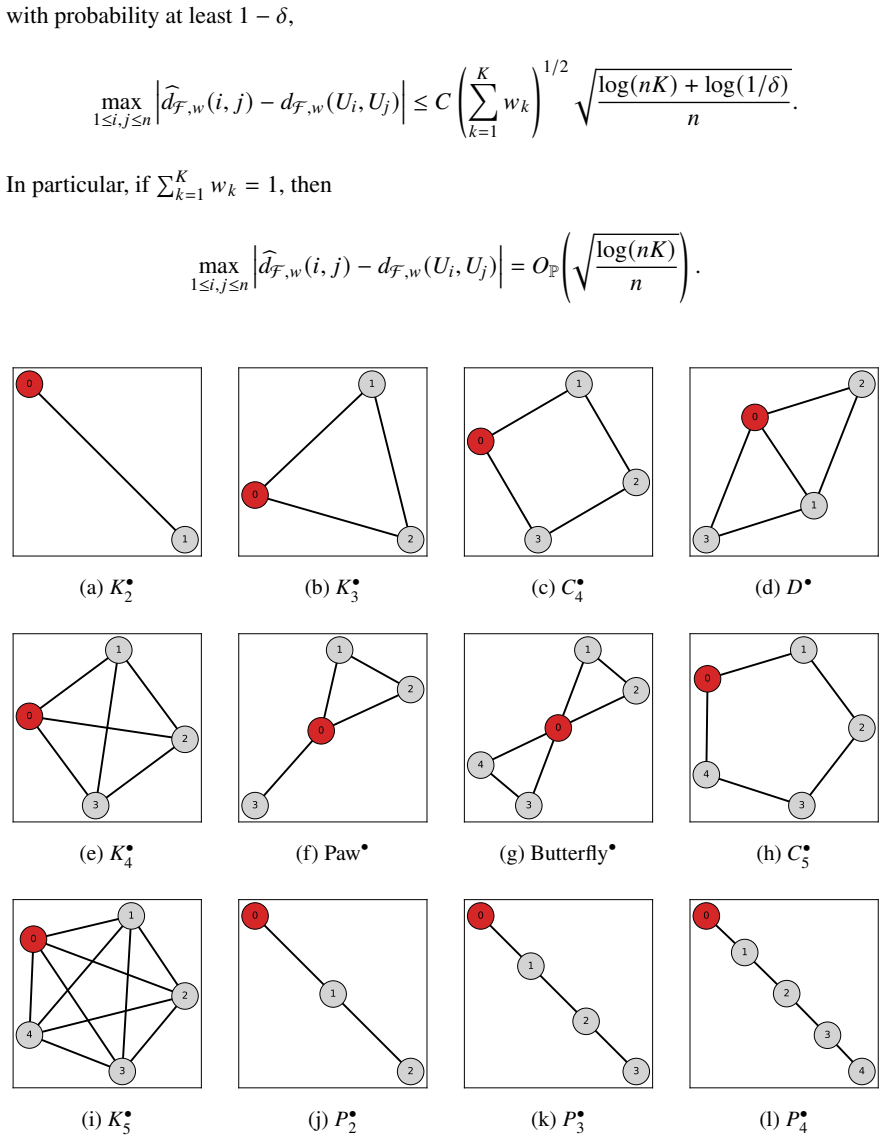
Rooted motif signatures, which record at each latent position the densities of rooted motifs such as triangles, cycles and paths.
If this is right
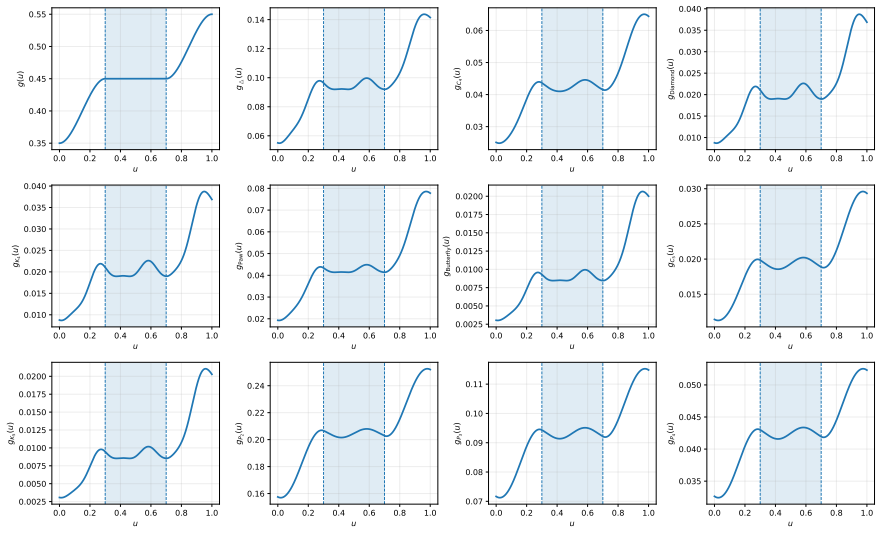
- Identifiability holds for graphons whose degree function is constant or non-injective.
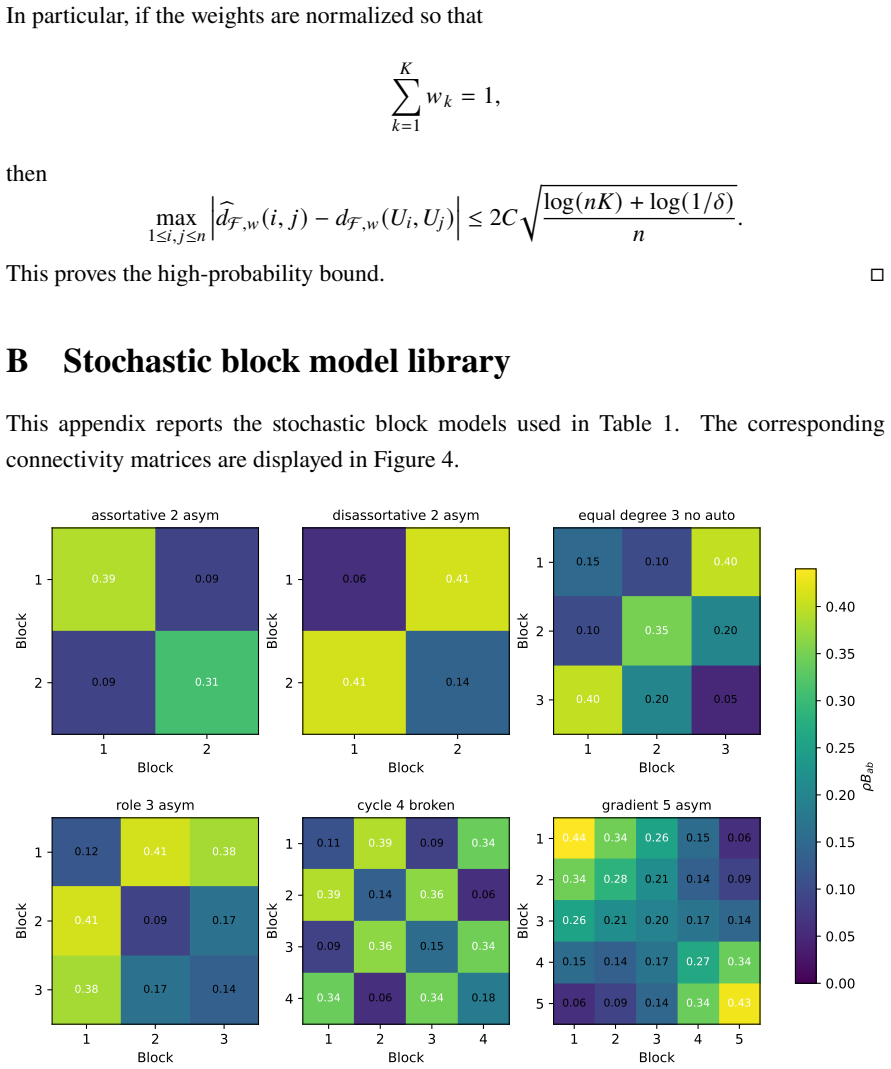
- The result covers stochastic block models with equal block degrees.
- Uniform concentration bounds apply to empirical rooted motif signatures computed from one graph.
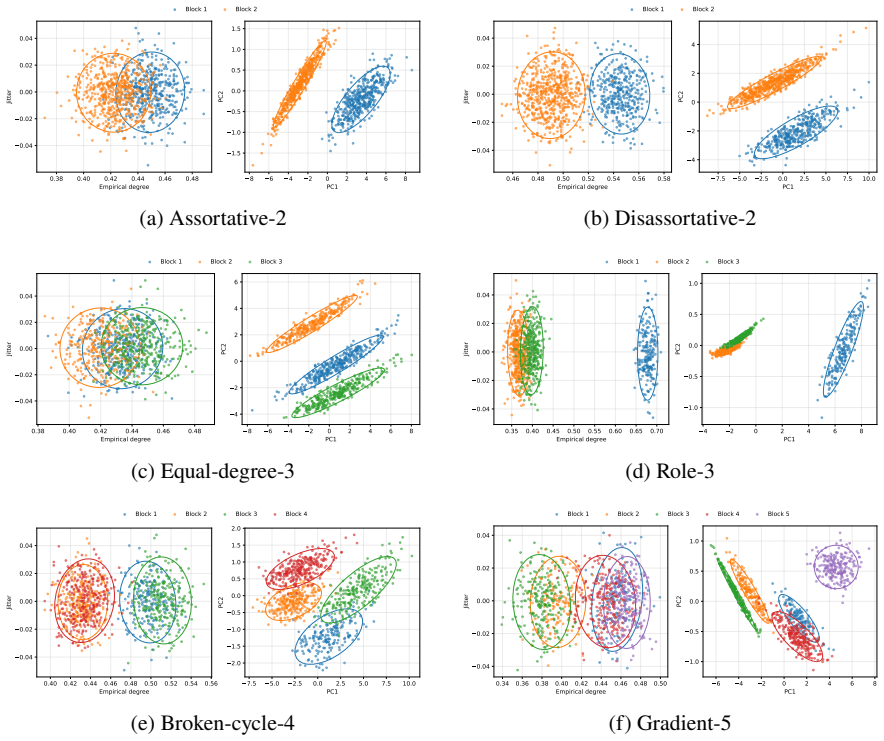
- Latent structure becomes recoverable in regimes where degree information alone is uninformative.
Where Pith is reading between the lines
- Motif signatures may supply node features for embedding algorithms on degree-homogeneous networks.
- The finite-rank restriction suggests checking whether infinite-rank graphons require motif collections of growing order.
- The same signatures could be tested as input features for community detection when block degrees coincide.
- Extensions to time-varying or multilayer graphons would require verifying that the generic finite-rank condition still separates positions.
Load-bearing premise
The graphon must be generic and finite-rank.
What would settle it
An explicit generic finite-rank graphon in which two distinct latent positions produce identical densities for every rooted motif in the chosen collection would falsify the identifiability claim.
Figures
read the original abstract
Graphon estimation requires structural assumptions to address its intrinsic non-identifiability. A standard approach is degree-based identifiability, where the degree function is assumed to be strictly monotonic. This assumption is rather restrictive and fails for graphons with constant or non-injective degree function, even when distinct latent positions have different connectivity profiles. In this paper, we introduce \emph{rooted motif signatures} as higher-order node-level representations for graphons. They extend the degree function by recording, at each latent position, the densities of rooted motifs such as triangles, cycles, paths, and other local subgraph patterns. We study the extent to which these signatures can distinguish latent positions beyond degree information. For generic finite-rank graphons, we prove that suitable rooted motif signatures determine the connectivity profiles of latent positions. We also explain why such a property cannot hold for arbitrary graphons without additional assumptions, since different latent positions may have identical rooted motif signatures. On the statistical side, we define empirical rooted motif signatures from a single observed graph and prove uniform concentration bounds for these estimators. Simulation experiments illustrate that rooted motif signatures can reveal latent structure in settings where degree-based representations are uninformative, including graphons with constant or non-injective degree functions and stochastic block models with equal block degrees.
Editorial analysis
A structured set of objections, weighed in public.
Referee Report
Summary. The paper introduces rooted motif signatures—node-level densities of rooted subgraphs such as triangles, cycles, and paths—as higher-order extensions of the degree function for graphon models. It proves that, under generic finite-rank assumptions, suitable choices of these signatures uniquely determine the connectivity profiles W(x,·) of latent positions x, while explicitly noting that the property fails for arbitrary graphons. The work also establishes uniform concentration bounds for empirical estimators computed from a single observed graph and presents simulations demonstrating recovery of latent structure in constant-degree graphons and equal-degree stochastic block models where degree-based methods are uninformative.
Significance. If the identifiability and concentration results hold, the contribution is significant: it relaxes the restrictive strict-monotonicity assumption on degrees that is standard in the graphon literature, thereby enlarging the class of identifiable models without introducing data-dependent parameters. The explicit scoping to generic finite-rank graphons, combined with both theoretical guarantees and targeted simulations, supplies a concrete, falsifiable advance for nonparametric network estimation.
minor comments (3)
- [§2] §2 (or wherever the finite-rank and genericity conditions are formalized): the precise measure-theoretic definition of 'generic' should be stated explicitly so that readers can verify it does not inadvertently exclude interesting finite-rank examples.
- [Simulation experiments] The simulation section would benefit from a brief statement of the exact motif collection used in each experiment and the numerical tolerance applied when checking signature equality.
- [Introduction / Definitions] Notation for rooted motif densities (e.g., the distinction between rooted and unrooted versions) should be introduced once with a small diagram or table to avoid later ambiguity.
Simulated Author's Rebuttal
We thank the referee for the positive summary, significance assessment, and recommendation for minor revision. We are grateful for the recognition that the rooted motif signatures relax the strict monotonicity assumption on degrees while providing explicit scoping to generic finite-rank graphons together with concentration bounds and targeted simulations.
Circularity Check
No significant circularity identified
full rationale
The derivation consists of a mathematical proof establishing identifiability of latent positions via rooted motif signatures for generic finite-rank graphons, with the abstract explicitly scoping the result and noting its failure for arbitrary graphons. No load-bearing steps reduce to self-definition, fitted parameters renamed as predictions, or self-citation chains; the finite-rank and generic assumptions function as domain conditions rather than data-dependent fits. The extension from degree functions to higher-order motifs is presented as a direct definitional and analytic step without circular reduction to inputs.
Axiom & Free-Parameter Ledger
axioms (1)
- domain assumption The graphon is generic and finite-rank
Reference graph
Works this paper leans on
-
[1]
Journal of Machine Learning Research , year =
Emmanuel Abbe , title =. Journal of Machine Learning Research , year =
-
[2]
Advances in Neural Information Processing Systems , volume =
Airoldi, Edoardo and Costa, Thiago and Chan, Stanley , title =. Advances in Neural Information Processing Systems , volume =. 2013 , pages =
2013
-
[3]
Statistical Mechanics of Complex Networks , journal =
Albert, R. Statistical Mechanics of Complex Networks , journal =. 2002 , volume =
2002
-
[4]
Journal of Multivariate Analysis , volume=
Representations for partially exchangeable arrays of random variables , author=. Journal of Multivariate Analysis , volume=
-
[5]
Nature Reviews Genetics , volume =
Alon, Uri , title =. Nature Reviews Genetics , volume =
-
[6]
Prominent examples of flip processes , volume =
Araújo, Pedro and Hladky, Jan and Hng, Eng Keat and Šileikis, Matas , year =. Prominent examples of flip processes , volume =
-
[7]
Statistics & Probability Letters , volume =
Arcones, Miguel , title =. Statistics & Probability Letters , volume =
-
[8]
On exchangeable random variables and the statistics of large graphs and hypergraphs , volume =
Austin, Tim , year =. On exchangeable random variables and the statistics of large graphs and hypergraphs , volume =. Probability Surveys , doi =
-
[9]
and Segarra, Santiago , title =
Avella-Medina, Marco and Parise, Francesca and Schaub, Michael T. and Segarra, Santiago , title =. IEEE Transactions on Network Science and Engineering , volume =
-
[10]
Proceedings of The 28th International Conference on Artificial Intelligence and Statistics , pages =
Scalable implicit graphon learning , author =. Proceedings of The 28th International Conference on Artificial Intelligence and Statistics , pages =. 2025 , editor =
2025
-
[11]
Science , volume =
Benson, Austin and Gleich, David and Leskovec, Jure , title =. Science , volume =
-
[12]
Bickel, Peter and Chen, Aiyou , title =. Proc. Natl. Acad. Sci. USA , year =
-
[13]
Convergent sequences of dense graphs I: Subgraph frequencies, metric properties and testing , journal =
Borgs, Christian and Chayes, Jennifer and Lov. Convergent sequences of dense graphs I: Subgraph frequencies, metric properties and testing , journal =. 2008 , volume =
2008
-
[14]
Moments of two-variable functions and the uniqueness of graph limits , journal =
Borgs, Christian and Chayes, Jennifer and Lov. Moments of two-variable functions and the uniqueness of graph limits , journal =. 2010 , volume =
2010
-
[15]
Advances in Neural Information Processing Systems , year =
Borgs, Christian and Chayes, Jennifer and Smith, Adam , title =. Advances in Neural Information Processing Systems , year =
-
[16]
Concentration Inequalities , publisher =
Boucheron, St. Concentration Inequalities , publisher =
-
[17]
An iterative step-function estimator for graphons
Cai, Diana and Ackerman, Nathanael and Freer, Cameron , title =. arXiv preprint arXiv:1412.2129 , year =
work page internal anchor Pith review Pith/arXiv arXiv
-
[18]
Medical Imaging with Deep Learning , pages =
DBGDGM: Dynamic Brain Graph Deep Generative Model , author =. Medical Imaging with Deep Learning , pages =. 2024 , volume =
2024
-
[19]
and Daudin, J and Pierre, L , title =
Celisse, A. and Daudin, J and Pierre, L , title =. Electronical Journal of Statistics , year = 2012, volume = 6, pages =
2012
-
[20]
The Annals of Applied Statistics , number =
Saint-Clair Chabert-Liddell and Pierre Barbillon and Sophie Donnet , title =. The Annals of Applied Statistics , number =
-
[21]
Journal of Mathematical Imaging and Vision , year =
Antonin Chambolle , title =. Journal of Mathematical Imaging and Vision , year =
-
[22]
and Khoshabeh, Ramsin and Gibson, Kristofor B
Chan, Stanley H. and Khoshabeh, Ramsin and Gibson, Kristofor B. and Gill, Philip E. and Nguyen, Truong Q. , journal=. An augmented lagrangian method for total variation video restoration , year=
-
[23]
International Conference on Machine Learning , year =
Chan, Stanley and Airoldi, Edoardo , title =. International Conference on Machine Learning , year =
-
[24]
Statistics Theory , year=
Classification and estimation in the Stochastic Block Model based on the empirical degrees , author=. Statistics Theory , year=
-
[25]
Matrix estimation by universal singular value thresholding , year =
Sourav Chatterjee , journal =. Matrix estimation by universal singular value thresholding , year =
-
[26]
and Wolfe, Patrick J
Choi, David S. and Wolfe, Patrick J. , title =. The Annals of Statistics , year =
-
[27]
Graphons, mergeons, and so on! , volume =
Eldridge, Justin and Belkin, Mikhail and Wang, Yusu , booktitle =. Graphons, mergeons, and so on! , volume =
-
[28]
On Random Graphs
Erd. On Random Graphs. Publicationes Mathematicae Debrecen , volume =
-
[29]
On the evolution of random graphs , fjournal =
Erd. On the evolution of random graphs , fjournal =. Publ. Math. Inst. Hung. Acad. Sci., Ser. A , volume =
-
[30]
Rendiconti di Matematica e delle sue Applicazioni, Series VII , year =
Diaconis, Persi and Janson, Svante , title =. Rendiconti di Matematica e delle sue Applicazioni, Series VII , year =
-
[31]
NeuroImage , year=
Graph analysis of the human connectome: Promise, progress, and pitfalls , author=. NeuroImage , year=
-
[32]
Quick Approximation to Matrices and Applications , volume =
Frieze, Alan and Kannan, Ravindran , year =. Quick Approximation to Matrices and Applications , volume =. Combinatorica , doi =
-
[33]
Annals of Statistics , year=
Rate-optimal graphon estimation , author=. Annals of Statistics , year=
-
[34]
, title =
Gao, Shuang and Caines, Peter E. , title =. IEEE Conference on Decision and Control , year =
-
[35]
Foundations and Trends® in Machine Learning , title =. 2010 , volume =. doi:10.1561/2200000005 , issn =
-
[36]
Proceedings of the 39th International Conference on Machine Learning , pages =
G-Mixup: Graph data augmentation for graph classification , author =. Proceedings of the 39th International Conference on Machine Learning , pages =. 2022 , editor =
2022
-
[37]
Journal of the American Statistical Association , volume =
Hoeffding, Wassily , title =. Journal of the American Statistical Association , volume =
-
[38]
Journal of the American Statistical Association , volume =
Peter D Hoff and Adrian E Raftery and Mark S Handcock , title =. Journal of the American Statistical Association , volume =. 2002 , publisher =
2002
-
[39]
, title =
Hoover, Douglas N. , title =
-
[40]
A graphon counter example , volume =
Janson, Svante , year =. A graphon counter example , volume =. Discrete Mathematics , doi =
-
[41]
1989 , doi =
On the representation theorem for exchangeable arrays , journal =. 1989 , doi =
1989
-
[42]
Kallenberg, Olav , title =
-
[43]
IEEE Transactions on Information Theory , issn =
Matrix completion from a few entries , author =. IEEE Transactions on Information Theory , issn =. 2010 , volume =
2010
-
[44]
International Conference on Learning Representations , year=
Adam: A method for stochastic optimization , author=. International Conference on Learning Representations , year=
-
[45]
The Annals of Statistics , YEAR =
Olga Klopp and Alexandre Tsybakov and Nicolas Verzelen , TITLE =. The Annals of Statistics , YEAR =
-
[46]
Eric Kolaczyk , title =. 2009 , isbn =. doi:10.1007/978-0-387-88146-1 , pages =
-
[47]
The Annals of Statistics , volume =
Lei, Jing and Rinaldo, Alessandro , title =. The Annals of Statistics , volume =
-
[48]
, title =
Lloyd, James Robert and Orbanz, Peter and Ghahramani, Zoubin and Roy, Daniel M. , title =. 2012 , booktitle =
2012
-
[49]
Limits of dense graph sequences , journal =
Lov\'. Limits of dense graph sequences , journal =. 2006 , volume =
2006
-
[50]
Large Networks and Graph Limits , series =
Lov. Large Networks and Graph Limits , series =. 2012 , doi =
2012
-
[51]
, title =
Jolliffe, Ian T. , title =
-
[52]
Surveys in Combinatorics , publisher =
McDiarmid, Colin , title =. Surveys in Combinatorics , publisher =
-
[53]
and Robin, S
Matias, C. and Robin, S. , title =. Esaim Proc. & Surveys , year = 2014, volume = 47, pages =
2014
-
[54]
Philosophical Transactions of the Royal Society A , volume =
Mercer, James , title =. Philosophical Transactions of the Royal Society A , volume =
-
[55]
Science , volume =
Milo, Ron and Shen-Orr, Shalev and Itzkovitz, Shai and Kashtan, Nadav and Chklovskii, Dmitri and Alon, Uri , title =. Science , volume =
-
[56]
Proceedings of the International Conference on Machine Learning, Workshop on Graph Representation Learning and Beyond (GRL+ 2020) , year =
TUDataset: A Collection of benchmark datasets for learning with graphs , author =. Proceedings of the International Conference on Machine Learning, Workshop on Graph Representation Learning and Beyond (GRL+ 2020) , year =
2020
-
[57]
ICASSP 2023-2023 IEEE International Conference on Acoustics, Speech and Signal Processing , pages=
GraphMAD: Graph mixup for data augmentation using data-driven convex clustering , author=. ICASSP 2023-2023 IEEE International Conference on Acoustics, Speech and Signal Processing , pages=. 2023 , organization=
2023
-
[58]
, title =
Newman, M. , title =. SIAM Review , year =
-
[59]
and Wolfe, Patrick J
Olhede, Sofia C. and Wolfe, Patrick J. , title =. Proceedings of the National Academy of Sciences , year =
-
[60]
and K\'efi, Sonia and Massol, Fran cois and Mouquet, Nicolas and Romanuk, Tamara N
Poisot, Timoth\'ee and Baiser, Benjamin and Dunne, Jennifer A. and K\'efi, Sonia and Massol, Fran cois and Mouquet, Nicolas and Romanuk, Tamara N. and Stouffer, Daniel B. and Wood, Spencer A. and Gravel, Dominique , title =. Ecography , volume =
-
[61]
Statistics and Computing , year=
Tabea Rebafka , title=. Statistics and Computing , year=
-
[62]
The Annals of Statistics , volume =
Rohe, Karl and Chatterjee, Sourav and Yu, Bin , title =. The Annals of Statistics , volume =
-
[63]
Advances in Neural Information Processing Systems , volume=
Graphon neural networks and the transferability of graph neural networks , author=. Advances in Neural Information Processing Systems , volume=
-
[64]
IEEE Transactions on Signal Processing , volume=
Transferability properties of graph neural networks , author=. IEEE Transactions on Signal Processing , volume=. 2023 , publisher=
2023
-
[65]
EM-based smooth graphon estimation using MCMC and spline-based approaches , journal =. 2022 , issn =. doi:https://doi.org/10.1016/j.socnet.2021.08.007 , author =
-
[66]
Implicit Neural Representations with Periodic Activation Functions , volume =
Sitzmann, Vincent and Martel, Julien and Bergman, Alexander and Lindell, David and Wetzstein, Gordon , booktitle =. Implicit Neural Representations with Periodic Activation Functions , volume =
-
[67]
Journal of the American Statistical Association , year =
K Nowicki and T Snijders , title =. Journal of the American Statistical Association , year =
-
[68]
Proceedings of The 29th International Conference on Artificial Intelligence and Statistics , year =
Sogan, Roland Boniface and Rebafka, Tabea , title =. Proceedings of The 29th International Conference on Artificial Intelligence and Statistics , year =
-
[69]
and Fishkind, Donniell E
Tang, Minh and Sussman, Daniel L. and Fishkind, Donniell E. and Priebe, Carey E. , title =. The Annals of Statistics , volume =
-
[70]
, title =
Tsybakov, Alexandre B. , title =. 2009 , series =
2009
-
[71]
Weber-Zendrera and N
A. Weber-Zendrera and N. Sokolovska and H. Soula , Title =
-
[72]
arXiv: Statistics Theory , year=
Nonparametric graphon estimation , author=. arXiv: Statistics Theory , year=
-
[73]
, journal=
Wu, Zonghan and Pan, Shirui and Chen, Fengwen and Long, Guodong and Zhang, Chengqi and Yu, Philip S. , journal=. A Comprehensive survey on graph neural networks , year=
-
[74]
Proceedings of The 26th International Conference on Artificial Intelligence and Statistics , pages =
Implicit graphon neural representation , author =. Proceedings of The 26th International Conference on Artificial Intelligence and Statistics , pages =. 2023 , editor =
2023
-
[75]
7th International Conference on Learning Representations , year =
How powerful are graph neural networks? , author =. 7th International Conference on Learning Representations , year =
-
[76]
Learning Graphons via Structured Gromov-Wasserstein Barycenters , volume =
Xu, Hongteng and Luo, Dixin and Carin, Lawrence and Zha, Hongyuan , year =. Learning Graphons via Structured Gromov-Wasserstein Barycenters , volume =. Proceedings of the AAAI Conference on Artificial Intelligence , doi =
-
[77]
ACM SIGKDD International Conference on Knowledge Discovery and Data Mining , year=
Deep graph kernels , author=. ACM SIGKDD International Conference on Knowledge Discovery and Data Mining , year=
-
[78]
International Conference on Artificial Intelligence and Statistics , year=
Nonparametric estimation and testing of exchangeable graph models , author=. International Conference on Artificial Intelligence and Statistics , year=
-
[79]
and Levina, E
Zhang, Y. and Levina, E. and Zhu, J. , title =. Biometrika , volume =
-
[80]
Electronic Journal of Statistics , year =
Ambroise, Christophe and Chiquet, Julien and Matias, Catherine , title =. Electronic Journal of Statistics , year =
discussion (0)
Sign in with ORCID, Apple, or X to comment. Anyone can read and Pith papers without signing in.