EHHN: An Event-driven Heterogeneous Hypergraph Network for Object-Centric Next Activity Prediction
Pith reviewed 2026-07-03 17:25 UTC · model grok-4.3
The pith
A heterogeneous hypergraph with dual-stream fusion predicts next activities in object-centric event logs more accurately than existing approaches.
A machine-rendered reading of the paper's core claim, the machinery that carries it, and where it could break.
Core claim
EHHN represents each prediction prefix as a heterogeneous hypergraph, where event--object hyperedges bind retained co-participating objects and a lifecycle hyperedge groups the primary object's observed lifecycle events. Based on this representation, EHHN uses a dual-stream architecture in which a micro-spatial stream models event-driven object-state evolution and a macro-evolution stream captures temporal dynamics using retrieved global prototypes. The two streams are fused to predict the next activity.
What carries the argument
Heterogeneous hypergraph representation of prediction prefixes combined with a dual-stream micro-spatial and macro-evolution architecture for fusion-based prediction.
If this is right
- Processes can anticipate steps to avoid delays and exceptions in multi-object services.
- Cross-object context is retained without losing information through flattening.
- Both local event timing and global execution patterns inform the predictions.
- GPU memory usage drops substantially compared to native graph models on the same data.
Where Pith is reading between the lines
- The hypergraph construction might apply to predicting other outcomes like remaining time or next object in OCEL data.
- Similar dual-stream designs could enhance other hypergraph applications in temporal data.
- Further work could explore adaptive hyperedge selection for varying object complexities.
Load-bearing premise
The event-object hyperedges and lifecycle hyperedges together with the dual-stream fusion capture all required context for next activity prediction on the tested benchmarks.
What would settle it
Evaluating EHHN on the four public OCEL benchmarks without any post-hoc data exclusions and observing no improvement in accuracy or macro F1-score over the strongest of the nine baselines.
Figures


read the original abstract
Next activity prediction helps service-oriented processes anticipate upcoming steps before delays, exceptions, or service-level risks occur. Most existing methods assume classical single-case event logs, whereas real service processes often involve events shared by multiple typed business objects. Object-centric event logs (OCELs) capture such interactions, but current predictors remain limited. Flattening-based approaches lose cross-object context, and native OCEL graph-based approaches encode multi-object events through pairwise relations. Existing models also do not jointly capture event-driven object state changes, inter-event timing, and global execution patterns. We propose EHHN, an Event-driven Heterogeneous Hypergraph Network for object-centric next activity prediction. EHHN represents each prediction prefix as a heterogeneous hypergraph, where event--object hyperedges bind retained co-participating objects and a lifecycle hyperedge groups the primary object's observed lifecycle events. Based on this representation, EHHN uses a dual-stream architecture in which a micro-spatial stream models event-driven object-state evolution and a macro-evolution stream captures temporal dynamics using retrieved global prototypes. The two streams are fused to predict the next activity. Experiments on four public OCEL benchmarks against nine baselines show that EHHN achieves the best accuracy and macro F1-score on all datasets, with improvements of up to 8.1 and 12.4 percentage points over the strongest baselines. Compared with the strongest OCEL-native graph baseline, EHHN also reduces peak GPU memory by up to 24 times. Code is available at https://github.com/chenkaitao1112/EHHN.
Editorial analysis
A structured set of objections, weighed in public.
Referee Report
Summary. The paper proposes EHHN, an event-driven heterogeneous hypergraph network for next-activity prediction on object-centric event logs (OCELs). Each prefix is encoded as a heterogeneous hypergraph with event-object hyperedges (for co-participating objects) and a lifecycle hyperedge (for the primary object's events). A dual-stream architecture is used: a micro-spatial stream models event-driven object-state evolution and a macro-evolution stream captures temporal dynamics via retrieved global prototypes; the streams are fused for prediction. Experiments on four public OCEL benchmarks against nine baselines report that EHHN achieves the highest accuracy and macro F1 on every dataset (gains up to 8.1 and 12.4 pp) and reduces peak GPU memory by up to 24× versus the strongest OCEL-native graph baseline.
Significance. If the reported gains and memory reductions hold under rigorous verification, the work offers a concrete advance over both flattening-based and pairwise-graph OCEL predictors by jointly encoding cross-object context, timing, and global patterns. The memory-efficiency result is particularly noteworthy for deployment on large logs. The open code link is a positive factor for reproducibility.
major comments (3)
- [§4] §4 (Experiments) and the abstract: the headline claim of best accuracy/F1 on all four benchmarks with gains up to 8.1/12.4 pp is load-bearing, yet the section supplies no protocol for prefix construction, hyperparameter search, statistical testing, or error bars; without these the superiority cannot be verified against the nine baselines.
- [§3.3] §3.3 (Macro-evolution stream): the description of prototype retrieval does not state whether retrieval is restricted to the training portion of each log. If test prefixes or future events are included, the reported gains become unreliable due to information leakage; this directly affects the central claim that the dual-stream fusion suffices without overfitting.
- [§3.2] §3.2 (Hypergraph construction): the sufficiency of event-object hyperedges plus a single lifecycle hyperedge for capturing all necessary higher-order object interactions and timing is asserted but not tested via ablation; if this representation misses key patterns, both the accuracy gains and the 24× memory reduction versus graph baselines rest on an unverified assumption.
minor comments (2)
- [§3] Notation for hyperedge types and stream outputs is introduced without a consolidated table of symbols; a single notation table would improve readability.
- [Figure 2] Figure 2 (architecture diagram) uses small font sizes for stream labels; enlarging these would aid clarity.
Simulated Author's Rebuttal
We thank the referee for the detailed and constructive feedback. We address each of the major comments below, providing clarifications and committing to revisions where appropriate to improve the manuscript's rigor and reproducibility.
read point-by-point responses
-
Referee: [§4] §4 (Experiments) and the abstract: the headline claim of best accuracy/F1 on all four benchmarks with gains up to 8.1/12.4 pp is load-bearing, yet the section supplies no protocol for prefix construction, hyperparameter search, statistical testing, or error bars; without these the superiority cannot be verified against the nine baselines.
Authors: We agree that providing these experimental details is essential for verifying the reported results. In the revised manuscript, we will expand §4 to include: (1) the exact protocol for constructing prediction prefixes from the OCEL logs, (2) the hyperparameter search strategy and ranges, (3) the statistical testing procedure (e.g., multiple runs with different seeds and significance tests), and (4) error bars or standard deviations in the reported accuracy and F1 scores. This will allow direct comparison with the baselines. revision: yes
-
Referee: [§3.3] §3.3 (Macro-evolution stream): the description of prototype retrieval does not state whether retrieval is restricted to the training portion of each log. If test prefixes or future events are included, the reported gains become unreliable due to information leakage; this directly affects the central claim that the dual-stream fusion suffices without overfitting.
Authors: We confirm that all prototype retrieval in the macro-evolution stream is strictly limited to the training set of each log to avoid any information leakage from test data or future events. The global prototypes are computed solely from training prefixes. We will revise the description in §3.3 to explicitly state this restriction and provide additional details on how the retrieval is implemented to ensure no test information is used. revision: yes
-
Referee: [§3.2] §3.2 (Hypergraph construction): the sufficiency of event-object hyperedges plus a single lifecycle hyperedge for capturing all necessary higher-order object interactions and timing is asserted but not tested via ablation; if this representation misses key patterns, both the accuracy gains and the 24× memory reduction versus graph baselines rest on an unverified assumption.
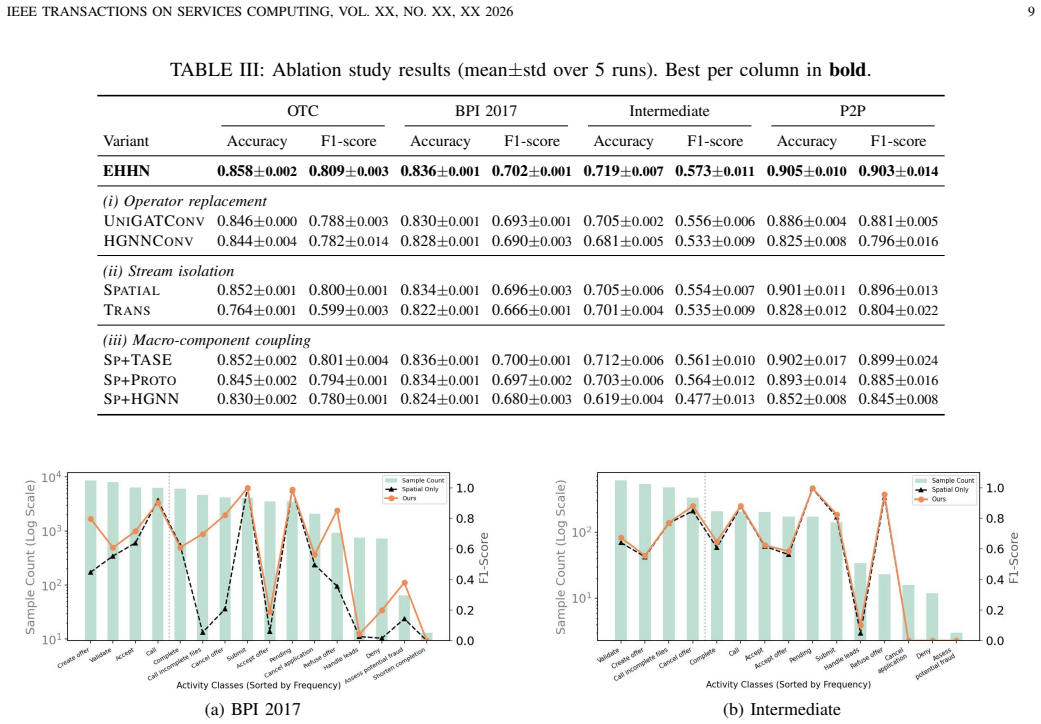
Authors: We acknowledge that an ablation study on the hyperedge types would strengthen the justification for our hypergraph construction. While the design is motivated by the need to capture co-participation and lifecycle without excessive complexity, we will add an ablation experiment in the revised §4 comparing variants with and without each hyperedge type to empirically validate their contribution to performance and efficiency. revision: yes
Circularity Check
No circularity; empirical evaluation on external public benchmarks is independent of model internals
full rationale
The paper introduces EHHN as a heterogeneous hypergraph model with event-object and lifecycle hyperedges plus a dual-stream (micro-spatial and macro-evolution) architecture whose outputs are fused for next-activity prediction. All load-bearing claims are performance numbers (accuracy, macro F1, memory) measured on four fixed public OCEL benchmarks against nine external baselines; these quantities are not algebraically or statistically forced by any fitted parameter inside the model. No equation equates a prediction to a quantity defined from the same fitted values, no uniqueness theorem is imported from self-citation, and no ansatz is smuggled via prior work. The derivation chain is therefore self-contained against external data.
Axiom & Free-Parameter Ledger
free parameters (2)
- hyperedge construction thresholds
- prototype retrieval parameters
Reference graph
Works this paper leans on
-
[1]
PROPHET: Explainable predictive process monitoring with heterogeneous graph neural networks,
V . Pasquadibisceglie, R. Scaringi, A. Appice, G. Castellano, and D. Malerba, “PROPHET: Explainable predictive process monitoring with heterogeneous graph neural networks,”IEEE Transactions on Services Computing, vol. 17, no. 4, pp. 1521–1534, 2024. IEEE TRANSACTIONS ON SERVICES COMPUTING, VOL. XX, NO. XX, XX 2026 12
2024
-
[2]
Mhg-predictor: A multi-layer heterogeneous graph-based predictor for next activity in complex business processes,
J. Wang, Y . Yu, N. Fang, B. Cao, J. Fan, and J. Zhang, “Mhg-predictor: A multi-layer heterogeneous graph-based predictor for next activity in complex business processes,” inCompanion Proceedings of the ACM on Web Conference 2025, 2025, pp. 500–509
2025
-
[3]
Next activity prediction of ongoing business processes based on deep learning,
X. Sun, S. Yang, Y . Ying, and D. Yu, “Next activity prediction of ongoing business processes based on deep learning,”Expert Systems, vol. 41, no. 5, p. e13421, 2024
2024
-
[4]
A switch-transformer predic- tive process monitoring model for next activity prediction in business process management,
T.-H. Nguyen, K.-S. Kim, and K. P. Kim, “A switch-transformer predic- tive process monitoring model for next activity prediction in business process management,” inProceedings of the 2024 8th International Conference on Advances in Artificial Intelligence, 2024, pp. 196–200
2024
-
[5]
H. Zare, M. Abbasi, M. Ahang, and H. Najjaran, “An innovative next activity prediction approach using process entropy and daw-transformer,” arXiv preprint arXiv:2502.10573, 2025
work page internal anchor Pith review Pith/arXiv arXiv 2025
-
[6]
Snap: semantic stories for next activity prediction,
A. Oved, S. Shlomov, S. Zeltyn, N. Mashkif, and A. Yaeli, “Snap: semantic stories for next activity prediction,” inProceedings of the AAAI Conference on Artificial Intelligence, vol. 39, no. 28, 2025, pp. 28 871– 28 877
2025
-
[7]
Dual-view deep learning approach for predictive business process monitoring,
B. Chen, S. Zhao, Q. Zhang, C. Tang, and L. Lin, “Dual-view deep learning approach for predictive business process monitoring,”IEEE Transactions on Services Computing, vol. 18, 2025, early access
2025
-
[8]
Higpp: A history-informed graph-based process predictor for next activity,
J. Wang, C. Lu, Y . Yu, B. Cao, K. Fang, and J. Fan, “Higpp: A history-informed graph-based process predictor for next activity,” in International Conference on Service-Oriented Computing. Springer, 2025, pp. 337–353
2025
-
[9]
Ocel: A standard for object-centric event logs,
A. F. Ghahfarokhi, G. Park, A. Berti, and W. M. P. van der Aalst, “Ocel: A standard for object-centric event logs,” inNew Trends in Database and Information Systems, L. Bellatreche, M. Dumas, P. Karras, R. Matulevi ˇcius, A. Awad, M. Weidlich, M. Ivanovi ´c, and O. Hartig, Eds. Cham: Springer International Publishing, 2021, pp. 169–175
2021
-
[10]
A comparative analysis of predictive pro- cess monitoring: Object-centric versus classical event logs,
S. Fioretto and E. Masciari, “A comparative analysis of predictive pro- cess monitoring: Object-centric versus classical event logs,”Knowledge and Information Systems, vol. 67, pp. 7355–7398, 2025
2025
-
[11]
Object-centric predic- tive process monitoring,
W. Gherissi, J. El Haddad, and D. Grigori, “Object-centric predic- tive process monitoring,” inService-Oriented Computing—ICSOC 2022 Workshops, ser. LNCS, vol. 13821. Springer, 2023, pp. 27–39
2022
-
[12]
Predictive object-centric process monitoring,
T. Rohrer, A. F. Ghahfarokhi, M. Behery, G. Lakemeyer, and W. M. P. van der Aalst, “Predictive object-centric process monitoring,”arXiv preprint arXiv:2207.10017, 2022
-
[13]
Object-centric process predictive analytics,
R. Galanti, M. de Leoni, N. Navarin, and A. Marazzi, “Object-centric process predictive analytics,”Expert Systems with Applications, vol. 213, p. 119173, 2023
2023
-
[14]
A framework for extracting and encoding features from object-centric event data,
J. N. Adams, G. Park, S. Levich, D. Schuster, and W. M. P. van der Aalst, “A framework for extracting and encoding features from object-centric event data,” inInternational Conference on Service-Oriented Computing (ICSOC). Springer, 2022, pp. 36–53
2022
-
[15]
Preserving complex object-centric graph structures to improve machine learning tasks in process mining,
J. N. Adams, G. Park, and W. M. P. van der Aalst, “Preserving complex object-centric graph structures to improve machine learning tasks in process mining,”Engineering Applications of Artificial Intelligence, vol. 125, p. 106764, 2023
2023
-
[16]
HOEG: A new approach for object-centric predictive process monitoring,
T. K. Smit, H. A. Reijers, and X. Lu, “HOEG: A new approach for object-centric predictive process monitoring,” inAdvanced Information Systems Engineering (CAiSE), ser. LNCS, vol. 14663. Springer, 2024, pp. 231–247
2024
-
[17]
A framework for object- centric predictive process monitoring using graph-based process execu- tions,
W. Gherissi, J. El Haddad, and D. Grigori, “A framework for object- centric predictive process monitoring using graph-based process execu- tions,” inIEEE International Conference on Web Services, 2025
2025
-
[18]
Predictive monitoring of business processes: A survey,
A. E. M ´arquez-Chamorro, M. Resinas, and A. Ruiz-Cort ´es, “Predictive monitoring of business processes: A survey,”IEEE Transactions on Services Computing, vol. 11, no. 6, pp. 962–977, 2017
2017
-
[19]
Clustering-based predictive process monitoring,
C. Di Francescomarino, M. Dumas, F. M. Maggi, and I. Teinemaa, “Clustering-based predictive process monitoring,”IEEE Transactions on Services Computing, vol. 12, no. 6, pp. 896–909, 2019
2019
-
[20]
Probability based heuristic for pre- dictive business process monitoring,
K. B ¨ohmer and S. Rinderle-Ma, “Probability based heuristic for pre- dictive business process monitoring,” inOn the Move to Meaningful Internet Systems (OTM). Springer, 2018, pp. 78–96
2018
-
[21]
An empirical comparison of classification techniques for next event prediction using business process event logs,
B. A. Tama and M. Comuzzi, “An empirical comparison of classification techniques for next event prediction using business process event logs,” Expert Systems with Applications, vol. 129, pp. 233–245, 2019
2019
-
[22]
Predictive business process monitoring with LSTM neural networks,
N. Tax, I. Verenich, M. La Rosa, and M. Dumas, “Predictive business process monitoring with LSTM neural networks,” inAdvanced Informa- tion Systems Engineering (CAiSE), 2017, pp. 477–492
2017
-
[23]
Learning accurate LSTM models of business processes,
M. Camargo, M. Dumas, and O. Gonz ´alez-Rojas, “Learning accurate LSTM models of business processes,” inBusiness Process Management (BPM), ser. LNCS, vol. 11675. Springer, 2019, pp. 286–302
2019
-
[24]
A direct data aware LSTM neural network architecture for complete remaining trace and runtime prediction,
B. R. Gunnarsson, S. vanden Broucke, and J. De Weerdt, “A direct data aware LSTM neural network architecture for complete remaining trace and runtime prediction,”IEEE Transactions on Services Computing, vol. 16, no. 4, pp. 2330–2342, 2023
2023
-
[25]
Processtransformer: Predictive business process monitoring with transformer network,
Z. A. Bukhsh, A. Saeed, and R. M. Dijkman, “Processtransformer: Predictive business process monitoring with transformer network,”arXiv preprint arXiv:2104.00721, 2021
-
[26]
Predictive business process monitoring approach based on hierarchical transformer,
W. Ni, G. Zhao, T. Liu, Q. Zeng, and X. Xu, “Predictive business process monitoring approach based on hierarchical transformer,”Electronics, vol. 12, no. 6, p. 1273, 2023
2023
-
[27]
Ham-net: Predictive business process monitoring with a hierarchical attention mechanism,
A. Jalayer, M. Kahani, A. Pourmasoumi, and A. Beheshti, “Ham-net: Predictive business process monitoring with a hierarchical attention mechanism,”Knowledge-Based Systems, vol. 236, p. 107722, 2022
2022
-
[28]
A multi-view deep learning approach for predictive business process mon- itoring,
V . Pasquadibisceglie, A. Appice, G. Castellano, and D. Malerba, “A multi-view deep learning approach for predictive business process mon- itoring,”IEEE Transactions on Services Computing, vol. 15, no. 4, pp. 2382–2395, 2022
2022
-
[29]
Mitfm: A multi-view information fusion method based on transformer for next activity prediction of business processes,
J. Wang, C. Lu, B. Cao, and J. Fan, “Mitfm: A multi-view information fusion method based on transformer for next activity prediction of business processes,” inProceedings of the 14th Asia-Pacific Symposium on Internetware, 2023, pp. 281–291
2023
-
[30]
Multi-task prediction method of business process based on bert and transfer learning,
H. Chen, X. Fang, and H. Fang, “Multi-task prediction method of business process based on bert and transfer learning,”Knowledge-Based Systems, vol. 254, p. 109603, 2022
2022
-
[31]
Jarvis: Joining adversarial training with vision transformers in next-activity prediction,
V . Pasquadibisceglie, A. Appice, G. Castellano, and D. Malerba, “Jarvis: Joining adversarial training with vision transformers in next-activity prediction,”IEEE Transactions on Services Computing, vol. 17, no. 4, pp. 1593–1606, 2024
2024
-
[32]
I. Donadello, J. Ko, F. M. Maggi, J. Mendling, F. Riva, and M. Weidlich, “Knowledge-driven modulation of neural networks with attention mech- anism for next activity prediction,”arXiv preprint arXiv:2312.08847, 2023
-
[33]
Lupin: A llm approach for activity suffix prediction in business process event logs,
V . Pasquadibisceglie, A. Appice, and D. Malerba, “Lupin: A llm approach for activity suffix prediction in business process event logs,” in2024 6th International Conference on Process Mining (ICPM), 2024, pp. 1–8
2024
-
[34]
Enhancing next activity prediction in process mining with retrieval-augmented generation,
A. Casciani, M. L. Bernardi, M. Cimitile, and A. Marrella, “Enhancing next activity prediction in process mining with retrieval-augmented generation,”Information Systems, vol. 137, p. 102642, 2026
2026
-
[35]
Exploiting instance graphs and graph neural networks for next activity prediction,
A. Chiorrini, C. Diamantini, A. Mircoli, and D. Potena, “Exploiting instance graphs and graph neural networks for next activity prediction,” inInternational conference on process mining. Springer, 2021, pp. 115–126
2021
-
[36]
Multi- perspective enriched instance graphs for next activity prediction through graph neural network,
A. Chiorrini, C. Diamantini, L. Genga, and D. Potena, “Multi- perspective enriched instance graphs for next activity prediction through graph neural network,”Journal of Intelligent Information Systems, vol. 61, no. 1, pp. 5–25, 2023
2023
-
[37]
Embedding graph convolutional networks in recurrent neural networks for predictive monitoring,
E. Rama-Maneiro, J. C. Vidal, and M. Lama, “Embedding graph convolutional networks in recurrent neural networks for predictive monitoring,”IEEE Transactions on Knowledge and Data Engineering, vol. 36, no. 1, pp. 137–151, 2024
2024
-
[38]
Enhancing predictive process monitoring with sequential graphs and trace atten- tion,
Y . Deng, J. Wang, C. Wang, C. Zheng, M. Li, and B. Li, “Enhancing predictive process monitoring with sequential graphs and trace atten- tion,” inIEEE International Conference on Web Services. IEEE, 2024, pp. 406–415
2024
-
[39]
Predictive process monitoring using object-centric graph embeddings,
W. Gherissi, M. Acheli, J. E. Haddad, and D. Grigori, “Predictive process monitoring using object-centric graph embeddings,” inInternational Conference on Service-Oriented Computing. Springer, 2024, pp. 55–67
2024
-
[40]
Unignn: a unified framework for graph and hypergraph neural networks,
J. Huang and J. Yang, “Unignn: a unified framework for graph and hypergraph neural networks,”ArXiv, vol. abs/2105.00956, 2021
-
[41]
GNN-FiLM: Graph neural networks with feature- wise linear modulation,
M. Brockschmidt, “GNN-FiLM: Graph neural networks with feature- wise linear modulation,” inProceedings of the 37th International Conference on Machine Learning (ICML), ser. PMLR, vol. 119, 2020, pp. 1144–1152
2020
-
[42]
Semi-supervised classification with graph convolutional networks,
T. N. Kipf and M. Welling, “Semi-supervised classification with graph convolutional networks,” inInternational Conference on Learning Rep- resentations (ICLR), 2017
2017
-
[43]
P. Velickovic, G. Cucurull, A. Casanova, A. Romero, P. Li `o, and Y . Bengio, “Graph attention networks,”ArXiv, vol. abs/1710.10903, 2017
work page internal anchor Pith review Pith/arXiv arXiv 2017
-
[44]
Graph transformer networks,
S. Yun, M. Jeong, R. Kim, J. Kang, and H. J. Kim, “Graph transformer networks,” inNeural Information Processing Systems, 2019
2019
-
[45]
Scikit-learn: Machine learning in python,
F. Pedregosa, G. Varoquaux, A. Gramfort, V . Michel, B. Thirion, O. Grisel, M. Blondel, G. Louppe, P. Prettenhofer, R. Weiss, R. J. Weiss, J. Vanderplas, A. Passos, D. Cournapeau, M. Brucher, M. Perrot, and E. Duchesnay, “Scikit-learn: Machine learning in python,”J. Mach. Learn. Res., vol. 12, pp. 2825–2830, 2011
2011
discussion (0)
Sign in with ORCID, Apple, or X to comment. Anyone can read and Pith papers without signing in.