Quantum-optimal coronagraphy with spatial mode sorting for direct exoplanet observations
Pith reviewed 2026-07-03 05:08 UTC · model grok-4.3
The pith
The spatial mode maximizing classical signal-to-noise ratio approximates the quantum-optimal mode for exoplanet detection to leading order in stellar leakage and planet flux ratio.
A machine-rendered reading of the paper's core claim, the machinery that carries it, and where it could break.
Core claim
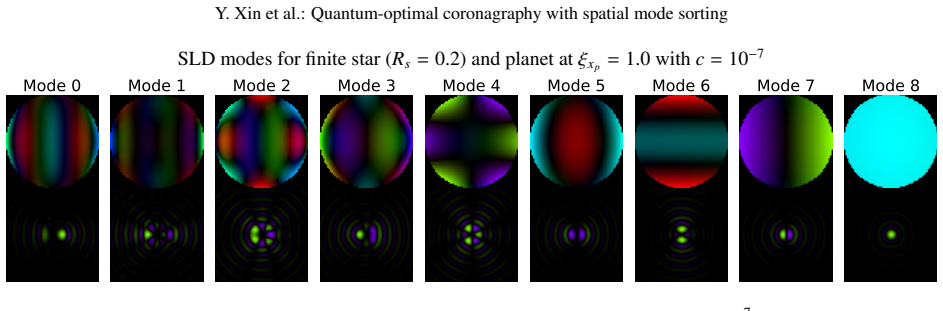
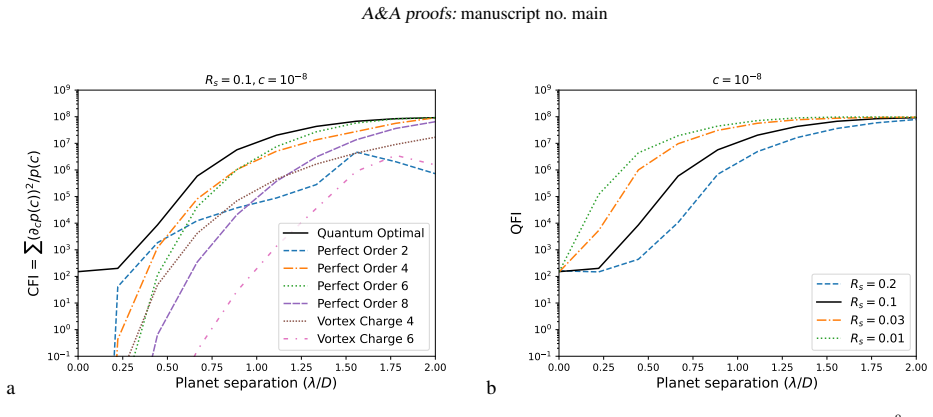
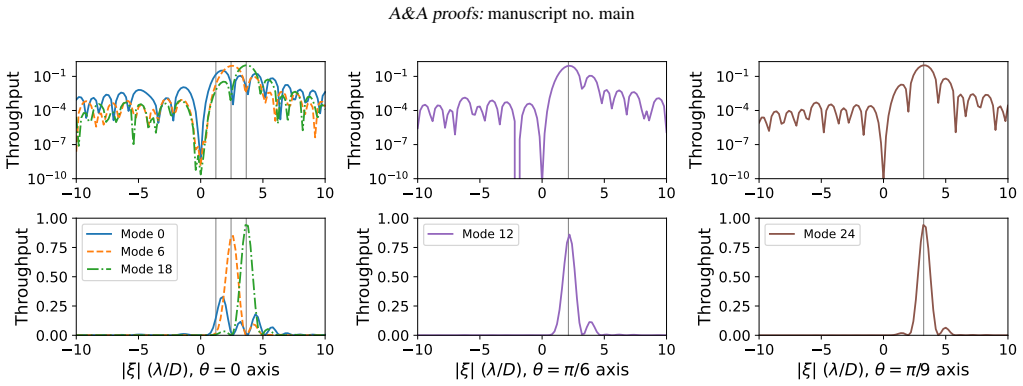
The optimal measurement for a planet parameter is calculable from the density matrix describing the state of the system. The spatial mode that maximizes the classical signal-to-noise ratio is approximately quantum optimal to leading order in the stellar leakage and the planet flux ratio. This enables computation of optimal nulling modes for realistic observational scenarios as a function of star size and planet parameters.
What carries the argument
The density matrix of the photon state across the telescope aperture, used with quantum information tools to derive spatial modes for nulling and detection.
Load-bearing premise
The optimal measurement for a planet parameter can be calculated directly from the density matrix describing the state of the light collected by the telescope.
What would settle it
A numerical computation or laboratory test that extracts the exact quantum-optimal mode for a star of finite angular diameter and shows whether its performance differs from the classical signal-to-noise-ratio mode at second or higher order in leakage.
Figures
read the original abstract
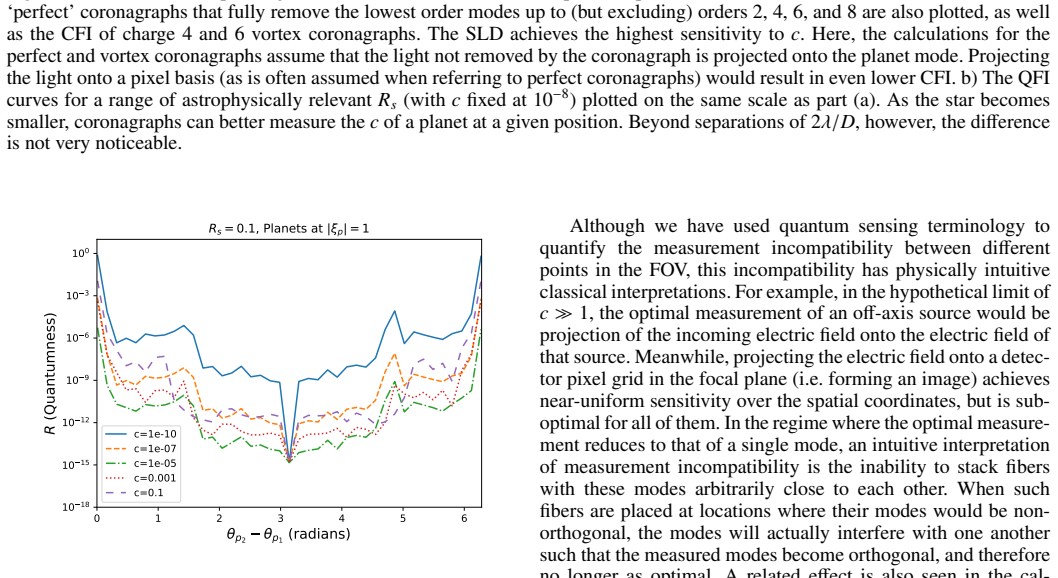
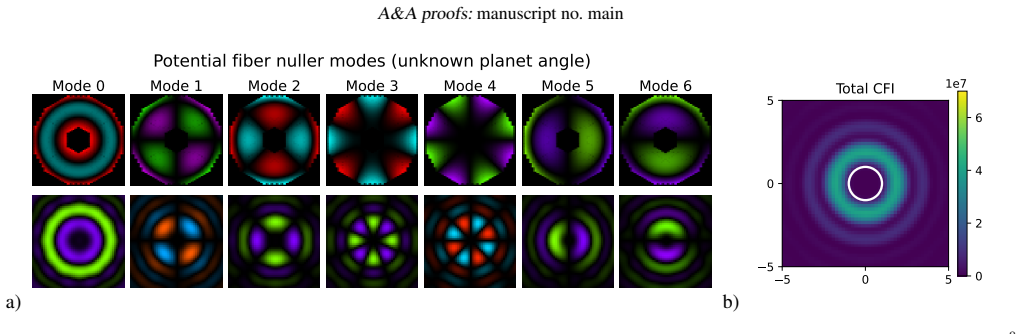
Conventional coronagraphs struggle to reach the theoretical limit of exoplanet detection at close separations to the star, particularly when the telescope has a complex aperture or when the star is partially resolved. Coronagraphy or nulling using spatial mode-sorting can reach the theoretical limit, but the optimal solution has so far only been calculated for an idealized unresolved star, whose signal lies entirely in the piston mode of the telescope. This work aims to enable the calculation of optimal nulling modes for realistic observational scenarios as a function of the size of the star and planet parameters, with the goal of improving coronagraphic performance at ~lambda/D working angles given partially resolved stars and complex telescope apertures. We perform numerical calculations using tools from quantum information theory and explore the behavior of optimal mode-sorting measurements. The optimal measurement for measuring a planet parameter is calculable from the density matrix describing the state of the system. The spatial mode that maximizes the classical signal-to-noise ratio is approximately quantum optimal to leading order in the stellar leakage and the planet flux ratio. We present optimal modes for measuring planets with known signals, and we characterize the tradeoffs inherent to coronagraphs targeting more than one planet location. Example coronagraph designs are presented for three cases of scientific interest: 1) the optimal extension of the fiber nuller architecture for detecting and spectrally characterizing planets across an arbitrary field-of-view using high-resolution spectroscopy, 2) following up planets detected by the visible coronagraph of the Habitable Worlds Observatory at more challenging infrared wavelengths, and 3) detecting and localizing planets at close working angles with the Planetary Camera and Spectrograph on the Extremely Large Telescope.
Editorial analysis
A structured set of objections, weighed in public.
Referee Report
Summary. The paper develops a quantum-information-theoretic framework for computing optimal spatial mode-sorting measurements in coronagraphy, extending previous results limited to unresolved stars to the case of finite stellar angular size and complex telescope apertures. It reports numerical calculations showing that the spatial mode maximizing classical SNR is approximately quantum-optimal to leading order in stellar leakage and planet flux ratio, and presents example mode sets for fiber-nuller extensions, HWO follow-up, and ELT PCS observations.
Significance. If the central perturbative result holds, the work supplies a practical route to near-quantum-limited coronagraph performance at ~λ/D separations for partially resolved stars, directly relevant to upcoming facilities. The explicit use of density-matrix methods and the identification of a classical-mode approximation constitute concrete strengths that could be adopted by instrument teams.
major comments (2)
- [§4] §4 (Numerical calculations): the claim that the classical SNR-maximizing mode is 'approximately quantum optimal to leading order' is supported only by numerical results whose error bars, convergence tests against the unresolved-star limit, and explicit perturbative expansion steps are not shown; without these the load-bearing approximation cannot be independently verified.
- [§3.2] §3.2 (Density-matrix construction): the mapping from finite star size to the input density matrix is stated to enable the QIT calculation, yet the precise truncation or discretization scheme used for the stellar disk is not specified, leaving the scaling of computational cost and accuracy with star angular size unquantified.
minor comments (2)
- [Figure 2] Figure 2 caption: the color scale for the mode amplitudes is not labeled with units or normalization, making direct comparison to the classical SNR mode difficult.
- [Eq. (12)] Eq. (12): the definition of the planet flux ratio ε appears without an explicit statement of whether it is monochromatic or integrated over the bandpass used in the numerical examples.
Simulated Author's Rebuttal
We thank the referee for their positive evaluation of the manuscript's significance and for the constructive major comments. We address each point below and will incorporate revisions to enhance verifiability and reproducibility.
read point-by-point responses
-
Referee: [§4] §4 (Numerical calculations): the claim that the classical SNR-maximizing mode is 'approximately quantum optimal to leading order' is supported only by numerical results whose error bars, convergence tests against the unresolved-star limit, and explicit perturbative expansion steps are not shown; without these the load-bearing approximation cannot be independently verified.
Authors: We agree that the numerical evidence for the leading-order approximation requires additional documentation to permit independent verification. In the revised manuscript we will add error bars to the numerical results in §4, include explicit convergence tests against the unresolved-star limit, and provide the step-by-step perturbative expansion that justifies the claim to leading order in stellar leakage and planet flux ratio. revision: yes
-
Referee: [§3.2] §3.2 (Density-matrix construction): the mapping from finite star size to the input density matrix is stated to enable the QIT calculation, yet the precise truncation or discretization scheme used for the stellar disk is not specified, leaving the scaling of computational cost and accuracy with star angular size unquantified.
Authors: We concur that the discretization details are necessary for assessing accuracy and cost. The revised §3.2 will specify the truncation and discretization scheme applied to the stellar disk and will quantify how computational cost and numerical accuracy scale with stellar angular size. revision: yes
Circularity Check
No significant circularity detected
full rationale
The paper's central derivation applies standard quantum information theory (density-matrix formalism and optimization over POVMs) to compute optimal spatial modes for a partially resolved star. The key result—that the classical SNR-maximizing mode is approximately quantum-optimal to leading order in stellar leakage and planet flux ratio—follows from an internal perturbative expansion whose validity is confined to the small-parameter regime explicitly targeted. No equations reduce a claimed prediction to a fitted input by construction, no load-bearing self-citation chains appear, and no ansatz is smuggled via prior work. The approach remains self-contained against external QIT benchmarks.
Axiom & Free-Parameter Ledger
free parameters (2)
- star angular size
- planet flux ratio
axioms (2)
- domain assumption The state of the incoming light field can be fully described by a density matrix whose eigenmodes yield the optimal measurement.
- ad hoc to paper The classical SNR-maximizing mode remains approximately quantum optimal to leading order in leakage and flux ratio.
Reference graph
Works this paper leans on
-
[1]
Deshler, Nico and Haffert, Sebastiaan and Ashok, Amit , month = jun, year =. Quantum. doi:10.48550/arXiv.2403.17988 , abstract =
-
[2]
Published in The Messenger vol. 182 , author =. 2021 , note =. doi:10.18727/0722-6691/5221 , abstract =
-
[3]
Kenworthy, Matthew A. and Haffert, Sebastiaan Y. , month = aug, year =. High-. Annual Review of Astronomy and Astrophysics , publisher =. doi:10.1146/annurev-astro-021225-022840 , abstract =
-
[4]
Ruane, Garreth and Wang, Ji and Mawet, Dimitri and Jovanovic, Nemanja and Delorme, Jacques-Robert and Mennesson, Bertrand and Wallace, J. Kent , month = nov, year =. Efficient. The Astrophysical Journal , publisher =. doi:10.3847/1538-4357/aae262 , abstract =
-
[5]
Por, E. H. and Haffert, S. Y. , month = mar, year =. The. Astronomy & Astrophysics , publisher =. doi:10.1051/0004-6361/201731616 , abstract =
-
[6]
Xin, Yinzi and Jovanovic, Nemanja and Ruane, Garreth and Mawet, Dimitri and Fitzgerald, Michael P. and Echeverri, Daniel and Lin, Jonathan and Leon-Saval, Sergio and Gatkine, Pradip and Kim, Yoo Jung and Norris, Barnaby and Sallum, Steph , month = oct, year =. Efficient. The Astrophysical Journal , publisher =. doi:10.3847/1538-4357/ac9284 , abstract =
-
[7]
Deep nulling of laser light with a single-mode-fiber beam combiner , volume =. Applied Optics , author =. 2006 , pages =. doi:10.1364/AO.45.002749 , language =
-
[8]
Birks, T. A. and Gris-Sánchez, I. and Yerolatsitis, S. and Leon-Saval, S. G. and Thomson, R. R. , month = jun, year =. The photonic lantern , volume =. Advances in Optics and Photonics , publisher =. doi:10.1364/AOP.7.000107 , abstract =
-
[9]
Tsang, Mankei and Nair, Ranjith and Lu, Xiao-Ming , month = aug, year =. Quantum. Physical Review X , publisher =. doi:10.1103/PhysRevX.6.031033 , abstract =
-
[10]
Ultimate limits of exoplanet spectroscopy:
Huang, Zixin and Schwab, Christian and Lupo, Cosmo , month = feb, year =. Ultimate limits of exoplanet spectroscopy:. Physical Review A , publisher =. doi:10.1103/PhysRevA.107.022409 , abstract =
-
[11]
Journal of the Optical Society of America A , author =
Programmable unitary spatial mode manipulation , volume =. Journal of the Optical Society of America A , author =. 2010 , keywords =. doi:10.1364/JOSAA.27.002524 , language =
-
[12]
Labroille, Guillaume and Denolle, Bertrand and Jian, Pu and Genevaux, Philippe and Treps, Nicolas and Morizur, Jean-François , month = jun, year =. Efficient and mode selective spatial mode multiplexer based on multi-plane light conversion , volume =. Optics Express , publisher =. doi:10.1364/OE.22.015599 , abstract =
-
[13]
Monthly Notices of the Royal Astronomical Society , author =
First on-sky demonstration of an integrated-photonic nulling interferometer: the. Monthly Notices of the Royal Astronomical Society , author =. 2020 , pages =. doi:10.1093/mnras/stz3277 , abstract =
-
[14]
and Guyon, Olivier and Lozi, Julien and Vievard, Sébastien and Deo, Vincent and Lawrence, Jon S
Martinod, Marc-Antoine and Norris, Barnaby and Tuthill, Peter and Lagadec, Tiphaine and Jovanovic, Nemanja and Cvetojevic, Nick and Gross, Simon and Arriola, Alexander and Gretzinger, Thomas and Withford, Michael J. and Guyon, Olivier and Lozi, Julien and Vievard, Sébastien and Deo, Vincent and Lawrence, Jon S. and Leon-Saval, Sergio , month = apr, year =...
-
[15]
Journal of Statistical Physics , author =
Quantum detection and estimation theory , volume =. Journal of Statistical Physics , author =. 1969 , keywords =. doi:10.1007/BF01007479 , abstract =
-
[16]
Bowler, Brendan P. , month = aug, year =. Imaging. Publications of the Astronomical Society of the Pacific , publisher =. doi:10.1088/1538-3873/128/968/102001 , abstract =
-
[17]
Audenaert, K. M. R. and Calsamiglia, J. and Muñoz-Tapia, R. and Bagan, E. and Masanes, Ll. and Acin, A. and Verstraete, F. , month = apr, year =. Discriminating. Physical Review Letters , publisher =. doi:10.1103/PhysRevLett.98.160501 , abstract =
-
[18]
Chernoff, Herman , month = dec, year =. A. The Annals of Mathematical Statistics , publisher =. doi:10.1214/aoms/1177729330 , abstract =
-
[19]
Wang, Ji and Mawet, Dimitri and Ruane, Garreth and Hu, Renyu and Benneke, Björn , month = mar, year =. Observing. The Astronomical Journal , publisher =. doi:10.3847/1538-3881/aa6474 , abstract =
-
[20]
Echeverri, Daniel and Xuan, Jerry W. and Monnier, John D. and Delorme, Jacques-Robert and Wang, Jason J. and Jovanovic, Nemanja and Horstman, Katelyn and Ruane, Garreth and Mennesson, Bertrand and Serabyn, Eugene and Mawet, Dimitri and Wallace, J. Kent and Hillman, Sofia and Baker, Ashley and Bartos, Randall and Calvin, Benjamin and Cetre, Sylvain and Dop...
-
[21]
Mawet, D. and Riaud, P. and Absil, O. and Surdej, J. , month = nov, year =. Annular. The Astrophysical Journal , publisher =. doi:10.1086/462409 , abstract =
-
[22]
Compatibility in multiparameter quantum metrology , volume =
Ragy, Sammy and Jarzyna, Marcin and Demkowicz-Dobrzański, Rafał , month = nov, year =. Compatibility in multiparameter quantum metrology , volume =. Physical Review A , publisher =. doi:10.1103/PhysRevA.94.052108 , abstract =
-
[23]
On quantumness in multi-parameter quantum estimation , volume =
Carollo, Angelo and Spagnolo, Bernardo and Dubkov, Alexander A and Valenti, Davide , month = sep, year =. On quantumness in multi-parameter quantum estimation , volume =. Journal of Statistical Mechanics: Theory and Experiment , publisher =. doi:10.1088/1742-5468/ab3ccb , abstract =
-
[24]
Mihailescu, George and Alushi, Uesli and Candia, Roberto Di and Felicetti, Simone and Gietka, Karol , month = oct, year =. Critical. doi:10.48550/arXiv.2510.02035 , abstract =
-
[25]
Roy, Olivier and Vetterli, Martin , year =. The
-
[26]
Haffert, S. Y. , month = jul, year =. Fundamental limit of single-mode integral-field spectroscopy , volume =. JOSA B , publisher =. doi:10.1364/JOSAB.421326 , abstract =
-
[27]
Mawet, D. and Ruane, G. and Xuan, W. and Echeverri, D. and Klimovich, N. and Randolph, M. and Fucik, J. and Wallace, J. K. and Wang, J. and Vasisht, G. and Dekany, R. and Mennesson, B. and Choquet, E. and Delorme, J.-R. and Serabyn, E. , month = mar, year =. Observing. The Astrophysical Journal , publisher =. doi:10.3847/1538-4357/aa647f , abstract =
-
[28]
Haffert, S. Y. and Por, E. H. and Keller, C. U. and Kenworthy, M. A. and Doelman, D. S. and Snik, F. and Escuti, M. J. , month = mar, year =. The. Astronomy & Astrophysics , publisher =. doi:10.1051/0004-6361/201731615 , abstract =
-
[29]
Vigan, A. and Morsy, M. El and Lopez, M. and Otten, G. P. P. L. and Garcia, J. and Costes, J. and Muslimov, E. and Viret, A. and Charles, Y. and Zins, G. and Murray, G. and Costille, A. and Paufique, J. and Seemann, U. and Houllé, M. and Anwand-Heerwart, H. and Phillips, M. and Abinanti, A. and Balard, P. and Baraffe, I. and Benedetti, J.-A. and Blanchard...
-
[30]
Belikov, Ruslan and Stark, Christopher and Siegler, Nick and Por, Emiel and Mennesson, Bertrand and Redmond, Susan and Chen, Pin and Fogarty, Kevin and Guyon, Olivier and Juanola-Parramon, Roser and Kasdin, Jeremy and Krist, John and Mawet, Dimitri and Morgan, Rhonda and Prada, Camilo Mejia and Pueyo, Laurent and Ruane, Garreth and Sirbu, Dan and Stapelfe...
-
[31]
and Guyon, Olivier and Stark, Christopher C
Belikov, Ruslan and Sirbu, Dan and Jewell, Jeffrey B. and Guyon, Olivier and Stark, Christopher C. , month = sep, year =. Theoretical performance limits for coronagraphs on obstructed and unobstructed apertures: how much can current designs be improved? , volume =. Techniques and. doi:10.1117/12.2594855 , abstract =
-
[32]
Communications in Mathematical Physics , author =
On the. Communications in Mathematical Physics , author =. 2007 , keywords =. doi:10.1007/s00220-007-0221-7 , abstract =
-
[33]
Kim, Yoo Jung and Fitzgerald, Michael P. and Vievard, Sébastien and Lin, Jonathan and Xin, Yinzi and Lucas, Miles and Guyon, Olivier and Lozi, Julien and Deo, Vincent and Huby, Elsa and Lacour, Sylvestre and Lallement, Manon and Amezcua-Correa, Rodrigo and Leon-Saval, Sergio and Norris, Barnaby and Nowak, Mathias and Sallum, Steph and Sarrazin, Jehanne an...
-
[34]
Bailey, Jeremy A. , month = jul, year =. Spectroastrometry: a new approach to astronomy on small spatial scales , volume =. Optical. doi:10.1117/12.316802 , abstract =
-
[35]
and Snik, Frans and Warriner, Nathaniel Z
Doelman, David S. and Snik, Frans and Warriner, Nathaniel Z. and Escuti, Michael J. , month = sep, year =. Patterned liquid-crystal optics for broadband coronagraphy and wavefront sensing , volume =. Techniques and. doi:10.1117/12.2273406 , abstract =
-
[36]
Astronomy & Astrophysics , author =
Phase-induced amplitude apodization of telescope pupils for extrasolar terrestrial planet imaging , volume =. Astronomy & Astrophysics , author =. 2003 , pages =. doi:10.1051/0004-6361:20030457 , number =
-
[37]
and Mennesson, Bertrand and Bryson, Stephen T
Stark, Christopher C. and Mennesson, Bertrand and Bryson, Stephen T. and Ford, Eric B. and Robinson, Tyler D. and Belikov, Ruslan and Bolcar, Matthew R. and Feinberg, Lee D. and Guyon, Olivier and Latouf, Natasha and Mandell, Avi M. and Rauscher, Bernard J. and Sirbu, Dan and Tuchow, Noah Wolfe , month = sep, year =. Paths to robust exoplanet science yiel...
-
[38]
Guyon, O. and Pluzhnik, E. A. and Kuchner, M. J. and Collins, B. and Ridgway, S. T. , month = nov, year =. Theoretical. The Astrophysical Journal Supplement Series , publisher =. doi:10.1086/507630 , abstract =
-
[39]
and Parenteau, Niki and Ranjan, Sukrit and Russell, Blair and Schwieterman, Edward W
Krissansen-Totton, Joshua and Ulses, Anna Grace and Frissell, Maxwell and Gilbert-Janizek, Samantha and Young, Amber and Lustig-Yaeger, Jacob and Robinson, Tyler and Olson, Stephanie and Alei, Eleonora and Arney, Giada and Hagee, Celeste and Harman, Chester and Hinkel, Natalie and Lafleche, Emilie and Latouf, Natasha and Mandell, Avi and Moussa, Mark M. a...
-
[40]
and Wallace, James Kent and Bartos, Randall D
Delorme, Jacques-Robert and Jovanovic, Nemanja and Echeverri, Daniel and Mawet, Dimitri P. and Wallace, James Kent and Bartos, Randall D. and Cetre, Sylvain and Wizinowich, Peter L. and Ragland, Sam and Lilley, Scott J. and Wetherell, Edward and Doppmann, Greg and Wang, Jason J. and Morris, Evan C. and Ruffio, Jean-Baptiste and Martin, Emily C. and Fitzge...
-
[41]
Konopacky, Quinn M. and Baker, Ashley D. and Mawet, Dimitri and Fitzgerald, Michael P. and Jovanovic, Nemanja and Beichman, Charles and Ruane, Garreth and Bertz, Rob and Terada, Hiroshi and Dekany, Richard and Lingvay, Larry and Kassis, Marc and Anderson, David and Tamura, Motohide and Benneke, Björn and Beatty, Thomas and Do, Tuan and Nishiyama, Shogo an...
-
[42]
Pathways to. doi:10.17226/26141 , author =
-
[43]
Currie, Thayne and Biller, Beth and Lagrange, Anne-Marie and Marois, Christian and Guyon, Olivier and Nielsen, Eric and Bonnefoy, Mickael and Rosa, Robert De , month = jul, year =. Direct. doi:10.48550/arXiv.2205.05696 , abstract =
-
[44]
Sirbu, Dan and Belikov, Ruslan and Fogarty, Kevin and Valdez, Carson and Sun, Zhanghao and Kroo, Annie and Solgaard, Olav and Miller, David A. B. and Guyon, Olivier , month = aug, year =. Space. doi:10.1117/12.3020518 , abstract =
-
[45]
Ertel, Steve and Pearce, Tim D. and Debes, John H. and Faramaz, Virginie C. and Danchi, William C. and Anche, Ramya M. and Defrère, Denis and Hasegawa, Yasuhiro and Hom, Justin and Kirchschlager, Florian and Rebollido, Isabel and Rousseau, Hélène and Scott, Jeremy and Stapelfeldt, Karl and Stuber, Thomas A. , month = mar, year =. Review and. Publications ...
-
[46]
Morgan, Rhonda and Savransky, Dmitry and Turmon, Michael and Damiano, Mario and Hu, Renyu and Mennesson, Bertrand and Mamajek, Eric E. and Robinson, Tyler D. and Tokadjian, Armen , month = aug, year =. Space. doi:10.1117/12.3020858 , abstract =
-
[47]
Ertel, S. and Defrère, D. and Hinz, P. and Mennesson, B. and Kennedy, G. M. and Danchi, W. C. and Gelino, C. and Hill, J. M. and Hoffmann, W. F. and Mazoyer, J. and Rieke, G. and Shannon, A. and Stapelfeldt, K. and Spalding, E. and Stone, J. M. and Vaz, A. and Weinberger, A. J. and Willems, P. and Absil, O. and Arbo, P. and Bailey, V. P. and Beichman, C. ...
-
[48]
Open Systems & Information Dynamics , author =
Mathematical techniques for quantum communication theory , volume =. Open Systems & Information Dynamics , author =. 1995 , keywords =. doi:10.1007/BF02228997 , abstract =
discussion (0)
Sign in with ORCID, Apple, or X to comment. Anyone can read and Pith papers without signing in.