Automated logical Clifford gadgets for heterogeneous architectures via chain maps
Pith reviewed 2026-07-03 11:22 UTC · model grok-4.3
The pith
Automated chain-map method synthesizes logical CNOT circuits between arbitrary CSS codes.
A machine-rendered reading of the paper's core claim, the machinery that carries it, and where it could break.
Core claim
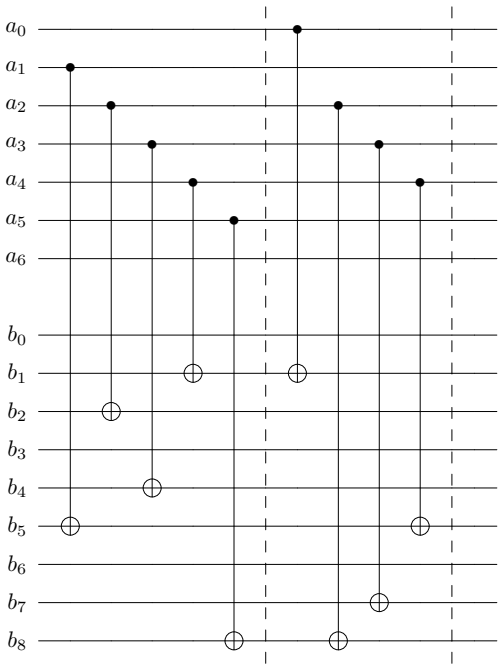
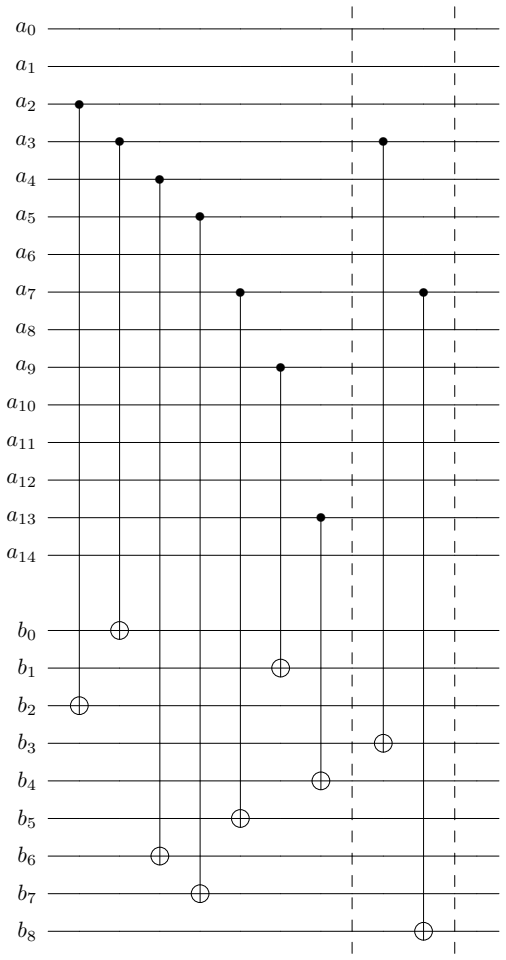
Given a prescribed bipartite logical CNOT network between arbitrary CSS codes, the method constructs the affine space of chain maps realising the desired logical action and searches this space for shallow and sparse physical circuit candidates.
What carries the argument
Affine space of chain maps that realize a prescribed logical CNOT action between CSS codes.
If this is right
- The approach recovers known transversal constructions for structurally related code families.
- It yields new low-depth solutions, including distance-preserving and partially distance-preserving circuits.
- Flag measurements promote selected solutions to full code distance.
- Bespoke chain maps provide favourable spacetime tradeoffs for logical interfaces in heterogeneous architectures.
- The framework extends directly to targeted logical CZ gates.
Where Pith is reading between the lines
- The same search over chain-map spaces could be used to generate other Clifford operations beyond CNOT and CZ.
- Tailored maps for concatenated codes might reduce interface overhead compared with generic constructions.
- Heuristic improvements to the search could scale the method to larger code distances.
- Integration with existing code-switching protocols could lower the cost of moving logical information between code families.
Load-bearing premise
An affine space of chain maps exists for any prescribed logical CNOT network between arbitrary CSS codes and can be searched to produce hardware-implementable shallow circuits.
What would settle it
A concrete pair of CSS codes and a logical CNOT network for which no chain map exists or every realizing map produces only impractically deep circuits.
Figures
read the original abstract
Transversal CNOTs are ubiquitous for entangling logical qubits of identical CSS codes pairwise. For distinct codes, the options are much more limited, and are typically known only for structurally related code families. We introduce an automated framework for synthesising inter-code logical CNOT circuits between arbitrary CSS codes using chain maps. Given a prescribed bipartite logical CNOT network between these codes, our method constructs the affine space of chain maps realising the desired logical action, and then searches this space for shallow and sparse physical circuit candidates. We benchmark this method on a range of heterogeneous CSS code pairs, recovering known transversal constructions, and finding new low-depth solutions, including distance-preserving and partially distance-preserving examples, which we demonstrate can be promoted to the full code distance using additional flag measurements. We discuss applications to code switching, magic-state injection, Pauli product measurements, and operations on concatenated codes, where bespoke chain maps offer favourable spacetime tradeoffs for logical interfaces tailored to heterogeneous architectures. Finally, we show how our framework straightforwardly extends to targeted logical CZ gates.
Editorial analysis
A structured set of objections, weighed in public.
Referee Report
Summary. The paper introduces an automated framework for synthesizing inter-code logical CNOT circuits between arbitrary CSS codes via chain maps. Given a prescribed bipartite logical CNOT network, the method constructs the affine space of chain maps realizing the desired logical action on homology and searches this space for shallow, sparse physical circuit candidates. It benchmarks the approach on heterogeneous CSS code pairs, recovers known transversal constructions, identifies new low-depth and distance-preserving solutions (promotable to full distance via flags), and discusses applications to code switching, magic-state injection, Pauli product measurements, and concatenated codes. The framework is also extended to targeted logical CZ gates.
Significance. If the central construction holds, the work provides a general, systematic tool for logical interfaces in heterogeneous quantum architectures, moving beyond case-by-case transversal gates for related code families. The algebraic approach via chain maps offers a reproducible route to circuit synthesis with explicit spacetime tradeoffs, and the benchmarks plus flag-promotion examples constitute concrete, falsifiable outputs. This could enable more flexible code-switching and concatenation strategies in fault-tolerant quantum computing.
major comments (2)
- [Abstract, §3] Abstract and the central construction (likely §3–4): the claim that the framework works for “arbitrary CSS codes” and “any prescribed bipartite logical CNOT network” rests on the linear system for chain maps always admitting a solution (i.e., the affine space being non-empty). The manuscript must either prove consistency of the system under the homology-map and boundary-commutation constraints for arbitrary CSS codes, or state the precise algebraic conditions under which solutions exist; without this, the subsequent search step cannot be guaranteed to produce a circuit.
- [§5] Benchmark section (likely §5): while new low-depth and distance-preserving examples are reported, the manuscript should quantify how often the affine-space search succeeds versus fails across the tested code pairs, and whether any prescribed logical networks were rejected because no chain map existed. This directly tests the scope of the “arbitrary” claim.
minor comments (2)
- [§2] Notation for the chain complexes and the induced homology map should be introduced with a small worked example (e.g., two small CSS codes) before the general construction, to improve readability for readers outside homological algebra.
- [§4] The search procedure over the affine space (exhaustive enumeration, integer-linear programming, or heuristic) is not described in sufficient algorithmic detail; pseudocode or complexity discussion would clarify reproducibility.
Simulated Author's Rebuttal
We thank the referee for their careful reading and constructive feedback. We address each major comment below. Where the manuscript requires clarification or additional quantification, we will revise accordingly.
read point-by-point responses
-
Referee: [Abstract, §3] Abstract and the central construction (likely §3–4): the claim that the framework works for “arbitrary CSS codes” and “any prescribed bipartite logical CNOT network” rests on the linear system for chain maps always admitting a solution (i.e., the affine space being non-empty). The manuscript must either prove consistency of the system under the homology-map and boundary-commutation constraints for arbitrary CSS codes, or state the precise algebraic conditions under which solutions exist; without this, the subsequent search step cannot be guaranteed to produce a circuit.
Authors: We agree that solutions to the linear system are not guaranteed for every possible prescribed logical network. The system is consistent precisely when the right-hand side (encoding the desired homology map together with the boundary-commutation requirements) lies in the column space of the coefficient matrix derived from the two chain complexes. This is equivalent to the prescribed map on homology admitting a chain-map lift. We will revise §3 to state this algebraic condition explicitly (rather than claiming solutions for arbitrary networks) and note that, for the standard bipartite CNOT networks considered in the benchmarks, the system was always consistent. We will also add a brief remark that the framework can be used to test realizability of a candidate network by checking consistency of the linear system. revision: yes
-
Referee: [§5] Benchmark section (likely §5): while new low-depth and distance-preserving examples are reported, the manuscript should quantify how often the affine-space search succeeds versus fails across the tested code pairs, and whether any prescribed logical networks were rejected because no chain map existed. This directly tests the scope of the “arbitrary” claim.
Authors: In the experiments reported in §5 we considered only networks for which the linear system was consistent; no prescribed network was rejected on consistency grounds. To address the request for quantification, we will add a short paragraph (or table footnote) reporting that, across the 12 heterogeneous code pairs and associated logical networks examined, the affine space was non-empty in every case and the subsequent search always returned at least one valid chain map. We will also note the total number of code-pair/network combinations tested so that the success rate is explicit. revision: yes
Circularity Check
No circularity; derivation applies standard homological algebra to chain complexes
full rationale
The paper constructs affine spaces of chain maps by solving linear systems enforcing boundary commutation and a prescribed homology map. This is a direct, non-circular application of standard algebraic topology to CSS code chain complexes. No self-definitional reductions, fitted inputs renamed as predictions, or load-bearing self-citations appear in the derivation. The method is self-contained; any limitations on solvability for arbitrary inputs are questions of correctness rather than circularity.
Axiom & Free-Parameter Ledger
Reference graph
Works this paper leans on
-
[1]
2025 , journal=
Tour de gross: A modular quantum computer based on bivariate bicycle codes , author=. 2025 , journal=
2025
-
[2]
PRX Quantum , volume =
Universal Adapters between Quantum Low-Density Parity Check Codes , author =. PRX Quantum , volume =. 2026 , month =
2026
-
[3]
2025 , journal=
Transversal dimension jump for product qLDPC codes , author=. 2025 , journal=
2025
-
[4]
2025 , journal=
Single-Shot Universality in Quantum LDPC Codes via Code-Switching , author=. 2025 , journal=
2025
-
[5]
Fault-Tolerant Conversion between the Steane and Reed-Muller Quantum Codes , author =. Phys. Rev. Lett. , volume =. 2014 , month =
2014
-
[6]
2026 , journal=
The Pinnacle Architecture: Reducing the cost of breaking RSA-2048 to 100 000 physical qubits using quantum LDPC codes , author=. 2026 , journal=
2048
-
[7]
PRX Quantum , volume =
Homomorphic Logical Measurements , author =. PRX Quantum , volume =. 2023 , month =
2023
-
[8]
Fast and Parallelizable Logical Computation with Homological Product Codes , author =. Phys. Rev. X , volume =. 2025 , month =
2025
-
[9]
1997 , journal=
Stabilizer Codes and Quantum Error Correction , author=. 1997 , journal=
1997
-
[10]
arXiv preprint arXiv:2109.03338 , year =
Kai Pfeiffer and Ludovic Righetti , title =. arXiv preprint arXiv:2109.03338 , year =
-
[11]
SIAM Journal on Algebraic Discrete Methods , volume=
Computing a sparse basis for the null space , author=. SIAM Journal on Algebraic Discrete Methods , volume=. 1987 , publisher=
1987
-
[12]
Complexity , author=
The null space problem I. Complexity , author=. SIAM Journal on Algebraic Discrete Methods , volume=. 1986 , publisher=
1986
-
[13]
Algorithms , author=
The null space problem II. Algorithms , author=. SIAM Journal on Algebraic Discrete Methods , volume=. 1987 , publisher=
1987
-
[14]
arXiv preprint arXiv:2111.06257 , year=
Branch and bound in mixed integer linear programming problems: A survey of techniques and trends , author=. arXiv preprint arXiv:2111.06257 , year=
-
[15]
Quantum LDPC Codes With Positive Rate and Minimum Distance Proportional to the Square Root of the Blocklength , volume=
Tillich, Jean-Pierre and Zemor, Gilles , year=. Quantum LDPC Codes With Positive Rate and Minimum Distance Proportional to the Square Root of the Blocklength , volume=. IEEE Transactions on Information Theory , publisher=
-
[16]
arXiv preprint arXiv:2505.20261 , year=
Hardware-tailored logical Clifford circuits for stabilizer codes , author=. arXiv preprint arXiv:2505.20261 , year=
-
[17]
IEEE Transactions on Quantum Engineering , volume=
Logical Clifford synthesis for stabilizer codes , author=. IEEE Transactions on Quantum Engineering , volume=. 2020 , publisher=
2020
-
[18]
Stim: a fast stabilizer circuit simulator , volume=
Gidney, Craig , year=. Stim: a fast stabilizer circuit simulator , volume=. Quantum , publisher=
-
[19]
Bravyi, Sergey and Smith, Graeme and Smolin, John A. , year=. Trading Classical and Quantum Computational Resources , volume=. Physical Review X , publisher=
-
[20]
and Kim, Isaac H
Cohen, Lawrence Z. and Kim, Isaac H. and Bartlett, Stephen D. and Brown, Benjamin J. , year=. Low-overhead fault-tolerant quantum computing using long-range connectivity , volume=. Science Advances , publisher=
-
[21]
CSS code surgery as a universal construction , volume=
Cowtan, Alexander and Burton, Simon , year=. CSS code surgery as a universal construction , volume=. Quantum , publisher=
-
[22]
2025 , journal=
Extractors: QLDPC Architectures for Efficient Pauli-Based Computation , author=. 2025 , journal=
2025
-
[23]
2026 , journal=
Parallel Logical Measurements via Quantum Code Surgery , author=. 2026 , journal=
2026
-
[24]
2025 , journal=
Explicit construction of low-overhead gadgets for gates on quantum LDPC codes , author=. 2025 , journal=
2025
-
[25]
Quantum Kronecker sum-product low-density parity-check codes with finite rate , author =. Phys. Rev. A , volume =. 2013 , month =
2013
-
[26]
2026 , journal=
Constant-Time Surgery on 2D Hypergraph Product Codes with Near-Constant Space Overhead , author=. 2026 , journal=
2026
-
[27]
2024 , journal=
Low-overhead fault-tolerant quantum computation by gauging logical operators , author=. 2024 , journal=
2024
-
[28]
and Nadkarni, Priya J
Ide, Benjamin and Gowda, Manoj G. and Nadkarni, Priya J. and Dauphinais, Guillaume , year=. Fault-Tolerant Logical Measurements via Homological Measurement , volume=. Physical Review X , publisher=
-
[29]
and Martin-Delgado, M
Bombin, H. and Martin-Delgado, M. A. , year=. Topological Quantum Distillation , volume=. Physical Review Letters , publisher=
-
[30]
High-performance syndrome extraction circuits for quantum codes , author=. arXiv preprint arXiv:2603.05481 , year=
-
[31]
Quantum , volume=
Distance-preserving stabilizer measurements in hypergraph product codes , author=. Quantum , volume=. 2025 , publisher=
2025
-
[32]
arXiv preprint arXiv:2505.01370 , year=
Engineering CSS surgery: compiling any CNOT in any code , author=. arXiv preprint arXiv:2505.01370 , year=
-
[33]
A Game of Surface Codes: Large-Scale Quantum Computing with Lattice Surgery , volume=
Litinski, Daniel , year=. A Game of Surface Codes: Large-Scale Quantum Computing with Lattice Surgery , volume=. Quantum , publisher=
-
[34]
Knill, E. , year=. Quantum computing with realistically noisy devices , volume=. Nature , publisher=
-
[35]
2026 , journal=
Shor's algorithm is possible with as few as 10,000 reconfigurable atomic qubits , author=. 2026 , journal=
2026
-
[36]
Efficient fault-tolerant code switching via one-way transversal CNOT gates , volume=
Heußen, Sascha and Hilder, Janine , year=. Efficient fault-tolerant code switching via one-way transversal CNOT gates , volume=. Quantum , publisher=
-
[37]
Code conversion with the quantum Golay code for a universal transversal gate set , volume=
Sullivan, Matthew , year=. Code conversion with the quantum Golay code for a universal transversal gate set , volume=. Physical Review A , publisher=
-
[38]
Magic state cultivation: growing T states as cheap as CNOT gates
Magic state cultivation: growing T states as cheap as CNOT gates , author=. arXiv preprint arXiv:2409.17595 , year=
work page internal anchor Pith review Pith/arXiv arXiv
-
[39]
2025 , journal=
Simple logical quantum computation with concatenated symplectic double codes , author=. 2025 , journal=
2025
-
[40]
and Gambetta, Jay M
Bravyi, Sergey and Cross, Andrew W. and Gambetta, Jay M. and Maslov, Dmitri and Rall, Patrick and Yoder, Theodore J. , year=. High-threshold and low-overhead fault-tolerant quantum memory , volume=. Nature , publisher=
-
[41]
2025 , journal=
Breaking even with magic: demonstration of a high-fidelity logical non-Clifford gate , author=. 2025 , journal=
2025
-
[42]
High-performance fault-tolerant quantum computing with many-hypercube codes , volume=
Goto, Hayato , year=. High-performance fault-tolerant quantum computing with many-hypercube codes , volume=. Science Advances , publisher=
-
[43]
Magic-state distillation with low overhead , volume=
Bravyi, Sergey and Haah, Jeongwan , year=. Magic-state distillation with low overhead , volume=. Physical Review A , publisher=
-
[44]
2025 , journal=
ConiQ: Enabling Concatenated Quantum Error Correction on Neutral Atom Arrays , author=. 2025 , journal=
2025
-
[45]
arXiv preprint arXiv:2603.17703 , year=
Independent Trivariate Bicycle Codes , author=. arXiv preprint arXiv:2603.17703 , year=
-
[46]
arXiv preprint arXiv:2603.05398 , year=
QGPU: Parallel logic in quantum LDPC codes , author=. arXiv preprint arXiv:2603.05398 , year=
-
[47]
IEEE Journal on Selected Areas in Information Theory , year=
Transversal clifford and t-gate codes of short length and high distance , author=. IEEE Journal on Selected Areas in Information Theory , year=
-
[48]
, year =
Cercelescu, Benhemou , title =. , year =
-
[49]
2013 IEEE International Symposium on Information Theory , pages=
Leveraging automorphisms of quantum codes for fault-tolerant quantum computation , author=. 2013 IEEE International Symposium on Information Theory , pages=. 2013 , organization=
2013
-
[50]
and Takagi, Ryuji and Chuang, Isaac L
Yoder, Theodore J. and Takagi, Ryuji and Chuang, Isaac L. , year=. Universal Fault-Tolerant Gates on Concatenated Stabilizer Codes , volume=. Physical Review X , publisher=
-
[51]
2026 , journal=
Construction of the full logical Clifford group for high-rate quantum Reed-Muller codes using only transversal and fold-transversal gates , author=. 2026 , journal=
2026
-
[52]
2026 , journal=
Entangling logical qubits without physical operations , author=. 2026 , journal=
2026
-
[53]
2025 , journal=
Transversal Surface-Code Game Powered by Neutral Atoms , author=. 2025 , journal=
2025
-
[54]
and Benedetti, Marcello and Amaro, David , year=
Self, Chris N. and Benedetti, Marcello and Amaro, David , year=. Protecting expressive circuits with a quantum error detection code , volume=. Nature Physics , publisher=
discussion (0)
Sign in with ORCID, Apple, or X to comment. Anyone can read and Pith papers without signing in.