REVIEW 3 major objections 6 minor 44 references
Towards Human-level Dexterous Teleoperation
T0 review · 3 major / 6 minor · reviewed 2026-07-14 · grok-4.5
Pith's one-line read A hand–object co-tracking controller trained on consecutive human-motion subgoals delivers real-robot in-hand and tool teleoperation at about 75% average success where prior systems fail.
desk verdict Strong real-robot co-tracking teleop result (~75% SR on hard in-hand/tool tasks); the DexGen baseline is compromised by using their own controller for rollouts, but absolute numbers and other baselines still carry the paper. read the letter →
The pith
A machine-rendered reading of the paper's core claim, the machinery that carries it, and where it could break.
The reading
What carries the argument
Consecutive subgoal co-tracking: ordered fingertip-and-object pose targets derived from human HOI motions that the policy must reach before advancing, trained with a hybrid sparse subgoal-reaching plus dense tracking reward, and regularized by random action masking for zero-shot sim-to-real transfer.
What would settle it
Retrain and redeploy the co-tracking policy with consecutive subgoals, hybrid reward, and random action masking on the same seven real tasks and two hands; if success on stages that need in-hand reorientation or sustained tool contact remains near the near-zero rates of kinematic and generative baselines, the central claim is false.
Extended reading notes
Core claim
TeleDexter shows that casting dexterous teleoperation as hand–object co-tracking—operator-specified fingertip positions and object poses executed by a single-stage RL controller trained on consecutive subgoals from human reference motions—yields real-world in-hand reorientation, finger gaiting, and multi-stage tool use at about 75% average success across seven tasks and two hand embodiments, where pure kinematic retargeting and prior learned action priors consistently fail.
Load-bearing premise
The claim rests on free-space hand–object contact skills learned from retargeted human subgoals in simulation, without tool–environment impact forces or touch sensing, being enough for long real-world tool use once action masking and domain randomization are applied.
Editorial extensions
If this is right
- Operators can teleoperate contact-rich skills—in-hand reorientation, finger gaiting, hammering, screwdriving, bulb install—that kinematic retargeting cannot stabilize.
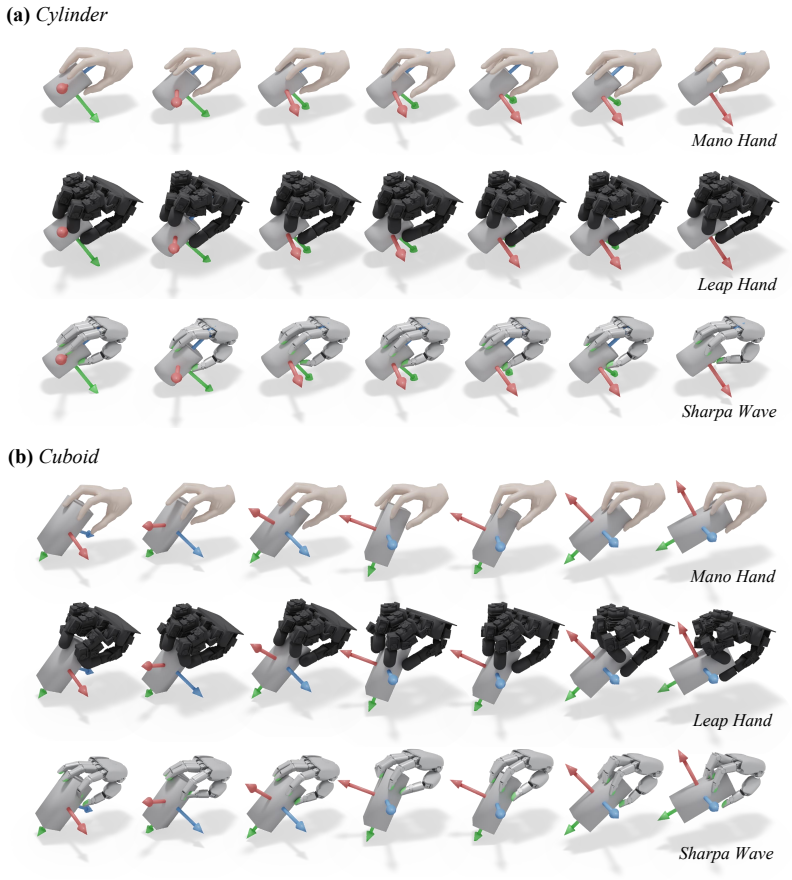
- The same human references, after geometry-aware retargeting, train controllers for both four-finger and five-finger hands without recollecting motions.
- Teleoperation traces collected with TeleDexter can train autonomous diffusion policies on dexterous subtasks from tens of demonstrations.
- Diverse in-hand modalities can be learned in a single RL stage without per-task reward engineering when goals are consecutive co-tracking subgoals rather than frame-wise imitation.
- Random action masking is presented as a necessary action-space regularizer for zero-shot transfer of contact-rich hand policies.
Reading between the lines
- Object-specific controllers and motion-capture pose streams remain the main deployment bottlenecks; a vision-conditioned multi-object co-tracker is the natural next system.
- Documented failure modes—impact perturbation, contact jam, tracking stall—imply that adding tactile sensing and tool–environment impacts in training could close remaining long-horizon gaps.
- If ordered fingertip–object subgoals are the right intermediate representation, the same formulation may extend to bimanual or multi-object in-hand tasks without new reward design.
- High-quality teleop data from this interface could become a standard substrate for imitation learning of skills pure vision-based retargeting cannot demonstrate.
Signed reviews
Editorial analysis
A structured set of objections, weighed in public.
Referee Report
Summary. The paper introduces TELEDEXTER, a hand–object co-tracking controller for dexterous teleoperation. The operator specifies synchronized fingertip and object pose targets; a low-level RL policy, trained in simulation on consecutive co-tracking subgoals derived from geometry-aware retargeted human HOI motions, realizes multi-contact dynamics. Training uses a hybrid sparse subgoal / dense tracking reward, curriculum annealing, domain randomization, and random action masking, and is claimed to transfer zero-shot. Real-world evaluation on seven reorientation and long-horizon tool-use tasks across SharpaWave and LeapHand reports ~75% average success (75.2% SR / 87.1% TP on SharpaWave) where kinematic retargeting, a reimplemented generative prior, and an object-centric tool policy largely fail. Teleoperated demos are further used to train Diffusion Policies for autonomous execution of contact-intensive stages.
Significance. If the absolute real-world results hold, this is a substantial systems contribution: continuous in-hand reorientation, finger gaiting, and multi-stage tool use under teleoperation remain largely out of reach for pure kinematic retargeting, and the paper shows a single-stage, reference-driven RL controller can close much of that gap on two hand morphologies without per-task reward engineering. Strengths include stage-wise SR/TP reporting, honest failure-mode analysis (Supp. A.4), ablations of sparse vs. dense tracking (sim) and action masking (real), any-to-any reposition stress tests, and a demonstrated path from teleop demos to autonomous BC. Random action masking as an action-space regularizer is a concrete, transferable sim-to-real idea. The work is a credible step toward scalable collection of contact-rich dexterous data, even though controllers remain object-specific and MoCap-dependent.
major comments (3)
- [Supp. D; Tab. 1; Abstract; §4.2] Supp. D (DexGen): The paper states that DexGen has no official code and that the authors “substitute it with our co-tracking controller to generate the simulation rollouts” for the AnyGrasp-to-AnyGrasp stage before training the diffusion prior. The generative baseline is therefore trained on trajectories from the same co-tracking family being evaluated, so it is not an independent reproduction of published DexGen. Tab. 1 and the abstract’s claim that “all baselines consistently fail” group this compromised baseline with cleaner ones (DexRT, GeoRT, SimToolReal). Please either (i) re-implement the missing stage without TELEDEXTER rollouts, (ii) drop DexGen from the main comparison, or (iii) clearly caveat Tab. 1 / abstract / §4.2 so that the comparative claim rests only on independent baselines. Absolute TELEDEXTER numbers can still stand.
- [§3.1–3.2; §6; Supp. A.4; Abstract] §3.1–3.2 and §6: Controllers are object-specific and trained only on free-space hand–object HOI (no tool–environment impact). Supp. A.4 correctly identifies interaction perturbation under hammering as a dominant failure mode. HammerUse still reports 66.7% SR, so the method is partially effective, but the abstract’s framing of “long-horizon tool use” and “human-level” contact transitions should be tightened to match the training distribution and the disclosed impact gap (e.g., quantify how often nail-driving succeeds vs. fails due to impulsive reaction). This is needed so readers do not over-read free-space co-tracking as sufficient for impact-rich tool application.
- [§4.2; Fig. 6; Supp. B.3] §4.2 Protocol: Each task uses 15 trials and a skilled operator in the loop with MoCap. SR/TP therefore conflate operator skill, interface latency, and controller robustness. Stage-wise plots (Fig. 6) help, but the paper should report operator protocol more tightly (same operator across methods? practice trials? stopping rules) and, where possible, inter-operator or inter-session variance, so that the large gap vs. DexRT/GeoRT is attributable to the learned contact prior rather than unequal human adaptation. Without this, the comparative half of the headline claim is harder to interpret even for the clean kinematic baselines.
minor comments (6)
- [Title; Abstract; §5–6] Title and abstract use “human-level” while §6 and Supp. A.4 document object-specificity, MoCap dependence, and three systematic failure modes. Soften or define the phrase (e.g., “toward human-like in-hand contact transitions under teleoperation”).
- [Eq. (2)–(3); Supp. C.2–C.3] Eq. (2)–(3) and Supp. C.2 list many free reward/curriculum parameters (α_dense, β’s, w_step rules, N_stay, σ schedule). A short sensitivity note or default-transfer statement would help reproducibility claims for new objects/hands.
- [Tab. 2; §4.2] Tab. 2 reports only three reorientation tasks on LeapHand; tool-use results for LeapHand are absent. Either add them or state explicitly that tool-use evaluation is SharpaWave-only.
- [Fig. 2] Fig. 2 “86% in real world” is unclear relative to Tab. 1’s 75.2% SR / 87.1% TP; align figure callouts with table metrics.
- [Tab. 1] SimToolReal is correctly labeled non-teleoperation, but Tab. 1 averages it over three tasks only while TELEDEXTER is averaged over seven; footnote this more prominently when stating “all baselines.”
- [Front matter] Typographical: “arXiv:2607.11481v1” date line and occasional spacing (e.g., “hand–object” consistency) should be cleaned in camera-ready.
Circularity Check
Empirical systems paper: real-world SR/TP are measured outcomes, not quantities forced by construction from training subgoals or self-cited uniqueness theorems.
full rationale
TeleDexter’s load-bearing claims are empirical: a single-stage RL co-tracking controller trained on consecutive fingertip/object subgoals from geometry-aware retargeted human HOI, with hybrid sparse/dense reward and random action masking, is evaluated zero-shot on seven real teleoperation tasks (15 trials each) and reports ~75% average SR where kinematic and generative baselines fail. Success is defined by staged task completion on hardware (object not dropped; stages in Fig. 3 / Supp. B.1), not by equating a fitted training objective to a reported prediction. Human references supply subgoal sequences and contact modes for RL; they do not algebraically determine real-world SR under operator-driven goals, domain randomization, and hardware dynamics. Self-citations (e.g., Li et al. [23] for reward kernels, curriculum, RSI) supply reusable method components, not uniqueness theorems that forbid alternatives or force the headline result. The DexGen reimplementation note (Supp. D: substituting the authors’ co-tracking controller for the missing AnyGrasp-to-AnyGrasp stage) is a baseline-independence / experimental-fairness concern, not a circular reduction of TeleDexter’s own success metric to its training inputs. No self-definitional identity, fitted-parameter-as-prediction, or ansatz-smuggled uniqueness chain is present in the derivation. Residual score 1 only for ordinary method self-citation that is not load-bearing for the central claim.
Assumptions & free parameters
free parameters (8)
- Hybrid reward scales (α_dense, α_s, c_time, w_step rules)
- Subgoal tolerances and dwell (ε_pos, ε_tip, ε_rot, N_stay)
- Kernel decay rates β and blend weights for fingers/object
- Curriculum bounds (σ_min, step size 40→80, mask duration 1→10, gravity anneal)
- Random action masking (p_mask=0.15, n_m=3 DoFs)
- Domain randomization ranges (mass, friction, noise, latency, external force)
- Action residual scale and deadzone (α_a=0.1, τ=0.1)
- Retargeting loss weights (λ_surf, λ_pen, λ_col, λ_smooth, τ_surf)
assumptions (5)
- domain assumption Operator-specified fingertip positions and object SE(3) targets in the wrist frame are a sufficient interface for human intent during dexterous teleoperation; arm IK tracks wrist independently.
- domain assumption Unscripted human HOI MoCap trajectories, after two-stage geometry-aware retargeting, yield physically grounded co-tracking subgoals covering translation, rotation, gaiting, and tool-use modes needed at deployment.
- ad hoc to paper Sparse consecutive subgoal reaching plus light dense tracking is less restrictive than frame-wise imitation and enables single-stage discovery of contact-switching strategies.
- domain assumption Rigid-body simulation with domain randomization and random action masking is close enough to real direct-drive multi-finger hands for zero-shot transfer of long-horizon contact skills without tactile feedback.
- domain assumption Standard RL optimization (SAPG in Isaac Gym) with RSI and cross-trajectory resets converges to a usable co-tracking policy from the hybrid reward.
invented entities (3)
-
TeleDexter hand–object co-tracking controller
-
Consecutive subgoal co-tracking formulation
-
Random action masking regularizer
Cite this review
Pith. "Pith review of Towards Human-level Dexterous Teleoperation." pith.science (2026). https://pith.science/paper/5UI5ICYJ
@misc{pith2026260711481,
  author       = {Pith},
  title        = {Pith review of: Towards Human-level Dexterous Teleoperation},
  year         = {2026},
  howpublished = {\url{https://pith.science/paper/5UI5ICYJ}},
  note         = {Machine review of arXiv:2607.11481}
}
read the original abstract
Humans routinely wield tools, swap grasps, and reposition objects within a single hand, seamlessly orchestrating contact transitions that span translation, reorientation, and finger gaiting. Endowing robot dexterous hands with this level of in-hand dexterity through teleoperation requires precise control of object motion via dynamic hand-object contact, yet current teleoperation systems remain far from this capability. To bridge this gap, we take a major step towards human-level dexterous teleoperation by introducing TeleDexter, a hand-object co-tracking controller that maps operator intent into learned, low-level contact execution. The controller is trained on consecutive co-tracking subgoals derived from human reference motions, utilizing a hybrid reward that couples sparse subgoal objectives with dense tracking rewards to enable learning across diverse interaction modalities rather than frame-wise trajectory imitation. The entire pipeline requires only single-stage RL and, with random action masking and domain randomization, transfers zero-shot to the real robot. We evaluate TeleDexter on seven challenging dexterous teleoperation tasks spanning object reorientation and long-horizon tool use across two dexterous hands, achieving a 75% average success rate where all baselines consistently fail. Furthermore, the collected demonstrations successfully train autonomous policies via behavioral cloning, marking a concrete step towards human-level dexterous teleoperation.
Figures


Figures from the paper (6 more)


Reference graph
Works this paper leans on
-
[1]
Billard and D
A. Billard and D. Kragic. Trends and challenges in robot manipulation.Science, 364(6446): eaat8414, 2019
2019
-
[2]
I. M. Bullock, R. R. Ma, and A. M. Dollar. A hand-centric classification of human and robot dexterous manipulation.IEEE Transactions on Haptics, 6(2):129–144, 2013. doi:10.1109/ TOH.2012.53
2013
-
[3]
Zhang, Z
T. Zhang, Z. McCarthy, O. Jow, D. Lee, X. Chen, K. Goldberg, and P. Abbeel. Deep imita- tion learning for complex manipulation tasks from virtual reality teleoperation. In2018 IEEE international conference on robotics and automation (ICRA), pages 5628–5635. IEEE, 2018
2018
-
[4]
A. Mandlekar, D. Xu, R. Mart ´ın-Mart´ın, Y . Zhu, L. Fei-Fei, and S. Savarese. Human-in-the- loop imitation learning using remote teleoperation.arXiv preprint arXiv:2012.06733, 2020
arXiv 2012
-
[5]
Y . Qin, W. Yang, B. Huang, K. Van Wyk, H. Su, X. Wang, Y .-W. Chao, and D. Fox. Anyteleop: A general vision-based dexterous robot arm-hand teleoperation system.arXiv preprint arXiv:2307.04577, 2023
arXiv 2023
-
[6]
Handa, K
A. Handa, K. Van Wyk, W. Yang, J. Liang, Y .-W. Chao, Q. Wan, S. Birchfield, N. Ratliff, and D. Fox. Dexpilot: Vision-based teleoperation of dexterous robotic hand-arm system. In2020 IEEE International Conference on Robotics and Automation (ICRA), pages 9164–9170. IEEE, 2020
2020
-
[7]
R. Ding, Y . Qin, J. Zhu, C. Jia, S. Yang, R. Yang, X. Qi, and X. Wang. Bunny-visionpro: Real- time bimanual dexterous teleoperation for imitation learning. In2025 IEEE/RSJ International Conference on Intelligent Robots and Systems (IROS), pages 12248–12255. IEEE, 2025
2025
-
[8]
Cheng, J
X. Cheng, J. Li, S. Yang, G. Yang, and X. Wang. Open-television: Teleoperation with immer- sive active visual feedback. In8th Annual Conference on Robot Learning, 2024
2024
Show all 44 references
-
[9]
Zhang, S
H. Zhang, S. Hu, Z. Yuan, and H. Xu. Doglove: Dexterous manipulation with a low-cost open-source haptic force feedback glove.arXiv preprint arXiv:2502.07730, 2025
2025 arXiv
-
[10]
H.-S. Fang, B. Romero, Y . Xie, A. Hu, B.-R. Huang, J. Alvarez, M. Kim, G. Margolis, K. An- barasu, M. Tomizuka, et al. Dexop: A device for robotic transfer of dexterous human manipu- lation.arXiv preprint arXiv:2509.04441, 2025
2025 arXiv
-
[11]
A. Zhu, M. Zhu, B. J. Kim, J. V . S. Ramos, Y . Shi, Y . Wu, R. Dhar, F. Yang, R. Hou, H. Fang, et al. Dexexo: A wearability-first dexterous exoskeleton for operator-agnostic demonstration and learning.arXiv preprint arXiv:2603.17323, 2026
2026
-
[12]
Z.-H. Yin, C. Wang, L. Pineda, K. Bodduluri, T. Wu, P. Abbeel, and M. Mukadam. Geometric retargeting: A principled, ultrafast neural hand retargeting algorithm. In2025 IEEE/RSJ In- ternational Conference on Intelligent Robots and Systems (IROS), pages 17376–17382. IEEE, 2025
2025
-
[13]
Z.-H. Yin, C. Wang, L. Pineda, F. Hogan, K. Bodduluri, A. Sharma, P. Lancaster, I. Prasad, M. Kalakrishnan, J. Malik, et al. Dexteritygen: Foundation controller for unprecedented dex- terity.arXiv preprint arXiv:2502.04307, 2025
2025 arXiv
-
[14]
Niemeyer, C
G. Niemeyer, C. Preusche, S. Stramigioli, and D. Lee. Telerobotics. InSpringer handbook of robotics, pages 1085–1108. Springer, 2016
2016
-
[15]
Hedayati, M
H. Hedayati, M. Walker, and D. Szafir. Improving collocated robot teleoperation with aug- mented reality. InProceedings of the 2018 ACM/IEEE international conference on human- robot interaction, pages 78–86, 2018. 10
2018
-
[16]
G. Du, P. Zhang, J. Mai, and Z. Li. Markerless kinect-based hand tracking for robot teleopera- tion.International Journal of Advanced Robotic Systems, 9(2):36, 2012
2012
-
[17]
Kofman, S
J. Kofman, S. Verma, and X. Wu. Robot-manipulator teleoperation by markerless vision-based hand-arm tracking.International Journal of Optomechatronics, 1(3):331–357, 2007
2007
-
[18]
S. Yang, M. Liu, Y . Qin, R. Ding, J. Li, X. Cheng, R. Yang, S. Yi, and X. Wang. Ace: A cross- platform and visual-exoskeletons system for low-cost dexterous teleoperation. In8th Annual Conference on Robot Learning, 2024
2024
-
[19]
C. Wang, H. Shi, W. Wang, R. Zhang, L. Fei-Fei, and C. K. Liu. Dexcap: Scalable and portable mocap data collection system for dexterous manipulation.arXiv preprint arXiv:2403.07788, 2024
2024 arXiv
-
[20]
P. Li, T. Liu, Y . Li, Y . Geng, Y . Zhu, Y . Yang, and S. Huang. Gendexgrasp: Generalizable dex- terous grasping. In2023 IEEE International Conference on Robotics and Automation (ICRA), pages 8068–8074. IEEE, 2023
2023
-
[21]
Y . Xu, W. Wan, J. Zhang, H. Liu, Z. Shan, H. Shen, R. Wang, H. Geng, Y . Weng, J. Chen, et al. Unidexgrasp: Universal robotic dexterous grasping via learning diverse proposal generation and goal-conditioned policy. InProceedings of the IEEE/CVF Conference on Computer Vision a...
2023
-
[22]
Y . Li, B. Liu, Y . Geng, P. Li, Y . Yang, Y . Zhu, T. Liu, and S. Huang. Grasp multiple objects with one hand.IEEE Robotics and Automation Letters, 9(5):4027–4034, 2024
2024
-
[23]
K. Li, P. Li, T. Liu, Y . Li, and S. Huang. Maniptrans: Efficient dexterous bimanual manipula- tion transfer via residual learning. InProceedings of the IEEE/CVF Conference on Computer Vision and Pattern Recognition, pages 6991–7003, 2025
2025
-
[24]
Andrychowicz, B
M. Andrychowicz, B. Baker, M. Chociej, R. J ´ozefowicz, B. McGrew, J. Pachocki, A. Petron, M. Plappert, G. Powell, A. Ray, J. Schneider, S. Sidor, J. Tobin, P. Welinder, L. Weng, and W. Zaremba. Learning dexterous in-hand manipulation.The International Journal of Robotics Rese...
2020 doi
-
[25]
Akkaya, M
I. Akkaya, M. Andrychowicz, M. Chociej, M. Litwin, B. McGrew, A. Petron, A. Paino, M. Plappert, G. Powell, R. Ribas, et al. Solving rubik’s cube with a robot hand.arXiv preprint arXiv:1910.07113, 2019
1910 arXiv
-
[26]
Handa, A
A. Handa, A. Allshire, V . Makoviychuk, A. Petrenko, R. Singh, J. Liu, D. Makoviichuk, K. Van Wyk, A. Zhurkevich, B. Sundaralingam, et al. Dextreme: Transfer of agile in-hand manipulation from simulation to reality. In2023 IEEE International Conference on Robotics and Automati...
2023
-
[27]
H. Qi, A. Kumar, R. Calandra, Y . Ma, and J. Malik. In-hand object rotation via rapid mo- tor adaptation. InProceedings of The 6th Conference on Robot Learning, volume 205 of Proceedings of Machine Learning Research, pages 1722–1732. PMLR, 2023. URLhttps: //proceedings.mlr.pre...
2023
-
[28]
T. Chen, M. Tippur, S. Wu, V . Kumar, E. Adelson, and P. Agrawal. Visual dexterity: In-hand reorientation of novel and complex object shapes.Science Robotics, 8(84):eadc9244, 2023
2023
-
[29]
M. Yang, A. Church, Y . Lin, C. J. Ford, H. Li, E. Psomopoulou, D. A. Barton, N. F. Lepora, et al. Anyrotate: Gravity-invariant in-hand object rotation with sim-to-real touch. In8th Annual Conference on Robot Learning, 2024
2024
-
[30]
X. Liu, H. Wang, and L. Yi. Dexndm: Closing the reality gap for dexterous in-hand rotation via joint-wise neural dynamics model.arXiv preprint arXiv:2510.08556, 2025. 11
2025
-
[31]
H. Qi, B. Yi, M. Lambeta, Y . Ma, R. Calandra, and J. Malik. From simple to complex skills: The case of in-hand object reorientation. In2025 IEEE International Conference on Robotics and Automation (ICRA), pages 14291–14298. IEEE, 2025
2025
-
[32]
J. Wang, Y . Yuan, H. Che, H. Qi, Y . Ma, J. Malik, and X. Wang. Lessons from learning to spin” pens”.arXiv preprint arXiv:2407.18902, 2024
2024 arXiv
-
[33]
X. Liu, K. Lyu, J. Zhang, T. Du, and L. Yi. Parameterized quasi-physical simulators for dexterous manipulations transfer. InEuropean Conference on Computer Vision, pages 164–
-
[34]
Y . Chen, C. Wang, Y . Yang, and K. Liu. Object-centric dexterous manipulation from human motion data. In8th Annual Conference on Robot Learning, 2024
2024
-
[35]
X. Liu, J. Adalibieke, Q. Han, Y . Qin, and L. Yi. Dextrack: Towards generalizable neu- ral tracking control for dexterous manipulation from human references.arXiv preprint arXiv:2502.09614, 2025
2025 arXiv
-
[36]
X. B. Peng, M. Andrychowicz, W. Zaremba, and P. Abbeel. Sim-to-real transfer of robotic control with dynamics randomization. In2018 IEEE international conference on robotics and automation (ICRA), pages 3803–3810. IEEE, 2018
2018
-
[37]
Makoviychuk, L
V . Makoviychuk, L. Wawrzyniak, Y . Guo, M. Lu, K. Storey, M. Macklin, D. Hoeller, N. Rudin, A. Allshire, A. Handa, et al. Isaac gym: High performance gpu-based physics simulation for robot learning.arXiv preprint arXiv:2108.10470, 2021
2021 arXiv
-
[38]
Singla, A
J. Singla, A. Agarwal, and D. Pathak. Sapg: split and aggregate policy gradients. InProceed- ings of the 41st International Conference on Machine Learning, pages 45759–45772, 2024
2024
-
[39]
Fuji Tsang, M
C. Fuji Tsang, M. Shugrina, J. F. Lafleche, O. Perel, C. Loop, T. Takikawa, V . Modi, A. Zook, J. Wang, W. Chen, T. Shen, J. Gao, K. M. Jatavallabhula, E. Smith, A. Rozantsev, S. Fi- dler, G. State, J. Gorski, T. Xiang, J. Li, M. Li, and R. Lebaredian. Kaolin: A pytorch librar...
2024
-
[40]
Sundaralingam, A
B. Sundaralingam, A. Murali, and S. Birchfield. curobov2: Dynamics-aware motion generation with depth-fused distance fields for high-dof robots, 2026
2026
-
[41]
K. Shaw, A. Agarwal, and D. Pathak. Leap hand: Low-cost, efficient, and anthropomorphic hand for robot learning.arXiv preprint arXiv:2309.06440, 2023
2023 arXiv
-
[42]
Kedia, T
K. Kedia, T. G. W. Lum, J. Bohg, and C. K. Liu. Simtoolreal: An object-centric policy for zero-shot dexterous tool manipulation.arXiv preprint arXiv:2602.16863, 2026
2026
-
[43]
hold-still
C. Chi, Z. Xu, S. Feng, E. Cousineau, Y . Du, B. Burchfiel, R. Tedrake, and S. Song. Diffusion policy: Visuomotor policy learning via action diffusion.The International Journal of Robotics Research, 44(10-11):1684–1704, 2025. 12 Supplementary Materials of Towards Human-level D...
2025
-
[44]
C.6) and the corresponding robot vectors
without modification: a weighted Huber on per-vector errors between the captured operator hand keypoints (Sec. C.6) and the corresponding robot vectors. We refer readers to the original papers for the exact loss form, keypoint vector set, and per-vector weights. Surface Attrac...
Reviewed July 14, 2026 · model on record in the stance chip above.
Discussion (0). Continue with ORCID to comment.