pith. machine review for the scientific record. sign in

cs.RO

Robotics

Roughly includes material in ACM Subject Class I.2.9.

0
cs.RO 2026-05-13 2 theorems

Benchmark finds successful robot tasks often unsafe

SafeManip: A Property-Driven Benchmark for Temporal Safety Evaluation in Robotic Manipulation

LTLf templates applied to six policies across 50 household tasks show many completed runs still violate rules on contact, release, and cross

Figure from the paper full image
abstract click to expand
Robotic manipulation is typically evaluated by task success, but successful completion does not guarantee safe execution. Many safety failures are temporal: a robot may touch a clean surface after contamination or release an object before it is fully inside an enclosure. We introduce SafeManip, a property-driven benchmark to explicitly evaluate temporal safety properties in robotic manipulation, moving beyond prior evaluations that largely focus on task completion or per-state constraint violations. SafeManip defines reusable safety templates over finite executions using Linear Temporal Logic over finite traces (LTLf). It maps observed rollouts to symbolic predicate traces and evaluates them with LTLf-based monitors. Its property suite covers eight manipulation safety categories: collision and contact safety, grasp stability, release stability, cross-contamination, action onset, mechanism recovery, object containment, and enclosure access. Templates can be instantiated with task-specific objects, fixtures, regions, or skills, allowing the same safety specifications to generalize across tasks and environments. We evaluate SafeManip on six vision-language-action policies, including $\pi_0$, $\pi_{0.5}$, GR00T, and their training variants, across 50 RoboCasa365 household tasks. Results show that even strong models often behave unsafely. Task-success gains do not reliably translate into safer execution: many successful rollouts remain unsafe, while longer-horizon or more complex tasks expose more violations. SafeManip provides a reusable evaluation layer for diagnosing temporal safety failures and measuring safe success beyond task completion.
0
0
cs.RO 2026-05-13 2 theorems

Specialized heads boost VLA robot success in and out of domain

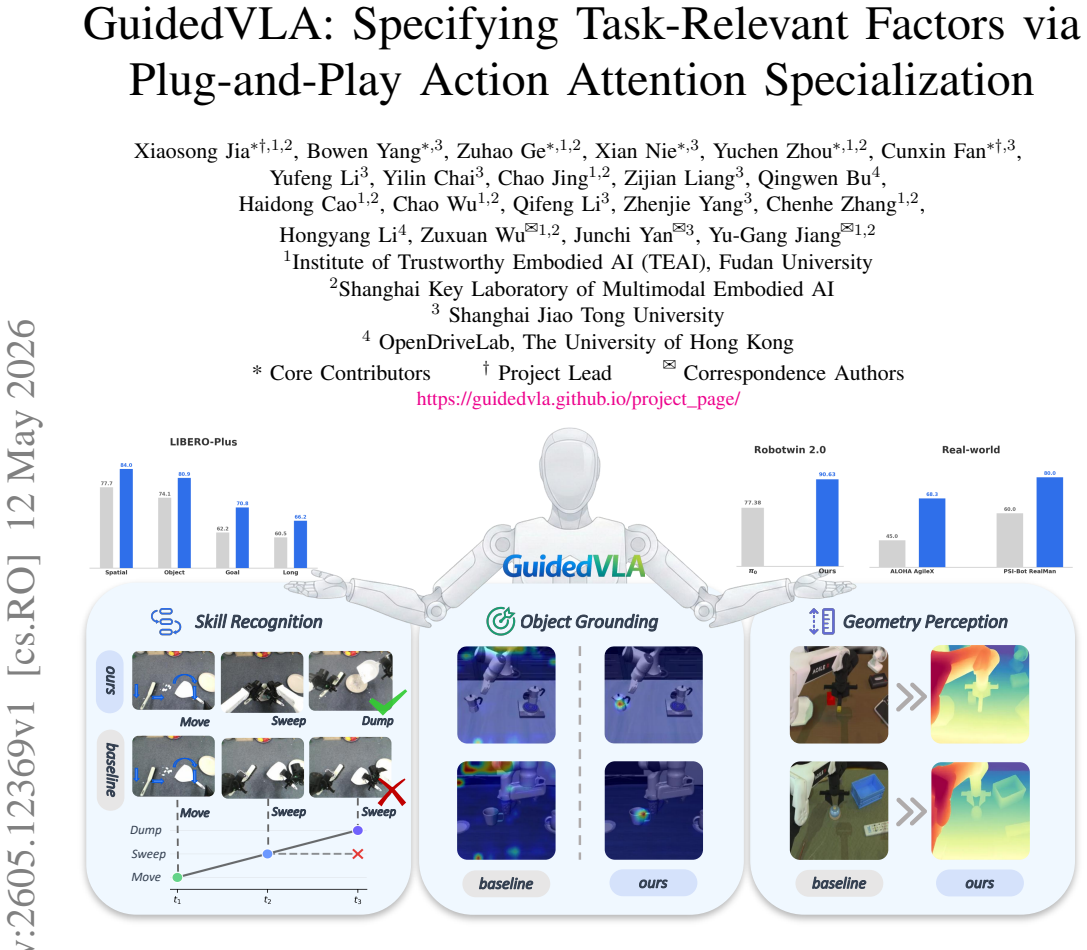
GuidedVLA: Specifying Task-Relevant Factors via Plug-and-Play Action Attention Specialization

GuidedVLA assigns separate attention heads to object, space, and time factors using auxiliary signals to cut spurious correlations.

Figure from the paper full image
abstract click to expand
Vision-Language-Action (VLA) models aim for general robot learning by aligning action as a modality within powerful Vision-Language Models (VLMs). Existing VLAs rely on end-to-end supervision to implicitly enable the action decoding process to learn task-relevant features. However, without explicit guidance, these models often overfit to spurious correlations, such as visual shortcuts or environmental noise, limiting their generalization. In this paper, we introduce GuidedVLA, a framework designed to manually guide the action generation to focus on task-relevant factors. Our core insight is to treat the action decoder not as a monolithic learner, but as an assembly of functional components. Individual attention heads are supervised by manually defined auxiliary signals to capture distinct factors. As an initial study, we instantiate this paradigm with three specialized heads: object grounding, spatial geometry, and temporal skill logic. Across simulation and real-robot experiments, GuidedVLA improves success rates in both in-domain and out-of-domain settings compared to strong VLA baselines. Finally, we show that the quality of these specialized factors correlates positively with task performance and that our mechanism yields decoupled, high-quality features. Our results suggest that explicitly guiding action-decoder learning is a promising direction for building more robust and general VLA models.
0
0
cs.RO 2026-05-13 2 theorems

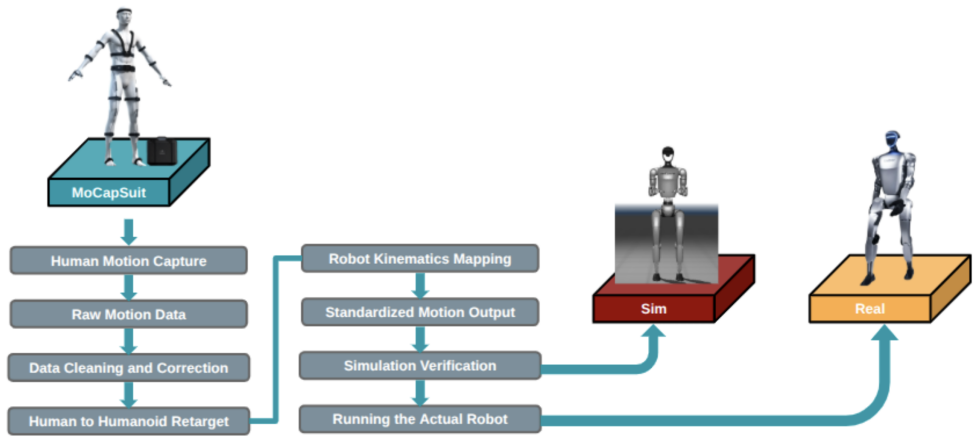
IMU suit teleoperates humanoid robot in real time with stable motions

Real-Time Whole-Body Teleoperation of a Humanoid Robot Using IMU-Based Motion Capture with Sim2Sim and Sim2Real Validation

A no-learning pipeline retargets full-body IMU data to the robot for walking, sitting and gestures, validated from sim to physical unit.

Figure from the paper full image
abstract click to expand
Stable, low-latency whole-body teleoperation of humanoid robots is an open research challenge, complicated by kinematic mismatches between human and robot morphologies, accumulated inertial sensor noise, non-trivial control latency, and persistent sim-to-real transfer gaps. This paper presents a complete real-time whole-body teleoperation system that maps human motion, recorded with a Virdyn IMU-based full-body motion capture suit, directly onto a Unitree G1 humanoid robot. We introduce a custom motion-processing, kinematic retargeting, and control pipeline engineered for continuous, low-latency operation without any offline buffering or learning-based components. The system is first validated in simulation using the MuJoCo physics model of the Unitree G1 (sim2sim), and then deployed without modification on the physical platform (sim2real). Experimental results demonstrate stable, synchronized reproduction of a broad motion repertoire, including walking, standing, sitting, turning, bowing, and coordinated expressive full-body gestures. This work establishes a practical, scalable framework for whole-body humanoid teleoperation using commodity wearable motion capture hardware.
0
0
cs.RO 2026-05-13 2 theorems

One diffusion policy learns both search and insertion

SI-Diff: A Framework for Learning Search and High-Precision Insertion with a Force-Domain Diffusion Policy

Mode conditioning lets a single force-based model tolerate 5 mm misalignments and transfer to unseen shapes

Figure from the paper full image
abstract click to expand
Contact-rich assembly is fundamental in robotics but poses significant challenges due to uncertainties in relative poses, such as misalignments and small clearances in peg-in-hole tasks. Existing approaches typically address search and high-precision insertion separately, because these tasks involve distinct action patterns. However, supporting both tasks within a single model, without switching models or weights, is desirable for intelligent assembly systems. In this work, we propose SI-Diff, a framework that learns both search and high-precision insertion through a force-domain diffusion policy. To this end, we introduce a new mode-conditioning mechanism that enables the policy to capture distinct action behaviors under a single framework. Moreover, we develop a new search teacher policy that can generate diverse trajectories. By training on successful and efficient demonstrations provided by the teacher policy, the model learns the mapping from tactile and end-effector velocity observations to effective action behaviors. We conduct thorough experiments to show that SI-Diff extends the tolerance to x-y misalignments from 2 mm to 5 mm compared to the state-of-the-art baseline, TacDiffusion, while also demonstrating strong zero-shot transferability to unseen shapes.
0
0
cs.RO 2026-05-13 2 theorems

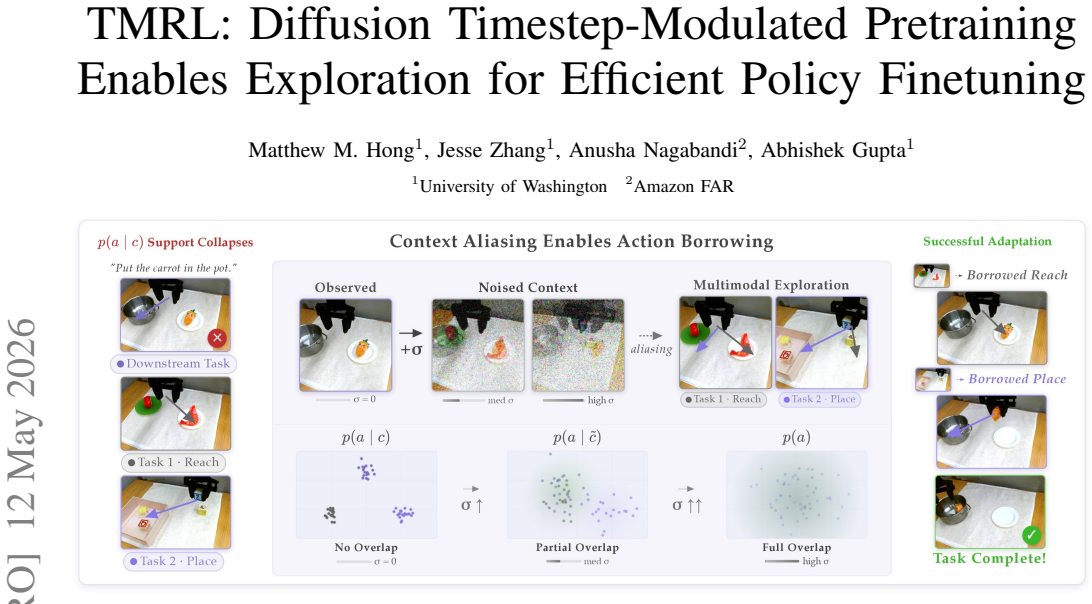
Timestep modulation turns diffusion pretraining into efficient robot exploration

TMRL: Diffusion Timestep-Modulated Pretraining Enables Exploration for Efficient Policy Finetuning

Noise injection during pretraining plus timestep control in fine-tuning lets complex manipulation tasks be learned in under an hour of real

Figure from the paper full image
abstract click to expand
Fine-tuning pre-trained robot policies with reinforcement learning (RL) often inherits the bottlenecks introduced by pre-training with behavioral cloning (BC), which produces narrow action distributions that lack the coverage necessary for downstream exploration. We present a unified framework that enables the exploration necessary to enable efficient robot policy finetuning by bridging BC pre-training and RL fine-tuning. Our pre-training method, Context-Smoothed Pre-training (CSP), injects forward-diffusion noise into policy inputs, creating a continuum between precise imitation and broad action coverage. We then fine-tune pre-trained policies via Timestep-Modulated Reinforcement Learning (TMRL), which trains the agent to dynamically adjust this conditioning during fine-tuning by modulating the diffusion timestep, granting explicit control over exploration. Integrating seamlessly with arbitrary policy inputs, e.g., states, 3D point clouds, or image-based VLA policies, we show that TMRL improves RL fine-tuning sample efficiency. Notably, TMRL enables successful real-world fine-tuning on complex manipulation tasks in under one hour. Videos and code available at https://weirdlabuw.github.io/tmrl/.
0
0
cs.RO 2026-05-13 2 theorems

Symmetry prior speeds up bimanual robot learning

Morphologically Equivariant Flow Matching for Bimanual Mobile Manipulation

Flow matching policies that enforce left-right reflection symmetry need fewer demonstrations and handle mirrored tasks they never saw in the

Figure from the paper full image
abstract click to expand
Mobile manipulation requires coordinated control of high-dimensional, bimanual robots. Imitation learning methods have been broadly used to solve these robotic tasks, yet typically ignore the bilateral morphological symmetry inherent in such systems. We argue that morphological symmetry is an underexplored but crucial inductive bias for learning in bimanual mobile manipulation: knowing how to solve a task in one configuration directly determines how to solve its mirrored counterpart. In this paper, we formalize this symmetry prior and show that it constrains optimal bimanual policies to be ambidextrous and equivariant under reflections across the robot's sagittal plane. We introduce a $\mathbb{C}_2$-equivariant flow matching policy that enforces reflective symmetry either via a regularized training loss or an equivariant velocity network. Across planar and 6-DoF mobile manipulation tasks, symmetry-informed policies consistently improve sample efficiency and achieve zero-shot generalization to mirrored configurations absent from the training distribution. We further validate this zero-shot generalization capability on a real-world manipulation task with a TIAGo++ robot. Together, our findings establish morphological symmetry as an effective, generalizable, and scalable inductive bias for ambidextrous generative policy learning.
0
0
cs.RO 2026-05-13 Recognition

Virtual objectives stabilize twist retargeting for dexterous hands

DexTwist: Dexterous Hand Retargeting for Twist Motion via Mixed Reality-based Teleoperation

Minimizing turning angle and screw axis errors reduces slip during cap and bolt tasks compared with pose-matching baselines.

Figure from the paper full image
abstract click to expand
Dexterous teleoperation via Mixed Reality (MR)-based interfaces offers a scalable paradigm for transferring human manipulation skills to dexterous robot hands. However, conventional retargeting approaches that minimize kinematic dissimilarity (e.g., joint angle or fingertip position error) often fail in contact-rich rotational manipulation, such as cap opening, key turning, and bolt screwing. This failure stems from the embodiment gap: mismatched link lengths, joint axes/limits, and fingertip geometry can cause direct pose imitation to induce tangential fingertip sliding rather than stable object rotation, resulting in screw axis drift, contact slip, and grasp instability. To address this, we propose DexTwist, a functional twist-retargeting framework for MR-based dexterous teleoperation. DexTwist detects a tripod pinch, estimates the operator's intended screw axis and twist magnitude, and applies a real-time residual joint-space refinement that tracks turning progress while regularizing the robot tripod geometry. The refinement minimizes a virtual-object objective defined by turning angle, screw axis consistency, fingertip closure, and tripod stability. Simulation and real-world experiments show that DexTwist improves turning angle tracking and screw axis stability compared with a vector-based retargeting baseline.
0
0
cs.RO 2026-05-13 2 theorems

Mixture of inverse models turns robot video predictions into actions

From Imagined Futures to Executable Actions: Mixture of Latent Actions for Robot Manipulation

By extracting latent actions from semantic, depth, and flow transitions, MoLA improves success and consistency over direct use of generatedεΈ§

Figure from the paper full image
abstract click to expand
Video generation models offer a promising imagination mechanism for robot manipulation by predicting long-horizon future observations, but effectively exploiting these imagined futures for action execution remains challenging. Existing approaches either condition policies on predicted frames or directly decode generated videos into actions, both suffering from a mismatch between visual realism and control relevance. As a result, predicted observations emphasize perceptual fidelity rather than action-centric causes of state transitions, leading to indirect and unstable control. To address this gap, we propose MoLA (Mixture of Latent Actions), a control-oriented interface that transforms imagined future videos into executable representations. Instead of passing predicted frames directly to the policy, MoLA leverages a mixture of pretrained inverse dynamics models to infer a mixture of latent actions implied by generated visual transitions. These modality-aware inverse dynamics models capture complementary semantic, depth, and flow cues, providing a structured and physically grounded action representation that bridges video imagination and policy execution. We evaluate our approach on simulated benchmarks (LIBERO, CALVIN, and LIBERO-Plus) and real-world robot manipulation tasks, achieving consistent gains in task success, temporal consistency, and generalization.
0
0
cs.RO 2026-05-13

Bidirectional pose-action loop boosts robot manipulation

X-Imitator: Spatial-Aware Imitation Learning via Bidirectional Action-Pose Interaction

Reciprocal conditioning between pose estimates and actions enables continuous refinement and higher success on complex tasks than decoupled

Figure from the paper full image
abstract click to expand
Effectively handling the interplay between spatial perception and action generation remains a critical bottleneck in robotic manipulation. Existing methods typically treat spatial perception and action execution as decoupled or strictly unidirectional processes, fundamentally restricting a robot's ability to master complex manipulation tasks. To address this, we propose X-Imitator, a versatile dual-path framework that models spatial perception and action execution as a tightly coupled bidirectional loop. By reciprocally conditioning current pose predictions on past actions and vice versa, this framework enables continuous mutual refinement between spatial reasoning and action generation. This joint modeling exactly mimics human internal forward models. Designed as a modular architecture, the system can be seamlessly integrated into various visuomotor policies. Extensive experiments across 24 simulated and 3 real-world tasks demonstrate that our framework significantly outperforms both vanilla policies and prior methods utilizing explicit pose guidance. The code will be open sourced.
0
0
cs.RO 2026-05-13 2 theorems

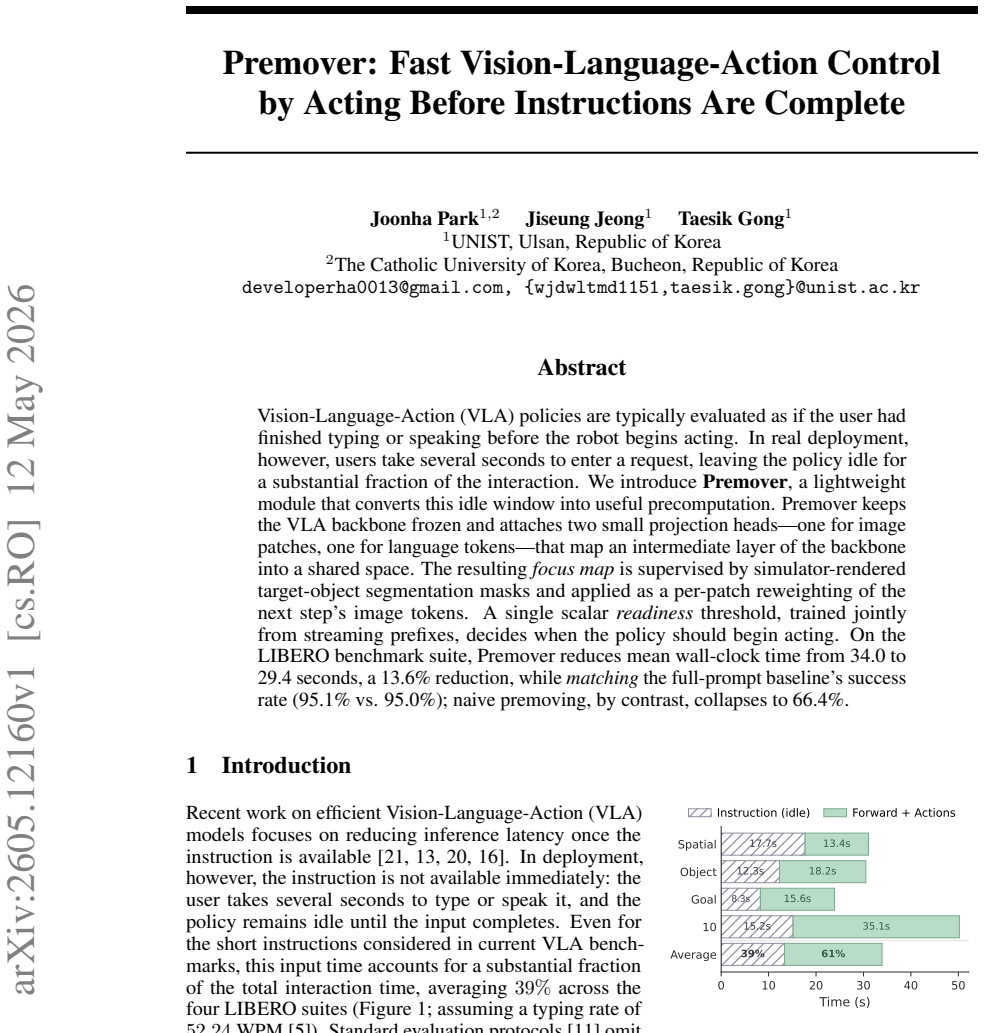
Premover cuts robot task time 13.6% by acting on incomplete commands

Premover: Fast Vision-Language-Action Control by Acting Before Instructions Are Complete

Two small heads generate focus maps from streaming prefixes and a learned threshold decides when to move, keeping success rate unchanged on

Figure from the paper full image
abstract click to expand
Vision-Language-Action (VLA) policies are typically evaluated as if the user had finished typing or speaking before the robot begins acting. In real deployment, however, users take several seconds to enter a request, leaving the policy idle for a substantial fraction of the interaction. We introduce Premover, a lightweight module that converts this idle window into useful precomputation. Premover keeps the VLA backbone frozen and attaches two small projection heads, one for image patches, one for language tokens, that map an intermediate layer of the backbone into a shared space. The resulting focus map is supervised by simulator-rendered target-object segmentation masks and applied as a per-patch reweighting of the next step's image tokens. A single scalar readiness threshold, trained jointly from streaming prefixes, decides when the policy should begin acting. On the LIBERO benchmark suite, Premover reduces mean wall-clock time from 34.0 to 29.4 seconds, a 13.6% reduction, while matching the full-prompt baseline's success rate (95.1% vs. 95.0%); naive premoving, by contrast, collapses to 66.4%.
0
0
cs.RO 2026-05-13 Recognition

World models merge with action generation for embodied AI

World Action Models: The Next Frontier in Embodied AI

Survey defines World Action Models that jointly predict future states and actions instead of mapping observations straight to moves.

abstract click to expand
Vision-Language-Action (VLA) models have achieved strong semantic generalization for embodied policy learning, yet they learn reactive observation-to-action mappings without explicitly modeling how the physical world evolves under intervention. A growing body of work addresses this limitation by integrating world models, predictive models of environment dynamics, into the action generation pipeline. We term this emerging paradigm World Action Models (WAMs): embodied foundation models that unify predictive state modeling with action generation, targeting a joint distribution over future states and actions rather than actions alone. However, the literature remains fragmented across architectures, learning objectives, and application scenarios, lacking a unified conceptual framework. We formally define WAMs and disambiguate them from related concepts, and trace the foundations and early integration of VLA and world model research that gave rise to this paradigm. We organize existing methods into a structured taxonomy of Cascaded and Joint WAMs, with further subdivision by generation modality, conditioning mechanism, and action decoding strategy. We systematically analyze the data ecosystem fueling WAMs development, spanning robot teleoperation, portable human demonstrations, simulation, and internet-scale egocentric video, and synthesize emerging evaluation protocols organized around visual fidelity, physical commonsense, and action plausibility. Overall, this survey provides the first systematic account of the WAMs landscape, clarifies key architectural paradigms and their trade-offs, and identifies open challenges and future opportunities for this rapidly evolving field.
0
0
cs.RO 2026-05-13 1 theorem

QOED focuses robot exploration on identifiable parameters

Learning What Matters: Adaptive Information-Theoretic Objectives for Robot Exploration

Eigenspace analysis of the Fisher information matrix approximates ideal information gain by suppressing nuisance effects.

Figure from the paper full image
abstract click to expand
Designing learnable information-theoretic objectives for robot exploration remains challenging. Such objectives aim to guide exploration toward data that reduces uncertainty in model parameters, yet it is often unclear what information the collected data can actually reveal. Although reinforcement learning (RL) can optimize a given objective, constructing objectives that reflect parametric learnability is difficult in high-dimensional robotic systems. Many parameter directions are weakly observable or unidentifiable, and even when identifiable directions are selected, omitted directions can still influence exploration and distort information measures. To address this challenge, we propose Quasi-Optimal Experimental Design (Q{\footnotesize OED}), an adaptive information objective grounded in optimal experimental design. Q{\footnotesize OED} (i) performs eigenspace analysis of the Fisher information matrix to identify an observable subspace and select identifiable parameter directions, and (ii) modifies the exploration objective to emphasize these directions while suppressing nuisance effects from non-critical parameters. Under bounded nuisance influence and limited coupling between critical and nuisance directions, Q{\footnotesize OED} provides a constant-factor approximation to the ideal information objective that explores all parameters. We evaluate Q{\footnotesize OED} on simulated and real-world navigation and manipulation tasks, where identifiable-direction selection and nuisance suppression yield performance improvements of \SI{35.23}{\percent} and \SI{21.98}{\percent}, respectively. When integrated as an exploration objective in model-based policy optimization, Q{\footnotesize OED} further improves policy performance over established RL baselines.
0
0
cs.RO 2026-05-13 Recognition

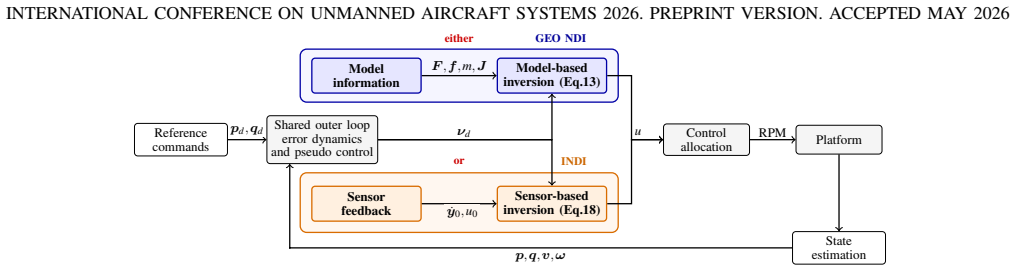
INDI yields lower position errors than geometric NDI on hexarotors

Control of Fully Actuated Aerial Vehicles: A Comparison of Model-based and Sensor-based Dynamic Inversion

Sensor-based incremental inversion handles mismatches, gusts and sensor issues better, while model-based NDI excels at attitude tracking at

Figure from the paper full image
abstract click to expand
Fully actuated multirotor platforms decouple translational force generation from vehicle attitude, enabling independent control of position and orientation and shifting performance limitations from attitude authority to actuator dynamics and control effectiveness. This paper compares a model-based nonlinear dynamic inversion controller (geometric NDI) with a sensor-based incremental dynamic inversion controller (INDI) on a fixed-tilt fully actuated hexarotor. Both controllers share an identical outer-loop structure and are both executed at 500 Hz; therefore, performance differences can be attributed primarily to the inversion strategy. Controller performance is evaluated in five experiments covering attitude step tracking under nominal conditions and under a 50% mismatch in the rotor force coefficient, hover disturbance rejection under an external lateral load, waypoint tracking in the presence of wind gust disturbances, reduced control frequency, and injected sensor degradation. The results show that INDI offers clear advantages under parameter mismatch, gust disturbances, and sensor degradation, and maintains lower position errors across the controller-frequency sweep. However, its advantages are not universal: geometric NDI yields better attitude tracking at reduced control frequencies. To the authors' best knowledge, this work presents the first experimental validation of a full pose tracking INDI controller with decoupled translational and rotational dynamics. These findings highlight the trade-off between measurement-based and model-based inversion for robust control and rapid deployment of fully actuated UAVs.
0
0
cs.RO 2026-05-13 1 theorem

Motion statecharts execute semantic tasks on eight robot platforms

Closing the Motion Execution Gap: From Semantic Motion Task Constraints to Kinematic Control

A shared kinematic model plus jerk-bounded control turns high-level constraints into smooth, transferable trajectories without per-robot ret

Figure from the paper full image
abstract click to expand
This paper addresses the Motion Execution Gap, the disconnect between high-level symbolic task descriptions using semantic constraints and executable robot motions. Motion Statecharts are introduced as an executable symbolic representation for complex motions. They allow the arbitrary arrangement of motion constraints, monitors or nested statecharts in parallel and sequence. World-centric motion specification and generalization across embodiments are enabled through the use of a unified differentiable kinematic world model of both, robots and environments. Motion execution is realized through a lMPC-based implementation of the task-function approach, in which smooth transitions during task switches are ensured using jerk bounds. Cross-platform transferability was demonstrated by deploying the method on eight robot platforms, operating in diverse environments. The proposed framework is called Giskard and is available open source: https://github.com/cram2/cognitive_robot_abstract_machine.
0
0
cs.RO 2026-05-13 Recognition

Robot blocks unsafe merges at blind intersections

Cooperative Robotics Reinforced by Collective Perception for Traffic Moderation

Fused camera and vehicle data lets the system predict collision risks and intervene physically where alerts alone are ignored.

Figure from the paper full image
abstract click to expand
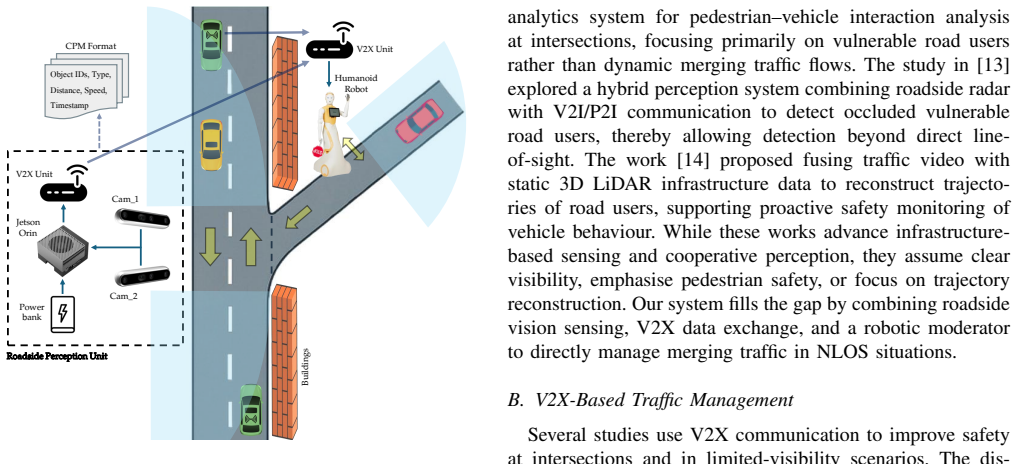
Collisions at non-line-of-sight (NLOS) intersections remain a major safety concern because drivers have limited visibility of approaching traffic. V2X based warnings can reduce these risks, yet many vehicles are not equipped with V2X and drivers may ignore in vehicle alerts. Collective perception (CP) can compensate for low V2X penetration by extending the awareness of connected vehicles, but it cannot influence unconnected vehicles. To fill this gap, our work introduces a complementary concept that adds a cooperative humanoid robot as an active traffic moderator capable of physically stopping a vehicle that attempts to merge into an unseen traffic stream. The system operates on two parallel perception pathways. A dual camera infrastructure unit detects the position, speed and motion of approaching vehicles and transmits this information to the robot as a collective perception message (CPM). The robot also receives cooperative awareness messages (CAM) from connected vehicles through its onboard V2X unit and can act as a relay for decentralized environmental notification messages (DENM) when safety events originate elsewhere along the road. A fusion module combines these streams to maintain a robust real time view of the main road. A Zone of Danger (ZoD) is defined and used to predict whether an approaching vehicle creates a collision risk for a merging road user. When such a risk is detected, the robot issues a human-like STOP gesture and blocks the merging path until the hazard disappears. The full system was deployed at the Future Mobility Park (FMP) in Rotterdam. Experiments show that the combined vision and V2X perception allows the robot to detect approaching vehicles early, predict hazards reliably and prevent unsafe merges in real world NLOS conditions.
0
0
cs.RO 2026-05-13 Recognition

Pre-planned graph branches let robots recover from failures instantly

From Reaction to Anticipation: Proactive Failure Recovery through Agentic Task Graph for Robotic Manipulation

AgentChord augments task graphs with corrective paths so monitors can switch without re-planning, raising success on long bimanual jobs.

Figure from the paper full image
abstract click to expand
Although robotic manipulation has made significant progress, reliable execution remains challenging because task failures are inevitable in dynamic and unstructured environments. To handle such failures, existing frameworks typically follow a stepwise detect-reason-recover pipeline, which often incurs high latency and limited robustness due to delayed reasoning and reactive planning. Inspired by the human capability to anticipate and proactively plan for potential failures, we introduce AgentChord, an agentic system that models a manipulation task as a directed task graph. Before execution, this graph is enriched with anticipatory recovery branches that specify context-aware corrective behaviors, enabling immediate and targeted responses when failures occur. Specifically, AgentChord operates through a choreography of specialized agents: a composer that structures the nominal task graph, an arranger that augments the graph with anticipatory recovery branches, and a conductor that compiles and coordinates executable transitions using low-latency monitors to detect deviations and trigger pre-compiled recoveries without re-planning. Empirical studies on diverse long-horizon bimanual manipulation tasks demonstrate that AgentChord substantially improves success rates and execution efficiency, advancing the reliability and autonomy of real-world robotic systems. The project page is available at: https://shengxu.net/AgentChord/.
0
0
cs.RO 2026-05-13 2 theorems

LLM evolution designs superior robot navigation rewards

EvoNav: Evolutionary Reward Function Design for Robot Navigation with Large Language Models

EvoNav's three-stage checks let language models search reward functions efficiently, outperforming manual designs in experiments.

Figure from the paper full image
abstract click to expand
Robot navigation is a crucial task with applications to social robots in dynamic human environments. While Reinforcement Learning (RL) has shown great promise for this problem, the policy quality is highly sensitive to the specification of reward functions. Hand-crafted rewards require substantial domain expertise and embed inductive biases that are difficult to audit or adapt, limiting their effectiveness and leading to suboptimal performance. In this paper, we propose EvoNav, an evolutionary framework that automates the design of robot navigation reward functions via large language models (LLMs). To overcome prohibitively costly policy training, EvoNav evaluates each candidate proposal from the LLM via a progressive three-stage warm-up-boost procedure. EvoNav advances from analytical proxies with low-cost surrogates, such as small datasets and analytic rules, to lightweight rollouts and, finally, to full policy training, enabling computationally efficient exploration under effective feedback. Experiment results show that EvoNav produces more effective navigation policies than manually designed RL rewards and state-of-the-art reward design methods.
0
0
cs.RO 2026-05-13 Recognition

Multi-view latents and manifold actions boost VLA robotic success

Learning Action Manifold with Multi-view Latent Priors for Robotic Manipulation

Synthesized novel views fix depth problems while direct manifold prediction skips inefficient regression for higher manipulation rates.

Figure from the paper full image
abstract click to expand
This paper tackles spatial perception and manipulation challenges in Vision-Language-Action (VLA) models. To address depth ambiguity from monocular input, we leverage a pre-trained multi-view diffusion model to synthesize latent novel views and propose a Geometry-Guided Gated Transformer (G3T) that aligns multi-view features under 3D geometric guidance while adaptively filtering occlusion noise. To improve action learning efficiency, we introduce Action Manifold Learning (AML), which directly predicts actions on the valid action manifold, bypassing inefficient regression of unstructured targets like noise or velocity. Experiments on LIBERO, RoboTwin 2.0, and real-robot tasks show our method achieves superior success rate and robustness over SOTA baselines. Project page: https://junjxiao.github.io/Multi-view-VLA.github.io/.
0
0
cs.RO 2026-05-13 Recognition

Body regions dictate robot affective touch strategies

Mapping Embodied Affective Touch Strategies on a Humanoid Robot

Full-body tactile study shows free and limited access produce different locations and dynamics for expressing emotions on the iCub.

Figure from the paper full image
abstract click to expand
Affective touch in human-robot interaction is shaped not only by emotional intent, but also by robot embodiment, including touch location, physical constraints, and perceived agency or social role. Existing HRI studies typically focus on one or two isolated body parts, limiting understanding of how affective touch generalises across the full humanoid body. We present a study with 32 participants interacting with the iCub robot, which is equipped with full-body distributed tactile sensors. Participants expressed eight emotions under three conditions: free touch, arm-only touch, and torso-only touch. Results show that body region and spatial constraints jointly shaped both touch location and dynamics. In free touch, participants preferred socially accessible upper-body regions, while less frequently touched areas showed stronger emotion-specific selectivity. Emotion-related variation was more evident in motion features for arm-only touch and pressure features for torso-only touch. Touch strategies also did not transfer directly between free and constrained conditions, even within the same coarse body region. Participants reported increased closeness to the robot after interaction, with around 30 percent reporting a change in perceived social relationship. Together, these findings show that affective touch expression is strongly body-region dependent and shaped by embodiment constraints.
0
0
cs.RO 2026-05-13 1 theorem

Grid sampler trims VLA tokens to under 10% with full success

See What Matters: Differentiable Grid Sample Pruning for Generalizable Vision-Language-Action Model

Continuous coordinate-based resampling preserves contact points and spatial relations better than traditional pruning methods.

Figure from the paper full image
abstract click to expand
Vision-Language-Action (VLA) models have shown remarkable promise in robotics manipulation, yet their high computational cost hinders real-time deployment. Existing token pruning methods suffer from a fundamental trade-off: aggressive compression using pruning inevitably discards critical geometric details like contact points, leading to severe performance degradation. This forces a compromise, limiting the achievable compression rate and thus the potential speedup. We argue that breaking this trade-off requires rethinking compression as a geometry-aware, continuous token resampling in the vision encoder. To this end, we propose the Differentiable Grid Sampler (GridS), a plug-and-play module that performs task-aware, continuous resampling of visual tokens in VLA. By adaptively predicting a minimal set of salient coordinates and extracting features via differentiable interpolation, GridS preserves essential spatial information while achieving drastic compression (with fewer than 10% original visual tokens). Experiments on both LIBERO benchmark and a real robotic platform demonstrate that validating the lowest feasible visual token count reported to date, GridS achieves a 76% reduction in FLOPs with no degradation in the success rate. The code is available at https://github.com/Fediory/Grid-Sampler.
0
0
cs.RO 2026-05-13 1 theorem

Online imitation learning improves navigation via privileged planner labels

NavOL: Navigation Policy with Online Imitation Learning

A diffusion policy gathers optimal paths from its own simulator rollouts and retrains without rewards or distribution shift, showing gains

Figure from the paper full image
abstract click to expand
Learning robust navigation policies remains a core challenge in robotics. Offline imitation learning suffers from distribution shift and compounding errors at rollout, while reinforcement learning requires reward engineering and learns inefficiently. In this paper, we propose NavOL, an online imitation learning paradigm that interacts with a simulator and updates itself using expert demonstrations gathered online. Built upon a pretrained navigation diffusion policy that maps local observations to future waypoints, NavOL trains in a rollout update loop: during rollout, the policy acts in the simulator and queries a global planner which has privileged access to the global environment for the optimal path segment as ground truth trajectory labels; during update, the policy is trained on the online collected observation trajectory pairs. This online imitation loop removes the need for reward design, improves learning efficiency, and mitigates distribution shift by training on the policy own explored rollouts. Built on IsaacLab with fast, high-fidelity parallel rendering and domain randomization of camera pose and start-goal pairs, our system scales across 50 scenes on 8 RTX 4090 GPUs, collecting over 2,000 new trajectories per hour, each averaging more than 400 steps. We also introduce an indoor visual navigation benchmark with predefined start and goal positions for zero-shot generalization. Extensive evaluations on simulation benchmarks, including the NavDP benchmark and our proposed benchmark, as well as carefully designed real-world experiments, demonstrate the effectiveness of NavOL, showing consistent performance gains in online imitation learning.
0
0
cs.RO 2026-05-13 2 theorems

Robots dream short futures to dodge manipulation failures

DreamAvoid: Critical-Phase Test-Time Dreaming to Avoid Failures in VLA Policies

Test-time evaluation of candidate action outcomes during critical phases raises VLA success rates on real robots and simulations.

Figure from the paper full image
abstract click to expand
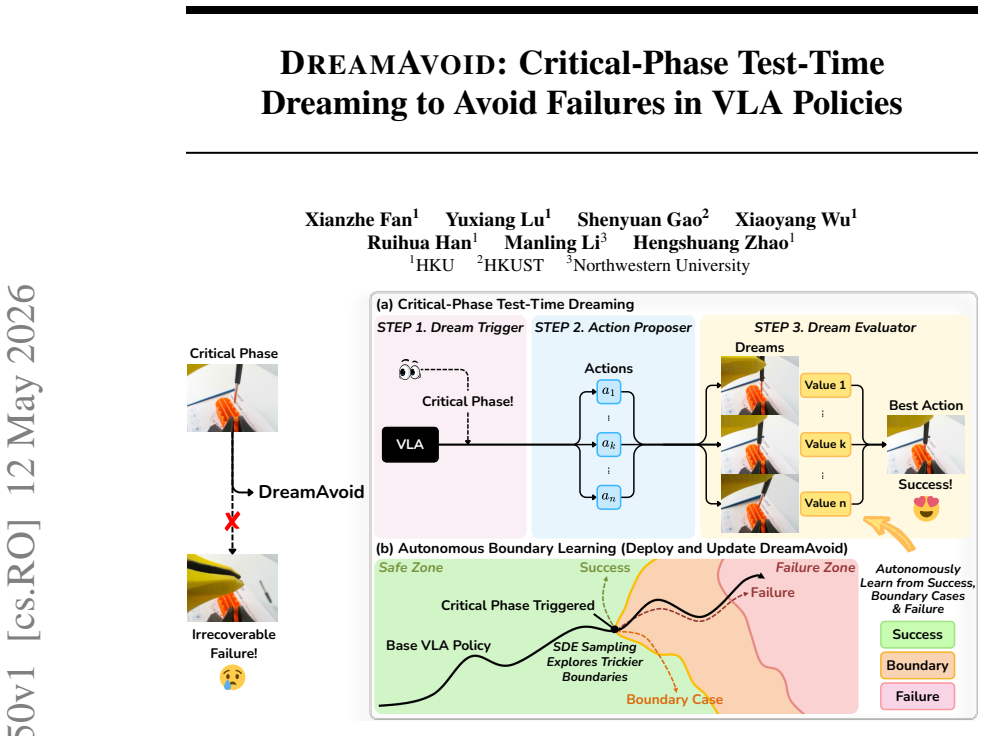
Vision-Language-Action (VLA) models are often brittle in fine-grained manipulation, where minor action errors during the critical phases can rapidly escalate into irrecoverable failures. Since existing VLA models rely predominantly on successful demonstrations for training, they lack an explicit awareness of failure during these critical phases. To address this, we propose DreamAvoid, a critical-phase test-time dreaming framework that enables VLA models to anticipate and avoid failures. We also introduce an autonomous boundary learning paradigm to refine the system's understanding of the subtle boundary between success and failure. Specifically, we (1) utilize a Dream Trigger to determine whether the execution has entered a critical phase, (2) sample multiple candidate action chunks from the VLA via an Action Proposer, and (3) employ a Dream Evaluator, jointly trained on mixed data (success, failure, and boundary cases), to "dream" the short-horizon futures corresponding to the candidate actions, evaluate their values, and select the optimal action. We conduct extensive evaluations on real-world manipulation tasks and simulation benchmarks. The results demonstrate that DreamAvoid can effectively avoid failures, thereby improving the overall task success rate. Our code is available at https://github.com/XianzheFan/DreamAvoid.
0
0
cs.RO 2026-05-13 2 theorems

Surfaces guide soft gripper to grasp paper sheets

Introducing Environmental Constraints to Grasping Strategies for Paper-Like Flexible Materials Using a Soft Gripper

Strategies built on environmental contacts define workable spaces and success rates for thin flexible materials.

abstract click to expand
Robotic manipulation of flexible objects is widely required in both industrial and service applications. Among such objects, paper-like materials exhibit distinct mechanical characteristics compared to cloth, being more sensitive to compressive stress, where minor variations in physical properties can significantly affect grasping. This study systematically investigates grasping strategies for paper-like materials using a universal soft gripper by exploiting environmental constraints. Based on manipulation primitives employed in existing grasping strategies, we proposed systematic grasping strategies for flexible materials by exploiting environmental constraints and analyzed their mechanical and kinematic models. To investigate the influence of materials and working conditions on grasping, an evaluation system for measuring grasping force and success rate was defined and experimentally evaluated. Finally, we summarized the specific workspaces and characteristics of different strategies that can satisfy various task requirements and lead to potential applications in household service robots for grasping planar flexible objects.
0
0
cs.RO 2026-05-13 2 theorems

Geometry tuning lets Rainbow DQN master cooperative insertions

Rainbow Deep Q-Learning with Kinematics-Aware Design for Cooperative Delta and 3-RRS Parallel Robot Insertion

Pre-optimizing 3-RRS workspace enlarges the safe region so the RL policy converges with fewer violations than vanilla DQN or planners.

Figure from the paper full image
abstract click to expand
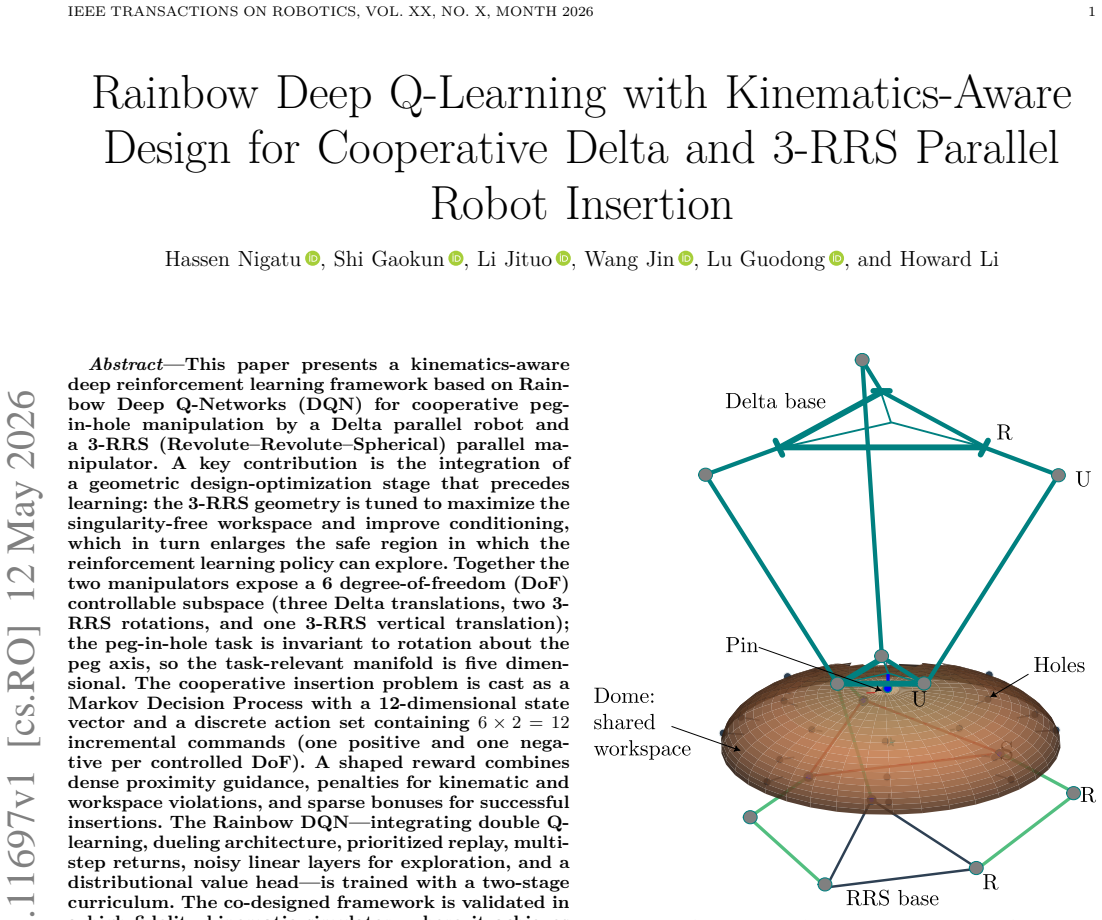
This paper presents a kinematics-aware deep reinforcement learning framework based on Rainbow Deep Q-Networks (DQN) for cooperative peg-in-hole manipulation by a Delta parallel robot and a 3-RRS (Revolute--Revolute--Spherical) parallel manipulator. A key contribution is the integration of a geometric design-optimization stage that precedes learning: the 3-RRS geometry is tuned to maximize the singularity-free workspace and improve conditioning, which in turn enlarges the safe region in which the reinforcement learning policy can explore. Together the two manipulators expose a 6~degree-of-freedom (DoF) controllable subspace (three Delta translations, two 3-RRS rotations, and one 3-RRS vertical translation); the peg-in-hole task is invariant to rotation about the peg axis, so the task-relevant manifold is five dimensional. The cooperative insertion problem is cast as a Markov Decision Process with a 12-dimensional state vector and a discrete action set containing $6 \times 2 = 12$ incremental commands (one positive and one negative per controlled DoF). A shaped reward combines dense proximity guidance, penalties for kinematic and workspace violations, and sparse bonuses for successful insertions. The Rainbow DQN -- integrating double Q-learning, dueling architecture, prioritized replay, multi-step returns, noisy linear layers for exploration, and a distributional value head -- is trained with a two-stage curriculum. The co-designed framework is validated in a high-fidelity kinematic simulator, where it achieves stable policy convergence, reliable insertions, and reduced constraint violations compared against a vanilla DQN agent and a classical sampling-based planner.
0
0
cs.RO 2026-05-13 Recognition

IEKF and smoother cut long-term error versus MUSE on quadruped data

A Proprioceptive-Only Benchmark for Quadruped State Estimation: ATE, RPE, and Runtime Trade-offs Between Filters and Smoothers

Short-term relative errors stay similar while runtimes show clear accuracy versus computation trade-offs

Figure from the paper full image
abstract click to expand
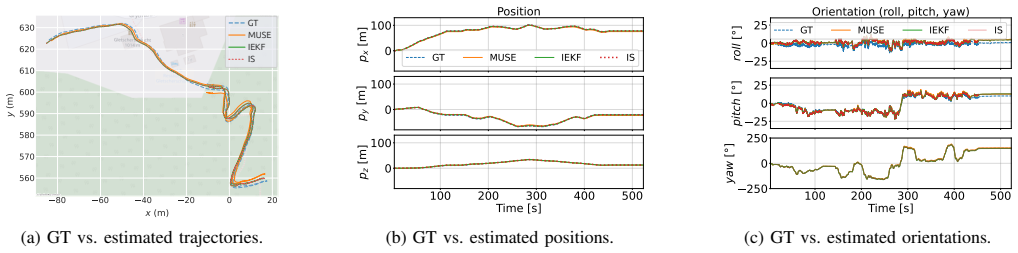
We compare three state-of-the-art proprioceptive state estimators for quadruped robots: MUSE [1], the Invariant Extended Kalman Filter (IEKF) [2], and the Invariant Smoother (IS) [3], on the CYN-1 sequence of the GrandTour Dataset [4]. Our goal is to give practitioners clear guidance on accuracy and computation time: we report long-term accuracy (Absolute Trajectory Error, ATE), short-term accuracy (translational and rotational Relative Pose Error, RPE), and per-update computation time on a fixed hardware/software stack. On this dataset, RPEs are broadly similar across methods, while IEKF and IS achieve a lower ATE than MUSE. Runtime results highlight the accuracy-latency trade-offs across the three approaches. In the discussion, we outline the evaluation choices used to ensure a fair comparison and analyze factors that influence short-horizon metrics. Overall, this study provides a concise snapshot of accuracy and cost, helping readers choose an estimator that fits their application constraints, with all evaluation code and documentation released open-source at https://github.com/iit-DLSLab/state_estimation_benchmark for full reproducibility.
0
0
cs.RO 2026-05-13 3 theorems

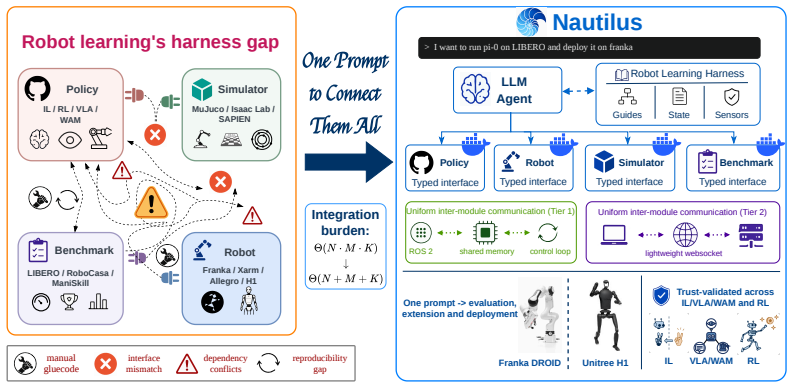
One prompt generates full robot learning pipelines

Nautilus: From One Prompt to Plug-and-Play Robot Learning

Nautilus auto-creates adapters so policies, benchmarks, and robots connect through a single uniform interface without hand-written glue.

Figure from the paper full image
abstract click to expand
Robot learning research is fragmented across policy families, benchmark suites, and real robots; each implementation is entangled with the others in a complex combination matrix, making it an engineering nightmare to port any single element. General-purpose coding agents may occasionally bridge specific setups, but cannot close this gap at scale because they lack the procedural priors and validation practices that characterize robotics research workflows. We propose NAUTILUS, an open-source harness that turns a single user prompt -- for example, "Evaluate policy A with benchmark B" -- into ready-to-use reproduction, evaluation, fine-tuning, and deployment workflows. NAUTILUS provides: plug-and-play agent skill sets with distilled priors from robotics research; typed contracts among policies, simulators/benchmarks, and real-world robots; unified interfaces and execution environments; and a trustworthy agentic coding workflow with explicit, automated validation, and testing at each milestone. NAUTILUS can not only automatically generate the required adapters and containers for existing implementations, but also wrap and onboard new or user-provided policies, simulators/benchmarks, and robots, all connected via a uniform interface. This expands cross-validation coverage without hand-written glue code. Like a nautilus shell that grows by adding chambers, NAUTILUS scales by extending its execution in chambered units, making it a research harness for scalability rather than a hand-curated framework, and aiming to reduce the engineering burden of cross-family reproduction and evaluation in the ever-growing robot learning ecosystem.
0
0
cs.RO 2026-05-13 2 theorems

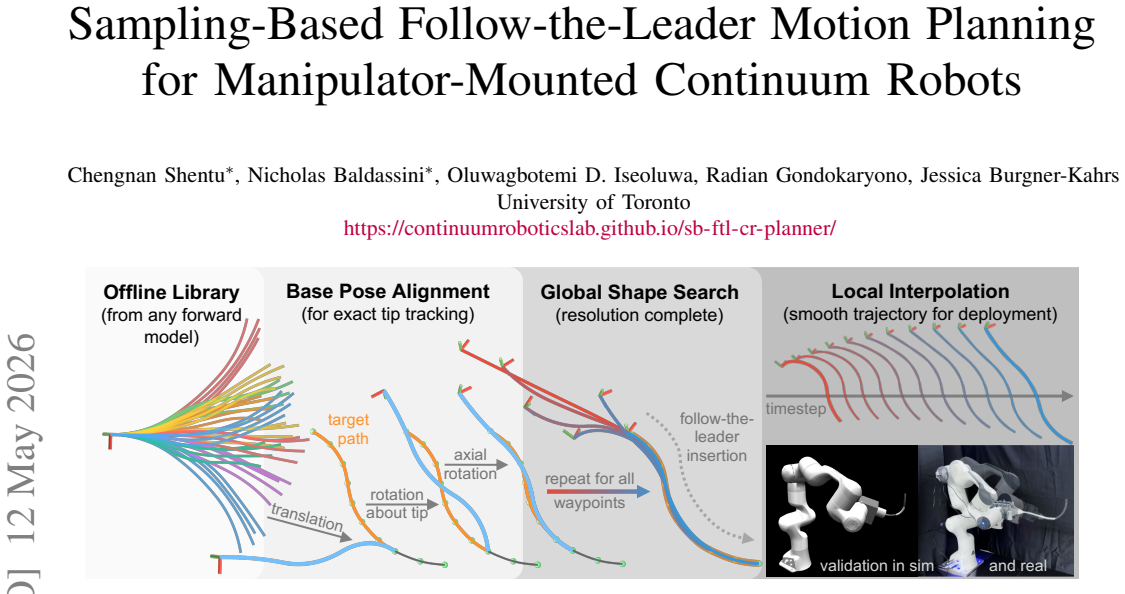
Planner achieves zero tip error for continuum robots on arms

Sampling-Based Follow-the-Leader Motion Planning for Manipulator-Mounted Continuum Robots

Sampling shapes and computing base poses in closed form enables efficient follow-the-leader planning with completeness guarantees for any 6D

Figure from the paper full image
abstract click to expand
Follow-the-leader (FTL) motion exploits the unique morphology of continuum robots (CRs) to navigate confined spaces by having the body retrace the path of the tip. While extensively studied, existing FTL methods typically assume a fixed base or a single degree-of-freedom insertion mechanism, limiting their applicability to practical systems in which CRs are mounted on robotic manipulators with fully actuated SE(3) base pose. This paper presents a sampling-based motion planner for FTL motion of manipulator-mounted CRs that jointly considers robot configuration and base pose. The key idea is to decouple global shape search from base pose determination by computing the base pose through a closed-form geometric construction, thereby avoiding iterative optimization during online planning. The approach supports general forward models and enables efficient planning by shifting the majority of computation offline. We establish theoretical guarantees including resolution complete shape search and converging tip tracking throughout waypoint traversal and interpolation. Experiments on 120 simulated paths over 3 test classes demonstrate 0% tip error and 1.9% mean shape deviation (w.r.t. robot length) at 100% success rate. We validate the practicality of our approach on a 6-DOF tendon-driven CR mounted on a serial manipulator. Code and visualization available at https://continuumroboticslab.github.io/sb-ftl-cr-planner/.
0
0
cs.RO 2026-05-13 Recognition

Lightweight Python layer lets users swap robot bodies with little code

RIO: Flexible Real-Time Robot I/O for Cross-Embodiment Robot Learning

RIO abstractions support data collection and VLA deployment on single-arm, bimanual, and humanoid platforms across four hardware setups.

Figure from the paper full image
abstract click to expand
Despite recent efforts to collect multi-task, multi-embodiment datasets, to design recipes for training Vision-Language-Action models (VLAs), and to showcase these models on different robot platforms, generalist cross-embodiment robot capabilities remains a largely elusive ideal. Progress is limited by fragmented infrastructure: most robot code is highly specific to the exact setup the user decided on, which adds major overhead when attempting to reuse, recycle, or share artifacts between users. We present RIO (Robot I/O), an open source Python framework that provides flexible, lightweight components for robot control, teleoperation, data formatting, sensor configuration, and policy deployment across diverse hardware platforms and morphologies. RIO provides abstractions that enable users to make any choice and to switch between them, with minimal reconfiguration effort. We validate RIO on VLA deployment workflows across three morphologies (single-arm, bimanual, humanoid) and four hardware platforms with varying grippers and cameras. Using teleoperated data collected with RIO, we fine-tune state-of-the-art VLAs including $\pi_{0.5}$ and GR00T on household tasks such as pick-and-place, folding, and bowl scrubbing. By open sourcing all our efforts, we hope the community can accelerate their pace of robot learning on real-world robot hardware. Additional details at: https://robot-i-o.github.io
0
0
cs.RO 2026-05-13 3 theorems

Benchmark shows intent resolution bottlenecks LLM household agents

PRISM: : Planning and Reasoning with Intent in Simulated Embodied Environments

Seven-model tests find long-horizon tasks cause 20% success for small models with excess token use signaling over-reasoning.

Figure from the paper full image
abstract click to expand
When an LLM-based embodied agent fails at a household task, the culprit could be misidentified objects, forgotten sub-goals, or poor action sequencing -- yet existing benchmarks report only a single success rate, making it impossible to tell which cognitive module is responsible. We present PRISM, a diagnostic benchmark that reframes this problem: rather than asking only \textit{did the agent succeed?}, PRISM asks \textit{which capability is most likely responsible for failure?} Built on five photorealistic multi-room apartments (4--8 rooms each), PRISM structures 300 human-verified tasks into three capability tiers -- \textit{Basic Ability}, \textit{Reasoning Ability}, and \textit{Long-horizon Ability} -- that isolate perception-to-action grounding, implicit intent resolution, and sustained multi-step coordination respectively. PRISM exposes an agent-agnostic executable action API that allows arbitrary agents: LLM agents, VLM agents, symbolic planners, RL policies, and hybrid systems, to be evaluated end-to-end under the same benchmark protocol. To support deeper diagnosis, optional probes for perception, memory, and planning can be adopted, replaced, or bypassed entirely, enabling controlled component-level analysis when desired. Experiments on seven contemporary LLMs establish a clear hierarchy: explicit spatial grounding is not the dominant failure source under oracle perception, implicit intent resolution is a significant bottleneck for all model families, and long-horizon coordination exposes a stark capability cliff -- lightweight models collapse to as low as 20.0\% success while simultaneously consuming more tokens than their frontier counterparts, a signature of compensatory over-reasoning rather than genuine planning capability. Project page: \href{https://sj-li.com/PROJ/PRISM}{link}.
0
0
cs.RO 2026-05-13 2 theorems

Single-agent demos plus cost produce coordinated multi-agent policies

Coordinated Diffusion: Generating Multi-Agent Behavior Without Multi-Agent Demonstrations

CoDi steers independent diffusion models with a guidance term to generate joint behavior without joint examples.

Figure from the paper full image
abstract click to expand
Imitation learning powered by generative models has proven effective for modeling complex single-agent behaviors. However, teaching multi-agent systems, like multiple arms or vehicles, to coordinate through imitation learning is hindered by a fundamental data bottleneck: as the joint state-action space grows exponentially with the number of agents, collecting a sufficient amount of coordinated multi-agent demonstrations becomes extremely costly. In this work, we ask: how can we leverage single-agent demonstration data to learn multi-agent policies? We present Coordinated Diffusion (CoDi), a framework that couples independently trained single-agent diffusion policies through a user-defined multi-agent cost function, without requiring any coordinated demonstrations. We derive a new diffusion-based sampling scheme wherein the diffusion score function decomposes into independent, single-agent pre-trained base policies plus a cost-driven guidance term that coordinates these base policies into cohesive multi-agent behavior. We show that this guidance term can be estimated in a gradient-free manner, making CoDi applicable to black-box, non-differentiable cost functions without additional training. Theoretically and empirically, we analyze the conditions under which this composition can faithfully approximate a target multi-agent behavior. We find a complementary role for demonstration data versus the cost function: single-agent demonstrations must cover the support of the desired multi-agent behavior, while the cost function must promote desired behavior from this product of single-agent policies. Our results in simulation and hardware experiments of a two-arm manipulation task show that CoDi discovers robust coordinated behavior from single-agent data, is more data-efficient than multi-agent baselines, and highlights the importance of joint guidance, base policy support, and cost design.
0
0
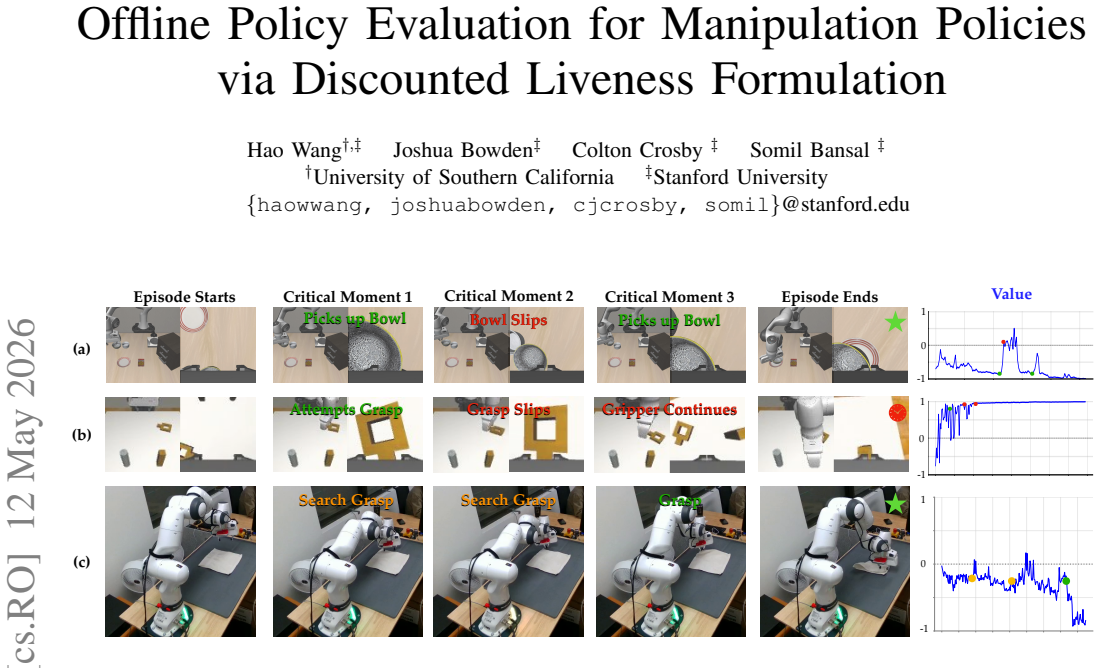
cs.RO 2026-05-13 2 theorems

Liveness operator cuts truncation bias in robot policy evaluation

Offline Policy Evaluation for Manipulation Policies via Discounted Liveness Formulation

It encodes task completion directly so finite rollouts still yield conservative, usable value estimates for manipulation.

Figure from the paper full image
abstract click to expand
Policy evaluation is a fundamental component of the development and deployment pipeline for robotic policies. In modern manipulation systems, this problem is particularly challenging: rewards are often sparse, task progression of evaluation rollouts are often non-monotonic as the policies exhibit recovery behaviors, and evaluation rollouts are necessarily of finite length. This finite length introduces truncation bias, breaking the infinite-horizon assumptions underlying standard methods relying on Bellman equations/principle of optimality. In this work, we propose a framework for offline policy evaluation from sparse rewards based on a liveness-based Bellman operator. Our formulation interprets policy evaluation as a task-completion problem and yields a conservative fixed-point value function that is robust to finite-horizon truncation. We analyze the theoretical properties of the proposed operator, including contraction guarantees, and show how it encodes task progression while mitigating truncation bias. We evaluate our method on two simulated manipulation tasks using both a Vision-Language-Action model and a diffusion policy, and a cloth folding task using human demonstrations. Empirical results demonstrate that our approach more accurately reflects task progress and substantially reduces truncation bias, outperforming classical baselines such as TD(0) and Monte Carlo policy evaluation.
0
0
cs.RO 2026-05-13 2 theorems

Training-free fix lifts VLA success rates up to 28.8% in dynamic scenes

Overcoming Dynamics-Blindness: Training-Free Pace-and-Path Correction for VLA Models

One quadratic cost over action chunks splits into pace and path channels that absorb motion without retraining or added latency.

Figure from the paper full image
abstract click to expand
Vision-Language-Action (VLA) models achieve remarkable flexibility and generalization beyond classical control paradigms. However, most prevailing VLAs are trained under a single-frame observation paradigm, which leaves them structurally blind to temporal dynamics. Consequently, these models degrade severely in non-stationary scenarios, even when trained or finetuned on dynamic datasets. Existing approaches either require expensive retraining or suffer from latency bottlenecks and poor temporal consistency across action chunks. We propose Pace-and-Path Correction, a training-free, closed-form inference-time operator that wraps any chunked-action VLA. From a single quadratic cost, joint minimization yields a unified solution that decomposes orthogonally into two distinct channels. The pace channel compresses execution along the planned direction, while the path channel applies an orthogonal spatial offset, jointly absorbing the perceived dynamics within the chunk window. We evaluate our approach on a comprehensive diagnostic benchmark MoveBench designed to isolate motion as the sole controlled variable. Empirical results demonstrate that our framework consistently outperforms state-of-the-art training-free wrappers and dynamic-adaptive methods and improves success rates by up to 28.8% and 25.9% in absolute terms over foundational VLA models in dynamic-only and static-dynamic mixed environments, respectively.
0
0
cs.RO 2026-05-13 Recognition

Kairos cuts physical AI task latency by 32-66 percent

Kairos: A Scalable Serving System for Physical AI

By keeping the serving system active during robot execution, it handles multi-round tasks and larger fleets more efficiently.

Figure from the paper full image
abstract click to expand
Physical AI is experiencing rapid growth with frontier foundation models increasing its capabilities across general environments. Physical AI tasks are characterized by inference properties that are markedly different from digital AI. They consist of multiple rounds of inference and action execution, generating a chunk of actions in each inference round, and asynchronously interleaving inference and execution. This makes existing digital AI serving systems unsuited for physical AI; a shortcoming that is critical for enabling their wide adoption, considering their size and the scale of the robot fleets they have to serve. To fill this gap, we design Kairos, the first multi-robot serving system that makes the generate-execute loop a first-class citizen, with active involvement in the execution phase. Across a wide range of physical AI models and robots, Kairos reduces the average end-to-end task latency by 31.8--66.5% over state-of-the-art digital AI serving practices, with gains scaling with the robot fleet size.
0
0
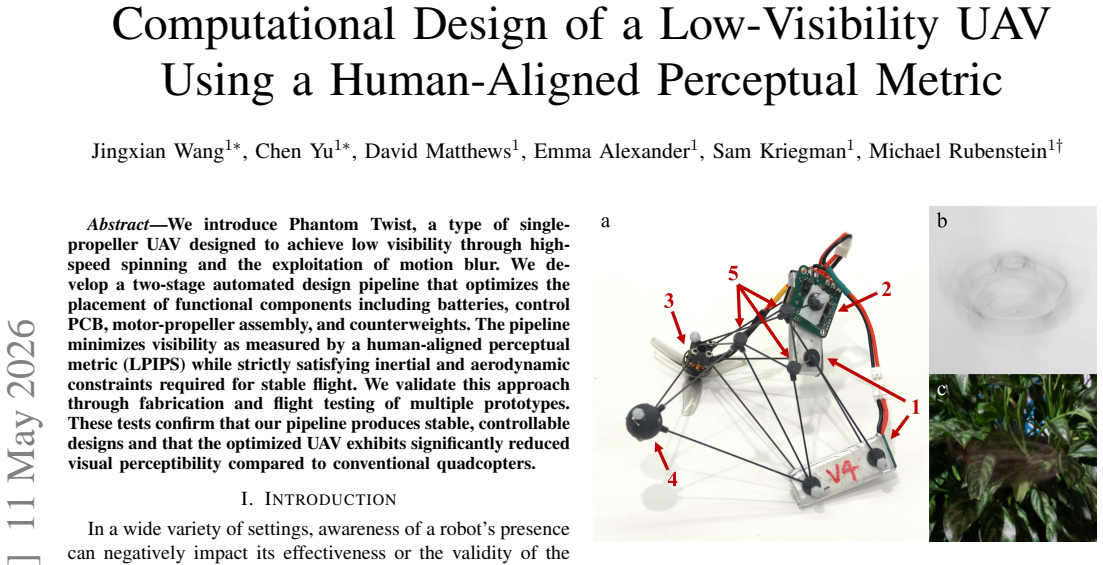
cs.RO 2026-05-12 1 theorem

Spinning single-propeller drone reduces visibility via motion blur

Computational Design of a Low-Visibility UAV Using a Human-Aligned Perceptual Metric

A design pipeline optimizes component placement for stable flight while minimizing human perceptibility, with prototypes showing better low-

Figure from the paper full image
abstract click to expand
We introduce Phantom Twist, a type of single-propeller UAV designed to achieve low visibility through high-speed spinning and the exploitation of motion blur. We develop a two-stage automated design pipeline that optimizes the placement of functional components including batteries, control PCB, motor-propeller assembly, and counterweights. The pipeline minimizes visibility as measured by a human-aligned perceptual metric (LPIPS) while strictly satisfying inertial and aerodynamic constraints required for stable flight. We validate this approach through fabrication and flight testing of multiple prototypes. These tests confirm that our pipeline produces stable, controllable designs and that the optimized UAV exhibits significantly reduced visual perceptibility compared to conventional quadcopters.
0
0
cs.RO 2026-05-12 2 theorems

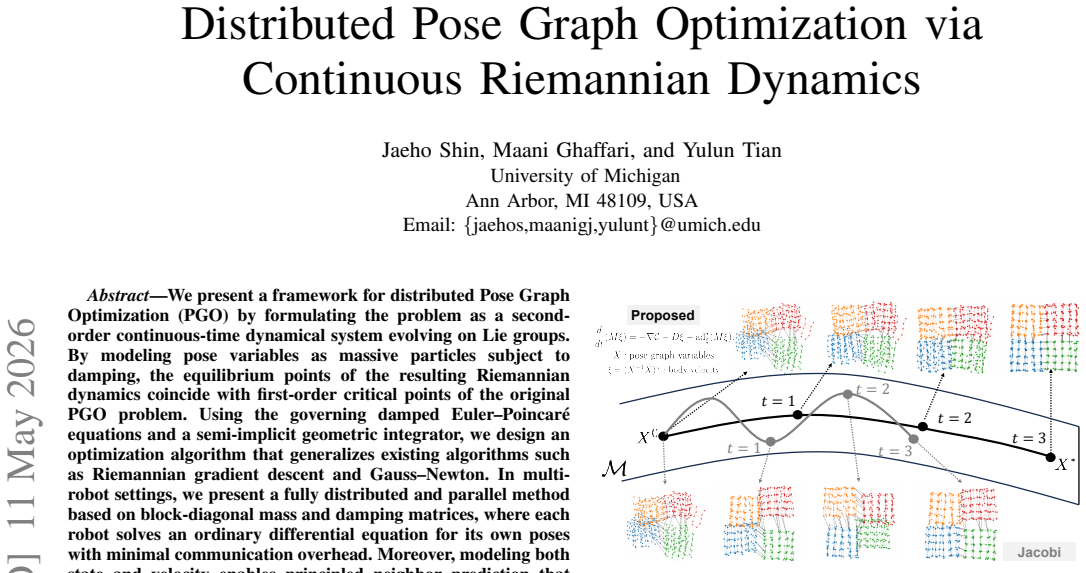
Damped particle motion solves distributed pose graphs

Distributed Pose Graph Optimization via Continuous Riemannian Dynamics

Equilibria of the continuous dynamics match PGO critical points and let each robot integrate its own poses with low communication and delay-

Figure from the paper full image
abstract click to expand
We present a framework for distributed Pose Graph Optimization (PGO) by formulating the problem as a second-order continuous-time dynamical system evolving on Lie groups. By modeling pose variables as massive particles subject to damping, the equilibrium points of the resulting Riemannian dynamics coincide with first-order critical points of the original PGO problem. Using the governing damped Euler--Poincar\'e equations and a semi-implicit geometric integrator, we design an optimization algorithm that generalizes existing algorithms such as Riemannian gradient descent and Gauss--Newton. In multi-robot settings, we present a fully distributed and parallel method based on block-diagonal mass and damping matrices, where each robot solves an ordinary differential equation for its own poses with minimal communication overhead. Moreover, modeling both state and velocity enables principled neighbor prediction that significantly improves convergence under delayed communication. Theoretically, we present an analysis and establish sufficient condition that ensures energy dissipation under the employed geometric discretization scheme. Experiments on benchmark PGO datasets demonstrate that the proposed solver achieves superior performance compared to state-of-the-art distributed baselines in both synchronous and asynchronous regimes.
0
0
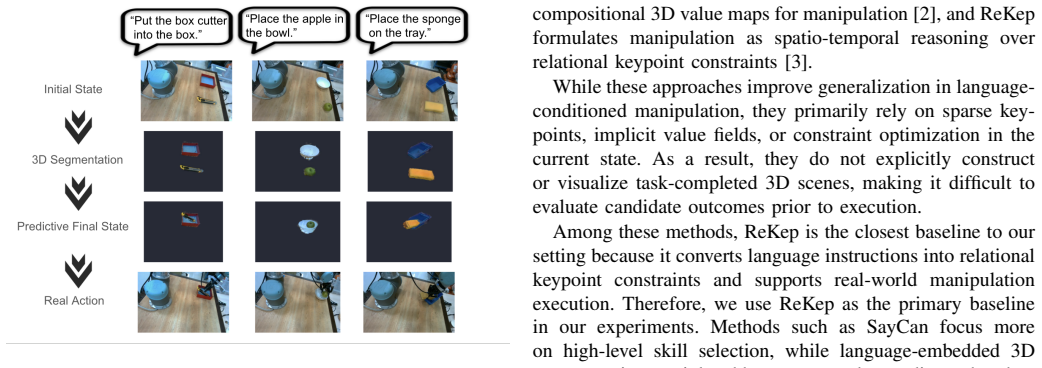
cs.RO 2026-05-12 Recognition

Forecasting 3D task outcomes raises pick-and-place success

Forecast-aware Gaussian Splatting for Predictive 3D Representation in Language-Guided Pick-and-Place Manipulation

Predicting the completed scene helps robots pick actions that match language instructions under partial views.

Figure from the paper full image
abstract click to expand
We introduce Forecast-aware Gaussian Splatting (Forecast-GS), a predictive 3D representation framework for language-conditioned robotic manipulation. While recent manipulation systems have made progress by grounding language instructions into robot affordances, value maps, or relational keypoint constraints, they usually reason over the current scene and do not explicitly model the task-completed state. This limitation is critical when success depends on satisfying spatial and semantic goals under partial observations, where the robot must evaluate whether a candidate action leads to a feasible task-consistent outcome. We validate Forecast-GS on real-world pick-and-place manipulation tasks, including Cutter-to-Box, Apple-to-Bowl, and Sponge-to-Tray. For each task, we conduct 25 real-world trials under varied initial object configurations using the same robot platform and sensing setup. Forecast-GS with automatic candidate selection achieves success rates of 21/25, 23/25, and 16/25 on the three tasks, respectively, outperforming the ReKep baseline, which achieves 15/25, 19/25, and 10/25. A diagnostic human-assisted setting further improves success rates to 23/25, 24/25, and 19/25, suggesting that candidate generation is effective while automatic ranking remains imperfect. These results suggest that explicitly forecasting task-completed 3D states enables more reliable action evaluation, while the gap between automatic and human-assisted selection indicates that robust final-state ranking remains an important challenge for fully autonomous manipulation. Overall, Forecast-GS provides an interpretable bridge between language understanding, 3D perception, and robotic manipulation planning.
0
0
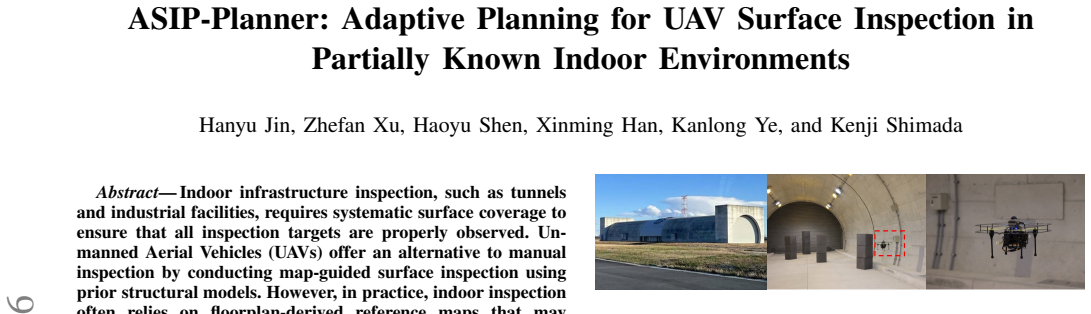
cs.RO 2026-05-12 2 theorems

Planner clusters surfaces to shorten UAV inspection flights

ASIP-Planner: Adaptive Planning for UAV Surface Inspection in Partially Known Indoor Environments

Global alignment grouping and local view tweaks deliver near-complete coverage despite incomplete indoor maps.

Figure from the paper full image
abstract click to expand
Indoor infrastructure inspection, such as tunnels and industrial facilities, requires systematic surface coverage to ensure that all inspection targets are properly observed. Unmanned Aerial Vehicles (UAVs) offer an alternative to manual inspection by conducting map-guided surface inspection using prior structural models. However, in practice, indoor inspection often relies on floorplan-derived reference maps that may not reflect unforeseen obstacles, such as temporary structures or equipment, leading to occluded viewpoints and degraded inspection quality. Existing coverage planning methods typically assume a fully known inspection environment and perform deterministic global viewpoint optimization based on accurate prior maps, making them vulnerable to environmental discrepancies during execution. This work presents an adaptive UAV inspection framework for partially known structured indoor environments. The proposed method integrates a segment-based global coverage planner with an inspection-oriented local view-angle adaptation module. The global planner organizes planar inspection targets into surface-aligned clusters to generate compact viewpoint sequences with improved orientation consistency. The local planner generates collision-free trajectories and adjusts the viewing direction online to mitigate occlusion-induced coverage loss while preserving the planned trajectory structure. The simulation results across randomized scene configurations demonstrate that the proposed global planner achieves near-complete coverage while reducing trajectory length compared to representative baselines. Real-world flight experiments further validate that the framework produces usable inspection data for downstream analysis. These results indicate that the proposed framework improves inspection efficiency and adaptability in partially known structured indoor environments.
0
0
cs.RO 2026-05-12 Recognition

SEVO transfers VLA policies to new rooms at 75-85% success

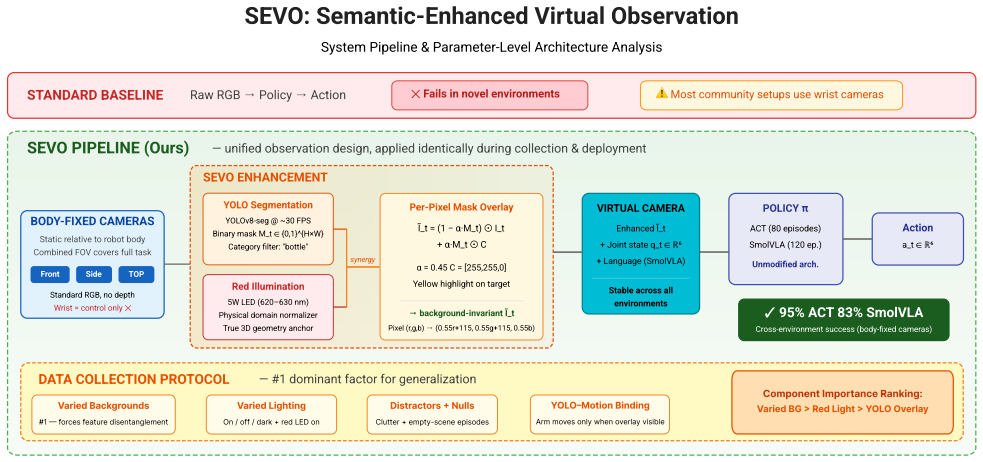
SEVO: Semantic-Enhanced Virtual Observation for Robust VLA Manipulation via Active Illumination and Data-Centric Collection

Fixed cameras, red light normalization, YOLO masks, and varied training data stabilize inputs so unchanged policies work outside the lab.

Figure from the paper full image
abstract click to expand
Vision-Language-Action (VLA) and imitation-learning policies trained via community toolchains on low-cost hardware frequently fail when deployed outside the training environment. Existing evaluations, including the original ACT and SmolVLA benchmarks, demonstrate high success rates under controlled, fixed backgrounds, yet community practitioners report near-zero transfer to new environments. We present SEVO (Semantic-Enhanced Virtual Observation), a data-centric approach that improves cross-environment manipulation robustness without modifying the policy architecture. SEVO transforms the raw RGB camera stream through three mechanisms: (1) body-fixed cameras whose combined fields of view cover the full manipulation workspace, (2) active red-spectrum illumination that physically normalizes object appearance, and (3) real-time YOLO segmentation overlay that provides a background-invariant semantic cue. Critically, we show that a diversified data collection protocol (systematically varying lighting, backgrounds, and distractors during teleoperation) is the single most important factor for generalization. We target transparent water bottles, objects that visually blend with their surroundings, and select a simple pick-and-place task to enable hundreds of controlled real-robot trials across two mobile platforms. The full pipeline achieves 95% grasp success with ACT and 83% with SmolVLA in the training environment, transferring to novel environments at 85% and 75%. Without SEVO, the same policies achieve only 75%/70% in training and collapse to 30-35% in novel environments. Our results demonstrate that principled observation design and environmental diversity during data collection, not model scaling, enable low-cost robots to operate reliably in everyday household environments.
0
0
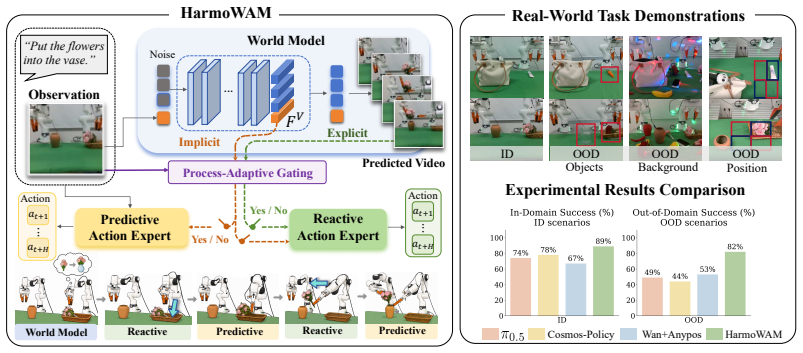
cs.RO 2026-05-12 1 theorem

Adaptive model unifies robot prediction and reaction for unseen tasks

HarmoWAM: Harmonizing Generalizable and Precise Manipulation via Adaptive World Action Models

HarmoWAM switches between experts using world-model priors and beats prior methods by 29-33 percent on real-world variations.

Figure from the paper full image
abstract click to expand
World Action Models (WAMs) have emerged as a promising paradigm for robot control by modeling physical dynamics. Current WAMs generally follow two paradigms: the "Imagine-then-Execute" approach, which uses video prediction to infer actions via inverse dynamics, and the "Joint Modeling" approach, which jointly models actions and video representations. Based on systematic experiments, we observe a fundamental trade-off between these paradigms: the former explicitly leverages world models for generalizable transit but lacks interaction precision, whereas the latter enables fine-grained, temporally coherent action generation but is constrained by the exploration space of the training distribution. Motivated by these findings, we propose HarmoWAM, an end-to-end WAM that fully leverages a world model to unify predictive and reactive control, enabling both generalizable transit and precise manipulation. Specifically, the world model provides spatio-temporal physical priors that condition two complementary action experts: a predictive expert that leverages latent dynamics for iterative action generation, and a reactive expert that directly infers actions from predicted visual evolution. To enable adaptive coordination, a Process-Adaptive Gating Mechanism is proposed to automatically determine the timing and location of switching between them. This allows the world model to drive the reactive expert to expand the exploration space and the predictive expert to perform precise interactions across different stages of a task. For evaluation, we construct three training-unseen test environments across six real-world robotic tasks, covering variations in background, position, and object semantics. Notably, HarmoWAM achieves strong zero-shot generalization across these scenarios, significantly outperforming prior state-of-the-art VLA models and WAMs by margins of 33% and 29%, respectively.
0
0
cs.RO 2026-05-12 Recognition

Freezing priors in VLA models boosts robot adaptation by 11 points

PriorVLA: Prior-Preserving Adaptation for Vision-Language-Action Models

PriorVLA updates 25 percent of parameters yet outperforms full fine-tuning on simulation and real tasks especially with limited data or new

Figure from the paper full image
abstract click to expand
Large-scale pretraining has made Vision-Language-Action (VLA) models promising foundations for generalist robot manipulation, yet adapting them to downstream tasks remains necessary. However, the common practice of full fine-tuning treats pretraining as initialization and can shift broad priors toward narrow training-distribution patterns. We propose PriorVLA, a novel framework that preserves pretrained priors and learns to leverage them for effective adaptation. PriorVLA keeps a frozen Prior Expert as a read-only prior source and trains an Adaptation Expert for downstream specialization. Expert Queries capture scene priors from the pretrained VLM and motor priors from the Prior Expert, integrating both into the Adaptation Expert to guide adaptation. Together, PriorVLA updates only 25% of the parameters updated by full fine-tuning. Across RoboTwin 2.0, LIBERO, and real-world tasks, PriorVLA achieves stronger overall performance than full fine-tuning and state-of-the-art VLA baselines, with the largest gains under out-of-distribution (OOD) and few-shot settings. PriorVLA improves over pi0.5 by 11 points on RoboTwin 2.0-Hard and achieves 99.1% average success on LIBERO. Across eight real-world tasks and two embodiments, PriorVLA reaches 81% in-distribution (ID) and 57% OOD success with standard data. With only 10 demonstrations per task, PriorVLA reaches 48% ID and 32% OOD success, surpassing pi0.5 by 24 and 22 points, respectively.
0
0
cs.RO 2026-05-12 Recognition

Dual memory buffers and prediction raise robot task success

RoboMemArena: A Comprehensive and Challenging Robotic Memory Benchmark

New 26-task benchmark with 68.9 percent memory-dependent subtasks shows structured storage beats standard vision-language-action models on 1

abstract click to expand
Memory is a critical component of robotic intelligence, as robots must rely on past observations and actions to accomplish long-horizon tasks in partially observable environments. However, existing robotic memory benchmarks still lack multimodal annotations for memory formation, provide limited task coverage and structural complexity, and remain restricted to simulation without real-world evaluation. We address this gap with RoboMemArena, a large-scale benchmark of 26 tasks, with average trajectory lengths exceeding 1,000 steps per task and 68.9% of subtasks being memory-dependent. The generation pipeline leverages a vision-language model (VLM) to design and compose subtasks, generates full trajectories through atomic functions, and provides memory-related annotations, including subtask instructions and native keyframe annotations, while paired real-world memory tasks support physical evaluation. We further design PrediMem, a dual-system VLA in which a high-level VLM planner manages a memory bank with recent and keyframe buffers and uses a predictive coding head to improve sensitivity to task dynamics. Extensive experiments on RoboMemArena show that PrediMem outperforms all baselines and provides insights into memory management, model architecture, and scaling laws for complex memory systems.
0
0
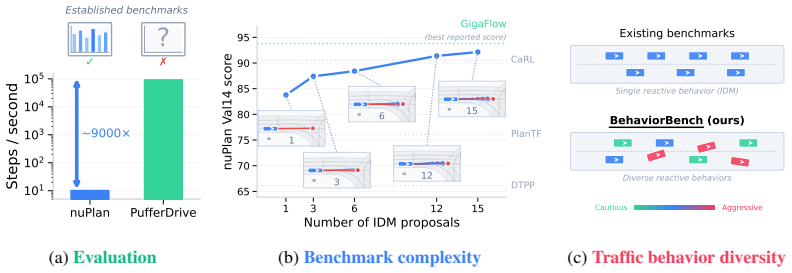
cs.RO 2026-05-12 Recognition

Multi-agent driving beats single agents in closed-loop benchmark

MDrive: Benchmarking Closed-Loop Cooperative Driving for End-to-End Multi-agent Systems

225 scenarios show shared perception does not always improve plans and negotiation harms results in dense traffic

Figure from the paper full image
abstract click to expand
Vehicle-to-Everything (V2X) communication has emerged as a promising paradigm for autonomous driving, enabling connected agents to share complementary perception information and negotiate with each other to benefit the final planning. Existing V2X benchmarks, however, fall short in two ways: (i) open-loop evaluations fail to capture the inherently closed-loop nature of driving, leading to evaluation gaps, and (ii) current closed-loop evaluations lack behavioral and interactive diversity to reflect real-world driving. Thus, it is still unclear the extent of benefits of multi-agent systems for closed-loop driving. In this paper, we introduce MDrive, a closed-loop cooperative driving benchmark comprising 225 scenarios grounded in both NHTSA pre-crash typologies and real-world V2X datasets. Our benchmark results demonstrate that multi-agent systems are generally better than single-agent counterparts. However, current multi-agent systems still face two important challenges: (i) perception sharing enhances perceptions, but doesn't always translate to better planning; (ii) negotiation improves planning performance but harms it in complex and dense traffic scenarios. MDrive further provides an open-source toolbox for scenario generation, Real2Sim conversion, and human-in-the-loop simulation. Together, MDrive establishes a reproducible foundation for evaluating and improving the generalization and robustness of cooperative driving systems.
0
0
cs.RO 2026-05-12 1 theorem

3D magnetic fields let UAVs plan paths 200 times faster than RRT*

Safe Aerial 3D Path Planning for Autonomous UAVs using Magnetic Potential Fields

Autoencoder predicts potential fields from voxel grids for 100% success across two unseen urban maps without retraining.

Figure from the paper full image
abstract click to expand
Safe autonomous Uncrewed Aerial Vehicle (UAV) navigation in urban environments requires real-time path planning that avoids obstacles. MaxConvNet is a potential-field planner that leverages properties of Maxwell's equations to generate a path to the goal without local minima. We extend the 2D MaxConvNet magnetic field planner to 3D, using a convolutional autoencoder to predict obstacle-aware potential fields from LiDAR-derived 101^3 voxel grids. Evaluation across 100 randomized closed-loop trials in two distinct Cosys-AirSim urban environments, a dense night-time cityscape and a suburban district shows a 100% path planning success rate on both maps without retraining. In offline path planning, 3DMaxConvNet produces path lengths comparable to A* on unseen maps while reducing runtime from 0.155--0.17s to 0.087--0.089s, or about 1.7--1.95 times faster than A*. Against RRT*(3k), 3DMaxConvNet achieves similar path quality while reducing planning runtime from 17.2--17.5s to about 0.09s, which is roughly 193--201 times faster than RRT*(3k).
0
0
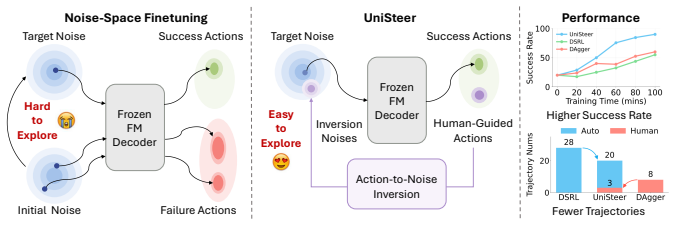
cs.RO 2026-05-12 2 theorems

Human corrections steer noise to lift robot success from 20% to 90%

Unified Noise Steering for Efficient Human-Guided VLA Adaptation

UniSteer inverts action interventions to supervise noise actor updates during RL, shortening real-world VLA adaptation.

Figure from the paper full image
abstract click to expand
Diffusion-based vision-language-action (VLA) models have emerged as strong priors for robotic manipulation, yet adapting them to real-world distributions remains challenging. In particular, on-robot reinforcement learning (RL) is expensive and time-consuming, so effective adaptation depends on efficient policy improvement within a limited budget of real-world interactions. Noise-space RL lowers the cost by keeping the pretrained VLA fixed as a denoising generator while updating only a lightweight actor that predicts the noise. However, its performance is still limited due to inefficient autonomous exploration. Human corrective interventions can reduce this exploration burden, but they are naturally provided in action space, whereas noise-space finetuning requires supervision over noise variables. To address these challenges, we propose UniSteer, a Unified Noise Steering framework that combines human corrective guidance with noise-space RL through approximate action-to-noise inversion. Given a human corrective action, UniSteer inverts the frozen flow-matching decoder to recover a noise target, which provides supervised guidance for the same noise actor that is simultaneously optimized via reinforcement learning. Real-world experiments on diverse manipulation tasks show that UniSteer adapts more efficiently than strong noise-space RL and action-space human-in-the-loop baselines, improving the success rate from 20% to 90% in 66 minutes on average across four real-world adaptation tasks.
0
0
cs.RO 2026-05-12 3 theorems

Algebraic latent transitions lift VLA success from 48% to 85% on MetaWorld

ALAM: Algebraically Consistent Latent Action Model for Vision-Language-Action Models

Consistency constraints on video-derived transitions supply additive structure that improves joint flow-based action generation.

Figure from the paper full image
abstract click to expand
Vision-language-action (VLA) models remain constrained by the scarcity of action-labeled robot data, whereas action-free videos provide abundant evidence of how the physical world changes. Latent action models offer a promising way to extract such priors from videos, but reconstruction-trained latent codes are not necessarily suitable for policy generation: they may predict future observations while lacking the structure needed to be reused or generated coherently with robot actions. We introduce ALAM (Algebraic Latent Action Model), an Algebraically Consistent Latent Action Model that turns temporal relations in action-free video into structural supervision. Given frame triplets, ALAM learns latent transitions that are grounded by reconstruction while being regularized by composition and reversal consistency, encouraging a locally additive transition space. For downstream VLA learning, we freeze the pretrained encoder and use its latent transition sequences as auxiliary generative targets, co-generated with robot actions under a joint flow-matching objective. This couples structured latent transitions with flow-based policy generation, allowing the policy to exploit ALAM's locally consistent transition geometry without requiring latent-to-action decoding. Representation probes show that ALAM reduces additivity and reversibility errors by 25-85 times over unstructured latent-action baselines and improves long-horizon cumulative reconstruction. When transferred to VLA policies, ALAM raises the average success rate from 47.9% to 85.0% on MetaWorld MT50 and from 94.1% to 98.1% on LIBERO, with consistent gains on real-world manipulation tasks. Ablations further confirm that the strongest improvements arise from the synergy between algebraically structured latent transitions and joint flow matching.
0
0
cs.RO 2026-05-12 2 theorems

RGB-only multi-agent SLAM matches RGB-D map quality

MAGS-SLAM: Monocular Multi-Agent Gaussian Splatting SLAM for Geometrically and Photometrically Consistent Reconstruction

MAGS-SLAM shares compact submap summaries and uses geometry-aware verification to fuse consistent 3D Gaussian maps without depth sensors.

Figure from the paper full image
abstract click to expand
Collaborative photorealistic 3D reconstruction from multiple agents enables rapid large-scale scene capture for virtual production and cooperative multi-robot exploration. While recent 3D Gaussian Splatting (3DGS) SLAM algorithms can generate high-fidelity real-time mapping, most of the existing multi-agent Gaussian SLAM methods still rely on RGB-D sensors to obtain metric depth and simplify cross-agent alignment, which limits the deployment on lightweight, low-cost, or power-constrained robotic platforms. To address this challenge, we propose MAGS-SLAM, the first RGB-only multi-agent 3DGS SLAM framework for collaborative scene reconstruction. Each agent independently builds local monocular Gaussian submaps and transmits compact submap summaries rather than raw observations or dense maps. To facilitate robust collaboration in the presence of monocular scale ambiguity, our framework integrates compact submap communication, geometry- and appearance-aware loop verification, and occupancy-aware Gaussian fusion, enabling coherent global reconstruction without active depth sensors. We further introduce ReplicaMultiagent Plus benchmark for evaluating collaborative Gaussian SLAM. Intensive experiments on synthetic and real-world datasets show that MAGS-SLAM achieves competitive tracking accuracy and comparable or superior rendering quality to state-of-the-art RGB-D collaborative Gaussian SLAM methods while relying only RGB images.
0
0
cs.RO 2026-05-12 2 theorems

View planner rankings flip with budget and reachability

ObjView-Bench: Rethinking Difficulty and Deployment for Object-Centric View Planning

Benchmark separates object occlusion from planning difficulty to show classical, learned, and hybrid methods change behavior under realistic

Figure from the paper full image
abstract click to expand
Object-centric view planning is a core component of active geometric 3D reconstruction in robotics, yet existing evaluations often conflate object complexity, planning difficulty, budget assumptions, and physical reachability constraints. As a result, conclusions drawn from idealized view-planning evaluations may not reliably predict performance under realistic reconstruction settings. We introduce ObjView-Bench, an evaluation framework for rethinking difficulty and deployment in object-centric view planning. First, we disentangle three quantities underlying view-planning evaluation: omnidirectional self-occlusion as an object-side attribute, observation saturation difficulty, and protocol-dependent planning difficulty defined through a set-cover formulation. This separation supports controlled dataset construction, analysis of slow-saturation objects, and a case study showing that planning difficulty-aware sampling can improve learned view planners. Second, we design deployment-oriented evaluation protocols that reveal how budget regimes and reachable-view constraints alter method behavior. Across classical, learned, and hybrid planners, ObjView-Bench shows that difficulty, budget, and reachability constraints substantially change method rankings and failure modes.
0
0
cs.RO 2026-05-12 Recognition

VRA restricts accelerations to voltage-realizable bounds

VRA: Grounding Discrete-Time Joint Acceleration in Voltage-Constrained Actuation

The interface ensures kinematic commands match what electric actuators can physically deliver, cutting saturation and oscillations in limit-

Figure from the paper full image
abstract click to expand
Discrete-time joint acceleration constraints are widely used to enforce position and velocity limits. However, under voltage-constrained electric actuators, kinematically admissible accelerations may be physically unrealizable, exposing a missing execution-level abstraction. We propose Voltage-Realizable Acceleration (VRA), a joint-level acceleration interface that grounds kinematic acceleration in voltage-constrained actuator physics by restricting commanded accelerations to voltage-realizable constraints. Hardware experiments on electric actuators and a wheel-legged quadruped show that VRA removes unrealizable accelerations, restores consistent near-constraint execution, and reduces constraint-induced oscillations.
0
0
cs.RO 2026-05-12 Recognition

Embodied AI Success Requires Safe Deployment as Much as Capability

Embodied AI in Action: Insights from SAE World Congress 2026 on Safety, Trust, Robotics, and Real-World Deployment

SAE 2026 panel concludes that trustworthy systems are essential for autonomous vehicles and robots to work in practice.

abstract click to expand
Embodied artificial intelligence is rapidly moving from research into real-world systems such as autonomous vehicles, mobile robots, and industrial machines. As these systems become more capable of perceiving, deciding, and acting in dynamic environments, they also introduce new challenges in safety, trust, governance, and operational reliability. This white paper summarizes key insights from the SAE World Congress 2026 panel session \textit{Embodied AI in Action}, which brought together experts from automotive, robotics, artificial intelligence, and safety engineering. The discussion highlighted the need to treat embodied AI as a systems challenge requiring engineering rigor, lifecycle governance, human-centered design, and evolving standards. The paper provides practical perspectives for executives, policymakers, and technical leaders seeking to adopt embodied AI responsibly. The panel reached broad agreement that long-term success will depend not only on advances in AI capability, but equally on safe and trustworthy deployment.
0
0
cs.RO 2026-05-12 Recognition

ForceFlow lifts robot contact success 37% over baseline

ForceFlow: Learning to Feel and Act via Contact-Driven Flow Matching

Flow matching policy treats force as global regulator and hands off from vision to touch for lower-cost, better-generalizing execution.

abstract click to expand
Existing imitation learning methods enable robots to interact autonomously with the physical environment. However, contact-rich manipulation tasks remain a significant challenge due to complex contact dynamics that demand high-precision force feedback and control. Although recent efforts have attempted to integrate force/torque sensing into policies, how to build a simple yet effective framework that achieves robust generalization under multimodal observations remains an open question. In this paper, we propose ForceFlow, a force-aware reactive framework built upon flow matching. For contact-stage policy design, we investigate force signal fusion mechanisms and adopt an asymmetric multimodal fusion architecture that treats force as a global regulatory signal, combined with a joint prediction paradigm that enhances the policy's understanding of instantaneous force and historical information, thereby achieving deep coupling between force and motion. For task-level hierarchical decomposition, we divide manipulation into a vision-dominant approach stage (VLM-based pointing for target localization) and a touch-dominant interaction stage (force-driven contact execution), with a Vision-to-Force (V2F) handover mechanism that explicitly decouples spatial generalization from contact regulation. Experimental results across six real-world contact-rich tasks demonstrate that ForceFlow achieves a 37% success rate improvement over the strong baseline ForceVLA while maintaining significantly lower cost. Moreover, ForceFlow exhibits accurate force signal prediction and demonstrates superior performance in contact force self-regulation and zero-shot out-of-distribution (OOD) generalization.
0
0
cs.RO 2026-05-12 2 theorems

Early 3D alignment in visual encoders boosts VLA robot performance

VEGA: Visual Encoder Grounding Alignment for Spatially-Aware Vision-Language-Action Models

Direct grounding with 3D features before language mixing delivers state-of-the-art results on manipulation tasks with no inference overhead.

Figure from the paper full image
abstract click to expand
Precise spatial reasoning is fundamental to robotic manipulation, yet the visual backbones of current vision-language-action (VLA) models are predominantly pretrained on 2D image data without explicit 3D geometric supervision, resulting in representations that lack accurate spatial awareness. Existing implicit spatial grounding methods partially address this by aligning VLA features with those of 3D-aware foundation models, but they rely on empirical layer search and perform alignment on LLM-level visual tokens where spatial structure has already been entangled with linguistic semantics, limiting both generalizability and geometric interpretability. We propose VEGA (Visual Encoder Grounding Alignment), a simple yet effective framework that directly aligns the output of the VLA's visual encoder with spatially-aware features from DINOv2-FiT3D, a DINOv2 model fine-tuned with multi-view consistent 3D Gaussian Splatting supervision. By performing alignment at the visual encoder output level, VEGA grounds spatial awareness before any linguistic entanglement occurs, offering a more interpretable and principled alignment target. The alignment is implemented via a lightweight projector trained with a cosine similarity loss alongside the standard action prediction objective, and is discarded at inference time, introducing no additional computational overhead. Extensive experiments on simulation benchmark and real-world manipulation tasks demonstrate that VEGA consistently outperforms existing implicit spatial grounding baselines, establishing a new state-of-the-art among implicit spatial grounding methods for VLA models.
0
0
cs.RO 2026-05-12 2 theorems

Point clouds modeled as Gaussian statistical manifolds

Learning Point Cloud Geometry as a Statistical Manifold: Theory and Practice

Self-supervised network predicts per-point Gaussians from sparse LiDAR to improve localization and mapping without labels.

Figure from the paper full image
abstract click to expand
Point clouds are a fundamental representation for robotic perception tasks such as localization, mapping, and object pose estimation. However, LiDAR-acquired point clouds are inherently sparse and non-uniform, providing incomplete observations of the underlying scene geometry. This makes reliable geometric reasoning challenging and degrades downstream perception performance. Existing approaches attempt to compensate for these limitations by estimating local geometry, but often rely on hand-crafted statistics or end-to-end supervised learning, which can suffer from limited scalability or require large amounts of accurately labeled data. To address these challenges, we explicitly model point cloud geometry under a principled mathematical formulation. We represent local geometry as a statistical manifold induced by a family of Gaussian distributions, where each point is associated with a Gaussian capturing its local geometric structure. Based on this formulation, we introduce Point-to-Ellipsoid (POLI), a deep neural estimator that predicts per-point Gaussian geometry. POLI learns a mapping from point cloud observations to their underlying geometry in a self-supervised manner, removing the need for labeled data while preserving strong geometric inductive biases. The resulting representation integrates seamlessly into existing robotic perception pipelines without architectural modifications. Extensive experiments show that POLI enables accurate and robust geometry estimation and consistently improves performance across diverse robotic perception tasks.
0
0
cs.RO 2026-05-12 Recognition

Compact network segments terrain on microcontrollers

Nano-U: Efficient Terrain Segmentation for Tiny Robot Navigation

Nano-U with few thousand parameters achieves strong results on garden and farm scenes with low memory use and latency on an ESP32.

Figure from the paper full image
abstract click to expand
Terrain segmentation is a fundamental capability for autonomous mobile robots operating in unstructured outdoor environments. However, state-of-the-art models are incompatible with the memory and compute constraints typical of microcontrollers, limiting scalable deployment in small robotics platforms. To address this gap, we develop a complete framework for robust binary terrain segmentation on a low-cost microcontroller. At the core of our approach we design Nano-U, a highly compact binary segmentation network with a few thousand parameters. To compensate for the network's minimal capacity, we train Nano-U via Quantization-Aware Distillation (QAD), combining knowledge distillation and quantization-aware training. This allows the final quantized model to achieve excellent results on the Botanic Garden dataset and to perform very well on TinyAgri, a custom agricultural field dataset with more challenging scenes. We deploy the quantized Nano-U on a commodity microcontroller by extending MicroFlow, a compiler-based inference engine for TinyML implemented in Rust. By eliminating interpreter overhead and dynamic memory allocation, the quantized model executes on an ESP32-S3 with a minimal memory footprint and low latency. This compiler-based execution demonstrates a viable and energy-efficient solution for perception on low-cost robotic platforms.
0
0
cs.RO 2026-05-12

Two-stage framework boosts heterogeneous object manipulation by 31%

HeteroGenManip: Generalizable Manipulation For Heterogeneous Object Interactions

Separating contact alignment from category-routed interaction planning cuts errors in robot tasks with varied objects and interactions.

Figure from the paper full image
abstract click to expand
Generalizable manipulation involving cross-type object interactions is a critical yet challenging capability in robotics. To reliably accomplish such tasks, robots must address two fundamental challenges: "where to manipulate" (contact point localization) and "how to manipulate" (subsequent interaction trajectory planning). Existing foundation-model-based approaches often adopt end-to-end learning that obscures the distinction between these stages, exacerbating error accumulation in long-horizon tasks. Furthermore, they typically rely on a single uniform model, which fails to capture the diverse, category-specific features required for heterogeneous objects. To overcome these limitations, we propose HeteroGenManip, a task-conditioned, two-stage framework designed to decouple initial grasp from complex interaction execution. First, Foundation-Correspondence-Guided Grasp module leverages structural priors to align the initial contact state, thereby significantly reducing the pose uncertainty of grasping. Subsequently, Multi-Foundation-Model Diffusion Policy (MFMDP) routes objects to category-specialized foundation models, integrating fine-grained geometric information with highly-variable part features via a dual-stream cross-attention mechanism. Experimental evaluations demonstrate that HeteroGenManip achieves robust intra-category shape and pose generalization. The framework achieves an average 31% performance improvement in simulation tasks with broad type setting, alongside a 36.7% gain across four real-world tasks with different interaction types.
0
0
cs.RO 2026-05-12

Two-stage framework raises manipulation success 31 percent across object types

HeteroGenManip: Generalizable Manipulation For Heterogeneous Object Interactions

Separating grasp localization from interaction planning and routing to category-specific models cuts errors in varied shapes and real tasks.

Figure from the paper full image
abstract click to expand
Generalizable manipulation involving cross-type object interactions is a critical yet challenging capability in robotics. To reliably accomplish such tasks, robots must address two fundamental challenges: "where to manipulate" (contact point localization) and "how to manipulate" (subsequent interaction trajectory planning). Existing foundation-model-based approaches often adopt end-to-end learning that obscures the distinction between these stages, exacerbating error accumulation in long-horizon tasks. Furthermore, they typically rely on a single uniform model, which fails to capture the diverse, category-specific features required for heterogeneous objects. To overcome these limitations, we propose HeteroGenManip, a task-conditioned, two-stage framework designed to decouple initial grasp from complex interaction execution. First, Foundation-Correspondence-Guided Grasp module leverages structural priors to align the initial contact state, thereby significantly reducing the pose uncertainty of grasping. Subsequently, Multi-Foundation-Model Diffusion Policy (MFMDP) routes objects to category-specialized foundation models, integrating fine-grained geometric information with highly-variable part features via a dual-stream cross-attention mechanism. Experimental evaluations demonstrate that HeteroGenManip achieves robust intra-category shape and pose generalization. The framework achieves an average 31% performance improvement in simulation tasks with broad type setting, alongside a 36.7% gain across four real-world tasks with different interaction types.
0
0
cs.RO 2026-05-12 2 theorems

Reranking imagined 3D rollouts raises robot success by 6.8 percent

Data-Asymmetric Latent Imagination and Reranking for 3D Robotic Imitation Learning

A latent model trained on suboptimal trajectories lets policies select better actions with under 0.7 times extra compute.

Figure from the paper full image
abstract click to expand
Robotic imitation learning typically assumes access to optimal demonstrations, yet real-world data collection often yields suboptimal, exploratory, or even failed trajectories. Discarding such data wastes valuable information about environment dynamics and failure modes, which can instead be leveraged to improve decision-making. While 3D policies reduce reliance on high-quality demonstrations through strong spatial generalization, they still require large-scale data to achieve high task success. To address this, we propose DALI-R, a Data-Asymmetric Latent Imagination and Reranking framework for 3D robotic imitation learning from mixed-quality trajectories. It learns a Latent World Model over 3D point clouds for imagined rollouts and a Task Completion Scorer that reranks candidate action chunks, improving decision-making without additional high-quality demonstrations. We instantiate DALI-R with both diffusion and efficient flow-matching policies and evaluate it on Adroit and MetaWorld benchmarks. Across the two evaluated 3D base policies, DALI-R achieves an average $6.8$\% improvement in success rate while incurring less than $0.7\times$ additional inference overhead.
0
0
cs.RO 2026-05-12 Recognition

Physics abstractions raise robot navigation transfer success

Plan in Sandbox, Navigate in Open Worlds: Learning Physics-Grounded Abstracted Experience for Embodied Navigation

Agents rehearse plans in simplified semantic environments before executing in open worlds and on physical hardware.

Figure from the paper full image
abstract click to expand
Vision-Language Models (VLMs) have demonstrated exceptional general reasoning capabilities. However, their performance in embodied navigation remains hindered by a scarcity of aligned open-world vision and robot control data. Despite simulators providing a cost-effective alternative for data collection, the inherent reliance on photorealistic simulations often limits the transferability of learned policies. To this end, we propose \textit{\textbf{S}andbox-\textbf{A}bstracted \textbf{G}rounded \textbf{E}xperience} (\textbf{\textit{SAGE}}), a framework that enables agents to learn within a physics-grounded semantic abstraction rather than a photorealistic simulation, mimicking the human capacity for mental simulation where plans are rehearsed in simplified physics abstractions before execution. \textit{SAGE} system operates via three synergistic phases: (1) \textit{Genesis}: constructing diverse, physics-constrained semantic environments to bootstrap experience; (2) \textit{Evolution}: distilling experiences through Reinforcement Learning (RL), utilizing a novel asymmetric adaptive clipping mechanism to stabilize updates; (3) \textit{Navigation}: bridging the abstract policy to open-world control. We demonstrate that \textit{SAGE} significantly improves planner-assisted embodied navigation, achieving a 53.21\% LLM-Match Success Rate on A-EQA (+9.7\% over baseline), while showing encouraging transfer to physical indoor robot deployment.
0
0
cs.RO 2026-05-12 Recognition

Frozen VLAs steer generation with memories of their own successes

Retrieve-then-Steer: Online Success Memory for Test-Time Adaptation of Generative VLAs

A retrieve-then-steer method lets vision-language-action models reuse verified executions for better reliability in repeated tasks without任何

Figure from the paper full image
abstract click to expand
Vision-Language-Action (VLA) models show strong potential for general-purpose robotic manipulation, yet their closed-loop reliability often degrades under local deployment conditions. Existing evaluations typically treat test episodes as independent zero-shot trials. However, real robots often operate repeatedly in the same or slowly changing environments, where successful executions provide environment-verified evidence of reliable behavior patterns. We study this persistent-deployment setting, asking whether a partially competent frozen VLA can improve its reliability by reusing its successful test-time experience. We propose an online success-memory guided test-time adaptation framework for generative VLAs. During deployment, the robot stores progress-calibrated successful observation-action segments in a long-term memory. At inference, it retrieves state-relevant action chunks, filters inconsistent candidates via trajectory-level consistency, and aggregates them into an elite action prior. To incorporate this prior into action generation, we introduce confidence-adaptive prior guidance, which injects the elite prior into an intermediate state of the flow-matching action sampler and adjusts the guidance strength based on retrieval confidence. This design allows the frozen VLA to exploit environment-specific successful experience while preserving observation-conditioned generative refinement. This retrieve-then-steer mechanism enables lightweight, non-parametric test-time adaptation without requiring parameter updates. Simulation and real-world experiments show improved task success and closed-loop stability, especially in long-horizon and multi-stage tasks.
0
0
cs.RO 2026-05-12 Recognition

Frozen VLA adapts by reusing its own successful actions

Retrieve-then-Steer: Online Success Memory for Test-Time Adaptation of Generative VLAs

Retrieve-then-steer stores verified segments, retrieves relevant priors, and guides the sampler to raise success and stability without any 0

Figure from the paper full image
abstract click to expand
Vision-Language-Action (VLA) models show strong potential for general-purpose robotic manipulation, yet their closed-loop reliability often degrades under local deployment conditions. Existing evaluations typically treat test episodes as independent zero-shot trials. However, real robots often operate repeatedly in the same or slowly changing environments, where successful executions provide environment-verified evidence of reliable behavior patterns. We study this persistent-deployment setting, asking whether a partially competent frozen VLA can improve its reliability by reusing its successful test-time experience. We propose an online success-memory guided test-time adaptation framework for generative VLAs. During deployment, the robot stores progress-calibrated successful observation-action segments in a long-term memory. At inference, it retrieves state-relevant action chunks, filters inconsistent candidates via trajectory-level consistency, and aggregates them into an elite action prior. To incorporate this prior into action generation, we introduce confidence-adaptive prior guidance, which injects the elite prior into an intermediate state of the flow-matching action sampler and adjusts the guidance strength based on retrieval confidence. This design allows the frozen VLA to exploit environment-specific successful experience while preserving observation-conditioned generative refinement. This retrieve-then-steer mechanism enables lightweight, non-parametric test-time adaptation without requiring parameter updates. Simulation and real-world experiments show improved task success and closed-loop stability, especially in long-horizon and multi-stage tasks.
0
0
cs.RO 2026-05-12 2 theorems

Cell decomposition adds visibility to simplify 3D path optimization

A cell-decomposition based path planner for 3D navigation in constrained workspaces

Ensuring each cell sees a neighbor fully lets solvers check feasible routes in constrained 3D spaces and scale to large maps via a hybrid k-

Figure from the paper full image
abstract click to expand
This paper proposes a cell decomposition algorithm for binary occupancy grids that ensures mutual complete visibility from each cell to at least one adjacent cell. This decomposition establishes a simplified framework for verifying path feasibility that can be easily embedded in optimization problems. To illustrate its utility, we formulate both second-order cone programs (SOCP) and their mixed-integer variant (MISOCP) within the proposed framework. Furthermore, we propose the KSP-SOCP method, which combines Yen's k-shortest path algorithm with the SOCP, achieving improved solutions compared to a standard SOCP approach while avoiding the computational burden of MISOCP. The cell decomposition algorithm, KSP-SOCP, and MISOCP approaches were evaluated in 9 city-like workspaces. The decomposition efficiently partitioned each map, enabling both optimization methods to compute feasible paths. The proposed KSP-SOCP achieved time performance comparable to the MISOCP while requiring less memory, making it highly suitable for large-scale problems.
0
0
cs.RO 2026-05-12 Recognition

Assistive forces halve learning time for robot jumps and flips

EFGCL: Learning Dynamic Motion through Spotting-Inspired External Force Guided Curriculum Learning

Spotting-style guidance during RL training lets quadrupeds acquire backflips and lateral flips that standard methods cannot, then run the g

Figure from the paper full image
abstract click to expand
Learning dynamic whole-body motions for legged robots through reinforcement learning (RL) remains challenging due to the high risk of failure, which makes efficient exploration difficult and often leads to unstable learning. In this paper, we propose External Force Guided Curriculum Learning (EFGCL), a guided RL approach based on the principle of physical guidance, in which external assistive forces are introduced during training. Inspired by spotting in artistic gymnastics, EFGCL enables agents to physically experience successful motion executions without relying on task-specific reward shaping or reference trajectories. Experiments on a quadrupedal robot performing Jump, Backflip, and Lateral-Flip tasks demonstrate that EFGCL accelerates learning of the Jump task by approximately a factor of two and enables the acquisition of complex whole body motions that conventional RL methods fail to learn. We further show that the learned policies can be deployed on real robot, reproducing motions consistent with those observed in simulation. These results indicate that physically guided exploration, which allows agents to experience success early in training, is an effective and general strategy for improving learning efficiency in dynamic whole-body motion tasks.
0
0
cs.RO 2026-05-12 2 theorems

Modified drift guides streaming stochastic policies

Guided Streaming Stochastic Interpolant Policy

Backward Kolmogorov analysis yields a drift change that ensures target sampling in low-latency streaming control.

Figure from the paper full image
abstract click to expand
Inference-time guidance is essential for steering generative robot policies toward dynamic objectives without retraining, yet existing methods are largely confined to chunk-based architectures that exhibit high latency and lack the reactivity needed for test-time preference alignment or obstacle avoidance. In this work, we formally derive the optimal guidance term for Stochastic Interpolants (SI) by analyzing the value function's time evolution via the Backward Kolmogorov Equation, establishing a modified drift that theoretically guarantees sampling from a target distribution. We apply this framework to real-time control through the Streaming Stochastic Interpolant Policy (SSIP), which generalizes the deterministic Streaming Flow Policy (SFP). Unifying this guidance law with the streaming architecture enables fast and reactive control. To support diverse deployment needs, we propose two complementary mechanisms: training-free Stochastic Trajectory Ensemble Guidance (STEG) that computes gradients on-the-fly for zero-shot adaptation, and training-based Conditional Critic Guidance (CCG) for amortized inference. Empirical evaluations demonstrate that our guided streaming approach significantly outperforms conventional chunk-based policies in reactivity and provides superior, physically valid guidance for dynamic, unstructured environments.
0
0
cs.RO 2026-05-12 Recognition

Self-play RL driving policies fail to generalize to new traffic behaviors

Beyond Self-Play and Scale: A Behavior Benchmark for Generalization in Autonomous Driving

BehaviorBench shows overfitting to training opponents and introduces a hybrid planner that mixes learned and rule-based components.

Figure from the paper full image
abstract click to expand
Recent Autonomous Driving (AD) works such as GigaFlow and PufferDrive have unlocked Reinforcement Learning (RL) at scale as a training strategy for driving policies. Yet such policies remain disconnected from established benchmarks, leaving the performance of large-scale RL for driving on standardized evaluations unknown. We present BehaviorBench -- a comprehensive test suite that closes this gap along three axes: Evaluation, Complexity, and Behavior Diversity. In terms of Evaluation, we provide an interface connecting PufferDrive to nuPlan, which, for the first time, enables policies trained via RL at scale to be evaluated on an established planning benchmark for autonomous driving. Complementarily, we offer an evaluation framework that allows planners to be benchmarked directly inside the PufferDrive simulation, at a fraction of the time. Regarding Complexity, we observe that today's standardized benchmarks are so simple that near-perfect scores are achievable by straight lane following with collision checking. We extract a meaningful, interaction-rich split from the Waymo Open Motion Dataset (WOMD) on which strong performance is impossible without multi-agent reasoning. Lastly, we address Behavior Diversity. Existing benchmarks commonly evaluate planners against a single rule-based traffic model, the Intelligent Driver Model (IDM). We provide a diverse suite of interactive traffic agents to stress-test policies under heterogeneous behaviors, beyond just using IDM. Overall, our benchmarking analysis uncovers the following insight: despite learning interactive behaviors in an emergent manner, policies trained via pure self-play under standard reward functions overfit to their training opponents and fail to generalize to other traffic agent behaviors. Building on this observation, we propose a hybrid planner that combines a PPO policy with a rule-based planner.
0
0
cs.RO 2026-05-12 2 theorems

Caching reuses diffusion steps for 4.6x faster robot plans

Muninn: Your Trajectory Diffusion Model But Faster

A training-free wrapper tracks deviation bounds so cached denoiser outputs keep final trajectories safe.

Figure from the paper full image
abstract click to expand
Diffusion-based trajectory planners can synthesize rich, multimodal robot motions, but their iterative denoising makes online planning and control prohibitively slow. Existing accelerations either modify the sampler or compress the network--sacrificing plan quality or requiring retraining without accounting for downstream control risk. We address the problem of making diffusion-based trajectory planners fast enough for real-time robot use without retraining the model or sacrificing trajectory quality, and in a way that works across diverse state-space diffusion architectures. Our key insight is that diffusion trajectory planners expose two signals we can exploit: a cheap probe of how their internal trajectory representation changes across steps, and analytic coefficients that describe how denoiser errors affect the sampler's state update. By calibrating the first signal against the second on offline runs, we obtain a per-step score that upper-bounds how far the final trajectory can deviate when we reuse a cached denoiser output, and we treat this bound as an uncertainty budget that we can spend over the denoising process. Building on this insight, we present Muninn, a training-free caching wrapper that tracks this uncertainty budget during sampling and, at each diffusion step, chooses between reusing a cached denoiser output when the predicted deviation is small and recomputing the denoiser when it is not. Across standard benchmarks Muninn delivers up to 4.6x wall-clock speedups across several trajectory diffusion models by reducing denoiser evaluations, while preserving task performance and safety metrics. Muninn further certifies that cached rollouts remain within a specified distance of their full-compute counterparts, and we validate these gains in real-time closed-loop navigation and manipulation hardware deployments. Project page: https://github.com/gokulp01/Muninn.
0
0
cs.RO 2026-05-12 Recognition

Stereo pairs lift robot manipulation policies above RGB and depth baselines

StereoPolicy: Improving Robotic Manipulation Policies via Stereo Perception

Independent 2D encoders fused by a transformer capture spatial cues without 3D reconstruction or calibration, with gains in sim and real b<f

Figure from the paper full image
abstract click to expand
Recent advances in robot imitation learning have yielded powerful visuomotor policies capable of manipulating a wide variety of objects directly from monocular visual inputs. However, monocular observations inherently lack reliable depth cues and spatial awareness, which are critical for precise manipulation in cluttered or geometrically complex scenes. To address this limitation, we introduce StereoPolicy, a new visuomotor policy learning framework that directly leverages synchronized stereo image pairs to strengthen geometric reasoning, without requiring explicit 3D reconstruction or camera calibration. StereoPolicy employs pretrained 2D vision encoders to process each image independently and fuses the resulting representations through a Stereo Transformer. This design implicitly captures spatial correspondence and disparity cues. The framework integrates seamlessly with diffusion-based and pretrained vision-language-action (VLA) policies, delivering consistent improvements over RGB, RGB-D, point cloud, and multi-view baselines across three simulation benchmarks: RoboMimic, RoboCasa, and OmniGibson. We further validate StereoPolicy on real-robot experiments spanning both tabletop and bimanual mobile manipulation settings. Our results underscore stereo vision as a scalable and robust modality that bridges 2D pretrained representations with 3D geometric understanding for robotic manipulation.
0
0
cs.RO 2026-05-12 2 theorems

HiDrive benchmark adds rare objects and moral tests to driving evaluation

HiDrive: A Closed-Loop Benchmark for High-Level Autonomous Driving

Saturated tests hide gaps in handling uncommon situations, rule compliance, and ethical decisions during emergencies.

Figure from the paper full image
abstract click to expand
End-to-end autonomous driving has witnessed rapid progress, yet existing benchmarks are increasingly saturated, with state-of-the-art models achieving near-perfect scores on widely used open-loop and closed-loop benchmarks. This saturation does not mean that the problem has been solved; instead, it reveals that current benchmarks remain limited in scenario diversity, object variety, and the breadth of driving capabilities they evaluate. In particular, they lack sufficient long-tail scenarios involving rare but safety-critical objects and fail to assess advanced decision-making such as legal compliance, ethical reasoning, and emergency response. To address these gaps, we propose HiDrive, a new closed-loop benchmark for end-to-end autonomous driving that emphasizes long-tail scenarios and a richer evaluation of driving capabilities. HiDrive introduces a diverse set of rare objects and uncommon traffic situations, and expands evaluation from basic driving skills to more advanced capabilities, including rule compliance, moral reasoning, and context-dependent emergency maneuvers. Correspondingly, we extend previous collision-avoidance-centered metrics into a comprehensive evaluation system that encompasses collision and braking, traffic-rule compliance, and moral-reasoning indicators. Built on a more advanced physics engine, HiDrive provides physically realistic lighting and high-fidelity visual rendering, offering a more challenging and realistic testbed for assessing whether autonomous driving systems can handle the complexity of real-world deployment. The HiDrive software, source code, digital assets, and documentation are available at https://github.com/VDIGPKU/HiDrive.
0
0
cs.RO 2026-05-12 2 theorems

JODA models joint forces, friction and damping as one three-channel field

JODA: Composable Joint Dynamics for Articulated Objects

Vision-language models propose primitives that compose into controllable, editable dynamics for realistic articulated-object simulation.

Figure from the paper full image
abstract click to expand
Articulated objects used in simulation and embodied AI are typically specified by geometry and kinematic structure, but lack the fine-grained dynamical effects that govern realistic mechanical behavior, such as frictional holding, detents, soft closing, and snap latching. Existing approaches either ignore the detailed structure of dynamics entirely, or use simple models with limited expressiveness. We introduce JODA, a framework for generating joint-level dynamics as a structured three-channel field over the joint degree of freedom, capturing conservative forces, dry friction, and damping. Instantiated using shape-constrained piecewise cubic interpolation (PCHIP), this formulation defines a compact and expressive function space that is both interpretable and compatible with differentiable simulation. Building on this representation, we develop methods for inferring and refining joint dynamics from multimodal inputs. Given visual observations and joint context, a vision-language model proposes structured dynamical primitives, which are composed into a unified dynamics field. The resulting representation supports both direct manipulation and gradient-based refinement. We demonstrate that JODA enables plausible and controllable modeling of diverse joint behaviors, providing a unified interface for inference, editing, and optimization. Code and example assets with their generated profiles will be released upon publication.
0
0
cs.RO 2026-05-12 Recognition

Explicit geometry parameters let humanoid climb unseen stairs

Explicit Stair Geometry Conditioning for Robust Humanoid Locomotion

Conditioning on height, depth and yaw enables 33-step outdoor success on Unitree G1

Figure from the paper full image
abstract click to expand
Robust humanoid stair climbing remains challenging due to geometric discontinuities, sensitivity to step height variations, and perception uncertainty in real-world environments. Existing learning-based locomotion policies often rely on implicit terrain representations or blind proprioceptive feedback, limiting their ability to generalize across varying stair geometries and to anticipate required gait adjustments. This paper proposes an explicit stair geometry conditioning framework for robust humanoid stair climbing. Instead of encoding terrain as high-dimensional latent features, we extract a compact set of interpretable geometric parameters, including step height, step depth, and current yaw angle relative to the robot heading. These explicit stair parameters directly condition a Proximal Policy Optimization (PPO)-based locomotion policy, enabling proactive modulation of swing-foot clearance and stride characteristics according to stair structure. Simulation experiments demonstrate improved generalization across unseen stair heights beyond the training distribution. Real-world experiments on the Unitree G1 humanoid validate reliable indoor and outdoor stair traversal. In challenging outdoor scenarios, the robot successfully ascends 33 consecutive steps without failure, demonstrating robustness and practical deployability.
0
0
cs.RO 2026-05-12 2 theorems

Neural distances guide map-free tractor-trailer control

Neural Distance-Guided Path Integral Control for Tractor-Trailer Navigation

A geometric encoder feeds real-time distances into the MPPI cost so the vehicle respects its full articulated shape in unknown cluttered env

Figure from the paper full image
abstract click to expand
Autonomous and safe navigation of tractor-trailer systems requires accurate, real-time collision avoidance and dynamically feasible control, particularly in cluttered and complex agricultural environments. This is challenging due to their articulated, deformable geometries and nonlinear dynamics. Traditional methods oversimplify vehicle geometry or rely on precomputed distance fields that assume a known map, limiting their applicability in dynamic, partially unknown environments. To address these limitations, we propose a geometric neural encoder that provides fast and accurate distance estimates between the full tractor-trailer body and raw LiDAR perception, enabling real-time, map-free geometric reasoning. These learned distances are integrated into a Model Predictive Path Integral (MPPI) controller, allowing the system to incorporate true articulated geometry directly into its cost evaluation and enabling more responsive navigation in challenging agricultural settings. Simulation results demonstrate that the proposed framework generates dynamically feasible and safe trajectories for navigating tractor-trailer systems in cluttered and complex environments.
0
0
cs.RO 2026-05-12 Recognition

Adaptive deltas cut world-model token distortion by 7 percent

Network-Efficient World Model Token Streaming

Dynamic keyframe selection using embedding distances and drift thresholds outperforms fixed periodic updates at fixed bitrates while keeping

Figure from the paper full image
abstract click to expand
Generative driving world models rely on compact latent state representations that must be efficiently transmitted and synchronized across distributed compute and connected vehicles. We study network-efficient streaming of a discrete world model state, where a stride-16 VQ-U-Net tokenizer (codebook size 8,192) maps each 288x512 frame to an 18x32 grid of token IDs (576 tokens/frame), equivalent to 936 bytes/frame under fixed-length coding. We consider a keyframe--delta protocol under strict per-message payload budgets and packet loss, and propose a fully online, label-free algorithm that prioritizes delta updates via cosine distance in codebook embedding space and triggers keyframes adaptively using a Hamming-drift threshold. The adaptive algorithm consistently improves the rate distortion frontier over periodic keyframes at matched bitrates: at 0.024 Mb/s (200-byte budget) dynamic-only embedding distortion drops from 0.0712 to 0.0661 (7.2\%), and at 0.036 Mb/s (400-byte budget) from 0.0427 to 0.0407 (4.8\%). Under 10\% delta packet loss at 200 bytes, dynamic-only distortion is 0.0757 versus 0.0789 for a matched periodic baseline. To connect state fidelity to world model usefulness, we train a lightweight next-token predictor and evaluate perplexity conditioned on streamed receiver states: at 0.024 Mb/s, dynamic-position perplexity improves from 206.0 to 193.1 (6.3\%), and at 0.036 Mb/s from 158.9 to 155.6 (2.1\%). These results support discrete token-state streaming as a practical systems layer for bandwidth-aware synchronization and improved downstream token-dynamics utility under vehicular networking constraints.
0
0
cs.RO 2026-05-12 Recognition

Semantic executive cuts oscillation in zero-shot navigation

ConsistNav: Closing the Action Consistency Gap in Zero-Shot Object Navigation with Semantic Executive Control

Persistent target memory and phase control raise success rate 11 percent on MP3D without retraining detectors or planners.

Figure from the paper full image
abstract click to expand
Zero-shot object navigation has advanced rapidly with open-vocabulary detectors, image--text models, and language-guided exploration. However, even after current methods detect a plausible target hypothesis, the agent may still oscillate between exploration and pursuit, or abandon the object near success. We identify this failure mode as an action consistency gap: semantic evidence is repeatedly reinterpreted at each step without persistent commitment across the episode. We introduce ConsistNav, a training-free zero-shot ObjectNav framework built around a semantic executive composed of three coordinated modules: Finite-State Executive Controller stages target pursuit through guarded semantic phases; Persistent Candidate Memory accumulates cross-frame target evidence into stable object hypotheses; and Stability-Aware Action Control suppresses rotational stagnation, ineffective pursuit, and unverified stopping. This design changes neither the detector nor the low-level planner; instead, it controls when semantic evidence should influence navigation and when it should be suppressed or revisited. We conduct extensive experiments on HM3D and MP3D, where ConsistNav achieves state-of-the-art results among compared zero-shot ObjectNav methods and improves SR by 11.4% and SPL by 7.9% over the controlled baseline on MP3D. Ablation studies and real-world deployment experiments further demonstrate the effectiveness and robustness of the proposed executive mechanism.
0
0
cs.RO 2026-05-11 Recognition

Visual loop closures merge USV and AUV maps without acoustics

Above and Below: Heterogeneous Multi-robot SLAM Across Surface and Underwater Domains

Centralized SLAM uses surface-to-underwater feature matches to cut AUV localization error in real maritime tests.

Figure from the paper full image
abstract click to expand
Multi-robot simultaneous localization and mapping (SLAM) is a fundamental task in multi-robot operations. Robots must have a common understanding of their location and that of their team members to complete coordinated actions. However, multi-robot SLAM between Uncrewed Surface Vessels (USVs) and Autonomous Underwater Vehicles (AUVs) has primarily been achieved through acoustic pinging between robots to retrieve range measurements; a measurement technique requires that robots to be in similar locations simultaneously, have an uninterrupted path for signal propagation, and may necessitate synchronized clocks. This is especially challenging in complex, cluttered maritime environments, where structures may impede signals. However, these same structures may be observable above and below the water's surface, presenting an opportunity for inter-robot SLAM loop closure between USV and AUV data streams. This work builds upon recent research on inter-robot SLAM loop closure between USV and AUV data, extending it to propose a centralized multi-robot SLAM system. Each robot performs its state estimation, and we detect loop closures between each AUV and the USV data. These inter-robot loop closures are used to merge each robot's state estimate into a centralized graph, yielding estimates for the whole time history of the USV and all AUVs in the system. Validation is performed using real-world perceptual data in three different environments. Results show improved errors for AUVs in the multi-robot SLAM system compared to single-robot SLAM over the same trajectories. To our knowledge, this is the first instance of a multi-robot SLAM system with AUVs and USVs built on loop closures rather than acoustic distance measurements.
0
0
cs.RO 2026-05-11 2 theorems

Precomputed bundles cut multi-robot planning time

Efficient Multi-Robot Motion Planning with Precomputed Translation-Invariant Edge Bundles

An offline library of reusable motion segments steers existing planners through robot interactions, shortening run times in centralized, de-

Figure from the paper full image
abstract click to expand
Solving multi-robot motion planning (MRMP) requires generating collision-free kinodynamically feasible trajectories for multiple interacting robots. We introduce Kinodynamic Translation-Invariant Edge Bundles or KiTE-Extend, a planner-agnostic action selection mechanism for sampling-based kinodynamic motion planning. KiTE-Extend uses a library of trajectory segments computed offline to guide action selection during online planning, improving the ability of existing planners to identify feasible motion segments without altering state propagation, collision checking, or cost evaluation, and without changing their theoretical guarantees. While KiTE-Extend can modestly improve single-agent planners, its benefits are most clear in the multi-agent setting, where it is able to explore more effectively and significantly improve planning through the dense spatiotemporal constraints introduced by robot-robot interaction. Through experiments on multiple kinodynamic systems and environments, we show that KiTE-Extend reduces planning time and improves scalability across the three most common MRMP paradigms: centralized, prioritized, and conflict-based.
0
0
cs.RO 2026-05-11 Recognition

Multiple randomized simulations train catchers that transfer directly to hardware

Zero-Shot Sim-to-Real Robot Learning: A Dexterous Manipulation Study on Reactive Catching

DRIS propagates a small set of instances in parallel so policies handle uncertainty in flat-plate catching without real-world fine-tuning.

Figure from the paper full image
abstract click to expand
Dexterous manipulation is physics-intensive and highly sensitive to modeling errors and perception noise, making sim-to-real transfer prohibitively challenging. Domain randomization (DR) is commonly used to improve the robustness of learned policies for such tasks, but conventional DR randomizes one instance per episode, offering very limited exposure to the variability of real-world dynamics. To this end, we propose Domain-Randomized Instance Set (DRIS), which represents and propagates a set of randomized instances simultaneously, providing richer approximation of uncertain dynamics and enabling policies to learn actions that account for multiple possible outcomes. Supported by theoretical analysis, we show that DRIS yields more robust policies and alleviates the need for real-world fine-tuning, even with a modest number of instances (e.g., 10). We demonstrate this on a challenging reactive catching task. Unlike traditional catching setups that use end-effectors designed to mechanically stabilize the object (e.g., curved or enclosing surfaces), our system uses a flat plate that offers no passive stabilization, making the task highly sensitive to noise and requiring rapid reactive motions. The learned policies exhibit strong robustness to uncertainties and achieve reliable zero-shot sim-to-real transfer.
0
0
cs.RO 2026-05-11 2 theorems

MVBB filter lifts grasp success 2.4x on frontal robot tasks

MVB-Grasp: Minimum-Volume-Box Filtering of Diffusion-based Grasps for Frontal Manipulation

By rejecting table-penetrating or misaligned diffusion candidates for low-cost arms with tight workspace limits.

Figure from the paper full image
abstract click to expand
State-of-the-art 6-DoF grasp generators excel on tabletop benchmarks with overhead cameras but struggle in frontal grasping scenarios on low-cost manipulators with constrained workspaces, where kinematic limits and approach-direction constraints cause high failure rates. We address this challenge for the Unitree Z1 arm by proposing MVB-Grasp, a novel grasping stack that injects a Minimum Volume Bounding Box (MVBB) geometric prior into diffusion-based grasp generation to dramatically improve success rates in frontal, workspace-constrained settings. Our key scientific contributions are threefold: (i) an MVBB-based geometric filter that exploits oriented bounding-box face normals to reject grasps approaching through the table or misaligned with accessible object faces in O(N) time; (ii) a combined re-scoring function that blends learned discriminator scores with face-alignment geometry {\alpha}=0.85, specifically calibrated for the Z1's frontal workspace and kinematic constraints; and (iii) a systematic MuJoCo evaluation protocol measuring grasp success across object types, distances, lateral positions, and pitch orientations to validate embodiment-specific performance. We implement MVB-Grasp on a Unitree Z1 arm with an Intel RealSense D405 camera, integrating YOLOv8 object detection, GraspGen for candidate generation, Principal Component Analysis (PCA)-based MVBB fitting, and inverse-kinematics trajectory planning. Experiments across 81 MuJoCo episodes (cylinder, asymmetric box, waterbottle) demonstrate that MVB-Grasp achieves 59.3% success versus 24.7% for vanilla GraspGen, a 2.4x improvement, by filtering geometrically infeasible candidates and prioritizing face-aligned grasps suited to the Z1's frontal approach constraints. Real-world trials confirm that the MVBB prior substantially improves grasp reliability on constrained, low-cost manipulators without requiring model retraining.
0
0
cs.RO 2026-05-11 2 theorems

Off-the-shelf video models cannot yet enable lag-free teleoperation

Towards Generative Predictive Display for Vision-Based Teleoperation: A Zero-Shot Benchmark of Off-the-Shelf Video Models

Benchmark on driving simulator data shows current models either accumulate errors or run too slowly to compensate for communication delays.

Figure from the paper full image
abstract click to expand
Teleoperation systems are fundamentally limited by communication latency, which degrades situational awareness and control performance. Predictive display aims to mitigate this limitation by presenting an estimate of the current visual state rather than delayed observations. While recent advances in generative video models enable high-quality video synthesis, their suitability for latency-sensitive predictive display remains unclear. This paper presents a zero-shot benchmark of off-the-shelf generative video models for short-horizon predictive display, without task-specific fine-tuning. We formulate the problem as rollout-based future frame prediction and develop a unified benchmarking pipeline using simulated driving data from the CARLA simulator. Five publicly released video models spanning transformer-based and diffusion-based families are evaluated across two resolutions and two conditioning regimes (multi-frame and single-frame). Performance is assessed using prediction accuracy (mean absolute difference), per-rollout latency, peak GPU memory usage, and temporal error evolution across the prediction horizon. On this zero-shot benchmark, no tested model simultaneously achieves low rollout error, non-divergent per-step error behavior, and real-time inference at the source frame rate. Increasing model scale or resolution yields limited and, in some cases, inverted improvements. These findings highlight a gap between general-purpose generative video synthesis and the requirements of predictive display in teleoperation, suggesting that practical deployment will require either explicit short-horizon temporal supervision, in-domain adaptation, or aggressive inference optimization rather than direct application of off-the-shelf models. Code, configurations, and qualitative results are released on the project page: https://bimilab.github.io/paper-GenPD
0
0
cs.RO 2026-05-11 3 theorems

Contractive law adapts Koopman models online safely

ASACK : Adaptive Safe Active Continual Koopman Learning for Uncertain Systems with Contractive Guarantees

Framework unifies learning, active excitation and robust control for uncertain robots without losing real-time performance.

Figure from the paper full image
abstract click to expand
Koopman operator theory provides a powerful framework for representing nonlinear dynamics through a linear operator acting on lifted observables, enabling the use of linear control techniques for nonlinear systems. However, Koopman models are typically learned from data and often degrade in performance under model uncertainty and distributional shifts between training and deployment. Although several works have explored online adaptation to address this issue, many rely on neural network-based updates that introduce significant computational overhead and lack formal safety guarantees, limiting their suitability for real-time and safety-critical robotic applications. In this work, we propose a unified framework for continual adaptive Koopman learning that enables safe and efficient online refinement of learned models during task execution. An autoencoder-based Koopman model is first learned offline and subsequently refined online through a contractive adaptation law, which provides theoretical convergence guarantees under distributional shifts and model uncertainty. To improve data efficiency and accelerate model refinement, the adaptation mechanism is integrated with an active learning strategy that drives the system to collect informative data while accomplishing task objectives. The resulting control problem is formulated as a nonconvex optimization problem incorporating both active learning objectives and safety constraints. We further derive theoretical bounds on model approximation error and show how these bounds can be incorporated within a robust Model Predictive Control (MPC) framework to provide formal safety guarantees. The proposed approach unifies learning, excitation, and safety within a single control framework without sacrificing real-time feasibility. Extensive simulation and experimental studies demonstrate superior performance compared to state-of-the-art baselines.
0
0
cs.RO 2026-05-11 2 theorems

Edge offloading cuts robot compute use by 83 percent

ORICF -- Open Robotics Inference and Control Framework

A YAML-driven framework moves AI inference to nearby computers, lowering onboard power draw while keeping pipelines modular and repeatable.

abstract click to expand
Recent advances in artificial intelligence (AI) have enabled effective perception and language models for robots, but their deployment remains computationally expensive, increasing latency and energy use. This work presents the Open Robotics Inference and Control Framework (ORICF), a modular, declarative, and model-agnostic platform for composing multimodal robotic inference pipelines. ORICF integrates input/output (I/O) adapters, pluggable inference back ends, and post-processing logic, while lightweight YAML specifications allow models, hardware targets, and data channels to be changed without code modification. The framework also supports edge offloading, i.e., executing inference on nearby external computers instead of onboard the robot. ORICF is evaluated on a mobile robot that answers spoken queries about people detected in its camera stream by combining automatic speech recognition (ASR), a large language model (LLM), and a convolutional neural network (CNN) detector through Robot Operating System 2 (ROS2). Compared with onboard execution, ORICF-based edge deployment reduces robot-side compute utilization by up to 83.16% and estimated energy consumption by 65.8%, while preserving modularity and reproducibility.
0
0
cs.RO 2026-05-11 Recognition

Tail objectives and RL cut worst-case latency in robot monitoring

Minimizing Worst-Case Weighted Latency for Multi-Robot Persistent Monitoring: Theory and RL-Based Solutions

New performance measures reformulated as average-reward MDPs let learning methods improve long-term monitoring on weighted graphs.

Figure from the paper full image
abstract click to expand
We study multi-robot persistent monitoring on weighted graphs, where node weights encode monitoring priorities and edge weights encode travel distances. The goal is to design joint robot trajectories that minimize the worst-case weighted latency across all nodes over an infinite time horizon. The widely adopted worst-case latency objective evaluates team performance over the entire time horizon and therefore may fail to distinguish strategies with poor transient behavior but strong asymptotic performance. To address this limitation, we propose a family of tail-performance objectives that generalize the standard objective and study the resulting functional optimization problems. We establish several key theoretical properties, including the existence of optimal strategies, relationships among the proposed objectives and their corresponding optimization problems, approximation by periodic solutions to arbitrary accuracy, and reductions to event-driven decision models with discretized waiting times. Building on these results, we construct an equivalent event-driven Markov decision process (MDP), called the Tail Worst-case Latency-Optimizing Markov Decision Process (TWLO-MDP), which reformulates the tail-performance objective as a standard average-reward criterion. We then develop reinforcement-learning-based solution methods for the TWLO-MDP and introduce the multi-robot monitoring benchmark (M2Bench), a unified platform that supports the evaluation and comparison of heuristic and learning-based monitoring algorithms. Experiments on synthetic and realistic monitoring scenarios show that our methods effectively reduce the worst-case weighted latency and outperform representative baselines.
0
0
cs.RO 2026-05-11 Recognition

Real store footage raises retail robot success over 2x

SABER: A Scalable Action-Based Embodied Dataset for Real-World VLA Adaptation

SABER supplies 44.8K natural action samples from grocery stores and lifts GR00T performance from 13.4 to 29.3 percent on ten tasks.

abstract click to expand
Robotic deployment in real-world environments depends on rich, domain-specific action data as much as on strong model architecture. General-purpose robot foundation models show modest performance in complex unseen tasks such as manipulation in a retail domain when applied out of the box. The root cause is a data gap: retail environments are structurally absent from general robot pretraining distributions, and the path to filling that gap through teleoperation is prohibitively expensive, logistically constrained, and difficult to scale. We introduce SABER, a high-fidelity retail robotics action dataset built from over 100 hours of natural in-store capture across multiple real grocery environments. Egocentric footage from head-mounted cameras records fine-grained hand activity at the point of interaction, while exocentric 360-degree scene footage from DreamVu's ALIA camera simultaneously observes all actors and activities across the entire space. This combination yields a uniquely complete picture of human retail behavior: dexterous hand activity, whole-body motion, and scene dynamics, all captured without staging, scripting, or teleoperation overhead. The SABER corpus contains 44.8K training samples across three action representation streams: 25K latent action sequences via LAPA-style encoding, 18.6K dexterous hand-pose trajectories retargeted to robot joint space, and 1.2K whole-body synchronized motion sequences retargeted to a humanoid embodiment. When applied to GR00T N1.6 via a shared-backbone multi-task post-training recipe, SABER yields a mean success rate of 29.3% across ten retail manipulation tasks -- more than 2.19x over fine-tuning baselines (13.4%). SABER demonstrates that the path to capable retail robots runs through better data, which can be collected today, at scale, without a robot in the loop. The dataset and code are available at https://dreamvu.ai/saber
0

browse all of cs.RO β†’ full archive Β· search Β· sub-categories