REVIEW 3 major objections 4 minor 33 references
Revisiting data-driven dynamic security assessment with a tabular foundation model
T0 review · 3 major / 4 minor · reviewed 2026-08-01 · deepseek-v4-flash
Pith's one-line read A single tabular foundation model, used without retraining, can assess power-system dynamic security per contingency with roughly 120 labelled operating conditions and can adapt to an unseen fault with ten labelled samples, matching an impr
desk verdict A credible sample-efficiency result for TabPFN in pre-fault DSA, but the unseen-contingency claim is overstated: zero-shot evaluation mostly holds out faults at buses that remain in the training context. read the letter →
The pith
A machine-rendered reading of the paper's core claim, the machinery that carries it, and where it could break.
The reading
What carries the argument
The central object is the tabular foundation model operating by in-context learning: a transformer pretrained on many synthetic tabular datasets that, given labelled context rows and unlabelled query rows, outputs the Bayesian posterior predictive in one forward pass, with no parameter updates. Coupled to it is the scenario vector: EDC, an 8-dimensional electrical-distance coordinate of the faulted bus computed from the network impedance (Z-bus) matrix, and its extension mod-EDC, the concatenation of pre- and post-fault EDCs, which acts as a label-free proxy for how the clearing action reduces synchronising power. The EDC makes unseen contingencies continuous with training contingencies; mod
What would settle it
Hold out contingency 15, the only contingency at bus 17 with no same-bus partner, train on the other 21 contingencies with EDC encoding, and measure zero-shot Macro F1 on 12,000 samples. If the TFM does not clearly beat a label-proportion-based baseline, the 'unseen contingency as interpolation' story fails for the case the current experimental design avoids.
Extended reading notes
Core claim
The central discovery is that pre-fault DSA can be reframed as an in-context learning problem solvable by a single pretrained tabular foundation model. On the IEEE 68-bus test system with 22 three-phase bus-fault contingencies, the TFM—with no retraining and no hyperparameter tuning—matches or beats tuned gradient-boosting, MLP, decision-tree and SVM baselines at every training size from 12 to 12,000 samples per contingency, reaching about 90% average Macro F1 with 120 samples per contingency. For unseen contingencies, the paper shows that a continuous scenario vector matters: one-hot fault IDs fail because an unseen ID is orthogonal to training data, whereas electrical distance coordinates
Load-bearing premise
The claim about zero-shot generalization to unseen contingencies rests on the assumption that a held-out fault's dynamic behaviour is predictable from electrically close faults at the same bus—something the paper shows holds when label proportions are similar and fails when they differ (its Table IV).
Editorial extensions
If this is right
- Operating utilities could shrink TDS database-generation budgets by roughly two orders of magnitude while keeping high accuracy, since 120 labels per contingency suffice.
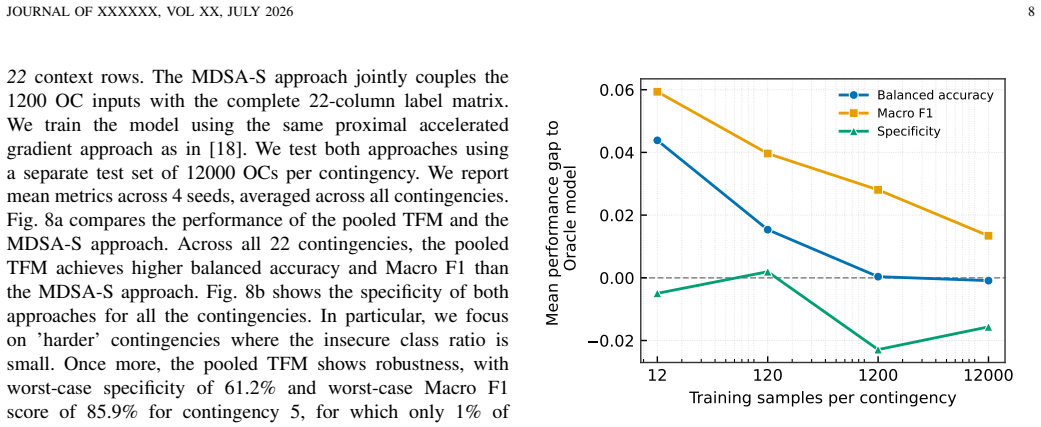
- A single model can replace per-contingency classifiers: the pooled TFM outperforms a multi-label baseline on balanced accuracy and Macro F1, and is robust for contingencies with very rare insecure cases.
- For a new/unseen contingency, 10 labelled samples added to the context—without finetuning—give accuracy on par with an impractical oracle transfer-learning approach; this is an operationally realistic few-shot adaptation.
- Zero-shot assessment of new contingencies becomes possible when the new fault's electrical-distance coordinate lies near training contingencies with similar stability-label proportions.
- The approach's computational cost is dominated by a single forward pass, avoiding the scaling cost of per-contingency hyperparameter tuning.
Reading between the lines
- The label-distribution dependence observed in the paper's same-bus table suggests a pre-screening rule the authors do not state: before trusting zero-shot EDC for a new contingency, estimate the new contingency's stable-label proportion; if it differs sharply from the nearest trained contingency, spend the 10 TDS samples.
- The mod-EDC idea—using the change in electrical coordinates induced by a topology change as a label-free severity proxy—could be transferred to other security assessments (e.g., voltage instability or cascading failure) where post-contingency topology is known.
- Because this class of tabular foundation model is pretrained once and reused across tasks, the same model instance could serve multiple operational tasks (pre-fault DSA, post-fault trajectory prediction, contingency screening) without separate training pipelines—a direction the paper mentions but leaves to future work.
- A direct testable extension: repeat the leave-one-contingency-out study on a system with several buses having only one contingency, isolating the no-same-bus case that the current study leaves under-sampled; if zero-shot performance collapses there, the generalization claim needs qualification.
Signed reviews
Editorial analysis
A structured set of objections, weighed in public.
Referee Report
Summary. The paper proposes using TabPFN, a tabular foundation model, for pre-fault dynamic security assessment (DSA). The central claims are: (i) a single TFM, applied without retraining or hyperparameter tuning, achieves an average Macro F1 of about 90% with only 120 labelled operating conditions per contingency, roughly two orders of magnitude fewer than conventional databases; (ii) a single pooled TFM outperforms a multi-label DSA baseline across 22 contingencies; and (iii) for unseen contingencies, an electrical-distance-coordinate (EDC) encoding enables zero-shot generalization, and adding just 10 labelled samples of the new contingency with a modified EDC (mod-EDC) matches the best achievable transfer-learning oracle (JDA-best). The paper also characterizes when EDC fails and discusses computational costs.
Significance. The sample-efficiency result is significant and, if confirmed, directly addresses the TDS database-generation bottleneck in data-driven DSA. Using a fixed pretrained model (TabPFN) avoids circular training on the DSA labels, and the comparison against a non-deployable oracle is a useful reference point. The paper is also honest in reporting that EDC degrades when same-bus contingencies have very different stable-label proportions (Table IV). However, the generalization-to-unseen-contingencies claim, as currently stated, is not fully supported: the experiments mostly test held-out contingencies at buses that already appear in training context, and the few-shot 'matches JDA-best' claim is only true on two of the four reported metrics. The central idea is promising, but the evidence for the strongest conclusions needs to be either strengthened or re-scoped.
major comments (3)
- [Section IV-E, Table IV, Eq. (6)] The zero-shot 'unseen contingency' experiment does not actually test generalization to unseen fault locations. Because EDC in Eq. (6) is computed only from the faulted bus, any held-out contingency at a bus that also appears among the 21 training contingencies has an EDC vector identical to same-bus training contingencies. The task then reduces to choosing among decision boundaries of electrically close—and often topologically identical—faults, not to extrapolating to a new location. Table IV shows precisely that when same-bus contingencies have different stable-label proportions (e.g., bus 54, range 0.40, Macro F1 0.70), zero-shot EDC degrades sharply. The aggregate averages across all 22 contingencies are dominated by these favorable same-bus cases; the truly unseen-bus cases (buses 17 and 22) are not reported separately. To support the advertised 'unseen contingency' generalization, t
- [Table V and Abstract] The claim that 'using just 10 labelled samples of the new contingency with EDC encoding matches the best achievable transfer learning oracle model' is only partially correct. Table V shows TFM+10 equals JDA-best on balanced accuracy (0.88 vs 0.88) and Macro F1 (0.87 vs 0.84), but on specificity TFM+10 is 0.84 versus 0.98 for JDA-best, and on precision 0.91 versus 0.94. Since Section IV-B explicitly states that specificity is the most operationally critical metric for DSA, the current abstract and conclusion overstate the few-shot result by omitting this substantial gap. The claim should be qualified to the metrics on which parity actually holds.
- [Section IV-A and IV-E] The few-shot protocol uses stratified sampling with a minimum of one sample per target class, as described in Section IV-A. This means the '10 additional labelled samples' in Section IV-E are not a random draw from the target distribution. For a contingency with only 1% insecure cases (e.g., contingency 5), the protocol guarantees an insecure example in the context, while a truly random 10-sample draw would provide one with probability roughly 0.1. Section IV-E states that samples are 'randomly sampled,' which is inconsistent with the stratified protocol. This constraint substantially changes the few-shot setting and may inflate the reported performance of TFM+10. Please clarify whether the minimum-1-per-class rule applies to the few-shot experiment and, if so, either report results under random sampling or qualify the 'just 10 labelled samples' claim.
minor comments (4)
- [Figures 10 and 11] Figures 10 and 11 report means over four seeds without variance bars or confidence intervals. Given that the crossover between EDC and mod-EDC occurs at n=10, showing the spread across seeds would help assess whether this crossover is robust.
- [Equation (8)] The definition Q_k = EDC_pre - EDC_post should clarify whether the same set of eight reference nodes is used for the post-fault network and whether the Z-bus matrix is recomputed after the line trip. This detail is needed to reproduce the mod-EDC encoding.
- [Section V] The last paragraph of Section V says 'the proposed workflow positively answers the three questions posed in Section III-C,' but the three questions are posed at the beginning of Section IV, not in Section III-C.
- [Section IV-A] The sentence 'TFM is the only model which correctly classifies up to 80% of all insecure cases on average when only 120 training samples are available' is slightly ambiguous; it should be explicit that this refers to average specificity across contingencies.
Circularity Check
No material circularity: the central claims are empirical benchmarks using a fixed pretrained TFM and label-free EDC features; the same-bus generalization caveat is explicitly disclosed.
full rationale
The paper's derivation chain is self-contained in the relevant sense. The TFM (TabPFN) is a fixed pretrained model: 'Conventional classifiers fit their parameters to the training data through gradient descent. Whereas the TFM is a transformer pretrained once on 100 million synthetic datasets and can be applied to a new task or dataset without further retraining.' No DSA labels are used to fit the model; the 'training' step reduces to caching context: 'The training step in conventional classifiers reduces to caching the training data in memory, but no further parameter update or hyperparameter search is required.' The sample-efficiency claim is evaluated on held-out operating conditions of the same contingencies (Section IV-C), and the multi-contingency claim is compared with an externally defined MDSA-S baseline. EDC and mod-EDC features are constructed from the impedance matrix and post-fault topology (Eqs. 6-9), not from stability labels, so using them for zero-shot prediction is not renaming a fitted input. The only self-citation of note is [20], used to motivate why ML classifiers extrapolate poorly; it is not load-bearing for the reported numbers. The paper also explicitly discloses the known limitation of identical EDC for same-bus contingencies: 'two contingencies at the same bus which are cleared by tripping different lines would have identical EDC encoding,' and Table IV shows performance degrading as stable-label proportions diverge. This is an honest boundary on the generalization claim, not a hidden circular reduction. The held-out contingencies often share a bus with training contingencies, which limits the strength of the zero-shot generalization claim for genuinely new locations, but the evaluation still tests on a contingency absent from the context and is not forced by any fitted parameter. Therefore no circular step meets the quoted-evidence threshold; the minor self-citation does not raise the score beyond 1.
Assumptions & free parameters
free parameters (1)
- Number of EDC reference nodes =
8
assumptions (5)
- domain assumption The TFM approximates the Bayesian posterior predictive distribution P(Y_test | X_test, X_train, Y_train).
- domain assumption If the scenario vector Phi is observed through a continuous encoding, an unseen contingency becomes interpolation rather than extrapolation.
- domain assumption Contingencies at similar electrical locations tend to have similar DSA labels.
- domain assumption The clearing line for a new contingency is known and clearing times are the same for all contingencies.
- domain assumption The TSI criterion (Eq. 3) and DAE model (Eq. 1) are a valid ground truth for transient stability.
Cite this review
Pith. "Pith review of Revisiting data-driven dynamic security assessment with a tabular foundation model." pith.science (2026). https://pith.science/paper/XCM3WQER
@misc{pith2026260716031,
  author       = {Pith},
  title        = {Pith review of: Revisiting data-driven dynamic security assessment with a tabular foundation model},
  year         = {2026},
  howpublished = {\url{https://pith.science/paper/XCM3WQER}},
  note         = {Machine review of arXiv:2607.16031}
}
read the original abstract
Data-driven pre-fault dynamic security assessment (DSA) rapidly evaluates the dynamic risk of credible contingencies on a power system using machine learning. Existing approaches face two limitations. First, they require a large labelled database for training, with a separate model trained, tuned, and maintained for each contingency in a potentially long list of credible contingencies. Second, the trained models generalize poorly to unseen contingencies. This work addresses the limitations by using a tabular foundation model (TFM) that assesses stability through in-context learning, requiring no retraining or hyperparameter optimization. A single TFM can assess many contingencies at once, removing the need for one model per classifier. We also characterize when the use of electrical distance coordinates (EDC) as continuous features enables generalization of TFM to unseen contingencies and when they do not, demonstrating how a few labelled samples can reliably improve generalization. Through comprehensive case studies on the IEEE 68-bus system, we show that a single TFM attains an average Macro F1 score of about 90% with only 120 labelled samples per contingency, roughly two orders of magnitude fewer than conventionally assumed, without any model retraining or hyperparameter tuning. For new/unseen contingencies, we show that using just 10 labelled samples of the new contingency with EDC encoding matches the best achievable transfer learning oracle model, which requires fully labelled data and is not deployable in practice. Overall, this initial study paves the way towards developing and deploying foundation models for power system operations, with possible applications across multiple operational tasks.
Figures


Figures from the paper (9 more)




Reference graph
Works this paper leans on
-
[1]
Operating in the Fog: Security Management Under Uncertainty,
P. Panciatici, G. Bareux, and L. Wehenkel, “Operating in the Fog: Security Management Under Uncertainty,”IEEE Power and Energy Magazine, vol. 10, no. 5, pp. 40–49, Sep. 2012
2012
-
[2]
Mitigating cascading failure in power grids with deep reinforcement learning-based remedial actions,
X. Zhang, Q. Wang, X. Bi, D. Li, D. Liu, Y . Yu, and C. K. Tse, “Mitigating cascading failure in power grids with deep reinforcement learning-based remedial actions,”Reliability Engineering & System Safety, vol. 250, p. 110242, Oct. 2024
2024
-
[3]
Machine-learned security assessment for changing system topologies,
F. Bellizio, J. L. Cremer, and G. Strbac, “Machine-learned security assessment for changing system topologies,”International Journal of Electrical Power & Energy Systems, vol. 134, p. 107380, Jan. 2022
2022
-
[4]
Recent Developments in Machine Learning for Energy Systems Reliability Management,
L. Duchesne, E. Karangelos, and L. Wehenkel, “Recent Developments in Machine Learning for Energy Systems Reliability Management,” Proceedings of the IEEE, vol. 108, no. 9, pp. 1656–1676, Sep. 2020
2020
-
[5]
L. A. Wehenkel,Automatic Learning Techniques in Power Systems. Boston, MA: Springer US, 1998
1998
-
[6]
S. C. Savulescu, Ed.,Real-Time Stability in Power Systems: Techniques for Early Detection of the Risk of Blackout, ser. Power Electronics and Power Systems. Cham: Springer International Publishing, 2014
2014
-
[7]
Selecting decision trees for power system security assessment,
A.-A. B. Bugaje, J. L. Cremer, M. Sun, and G. Strbac, “Selecting decision trees for power system security assessment,”Energy and AI, vol. 6, p. 100110, Dec. 2021
2021
-
[8]
Power System Transient Stability Assessment Based on Stacked Autoencoders and Support Vector Machine,
J. Tang and H. Sui, “Power System Transient Stability Assessment Based on Stacked Autoencoders and Support Vector Machine,”IOP Conference Series: Materials Science and Engineering, vol. 452, p. 042117, Dec. 2018
2018
Show all 33 references
-
[9]
Steady-state data-driven dynamic stability assessment in the Korean power system,
S. Song, S.-w. Min, and S. Jung, “Steady-state data-driven dynamic stability assessment in the Korean power system,”Scientific Reports, vol. 15, no. 1, p. 7756, Mar. 2025
2025
-
[10]
Intelligent Time-Adaptive Transient Stability Assessment System,
J. J. Q. Yu, D. J. Hill, A. Y . S. Lam, J. Gu, and V . O. K. Li, “Intelligent Time-Adaptive Transient Stability Assessment System,”IEEE Transac- tions on Power Systems, vol. 33, no. 1, pp. 1049–1058, Jan. 2018
2018
-
[11]
An Online Power System Stability Monitoring System Using Convolutional Neural Networks,
A. Gupta, G. Gurrala, and P. S. Sastry, “An Online Power System Stability Monitoring System Using Convolutional Neural Networks,” IEEE Transactions on Power Systems, vol. 34, no. 2, pp. 864–872, Mar. 2019
2019
-
[12]
A Frequency Domain Approach to Predict Power System Transients,
W. Cui, W. Yang, and B. Zhang, “A Frequency Domain Approach to Predict Power System Transients,”IEEE Transactions on Power Systems, vol. 39, no. 1, pp. 465–477, Jan. 2024
2024
-
[13]
Online Neural Dynamics Forecasting for power system security,
M. Karacelebi and J. L. Cremer, “Online Neural Dynamics Forecasting for power system security,”International Journal of Electrical Power & Energy Systems, vol. 167, p. 110566, Jun. 2025
2025
-
[14]
Continuous Feature Represen- tation of Fault Location Based on Electrical Distance for Generalizable Data-Driven Dynamic Security Assessment,
H. Qi, C. Li, Y . Liu, R. Sun, and J. Yan, “Continuous Feature Represen- tation of Fault Location Based on Electrical Distance for Generalizable Data-Driven Dynamic Security Assessment,”IEEE Transactions on Power Systems, vol. 40, no. 4, pp. 2930–2942, Jul. 2025
2025
-
[15]
Implementation of a Massively Parallel Dynamic Security Assessment Platform for Large-Scale Grids,
I. Konstantelos, G. Jamgotchian, S. H. Tindemans, P. Duchesne, S. Cole, C. Merckx, G. Strbac, and P. Panciatici, “Implementation of a Massively Parallel Dynamic Security Assessment Platform for Large-Scale Grids,” IEEE Transactions on Smart Grid, vol. 8, no. 3, pp. 1417–1426, May 2017
2017
-
[16]
A Bayesian Learning Based Scheme for Online Dynamic Security Assessment and Preventive Control,
T. Liu, Y . Liu, J. Liu, L. Wang, L. Xu, G. Qiu, and H. Gao, “A Bayesian Learning Based Scheme for Online Dynamic Security Assessment and Preventive Control,”IEEE Transactions on Power Systems, vol. 35, no. 5, pp. 4088–4099, Sep. 2020
2020
-
[17]
Transfer Learning-Based Power System Online Dynamic Security Assessment: Using One Model to Assess Many Unlearned Faults,
C. Ren and Y . Xu, “Transfer Learning-Based Power System Online Dynamic Security Assessment: Using One Model to Assess Many Unlearned Faults,”IEEE Transactions on Power Systems, vol. 35, no. 1, pp. 821–824, Jan. 2020
2020
-
[18]
Pre-Fault Dynamic Security Assessment of Power Systems for Multiple Different Faults via Multi-Label Learning,
C. Ren, H. Yuan, Q. Li, R. Zhang, and Y . Xu, “Pre-Fault Dynamic Security Assessment of Power Systems for Multiple Different Faults via Multi-Label Learning,”IEEE Transactions on Power Systems, vol. 38, no. 6, pp. 5501–5511, Nov. 2023
2023
-
[19]
An Online Dynamic Security Assessment Scheme Using Phasor Measurements and Decision Trees,
K. Sun, S. Likhate, V . Vittal, V . S. Kolluri, and S. Mandal, “An Online Dynamic Security Assessment Scheme Using Phasor Measurements and Decision Trees,”IEEE Transactions on Power Systems, vol. 22, no. 4, pp. 1935–1943, Nov. 2007
1935
-
[20]
Exploring extrapolation of machine learning models for power system time domain simulation,
O. Arowolo, J. Stiasny, and J. Cremer, “Exploring extrapolation of machine learning models for power system time domain simulation,” Sustainable Energy, Grids and Networks, vol. 43, p. 101908, Sep. 2025
2025
-
[21]
A Systematic Approach for Dynamic Security Assessment and the Corresponding Preventive Control Scheme Based on Decision Trees,
C. Liu, K. Sun, Z. H. Rather, Z. Chen, C. L. Bak, P. Thøgersen, and P. Lund, “A Systematic Approach for Dynamic Security Assessment and the Corresponding Preventive Control Scheme Based on Decision Trees,”IEEE Transactions on Power Systems, vol. 29, no. 2, pp. 717– 730, Mar. 2014
2014
-
[22]
A dataset generation toolbox for dynamic security assess- ment: On the role of the security boundary,
B. Giraud, L. Charles, A. M. Nakiganda, J. V orwerk, and S. Chatzi- vasileiadis, “A dataset generation toolbox for dynamic security assess- ment: On the role of the security boundary,”Sustainable Energy, Grids and Networks, vol. 43, p. 101833, Sep. 2025
2025
-
[23]
Split-based sequential sampling for realtime security assessment,
A.-A. B. Bugaje, J. L. Cremer, and G. Strbac, “Split-based sequential sampling for realtime security assessment,”International Journal of Electrical Power & Energy Systems, vol. 146, p. 108790, Mar. 2023
2023
-
[24]
Foundation models for the electric power grid,
H. F. Hamannet al., “Foundation models for the electric power grid,” Joule, vol. 8, no. 12, pp. 3245–3258, Dec. 2024
2024
-
[25]
Predicting Power- System Dynamic Trajectories with Foundation Models,
H. Li, L. Mai, C. Xiao, E. Blasch, and Y . Weng, “Predicting Power- System Dynamic Trajectories with Foundation Models,”arXiv, 2026
2026
-
[26]
Learning under Concept Drift: A Review,
J. Lu, A. Liu, F. Dong, F. Gu, J. Gama, and G. Zhang, “Learning under Concept Drift: A Review,”IEEE Transactions on Knowledge and Data Engineering, pp. 1–1, 2018
2018
-
[27]
A theory of learning from different domains,
S. Ben-David, J. Blitzer, K. Crammer, A. Kulesza, F. Pereira, and J. W. Vaughan, “A theory of learning from different domains,”Machine Learning, vol. 79, no. 1-2, pp. 151–175, May 2010
2010
-
[28]
Impossibility Theorems for Domain Adaptation,
S. B. David, T. Lu, T. Luu, and D. Pal, “Impossibility Theorems for Domain Adaptation,” inProceedings of the Thirteenth International Conference on Artificial Intelligence and Statistics. PMLR, 13–15 May 2010, pp. 129–136
2010
-
[29]
Accurate predictions on small data with a tabular foundation model,
N. Hollmann, S. M ¨uller, L. Purucker, A. Krishnakumar, M. K¨orfer, S. B. Hoo, R. T. Schirrmeister, and F. Hutter, “Accurate predictions on small data with a tabular foundation model,”Nature, vol. 637, no. 8045, pp. 319–326, Jan. 2025
2025
-
[30]
Language Models are Few-Shot Learners,
T. Brownet al., “Language Models are Few-Shot Learners,” inAdvances in Neural Information Processing Systems, H. Larochelle, M. Ranzato, R. Hadsell, M. F. Balcan, and H. Lin, Eds., vol. 33. Curran Associates, Inc., 2020, pp. 1877–1901
2020
-
[31]
Bikash and C
P. Bikash and C. Balarko,Robust Control in Power Systems, 1st ed., ser. Power Electronics and Power Systems. Springer New York, NY , Jun. 2005, no. 2196-3185
2005
-
[32]
From Optimization-Based Machine Learning to Interpretable Security Rules for Operation,
J. L. Cremer, I. Konstantelos, and G. Strbac, “From Optimization-Based Machine Learning to Interpretable Security Rules for Operation,”IEEE Transactions on Power Systems, vol. 34, no. 5, pp. 3826–3836, Sep. 2019
2019
-
[33]
A Confidence-Aware Machine Learning Framework for Dynamic Security Assessment,
T. Zhang, M. Sun, J. L. Cremer, N. Zhang, G. Strbac, and C. Kang, “A Confidence-Aware Machine Learning Framework for Dynamic Security Assessment,”IEEE Transactions on Power Systems, vol. 36, no. 5, pp. 3907–3920, Sep. 2021
2021
Reviewed August 1, 2026 · model on record in the stance chip above.
Discussion (0). Continue with ORCID to comment.