REVIEW 3 major objections 5 minor 2 cited by
HarmoHOI: Harmonizing Appearance and 3D Motion for Multi-view Hand-Object Interaction Synthesis
T0 review · 3 major / 5 minor · reviewed 2026-08-01 · deepseek-v4-flash
Pith's one-line read HarmoHOI is a unified diffusion framework that jointly generates synchronized multi-view hand-object interaction videos and globally aligned metric-scale 3D point tracks from a single reference image and target camera poses.
desk verdict Genuinely new multi-view HOI video+motion co-generation with a load-bearing scale-source gap at inference. read the letter →
The pith
A machine-rendered reading of the paper's core claim, the machinery that carries it, and where it could break.
The reading
What carries the argument
The load-bearing objects are two. First, the motion pseudo-video: 3D point tracks are depth-normalized, reverse-scaled, color-mapped into RGB-like frames, and VAE-encoded exactly like video frames, so the geometric signal shares a latent space with appearance. Second, the Global Motion Aligning Diffusion (GloMAD): a sparse-convolution point-cloud network with inter-view geometric attention that takes the coarse up-to-scale tracks from M2DiT and outputs globally aligned metric-scale trajectories. The two are wired into a closed loop: during denoising, GloMAD's refined tracks are projected back into pseudo-video and injected into M2DiT's next step, while M2DiT's estimated global scale token ma
What would settle it
Take a reference image with known ground-truth metric depth, run the pipeline, and compare the output 3D point tracks against motion-capture ground truth; if the tracks are off by a non-constant scale or more than a small rigid misalignment, the central claim fails. A simpler probe: scale the input depth by 0.5 and check whether the output tracks scale correspondingly—if the model ignores or hallucinates the scale, metric alignment is not actually happening.
Extended reading notes
Core claim
On its own terms, HarmoHOI claims that representing 3D point tracks as 'motion pseudo-videos' erases the domain gap between geometry and the latent space of video foundation models, so the same diffusion transformer can co-model 2D appearance and 3D motion. Co-denoising the two branches lets each constrain the other; inter-view geometric attention enforces epipolar consistency at every denoising step. GloMAD then refines the coarse tracks into metric-scale, globally aligned 3D trajectories, closing a loop by projecting refined tracks back into pseudo-video form to guide the next denoising step. With only a reference image, target cameras, and a text prompt, the framework outputs V synchroniz
Load-bearing premise
The method assumes that metric-scale depth of the reference image is available at inference, but the paper does not state how this depth is obtained; if only relative depth is available, the 'metric-scale' and 'globally aligned' parts of the claim lose their meaning.
Editorial extensions
If this is right
- A user supplies one reference image, target camera poses, and a text prompt; the model returns V synchronized videos and K metric-scale 3D point tracks in one pass.
- Multi-view geometric consistency is enforced during generation, not through post-hoc reconstruction or ICP alignment.
- Because point tracks are encoded as pseudo-videos, a pretrained video diffusion backbone can be adapted to generate 3D motion without training a separate 3D generator from scratch.
- The three-stage curriculum (single-view warm-up, multi-view appearance, then multi-view geometry) allows scarce multi-view HOI data to be supplemented by abundant single-view video.
- If the scale assumption is met, the 3D tracks have metric meaning, so they can be used directly for animation, simulation, or embodied-agent training.
Reading between the lines
- An extension left implicit: the pseudo-video representation is a general recipe; any dynamic 3D signal (object trajectories, human skeleton motion, scene flow) could be color-mapped and injected into a video DiT the same way, potentially turning other video generators into geometry-aware ones.
- The method's practical reach depends on resolving where metric reference depth comes from; a monocular depth network plus a scale calibration step could make the pipeline true RGB-only, a natural next step.
- The closed-loop design suggests a broader principle: rather than treating geometry as a conditioning side channel, feed a generator's own geometric output back as input at each denoising step—an idea that could transfer to other multi-view or 4D generation tasks.
Signed reviews
Editorial analysis
A structured set of objections, weighed in public.
Referee Report
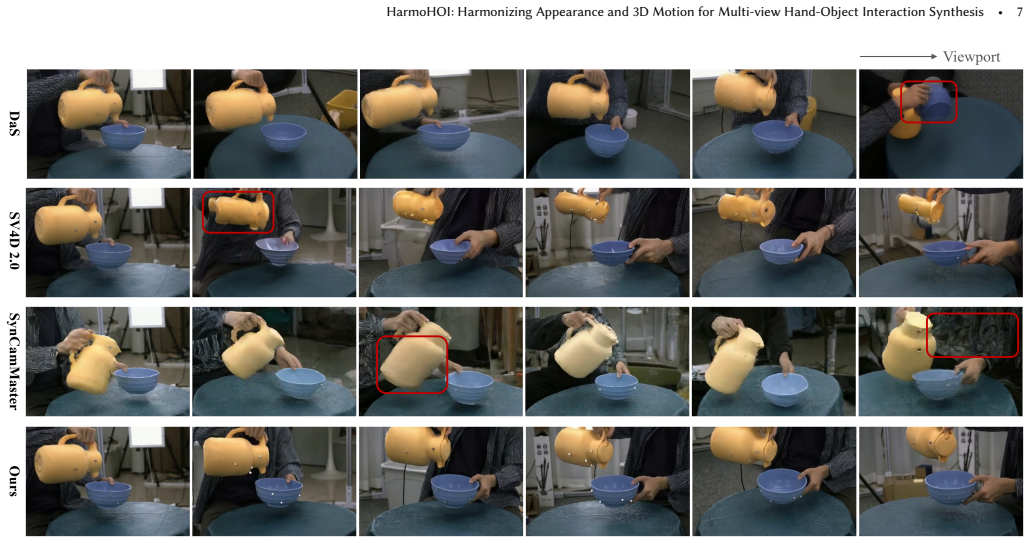
Summary. The paper proposes HarmoHOI, a unified diffusion framework for multi-view hand-object interaction (HOI) synthesis. From a single reference image, multi-view target camera poses, and a text prompt, the method jointly generates synchronized multi-view RGB videos and 3D point tracks claimed to be metric-scale and globally aligned. The architecture couples a Mixture of Multi-view Diffusion Transformer (M2DiT), which co-models RGB videos and motion pseudo-videos derived from point tracks, with a Global Motion Aligning Diffusion (GloMAD) module that refines coarse point tracks. A hybrid-data progressive curriculum uses single-view in-the-wild data, synthetic multi-view data, and lab-captured TACO data. Experiments report improved video quality, motion plausibility, and geometric consistency over several baselines on held-out TACO data, with ablations for each component.
Significance. If the claims hold, HarmoHOI is a substantial contribution: it is the first framework to jointly generate multi-view HOI videos and 3D point tracks in a single diffusion process, reuses video foundation model priors through pseudo-video representation, and explicitly targets metric-scale global alignment. The curriculum strategy is also a plausible way to mitigate the scarcity of paired multi-view video and 3D motion data. However, the central 'metric-scale globally aligned' claim depends on an inference-time depth/scale input that the paper never specifies, and the quantitative evidence is based solely on point estimates without error bars or significance tests. The conceptual framework is promising, but the manuscript currently overstates what is demonstrated.
major comments (3)
- [Sec. 3.3, Algorithm 1, Algorithm 2] The metric-scale claim is not supported by the stated inference inputs. Algorithm 1 consumes a reference depth d_ref and depth scale s to build motion pseudo-videos (lines 5-7), and Algorithm 2 lists only an 'averager depth scale s-bar' and the reference image. The task definition in Sec. 3 says input is a single reference image, camera poses, and text. A single RGB image is metrically ambiguous; the learnable scale tokens can at best regress a plausible scale from object priors, not recover true metric scale. The paper must state where d_ref and s come from at inference, and validate metric-scale alignment using that source (e.g., comparing outputs obtained with DA3-estimated depth vs. TACO ground-truth depth). If the method only produces up-to-scale geometry, the 'metric-scale' wording and the matching claims in the abstract and Sec. 4 must be revised.
- [Sec. 4.3, Tables 1-3] All quantitative comparisons are single point estimates with no error bars, confidence intervals, or significance tests. This is load-bearing for the 'state-of-the-art' claim, especially where margins are small (Table 1: CLIP-V 83.18 vs 83.01; Table 2: RPE 14.8 vs 16.7, non-contact rate 0.12 vs 0.15). Please report standard deviations over multiple evaluation seeds or test splits, state the number of test clips, and provide paired significance tests where appropriate. Table 3 also omits RPE for the row without GloMAD, making that ablation incomplete.
- [Sec. 4.3, Baselines] The baseline comparison protocol is underspecified. The text says baselines were fine-tuned on 'our data' but does not state whether the same TACO train/test split, reference images, and camera poses were used, nor the fine-tuning hyperparameters. SV4D 2.0 receives a source video and multi-view reference images, so its input is strictly richer; the paper should explain how this is accounted for. Without this detail, the reported gains over prior methods are hard to interpret.
minor comments (5)
- [Algorithm 2] 'averager depth scale s-bar' should be 'average depth scale s-bar'. Also, s-bar is never defined; please define it and explain how it is computed at inference.
- [Sec. 4.1 / Table 2] Table 2 has the typo 'Plaussibility' for 'Plausibility'. In addition, the column header 'Mat. Pix.' in Table 1 should match the metric name 'Matching Pixels' used in Sec. 4.1.
- [Sec. 4.1 / Table 2] Depth Anything 3 is used to produce pseudo-depth labels for HOIGen1M in Stage 1 and is also listed as a 3D motion baseline in Table 2. This creates a possible circularity; the paper should acknowledge this and discuss whether the comparison is affected.
- [Sec. 3.3] The name 'Mixture of Multi-view Diffusion Transformer' suggests a mixture-of-experts design, but the described architecture is a dual-branch transformer with inter-view attention. Please clarify the naming to avoid confusion.
- [Fig. 2] The figure uses abbreviations such as 'Bach Size', 'B', 't', 'V', 'hw', 'd' without a full legend. Please spell out 'Batch Size' and define all tensor-dimension symbols in the caption or text.
Circularity Check
No circular reduction in the derivation chain; metric-scale alignment is a supervised, held-out benchmarked output. Minor independence burdens come from same-group prior work (SViMo, TACO) and from Depth Anything 3 doubling as pseudo-label generator and baseline, but none of these make the central claim equivalent to its inputs by construction.
full rationale
The central claims are supported by supervised training objectives and external held-out evaluation, not by definitional equivalence. M2DiT is trained with Eq. (4), which jointly supervises the RGB velocity, the motion pseudo-video velocity, and the global metric scale s: ||ŝ - s||^2. The metric scale is therefore a learned regression target, not a quantity defined by the outputs. GloMAD refines coarse point tracks with a loss containing MSE and Chamfer distance against ground-truth M (Eq. 5), and the final 3D results are evaluated on a held-out TACO split using Chamfer distance, RPE, and inlier percentage. Thus the 'metric-scale, globally aligned 3D point tracks' are supervised predictions benchmarked against ground truth, not the same quantity as any fitted input. The skeptical concern about an unstated inference-time metric depth source is a correctness/assumption gap, not a circularity. Algorithm 1 consumes d_ref and s during training to build multi-view conditions; Algorithm 2 at inference uses the reference latent and predicted scale ŝ. The manuscript does not state where a metric d_ref would come from at inference, so the metric-scale property may degrade for arbitrary single RGB images. But this does not reduce the derivation to its own inputs: the paper never defines d_ref or s as the output, and the scale is not fitted to the final tracks. Self-citation is present but not load-bearing. SViMo (Dang et al. 2025) is a same-group prior method used as a related-work contrast and as a Table 1 baseline; TACO (Liu et al. 2024b) is co-authored by one of the present authors and used as the benchmark dataset. These are independence concerns, but the paper's central results are not justified by citing these works as theorems or as forced choices. The benchmark numbers come from held-out TACO ground truth with external metrics and additional external baselines. Similarly, Depth Anything 3 is used both to generate pseudo-labels in stage 1 and as a baseline in Table 2; this is a possible fairness/contamination issue, but the final TACO 3D evaluation uses ground-truth motion, so the headline quantitative result is not forced by that overlap. The explicit Limitation section concerns viewpoint density and future 4D Gaussian rendering, not a circular dependence. No uniqueness theorem is imported from the authors' prior work, no ansatz is smuggled in via a self-citation, and the pseudo-video representation is an architectural choice rather than a renaming of a kn
Assumptions & free parameters
free parameters (2)
- Global metric-scale tokens (two learnable tokens f_s)
- Average depth scale s̄
assumptions (5)
- domain assumption Depth-normalized, colormapped point tracks ('motion pseudo-videos') can be encoded by the same video VAE as RGB with sufficiently small information loss for 2D-to-3D co-generation.
- domain assumption The pretrained WAN 2.1 text-to-video DiT priors transfer to the motion pseudo-video branch and to multi-view joint generation without collapse.
- domain assumption Pseudo-geometric annotations from Depth Anything 3 on in-the-wild HOIGen1M are reliable enough to teach appearance-motion correspondence.
- ad hoc to paper Metric reference depth (or equivalent global scale) is available as an input at inference.
- domain assumption Multi-view epipolar consistency learned on synthetic UE5 and lab TACO data transfers to in-the-wild HOI scenes.
Cite this review
Pith. "Pith review of HarmoHOI: Harmonizing Appearance and 3D Motion for Multi-view Hand-Object Interaction Synthesis." pith.science (2026). https://pith.science/paper/5F5575OE
@misc{pith2026260717097,
  author       = {Pith},
  title        = {Pith review of: HarmoHOI: Harmonizing Appearance and 3D Motion for Multi-view Hand-Object Interaction Synthesis},
  year         = {2026},
  howpublished = {\url{https://pith.science/paper/5F5575OE}},
  note         = {Machine review of arXiv:2607.17097}
}
read the original abstract
Hand-Object Interaction (HOI) synthesis is a cornerstone for animation production and embodied AI. Despite the strong priors of video foundation models, multi-view consistent HOI synthesis remains challenging due to complex hand motions and occlusions. We present HarmoHOI, a unified diffusion framework that jointly and harmoniously generates synchronized multi-view HOI videos and globally aligned 3D point tracks. Our core insight is that robust multi-view consistency fundamentally requires globally aligned 3D geometry and motion. To this end, we propose a Mixture of Multi-view Diffusion Transformer that co-models RGB videos and 3D point tracks. By representing point tracks as pseudo-videos, we align 3D geometric signals with the 2D latent space of foundation models, thereby minimizing the domain gap and easing adaptation of priors. To further ensure geometry consistency, we introduce Global Motion Aligning Diffusion, which refines coarse point tracks into metric-scale, globally aligned 3D trajectories. HarmoHOI enables on-the-fly co-evolution of 2D appearance and 3D motion during denoising. To overcome the scarcity of multi-view HOI data, we employ a hybrid data curriculum learning strategy that successfully transfers generic priors from single-view data to synchronized multi-view generation. Experimental results show that HarmoHOI achieves state-of-the-art performance in visual quality, motion plausibility, and multi-view geometric consistency. Project page available at https://droliven.github.io/HarmoHOI_project.
Figures


Figures from the paper (7 more)


Forward citations
Cited by 2 Pith papers
-
Roomer: Reflective Object-Grounded Model Editing and Repair for 3D Indoor Layout Synthesis
Roomer repairs local violations in generated furniture layouts through object-grounded diagnosis, vision-language-model-proposed local edits, and verification-gated commit, improving physical validity and practical us...
-
StreamHOI: Interaction-aware Temporal Memory Adaptation for Streaming HOI Video Generation
A streaming image-to-video model that assigns block-specific sink/local memory and learned RoPE distance scaling preserves long human-object interactions under bounded latency.
Reviewed August 1, 2026 · model on record in the stance chip above.
Discussion (0). Continue with ORCID to comment.