REVIEW 3 major objections 3 minor 35 references
Dynamic Pricing for a Two-Sided Data Market Platform
T0 review · 3 major / 3 minor · reviewed 2026-08-01 · deepseek-v4-flash
Pith's one-line read This paper proves that a monopolistic data platform's optimal acquisition and selling prices are feedback functions of its data stock, characterized by a fully nonlinear integro-differential HJB equation plus a verification theorem, and num
desk verdict A genuinely new model with mostly standard machinery; the C²-regularity proof has a real hole that a referee should insist be filled. read the letter →
The pith
A machine-rendered reading of the paper's core claim, the machinery that carries it, and where it could break.
The reading
What carries the argument
The ID-HJB equation couples a second-order ODE in the state variable to a nonlocal integral operator capturing jumps in data volume; the proof works by freezing that nonlocal term as an inhomogeneous source, solving the resulting ODE locally, and then invoking viscosity comparison. The provider-side maximization is carried by the function f(p)=p+μdp(p)/μdp'(p), whose strict monotonicity makes the optimizer unique and locally Lipschitz. The consumer-side maximizer is a constant multiple of the data-quality function g(x).
What would settle it
Take a privacy-loss distribution with a flat density on some subinterval, so μdp'=0 there; then f(p) is not strictly increasing and the unique maximizer p̂(z) is not guaranteed. Solving the discrete HJB system for that distribution should reveal whether the provider-side supremum has multiple maximizers; if it does, the paper's uniqueness and verification claims fail for that case.
Extended reading notes
Core claim
For the state-dependent jump-diffusion model, the value function is the unique viscosity solution of the integro-differential HJB equation, is actually C^2, and the feedback prices are optimal, where the provider price is zero when the expected marginal benefit of added data is nonpositive and positive otherwise, while the consumer price rises with data quality and saturates. Under the chosen parameters the optimal provider price and the value function both have an inverted-U shape, so there is a finite optimal data stock beyond which buying more data destroys value.
Load-bearing premise
The main load-bearing assumption is that the privacy-loss distribution function μdp is C^1 and strictly increasing on (0,b) with the ratio μdp/(μdp)' locally uniformly increasing; if real privacy valuations have flat regions, mass points, or non-monotone hazards, the provider-price maximizer may fail to be unique and the verification theorem collapses.
Editorial extensions
If this is right
- If the theorems hold, the platform's optimal policy is implementable in feedback form: at each instant it observes current stock and sets both prices via the derived functions.
- The optimal acquisition price is zero whenever the expected marginal profit of an extra random data batch is nonpositive, so a rational platform stops buying data once its stock passes the peak of the value function.
- The optimal selling price is set by marking up the quality score by a constant factor determined by consumers' willingness-to-pay distribution, so better-quality data commands proportionally higher prices.
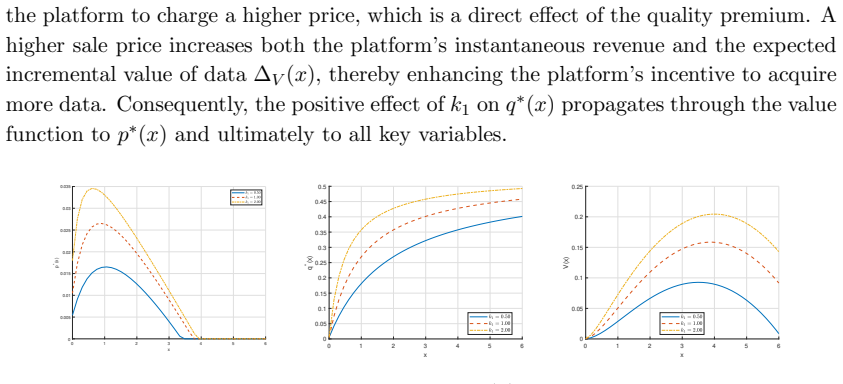
- Parameter shifts that raise data quality propagate through the value function to raise both prices, while higher processing costs lower acquisition price and value but leave the selling-price rule unchanged.
- The inverted-U pattern implies a finite optimal data stock; accumulating beyond it reduces expected discounted profit.
Reading between the lines
- The inverted-U result suggests a testable managerial rule: platforms with large legacy datasets should pay less for marginal data, and the model predicts a measurable negative relationship between existing data stock and acquisition bids, all else equal.
- Because the provider-side pricing rule depends on the shape of the privacy-loss distribution, regulatory changes that reshape privacy valuations would alter optimal acquisition prices through the same function f(p), and could be simulated by re-solving the HJB equation with a different μdp.
- The state-dependent arrival intensities act like a demand-side network effect; one could extend the framework to competing platforms or to a finite-horizon version and check whether the inverted-U persists when the quality function saturates faster or slower.
- The numerical scheme solves the HJB equation by freezing the nonlocal term and iterating, suggesting a convergent fixed-point approach for pricing in data markets that could also be used for calibration to transaction data.
Signed reviews
Editorial analysis
A structured set of objections, weighed in public.
Referee Report
Summary. This paper analyzes a continuous-time stochastic control problem for a monopolistic data platform that buys raw data from privacy-sensitive providers and sells data products to consumers. The state is the platform's data stock, evolving as a jump-diffusion with Brownian noise, deterministic depreciation, and state-dependent arrival processes for providers and consumers. The platform controls the acquisition price p and the selling price q. Under Assumption 2.1, the paper derives the ID-HJB equation (2.8), proves that the value function is its unique viscosity solution (Theorem 3.1), upgrades it to a classical C^2 solution (Theorem 4.1), and verifies optimality of the feedback prices (Theorem 4.2). Numerical experiments with exponential privacy valuations and quadratic costs produce an inverted-U value function and a life-cycle acquisition strategy.
Significance. If the missing proof steps are supplied, the paper would be a useful rigorous treatment of dynamic pricing with endogenous, state-dependent jumps and a nonlocal HJB equation. The main theorems provide an existential and verification framework, and the numerical section illustrates a concrete policy rule. Strengths include an explicit model of two-sided feedback, a careful statement of technical assumptions, and a detailed finite-difference implementation. The main theoretical idea—treating the nonlocal integral as an inhomogeneous source and reducing the ID-HJB equation to an ODE—is promising. However, the C^2 regularity theorem is currently asserted rather than proved, and the viscosity subsolution proof contains notational issues. These are repairable but currently undermine the central claim.
major comments (3)
- [Theorem 4.1 / Section 4] The proof of Theorem 4.1 is not self-contained at the decisive step. The uniqueness of viscosity solutions to Eq. (4.1) is asserted ('in line with Lemma 3.2') but not proved; the bounded-domain comparison principle is cited to Pham (2009) without stating hypotheses; and the gluing of the local C^2 solutions to the Dirichlet problems (4.2) to conclude V is in C^2(R) is not explained. In particular, the continuity of IV(x) is attributed to Proposition D.6 of Hernández-Lerma–Lasserre, a discrete-time control text, where it is not a standard result. Since C^2 regularity is used in Lemma 2.2 to construct Lipschitz feedback prices and in Theorem 4.2 to apply Itô's formula, this gap is load-bearing. A full proof (e.g., via linear ODE maximum principle or Feynman–Kac) must be supplied.
- [Lemma 3.1, Eq. (3.5)] In the subsolution step, the integral in Eq. (3.5) contains e^{-ρθ_n} (a constant depending on the upper limit) inside the time integral; Itô's formula gives e^{-ρt}. As printed, the inequality is not well-defined, and the deduction 'γ_n/h_n − ε(1/2 − E[θ_n]/h_n) ≤ 0' is not fully justified because the discount factor must be handled with care. The same issue appears in Eq. (3.3) of the supersolution step. This affects the proof of Lemma 3.1 and hence Theorem 3.1.
- [Lemma 3.2, Eq. (3.6)] The operator defined just below Eq. (3.6) as L_i φ(x) := 0.5σ² i − δx φ'(x) − Φ(x) + λc(x)H^c(x;p) is not a differential operator: i is a scalar (the second derivative value). Presumably L_{a_{n,ε}} and L_{b_{n,ε}} should be the second-order operators with coefficients a_{n,ε}, b_{n,ε}. This typo obscures the Crandall–Ishii step; please rewrite the operators consistently.
minor comments (3)
- [Assumption 2.1(iii)] The local uniform monotonicity condition on µdp/(µdp)' is purely technical. Please add a remark on its economic content, on which common distributions satisfy it, and on what can fail if it is violated.
- [Section 5 / Numerical] The quadratic extrapolation V_1 = 3V_2 − 3V_3 + V_4 and the Vtail fit a_R x² + b_R x + c_R are ad hoc; no grid-convergence test or sensitivity to boundary treatment is reported. The inverted-U conclusion should be presented with this caveat.
- [Theorem 3.1 proof] In the uniqueness proof, 'u_* and u^* are respectively the u.s.c. envelopes of u and v' should say 'of u and of v, respectively.' The current wording is ambiguous.
Circularity Check
No significant circularity: the HJB/verification chain is re-derived in-paper; self-citations are minor and non-load-bearing.
full rationale
Each load-bearing step is proved in the paper rather than imported from its own conclusions. Lemma 3.1 derives viscosity-solution status from the DPP and Itô calculus; Lemma 3.2 proves comparison via the Crandall–Ishii lemma, with the nonlocal term handled explicitly; Theorem 3.1 then gives uniqueness and continuity of V. Theorem 4.1 is a bootstrap: the nonlocal operator I V is fixed as a source term, the localized linear ODE is solved by standard elliptic theory (Gilbarg–Trudinger/Friedman), and a bounded-domain comparison (Pham) identifies the classical solution with V. The only self-citations—Bo and Huang (2025) for state-dependent jumps and for an event construction inside Lemma 3.1's proof—are not where the central claims rest; the surrounding details are written out. The numerical section (Section 5) uses illustrative parameter values from Table 1 and solves the same HJB fixed point; no fitted quantity is relabeled as an out-of-sample prediction. The Theorem 4.1 sentence 'so we omit them here' is a genuine proof omission (a rigor concern, not a circularity), and the continuity of I V is cited to a discrete-time source, but neither makes any equation equal to its input by construction.
Assumptions & free parameters
free parameters (9)
- α1 =
0.5
- α2 =
1.5
- k1 =
1.0 (varied 0.5–2.0)
- Λ =
0.8
- φ2 =
0.05 (varied 0.05–0.15)
- Ldp, Mdp, ldp =
1.0, 1.0, 0.1
- Lc, lc =
2.0, 0.1
- ρ, δ, σ =
3, 0.1, 0.1
- numerical grid + Vtail coefficients (aR, bR, cR) =
unspecified
assumptions (5)
- standard math Itô calculus, Gronwall's lemma, BDG inequality, dynamic programming principle, Crandall–Ishii lemma, and linear elliptic ODE existence (Gilbarg–Trudinger Thm 6.8; Friedman Thm 6.2.4) are used without proof in §2–§4.
- domain assumption Assumption 2.1(i)–(ii): λdp bounded & Lipschitz; g bounded & continuous; λc, Φ continuous with |λc(x)|+|Φ(x)| ≤ L(1+|x|^m), Φ convex; ν has finite 2m-th moment.
- ad hoc to paper Assumption 2.1(iii): local uniform monotonicity of µdp/(µdp)' with c_K > −1 (equivalently f(p)=p+µdp/(µdp)' increasing with slope ≥ 1+c_K), strict convexity of 1/(1−µc), and lim_{x→∞} x(1−µc(x))=0.
- domain assumption State space treated as R: X driven by (2.1) has a Brownian term and no reflecting boundary, so 'data volume' can go negative, while X0 ∈ R+ and X is called the total data volume; the paper silently defines λdp, λc, g, Φ on R.
- ad hoc to paper Numerical boundary treatment: quadratic extrapolation V1 = 3V2−3V3+V4 and VNx = 3VNx−1−3VNx−2+VNx−3, plus quadratic Vtail fit near boundaries.
Cite this review
Pith. "Pith review of Dynamic Pricing for a Two-Sided Data Market Platform." pith.science (2026). https://pith.science/paper/HBNGJWXM
@misc{pith2026260717119,
  author       = {Pith},
  title        = {Pith review of: Dynamic Pricing for a Two-Sided Data Market Platform},
  year         = {2026},
  howpublished = {\url{https://pith.science/paper/HBNGJWXM}},
  note         = {Machine review of arXiv:2607.17119}
}
read the original abstract
We study a continuous-time dynamic pricing problem for a data platform that purchases raw data from privacy-sensitive providers and sells data products to consumers. The platform controls both the acquisition price offered to providers and the selling price charged to consumers. Provider and consumer arrivals are modeled by point processes whose intensities depend on the platform's current data stock, capturing feedback between data accumulation and market participation. We formulate the platform's problem as an infinite-horizon stochastic control problem with a jump-diffusion state process and derive the associated nonlinear integro-differential HJB equation. We prove that the value function is the unique viscosity solution, establish classical regularity under suitable conditions, and verify the optimal feedback pricing policy. Finally, we conduct numerical analyses to examine the influences of model parameters on the optimal pricing policies.
Figures


Figures from the paper (6 more)




Reference graph
Works this paper leans on
-
[1]
Dahleh and T
Agarwal, A., M. Dahleh and T. Sarkar (2019): A marketplace for data: An algorithmic solution. In Proceedings of 2019 ACM Conf. Econ. Comput. 701-726
2019
-
[2]
Chasseigne and C
Barles, G., E. Chasseigne and C. Imbert (2008): On the Dirichlet problem for second-order elliptic integro-differential equations. Indiana U. Math. J. 213-246
2008
-
[3]
Barles, G. and C. Imbert (2008): Second-order elliptic integro-differential equations: viscosity solutions' theory revisited. Ann. I. H. Poincare-An. 25 (3), 567-585
2008
-
[4]
Bataineh, A. S., R. Mizouni, M. El Barachi and J. Bentahar (2016). Monetizing personal data: a two-sided market approach. Procedia Comput. Sci. 83 , 472-479
2016
-
[5]
Bergemann, D. and A. Bonatti (2024): Data, competition, and digital platforms. Amer. Econ. Rev. 114 (8), 2553-2595
2024
-
[6]
Bonatti and T
Bergemann, D., A. Bonatti and T. Gan (2022): The economics of social data. Rand J. Econ. 53 (2), 263-296
2022
-
[7]
Bo, L. and Y. Huang (2024): Dynamic pricing with surging demand. CSIAM Trans. Appl. Math. 5 (1), 142-181
2024
-
[8]
Bo, L. and Y. Huang (2025): Optimal inventory control with state-dependent jumps. Adv. Appl. Probab. 57 (4), 1360-1391
2025
Show all 35 references
-
[9]
Boyd, S. and L. Vandenberghe (2004): Convex Optimization . Cambridge university press, Cambridge
2004
-
[10]
(2022): Protecting data markets from strategic buyers
Castro Fernandez, R. (2022): Protecting data markets from strategic buyers. In Proceedings of 2022 Inter. Conf. Manag. Data . 1755–1769
2022
-
[11]
Paraschiv and G
Chenavaz, R., C. Paraschiv and G. Turinici (2021): Dynamic pricing of new products in competitive markets: A mean-field game approach. Dyn. Games Appl. 11 (3), 463-490
2021
-
[12]
Crandall, M. G., H. Ishii and P. L. Lions (1992): User’s guide to viscosity solutions of second order partial differential equations. Bull. Amer. Math. Soc. 27 (1), 1-67
1992
-
[13]
Dang, D. M., D. Nguyen and G. Sewell (2016): Numerical schemes for pricing Asian options under state-dependent regime-switching jump–diffusion models. Comput. Math. Appl. 71 (1), 443-458
2016
-
[14]
Davis, M. and S. Lleo (2013): Jump-diffusion risk-sensitive asset management II: jump-diffusion factor model. SIAM J. Contr. Optim. 51 (2), 1441-1480
2013
-
[15]
(2012): A few useful things to know about machine learning
Domingos, P. (2012): A few useful things to know about machine learning. Commun. ACM. 55 (10), 78-87
2012
-
[16]
(1975): Stochastic Differential Equations and Applications
Friedman, A. (1975): Stochastic Differential Equations and Applications . Vol. 1. Academic Press, New York
1975
-
[17]
Gallego, G. and G. Van Ryzin (1994): Optimal dynamic pricing of inventories with stochastic demand over finite horizons. Manag. Sci. 40 (8), 999-1020
1994
-
[18]
Gilbarg, D. and N.S. Trudinger (1998): Elliptic Partial Differential Equations of Second Order. Springer-Verlag, New York
1998
-
[19]
Hernández-Lerma, O. and J.B. Lasserre (2012): Discrete-time Markov Control Processes: Basic Optimality Criteria. Springer-Verlag, New York
2012
-
[20]
Ikeda, N. and W. Watanabe (1981). Stochastic Differential Equations and Diffusion Processes, 2nd Edition. North-Holland Publishing, Amsterdam
1981
-
[21]
Jiao, Y., P. Wang, S. Feng and D. Niyato (2018): Profit maximization mechanism and data management for data analytics services. IEEE Inter. Things J. 5 (3), 2001-2014
2018
-
[22]
Kushner, H.J. and P. Dupuis (1992): Numerical Methods for Stochastic Control Problems in Continuous Time. Springer-Verlag, New York
1992
-
[23]
Li, X., J. Yao, X. Liu and H. Guan (2017): A first look at information entropy-based data pricing. In 2017 IEEE 37th Inter. Conf. Distr. Comput. Syst. (ICDCS). 2053-2060
2017
-
[24]
Moody, D.L. and P. Walsh (1999): Measuring the value of information-an asset valuation approach. In ECIS. 496-512
1999
-
[25]
(2019): Data markets with dynamic arrival of buyers and sellers
Moor, D. (2019): Data markets with dynamic arrival of buyers and sellers. In Proceedings of 14th Workshop Econ. Networks, Syst. Comput. 1–6
2019
-
[26]
Zheng, F
Niu, C., Z. Zheng, F. Wu, S. Tang and G. Chen (2020): Online pricing with reserve price constraint for personal data markets. IEEE Trans. Knowl. Data Engin. 34 (4), 1928-1943
2020
-
[27]
Niyato, D., M. A. Alsheikh, P. Wang, D.I. Kim and Z. Han (2016): Market model and optimal pricing scheme of big data and Internet of Things (IoT). In 2016 IEEE Inter. Conf. Commun. (ICC). 1-6
2016
-
[28]
(2009): Continuous-time Stochastic Control and Optimization with Financial Applications
Pham, H. (2009): Continuous-time Stochastic Control and Optimization with Financial Applications. Springer-Verlag, New York
2009
-
[29]
Seo, E., H. Kim, B. Krishnamachari and E. Elmroth (2022): An ICN-based data marketplace model based on a game theoretic approach using quality-data discovery and profit optimization. IEEE Trans. Cloud Comput. 11 (2), 2110-2126
2022
-
[30]
Jiang, Y
Xu, L., C. Jiang, Y. Qian, Y. Zhao, J. Li and Y. Ren (2017): Dynamic privacy pricing: A uulti-armed bandit approach with time-variant rewards. IEEE Trans. Inf. Foren. Sec. 12 (2), 271–285
2017
-
[31]
Jiang, Y
Xu, L., C. Jiang, Y. Chen, Y. Ren and K. R. Liu (2015): Privacy or utility in data collection? A contract theoretic approach. IEEE J-STSP. 9 (7), 1256-1269
2015
-
[32]
(2022): Selling consumer data for profit: Optimal market-segmentation design and its consequences
Yang, K.H. (2022): Selling consumer data for profit: Optimal market-segmentation design and its consequences. Amer. Econ. Rev. 112 (4), 1364-1393
2022
-
[33]
Arafa, J
Zhang, M., A. Arafa, J. Huang and H.V.Poor (2021): Pricing fresh data. IEEE J. Sel. Area. Comm. 39 (5), 1211-1225
2021
-
[34]
Zhao, W. and Y.S. Zheng (2000): Optimal dynamic pricing for perishable assets with nonhomogeneous demand. Manag. Sci. 46 (3), 375-388
2000
-
[35]
Zheng, Z., Y. Peng, F. Wu, S. Tang and G. Chen (2017): Trading data in the crowd: Profit-driven data acquisition for mobile crowdsensing. IEEE J. Sel. Area. Comm. 35 (2), 486-501
2017
Reviewed August 1, 2026 · model on record in the stance chip above.
Discussion (0). Continue with ORCID to comment.