REVIEW 4 major objections 5 minor 13 references
Be Consistent! Enhancing Robust Visual Reasoning in LVLMs with Consistency Constraints
T0 review · 4 major / 5 minor · reviewed 2026-08-01 · deepseek-v4-flash
Pith's one-line read ConVLM claims that training a vision-language model to give consistent answers to logically equivalent questions improves visual reasoning, and backs it with a new benchmark, ConVBench.
desk verdict Useful benchmark, but the label-free consistency claim collapses once you read Appendix E: the 'consistency' reward is correctness parity against pseudo-labels, not answer agreement. read the letter →
The pith
A machine-rendered reading of the paper's core claim, the machinery that carries it, and where it could break.
The reading
What carries the argument
The central object is the logically equivalent question pair: for each image, a pair (q1, a1), (q2, a2) is generated so that the answer to one can be inferred from the answer to the other together with the image. The training objective uses GRPO, a group-relative policy optimization method, with a dual reward r = racc + γ·rcon. The consistency reward rcon compares model outputs on the paired questions, with the implemented rule being 1 if both answers are correct or both are incorrect according to the auto-generated pseudo-labels, and 0 otherwise. This couples two rollouts from the same image and encourages the policy to treat logically equivalent prompts as carrying the same answer, while t
What would settle it
Take a random sample of the automatically generated training question pairs, have humans re-label the answers, and compare the model's ConVBench robust accuracy when trained on original versus corrected labels. If the pseudo-label error rate is high and the gains shrink or reverse under corrected labels, the central claim that consistency itself drives improvement would be weakened.
Extended reading notes
Core claim
The central claim is that logical consistency across equivalent questions is a distinct, trainable dimension of visual reasoning. The paper shows that baseline LVLMs often give contradictory answers to equivalent questions about the same image, and that current benchmarks do not measure this failure. To fix this, ConVLM optimizes a reward that combines accuracy on individual answers with agreement between answers to paired logically equivalent questions. The authors report that this consistency-oriented training improves both consistency and robust accuracy on ConVBench, and that the gains transfer to other visual reasoning benchmarks. They further claim that the consistency reward alone, wi
Load-bearing premise
The training reward's consistency term relies on auto-generated pseudo-answers: an output pair counts as consistent only when both answers match the proposer's labels, so if those labels are frequently wrong the model can be rewarded for being consistently wrong, and the paper provides no estimate of how often they are wrong.
Editorial extensions
If this is right
- If the claim holds, consistency can be used as a training signal without human-annotated ground truth, because the question pairs are automatically generated from image captions and object boxes.
- Training with the consistency reward alone improves both consistency and accuracy, implying that logical agreement itself nudges the model toward better visual understanding.
- Baselines that score high on consistency but near-zero on accuracy show that single-question benchmarks can miss systematic failures; ConVBench-style paired evaluation would make these visible.
- The reported generalization to V*Bench (84.90% for ConVLM-7B) suggests the consistency training does not merely overfit to the benchmark's question format.
- Scaling the automatically generated training data from 1,000 to 5,000 images gives consistent gains, with diminishing returns, indicating a cheap path to improving visual reasoning robustness.
Reading between the lines
- Extension: because the implemented consistency rule treats 'both wrong' as consistent, the method's effectiveness likely depends on the accuracy of the auto-generated pseudo-labels; if those labels are often wrong, the model could be rewarded for being confidently wrong.
- Extension: the paper does not estimate the pseudo-label error rate on training data, so a concrete next step is to measure that error rate and test whether model gains survive label correction.
- Extension: replacing the binary both-correct-or-both-wrong rule with a softer semantic-agreement score, which the paper lists as future work, would separate 'consistency as agreement' from 'consistency as agreement with the generator'.
- Extension: applying the same consistency reward to video or text-only reasoning tasks would test whether the mechanism is general or specific to single-image visual QA.
Signed reviews
Editorial analysis
A structured set of objections, weighed in public.
Referee Report
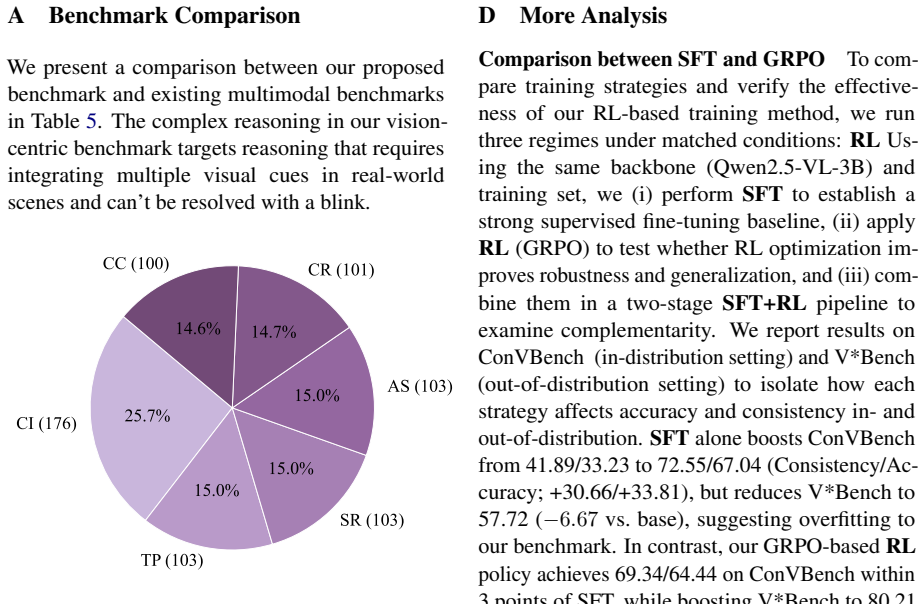
Summary. The paper introduces ConVBench, a vision-centric benchmark of 686 images with paired logically equivalent questions across six reasoning categories, and two metrics: logical consistency (CI) and robust accuracy (AI). It also presents ConVLM, a GRPO-based reinforcement learning method that trains an LVLM with a dual reward combining an accuracy reward and a consistency reward over automatically generated question-answer pairs. The authors report state-of-the-art open-source results on ConVBench (73.36% consistency and 66.83% robust accuracy for the 7B model), strong generalization to V*Bench (84.90%), and ablations showing contributions from both reward terms. The central technical claim is that a consistency reward improves robust visual reasoning without strict answer supervision. However, the paper contains an internal contradiction between the formal definition of the consistency function and its implemented form: Eq. (8) defines consistency as logical agreement between paired responses, while Appendix E implements it as equality of correctness status against GPT-4.1 pseudo-labels. This discrepancy affects both the training reward and the evaluation metric and is load-bearing for the paper's main claims.
Significance. If the consistency mechanism were implemented as described, the paper would make a useful contribution: a human-validated paired-question benchmark, a scalable generation pipeline, and an RL objective that encourages cross-question agreement. The human verification statistics (Appendix O), the independent V*Bench evaluation, and the careful ablation structure are strengths. However, as it stands, the central claim is not supported. The implemented reward is co-correctness under pseudo-labels, not logical agreement; the pseudo-label error rate is never measured; and the primary evaluation metric CI has the same functional form as the training reward. These issues are not presentation-level but concern the core definition of consistency, so the reported gains on ConVBench cannot be interpreted as evidence of improved logical consistency.
major comments (4)
- [§3.2, Eq. (8) vs. Appendix E] Eq. (8) defines r_con = c(o1_i, o2_i) and the text states that c(·) 'returns 1 if the two outputs are logically consistent'. Appendix E specifies the implemented c(·) as: 'If both generated answers are correct or incorrectly, it is 1; otherwise, it is 0', judged against GPT-4.1 pseudo-answers. These are different functions. The implemented reward is XNOR of correctness statuses, not agreement between response contents. A wrong-wrong pair receives the consistency reward even when the answers are logically contradictory, while a correct-incorrect pair receives 0 even when semantically aligned. This also contradicts the abstract's claim of functioning 'without strict answer supervision': computing c requires reference answers, so the learning signal is supervised by pseudo-labels.
- [§4.1, CI metric and Table 1] The benchmark metric CI is defined as '1 if both questions are answered either correctly or incorrectly, and 0 otherwise' — the same XNOR-of-correctness function used as the training reward c. The primary reported consistency gains are therefore gains on a training objective with the same functional form, not on an independently defined logical-consistency measure. Human-validated ground truth and the V*Bench generalization result partially mitigate circularity, but the headline consistency numbers on ConVBench cannot be interpreted as measuring logical agreement. Table 1 illustrates the problem: DeepSeek-VL2-tiny scores 63.63 CI on Causal & Intent with 0.56 accuracy, showing that a model that is consistently wrong can receive high consistency. A metric that awards both-wrong responses is not a logical-consistency metric.
- [§3.2 and Appendix E: pseudo-label quality] The method's noise-tolerance argument rests on the assumption that GPT-4.1 pseudo-answers are accurate enough for the parity signal to be meaningful. The introduction states that pseudo-answers are 'often noisy and frequently incorrect', but the paper provides no error-rate estimate, no comparison of pseudo-label accuracy against human labels, and no analysis of how the reward behaves under label noise. If the pseudo-label error rate is high, the γ·r_con term systematically rewards pairs that are both wrong, and r_acc is also computed against the same noisy references. This omission is load-bearing because both reward terms depend on unverified labels; without it, the weakly supervised learning claim is unsupported.
- [§3.2, 'without strict answer supervision' claim] The distinction between 'weakly supervised' and 'without strict answer supervision' is not established. The w/o-Acc ablation still uses the consistency reward, which itself requires pseudo-reference answers; therefore no experiment trains without some form of answer supervision. As implemented, both rewards require a reference answer (pseudo-label) to compute, so the claim in the abstract that the framework 'functions effectively with or without strict answer supervision' is not demonstrated by any experiment in the paper.
minor comments (5)
- [Algorithm 1] The pseudocode refers to 'Eq. (eq:advantages)' but the label is not defined in the text; it should refer to Eq. (5).
- [Eq. (6)] The symbol r_i(θ) is used for the probability ratio π_θ(o_i|I,q)/π_{θ_old}(o_i|I,q), but r was previously used for reward. Using the same symbol for two different quantities is confusing; a distinct symbol such as ρ_i(θ) would be clearer.
- [Table 3] Row names 'w/-GroupCon' and 'w/-SampleCon' are awkward and inconsistent with the rest of the paper; also the repeated phrase 'percentage points' in the paragraph should be cleaned.
- [References] GPT-4.1 is cited as 'Brown, 2020', which is the GPT-3 paper. A correct citation for GPT-4.1 should be provided.
- [Appendix I / Figure 6] There are typos: 'GoundTruth' and 'GroundTruth' appear inconsistently; the figure caption should be proofread.
Circularity Check
Consistency reward as implemented equals the ConVBench consistency metric, so headline consistency gains are the training objective; external V*Bench results partially break the loop.
-
self definitional
[Appendix E (Training Procedure); Eq. (8); Sec. 4.1 (Experimental Details)]
"For the consistency function (c(·)), we implement it based on string matching. If both generated answers are correct or incorrectly, it is 1; otherwise, it is 0."
Eq. (8) defines the training reward as rcon = c(o1_i, o2_i), while Sec. 4.1 defines the evaluation metric CI as 1 if both questions are answered either correctly or incorrectly, and 0 otherwise. Thus the reward and the headline metric are the same XNOR-of-correctness function by construction. The paper describes this as 'logically consistent' agreement, but the implemented c(·) is co-correctness under GPT-4.1 pseudo-labels, not semantic agreement. Consequently, reported ConVBench 'Consistency' gains are increases in the training objective itself; only the held-out human-validated pairs and the independent V*Bench results provide partial external grounding.
-
other
[Abstract; Appendix E (Training Procedure)]
"The framework functions effectively with or without strict answer supervision. ... For the consistency function (c(·)), we implement it based on string matching. If both generated answers are correct or incorrectly, it is 1; otherwise, it is 0."
The implemented c(·) requires knowing whether each answer is correct or incorrect, i.e., reference answers (here GPT-4.1 pseudo-labels). Therefore the claimed label-free or 'without strict answer supervision' consistency signal is not actually label-free. Moreover, since both-incorrect pairs receive reward γ, noisy pseudo-labels can reinforce systematic errors. This is a load-bearing mismatch between the stated method and the implementation rather than a classical derivation cycle, but it means the consistency construct reduces to co-correctness against unmeasured pseudo-labels.
full rationale
The core circular element is concrete and quotable: the training reward in Eq. (8)/Appendix E is the exact same function as the evaluation metric CI in Sec. 4.1 (both are XNOR of correctness against reference answers). Hence the central claim 'consistency reward improves consistency' is, on ConVBench, partly an optimization target rather than an independent test of logical consistency, and the paper's 'logical consistency' is defined by that same co-correctness parity rather than by answer agreement. The loop is not complete, however: ConVBench is human-validated, explicitly disjoint from the auto-generated training data (Appendix L), and the model is not fit to ConVBench parameters; the large V*Bench gains (84.90% accuracy) and InfoVQA results come from an external benchmark with different labels and metrics, providing genuine independent evidence that the training procedure generalizes. There is no load-bearing self-citation chain or imported uniqueness theorem, and no parameter is fitted to produce a numerical prediction on ConVBench. Weighing these, the circularity is partial: the benchmark's consistency measurement is self-definitionally tied to the training reward, but robust accuracy and cross-benchmark generalization retain independent content. Score 6.
Assumptions & free parameters
free parameters (4)
- γ (consistency weight) =
0.5 (ablation uses 0.3)
- β (KL coefficient) =
0.0
- G (GRPO samples) =
8
- m (minimum objects for spatial filter) =
5
assumptions (4)
- domain assumption GPT-4.1-generated pseudo-answers used as training rewards are accurate enough to serve as ground truth.
- domain assumption The human-validated ConVBench pairs are correctly labeled and logically equivalent.
- domain assumption GRPO with β=0 remains stable and generalizes for LVLMs.
- ad hoc to paper String-matching based consistency function captures logical consistency.
Cite this review
Pith. "Pith review of Be Consistent! Enhancing Robust Visual Reasoning in LVLMs with Consistency Constraints." pith.science (2026). https://pith.science/paper/A4GWVO2C
@misc{pith2026260721722,
  author       = {Pith},
  title        = {Pith review of: Be Consistent! Enhancing Robust Visual Reasoning in LVLMs with Consistency Constraints},
  year         = {2026},
  howpublished = {\url{https://pith.science/paper/A4GWVO2C}},
  note         = {Machine review of arXiv:2607.21722}
}
read the original abstract
While Large Vision-Language Models (LVLMs) exhibit strong perceptual capabilities, they remain vulnerable in visual reasoning tasks. Existing benchmarks largely focus on symbolic mathematical or scientific problems and simple vision-centric tasks, offering limited assessment of complex visual reasoning and logical consistency, a critical requirement for reliable reasoning systems. We introduce ConVBench, a complex vision-centric reasoning benchmark in which each image is paired with two logically equivalent questions across six categories: action and state, complex counting, spatial reasoning, causal and intent understanding, commonsense reasoning, and temporal perception. To complement this benchmark, we define two evaluation metrics, logical consistency and robust accuracy, that jointly assess both the correctness and consistency of model responses. We further present ConVLM, which improves LVLM reasoning through Group Relative Policy Optimization (GRPO)-based reinforcement learning with a novel consistency reward. This method leverages automatically generated logically equivalent question-answer pairs and a dual-reward design combining accuracy- and consistency-based signals, encouraging agreement between paired responses. The framework functions effectively with or without strict answer supervision.
Figures


Figures from the paper (3 more)


Reference graph
Works this paper leans on
-
[1]
the captions indicate xxx
The indirect question’s correct choice must follow from the direct answer, but the wording/semantic focus should differ. 2. Use the bounding-boxes to anchor content in the explanaiton. 3. Do not invent ob- jects or actions not supported by the cap- tions + bboxes. 4. The object in explana- tions should apear with its coordinates if it appears in the image...
-
[2]
Did the batter hit the ball?
The indirect question’s correct choice must follow from the direct answer, but the wording/semantic focus should differ (e.g. “Did the batter hit the ball?” → “Is the ball moving toward or away from the batter? optionA: toward optionB: away”). 3. Use the bounding-boxes only to anchor objects in the explanation. 4. Do not invent ob- jects or things not sup...
2022
-
[3]
Gemini 2.5: Pushing the frontier with ad- vanced reasoning, multimodality, long context, and next generation agentic capabilities.arXiv preprint arXiv:2507.06261. Alexey Dosovitskiy, Lucas Beyer, Alexander Kolesnikov, Dirk Weissenborn, Xiaohua Zhai, Thomas Unterthiner, Mostafa Dehghani, Matthias Minderer, Georg Heigold, Sylvain Gelly, Jakob Uszkoreit, and...
arXiv 2021
-
[4]
Ilya Loshchilov and Frank Hutter
Understanding r1-zero-like training: A critical perspective.CoRR, abs/2503.20783. Ilya Loshchilov and Frank Hutter. 2019. Decoupled weight decay regularization. In7th International Conference on Learning Representations, ICLR 2019, New Orleans, LA, USA, May 6-9, 2019. OpenRe- view.net. Haoyu Lu, Wen Liu, Bo Zhang, Bingxuan Wang, Kai Dong, Bo Liu, Jingxian...
arXiv 2019
-
[10]
the captions indicate xxx
Use the bounding-boxes only to anchor who/what is acting—focus on actions, not static attributes. 4. Do not invent objects or actions not supported by the captions + bboxes. 5. The object in explanations should appear with its coordinates if it ap- pears in the image. 6. The explanation is used to train model. And note that the model will not be provided ...
-
[12]
the captions indicate xxx
Use the bounding-boxes only to anchor who/what is acting—focus on actions, not static attributes. 4. Do not invent objects or actions not supported by the captions + bboxes. 5. The object in explanations should apear with its coordinates if it ap- pears in the image. 6. The explanation is used to train model. And note that the model will not be provided w...
-
[141]
Wenxuan Zhang, Mahani Aljunied, Chang Gao, Yew Ken Chia, and Lidong Bing
Springer. Wenxuan Zhang, Mahani Aljunied, Chang Gao, Yew Ken Chia, and Lidong Bing. 2023. M3exam: A multilingual, multimodal, multilevel benchmark for examining large language models. InAdvances in Neural Information Processing Systems 36: Annual Conference on Neural Information Processing Sys- tems 2023, NeurIPS 2023, New Orleans, LA, USA, December 10 - ...
arXiv 2023
-
[2015]
Are there more people on the side- walk than cars on the road?
except the commonsense category. m is set to 5. D More Analysis Comparison between SFT and GRPOTo com- pare training strategies and verify the effective- ness of our RL-based training method, we run three regimes under matched conditions:RLUs- ing the same backbone (Qwen2.5-VL-3B) and training set, we (i) performSFTto establish a strong supervised fine-tu...
2000
Show all 13 references
-
[2022]
Training language models to follow instruc- tions with human feedback. InAdvances in Neural Information Processing Systems 35: Annual Confer- ence on Neural Information Processing Systems 2022, NeurIPS 2022, New Orleans, LA, USA, November 28 - December 9, 2022. John Schulman, ...
2022 arXiv
-
[2023]
CoRR, abs/2308.01390
Openflamingo: An open-source framework for training large autoregressive vision-language models. CoRR, abs/2308.01390. Shuai Bai, Keqin Chen, Xuejing Liu, Jialin Wang, Wen- bin Ge, Sibo Song, Kai Dang, Peng Wang, Shi- jie Wang, Jun Tang, Humen Zhong, Yuanzhi Zhu, Mingkun Yang,...
-
[2024]
Cambrian-1: A fully open, vision-centric ex- ploration of multimodal llms. InAdvances in Neural Information Processing Systems 38: Annual Confer- ence on Neural Information Processing Systems 2024, NeurIPS 2024, Vancouver, BC, Canada, December 10 - 15, 2024. Hugo Touvron, Thib...
2024 arXiv
-
[2025]
Tom B Brown
Qwen2.5-vl technical report.arXiv preprint arXiv:2502.13923. Tom B Brown. 2020. Language models are few-shot learners.arXiv preprint arXiv:2005.14165. Zhe Chen, Weiyun Wang, Yue Cao, Yangzhou Liu, Zhangwei Gao, Erfei Cui, Jinguo Zhu, Shenglong Ye, Hao Tian, Zhaoyang Liu, et al...
2020 arXiv
-
[9567]
Rowan Zellers, Yonatan Bisk, Ali Farhadi, and Yejin Choi
IEEE. Rowan Zellers, Yonatan Bisk, Ali Farhadi, and Yejin Choi. 2019. From recognition to cognition: Visual commonsense reasoning. InIEEE Conference on Computer Vision and Pattern Recognition, CVPR 2019, Long Beach, CA, USA, June 16-20, 2019, pages 6720–6731. Computer Vision F...
2019
Reviewed August 1, 2026 · model on record in the stance chip above.
Discussion (0). Continue with ORCID to comment.