REVIEW 3 major objections 5 minor 15 references
Residual Flow Matching with Dynamic Cross-Interaction for 3D Multi-Person Motion Prediction
T0 review · 3 major / 5 minor · reviewed 2026-08-05 · deepseek-v4-flash
Pith's one-line read The paper claims that residual flow matching with a deterministic prior and dynamic cross-interaction achieves state-of-the-art accuracy in 3D multi-person motion prediction.
desk verdict A sensible two-stage residual flow matching decomposition with a real contribution, but a load-bearing contradiction between the main text and supplementary about single-step vs. 10-step ODE inference makes the reported SOTA claims impossible to verify as written. read the letter →
The pith
A machine-rendered reading of the paper's core claim, the machinery that carries it, and where it could break.
The reading
What carries the argument
The load-bearing object is the residual flow state $R^{(t)}=tR^{(1)}+(1-t)\beta R^{(0)}$, with the clean endpoint defined as $R^{(1)}=Y-X_{T_h}$, so the network predicts the residual from the last observed pose rather than the absolute skeleton. The second mechanism is the Dynamic Cross-Interaction gate $g(t)=w_{\min}+(w_{\max}-w_{\min})t^\gamma$, instantiated as $0.6+0.4t^{1.5}$, which multiplies the global-to-local message-passing terms in each refinement layer. The deterministic spatial prior $D_c$ stays unattenuated while the uncertain global context is gated, which is what suppresses early-stage noise interference.
What would settle it
Retrain with the gate reversed, $g(t)=0.6+0.4(1-t)^{1.5}$, keeping everything else identical; if MPJPE on 3DPW-RC stays comparable or improves, the benefit is not from keeping noisy early states local.
Extended reading notes
Core claim
The authors claim that the hard part of multi-person motion prediction is not sampling diverse futures but keeping those futures kinematically coherent while agents interact. Their decomposition lets a Deterministic Coarse Prior produce a first future, then a Residual Flow Matching module learns a conditional flow over the residual between that prior and the true future, so the generative model never has to create skeletons from isotropic noise. A Dynamic Cross-Interaction mechanism scales cross-person feature injection by $g(t)=0.6+0.4t^{1.5}$ over the ODE trajectory, leaving early noise-dominated states largely local and restoring social context as $t\to1$. With Winner-Takes-All endpoint t
Load-bearing premise
The load-bearing premise is that early ODE integration states are so corrupted by noise that suppressing cross-person attention according to a hand-set schedule is what creates the accuracy gain; if that premise is false, the reported improvement could be an artifact of changing model capacity instead of evidence about noise.
Editorial extensions
If this is right
- A single training recipe can combine deterministic structure with generative diversity: the coarse prior supplies the skeleton, the residual flow supplies the multiple plausible futures.
- Because the flow is parameterized by the clean endpoint, a short 10-step Euler solver is enough at inference, making the accuracy gain compatible with practical use.
- The gating principle implies that interaction strength should track the reliability of intermediate states, not just the time index, which is a general lesson for multi-agent generative models.
- Reported cross-dataset results suggest the learned interaction representations transfer from synthetic to real scenes rather than memorizing the training domain.
- The model's accuracy in the 10-person Mix2 setting suggests that dense social context can be used productively rather than treated as extra noise.
Reading between the lines
- Editorial extension: the gate is hand-set, so a direct next test is to learn $g(t)$ from the noise level of the intermediate state; a learned schedule could outperform the fixed power law on horizons where early states are cleaner or noisier.
- Editorial extension: the coarse-anchor-plus-residual-flow split is broader than skeletons; the same recipe could reduce generative load in trajectory forecasting where a cheap deterministic planner provides the anchor.
- Editorial extension: the paper's own stated limitations—ODE latency, preset gate, and fixed person count—bound the claim and identify where a follow-up would need to generalize it, not where the current evidence is silent.
- Editorial extension: measuring the signal-to-noise ratio of $R^{(t)}$ at small $t$ would test the stated motivation directly; if early states are not noise-dominated, the gate's benefit would be better explained as a capacity rebalancing effect.
Editorial analysis
A structured set of objections, weighed in public.
Referee Report
Summary. The paper proposes a framework for 3D multi-person motion prediction that combines a Deterministic Coarse Prior (DCP) with a conditional flow-matching model over motion residuals, plus a Dynamic Cross-Interaction (DCI) gate that scales cross-person message-passing with the integration progress t. The authors report state-of-the-art results on 3DPW, CMU-Syn, Mix1/Mix2, and cross-dataset settings, with ablations attributed to DCP, residual flow, DCI, joint branch, and full-sequence temporal alignment. The central methodological description, however, is internally inconsistent: the main text describes single-step decoding from K parallel heads, while the supplementary material and the conclusion describe an iterative 10-step Euler ODE solver at inference.
Significance. If the reported results are reproducible and the inference procedure is unambiguously specified, the framework would be a strong empirical contribution: it extends recent EMPMP-style hierarchical motion modeling with a residual flow objective and a time-gated social interaction module, and it is evaluated across multiple benchmarks and metrics. The paper also provides extensive ablations and qualitative comparisons, which strengthens the empirical case. However, the contribution currently cannot be cleanly assessed because the main text and the supplementary material disagree on a load-bearing implementation detail—whether DCI is active over a multi-step ODE trajectory or is evaluated in a single decoding step. That inconsistency must be resolved before the SOTA claim can be attributed to the described mechanism. The DCI ablation also conflates temporal modulation with overall attenuation, so the mechanism's specific benefit is not yet isolated.
major comments (3)
- [Future Motion Prediction (Eqs. 11-12) vs. Supplementary 'Flow Construction and ODE Sampling' (Eq. 19) vs. Conclusion] The main text states that the K parallel prediction heads decode residuals in a single step, but the supplementary material describes a fixed-step explicit Euler solver with 10 integration steps over t in [0,1), and the Conclusion explicitly acknowledges that 'iterative ODE integration in the flow matching process incurs higher inference latency.' These two descriptions are mutually exclusive. If inference is the 10-step ODE, the main text is false; if inference is single-step, then the DCI gate g(t)=0.6+0.4 t^1.5 in Eq. (9) is applied at only one value of t, so the 'Dynamic Cross-Interaction' mechanism has no dynamic role at inference and the DCI ablation in Table 3 does not test what it claims. This must be corrected and the actual inference procedure, including the number of steps and the value(s) of t used at test time, must be stated unambiguously before the reported SOTA numbers ca
- [Ablation Study: 'Effectiveness of Dynamic Cross-Interaction' (Table 3)] The only DCI ablation replaces the time-varying gate with the static interaction used in the coarse stage, i.e., g(t)=1. This comparison conflates the effect of temporal modulation with the effect of overall gate strength: a constant gate of 1.0 may simply inject more cross-agent information at every step, while a constant gate of 0.6 would test whether attenuation alone, without time-dependence, is beneficial. The premise that early flow states are noise-dominated and that the monotone power-law schedule is the correct temporal profile is asserted rather than derived. The supplementary hyperparameter analysis (wmin, wmax, gamma) is useful but still does not include a time-invariant gate at matched average strength. Please add constant-gate baselines at g=0.6 and g=1.0, and, if possible, a direct diagnostic of how prediction error varies with the integration step under different gates.
- [Abstract vs. Supplementary Material (Code Availability)] The abstract states that code is available at a GitHub URL, while the supplementary material states that code and trained models 'will be fully released to the public once this paper is accepted.' These statements are contradictory. Please harmonize the availability statement and, if the URL is indeed live, verify that it contains the code; if not, remove the URL or mark it as anonymous for review. This is a presentation issue but it affects reproducibility claims.
minor comments (5)
- [Eq. (7) / Eq. (18)] The scaling parameter for the noise term is called beta in Eq. (7) and sigma in Eq. (18); both are later reported as 2.0. Unify the notation to avoid confusion.
- [Ablation Study (Table 3)] The abbreviation 'AFM' in the row 'w/ AFM' is not expanded or explained anywhere in the text. It appears to mean 'Absolute Flow Matching,' but it should be defined at first use.
- [Table 1] The column header of Table 1 is garbled: the grouping 'Ori 16f/14f RC 16f/14f 2s/2s 1s/1s' is repeated, and the column labels do not clearly map to the reported metrics. Please reformat the table so that each dataset, protocol, and metric is unambiguously labeled.
- [Table 2] The caption says the results are for the '1s-input/3s-output setting,' but the column headers read 'Out Length 1s 2s 3s.' Clarify whether these columns are three output horizons within a single protocol or three separate settings.
- [Supplementary 'Details on Network and Training'] The sentence 'To accommodate asymmetric lengths, we define a unified sequence length I=max(T_h, T_f)' is followed by a procedure for padding/truncation; the wording is slightly confusing because the DCT length is I but the coordinate conversion and truncation are only described afterward. Consider rewriting for clarity.
Circularity Check
No circular reduction found; the central SOTA claim is a benchmark comparison against external baselines. Minor self-citation and unresolved inference-description contradictions reduce confidence but do not make the derivation circular.
full rationale
The paper's central claim is an empirical SOTA comparison against external baselines (T2P, CoMusion, JRT, TBIFormer, EMPMP) on public benchmarks. Such comparisons cannot reduce to the model's own inputs by construction; lower errors on held-out test sets are externally falsifiable. The residual flow formulation (Eq. 7) defines R(t) = t R(1) + (1-t) beta R(0) and the final prediction Y_k = \hat R(1)_k + X_{T_h}; this is a standard flow-matching reparameterization, not a self-justifying identity. The DCI gate g(t) = w_min + (w_max - w_min)t^gamma (Eq. 9) is an asserted schedule whose hyperparameters are tuned on validation data and ablated (supplementary Fig. 3); tuning an architectural hyperparameter is not 'fitting a parameter and calling it a prediction.' The paper does cite the authors' prior EMPMP for the DCT-initialized motion encoder and for the fixed-person-count assumption, but EMPMP is also treated as an external baseline to be beaten, so the self-citation is not load-bearing for the SOTA claim. Two non-circular inconsistencies should nevertheless be noted: (1) the main text says K heads 'directly decode distinct multi-modal residuals in a single step' (Eqs. 11-12), while the supplementary describes a 10-step explicit Euler ODE solve (Eq. 19) and the Conclusion acknowledges 'iterative ODE integration ... incurs higher inference latency'; these cannot both describe the deployed model, so the reported numbers are not cleanly attributable to the mechanism as written. (2) The abstract promises a GitHub URL, while the supplementary says code 'will be fully released ... once accepted.' Neither issue is a circularity, but both weaken the reproducibility of the empirical claim. Score 2 reflects the minor self-citation presence without any circular reduction of the central result.
Assumptions & free parameters
free parameters (5)
- DCI gating weights (w_min, w_max, gamma) =
0.6, 1.0, 1.5
- Flow noise scale sigma (beta) =
2.0
- Global contribution weight alpha =
0.2
- Hidden dimension =
39 (3DPW), 45 (others)
- ODE integration steps =
10
assumptions (4)
- domain assumption Early flow states are noise-dominated and gating cross-agent attention by integration progress improves fidelity.
- domain assumption The fixed number of interacting individuals is known and constant.
- domain assumption Custom synthetic splits for Mix1/Mix2 (800/100 for 2s/2s) are representative and baseline reproduction is exact.
- standard math Endpoint parameterization with linear interpolation is a valid flow matching objective.
Cite this review
Pith. "Pith review of Residual Flow Matching with Dynamic Cross-Interaction for 3D Multi-Person Motion Prediction." pith.science (2026). https://pith.science/paper/JK4DBX6E
@misc{pith2026260803379,
  author       = {Pith},
  title        = {Pith review of: Residual Flow Matching with Dynamic Cross-Interaction for 3D Multi-Person Motion Prediction},
  year         = {2026},
  howpublished = {\url{https://pith.science/paper/JK4DBX6E}},
  note         = {Machine review of arXiv:2608.03379}
}
read the original abstract
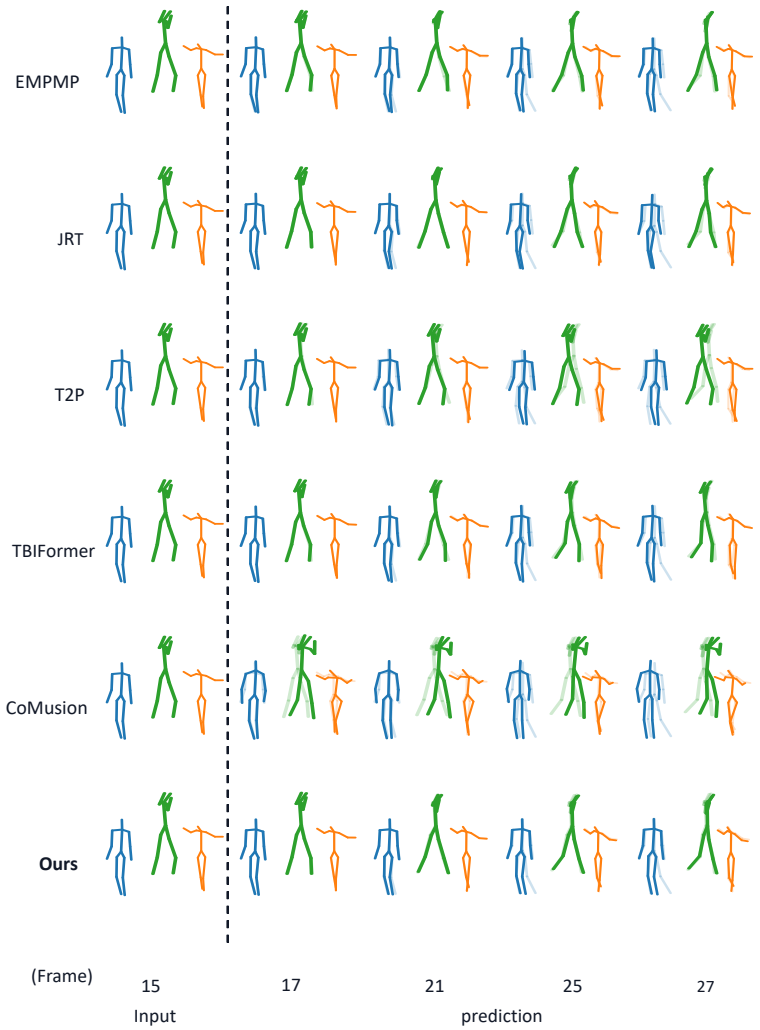
3D multi-person motion prediction requires modeling both individual kinematics and inter-person interactions. While Flow Matching is effective for multi-hypothesis generation to improve prediction accuracy, directly predicting skeletal sequences from pure noise often compromises structural consistency and introduces unreliable cross-agent interactions during early noise-dominated integration steps. To address this, we propose a Prior-Guided Residual Flow Matching framework. First, a Deterministic Coarse Prior (DCP) establishes a kinematic anchor, formulating the generative process as a conditional flow over motion residuals to simplify the generative objective and preserve structural stability. Second, a Dynamic Cross-Interaction (DCI) mechanism temporally synchronizes inter-agent message-passing with the integration progress, ensuring the extraction of reliable social contexts and improving multi-person motion fidelity. Finally, a decoupled joint-motion architecture with bidirectional fusion effectively preserves fine-grained kinematic coherence. Extensive experiments demonstrate that our approach achieves state-of-the-art prediction accuracy across multiple datasets. Code is available at https://github.com/Wei-Wei-a/Residual-Flow-Matching-with-Dynamic-Cross-Interaction-for-3D-Multi-Person-Motion-Prediction.
Figures


Figures from the paper (4 more)



Reference graph
Works this paper leans on
-
[2]
InProceedings of the IEEE/CVF International Conference on Computer Vision, 9544–9555
HumanMAC: Masked Motion Completion for Hu- man Motion Prediction. InProceedings of the IEEE/CVF International Conference on Computer Vision, 9544–9555. Ding, P.; Cui, Q.; Wang, H.; Zhang, M.; Liu, M.; and Wang, D.2024. ExpressiveForecastingof3DWhole-BodyHuman Motions.InProceedingsoftheAAAIConferenceonArtificial Intelligence, 1537–1545. Fragkiadaki, K.; Le...
work page 2024
-
[6]
InProceedings of the IEEE International Confer- ence on Robotics and Automation, 8246–8253
A Generic Diffusion-BasedApproachfor3DHumanPosePredictionin the Wild. InProceedings of the IEEE International Confer- ence on Robotics and Automation, 8246–8253. Sun,J.;andChowdhary,G.2024. CoMusion:TowardsCon- sistentStochasticHumanMotionPredictionviaMotionDif- fusion. InProceedingsoftheEuropeanConferenceonCom- puter Vision, 18–36. Tanke, J.; Zhang, L.; ...
work page 2024
-
[7]
In Proceedings of the IEEE/CVF International Conference on Computer Vision, 9601–9611
Social Diffu- sion: Long-Term Multiple Human Motion Anticipation. In Proceedings of the IEEE/CVF International Conference on Computer Vision, 9601–9611. Tevet, G.; Raab, S.; Gordon, B.; Shafir, Y.; Cohen-Or, D.; andBermano,A.H.2023. HumanMotionDiffusionModel. InProceedingsoftheInternationalConferenceonLearning Representations. Tian, S.; Zheng, M.; and Liang, X
work page 2023
-
[11]
InProceedings of the IEEE/CVF International Conference on Computer Vision, 10844–10853
Efficient Multi-Person Motion Prediction by Lightweight Spatial and Temporal In- teractions. InProceedings of the IEEE/CVF International Conference on Computer Vision, 10844–10853. Residual Flow Matching with Dynamic Cross-Interaction for 3D Multi-Person Motion Prediction Supplementary Material Details on Dataset We evaluate our framework on 3DPW (von Mar...
work page 2018
-
[12]
is a real-world in-the-wild dataset captured by moving cameras and IMU- assisted body reconstructions. It contains challenging inter- actions, frequent camera motion, partial occlusions, and di- verseindoorandoutdoorscenes.Followingthestandardpro- tocol (Vendrow et al. 2022; Xu et al. 2023; Zheng, Yu, and Sun2025),weevaluateboth3DPW-Oriand3DPW-RC.The form...
work page 2022
-
[13]
is a real- world multi-person dataset characterized by complex inter- actions, severe occlusions, and dynamic viewpoint changes. We utilize this dataset to evaluate zero-shot cross-dataset transferability.Specifically,modelstrainedsolelyonthesyn- theticCMU-SyndatasetaredirectlytestedonMuPoTS-3Dto assess their robustness against domain shifts and real-worl...
work page 2021
-
[14]
are high-density synthetic benchmarks containing 6 and 10 interacting individuals, respectively. These datasets are utilized to evaluate the model’s performance in complex and crowded multi-person scenarios. For the 2,s/1,s setting, we configure both Mix1 and Mix2 to include 800 training and 100 testing sequences, with models trained and eval- uated direc...
work page 2023
-
[15]
Training and OptimizationThe framework is optimized end-to-endusingtheAdamoptimizerwithaweightdecayof 10−4. The model employs a batch size of 64, with gradient accumulationsetto1andautomaticmixedprecision(AMP) disabled to ensure numerical stability during the ODE inte- gration. For AMASS pretraining and subsequent 3DPW fine-tuning, themodelistrainedfor50,...
Show all 15 references
-
[2015]
InPro- ceedingsoftheIEEE/CVFInternationalConferenceonCom- puter Vision, 4346–4354
Recurrent Network Models for Human Dynamics. InPro- ceedingsoftheIEEE/CVFInternationalConferenceonCom- puter Vision, 4346–4354. Fu,Y.;Yan,Q.;Wang,L.;Li,K.;andLiao,R.2025.MoFlow: One-Step Flow Matching for Human Trajectory Forecasting via Implicit Maximum Likelihood Estimation ...
2025
-
[2018]
InInter- national Conference on 3D Vision (3DV), 120–130
Single-Shot Multi- Person 3D Pose Estimation from Monocular RGB. InInter- national Conference on 3D Vision (3DV), 120–130. Peng,X.;Mao,S.;andWu,Z.2023. Trajectory-AwareBody Interaction Transformer for Multi-Person Pose Forecasting. InProceedings of the IEEE/CVF Conference on C...
2023
-
[2020]
Yuan,Y.;Song,J.;Iqbal,U.;Vahdat,A.;andKautz,J.2023
DLow: Diversifying Latent FlowsforDiverseHumanMotionPrediction.InProceedings of the European Conference on Computer Vision, 346–364. Yuan,Y.;Song,J.;Iqbal,U.;Vahdat,A.;andKautz,J.2023. PhysDiff: Physics-Guided Human Motion Diffusion Model. InProceedings of the IEEE/CVF Interna...
2023
-
[2021]
InProceedingsoftheIEEE/CVFInternationalConfer- ence on Computer Vision, 13309–13318
Generating Smooth Pose Sequences for Diverse Human Motion Predic- tion. InProceedingsoftheIEEE/CVFInternationalConfer- ence on Computer Vision, 13309–13318. Mao,W.;Liu,M.;Salzmann,M.;andLi,H.2019. Learning Trajectory Dependencies for Human Motion Prediction. In Proceedings of ...
2019
-
[2023]
InProceedings of the IEEE/CVF International Conference on Computer Vision, 2317–2327
BeLFu- sion: Latent Diffusion for Behavior-Driven Human Motion Prediction. InProceedings of the IEEE/CVF International Conference on Computer Vision, 2317–2327. Barsoum,E.;Kender,J.;andLiu,Z.2018. HP-GAN:Proba- bilistic3DHumanMotionPredictionviaGAN. InProceed- ings of the IEEE...
2018
-
[2024]
InProceedings of the Euro- pean Conference on Computer Vision, 402–419
Multi-Person Pose Forecasting with Individual Interaction Perceptron and Prior Learning. InProceedings of the Euro- pean Conference on Computer Vision, 402–419. Xu,Q.;Mao,W.;Gong,J.;Xu,C.;Chen,S.;Xie,W.;Zhang, Y.;andWang,Y.2023.Joint-RelationTransformerforMulti- Person Motion ...
2023
-
[2025]
arXiv:2512.13903
PrediFlow: A Flow-Based Prediction-Refinement Framework for Real- Time Human Motion Prediction in Human-Robot Collabo- ration. arXiv:2512.13903. Vendrow,E.;Kumar,S.;Adeli,E.;andRezatofighi,H.2022. SoMoFormer: Multi-Person Pose Forecasting with Trans- formers. arXiv:2208.14023....
2022
Reviewed August 5, 2026 · model on record in the stance chip above.
Discussion (0). Continue with ORCID to comment.