REVIEW 4 major objections 4 minor 49 references
Defect-induced optical magnons and local magnetic correlations in MnSb2Te4
T0 review · 4 major / 4 minor · reviewed 2026-08-16 · deepseek-v4-flash
Pith's one-line read In MnSb2Te4, antisite defects create a strongly antiferromagnetic Mn–Te–Mn bond about ten times stronger than the host ferromagnet, producing a large-gap optical magnon and controlling the measured spin dynamics.
desk verdict First single-crystal INS study resolving a defect-induced optical magnon in MnSb2Te4; the qualitative picture is solid, but the quantitative J' is more model-dependent than it appears. read the letter →
The pith
A machine-rendered reading of the paper's core claim, the machinery that carries it, and where it could break.
The reading
What carries the argument
The load-bearing object is the effective tri-layer model of one septuple block: a central Mn layer with reduced moment $S_A = pS$, and two Sb-layer sheets with moments $S_B = qS$, where $p = 0.588$ and $q = 0.129$ come from diffraction. The central layer has ferromagnetic intralayer exchange $J_0 < 0$, and the defect sheets couple antiferromagnetically to it through $J' > 0$ along linear Mn–Te–Mn bonds; the analytical model neglects intralayer coupling of the dilute defect layers, the interlayer coupling $J_c$, and single-ion anisotropy $D$. Expressing the spins as bosons and diagonalizing the resulting quadratic form yields three branches—an acoustic mode $E_1$, a gapped optical mode $E_2$ whose gap sets $J'$, and a flat mode $E_3$—plus an analytic stiffness ratio $A/A_0 = (3p^2 + 8pq|J'/J_0|)/(6(p - 2q))$ that lets the fit explain the stiffened acoustic branch. Stochastic classical spin dynamics on a $40 \times 40 \times 4$ supercell with random vacancies and antisite spins is the disordered counterpart that captures the broad, localized short-wavelength excitations and the dimer-like correlations above $T_N$.
What would settle it
Measure the spin excitations in MnSb2Te4 crystals with deliberately varied antisite concentrations: if $J'$ really is the defect-induced Mn–Te–Mn bond, the optical gap should track the defect fraction $q$, the stiffness enhancement should follow $A/A_0 = (3p^2 + 8pq|J'/J_0|)/(6(p - 2q))$, and a nearly stoichiometric sample should show no optical branch. Conversely, a high-resolution $(0,0,L)$ measurement that resolves the interlayer dispersion would test the $J_c = 0$ assumption, since a finite interlayer coupling would move the branches in a way the tri-layer model cannot reproduce.
Extended reading notes
Core claim
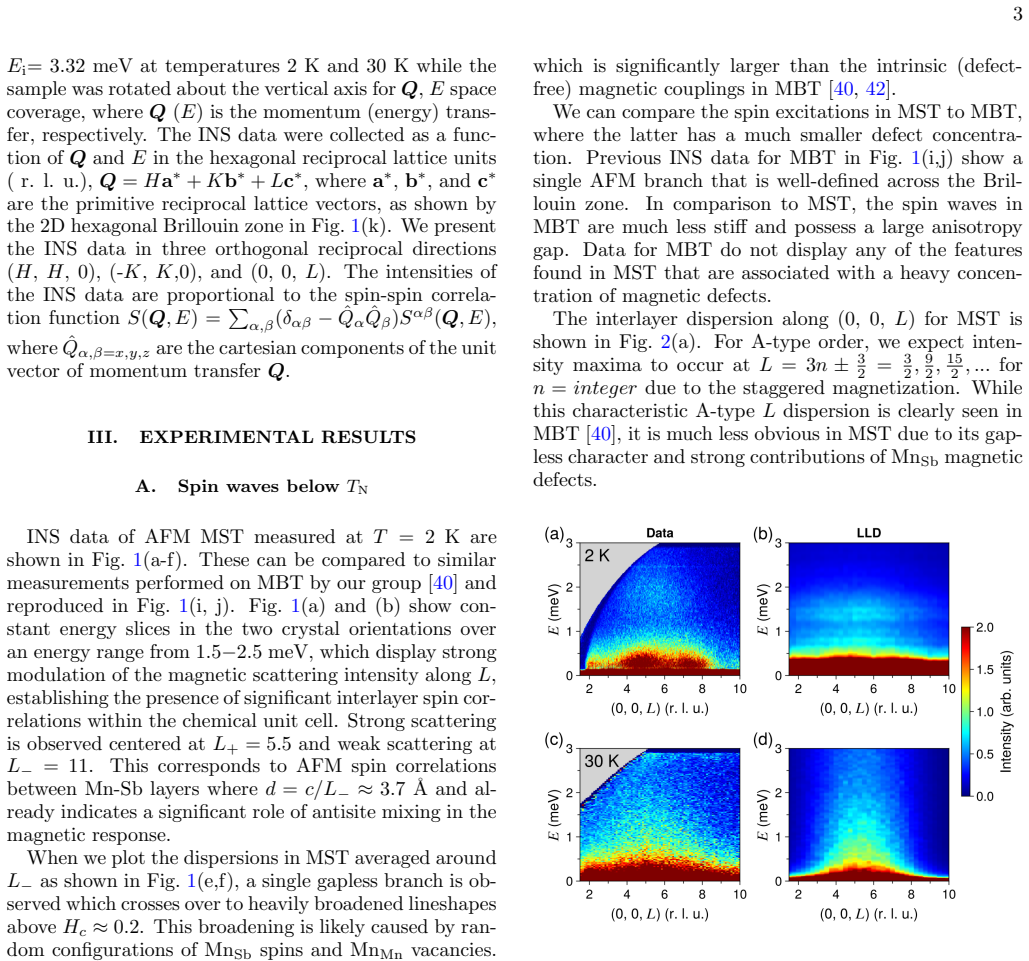
Using inelastic neutron scattering on single crystals of A-type antiferromagnetic MnSb2Te4 ($T_N = 19$ K), the paper finds spin excitations qualitatively different from the nearly defect-free host MnBi2Te4: a gapless acoustic branch crosses over to broad, disorder-dominated excitations beyond $H_c \approx 0.2$, and a second, gapped optical branch appears with onset $\Delta' \approx 1.5$ meV. The interlayer modulation of the scattering, with strong intensity at $L = 5.5$ and weak at $L = 11$, shows that moments in neighboring Mn and Sb layers are antiferromagnetically correlated within each septuple block. Fitting the acoustic and optical branches with an effective tri-layer linear spin-wave model yields $J_0 = -0.075(1)$ meV and $J' = 0.75(3)$ meV, and the model predicts a defect-driven enhancement of the acoustic stiffness by a factor $A/A_0 \approx 3.6$, close to the observed $\approx 3$. Classical spin-dynamics simulations with quenched disorder reproduce the ordered and paramagnetic scattering, and the measured $Q$-dependence above $T_N$ matches the structure factor of a magnetic dimer connected by the next-nearest-neighbor Mn–Te–Mn bond. The conclusion is that antisite defects form an intrinsic second magnetic subsystem whose exchange interactions dominate the intrinsic energy scales of the material.
Load-bearing premise
The fitted strengths of the two magnetic bonds come from a simplified model in which the messy, partly empty Mn and Sb layers are treated as two smooth uniform sheets with reduced magnetization, and two smaller energy terms—coupling between blocks and a direction-preference term—are set to zero; if the real disorder or those neglected terms bends the measured spin-wave curves, the reported bond strengths would shift.
Editorial extensions
If this is right
- Antisite concentration becomes a control knob for the magnetic Hamiltonian: crystals grown or annealed with different Mn/Sb mixing should show optical-gap and spin-stiffness variations that track $p$ and $q$.
- Spin-wave measurements on Mn(Bi,Sb)2Te4 with intermediate Sb content should interpolate between the single well-defined branch of nearly defect-free MnBi2Te4 and the defect-dominated spectrum reported here, providing a direct test of the defect-subsystem picture.
- Because the strong coupling runs through nearly linear Mn–Te–Mn bonds, the same defect-induced ferrimagnetism should appear in other quintuple- and septuple-layer topological insulators with Mn/Sb or Mn/Sn antisite mixing, as already suggested by Mn-doped Sb2Te3 and SnTe.
- The broad, disorder-dominated short-wavelength excitations and the large optical gap are observable fingerprints that distinguish defect-rich from defect-poor crystals, so neutron and magnetization experiments can diagnose antisite content without crystallographic refinement.
Reading between the lines
- A testable extension the paper does not pursue: at lower temperatures and higher resolution, the continuum observed above $T_N$ might resolve into discrete dimer spin-state excitations, since the dimer-like structure factor indicates bound Mn–Mn pairs with quantized levels.
- If the paper's picture is right, the fitted $J'$ and $J_0$ may partly absorb a small interlayer coupling $J_c$, and a three-dimensional spin-wave fit on better-resolved $(0,0,L)$ data could separate $J_c$ and test whether the stiffness enhancement is entirely defect-driven.
- The unresolved competition between the ferromagnetic defect–defect interlayer interaction and the antiferromagnetic Mn–Mn interlayer coupling could produce a defect-concentration-driven transition from A-type antiferromagnetism to net ferrimagnetism, which magnetization and transport measurements on tuned samples could probe.
- High-field inelastic neutron scattering offers a further direct test: if the optical magnon gap is set by the ferrimagnetic exchange field, a field strong enough to flip the defect sublattice should collapse the optical branch.
Signed reviews
Editorial analysis
A structured set of objections, weighed in public.
Referee Report
Summary. Jaishi et al. report inelastic neutron scattering measurements on single crystals of MnSb2Te4, an A-type antiferromagnet with substantial Mn/Sb antisite mixing. They observe a gapless acoustic spin-wave branch that broadens at short wavelengths and an additional gapped optical branch that they attribute to antiferromagnetic coupling J' between Mn_Sb antisite defects and Mn_Mn moments. Above T_N, the Q dependence of the scattering resembles the structure factor of next-nearest-neighbor Mn-Te-Mn dimers. The authors analyze the dispersions with a minimal tri-layer linear spin-wave model, obtaining J0 ≈ -0.075 meV and J' ≈ 0.75 meV, and reproduce the main features with Landau-Lifshitz dynamics simulations on quenched-disorder supercells. They conclude that antisite defects act as an intrinsic magnetic subsystem that dominates the spin dynamics of MnSb2Te4.
Significance. The central observation of a defect-induced optical magnon with a large gap is plausible, and the paper has several genuine strengths: the optical branch is directly visible in the constant-energy data, the above-T_N structure factor is compared to explicit dimer structure-factor calculations, the LLD simulations treat the quenched disorder explicitly and reproduce the qualitative broadening, and the extracted J' is consistent with prior high-field magnetization and dilute-Sb2Te3 results. If the quantitative extraction is confirmed, the work would establish antisite defects as a controllable second magnetic subsystem in the Mn(Bi,Sb)2Te4 family, with direct implications for defect-engineered topological magnetism. The main limitations are the reliance of J' on a homogeneous tri-layer LSWT model in a regime close to the triangular-lattice percolation threshold and the absence of an independent determination of J' from the disorder-resolved simulations.
major comments (4)
- [III.A and Appendix C] The reported optical gap is inconsistent: the main text gives an onset Δ'≈1.5 meV (Section III.A), while Appendix C states that the fitted optic mode has a gap Δ'≈1.9 meV at q=0. Since the fitted J' scales linearly with this gap through E2(0)=3J'(SA-2SB), the discrepancy directly affects the headline value. Please reconcile the two numbers, and state whether the optical branch has a soft onset with a peak at higher energy or whether one of the values is a typo.
- [IV.B / Appendix C] The homogeneous tri-layer LSWT model of Section IV.B and Appendix C replaces the diluted Mn layers (p=0.588, q=0.129) by uniform layers with S_A=pS and S_B=qS and sets J_c=D=0. For a triangular lattice the site-percolation threshold is p_c≈0.5, so the Mn layer sits only ≈0.09 above percolation, and the crossover to broad localized modes at H_c≈0.2 described in Section III.A is a direct sign of strong-disorder physics. As the optical gap depends linearly on (S_A-2S_B), any error in the effective moments enters linearly in J'. Please justify the homogeneous approximation quantitatively, for example by comparing analytic dispersions with explicit-disorder LLD simulations for a range of J', or by providing a percolation-aware uncertainty estimate for J'.
- [IV.C] Section IV.C uses J'=0.75 meV as an input to the LLD simulations, so the resulting agreement of the simulated optical mode is a consistency check rather than an independent validation of J'. To make the quantitative claim robust, the authors should show a sensitivity analysis over J' (and ideally over the effective moments) demonstrating how the simulated optical gap and linewidths change; the quoted ±0.03 meV from the LSWT fit does not capture the model uncertainty.
- [Data Availability] The Data Availability statement cites reference [49] as 'Link Here', which is a placeholder with no usable URL. Since the central quantitative claim depends on fits whose results are not fully checkable from the figures, the data, fitted peak positions, and simulation outputs should be made accessible prior to publication.
minor comments (4)
- [III.A] The relation p_eff≈(2H_c)^2=0.16 is asserted without derivation or reference; please provide the basis for this estimate.
- [Eq. (1) / IV.C] The sign convention for the single-ion anisotropy D in Eq. (1) is not defined, and the text sets D=0 for the LSWT fit while using D=-0.002 meV in the LLD simulations; please clarify the convention and the rationale for the different values.
- [Fig. 1] The caption describes a dispersionless feature near 2.5 meV as spurious; since this energy is close to the reported optical branch, please explain how the spurious feature was identified and excluded from the peak fits.
- [Appendix C] The model predicts a flat mode E3=3S_AJ'≈3.3 meV, but the paper does not discuss whether this mode is observed, falls outside the accessible energy window, or is overdamped; please address this.
Circularity Check
No significant circularity: J' is genuinely fitted to the measured optical magnon branch and independently corroborated; one derived stiffness comparison is labeled 'predicted' even though it follows from the same fit.
-
fitted input called prediction
[Section IV.B (paragraph on spin stiffness, after the LSWT fit)]
"Using our analytical expressions, we find that A/A0 = (3p^2 + 8pq|J'/J0|)/6(p−2q) where A0 is the spin stiffness of defect-free MBT. Generally, A/A0≥1 and for p=0.588, q=0.13, and |J'/J0|≈10, we find that A/A0≈3.6. This predicted increase in spin stiffness due to defects is in good accordance with experimental data, where we estimate that A/A0≈3."
The analytical tri-layer model was fitted to the peak centers of the measured acoustic and optic branches to determine J0 and J'. The stiffness ratio A/A0 is an explicit function of these same fitted parameters, so A/A0≈3.6 is a rearrangement of the fit, and the 'experimental' A/A0≈3 is estimated from the same dispersion data used in the fit. Calling this increase 'predicted' overstates its independence; it is a consistency check rather than a new prediction. This minor step is not load-bearing for the central claim, because the magnitude of J' is a direct fit to the optical gap and is separately corroborated by high-field magnetization [26] and INS on dilute Sb2Te3 [25].
full rationale
The paper's central claim is that antisite defects generate a strong AFM coupling J' ≈ 0.75 meV, evidenced by an optical magnon with a large gap. This is a genuine fit: the authors extract peak centers from the measured inelastic neutron scattering dispersions and fit them to an analytical tri-layer LSWT dispersion (Appendix C), obtaining J0 = -0.075(1) meV and J' = 0.75(3) meV. The optical branch is observed in the data (Fig. 1c,d), so this is not a case where the model generates the phenomenon from itself. The LLD simulations use the fitted J' = 0.75 meV as an input and reproduce the optical mode; that is a parameter-consistency check, not an independent derivation, and the paper does not claim the simulations determine J'. The agreement with the high-field magnetization estimate of Lai et al. [26] and with INS on dilute Mn-doped Sb2Te3 [25] provides external corroboration; those are same-group citations but they are independent measurements, not a self-citation chain that forces the result. The only mildly circular element is the 'predicted' increase in spin stiffness A/A0: since J0 and J' were fitted to the same dispersion data, the predicted stiffness ratio is partly by construction. This is a minor overstatement, not a fatal circularity. The data availability statement gives only a placeholder link [49], which impedes external verification but does not make the derivation circular. Overall, the main coupling value is fit-derived and independently supported, so the circularity score is low: 2.
Assumptions & free parameters
free parameters (4)
- J0 (intralayer FM exchange) =
-0.075(1) meV
- J' (defect-induced AFM exchange) =
0.75(3) meV
- Jc (interlayer exchange across septuple blocks) =
0.002 meV (set, not fitted)
- D (single-ion anisotropy) =
0 in LSWT; -0.002 meV in LLD
assumptions (6)
- domain assumption The disordered Mn and Sb layers can be represented as homogeneous sheets with reduced moments SA=pS and SB=qS (p=0.588, q=0.129 from neutron diffraction).
- domain assumption Interlayer coupling Jc and single-ion anisotropy D are zero or negligible in the tri-layer LSWT extraction (D=0, Jc=0; LLD later uses Jc=0.002 meV and D=-0.002 meV).
- standard math Holstein-Primakoff transformation truncated at lowest order gives an adequate description of the spin wave dispersions.
- domain assumption The intralayer exchange within the dilute Sb-layer Mn sublattice is negligible.
- domain assumption Magnetic defects occupy Sb sites rather than interstitial positions.
- domain assumption Nearly linear Mn-Te-Mn bonding produces large AFM superexchange per Goodenough-Kanamori rules.
Cite this review
Pith. "Pith review of Defect-induced optical magnons and local magnetic correlations in MnSb2Te4." pith.science (2026). https://pith.science/paper/CTTT5QTA
@misc{pith2026260812505,
  author       = {Pith},
  title        = {Pith review of: Defect-induced optical magnons and local magnetic correlations in MnSb2Te4},
  year         = {2026},
  howpublished = {\url{https://pith.science/paper/CTTT5QTA}},
  note         = {Machine review of arXiv:2608.12505}
}
read the original abstract
Magnetic defect engineering offers a route to manipulate and control magnetic and electronic states in quantum materials. In the Mn(Bi,Sb)2Te4 family of topological magnetic insulators, Sb substitution facilitates site mixing between Mn and Sb atoms that affects magnetic order and band topology. Here we directly probe these defect-induced magnetic interactions using inelastic neutron scattering on single crystals of MnSb2Te4. We find that antisite mixing generates inequivalent and disordered magnetic sublattices where strong defect-induced antiferromagnetic coupling produces an optical magnon with a large gap. Semi-classical spin-dynamics simulations accurately capture magnetic excitations in the ordered and paramagnetic states and identify that linear Mn-Te-Mn bonds mediate coupling to antisite magnetic defects.
Figures


Figures from the paper (1 more)

Reference graph
Works this paper leans on
- [49]
-
[1]
C. L. Kane and E. J. Mele,Z 2 Topological Order and the Quantum Spin Hall Effect, Phys. Rev. Lett.95, 146802 (2005)
2005
-
[2]
C. L. Kane and E. J. Mele, Quantum Spin Hall Effect in Graphene, Phys. Rev. Lett.95, 226801 (2005)
2005
-
[3]
J. E. Moore and L. Balents, Topological invariants of time-reversal-invariant band structures, Phys. Rev. B75, 121306 (2007)
2007
-
[4]
Zhang, C.-X
H. Zhang, C.-X. Liu, X.-L. Qi, X. Dai, Z. Fang, and S.- C. Zhang, Topological insulators in Bi 2Se3, Bi 2Te3 and Sb2Te3 with a single Dirac cone on the surface, Nat. Phys.5, 438 (2009)
2009
-
[5]
R. Yu, W. Zhang, H.-J. Zhang, S.-C. Zhang, X. Dai, and Z. Fang, Quantized anomalous Hall effect in magnetic topological insulators, Science329, 61 (2010)
2010
-
[6]
R. Li, J. Wang, X.-L. Qi, and S.-C. Zhang, Dynamical axion field in topological magnetic insulators, Nat. Phys. 6, 284 (2010)
2010
-
[7]
C.-Z. Chang and M. Li, Quantum anomalous Hall ef- fect in time-reversal-symmetry breaking topological in- sulators, J. Phys.: Condens. Matter28, 123002 (2016)
work page 2016
Show all 49 references
-
[8]
M. Mogi, M. Kawamura, A. Tsukazaki, R. Yoshimi, K. S. Takahashi, M. Kawasaki, and Y. Tokura, Tailoring tri- color structure of magnetic topological insulator for ro- bust axion insulator, Sci. Adv.3, eaao1669 (2017)
2017
-
[9]
M. Mogi, Y. Okamura, M. Kawamura, R. Yoshimi, K. Yasuda, A. Tsukazaki, K. S. Takahashi, T. Mori- moto, N. Nagaosa, M. Kawasaki, Y. Takahashi, and Y. Tokura, Experimental signature of the parity anomaly in a semi-magnetic topological insulator, Nat. Phys.18, 390 (2022)
2022
-
[10]
B. A. Bernevig, C. Felser, and H. Beidenkopf, Progress and prospects in magnetic topological materials, Nature 603, 41 (2022)
2022
-
[11]
M. M. Otrokov, I. I. Klimovskikh, H. Bentmann, D. Es- tyunin, A. Zeugner, Z. S. Aliev, S. Gaß, A. Wolter, A. Koroleva, A. M. Shikin, M. Hoffmann, I. P. Rusi- nov, A. Y. Vyazovskaya, S. V. Eremeev, Y. M. Koro- teev, V. M. Kuznetsov, F. Freyse, J. S´ anchez-Barriga, I. R. Amiras...
2019
-
[12]
Zhang, M
D. Zhang, M. Shi, T. Zhu, D. Xing, H. Zhang, and J. Wang, Topological Axion States in the Magnetic In- sulator MnBi 2Te4 with the Quantized Magnetoelectric Effect, Phys. Rev. Lett.122, 206401 (2019)
2019
-
[13]
J. Li, Y. Li, S. Du, Z. Wang, B.-L. Gu, S.-C. Zhang, K. He, W. Duan, and Y. Xu, Intrinsic magnetic topolog- ical insulators in van der Waals layered MnBi2Te4-family materials, Sci. Adv.5, eaaw5685 (2019)
2019
-
[14]
Y. Gong, J. Guo, J. Li, K. Zhu, M. Liao, X. Liu, Q. Zhang, L. Gu, L. Tang, X. Feng, D. Zhang, W. Li, C. Song, L. Wang, P. Yu, X. Chen, Y. Wang, H. Yao, W. Duan, Y. Xu, S.-C. Zhang, X. Ma, Q.-K. Xue, and K. He, Experimental Realization of an Intrinsic Mag- netic Topological Ins...
2019
-
[15]
S. Li, T. Liu, C. Liu, Y. Wang, H.-Z. Lu, and X. C. Xie, Progress on the antiferromagnetic topological insulator MnBi2Te4, Nat. Sci. Rev.11, nwac296 (2024)
2024
-
[16]
A. Y. Vyazovskaya, M. Bosnar, E. V. Chulkov, and M. M. Otrokov, Intrinsic magnetic topological insulators of the MnBi2Te4 family, Commun. Mater.6, 88 (2025)
2025
-
[17]
Y. Deng, Y. Yu, M. Z. Shi, Z. Guo, Z. Xu, J. Wang, X. H. Chen, and Y. Zhang, Quantum anomalous Hall effect in intrinsic magnetic topological insulator MnBi 2Te4, Sci- ence367, 895 (2020)
2020
-
[18]
C. Liu, Y. Wang, H. Li, Y. Wu, Y. Li, J. Li, K. He, Y. Xu, J. Zhang, and Y. Wang, Robust axion insulator and Chern insulator phases in a two-dimensional anti- ferromagnetic topological insulator, Nat. Mater.19, 522 (2020)
2020
-
[19]
W. Lin, Y. Feng, Y. Wang, J. Zhu, Z. Lian, H. Zhang, H. Li, Y. Wu, C. Liu, Y. Wang, J. Zhang, Y. Wang, C.-Z. Chen, X. Zhou, and J. Shen, Direct visualization of edge state in even-layer MnBi2Te4 at zero magnetic field, Nat. Commun.13, 7714 (2022)
2022
-
[20]
J.-X. Qiu, B. Ghosh, J. Sch¨ utte-Engel, T. Qian, M. Smith, Y.-T. Yao, J. Ahn, Y.-F. Liu, A. Gao, C. Tzschaschel, H. Li, I. Petrides, D. B´ erub´ e, T. Dinh, T. Huang, O. Liebman, E. M. Been, J. M. Blawat, K. Watanabe, T. Taniguchi, K. C. Fong, H. Lin, P. P. Orth, P. Narang, C...
2025
-
[21]
Gao, Y.-F
A. Gao, Y.-F. Liu, C. Hu, J.-X. Qiu, C. Tzschaschel, B. Ghosh, S.-C. Ho, D. B´ erub´ e, R. Chen, H. Sun, Z. Zhang, X.-Y. Zhang, Y.-X. Wang, N. Wang, Z. Huang, C. Felser, A. Agarwal, T. Ding, H.-J. Tien, A. Akey, J. Gardener, B. Singh, K. Watanabe, T. Taniguchi, K. S. Burch, D....
2021
-
[22]
Tokura, K
Y. Tokura, K. Yasuda, and A. Tsukazaki, Magnetic topo- logical insulators, Nat. Rev. Phys.1, 126 (2019). 9
2019
-
[23]
Y. S. Hor, P. Roushan, H. Beidenkopf, J. Seo, D. Qu, J. G. Checkelsky, L. A. Wray, D. Hsieh, Y. Xia, S.-Y. Xu, D. Qian, M. Z. Hasan, N. P. Ong, A. Yazdani, and R. J. Cava, Development of ferromagnetism in the doped topo- logical insulator Bi 2−xMnxTe3, Phys. Rev. B81, 195203 (2010)
2010
-
[24]
Zhang, W
J.-M. Zhang, W. Ming, Z. Huang, G.-B. Liu, X. Kou, Y. Fan, K. L. Wang, and Y. Yao, Stability, electronic, and magnetic properties of the magnetically doped topo- logical insulators Bi2Se3, Bi2Te3, and Sb2Te3, Phys. Rev. B88, 235131 (2013)
2013
-
[25]
Islam, Y
F. Islam, Y. Lee, D. M. Pajerowski, J. Oh, W. Tian, L. Zhou, J. Yan, L. Ke, R. J. McQueeney, and D. Vaknin, Role of magnetic defects in tuning ground states of mag- netic topological insulators, Adv. Mater.35, 2209951 (2023)
2023
-
[26]
Y. Lai, L. Ke, J. Yan, R. D. McDonald, and R. J. McQueeney, Defect-driven ferrimagnetism and hidden magnetization in MnBi 2Te4, Phys. Rev. B103, 184429 (2021)
2021
-
[27]
Liu, L.-L
Y. Liu, L.-L. Wang, Q. Zheng, Z. Huang, X. Wang, M. Chi, Y. Wu, B. C. Chakoumakos, M. A. McGuire, B. C. Sales, W. Wu, and J. Yan, Site Mixing for Engi- neering Magnetic Topological Insulators, Phys. Rev. X 11, 021033 (2021)
2021
-
[28]
Garnica, M
M. Garnica, M. M. Otrokov, P. C. Aguilar, I. I. Klimovskikh, D. Estyunin, Z. S. Aliev, I. R. Amiraslanov, N. A. Abdullayev, V. N. Zverev, M. B. Babanly, N. T. Mamedov, A. M. Shikin, A. Arnau, A. L. V. de Parga, E. V. Chulkov, and R. Miranda, Native point defects and their impl...
2022
-
[29]
Murakami, Y
T. Murakami, Y. Nambu, T. Koretsune, G. Xiangyu, T. Yamamoto, C. M. Brown, and H. Kageyama, Realiza- tion of interlayer ferromagnetic interaction in MnSb 2Te4 toward the magnetic Weyl semimetal state, Phys. Rev. B100, 195103 (2019)
2019
-
[30]
X. Hu, X. He, Z. Guo, T. Kamiya, and J. Wu, Antisite- Defects Control of Magnetic Properties in MnSb 2Te4, ACS Nano18, 738 (2024)
2024
-
[31]
Sahoo, I
M. Sahoo, I. J. Onuorah, L. C. Folkers, E. Kochetkova, E. V. Chulkov, M. M. Otrokov, Z. S. Aliev, I. R. Ami- raslanov, A. U. B. Wolter, B. B¨ uchner, L. T. Corre- dor, C. Wang, Z. Salman, A. Isaeva, R. De Renzi, and G. Allodi, Ubiquitous Order-Disorder Transition in the Mn Ant...
2024
-
[32]
T. J. Slade, A. Sapkota, J. M. Wilde, Q. Zhang, L.-L. Wang, S. H. Lapidus, J. Schmidt, T. Heitmann, S. L. Bud’ko, and P. C. Canfield, Vacancy-tuned magnetism in LaMnxSb2, Phys. Rev. Mater.7, 114203 (2023)
2023
-
[33]
S. X. M. Riberolles, Q. Zhang, E. Gordon, N. P. Butch, L. Ke, J. Q. Yan, and R. J. McQueeney, Evolution of magnetic interactions in Sb-substituted MnBi2Te4, Phys. Rev. B104, 064401 (2021)
2021
-
[34]
J. Q. Yan, S. Okamoto, M. A. McGuire, A. F. May, R. J. McQueeney, and B. C. Sales, Evolution of structural, magnetic, and transport properties in MnBi 2−xSbxTe4, Phys. Rev. B100, 104409 (2019)
2019
-
[35]
Hu, S.-W
C. Hu, S.-W. Lien, E. Feng, S. Mackey, H.-J. Tien, I. I. Mazin, H. Cao, T.-R. Chang, and N. Ni, Tuning mag- netism and band topology through antisite defects in Sb- doped MnBi 4Te7, Phys. Rev. B104, 054422 (2021)
2021
-
[36]
Pham and P
A. Pham and P. Ganesh, Quantum material topology via defect engineering, Phys. Rev. B100, 241110(R) (2019)
2019
-
[37]
M.-H. Du, J. Yan, V. R. Cooper, and M. Eisenbach, Tun- ing Fermi Levels in Intrinsic Antiferromagnetic Topolog- ical Insulators MnBi 2Te4 and MnBi 4Te7 by Defect En- gineering and Chemical Doping, Adv. Funct. Mater.31, 2006516 (2021)
2021
-
[38]
H. Chen, J. Wang, H. Li, X. Duan, Y. Wang, Z. Xu, Y. Xia, W. He, Z. Jia, X. Cao, Y. Mou, X. Jiang, J. Gu, P. Leng, F. Zhu, C. Zheng, X. Yuan, F. Xiu, T. Zhou, L. Miao, and C. Zhang, Defect Engineering for Stabilizing Magnetic and Topological Properties in Mn (Bi1−xSbx)2Te4, Na...
2025
-
[39]
Enkhtur and D
U. Enkhtur and D. Odkhuu, Atomic engineering of intrin- sic permanent magnetism in MnBi, Sci. Rep.15, 36792 (2025)
2025
-
[40]
B. Li, D. M. Pajerowski, S. X. M. Riberolles, L. Ke, J.- Q. Yan, and R. J. McQueeney, Quasi-two-dimensional ferromagnetism and anisotropic interlayer couplings in the magnetic topological insulator MnBi2Te4, Phys. Rev. B104, L220402 (2021)
2021
-
[41]
J.-Q. Yan, Q. Zhang, T. Heitmann, Z. Huang, K. Y. Chen, J.-G. Cheng, W. Wu, D. Vaknin, B. C. Sales, and R. J. McQueeney, Crystal growth and magnetic structure of MnBi2Te4, Phys. Rev. Mater.3, 064202 (2019)
2019
-
[42]
Li, J.-Q
B. Li, J.-Q. Yan, D. M. Pajerowski, E. Gordon, A.-M. Nedi´ c, Y. Sizyuk, L. Ke, P. P. Orth, D. Vaknin, and R. J. McQueeney, Competing Magnetic Interactions in the Antiferromagnetic Topological Insulator MnBi 2Te4, Phys. Rev. Lett.124, 167204 (2020)
2020
-
[43]
Furrer and O
A. Furrer and O. Waldmann, Magnetic cluster excita- tions, Rev. Mod. Phys.85, 367 (2013)
2013
-
[44]
Vaknin, S
D. Vaknin, S. Pakhira, D. Schlagel, F. Islam, J. Zhang, D. M. Pajerowski, C. Z. Wang, D. C. Johnston, and R. J. McQueeney, Localized singlets and ferromagnetic fluctuations in the dilute magnetic topological insulator Sn0.95Mn0.05Te, Phys. Rev. B101, 140406 (2020)
2020
-
[45]
B. Li, D. M. Pajerowski, J.-Q. Yan, and R. J. Mc- Queeney, Role of nonmagnetic spacers in the magnetic interactions of antiferromagnetic topological insulators MnBi4Te7 and MnBi 2Te4, Phys. Rev. B111, 064418 (2025)
2025
-
[46]
Dahlbom, H
D. Dahlbom, H. Zhang, C. Miles, S. Quinn, A. Niraula, B. Thipe, M. Wilson, S. Matin, H. Mankad, S. Hahn, D. Pajerowski, S. Johnston, Z. Wang, H. Lane, Y. W. Li, X. Bai, M. Mourigal, C. D. Batista, and K. Barros, Sunny.jl: A Julia Package for Spin Dynamics, J. Open Source Softw...
2025
-
[47]
J. B. Goodenough, Theory of the Role of Covalence in the Perovskite-Type Manganites [La, M(II)]MnO3, Phys. Rev.100, 564 (1955)
1955
-
[48]
Kanamori, Superexchange interaction and symmetry properties of electron orbitals, J
J. Kanamori, Superexchange interaction and symmetry properties of electron orbitals, J. Phys. Chem. Solids10, 87 (1959)
1959
Reviewed August 16, 2026 · model on record in the stance chip above.
Discussion (0). Continue with ORCID to comment.