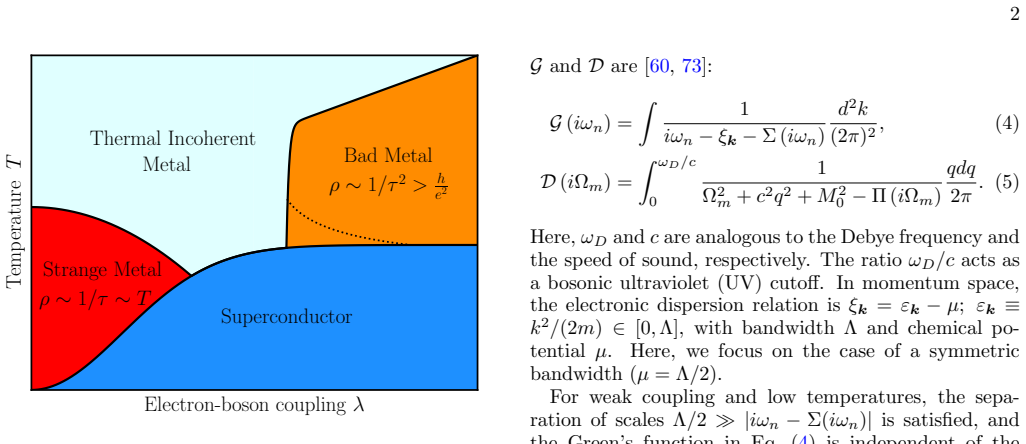
Linear magnetoresistance (LMR) is a widespread phenomenon observed in a host of quantum materials ranging from semiconductor nanostructures to quantum critical and strange metals. While multiple scenarios to explain LMR have been proposed, a complete understanding of the phenomenon remains elusive. Indeed, it is highly likely that the origin of LMR depends on the specific electronic state. Here, we report a study of the impact of disorder on the form of the magnetoresistance of the prototypical charge-density-wave (CDW) compound 2$H$-NbSe$_2$. The magnetoresistance is shown to exhibit strong qualitative and quantitative agreement with Boltzmann transport analysis incorporating impeded cyclotron motion (ICM). We identify the source of ICM in 2$H$-NbSe$_2$ as strong scattering sinks where the CDW order connects the high temperature Fermi cylinders. Such unusual "hotspots" provide an explanation for the observed LMR as well as for the long-unexplained absence of quantum oscillations inside the charge ordered state in 2$H$-NbSe$_2$. These findings provide strong evidence that ICM generates LMR in certain correlated metals.
We report a comprehensive investigation of the structural and magnetic properties of Na$_5$Yb(MoO$_4$)$_4$, a member of the stretched diamond magnetic lattice family. Neutron powder diffraction at 3.3~K confirms that the compound crystallizes in the tetragonal \textit{I4$_1$/a} space group, with a large interatomic separation of 6.33~\AA{} between magnetic Yb ions forming a three-dimensional stretched diamond framework. Magnetic susceptibility and specific heat measurements reveal no evidence of long-range magnetic order down to 60~mK. The low-temperature magnetic behavior is governed by an effective $J_{\mathrm{eff}} = 1/2$ Kramers doublet ground state, well separated from excited crystal-field levels, arising from the distorted dodecahedral oxygen coordination of Yb$^{3+}$. Density functional theory calculations within the DFT+$U$ framework indicate that exchange interactions between Yb ions are negligibly small, consistent with the long O--Mo--O super-superexchange pathways. The temperature dependence of the specific heat exhibits signatures of gapped spin excitations, most likely originating from long-range dipolar correlations and further shaped by weak exchange interactions together with the strong single-ion anisotropy of the Yb moments. Muon spin relaxation measurements reveal persistent low-energy spin dynamics, indicating that dipolar correlations remain dynamic and are insufficient to stabilize static magnetic order down to 50~mK. These results identify Na$_5$Yb(MoO$_4$)$_4$ as a rare example of a dipolar quantum paramagnet in which single-ion physics and long-range dipolar interactions dominate, while exchange interactions are suppressed to the millikelvin energy scale.
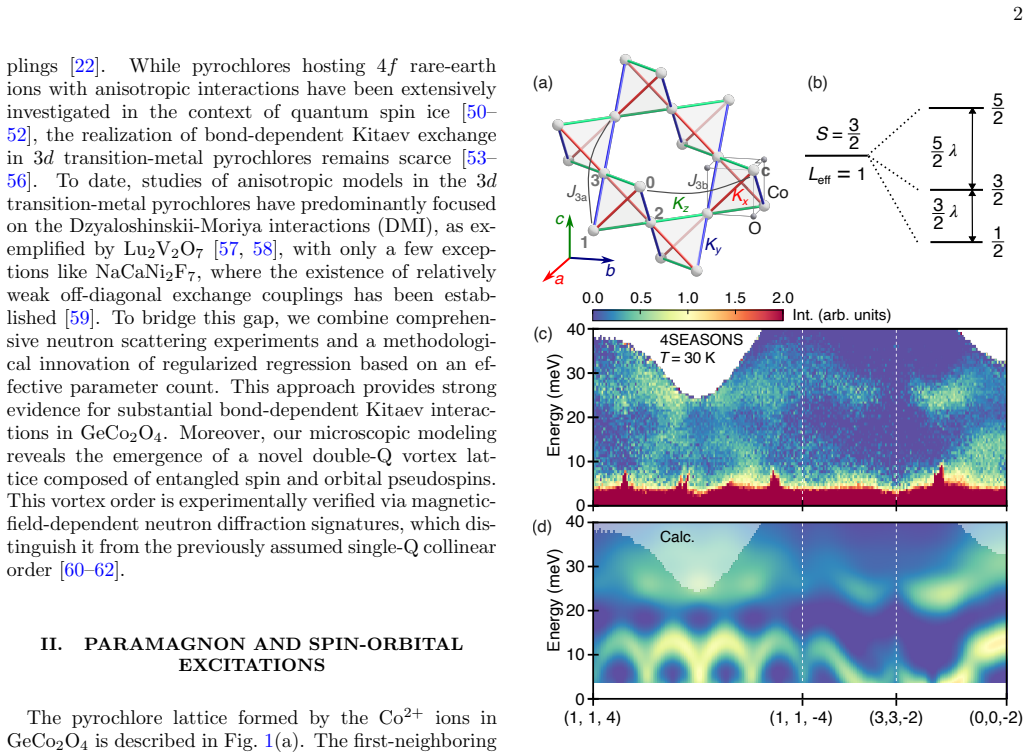
Entangled spin and orbital degrees of freedom provide a multiflavor route to novel magnetic states inaccessible in conventional spin systems. Here, we report the experimental identification of an emergent vortex lattice in the multiflavor pyrochlore-lattice compound GeCo$_2$O$_4$. By combining comprehensive neutron scattering experiments with a regularized regression framework, we identify substantial Kitaev interactions among the nearest-neighboring Co$^{2+}$ pseudospins, which cooperate with geometric frustration to stabilize the vortex order. These results reveal an unexpected route to vortex-lattice order in a three-dimensional Kitaev-frustrated magnet and demonstrate a regularized protocol for Hamiltonian determination in frustrated quantum materials.
We report on the finite temperature staggered spin susceptibility $\chi(Q)$ as a function of the mode-mode coupling constant $y_1$ in the self-consistent renormalization theory of two-dimensional antiferromagnetic spin fluctuations with zero-point quantum fluctuations just at the quantum critical point ($y_0$ = 0). We find that the value $y_1$ = 0.1 is a criterion to classify the effect of the zero-point spin fluctuations on the temperature dependence of $\chi(Q)$ into a Curie law for weak $y_1 < $ 0.1 and a Curie-Weiss type or a power law type for strong $y_1 > $ 0.1.
We investigate the connection between doping-induced in-gap states and underlying spin excitations in Mott insulators by employing cluster perturbation theory on one-dimensional (1D) and quasi-1D Kitaev-Hubbard models. By manipulating Kitaev-like hopping terms ($t^{\prime}$) that selectively control spin anisotropies in the strong-coupling limit, we establish a direct correspondence between the kinetic dispersion of the in-gap states and the spin excitation spectra. Specifically, in the Z chain, in-gap states evolve from a gapless dispersion to a gapped flat band as the system transitions from the Heisenberg to the Ising model, exhibiting a gap scaling of $2t^{\prime 2}/U$ that matches the Ising spin gap. In the XY chain, the in-gap states split into a dispersive and a flat branch at the Kitaev limit, perfectly mirroring the Jordan-Wigner fermionic spectrum. For the two-leg ladder, we observe an emergent broad continuum of in-gap states that reflects the fractionalization of spin excitations, accompanied by a gap manifesting the presence of topological $Z_2$ visons. Our results establish a robust correspondence between charge and spin dynamics in doped Mott insulators and demonstrate that in-gap states can serve as a probe of exotic quantum spin phenomena, including fractionalization and topological excitations, offering a new pathway to investigate spin liquids via spectroscopic probes of charge excitations.
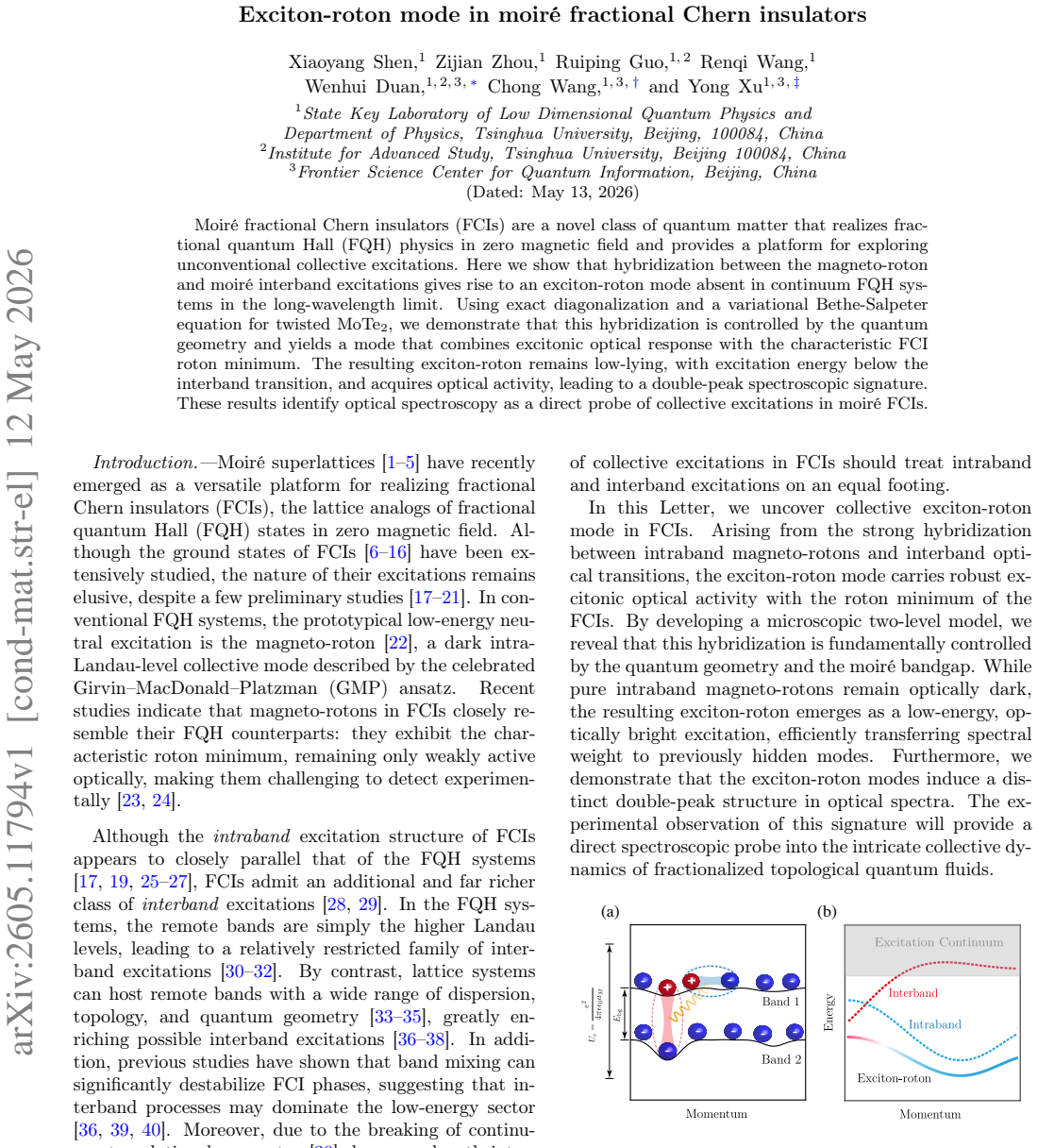
Moir\'e fractional Chern insulators (FCIs) are a novel class of quantum matter that realizes fractional quantum Hall (FQH) physics in zero magnetic field and provides a platform for exploring unconventional collective excitations. Here we show that hybridization between the magneto-roton and moir\'e interband excitations gives rise to an exciton-roton mode absent in continuum FQH systems in the long-wavelength limit. Using exact diagonalization and a variational Bethe-Salpeter equation for twisted MoTe$_2$, we demonstrate that this hybridization is controlled by the quantum geometry and yields a mode that combines excitonic optical response with the characteristic FCI roton minimum. The resulting exciton-roton remains low-lying, with excitation energy below the interband transition, and acquires optical activity, leading to a double-peak spectroscopic signature. These results identify optical spectroscopy as a direct probe of collective excitations in moir\'e FCIs.
Exact diagonalization (ED) is a workhorse technique in computational quantum many-body physics, but published ED results are rarely accompanied by machine-checkable evidence of their numerical correctness. The community typically relies on the implicit trust chain LAPACK $\to$ user code $\to$ result, with at most informal agreement against another package treated as confirmation. We argue that this practice is inadequate for a method whose output frequently underpins theoretical claims, and we present \textsc{certify-ed}, a verification framework designed to be used \emph{alongside} existing ED packages (QuSpin, XDiag, ALPS) rather than as a replacement for them. The framework consists of (i) a multi-oracle eigensolver that runs three independent LAPACK paths and reports their pairwise disagreement, (ii) thirteen logically independent validation layers covering algebraic invariants, analytic limits, alternative algorithms, arbitrary-precision reference computation, conservation laws, dynamical consistency, and finite-size scaling, and (iii) tamper-evident SHA-256 hashed certificates that downstream consumers can verify. The framework also ships an error-injection layer that confirms the entire pipeline detects six injected error classes. Running on sixteen physics models from one-dimensional spin chains to two-dimensional Kitaev honeycomb clusters, our reference implementation passes 53 of 53 unit tests and 81 of 81 individual validation tests in under thirty seconds, with maximum disagreement against QuSpin of $1.6\times 10^{-14}$ across 320 eigenvalue comparisons, and agreement with 50-digit \texttt{mpmath} reference values to $1.6\times 10^{-15}$. The package is released under the MIT license on Zenodo and Github
By means of slave-boson theory for the Hubbard model on the checkerboard lattice, we calculate dynamical altermagnetic spin susceptibilities from the metallic to the Mott-insulating regime. We track magnon dispersion and lifetime renormalization, allowing us to uncover a crossover from a chirality-selective dissipation of magnon modes to coherent yet strongly deformed chiral magnon branches across the metal insulator transition. Our formalism lends itself to a quantitative description of collective spin dynamics in correlated altermagnets.
Bond and angle compression strengthens 5d-3d exchange while rock-salt order prevents frustration.
abstractclick to expand
Understanding and predicting the properties of 5d compounds critically depend on the identification of the superexchange interactions from which their magnetism emerges. The study of pressure effects on double perovskites Y2NiIrO6 (YNIO) provide deep insight toward this goal. At ambient pressure, YNIO is a ferrimagnetic insulator with the Ir4+-5d Jeff = 1/2 Mott-insulating state. Under the physical pressure up to 17 GPa, the compound exhibits concurrent compression on Ni/Ir-O bond lengths and Ni-O-Ir bond angles, leading to increase of the Curie temperature from 192 to 240 K. In contrary, external pressure increases distanced Ir-Ir interaction and in turn induces magnetic frustration in Sr2IrO4/Sr3Ir2O7 due to the extended 5d orbitals. In YNIO, the rock-salt ordered Ni-Ir naturally blocks extended superexchange beyond the nearest neighbor, and in turn suppresses such magnetic frustration. Moreover, the orthogonal Ni eg-Ir t2g pathway in YNIO is robust under lattice distortion, while the superexchange is weakened by bond bending in La2NiMnO6 with a similar half-filed eg-t2g configuration. Our findings establish a framework for elucidating the mechanism of 5d-3d superexchange and guides bond-engineered magnetism in iridate-related systems.
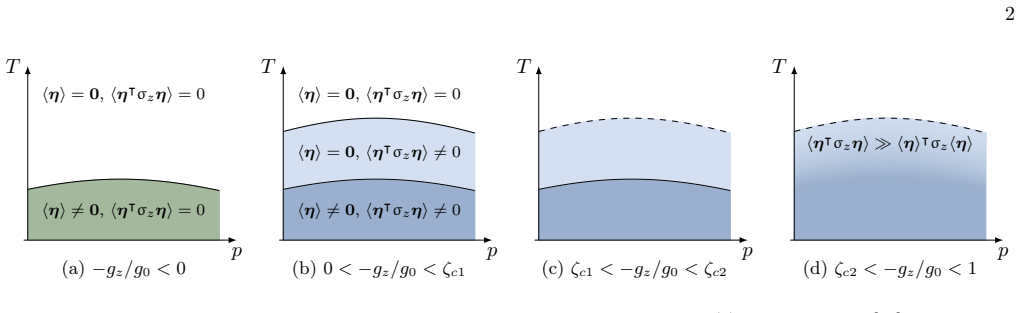
When a primary order breaks multiple symmetries, partially ordered phases that only break a subset of those symmetries, known as vestigial phases, may onset at a higher temperature. This concept has been applied to a wide range of systems, including iron pnictides, cuprates, van der Waals antiferromagnets, doped topological insulators, and twisted bilayer graphene. In general, a multi-component primary order parameter (OP) supports multiple vestigial channels, each described by a quadratic (or higher-order) composite OP. However, the standard large-$N$ approach to the Ginzburg-Landau action of the primary OP has an intrinsic ambiguity in how one decouples the composite OPs, leading to situations in which one can seemingly enhance or eliminate altogether any vestigial instability. Here, we show that this ambiguity is a direct consequence of redundancy relations, such as Fierz identities, that relate different composite OPs, reflecting the fact that different vestigial channels interfere with each other and thus cannot be treated separately. To resolve this ambiguity, we propose an unbiased large-$N$ approach that respects both the redundancy relations and the underlying symmetry-group structure, and that gives unique values for the effective interactions of all vestigial channels. Our analysis reveals the generic existence of regions in the parameter space of quartic Landau coefficients where no vestigial order is stable, in contrast to the standard large-$N$ approach, but in agreement with weak-coupling and variational approaches. We illustrate our results by analyzing the vestigial orders of charge-density waves, spin-density waves, and multi-component superconductors in tetragonal, hexagonal, and cubic systems, respectively, revealing the presence of exotic vestigial phases describing spin-quadrupolar, charge-$4e$ superconducting, and altermagnetic orders.
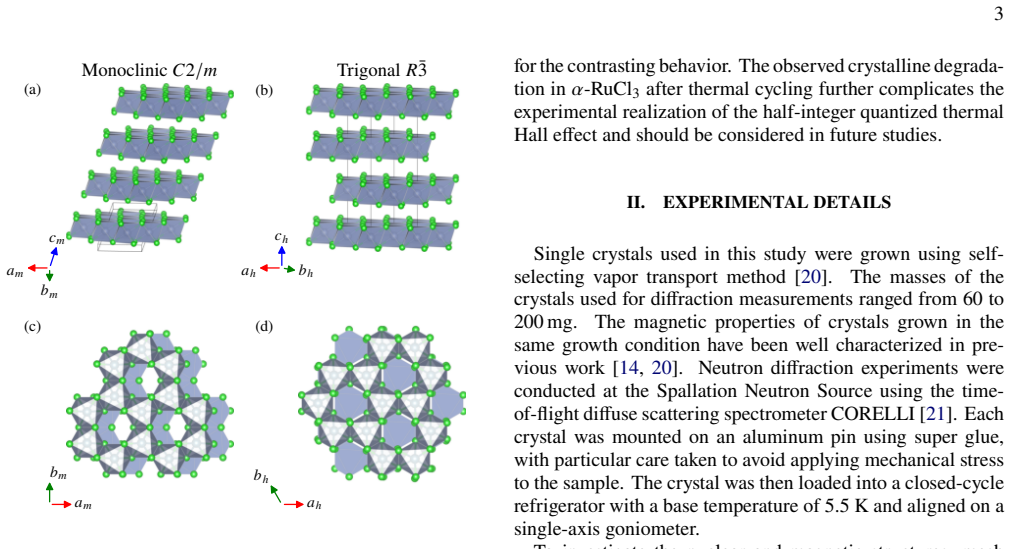
We report a comparative neutron single crystal diffraction study of the structural and magnetic properties of layered halides CrCl$_3$ and $\alpha$-RuCl$_3$, which host a honeycomb arrangement of transition metal ions with distinct electronic configurations and undergo a first-order structural transition between high-temperature \textit{C}2/\textit{m} and low-temperature \textit{R}$\bar{3}$. Both compounds show a step-like change in the $c$-lattice, consistent with an expected stacking rearrangement. In contrast, the in-plane lattice response is quite different: $\alpha$-RuCl$_3$ exhibits an abrupt hysteretic change across the transition accompanied by progressive crystalline degradation upon thermal cycling, whereas CrCl$_3$ shows a smooth in-plane lattice evolution and remains structurally robust. Magnetically, CrCl$_3$ orders into an A-type antiferromagnetic structure at T$_N$=14\,K and exhibits pronounced diffuse magnetic scattering extending up to about 40\,K. $\alpha$-RuCl$_3$ shows no observable magnetic diffuse scattering above its zig-zag antiferromagnetic ordering temperature T$_N$=7.6\,K. These results suggest that the contrasting structural and magnetic behaviors arise from an interplay between interlayer sliding energetics and the fundamentally different electronic configurations of the two compounds.
We investigate two-dimensional Dirac fermions embedded in a deep-subwavelength cavity formed by high-impedance metasurfaces. We point out that, unlike conventional metallic boundaries, these metasurfaces support quasielectrostatic transverse-magnetic modes that mediate a long-range interaction between two-dimensional electrons. Combining static electronic screening with a Dyson-Schwinger analysis, we show that this engineered interaction can qualitatively alter the ground-state properties of Dirac materials. For a fermion flavor number $N_{f}$ below a critical value $N_{c}=16/\pi$, the interaction drives an excitonic insulating phase through an infinite-order quantum phase transition and spontaneously generates a mass gap. At $N_{f}>N_{c}$, the system remains gapless but enters a non-Fermi-liquid critical regime where the quasiparticle residue is singularly suppressed to zero, and the Dirac cone exhibits a nonanalytic dispersion relation. Furthermore, under a perpendicular magnetic field, the cavity fluctuations dynamically lift the zeroth Landau level degeneracy across all $N_{f}$. These results identify high-impedance metasurface cavities as promising platforms for engineering correlated Dirac matter.
Chern-Simons theory derives a non-analytic term in the free energy that produces B-H hysteresis without domain walls.
abstractclick to expand
The log H term is derived in the free energy of many-electron system from Chern-Simons gauge theory. Owing to the singularity at $H=0$, this leads the first order transition and B-H hysteresis to many-electron systems of symmetric and single domain. This has the origin in quantum mechanics and is irrelevant to non-invertible motions of domains. This transition appears in single and symmetric domain.
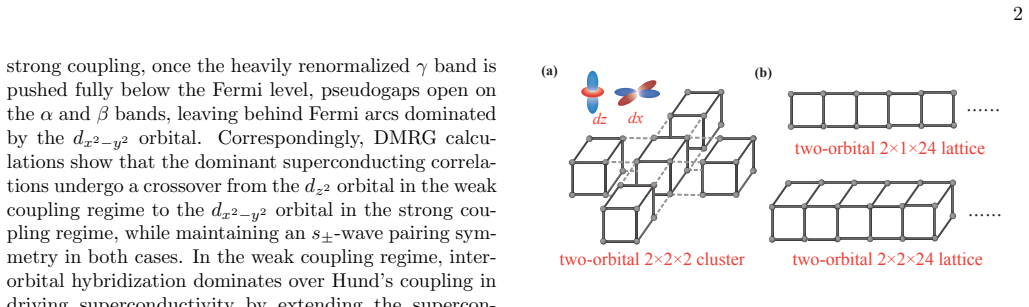
Recent angle-resolved photoemission measurements on La$_3$Ni$_2$O$_7$ have challenged the density-functional-theory-based picture of three Fermi surfaces by revealing that the $d_{z^2}$-derived $\gamma$ band can reside below the Fermi level. Motivated by this discrepancy, we investigate a realistic bilayer two-orbital Hubbard model using time-dependent variational principle (TDVP)-based cluster perturbation theory (CPT), alongside large-scale density matrix renormalization group (DMRG) calculations. Our TDVP-CPT calculations, performed on clusters of up to 16 physical sites, reveal that electronic correlations drive a pronounced orbital-selective reconstruction of the low-energy spectrum: the $d_{z^2}$ spectral weight is progressively depleted, the $\gamma$ band sinks below the Fermi level, and pseudogaps open on the remaining $\alpha$ and $\beta$ bands, leaving Fermi arcs dominated by the $d_{x^2-y^2}$ orbital at strong coupling. Furthermore, large-scale DMRG calculations demonstrate that the leading superconducting correlations evolve consistently with this Fermi surface reconstruction, transitioning from $d_{z^2}$-dominated to $d_{x^2-y^2}$-dominated interlayer spin-singlet pairing while retaining an $s_{\pm}$ structure. Consequently, our results indicate that the disappearance of the $\gamma$ pocket is not detrimental to superconductivity; rather, it signals a correlation-driven shift of the pairing channel mediated by interlayer antiferromagnetism, Hund's coupling, and inter-orbital hybridization.
Contraction along the c axis in the gallium compound strengthens magnetic exchange relative to the germanium version.
abstractclick to expand
High-quality single crystals of the two-dimensional van der Waals ferromagnet Fe$_3$GaTe$_2$ (FGaT) were successfully grown using the chemical vapour transport method, which effectively reduced surface impurities compared with conventional self-flux growth. Structural and magnetic characterizations were performed using single-crystal X-ray and neutron diffraction. The results confirm that FGaT crystallizes in the hexagonal $P6_3/mmc$ structure, with Fe occupying two inequivalent sites (Fe$^{i}$ and Fe$^{ii}$), where the magnetic moment of Fe$^{i}$ [1.9(2) $\mu_B$] is larger than that of Fe$^{ii}$ [1.4(6) $\mu_B$]. The magnetic easy axis is oriented along the $c$ axis and the Curie temperature ($T_C$) is approximately 355-360 K. Compared with Fe$_3$GeTe$_2$ (FGT), FGaT exhibits a slightly expanded $a$ axis and a contracted $c$ axis, resulting in a reduction in the Fe$^{i}$-Fe$^{ii}$ interatomic distance along the $c$ axis. This pronounced contraction could strengthen the Fe$-$Fe exchange interaction, which is believed to be the key factor responsible for the significantly higher $T_C$ in FGaT relative to FGT.
We propose a three-dimensional multi-orbital tight-binding model for rare-earth nickelates RNiO$_3$ that treats charge, spin, orbital, and lattice degrees of freedom on equal footing. All model parameters, including the on-site interactions $U$ and $J$ and the electron-phonon (el-ph) coupling to the breathing mode, are extracted from hybrid-functional DFT calculations for the small-bandwidth nickelate LuNiO$_3$. The model describes three competing insulating phases governed by the interplay of $U{-}3J$ and el-ph coupling to the breathing and Jahn--Teller (JT) modes. For large $U{-}3J$, the insulating state is stabilized by local JT distortions on high-spin Ni$^{3+}$ sites. For smaller $U{-}3J$, the system undergoes charge disproportionation, $2\mathrm{Ni}^{3+}\rightarrow\mathrm{Ni}^{2+}+\mathrm{Ni}^{4+}$, resulting in the spin-polarized charge-ordered state observed experimentally below the N\'eel temperature in small-bandwidth RNiO$_3$. When the JT energy on the Ni$^{2+}$ site exceeds Hund's exchange $3J$, a distinct charge- and orbital-ordered insulating phase emerges in which the two $e_g$-electrons occupy the same orbital with opposite spin. The stability of this phase is further confirmed by self-consistent calculations within the full three-dimensional tight-binding model. This newly predicted metastable state, characterized by JT distortions in a nonmagnetic charge-ordered RNiO$_3$ phase, shows that the onset of magnetic order is not required for the metal-insulator transition in RNiO$_3$.
Spin-charge separation is a hallmark of one-dimensional fermionic systems, yet its realization in higher dimensions remains an open question. To address this issue, we investigate a two-leg t-J ladder using the density matrix renormalization group (DMRG) method and its time-dependent extension. By analyzing ground-state correlations and single-particle removal spectra, we systematically examine the effects of plaquette diagonal hopping, spin exchange, and hole doping. Within appropriate parameter regimes, these factors drive the system from the well-known Luther Emery phase, with gapped spin and gapless charge modes, into a Luttinger liquid phase characterized by gapless spin and charge excitations, where signatures of spin-charge separation emerge. In combination with previous studies using exact diagonalization, our results provide evidence that spin-charge separation may persist in wider ladder systems.
The topological degeneracy is a characteristic of quantum phase diagram in an Ising chain with transverse field. We revisit the phase diagram at nonzero temperature of an Ising chain with two types of open boundary conditions. In this work, we focus on an alternative boundary condition that not only removes the coupling between the two end sites but also eliminates the transverse field on them. We show that such a system can be exactly mapped onto two independent Kitaev chains, where spinless fermions correspond to domain-wall excitations. This results in a switch in the existence of the topological Kramers-like degeneracy in the phase diagram. The underlying mechanism is analyzed within the Majorana representation, which indicates that such a switch arises from the gauge dependence of the winding number in an SSH chain. The manifestation of bulk-boundary correspondence at nonzero temperature is demonstrated by numerical simulations on finite-size systems. This finding provides insight into the quantum spin chain.
Unconventional magnetism represents a class of metallic states whose Fermi surfaces exhibit spin-dependent splittings under the non-trivial representations of the rotation group. The $d$-wave $\alpha$-phase unconventional magnetic state, commonly known as altermagnet, recently, has attracted significant attention. While these systems exhibit distinct anisotropic $d$-wave characteristics in momentum space, how this microscopic topology translates into the spin distributions in real space remains a question. In this work, we bridge the intrinsic spin quadrupolar ordering in momentum space to the real-space staggered magnetic distribution. By introducing a weak, non-magnetic periodic crystal potential into a $d$-wave unconventional magnetic state, the spin-charge cross susceptibility is calculated by using the linear response theory. We reveal that the interplay between the crystal potential and the intrinsic $d$-wave spin-splitting naturally induces a spatial spin quadrupole distribution without enlarging the unit cell. Our study thus provides a physical connection between momentum-space multipoles in the even partial wave channel and real-space spin multipole orders.
We develop a microscopic theory for how slow Liouvillian sectors are selected in an open correlated lattice. The starting point is not a postulated non-Hermitian band, but a local interacting resonance between an on-site doublon and a branch-resolved nearest-neighbor bond. This resonance defines a composite shell orbital whose doublon weight controls reservoir visibility and whose mixed doublon-bond character controls shell mobility. Projecting the microscopic hopping onto the selected shell yields a branch-selective dimerized channel. In the dilute regime, a boundary doublon-loss channel yields an exponentially slow edge-memory pole through a Zeno-type return. At the shell-critical point, the edge pole is replaced by a near-zero standing-wave doublet with an algebraic coherent spacing. At finite shell filling, the same local shell becomes density dressed. A number-conserving phase-locking jump removes a bright mismatch sector, leaving defects as the asymptotic slow variables and producing a diffusive finite-size gap. We derive the local shell, the projected branch topology, the edge-memory law, the shell-critical doublet, the density-dressed shell Hamiltonian, and the defect generator within one Schur-projection framework. The resulting mechanism identifies the reservoir-engineered fast block as the selector of the observable slow sector, while the microscopic parent shell remains fixed.
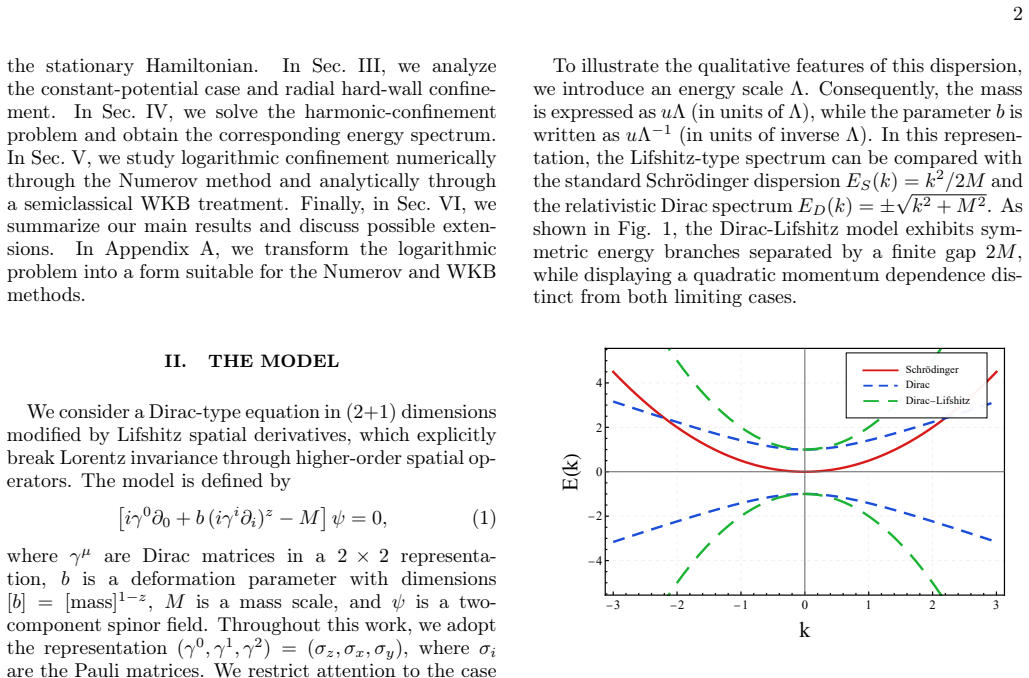
We investigate a Dirac-type equation in (2+1) dimensions modified by Lifshitz spatial derivatives with dynamical exponent $z=2$, focusing on the spectral properties of bound states under radial confinement. Analytical solutions are obtained for constant backgrounds, hard-wall confinement, and harmonic potentials, while logarithmic confinement is treated numerically via the Numerov method and complemented by a semiclassical WKB analysis. The resulting spectra exhibit characteristic scaling laws governed by the Lifshitz parameter $b$, including $E - M \propto b/R_0^2$ for hard-wall confinement, $E - M \propto \sqrt{2b}\,\omega$ for harmonic trapping, and $E - M \sim \alpha \ln\sqrt{b}$ in the semiclassical regime of logarithmic confinement. These results provide a consistent characterization of how higher-order spatial derivatives modify bound-state spectra in two-dimensional Dirac systems and may be relevant for effective descriptions of materials with quadratic low-energy dispersion, such as bilayer graphene and related anisotropic 2D systems.
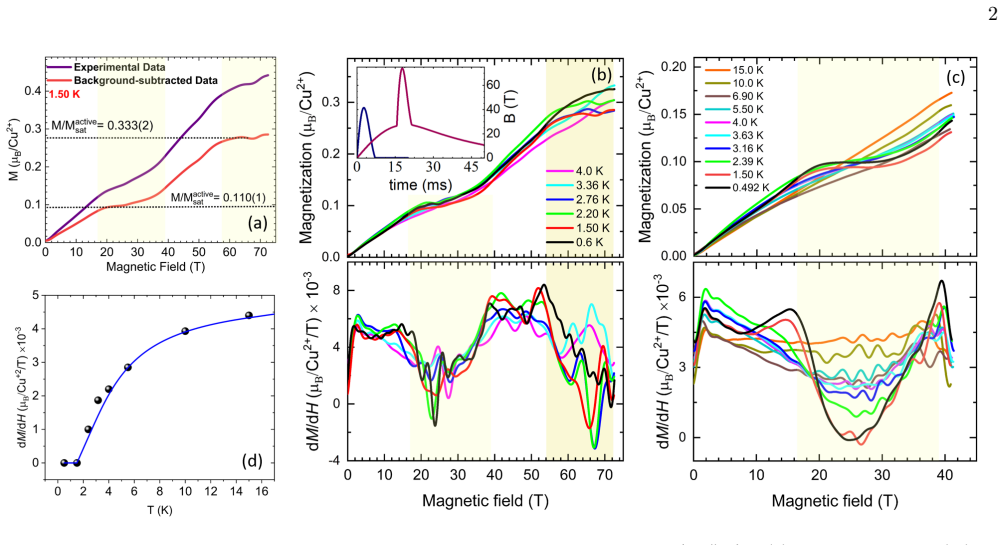
Fractional magnetization plateaus provide a sensitive probe of many-body spin states in frustrated quantum magnets, yet their microscopic origin in kagome antiferromagnets remains unresolved. This is particularly true of the mysterious $1/9$ plateau, which is predicted by theory but infrequently observed in experiment. Here, we investigate this problem in the $S = 1/2$ anisotropic kagome antiferromagnet Y-kapellasite, Y$_3$Cu$_9$(OH)$_{19}$Cl$_8$, using pulsed-field magnetization measurements on single crystals and high-field $^{35}$Cl NMR. We identify a hierarchy of field-induced fractional features, including $1/3$ and $1/9$ plateaus, as well as a weaker low-field feature. Analysis of the NMR spectra and the magnetic susceptibility across the $1/9$ plateau demonstrate that it is accompanied by an ordered local spin configuration, a strong suppression of low-energy spin fluctuations and activated behavior, consistent with a gapped fractional state. These features differ from those in the only other material YCu$_3$(OH)$_6$Br$_2$[Br$_{1-y}$(OH)$_y$] in which this plateau is observed, implying a surprising robustness of the $1/9$ state to the details of the underlying magnetism.
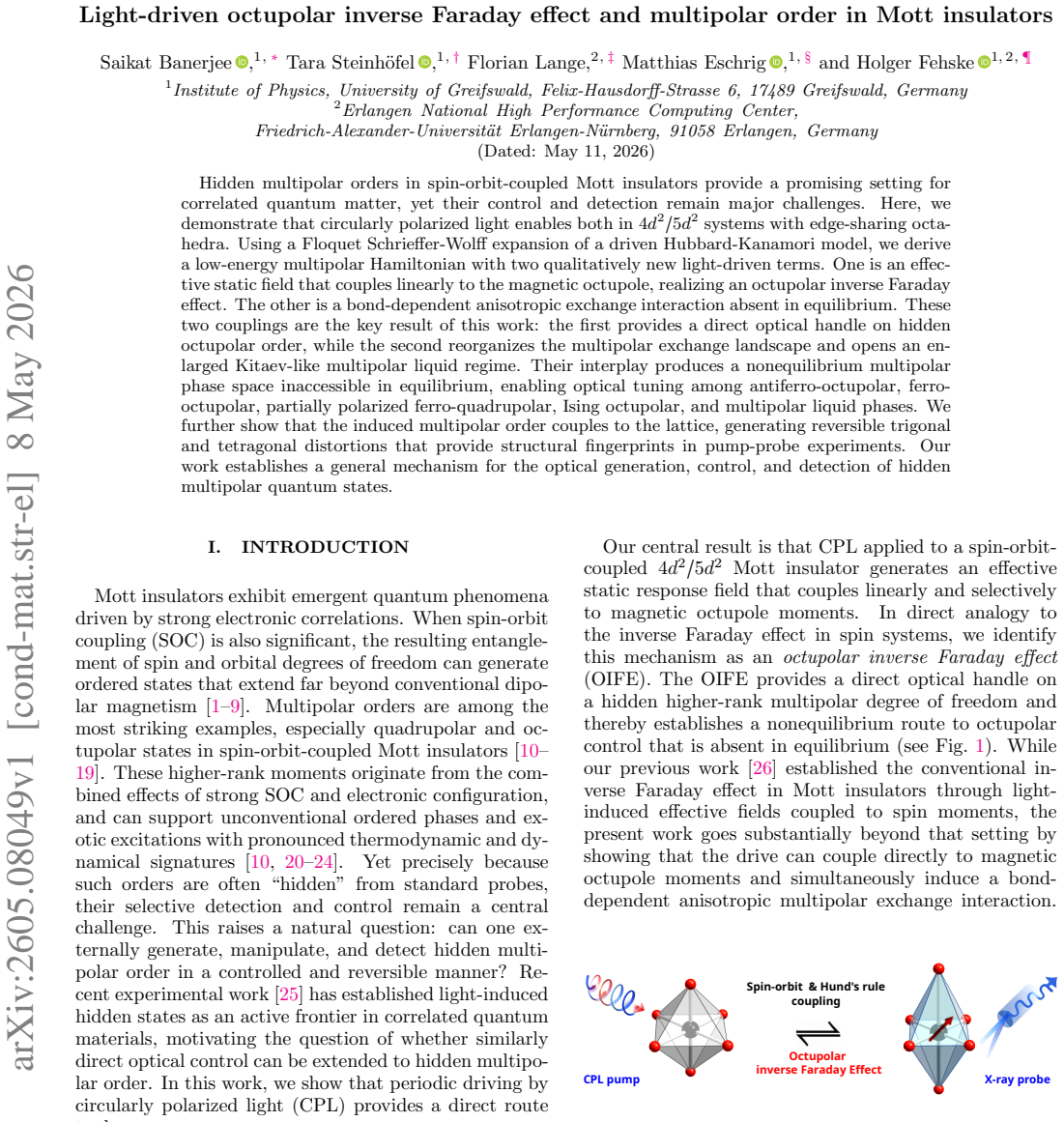
Hidden multipolar orders in spin-orbit-coupled Mott insulators provide a promising setting for correlated quantum matter, yet their control and detection remain major challenges. Here, we demonstrate that circularly polarized light enables both in $4d^2/5d^2$ systems with edge-sharing octahedra. Using a Floquet Schrieffer-Wolff expansion of a driven Hubbard-Kanamori model, we derive a low-energy multipolar Hamiltonian with two qualitatively new light-driven terms. One is an effective static field that couples linearly to the magnetic octupole, realizing an octupolar inverse Faraday effect. The other is a bond-dependent anisotropic exchange interaction absent in equilibrium. These two couplings are the key result of this work: the first provides a direct optical handle on hidden octupolar order, while the second reorganizes the multipolar exchange landscape and opens an enlarged Kitaev-like multipolar liquid regime. Their interplay produces a nonequilibrium multipolar phase space inaccessible in equilibrium, enabling optical tuning among antiferro-octupolar, ferro-octupolar, partially polarized ferro-quadrupolar, Ising octupolar, and multipolar liquid phases. We further show that the induced multipolar order couples to the lattice, generating reversible trigonal and tetragonal distortions that provide structural fingerprints in pump-probe experiments. Our work establishes a general mechanism for the optical generation, control, and detection of hidden multipolar quantum states.
We report a comprehensive NMR study of the chiral square-cupola antiferromagnet Pb(TiO)Cu$_4$(PO$_4$)$_4$ and compare its microscopic hyperfine and local-field parameters with the Ba/Sr analogues in the $A$(TiO)Cu$_4$(PO$_4$)$_4$ family. Above $T_{\rm N}\simeq 6.7$ K, the $^{31}$P Knight shift tracks the bulk susceptibility and yields nearly isotropic transferred hyperfine couplings $H_{\rm hf}^{[010]}=6.77(3)$ and $H_{\rm hf}^{[001]}=6.19(3)$ kOe/$\mu_{\rm B}$. Below $T_{\rm N}$, the frequency-swept $^{31}$P spectrum splits into three lines, in contrast to the four-line pattern reported for BaTCPO. The line separation tracks the onset of the static $^{31}$P internal field with a power-law exponent $\beta\simeq 0.23$, consistent with quasi-two-dimensional criticality. Crystal-rotation $^{31}$P NMR in the ordered state resolves all eight symmetry-related P sites and their site-dependent anisotropy. In the ordered state, zero-field $^{63,65}$Cu NMR gives a Cu-site internal field $B_{\rm int}=14.50(6)$ T and a quadrupole frequency $\nu_Q=32.72(5)$ MHz, while point-charge electric-field-gradient calculations including Sternheimer corrections yield an on-site Cu hole occupancy $n_d=0.20(4)$, consistent with a ligand-hole-dominated charge-transfer character. Comparing PbTCPO with BaTCPO and SrTCPO, we find that the transferred hyperfine coupling $H_{\rm hf}$ varies across the series, reflecting changes in local Cu-O-P covalency, whereas the ordered-state $^{31}$P internal field in PbTCPO is $69.5$ mT, considerably higher than in BaTCPO ($35.6$ mT) and SrTCPO ($34.6$ mT). This enhancement is not captured by dipolar terms alone and points to the combined effects of transferred contributions and stacking-dependent cancellation.
Parafermions with non-Abelian statistics have been proposed as a promising platform for quantum computation, potentially enabling a broader set of topologically protected gates than Majorana fermions. The experimental and theoretical exploration of these exotic quasiparticles remains challenging, as their stability is linked to strong electron-electron interactions. A key step toward practical applications is the controlled shuttling of parafermionic modes, which is required for implementing geometric braiding operations. In the present work, we investigate the real-time dynamics of the elementary shuttling process by applying a combination of the density matrix renormalization group and the time-dependent variational principle approaches. We analyze the transport of $\mathbb{Z}_4$ parafermion edge states and assess the corresponding adiabatic speed limit under experimentally relevant conditions.
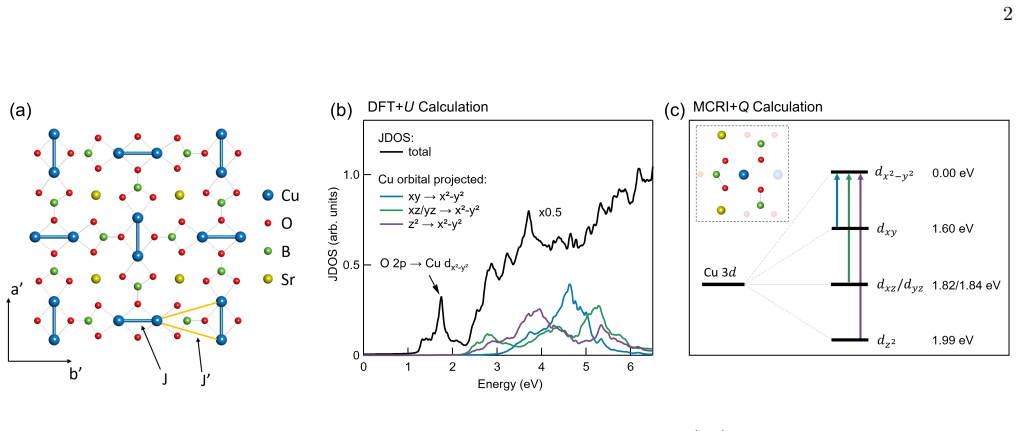
SrCu2(BO3)2 (SCBO) is a paradigmatic realization of the Shastry-Sutherland model, hosting geometrically frustrated spin dimers and a variety of quantum magnetic phases and phenomena. Although its magnetic properties have been extensively studied, the high-energy electronic excitations that determine the crystal-field environment and Cu-O hybridization have remained largely unexplored. Here we combine Cu L3-edge resonant inelastic x-ray scattering (RIXS), broadband optical spectroscopy, and electronic-structure calculations to determine the relevant local and interband excitation energy scales in SCBO. RIXS resolves a well-defined manifold of localized Cu2+ d-d excitations between 1.8 and 2.4 eV, whose energies and polarization dependence are well reproduced by multireference quantum-chemistry calculations. In contrast, optical spectroscopy identifies charge-transfer excitations with an absorption onset near 1.2-1.6 eV and a broader higher-energy structure around 4.5 eV, which are qualitatively captured by DFT+U calculations. Taken together, these results define the characteristic energy scales of d-d and CT excitations, offering quantitative benchmarks for computational frameworks and providing essential input for refining superexchange-based magnetic models of this prototypical frustrated quantum antiferromagnet.
While deep learning offers powerful capabilities for scientific research, its application is often hindered by a lack of quantitative reliability. To address this, we introduce a probabilistic denoising framework that simultaneously extracts denoised signals and element-wise predictive uncertainties from noisy data. We demonstrate this approach on three-dimensional angle-resolved photoemission spectroscopy data, showing that the model reliably recovers the spectral features of a cuprate superconductor from Poisson-distributed noise with an average count of only 0.02 electrons per voxel. Crucially, we show that these predicted uncertainties can be propagated into subsequent superconducting gap analyses, enabling quantitative parameter extraction with scientifically meaningful error bars. Furthermore, we validate the broad applicability of our approach by successfully extending it to two-dimensional X-ray diffraction data. Ultimately, this approach establishes uncertainty-aware deep learning not merely as a visualization tool, but as a rigorous framework for scientific data analysis.
The Emery model is the quintessential model for cuprate superconductors. In his eponymous paper, Emery only considered the next-nearest-neighbor oxygen-copper hopping. Later, also the relevance of nearest- and next-nearest oxygen-oxygen hoppings has been pointed out. Using dynamical vertex approximation, we find a superconducting dome consistent with cuprates. However, long-range hoppings beyond the three conventional hopping parameters are necessary for the quantitatively correct phase diagram and for a proper d-wave order parameter.
We report numerical ground states for the dipolar XY spin model, which describes extended antiferromagnetic interactions in two-dimensional arrays of polar molecules and two-level Rydberg atoms. Carrying out large-scale density matrix renormalization group (DMRG) calculations, we compute ground state properties on nine of the eleven Archimedean lattices--tilings of the plane by regular polygons. Four of these host trivial paramagnets, while another four develop collinear Neel magnetic order, as was found previously for the square lattice. For the ordered states, we calculate the hydrodynamic parameters (magnetization, susceptibility, and stiffness) and compare to linear spin wave theory. We also investigate the triangular lattice, for which we find several competing phases including coplanar magnetism, stripe density wave order, and a possible spin liquid; their relative stability is sensitive to the long-range couplings present in our dipolar model. Finally, the Archimedean classification is completed by the kagome lattice, which we argue in a companion work is likely to be a Dirac spin liquid.
Muon measurements show persistent quantum fluctuations in this 3D mixed-metal oxide despite strong antiferromagnetic couplings.
abstractclick to expand
Quantum-disordered magnetic ground states are challenging to identify in three-dimensional (3D) oxides, where strong exchange pathways typically favour long-range magnetic order or spin freezing. The quadruple perovskite $\mathrm{CaCu_3Ir_4O_{12}}$, crystallizing in the cubic $Im\bar{3}$ structure, provides a 3D lattice where $\mathrm{Cu^{2+}}$ $3d$ moments are coupled to an extended Ir $5d$ network, offering a rare platform for probing quantum-disordered magnetism in a mixed $3d/5d$ electron system. Here, we combine bulk probes, including DC and AC magnetic susceptibility, and heat capacity measurements (down to $50~\mathrm{mK}$), along with the local microscopic probe muon spin relaxation ($\mu$SR) (down to $40~\mathrm{mK}$), to investigate the true magnetic ground state of $\mathrm{CaCu_3Ir_4O_{12}}$. Despite strong antiferromagnetic interactions ($\theta_{\mathrm{W}} \sim -200~\mathrm{K}$, with an applied-field dependence), no signature of long-range magnetic ordering or spin freezing is detected down to the lowest measured temperatures. Furthermore, our in-depth zero-field (ZF) and longitudinal-field (LF) $\mu$SR characterizations confirm strong quantum spin fluctuations and the truly dynamic nature of the local moments down to $40~\mathrm{mK}$. These results establish $\mathrm{CaCu_3Ir_4O_{12}}$ as a promising 3D quantum-disordered magnet and a well-characterized platform for exploring fluctuation-dominated states in correlated $3d/5d$ oxides.
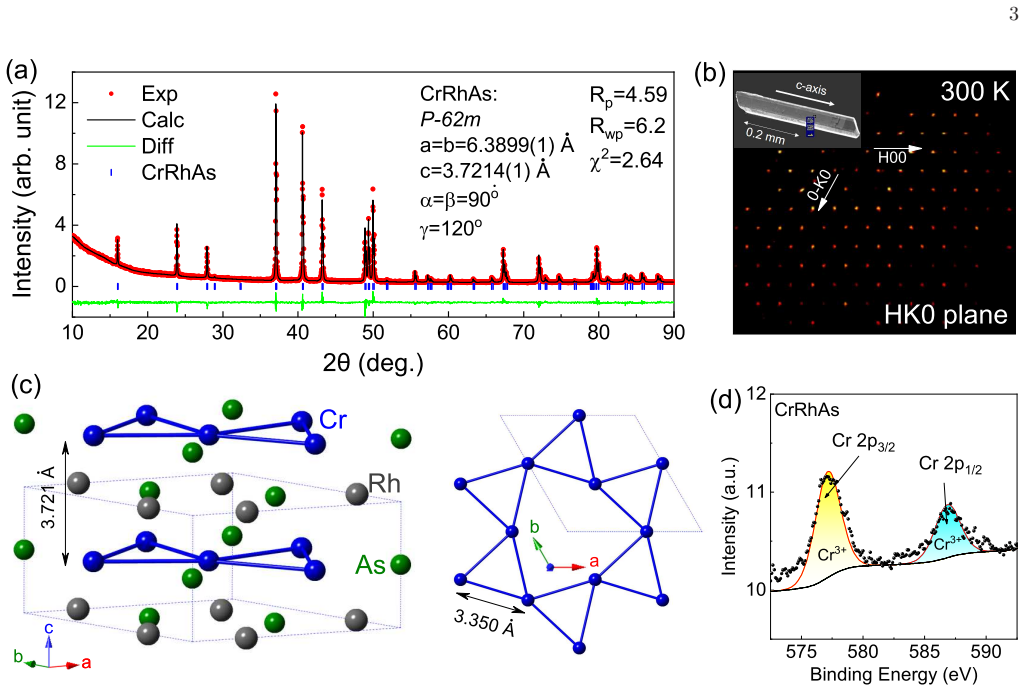
CrRhAs was theoretically proposed to be a kagome metal with unusual magnetic ground states; however, little is known about its magnetic structure and physical properties experimentally. Here, we present an experimental investigation of CrRhAs with ZrNiAl-type structure and a distorted Cr kagome lattice. CrRhAs is an antiferromagnet with TN = 149 K. Powder neutron diffraction analysis reveals a noncollinear antiferromagnetic structure with propagation vector k = (1/3, 1/3, 1/2), which features a ferromagnetic second nearest neighbor coupling in the kagome plane that is different from the prediction in previous density functional theory calculations. Furthermore, CrRhAs exhibits anomalous electrical transport properties which are possibly related to multiband effects and strong spin fluctuations. For the temperature-dependent longitudinal resistivity \r{ho}xx, it is semiconductinglike above TN and becomes metallic below TN . The Hall coefficients exhibit two sign changes near 70 and 300 K. Combined with the results of heat capacity measurements, a large Kadowaki-Woods ratio {\alpha} = 33.9 {\mu}{\Omega} cm mol2 K2/J2 is obtained. The above results suggest CrRhAs is a strongly correlated kagome metal with multiband and noncollinear magnetic structure features.
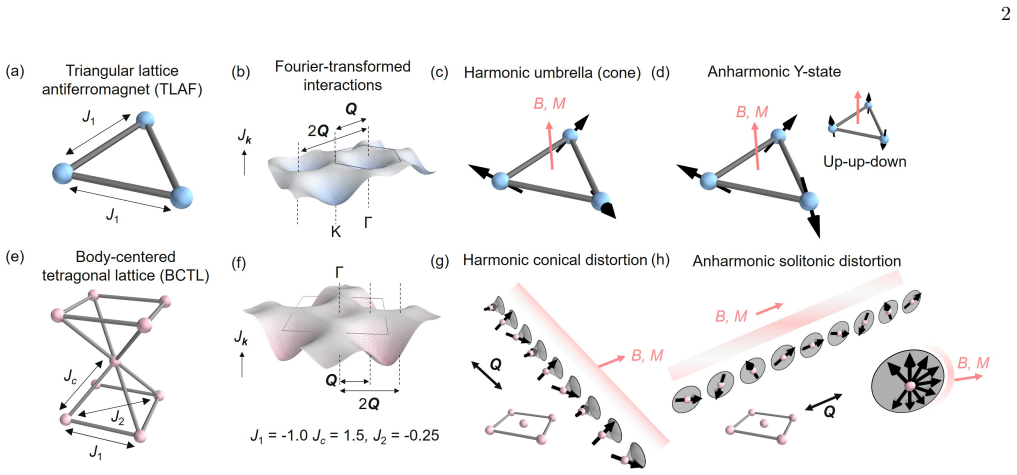
The triangular lattice antiferromagnet (TLAF) with nearest-neighbor exchange interaction is a model platform in the field of frustrated magnetism. Here, anharmonic ('up-up-down') and harmonic magnetic states compete, because a helimagnetic wave and its higher harmonic are degenerate in energy. We show that a body-centered tetragonal lattice (BCTL) can realize a similar frustration of harmonic and anharmonic helimagnetic states, and that the tetragonal magnetic Weyl semimetal GdAlSi realizes this scenario. In an applied magnetic field, resonant elastic X-ray scattering reveals a competition of harmonic cycloidal and solitonic double-Q states, well consistent with mean-field calculations. Our work provides a new paradigm for frustration physics in BCTL materials.
Magnetoelectric (ME) effects in antiferromagnets provide a fertile platform for exploring symmetry-driven cross-correlated responses. However, their microscopic origin remains elusive and is often obscured in simplified low-energy descriptions. In this study, we revisit the microscopic mechanism of the ME effect in a collinear antiferromagnetic zigzag chain by employing a multi-orbital tight-binding model that explicitly includes both $s$- and $p$-orbital degrees of freedom. Using analytical and numerical calculations based on the Kubo formula, we demonstrate that the ME response is governed by orbital degrees of freedom activated through $s$--$p$ hybridization, while the spin contribution vanishes due to spin conservation. To elucidate the low-energy description, we derive an effective Hamiltonian projected onto the $s$-orbital subspace using the Schur complement. We show that a naive application of the Kubo formula within this effective model fails to capture the ME response. This issue is resolved by systematically incorporating vertex corrections in terms of orbital hybridization into the response functions. Furthermore, by introducing a quasiparticle renormalization scheme, we formulate a renormalized Kubo formula that preserves conservation laws and accurately reproduces the full multi-orbital results. Our analysis revisits the conventional low-energy perspective and reveals that the ME effect originates from virtual interorbital processes encoded in vertex corrections, rather than from the bare low-energy Hamiltonian. The effective framework developed here provides a unified microscopic understanding of orbital-driven ME responses and offers a systematic route to incorporate hybridization effects beyond simple low-energy models.
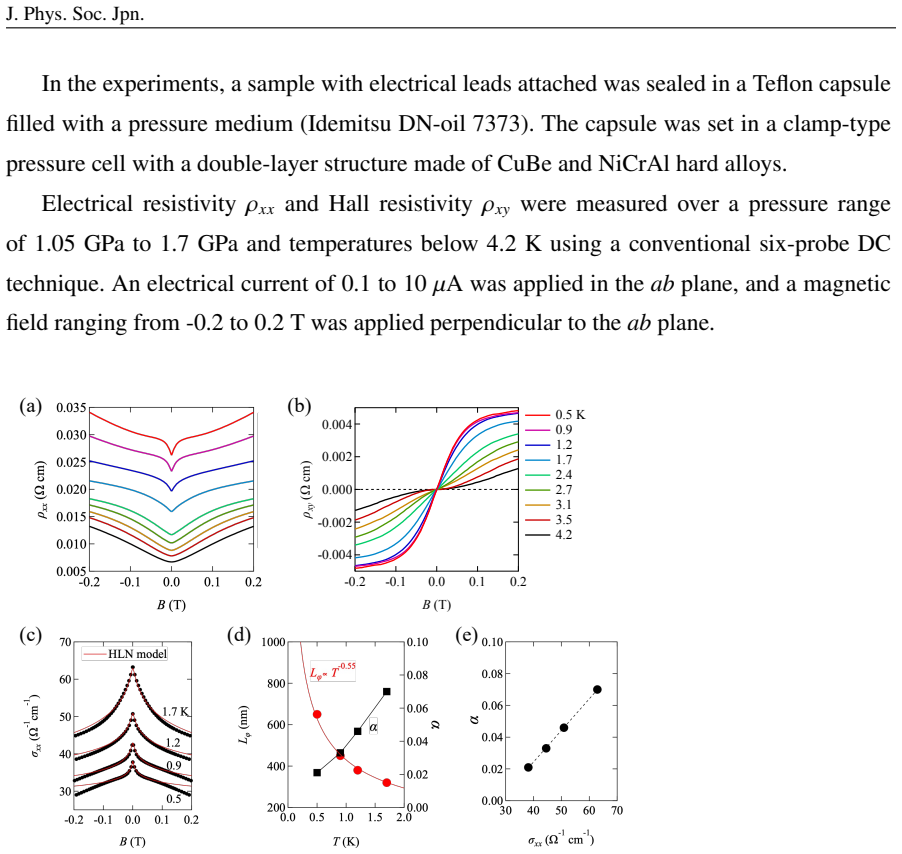
We have investigated the weak antilocalization (WAL) in the pressurized Dirac semimetal $\alpha$-(BEDT-TTF)$_2$I$_3$ across a correlation-driven quantum phase transition to a charge-ordered insulating state and evaluated the phase coherence length $L_{\phi}$ and its temperature scaling under various pressures from the low-temperature magnetoconductivity. In the high-pressure regime, the system exhibits the conventional two-dimensional dephasing behavior ($L_{\phi} \propto T^{-p}$ with $p \approx 1/2$), characteristic of electron-electron scattering in diffusive conductors. As the pressure approaches the critical pressure ($P_c \sim 1.2$ GPa), the temperature exponent is suppressed to $p \sim 0.3$, while $L_{\phi}$ remains large ($700\text{-}800$ nm at 0.5 K). This anomalous scaling suggests nontrivial inelastic scattering associated with Dirac electrons near the quantum critical point. The persistence of WAL across the transition supports a gapless or nearly gapless quantum phase transition.
We investigate the emergence of nontrivial topology in a twisted cuprate bilayer described by the Hubbard model in the weak-interaction regime. Our results show that the topological character depends sensitively on the doping level. For $U/t=3.85$, the Chern number assumes a value of $\pm 8$ in the electron-doped case, whereas it vanishes (0) in the hole-doped regime. The presence of nontrivial topology is further supported by an analysis the associated edge states and their chirality in a finite-width geometry, while keeping full correlations.
In general, quantum fluctuations are suppressed in ferromagnetic materials because they admit a simple unfrustrated ground state, greatly limiting the scope of phenomena that can be observed in these materials. In this work, we show how magnetization-non-conserving couplings fundamentally alter this paradigm by demonstrating the existence of a chiral ferromagnet that is stabilized by quantum fluctuations. More specifically, we show how these spin-orbit interactions modify the classical phase diagram; whereas a classical analysis predicts only collinear states, we observe fluctuation-stabilized phases, including a ferromagnet with large orbital chirality and a chiral stripe regime. We elucidate how such couplings spontaneously generate a scalar orbital chirality, in contrast to conventional mechanisms which rely upon a field-induced canting of vector chiral order. The resultant chiral states exhibit distinct transport signatures, namely an enhanced thermal Hall effect, and are of direct relevance to moir\'e heterostructures, Rydberg-atom arrays, and solid-state materials featuring non-Kramers spins.
We investigate the claims by Park and Haldane [Phys. Rev. B 90, 045123 (2014)] of an intrinsic protected value of the electric dipole moment at the physical edge of fractional quantum Hall (FQH) systems. Contrary to prevailing expectations, we find that the edge dipole takes the expected intrinsic value only in certain very special cases. We identify key limitations in earlier numerical studies and employ density matrix renormalization group (DMRG) methods to accurately compute the ground-state dipole. We focus on three representative systems: the $\nu=1/3$-vacuum edge, the $\nu=2/3$-vacuum edge, and the interface between Pfaffian and anti-Pfaffian phases. We find that the expected intrinsic dipole value occurs only at $\nu=1/3$, whereas the other systems do not exhibit the claimed intrinsic value. We give arguments based on composite fermions as to why hierarchy states should generally not have protected intrinsic dipoles. These results have important implications for the energetics and edge structure of FQH states.
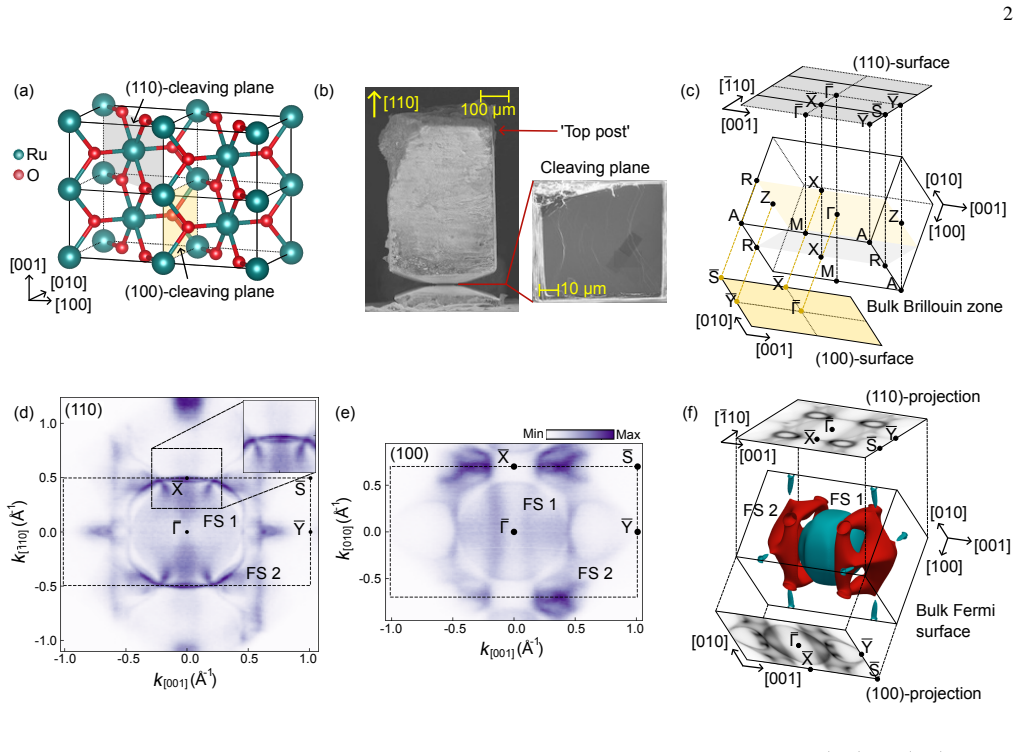
Rutile RuO$_2$ has attracted significant interest due to its putative unconventional electronic and magnetic properties and its proximity to superconductivity. However, the measurement and interpretation of its electronic structure has been complicated by a strongly three-dimensional crystal structure. Here, we demonstrate how the preparation of targeted $(110)$ and $(100)$ surfaces via focused ion beam (FIB)-engineered cleaving allows the acquisition of high-quality measurements of the electronic structure using angle-resolved photoemission spectroscopy. Our results demonstrate that ARPES spectra of RuO$_2$ are, in fact, largely dominated by signatures of distinct surface electronic states. From comparison with density-functional theory, we resolve a surface termination-dependent variation of these, and disentangle them from highly-three-dimensional bulk states and surface resonances. Moreover, we find a marked role of the substantial spin-orbit coupling of the Ru 4$d$ orbitals in the surface region, where a breaking of spatial inversion symmetry leads to significant Rashba-type spin splittings of the surface bands.
A categorification recovers Levin-Wen models and characterizes particles as modules over promonads while relaxing semisimplicity and finiti
abstractclick to expand
We introduce the pro-tensor network, a categorification of the tensor network, as a fully rigorous yet graphically transparent framework for studying the collection of many many-body theories, which we dub many-many-body theory. We provide a comprehensive toolbox for the graphical calculations using pro-tensor networks. As applications, we recover the Levin-Wen model as a "uniform" pro-tensor network and generalize a result of Kitaev and Kong by characterizing particles as modules over promonads. One can also interpret the string-net pro-tensor network as the space of symmetric tensor networks, thus our framework also applies to the study of generalized symmetry and topological holography. Notably, our generalization dispenses with the assumptions of semisimplicity, finiteness, and rigidity, potentially facilitating the exploration of many-body physics beyond these constraints.
The 1T polymorph of NbSe$_2$, long confined to the monolayer limit, has remained inaccessible in bulk. Here, we report the realization of bulk 1T-NbSe$_2$ via electrochemical Sn intercalation. Transmission electron microscopy directly reveals the formation of the 1T structure induced by Sn intercalation. The intercalated samples exhibit insulating transport behavior, in stark contrast to metallic 2H-NbSe$_2$. Density functional theory calculations, however, predict a metallic band structure, highlighting the crucial role of emergent electronic correlations in the observed insulating state. Raman spectroscopy further reveals vibrational modes associated with Sn intercalation and possible charge density wave order. Our results establish electrochemical intercalation as an effective route to stabilize otherwise inaccessible bulk polytypes, positioning bulk 1T-NbSe$_2$ as a new platform for investigating correlated electronic states.
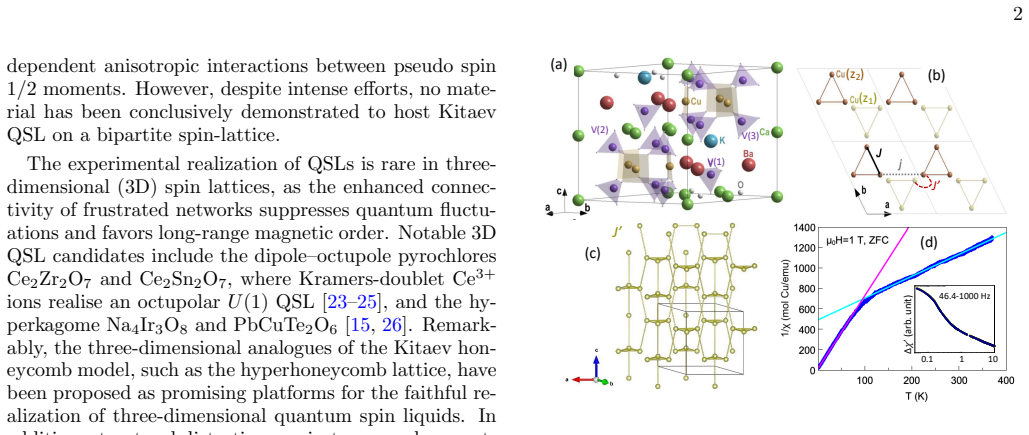
Quantum spin liquids (QSLs) represent highly entangled states of matter in which frustration-induced quantum fluctuations suppress any symmetry-breaking phase transition down to absolute zero, giving rise to fractionalized excitations and emergent gauge fields. Theoretically, bond anisotropy can stabilize QSLs even on bipartite lattices, as exemplified by the Kitaev honeycomb model; however, no material has so far been established to realize such a state as its true ground state. Here we identify the three-dimensional spin-trimer magnet KBa$_3$Ca$_4$Cu$_3$V$_7$O$_{28}$ as a promising candidate for a bipartite quantum spin liquid persisting to the lowest temperatures. Strongly coupled Cu$^{2+}$ trimers form effective pseudospin-1/2 degrees of freedom upon cooling, which in turn constitute a three-dimensional bipartite network. Bulk thermodynamic measurements, neutron scattering, $\mu$SR, and NMR detect no spin freezing or symmetry-breaking phase transition down to 20 mK, but instead reveal a gapless dynamical ground state with algebraic spin autocorrelations. Complementary Monte Carlo and exact-diagonalization calculations show that this state is stabilized by a strong enhancement of effective anisotropy: a weak microscopic Cu-Cu exchange anisotropy of approximately 15 percent is generically amplified at the trimer level, producing effective pseudospin-pseudospin interaction anisotropies of 60 to 100 percent. Our results establish trimer-based networks as a promising platform for realizing anisotropy-stabilized quantum entangled states, even in three-dimensional bipartite systems with only weak microscopic anisotropy.
We investigate the electronic phases of an effective Hubbard model on the body-centered-cubic lattice, motivated by alkali-doped fulleride molecular solids. The model incorporates renormalized on-site interactions and an effective inverted Hund's coupling originating from electron-phonon interactions. To access complementary interaction regimes, we employ two theoretical approaches. In the intermediate-coupling regime, the on-site repulsive interaction is approximated by a long-range interaction in momentum space, yielding an exactly solvable Hatsugai-Kohmoto model supplemented by a BCS-type pairing term. Within this framework, we analyze the superconducting instability and demonstrate a first-order normal-superconducting phase transition, characterized by a discontinuous jump of the order parameter. In the strong-coupling regime, where pairing fluctuations are suppressed, we apply the spin rotationally invariant slave-boson formalism to map out the temperature-interaction phase diagram. This analysis reveals first-order transitions between a Fermi-liquid phase, an antiferromagnetic phase, and a Mott insulating phase, with a narrow intermediate region where all three phases compete. The resulting phase diagram captures the interplay of itinerancy, magnetic order, and Mott localization in three dimensions and provides a unified perspective on superconducting and correlation-driven phenomena in fulleride-inspired lattice systems.
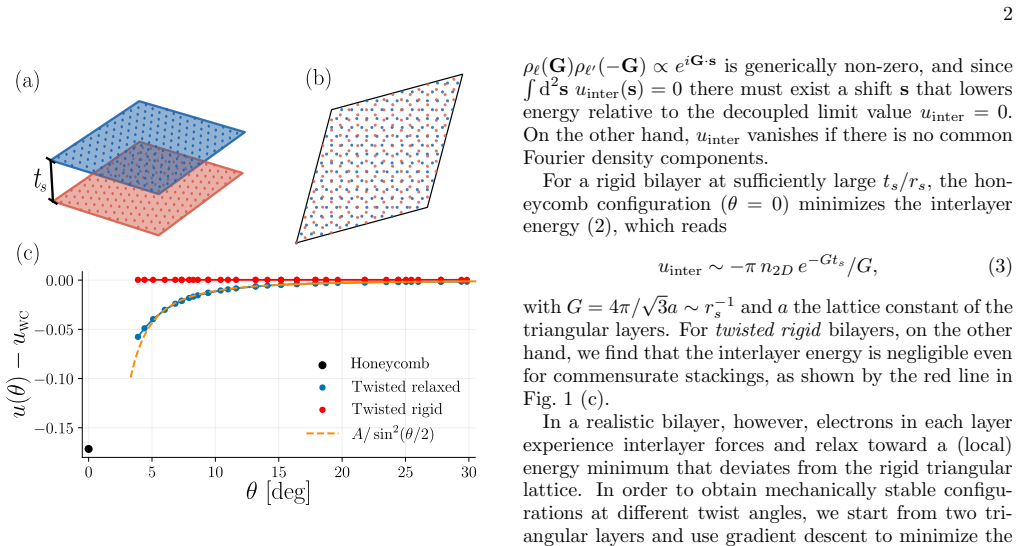
The strongly correlated phases of the homogeneous electron gas constitute the vocabulary of many-body condensed matter physics and find a natural realization in semiconductors. In this setting, recent neural-network variational Monte Carlo calculations discovered an unexpected quantum phase of matter in wide quantum wells: an electronic quasicrystal formed by a bilayer Wigner crystals with a 30-degrees twist. This state defies classical expectations and emerges in a regime dominated by quantum fluctuations. Here, we develop an analytical framework to reveal its origin. By computing zero-point energy corrections to bilayer Wigner crystal configurations, we show that quantum fluctuations qualitatively reshape the energetic landscape, destabilizing the classical honeycomb state and selecting the 30-degrees quasicrystalline ground state over a broad parameter range. Our results identify zero-point motion as the mechanism stabilizing the electronic quasicrystal and establish a route to spontaneous moir\'e physics driven by many-body quantum effects.
Intrinsic defects govern carrier trapping and recombination in two-dimensional semiconductors, yet the microscopic origin of defect-dependent capture dynamics remains unclear. Here, we compute carrier capture coefficients of vacancy defects, treating monolayer MoS$_2$ as a prototype, from first principles. We find that the single Sulphur vacancy forms a shallow defect with a small capture coefficient of $\sim 10^{-16}\ \mathrm{cm}^3/\mathrm{s}$, whereas the Sulphur divacancy exhibits a capture coefficient larger by seven orders of magnitude, $\sim 10^{-9}\ \mathrm{cm}^3/\mathrm{s}$, despite being only moderately deeper in energy. This enhancement originates from strong lattice relaxation enabling efficient multiphonon capture. Consequently, single vacancies contribute weakly to trapping, while Sulphur divacancies dominate nonradiative recombination and reduce quantum yield. In contrast, molybdenum vacancies and Sulphur antisites, although deep, show much smaller capture coefficients, indicating a limited role in carrier trapping in n-type devices.
Competing interactions, non-trivial electronic band topology, quantum fluctuations, and the interplay between emergent degrees of freedom in frustrated quantum materials can give rise to a wide range of exotic phenomena. Glassy dynamics, originally studied in amorphous materials and biological systems, has recently attracted considerable interest in quantum condensed matter, particularly in relation to the collective behavior of spins, quasiparticle excitations, and topological spin textures. Here, we investigate the emergence of unconventional glassy spin dynamics in a broad class of frustrated quantum materials, where spin freezing exhibit distinct signatures in both thermodynamic and microscopic measurements. Using a comprehensive set of experimental probes, including thermodynamic, NMR, ($\mu$SR), and neutron scattering, we identify characteristic signatures of topological spin-glass behavior and these complementary techniques reveal unconventional spin dynamics, short-range spin correlations, emergent low-energy excitations, and glassy behavior of topological origins, distinguishing these states from conventional spin glasses and disordered magnets. Furthermore, we discuss the role of hydrodynamic spin modes in governing glassy dynamics and the emergence of spin-jam states in frustrated lattices, providing a unified framework for understanding unconventional spin freezing of topological origin and bridging experimental observations with theoretical models. This review aims to advance our understanding of collective many-body phenomena arising from competing interactions, topological defects, collective excitations, quantum entanglement, and symmetry constraints. Such insights may facilitate the discovery and design of novel quantum materials and help address fundamental questions in contemporary condensed matter physics, with potential implications for future quantum technologies.
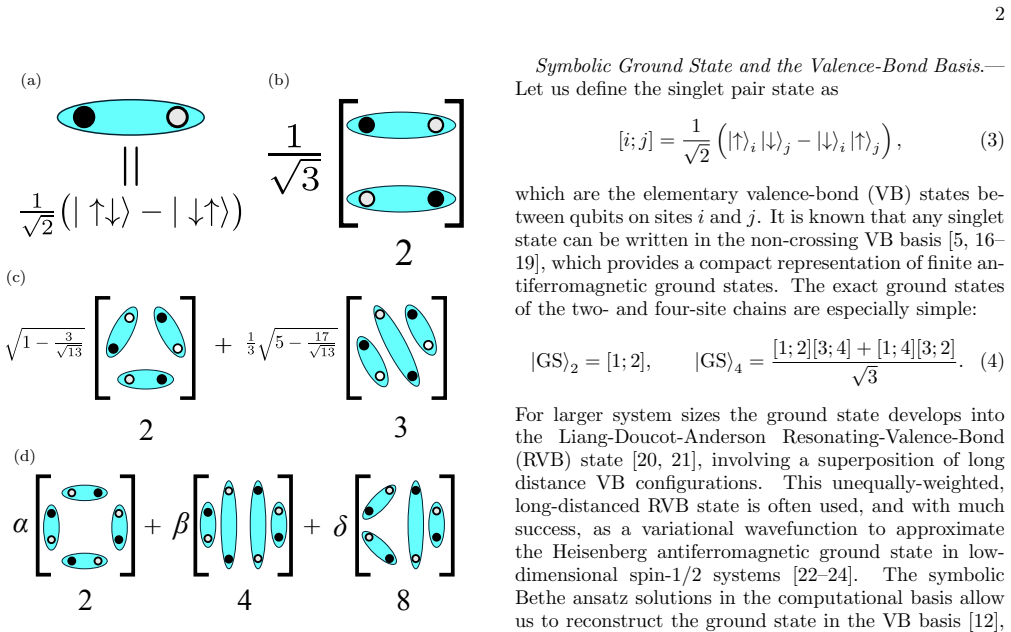
The spin-1/2 Heisenberg antiferromagnetic chain is the canonical example of an integrable quantum many-body model. Despite its exact solvability, explicit finite-size solutions are typically only accessible via numerical evaluation of the Bethe ansatz equations. Here, we analyse the algebraic structure of the exact, symbolic ground states for chains up to ten sites using the coordinate Bethe ansatz. We show that both the ground state wavefunction and the Bethe-roots rapidly develop algebraic complexity with respect to system size, but at different rates. The Bethe-roots appear to become Galois unsolvable for chains of eight or more sites, whereas the ground state wavefunction coefficients and energy appear to become unsolvable for ten or more sites. This demonstrates a lack of explicit analytic tractability in a quantum integrable model due to algebraic complexity.
In antiferromagnetic spin-dimer chains the applied field generates local excitations that produce the plateau without single-ion anisotropy.
abstractclick to expand
Certain antiferromagnets composed of antiferromagnetic spin dimers exhibit a zero-magnetization plateau despite that the single-ion anisotropy of their magnetic ions is negligible. The cause for this observation was investigated by analyzing how a magnetic field affects the energy spectrum of an antiferromagnetic chain composed of antiferromagnetic spin dimers made up of two spin-half ions and by carrying out specific heat measurements for potassium copper chloride as a function magnetic field at 2 K.
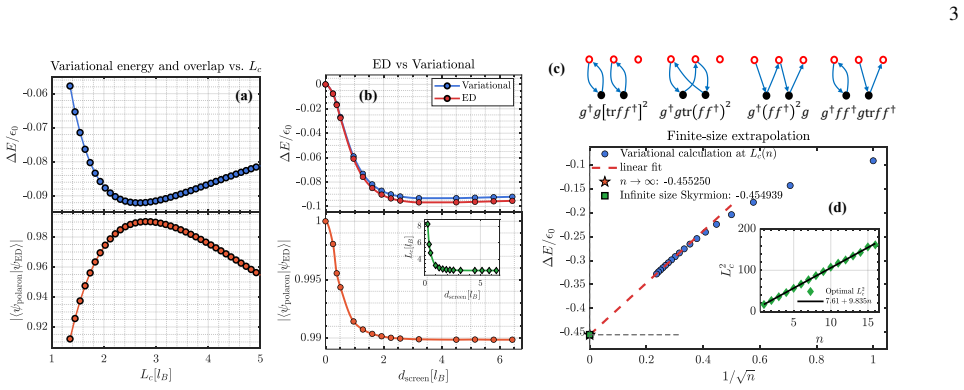
We develop a microscopic theory of charged excitations in an SU(2) Chern ferromagnet and obtain closed-form wavefunctions for a hierarchy of charge-$e$ spin polaron states binding an arbitrary number of spin flips. In an ideal Chern-$1$ band with a normal-ordered contact interaction, we show that these polarons are exact eigenstates of the Hamiltonian with the same energy as single-hole excitations. Away from this ideal limit, we promote these states to a variational family by introducing a single size parameter and a geometry-informed single-particle dressing. Our momentum-space wavefunctions admit two equivalent representations: a ratio of Jastrow factors of Weierstrass functions of relative momenta or an antisymmetrized geminal product of particle-hole wavefunctions. The latter enables efficient evaluation of overlaps and expectation values for large system sizes and many spin flips. Benchmarking in the lowest Landau level, the single-spin-flip ansatz achieves $\gtrsim 99\%$ overlap with exact diagonalization and accurately captures binding energies, while the multi-spin-flip energies interpolate smoothly toward the large-texture (skyrmion) regime. For Chern bands with tunable quantum geometry, we find that interaction-generated single particle dispersion quickly destabilizes the spin polarons once quantum geometry becomes sufficiently non-uniform. When such dispersion is suppressed, however, the bound states persist deeper into the non-uniform regime, with the binding energy slowly decreasing and the bound state becoming larger as the quantum geometry becomes more concentrated. Our results provide a microscopic foundation for analyzing doped Chern ferromagnets in moir\'e platforms and lay the groundwork for variational wavefunctions of multi-polaron excitations and phases.
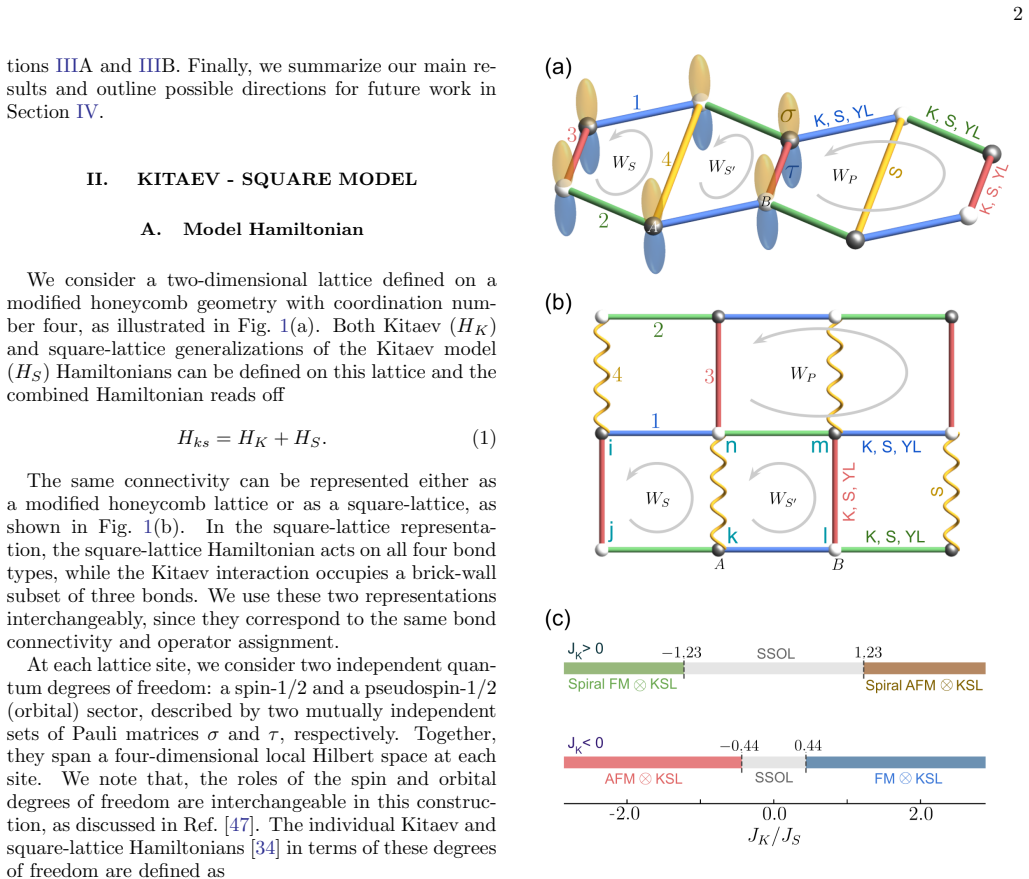
Spin-orbital generalization of Kitaev model provides a robust extension to the original Kitaev model. However, real materials often exhibit competing interactions that break exact solvability which can give rise to new phases. Motivated by recent microscopic proposals of coexisting Yao-Lee and Kitaev couplings, we investigate the fate of the ground state when two independent exactly solvable spin liquid Hamiltonians each originally formulated on different lattice geometries are combined on a common lattice environment. We first focus on the hybrid Kitaev's honeycomb and square-lattice model. Using self-consistent mean-field analysis and perturbative calculation, we show that the strong-Kitaev regime yields magnetic order in the spin sector, while the orbital sector retains its topological order. We further analyze the hybridization of the Yao-Lee and square-lattice models and find that the model exhibits a rich evolution of Majorana Dirac bands and Lifshitz transitions. Remarkably, when the Yao-Lee and square-lattice couplings are equal and opposite, the model restores its exact solvability with a single itinerant Majorana flavor. These results demonstrate that hybrid spin liquid platforms may host various emergent phases beyond conventional exactly solvable limits.
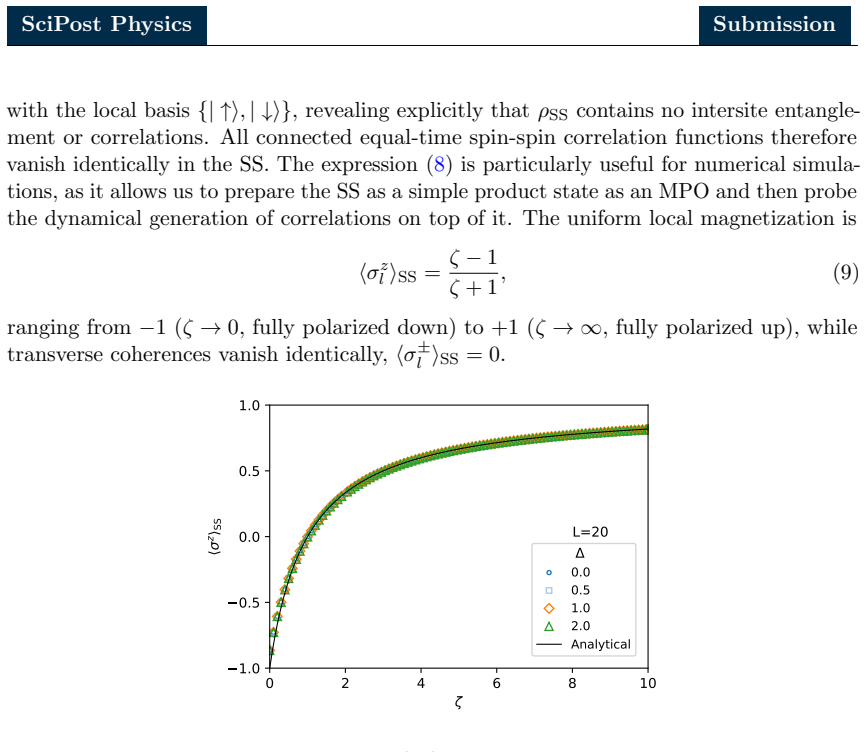
We study dynamical spin correlations in a dissipative XXZ spin chain subject to uniform local spin-loss and pumping. Starting from a mixed steady state that is featureless albeit possessing finite magnetization, rich dynamics emerges in time-dependent two-point correlators evaluated on top of it. For unitary evolution in which the reservoir is absent, the longitudinal correlators reproduce the established hierarchy of spin-transport universality classes - ballistic, Kardar-Parisi-Zhang (KPZ) superdiffusive, and diffusive - across the phase diagram. However, for finite magnetization, additional ballistic light cone propagation gets superimposed on the previous universality classes, arising from magnon propagation.The transverse correlator displays very fast, exponential decay of correlations without wavefront propagation in the easy-plane case. At the isotropic point, it follows KPZ scaling due to $SU(2)$ symmetry, while in the easy-axis regime, it is characterized by ballistic spreading of correlations. Under full Lindbladian dynamics, the universality classes are preserved at early times, while the correlations acquire an overall exponential damping in the long-time limit. In terms of methods, we have used vectorized TEBD for numerical simulations and exact analytical results obtained via a Pfaffian representation and the third-quantization framework for the noninteracting XX case.
Dissipationless charge transport without any energy loss is one of the most fascinating phenomena in condensed matter physics. This extraordinary state manifests in two well-established systems: superconductors and quantum Hall systems. A proposed third category is associated with chiral loop current order, characterized by the spontaneous formation of microscopic electric current loops. The microscopic origin of these currents stems from imaginary hopping terms, conceptualized as an imaginary charge density wave (iCDW). Despite extensive investigations, its existence remains highly controversial. Here we report site-selective spectroscopic evidence for a pure iCDW in the kagome nonmagnetic metal CsV$_3$Sb$_5$. Nuclear quadrupole resonance spectra at out-of-plane $^{121}$Sb site sensitive to in-plane currents reveal anomalous broadening below $T^*\approx$120 K, coinciding with the nematic transition well above the real charge density wave (CDW). Under magnetic fields, the spectra exhibit asymmetric lineshapes, demonstrating that this broadening purely originates from magnetic effects rather than from electric quadrupolar effects associated with CDW fluctuations. The observed lineshapes are quantitatively consistent with ~1 mT local fields induced by chiral loop currents, indicating spontaneous time-reversal symmetry breaking. This microscopic identification of the long-sought pure iCDW establishes a novel form of quantum order, potentially revolutionizing our understanding of exotic electronic states in quantum materials.
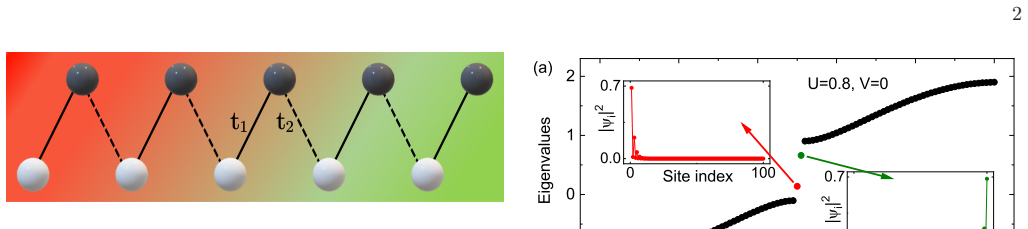
Using Hartree-Fock mean-field approach, we study the role of on-site ($U$) and extended ($V$) Hubbard interactions on the existence and evolution of edge modes in a half-filled Su-Schrieffer-Heeger (SSH) chain. We analyze the energy spectrum, local probability amplitudes, and site-resolved charge and spin density profiles across topological, critical, and trivial hopping regimes. We find that the localization of bound states is controlled by the ratio $2V/U$, with edge spin-density-wave modes for $U>2V$ and mid-chain charge-density-wave domain walls for $U<2V$, independent of band topology. These results establish the correlation-driven origin of localized states in finite one-dimensional chains.
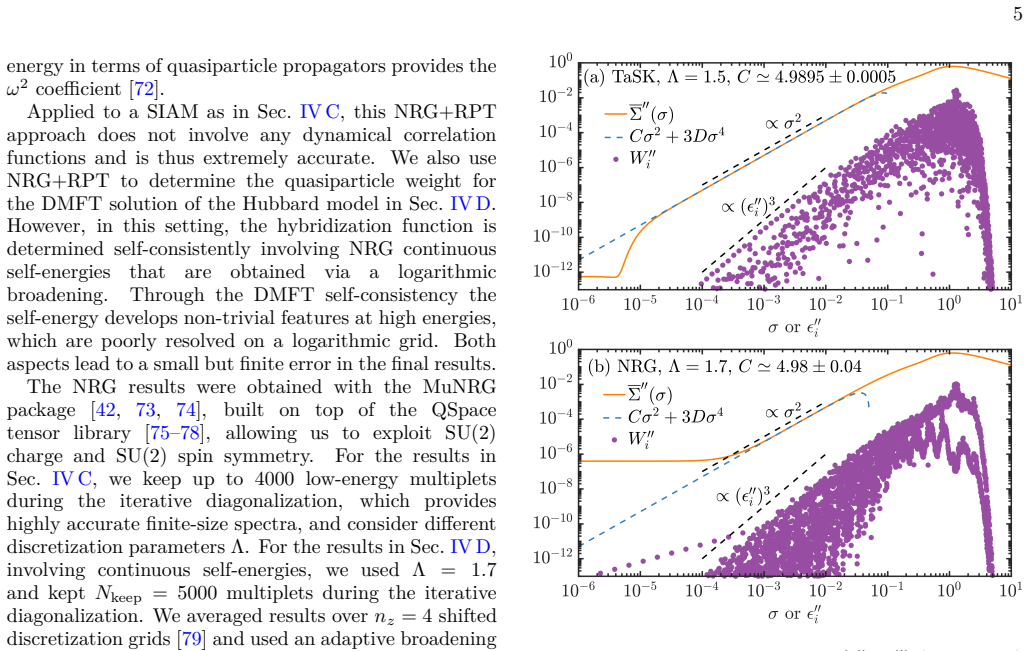
We derive a discrete spectral representation of the single-particle self-energy using a discrete evaluation of Kugler's symmetric improved estimator. Our construction can be used on both the real and the complex (Matsubara) frequency axis. It is guaranteed to remain causal at the numerical level, in contrast to standard approaches that may generate unphysical negative spectral weight or require additional broadening. Our representation can be used for any Hamiltonian; here we apply it to quantum impurity models and in dynamical mean-field theory. The latter is formulated with a discrete hybridization function throughout its self-consistency loop. In both cases and across various numerical methods, we obtain significantly improved accuracy for a range of impurity properties.
In erbium heptatantalate a three-sublattice spin solid forms then dissolves into short-range stripes at lower temperatures from competing Fr
abstractclick to expand
Heating enhances thermal fluctuations and typically leads to melting of solids, but in exceptional cases, heating can also cause liquids to solidify. The paradigm of this counterintuitive phenomenon is solidification of liquid $^3$He upon increasing temperature, known as the Pomeranchuk effect. Here we show that such inverse melting also appears in quantum magnetism. We find that, on cooling, the Ising-like triangular-lattice antiferromagnet erbium heptatantalate first develops a three-sublattice long-range magnetic order -- analogous to a solid -- which then, unexpectedly, melts at even lower temperatures into a short-range correlated spin-stripe state -- analogous to a liquid. We propose that such an unprecedented ``spin Pomeranchuk effect" can generically arise from strong competition between spin-spin interactions in frustrated magnets, and provides a novel avenue to transformations between exotic magnetic phases.
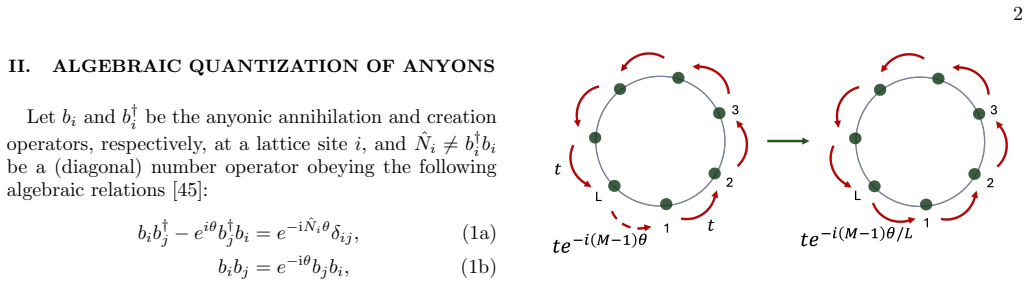
Anyons exhibit a non-trivial interplay between local exclusion rules and non-local braiding and exchange phases, making a consistent commutation algebra and second-quantized formulation challenging. We develop an algebraic framework for Abelian anyons in one dimension with statistical phase $\theta$ = $\pi$/N that enforces a finite on-site occupancy of N-1 anyons with the exchange phase $\theta$ between different sites. Moreover, we introduce an exact Jordan-Wigner duality between $\pi$/3 anyons and spin-1 operators, allowing us to map a tight-binding anyon model to an XY-like spin-1 model. The model exhibits anyon-density-dependent flux, incompressible or gapless regions, and critical points with level crossings that appear as discontinuities in ground-state currents, momenta, fidelities, and correlation functions. Our second-quantization formalism establishes a novel spin anyon duality, offering a conceptually new route to realize anyons from spin Hamiltonians and to engineer corresponding device architectures.
Sub-micron AAFM reveals shear modes with 10^{-3} dB per wavelength loss for potential use in 2DEG quantum devices.
abstractclick to expand
The LaAlO$_3$/SrTiO$_3$ (LAO/STO) interface hosts a gate-tunable superconducting two-dimensional electron gas (2DEG) which can be programmed to create quantum devices such as ballistic electron waveguides and quantum dots. To fully exploit this platform for quantum transport, a key requirement is the ability to shuttle single electrons, electron pairs, and other exotic states between spatially separated devices with precision. Surface acoustic waves (SAWs), which travel along the surface of a solid, offer a powerful route to achieve this through their moving electrical potential that captures and transfers electrons. %acoustoelectric coupling. In particular, SAWs in the GHz regime enable fast, controlled transport of individual quantum particles. Although this approach is well-explored in GaAs-based 2DEG, SAW generation in STO remains largely unexplored due to the lack of intrinsic piezoelectricity at room temperature. Here, we investigate room-temperature SAWs in LAO/STO and observe SAW modes up to 2.2 GHz with very low propagation loss of the order $10^{-3}$ dB per wavelength. To directly visualize these modes, we employ Atomic Acoustic Force Microscopy (AAFM), achieving sub-micron resolution imaging of the SAW wave forms, providing insight into the electrostriction-induced SAW generation mechanism. Our measurements indicate a shear horizontal-type mode, which provides the ability to couple to in-plane degrees of freedom for future acoustoelectric and quantum device applications. This work studies the fundamentals of SAW excitation and propagation on STO, a widely used and commercially available substrate, enabling straightforward coupling of SAWs to a broad range of materials that can be grown or transferred onto STO.
A highly exotic phenomenon in solid-state physics is the observation of magnetic quantum oscillations in insulators. For instance, in the Kondo insulator YbB$_{12}$ various groups reported the observation of such oscillations seemingly originating from Fermi surfaces, though this contradicts the concept of an insulator having no charged quasiparticles. In this study, we searched for quantum oscillations in YbB$_{12}$ by using bulk-sensitive ultrasonic experiments in high magnetic fields up to 65 T and down to 485 mK. For that, we utilized an YbB$_{12}$ single crystal that, in previous experiments, revealed oscillations in the magnetoresistance in the insulating state. We confirmed oscillation-like behavior of the magnetoresistance as well as field-dependent oscillations in the magnetocaloric effect. However, we could not observe magnetoacoustic quantum oscillations in the insulating state, only in the field-induced metallic state. In the insulating state, we found some anomalies in our ultrasound data, the origin of which remains elusive. Our findings provide further information on the puzzling behavior of the insulating state of YbB$_{12}$.
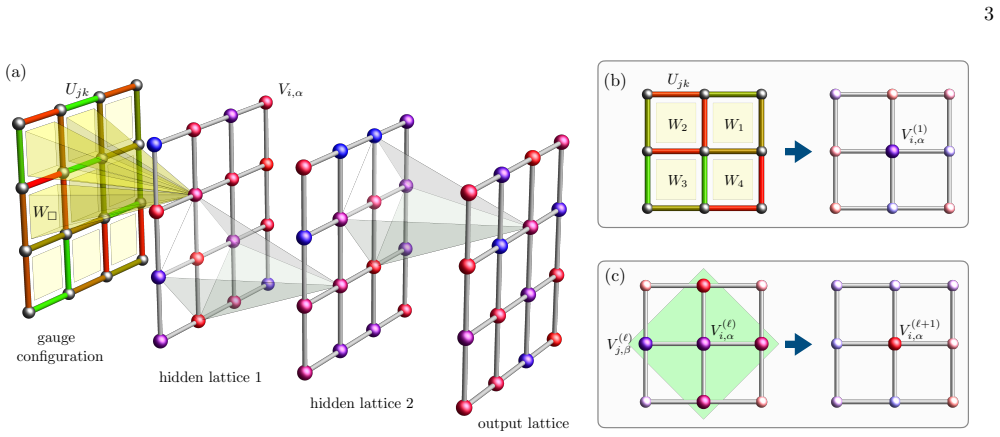
Local gauge structures play a central role in a wide range of condensed matter systems and synthetic quantum platforms, where they emerge as effective descriptions of strongly correlated phases and engineered dynamics. We introduce a gauge-invariant graph neural network (GNN) architecture for Abelian lattice gauge models, in which symmetry is enforced explicitly through local gauge-invariant inputs, such as Wilson loops, and preserved throughout message passing, eliminating redundant gauge degrees of freedom while retaining expressive power. We benchmark the approach on both $\mathbb{Z}_2$ and $\mathrm{U}(1)$ lattice gauge models, achieving accurate predictions of global observables and spatially resolved quantities despite the nonlocal correlations induced by gauge-matter coupling. We further demonstrate that the learned model serves as an efficient surrogate for semiclassical dynamics in $\mathrm{U}(1)$ quantum link models, enabling stable and scalable time evolution without repeated fermionic diagonalization, while faithfully reproducing both local dynamics and statistical correlations. These results establish gauge-invariant message passing as a compact and physically grounded framework for learning and simulating Abelian lattice gauge systems.
Within the toric-code phase, we study parameterized families of topologically ordered states. We construct $1$- and $2$-parameter families of local Hamiltonians and confirm their non-triviality via topological pumping. For the $1$-parameter family, we show that the $em$-exchange defect is pumped into the bond Hilbert space of a tensor-network representation. For the $2$-parameter case, we construct a ``pump of a pump'' that transports an $S^1$-family of a system in one lower spatial dimension. Using similar methods, we also present a $1$-parameter family with a higher-order anyon pump that produces corner-localized anyon modes. These constructions provide explicit lattice realizations and concrete diagnostics of family-level topology. We use recently developed boundary algebra methods to study the non-triviality of these families.
We solve an infrared effective holographic model of a non-Fermi liquid at finite temperature that satisfies Luttinger's theorem and incorporates long-range Coulomb interactions. Motivated by the absence of a Luttinger-counting Fermi surface in standard Reissner-Nordstrom holographic metals, we consider a Maxwell-Chern-Simons theory in a static anti-de Sitter-Schwarzschild background, coupled to an LU(1) gauge field rather than a conventional U(1) gauge field. By an appropriate choice of boundary conditions, we obtain a damped collective plasmon mode whose plasma frequency scales as predicted by Luttinger's theorem. We further analyze the density-density correlator in the absence of long-range Coulomb interactions and identify a contribution consistent with a Lindhard-like continuum.
Moir\'e transition metal dichalcogenides have served as a versatile platform for simulating Hubbard physics. Recent experiments have identified robust superconductivity in moir\'e bilayer WSe$_2$ for certain twist angles. Here, we propose the gossamer nature of the superconductivity recently discovered at half-filling and zero displacement field in twisted WSe$_2$. By mapping the moir\'e continuum system to an effective extended single-orbital Hubbard model on the triangular lattice, we employ renormalized mean-field theory to investigate the strong-coupling phase diagram. We find that a moderate Coulomb repulsion partially suppresses charge fluctuations while preserving a finite density of mobile doublons and holes. In this regime, the interplay between extended kinetic hoppings and antiferromagnetic superexchange stabilizes a chiral $d+id$ superconducting phase. Our results naturally account for the twist-angle-dependent evolution from a Mott insulator to a superconductor and eventually to a correlated metal. Furthermore, the model demonstrates that this half-filled pairing state vanishes rapidly upon density doping, consistent with experimental observations.
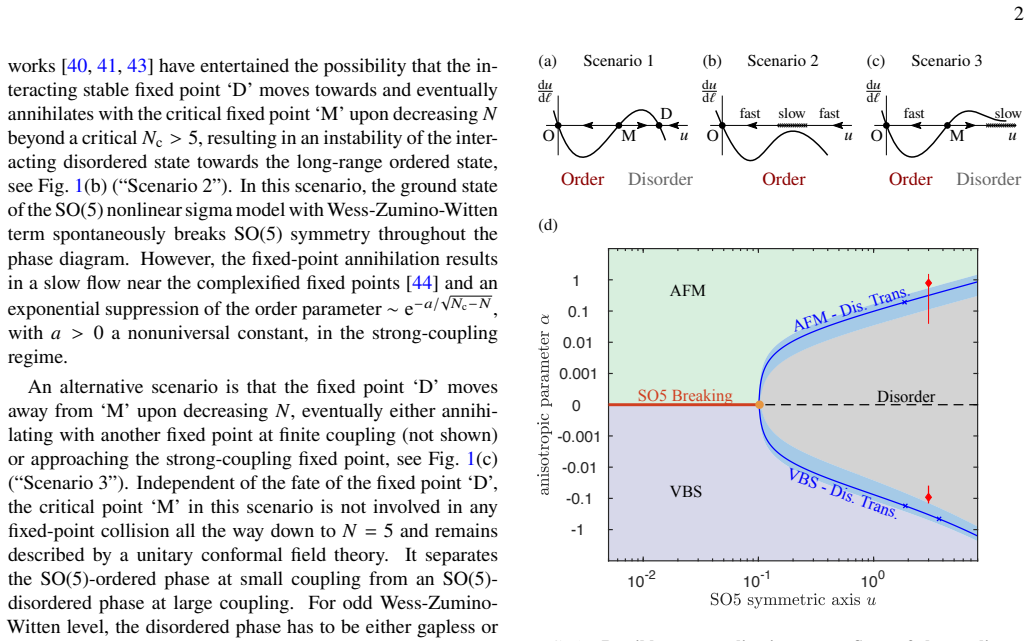
We develop an optimized continuous-field quantum Monte Carlo (QMC) algorithm to investigate the SO(5) nonlinear sigma model with a Wess-Zumino-Witten term, which describes half-filled Dirac fermions in 2+1 space-time dimensions akin to graphene and Yukawa coupled to a quintuplet of compatible mass terms. To regularize the theory, we project onto the lowest Landau level for both spherical and torus geometries. Our algorithm reduces the computational complexity to $O(\beta N_{\mathbf{q}} N_\phi^2)$, yielding a speedup of a factor of $N_\phi$ (the number of magnetic fluxes, i.e., system size) relative to prior works [1-3]. This advance enables us to simulate system sizes up to $N_\phi=140$ on torus and $N_\phi=49$ on sphere, far exceeding the maximum sizes accessed, and to map out the universal phase diagram of the model on both geometries. Most notably, we identify and characterize a critical point that separates an SO(5)-broken ordered phase at small coupling from an SO(5)-symmetric disordered phase at large coupling. The critical point becomes multicritical upon the inclusion of terms that break the SO(5) symmetry down to $\mathrm{U}(1) \times \mathrm{SU}(2)$, relevant for the deconfined phase transition between N\'eel antiferromagnetic and valence-bond-solid orders in quantum magnets. While the precise nature of the disordered phase in the thermodynamic limit remains to be determined, we argue that it is neither conformal nor trivially gapped, akin to a chiral quantum spin liquid with a small gap. Our finding of a multicritical point in the phase diagram of the SO(5) nonlinear sigma model with Wess-Zumino-Witten term resolves the long-standing open question of its global structure, and our QMC framework opens a new avenue for systematic studies of projected Hamiltonians, ranging from correlated flat bands to fractional quantum (anomalous) Hall systems.
Based on a renormalization group (RG) analysis, we study the bosonization formulas in spin-S Kitaev-Gamma and Kitaev-Heisenberg-Gamma chains in the (K < 0, Gamma > 0, J > 0) parameter region, where S is a half-odd integer. We find that the effects associated with the breaking of emergent continuous symmetries in bosonization formulas scale as 1/S in the large-S limit, which is in qualitative agreement with DMRG numerical results for Kitaev-Gamma chains. In Kitaev-Heisenberg-Gamma chains, symmetry analysis reveals ten independent bosonization coefficients, five of which are predicted by the RG analysis to have no dependence on the Heisenberg coupling up to linear order. Our work may offer valuable input for determining magnetic ordering tendencies in two-dimensional Kitaev spin models within a quasi-one-dimensional approach.
Rock-salt and zincblende forms produce distinct spectral functions when correlation strength U and oxygen 2p effects are varied in DFT+DMFT.
abstractclick to expand
The intriguing physics and rich application potential of strongly correlated first-row transition metal oxide compounds result from the complex interplay of several factors that influence the electronic structure. To shed light on the effect of composition, structure, and correlation strength, we apply a well-established charge self-consistent combination of density functional theory and dynamical mean field theory, which has proven to give electron binding energies in good agreement to experimentally derived excitation spectra. For paramagnetic NiO and CoO, we analyze the effect of rock-salt and zincblende structures and their different ligand fields on the spectral functions. By varying the value of the interaction parameter U, different correlation strengths among the transition-metal 3d electrons are considered, as well as the effect of additionally accounting for correlations in the oxygen 2p orbitals by a self-interaction-correction pseudopotential scheme.
La3Ni2O7 shows narrower bandwidth than cuprates but comparable fluctuating moment from enhanced local susceptibility.
abstractclick to expand
The recent discovery of high-temperature superconductivity in pressurized and thin film nickelates has generated intense interest, yet the nature of magnetism in their ambient-pressure parent phases remains poorly understood, despite its potentially crucial role in pairing. Here we use neutron scattering to resolve the spin order and dynamics of single-crystalline La3Ni2O7, an ambient-pressure parent of this class. Well defined spin excitations are observed at Q = (0, 0.5, 2.5), featuring a~5 meV spin gap and anisotropic in-plane dispersions, with zone-boundary softening along the transverse direction indicative of competing exchange interactions. The excitations exhibit pronounced out-of-plane modulations with bilayer periodicity, providing direct evidence for antiferromagnetic interlayer coupling. Their dispersion is well described by a bilayer Heisenberg Hamiltonian with strong interlayer exchange and competing in-plane couplings within a stripe-type magnetic order. Normalization of the spectra to absolute units reveals that, although the spin-wave bandwidth is only about 25% of that in cuprates, the local dynamic susceptibility at comparable energies is significantly enhanced, yielding a total fluctuating moment of comparable magnitude. These results highlight intense mid-energy spin excitations rooted in substantial electronic correlations as a defining feature of this family, establishing a magnetic framework distinct from cuprates and directly relevant to understanding superconductivity in this system.
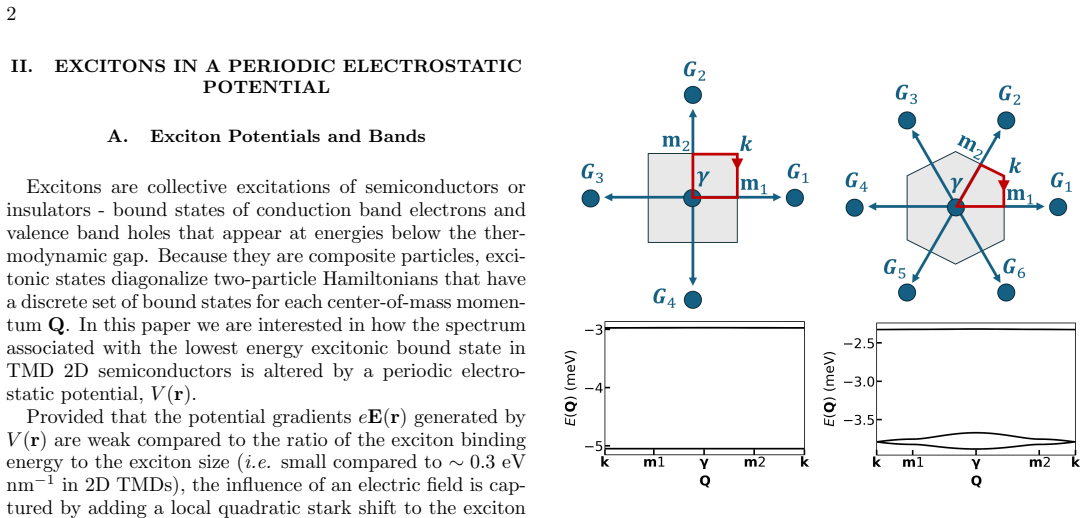
Two-dimensional (2D) van-der-Waals materials are a promising platform for exciton state engineering. In this paper, we study the properties of excitons in 2D group VI transition-metal dichalcogenide (TMD) semiconductors that are modified by a periodic electrostatic potential through the quadratic Stark effect. Using a model that retains only center-of-mass and valley degrees-of-freedom, we find that electrostatic potentials can drive optical valley splitting up to 10meVs and induce valley selective exciton dispersion. We explain why both properties are sensitive to the rotational symmetry of the electrostatic trapping potential using a combination of numerical results and analytical approximations. An important consequence of valley-splitting is that the lowest exciton band is non-degenerate and has a linear dispersion around $\gamma$ that is expected to suppress thermal excitations, allowing true Bose condensation and superfluidity of excitons in two space dimensions.
Orbitally degenerate systems provide a promising platform for realizing novel quantum phases driven by spin-orbital exchange interactions, as described by the Kugel-Khomskii model. Spinel vanadates, in which orbital degrees of freedom remain active, exhibit structural and magnetic transitions accompanied by orbital ordering, but the nature of the orbital state in MnV$_2$O$_4$ remains under debate. Here, we combine first-principles calculations with an effective spin-orbital model to address this problem. We show that a significant trigonal crystal field is present in high-temperature cubic phase and plays an essential role in determining the low-energy degrees of freedom. Based on the resulting parameters, we construct an effective Hamiltonian beyond the conventional dominant-hopping approximation and demonstrate that subdominant hopping processes strongly modify the spin-orbital exchange interactions. As a result, the system stabilizes a two-in/two-out magnetic configuration featuring spin canting and intertwined dipole-quadrupole orbital order.
Numerous unconventional superconductors such as cuprates, heavy-fermions, and twisted-bilayer graphene exhibit incoherent metallic transport above the superconducting critical temperature. This phenomenon cannot be described with Fermi-liquid theory and has presented a significant theoretical challenge to overcome. We utilize the two-dimensional Yukawa-SYK model of fermions with spatially random coupling to quantum-critical bosons to study transport in a manner which is non-perturbative in the coupling strength. Our work provides a microscopic model of quantum-critical incoherent metals and their concomitant properties, including a non-Boltzmann transport formula between resistivity and quasi-particle lifetime, violation of the Mott-Ioffe-Regel resistivity bound, and violation of the Kovtun-Son-Starinets shear viscosity to entropy density bound.
We introduce a generalised six-state clock chain that interpolates between the clock and Potts models via a multicritical point described by decoupled Ising and three-state Potts models. We find that this decoupling extends into stable phases that break only $\mathbb{Z}_2$ or $\mathbb{Z}_3$ symmetry. We also use boundary CFT analysis and level spectroscopy to conclusively identify a $\mathbb{Z}_6$ parafermion multicritical point terminating the clock model Luttinger-liquid phase. Our work shows that parafermions emerge far from integrability, even in systems with intertwined Ising and three-state Potts orders.
The discovery of high-$T_c$ superconductivity in Ruddlesden-Popper nickelates has sparked substantial effort towards understanding unconventional electronic states beyond a traditional cuprate-like d^9 configurational ground state. An understanding of the interplay between magnetic ground states and multi-orbital physics is key for establishing a microscopic mechanism for superconductivity. In the bilayer nickelates, spin density wave (SDW) order is a prominent feature in the non-superconducting regime. However, its relation to superconducting pairing remains an open question. Here, we use resonant x-ray scattering to examine the existence of SDW order in superconducting bilayer nickelate thin films La$_2$PrNi$_2$O$_7$ (LPNO). Comparing superconducting and oxygen-deficient LPNO thin films, we find that superconductivity occurs in SDW-free, oxygen-stoichiometric regions, whereas oxygen-deficiency promotes SDW order, indicating phase segregation of SDW and superconductivity. Furthermore, Ni-$L_3$ and O-$K$ edge spectroscopy reveals distinct electronic structures - particularly along the $c$-axis - between the two domains. Our results identify oxygen stoichiometry as a key parameter controlling interlayer coupling and thus the electronic structure of bilayer nickelates. In concert with theory, we propose that a ligand hole primarily resides at the inter-bilayer apical oxygen, forming a robust interlayer five-spin polaron state, which serves as the ground state for superconducting bilayer nickelates.
Strong electronic correlations generally require non-perturbative treatment. Local correlations are captured by dynamical mean-field theory while nonlocal correlations can be treated with diagrammatic extensions such as the Dual Fermion approach. Dual Fermion is built on physically motivated, but in principle uncontrolled approximations, so careful benchmarking is needed to understand the strengths and limitations of the method. In this work, we benchmark ladder Dual Fermion and dynamical mean-field theory for the Falicov-Kimball model with the exact classical Monte Carlo solution. We focus on the thermodynamics, electronic structure and susceptibility, especially at the combined frequency and momentum structure, and find that Dual Fermion clearly outperforms dynamical mean-field theory. Somewhat surprisingly, Dual Fermion is not as accurate for the relation between orbital density versus chemical potential in the doped system. These results demonstrate the need for rigorous benchmarking of diagrammatic extensions of dynamical mean-field theory for models with inequivalent orbitals, which is essential for modelling materials.
Two-dimensional high-spin bipartite honeycomb networks, where anisotropy, competing exchange interactions, and spin fluctuations interplay, provide an alternative platform to test theoretical models that distinguish between classical and quantum magnetism in the context of emergent many-body phenomena and exotic excitations. Here, we report the crystal structure, magnetization, specific heat, and inelastic neutron scattering measurements of the $S = 5/2$ distorted honeycomb magnet $\mathrm{CaZn_2Fe(PO_4)_3}$. Magnetization measurements reveal dominant antiferromagnetic interactions between the $\mathrm{Fe^{3+}}$ ($S = 5/2$) moments. The development and field evolution of a dip in the magnetic susceptibility under an external magnetic field indicate an unconventional field-induced transition, further supported by anomalies observed in magnetization isotherms. Zero-field specific heat measurements show an antiferromagnetic transition at $T_N \approx 1.67 \mathrm{K}$, which evolves under applied magnetic field, suggesting stabilization of a field-induced spin-canted state. Thermodynamic measurements reveal short-range spin correlations above the transition temperature. Inelastic neutron scattering results further corroborate antiferromagnetic ordering, consistent with specific heat data. Spin-wave calculations indicate competing exchange interactions that introduce magnetic frustration, along with weak Ising-like anisotropy. The interplay of competing interactions and anisotropy gives rise to exotic field-induced behavior and places the system in close proximity to a mean-field tricritical point in the $J_2/J_1$--$J_3/J_1$ phase diagram, opening a route to unconventional states in high-spin frustrated honeycomb magnets.
In non-diffusive conduction regimes of strongly correlated quantum electron systems, electromagnetic perturbations simultaneously probe the electronic dynamics in time and space: the exchanged energy $\hbar \omega$ excites retarded, i.e., frequency-dependent, many-body interactions, while the probing spatial modulation renders the response spatially nonlocal, i.e., dependent on the external wave vector $\vec{q}$. This work determines the exact nonlocal electrodynamic response of such dynamical quantum fluids under the assumptions of local, frequency-dependent interactions and charge/mass conservation. The latter is ensured by Bethe-Salpeter equations for renormalized interaction vertices, entering the Kubo formalism for two-particle correlation functions (e.g., for density, currents, momentum, stress). Within such framework, it is shown that vertex corrections generally vanish at $q=0$ for single-particle dispersions with inversion symmetry and for bare interaction vertices that are odd with respect to specific point group transformations in momentum space, including inversion for vector vertices, and mirror reflections or two- or higher-fold rotations for tensor vertices. In addition, for quadratic dispersion vertex corrections identically vanish from the current-current correlation function, at any momentum $\vec{q}$ and frequency $\omega$. The robustness of these criteria against further symmetry breaking, multiband effects, and additionally imposing momentum conservation, is discussed, with application to the Hall viscosity of Landau levels. Explicit expressions for generic nonlocal correlation functions are derived for Fermi liquids (with well-defined quasiparticle peaks) and non-Fermi liquids (devoid of quasiparticles), for arbitrary local self-energies.
Nonequilibrium Green's functions provide a powerful framework for studying quantum many-body dynamics including the laser-induced dynamics in solids. The Non-Equilibrium Systems Simulation package (NESSi) offers an efficient platform for such simulations, ranging from perturbative approaches like nonequilibrium $GW$ to nonequilibrium dynamical mean-field theory. However, simulations based on nonequilibrium Green's functions become computationally demanding when the dynamics span a large temporal range, such as from sub-femtosecond electron dynamics to the picosecond dynamics of collective modes. Due to the memory integral in the Kadanoff-Baym equations, which serve as equations of motion for nonequilibrium Green's functions, the computational cost scales as $\mathcal{O}(N_t^3)$ with the number of timesteps $N_t$, and the memory requirement scales as $\mathcal{O}(N_t^2)$. In this work, we extend NESSi by incorporating techniques that aim to overcome this bottleneck: (i) By truncating the memory integrals in the KBE to a maximum of $N_c$ timesteps, the computational complexity is reduced to $\mathcal{O}(N_tN_c^2)$, and the memory requirement to $\mathcal{O}(N_c^2)$. Provided that the results converge with respect to the cutoff $N_c$, memory truncation allows to extend the simulations to significantly longer times. (ii) We introduce functionalities to describe nonequilibrium steady states, i.e. time-translationally invariant nonequilibrium states. Such states are relevant for transport settings, and they provide an approximate description of slowly evolving (prethermal) nonequilibrium states.
The von Neumann entanglement entropy of exact valence-bond ground states is studied in two frustrated one-dimensional spin chains: the spin-1/2 Majumdar-Ghosh (MG) model and the spin-3/2 J1-J2-J3 chain in its fully dimerized (FD) and partially dimerized (PD) phases. Using matrix-product-state representations, the entropy is computed as a function of system size for three complementary bipartitions - half-chain, single-site, and pairwise - under both open and periodic boundary conditions. In all cases, the entropy saturates to a finite constant in the thermodynamic limit, confirming area-law behavior. The saturation values, extracted via finite-size scaling, are directly related to the underlying virtual-spin bond structure. The MG model and FD phase exhibit similar entanglement behavior, differing primarily in saturation magnitude determined by spin value and bond multiplicity, and both display even-odd oscillations and exponential convergence with system size. In contrast, the PD phase shows qualitatively distinct signatures, including multiple half-chain saturation values depending on the bond type at the cut, asymmetric edge contributions in the single-site entropy, and a multi-band structure in the pairwise entropy reflecting the coexistence of single- and double-singlet bonds. These results establish entanglement entropy as a robust signature of frustrated bond architecture, enabling clear distinction among dimerized phases with different spin magnitude, bond multiplicity, and dimerization patterns.
We study the quadrupolar Kitaev model, an $S=1$ honeycomb-lattice model with frustrated bond-dependent quadrupolar interactions. Using complementary methods and expanding around controlled limits, we uncover several intertwined structures. First, a semiclassical variational analysis based on $\mathrm{SU}(3)$ flavor theory reveals an extensively degenerate manifold of classical mean-field ground states, suggesting that quantum fluctuations may stabilize a quantum-disordered phase. Second, in the bond-anisotropic limit, perturbation theory is used to derive effective low-energy Hamiltonians, which crucially depend on the presence (or absence) of a residual symmetry $\mathcal{M}$ of combined lattice reflection and discrete spin rotation. A Majorana parton construction uncovers an exact $\mathbb Z_2$ gauge structure and motivates possible confined and deconfined phases driven by gauge-charge condensation, consistent with the effective theories obtained in anisotropic limit. Further, within the same parton formalism, different Majorana mean-field ans\"atze produce both gapless and gapped candidate quantum-disordered states, distinguished by linear versus projective implementations of $\mathcal M$. Our results highlight frustrated quadrupolar interactions as a route to quantum-disordered phases, relevant to $S \geq 1$ Kitaev materials and Rydberg-array quantum simulators.
The quasiparticle effective mass $m^*$ of the three-dimensional uniform electron gas (UEG) is a fundamental Fermi-liquid parameter whose value and density dependence have remained controversial for decades. Using renormalized perturbation theory with explicit counterterms, we determine $m^*$ in the metallic regime ($r_s \le 6$) from first principles by two complementary routes -- the self-energy and the forward-scattering four-point vertex via the $p$-wave spin-symmetric Landau parameter $F_1^s$ -- that agree within uncertainties at each density through sixth renormalized order. The resulting $m^*/m$ remains close to unity throughout the metallic regime, with a shallow non-monotonic density dependence -- a minimum near $r_s\approx 1$ followed by a gentle upturn -- reflecting the interplay of exchange and dynamical screening in the self-energy, and disfavoring strong monotonic suppression. This finding supports a physical picture for the metallic UEG in which dominant charge correlations are concentrated in nearly forward scattering and generate only a weak $F_1^s$ component.
Low-order hybridization expansion methods such as the non-crossing approximation (NCA) and the one-crossing approximation (OCA) are widely used impurity solvers in the study of strongly correlated systems, yet their accuracy in genuine multi-orbital settings remains poorly understood. Using the decoupled orbital limit as a controlled reference point, we derive analytic results connecting multi-orbital restricted propagators and Green's functions to their single-orbital counterparts, identify the diagrammatic mechanisms responsible for the breakdown of low-order methods in multi-orbital settings, and determine their regimes of applicability. Our central finding is that the accuracy of these methods is governed by the least correlated orbital: i.e., the orbital with the most rapidly decaying retarded Green's function. That orbital's properties are transferred to all other orbitals through a spurious coupling generated by the truncated expansion, thereby suppressing correlation-induced features such as the Kondo resonance. This occurs even in orbitals that are themselves strongly correlated within single-orbital calculations using the same approximation scheme. We confirm this numerically across representative two-orbital model systems in the steady-state, systematically identifying the parameter regimes in which low-order methods succeed or fail. Our results provide a practical guide for assessing when insights from single-orbital calculations carry over to multi-orbital settings, and serve as a benchmark for the development and validation of higher-order multi-orbital impurity solvers.
In this work, we explore a microscopic realization of three types of anyonic symmetries in a $\mathbb{Z}_2\times\mathbb{Z}_2$ topological order, corresponding to a double toric code. These symmetries act as nontrivial permutations on the anyon labels of the parent state. We consider a setup consisting of two decoupled Wen plaquette models stacked on top of each other and introduce dislocations that modify the Hamiltonian, giving rise to localized twist defects, eventually inducing interactions between the layers. In this context, branch cuts act as sources of anyon permutations when they cross it. We characterize the defects by calculating their quantum dimensions, and we also consider double loop operators around them that allow us to determine the non-Abelian fusion rules between the defects, including when they carry different anyon permutations.