REVIEW 3 major objections 1 minor 1 cited by
Predicting the Ocean Currents using Deep Learning
T0 review · 3 major / 1 minor · reviewed 2026-05-25 · grok-4.3
Pith's one-line read LSTM networks can predict ocean current speeds in two horizontal directions from historical measurements.
desk verdict LSTM applied to one short buoy record with no error numbers, baselines, or out-of-sample tests, so the prediction claim stays unverified. read the letter →
The pith
A machine-rendered reading of the paper's core claim, the machinery that carries it, and where it could break.
The reading
What carries the argument
The Long Short Term Memory (LSTM) network that processes sequences of ocean current measurements to output future values of u and v.
What would settle it
Running the trained LSTM on current measurements from a later year or a different bay and finding that the predicted u and v series deviate substantially from the recorded speeds or lose the correct frequency peaks.
Extended reading notes
Core claim
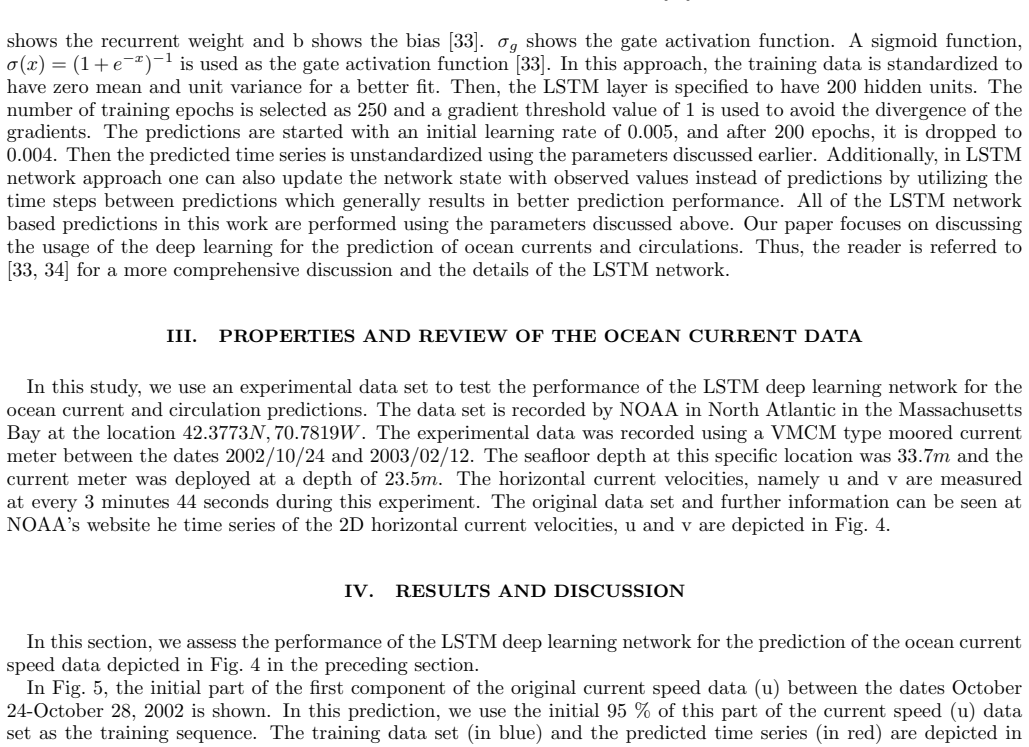
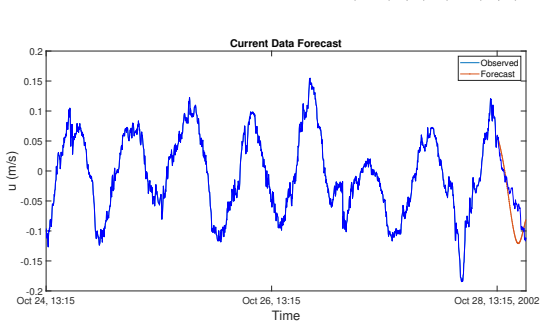
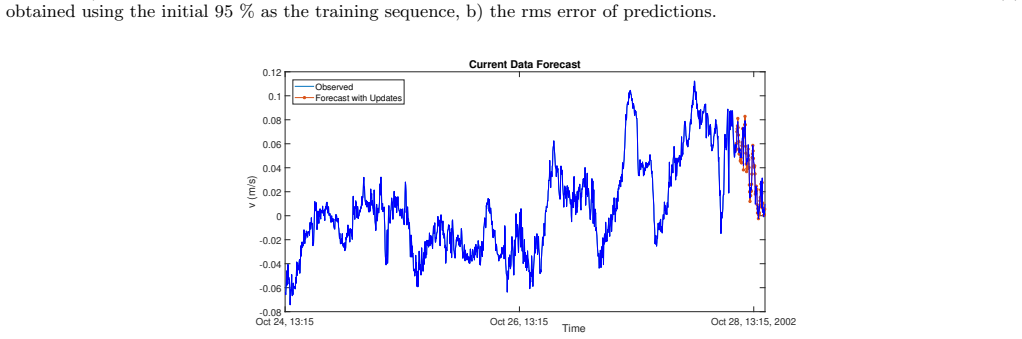
An LSTM network applied to the 2002-2003 Massachusetts Bay current records produces forecasts of the two horizontal velocity components u and v whose accuracy and spectral character depend on the temporal and spatial resolution of the training data.
Load-bearing premise
The accuracy achieved on the single 2002-2003 Massachusetts Bay training period will continue when the same model is applied to other periods or other coastal sites.
Editorial extensions
If this is right
- Forecast skill for u and v improves or degrades directly with the temporal or spatial density of the training records.
- The frequency spectrum of the LSTM output can be made to match the measured spectrum more closely by selecting appropriate training intervals.
- Prediction horizons in time and distance become longer when the data resolution is increased.
- The same trained model supplies inputs for tidal-energy estimates and for calculations of current-induced forces on marine structures.
Reading between the lines
- The method could be tested on real-time buoy streams to see whether forecasts remain stable when new measurements arrive continuously.
- Pairing the LSTM output with a simple physical circulation model might reduce drift over multi-day horizons.
- If the spectral fidelity holds across sites, the approach could help locate regions where chaotic currents block surface waves.
Editorial analysis
A structured set of objections, weighed in public.
Referee Report
Summary. The manuscript applies Long Short-Term Memory (LSTM) networks to predict the u and v components of ocean currents from NOAA buoy measurements collected in Massachusetts Bay between November 2002 and February 2003. It examines how training dataset size and temporal/spatial resolution affect prediction error and the spectral properties of the forecasts, and suggests applications including tidal energy variation, marine structure vibrations, and wave blocking estimation.
Significance. If the reported LSTM forecasts were shown to outperform standard baselines on temporally or spatially disjoint test data while preserving spectral content, the work would establish a viable data-driven method for short-term ocean current prediction. The focus on resolution-dependent prediction horizons and spectral fidelity would then provide concrete guidance on data requirements for operational forecasting in ocean engineering and renewable energy contexts.
major comments (3)
- [Abstract] Abstract: The central claim that 'the current speed in two horizontal directions, namely u and v, can be predicted using the LSTM' is presented without any quantitative error statistics (RMSE, correlation, etc.), baseline comparisons, or description of the train-test split, rendering the result an unverified assertion rather than a demonstrated finding.
- [Experiments/Results] Experiments/Results sections: All reported predictions and spectral comparisons are generated from the single 2002-2003 Massachusetts Bay dataset with no held-out seasons, locations, or cross-validation; without persistence, AR(1), or linear-regression baselines, any apparent accuracy cannot be attributed to learned dynamics rather than short-term autocorrelation already present in the buoy time series.
- [Methods] Methods: No model hyperparameters, regularization strategy, optimizer settings, or loss function are specified, and no numerical values for prediction error as a function of training-set size or resolution are tabulated, preventing assessment or reproduction of the claimed dependence of prediction times/distances on data resolution.
minor comments (1)
- [Abstract] The terms 'prediction times and distances' are used in the abstract without explicit definition or units, and the manuscript does not clarify whether these refer to forecast lead time, spatial extrapolation distance, or both.
Simulated Author's Rebuttal
We thank the referee for the constructive comments on our manuscript. We address each major comment below and indicate the revisions planned.
read point-by-point responses
-
Referee: [Abstract] Abstract: The central claim that 'the current speed in two horizontal directions, namely u and v, can be predicted using the LSTM' is presented without any quantitative error statistics (RMSE, correlation, etc.), baseline comparisons, or description of the train-test split, rendering the result an unverified assertion rather than a demonstrated finding.
Authors: We agree that the abstract should include quantitative support for the central claim. In the revised manuscript we will update the abstract to report key error statistics (RMSE and correlation for u and v) and briefly note the temporal train-test split employed in the study. revision: yes
-
Referee: [Experiments/Results] Experiments/Results sections: All reported predictions and spectral comparisons are generated from the single 2002-2003 Massachusetts Bay dataset with no held-out seasons, locations, or cross-validation; without persistence, AR(1), or linear-regression baselines, any apparent accuracy cannot be attributed to learned dynamics rather than short-term autocorrelation already present in the buoy time series.
Authors: The manuscript is an exploratory study of how training-set size and resolution affect error and spectral fidelity on this specific dataset. We will add persistence and AR(1) baseline comparisons in the revised results to help attribute performance beyond autocorrelation. The original analysis used a temporal split within the available record; we will clarify this and add time-series cross-validation where feasible. However, the study contains only one buoy record from a single season and location. revision: partial
-
Referee: [Methods] Methods: No model hyperparameters, regularization strategy, optimizer settings, or loss function are specified, and no numerical values for prediction error as a function of training-set size or resolution are tabulated, preventing assessment or reproduction of the claimed dependence of prediction times/distances on data resolution.
Authors: We will expand the Methods section to specify the LSTM architecture (layers, hidden units), all hyperparameters, regularization, optimizer, and loss function. We will also add a table reporting numerical prediction errors as a function of training-set size and resolution to support reproducibility and the claimed dependence. revision: yes
- The study is restricted to a single NOAA buoy record from one location and four-month period; results on temporally or spatially disjoint test data from other seasons or locations cannot be provided without new measurements.
Circularity Check
No circularity: LSTM predictions are generated by trained network on data, not algebraically equivalent to inputs.
full rationale
The paper applies a standard LSTM architecture to time-series buoy data from a single NOAA deployment. The claimed predictions of u and v components are produced by forward passes of the trained network on held-out segments of that data; they are not obtained by algebraic rearrangement of the training inputs, by re-using fitted parameters as the output, or by any self-referential definition. No uniqueness theorem, ansatz, or prior self-citation is invoked to force the result. The central claim therefore remains an empirical statement about model performance rather than a tautology. Minor self-citations, if present, are not load-bearing for the prediction step itself.
Assumptions & free parameters
free parameters (1)
- LSTM architecture hyperparameters
assumptions (1)
- domain assumption The measured current time series contains learnable temporal patterns that an LSTM can exploit for multi-step forecasting.
Cite this review
Pith. "Pith review of Predicting the Ocean Currents using Deep Learning." pith.science (2026). https://pith.science/paper/Y4H334IB
@misc{pith2026190608066,
  author       = {Pith},
  title        = {Pith review of: Predicting the Ocean Currents using Deep Learning},
  year         = {2026},
  howpublished = {\url{https://pith.science/paper/Y4H334IB}},
  note         = {Machine review of arXiv:1906.08066}
}
read the original abstract
In this paper, we analyze the predictability of the ocean currents using deep learning. More specifically, we apply the Long Short Term Memory (LSTM) deep learning network to a data set collected by the National Oceanic and Atmospheric Administration (NOAA) in Massachusetts Bay between November 2002-February 2003. We show that the current speed in two horizontal directions, namely u and v, can be predicted using the LSTM. We discuss the effect of training data set on the prediction error and on the spectral properties of predictions. Depending on the temporal or the spatial resolution of the data, the prediction times and distances can vary, and in some cases, they can be very beneficial for the prediction of the ocean current parameters. Our results can find many important applications including but are not limited to predicting the tidal energy variation, controlling the current induced vibrations of marine structures and estimation of the wave blocking point by the chaotic oceanic current and circulation.
Figures


Figures from the paper (17 more)





Forward citations
Cited by 1 Pith paper
-
LOTUSim: Multi-Domain Simulator for Marine Robotics
LOTUSim delivers real-time multi-user HITL simulation of heterogeneous maritime fleets plus an Ekman-layered current model that substantially reduces error versus Gauss–Markov baselines.
Reference graph
Works this paper leans on
-
[1]
P. Richardson, Benjamin Franklin and Timothy Folgers first printed chart of the Gulf Stream, Science, 207, 643, (1980)
work page 1980
-
[2]
R. G. Peterson and L. Stramma and G. Kortum, Early concepts and charts of ocean circulation, Prog. Oceanogr., 37, 1, (1996)
work page 1996
-
[3]
Munk, On the wind driven ocean circulation, J
W.H. Munk, On the wind driven ocean circulation, J. Meteor., 7, 79 (1950)
work page 1950
-
[4]
H. U. Sverdrup, Wind Driven Currents in a Baroclinic Ocean; With Application to the Equatorial Currents of the Eastern Pacific, Proc. Natl. Acad. Sci. USA, 33, 318, (1947)
work page 1947
-
[5]
B. B. Parker, Tidal Hydrodynamics, John Wiley and Sons, New York, (1991)
work page 1991
-
[6]
Stommel, A survey of ocean current theory, Deep Sea Res., 4, 149, (1957)
H. Stommel, A survey of ocean current theory, Deep Sea Res., 4, 149, (1957)
work page 1957
-
[7]
M. Tomczak and J.S. Godfrey, Regional Oceanography: an Introduction, Pergamon Press, Oxford, 1994
work page 1994
-
[8]
Wust, Schichtung und Zirkulation des Atlantisches Ozeans
G. Wust, Schichtung und Zirkulation des Atlantisches Ozeans. Die Stratosphare, Wissenschaftliche Ergebnisse der Deutschen Atlantischen Expedition auf dem Forschungs-und Vermessungsschiff, Meteor. 19251927, 6, 109 (1935)
work page 1935
Show all 34 references
-
[9]
H. U. Sverdrup and M.W. Johnson and R.H. Fleming, The Oceans: Their Physics, Chemistry and General Biology, Prentice Hall, New Jersey, 1942
1942
-
[10]
Siedler and J
G. Siedler and J. Church and J. Gould, Ocean Circulation and Climate: Observing and Modelling the Global Ocean, Academic Press, New York, 2001
2001
-
[11]
O˘ guz and E.¨Ozsoy and M
T. O˘ guz and E.¨Ozsoy and M. A. Latif and H. I. Sur and ¨U. ¨Unlata, Modeling of hydraulically controlled exchange flow in the Bosphorus Strait, J. Phys. Oceanogr., 20, 945, (1990)
1990
-
[12]
Jarosz and W
E. Jarosz and W. J. Teague and J. W. Book and S ¸. Be¸ siktepe, On flow variability in the Bosphorus Strait, J. Geophys. Res., 116, C08038, (2011)
2011
-
[13]
Bayındır, Shapes and statistics of the rogue waves generated by chaotic ocean current, Proc
C. Bayındır, Shapes and statistics of the rogue waves generated by chaotic ocean current, Proc. of the 26th ISOPE, (2016)
2016
-
[14]
Bayındır, Rogue waves of the Kundu-Eckhaus equation in a chaotic wavefield, Phys
C. Bayındır, Rogue waves of the Kundu-Eckhaus equation in a chaotic wavefield, Phys. Rev. E., 93, 032201, (2016)
2016
-
[15]
Bayındır, Rogue wave spectra of the Kundu-Eckhaus equation, Phys
C. Bayındır, Rogue wave spectra of the Kundu-Eckhaus equation, Phys. Rev. E., 93, 062215, (2016)
2016
-
[16]
Bayındır, Early detection of rogue waves by the wavelet transforms, Phys
C. Bayındır, Early detection of rogue waves by the wavelet transforms, Phys. Lett. A, 380, 156, (2016)
2016
-
[17]
Magagna and A
D. Magagna and A. Uihlein, Ocean energy development in Europe: current status and future perspectives, Int. J. Mar. Energy, 11, 84, (2015)
2015
-
[18]
Uihlein and D
A. Uihlein and D. Magagna, Wave and tidal current energy A review of the current state of research beyond technology, Renew. Sust. Energ. Rev., 58, 1070, (2016)
2016
-
[19]
Lynn, Electricity from wave and tide: an introduction to marine energy, John Wiley and Sons, Chichester, UK, 2013
P.A. Lynn, Electricity from wave and tide: an introduction to marine energy, John Wiley and Sons, Chichester, UK, 2013
2013
-
[20]
Roulston and J
M.S. Roulston and J. Ellepola and J. von Hardenberg and L.A. Smith, Forecasting wave height probabilities with numerical weather prediction models, Ocean. Eng., 32, 1841, (2005)
2005
-
[21]
Reikard and P
G. Reikard and P. Pinson and J-R. Bidlot, Forecasting ocean wave energy: the ECMWF wave model and time series methods, Ocean Eng., 38, 1089, (2011)
2011
-
[22]
Bayındır, Compressive spectral method for simulation of the nonlinear gravity waves, Scien
C. Bayındır, Compressive spectral method for simulation of the nonlinear gravity waves, Scien. Rep., 22100 (2016)
2016
-
[23]
Malmberg and U
A. Malmberg and U. Holst and J. Holst, Forecasting near-surface ocean winds with Kalman filter techniques, Ocean Eng., 32, 273, (2005)
2005
-
[24]
Ho and J
P.C. Ho and J. Z. Yim, Wave height forecasting by the transfer function model, Ocean Eng., 33, 1230, (2006)
2006
-
[25]
Londhe and V
S.N. Londhe and V. Panchang, One-day wave forecasts based on artificial neural networks, J. Atmos. Ocean. Technol., 23, 1593, (2006)
2006
-
[26]
Gaur and M.C
S. Gaur and M.C. Deo, Real-time wave forecasting using genetic programming, Ocean. Eng., 35, 1166, (2008)
2008
-
[27]
S. C. James and Y. Zhang and F. O’Donncha, A machine learning framework to forecast wave conditions, Coast. Eng., 137 , 1, (2018)
2018
-
[28]
Jiang and Y
Y. Jiang and Y. Gou and T. Zhang and K. Wang and C. Hu, A Machine Learning Approach to Argo Data Analysis in a Thermocline, Sensors, 17, 2225, (2017)
2017
-
[29]
Hollinger and A
G. Hollinger and A. Pereira and V. Ortenzi and G. Sukhatme, Towards improved prediction of ocean processes using statistical machine learning, Proc. Robotics: Science and Systems Workshop on Robotics for Environmental Monitoring (RSS), Sydney, Australia, (2012)
2012
-
[30]
Sarkar and M
D. Sarkar and M. A. Osborne and T. A. Adcock, Spatiotemporal prediction of tidal currents using Gaussian processes, J. Geophy. Res.: Oceans, (2019). doi:10.1029/2018jc014471
2019 doi
-
[31]
Bolton and L
T. Bolton and L. Zanna, Applications of Deep Learning to Ocean Data Inference and Subgrid Parameterization, J. Adv. Model. Earth Sys., 11, 376, (2019). 11
2019
-
[32]
D. J. C. MacKay, Information theory, inference and learning algorithms, Cambridge University Press, Cambridge, UK , 2003
2003
-
[33]
Hochreiter and J
S. Hochreiter and J. Schmidhuber, Long Short-Term Memory, Neur. Comp., 9, 1735, (1997)
1997
-
[34]
Greff and R
K. Greff and R. K. Srivastava and J. Koutnik and B. R. Steunebrink and J. Schmidhuber, LSTM: A search space odyssey, IEEE Trans. on Neur. Netw. and Learn. Sys., 28, 2222, (2015)
2015
Reviewed May 25, 2026 · model on record in the stance chip above.
Discussion (0). Continue with ORCID to comment.