The Self-energy of Nucleon in the Pseudovector Coupling Pion-nucleon System for the Electromagnetic Form Factor of Proton
Pith reviewed 2026-05-25 19:25 UTC · model grok-4.3
The pith
Incorporating a non-perturbative term into the nucleon self-energy corrects the Q^2 dependence of the proton electromagnetic form factor.
A machine-rendered reading of the paper's core claim, the machinery that carries it, and where it could break.
Core claim
The non-perturbative term is incorporated to correct the Q^2 dependence of the electromagnetic form factor of the proton in the pseudovector coupling pion-nucleon system.
What carries the argument
The non-perturbative term added to the nucleon self-energy in the pseudovector coupling pion-nucleon system
If this is right
- The proton electromagnetic form factor now follows the observed Q^2 dependence more closely than without the term.
- The same self-energy framework that was used for the anomalous magnetic moment extends consistently to the form factor.
- Pion-nucleon interaction effects captured through the self-energy influence the momentum-transfer behavior at finite Q^2.
Where Pith is reading between the lines
- The method could be applied to the neutron electromagnetic form factor or to other static properties of the nucleon.
- Direct numerical comparison with high-Q^2 data or with lattice results would test whether the correction remains accurate beyond the range studied.
- Success would indicate that selected non-perturbative contributions in effective pion-nucleon models can reproduce key features of nucleon structure.
Load-bearing premise
The pseudovector coupling pion-nucleon system together with the added non-perturbative term gives a valid description of how nucleon self-energy affects the proton electromagnetic form factor.
What would settle it
A direct comparison showing that the calculated form factor still deviates from experimental data at moderate to high Q^2 after the non-perturbative term is included would falsify the claimed correction.
Figures
read the original abstract
The electromagnetic form factor of proton is studied following our previous calculation of the anomalous magnetic moment. The non-perturbative term is incorporated to correct the $Q^2$ dependence.
Editorial analysis
A structured set of objections, weighed in public.
Referee Report
Summary. The manuscript studies the electromagnetic form factor of the proton within the nucleon self-energy calculated in the pseudovector pion-nucleon coupling model. It extends the author's prior calculation of the anomalous magnetic moment by incorporating an unspecified non-perturbative term whose purpose is to correct the Q² dependence of the form factor.
Significance. If a well-defined, non-ad-hoc non-perturbative term were derived and shown to reproduce empirical form-factor data while preserving consistency with the prior anomalous-moment result, the work could contribute to effective descriptions of nucleon structure. As presented, however, the absence of any explicit expression, derivation, or numerical comparison prevents assessment of whether the approach yields new insight or merely adjusts the Q² behavior by construction.
major comments (2)
- [Abstract] Abstract: the central claim that a non-perturbative term corrects the Q² dependence is stated without any equation defining the term, its insertion into the self-energy, or the resulting expression for the form factor; this omission renders the claim unevaluable.
- The manuscript provides no comparison of the corrected form factor to experimental data, no error analysis, and no demonstration that the added term is independent of the parameters already fixed in the preceding anomalous-magnetic-moment calculation.
Simulated Author's Rebuttal
We thank the referee for the thorough review of our manuscript. Below we provide point-by-point responses to the major comments, noting the revisions that will be made to address the identified issues.
read point-by-point responses
-
Referee: [Abstract] Abstract: the central claim that a non-perturbative term corrects the Q² dependence is stated without any equation defining the term, its insertion into the self-energy, or the resulting expression for the form factor; this omission renders the claim unevaluable.
Authors: We agree with this observation. The current abstract is brief and does not include the defining equation. In the revised manuscript, we will expand the abstract to include the expression for the non-perturbative term and how it is incorporated into the self-energy. revision: yes
-
Referee: The manuscript provides no comparison of the corrected form factor to experimental data, no error analysis, and no demonstration that the added term is independent of the parameters already fixed in the preceding anomalous-magnetic-moment calculation.
Authors: This comment correctly identifies omissions in the manuscript. We will revise the manuscript to include a comparison of the form factor to experimental data, an error analysis, and an explicit demonstration that the non-perturbative term does not alter the parameters fixed in the prior calculation. revision: yes
Circularity Check
No significant circularity identified
full rationale
The provided abstract states that the electromagnetic form factor is studied following a previous calculation and that a non-perturbative term corrects the Q^2 dependence, but supplies no equations, no explicit functional form for the term, and no derivation chain that reduces a claimed prediction to a fitted input or self-citation by construction. Without load-bearing equations or a demonstrated equivalence between output and input, the derivation cannot be shown to collapse into its own premises. The paper therefore remains self-contained against the supplied text.
Axiom & Free-Parameter Ledger
free parameters (1)
- non-perturbative term coefficient
axioms (1)
- domain assumption Pseudovector coupling provides an appropriate description of the pion-nucleon interaction for nucleon self-energy.
Reference graph
Works this paper leans on
-
[1]
The Self-energy of Nucleon for the Anomalous Magnetic Moment
S. Kinpara, arXiv:nucl-th/1809.00475
work page internal anchor Pith review Pith/arXiv arXiv
-
[2]
M. N. Rosenbluth, Phys. Rev. 79, 615 (1950)
work page 1950
-
[3]
Measurement of GEp/GMp in ep -> ep to Q2 = 5.6 GeV2
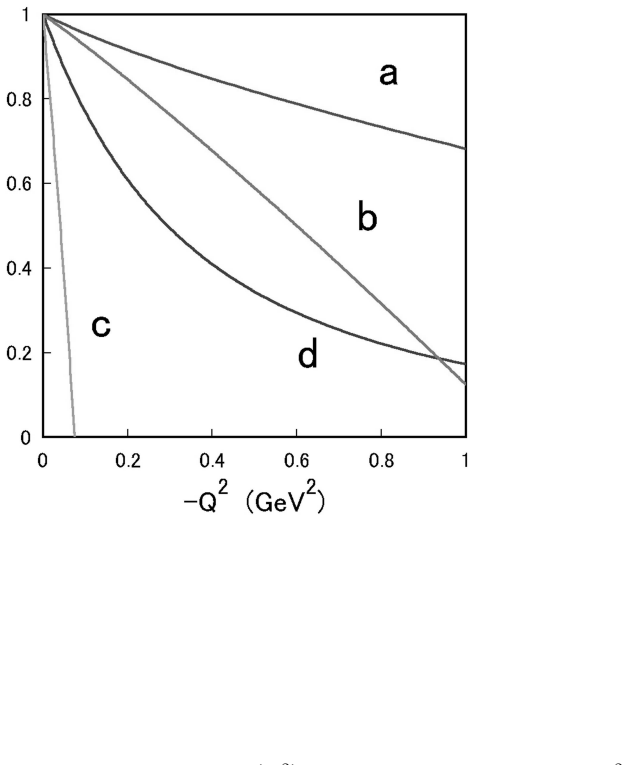
O. Gayou et al ., arXiv:nucl-ex/0111010v2. 9 Figure 1: The electric form factors GE(Q2) are shown as a function of −Q2. a: the result of the calculation with F1(Q2) ≡ 1. b: including the lowest- order self-energy effect on F1(Q2). c: including the full self-energy effect on F1(Q2). d: the dipole form factor GD(Q2) = (1 − Q2/ 0. 71)−2. 10
work page internal anchor Pith review Pith/arXiv arXiv
discussion (0)
Sign in with ORCID, Apple, or X to comment. Anyone can read and Pith papers without signing in.