Aspects of heavy flavor jet physics in heavy ion collisions
Pith reviewed 2026-05-25 18:42 UTC · model grok-4.3
The pith
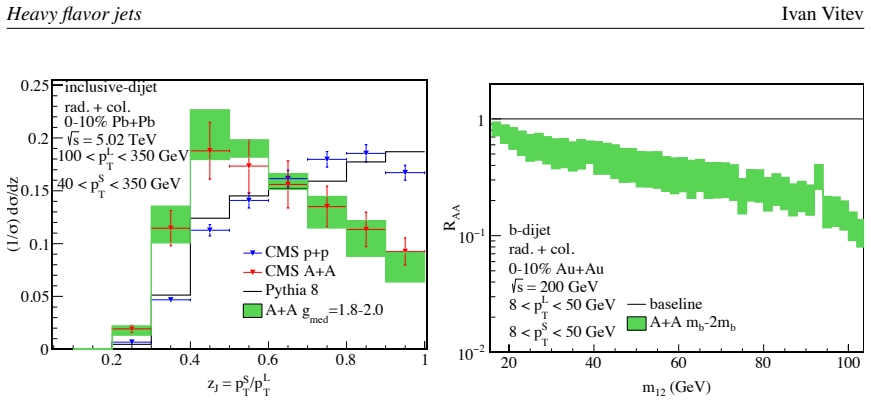
The semi-inclusive jet function formalism applies to heavy flavor jet production in proton-nucleus and nucleus-nucleus collisions.
A machine-rendered reading of the paper's core claim, the machinery that carries it, and where it could break.
Core claim
The central claim is that soft-collinear effective theory techniques bridge high-energy QCD and heavy-ion phenomenology, shown by the first application of the semi-inclusive jet function formalism to heavy flavor jet production in proton-nucleus and nucleus-nucleus collisions at the LHC; this is paired with a new formalism that computes branching processes in nuclear matter to any order in opacity, and with the identification of dijet mass modification as an observable that enhances sensitivity to parton energy loss while allowing sharper study of heavy-quark mass effects on shower formation.
What carries the argument
The semi-inclusive jet function formalism, which encodes jet production cross sections and incorporates medium modifications for heavy flavor jets.
If this is right
- Dijet mass modification supplies enhanced sensitivity to parton energy loss in nuclear matter.
- The same observable permits more precise examination of heavy quark mass effects on parton shower formation.
- Heavy flavor jet cross sections in proton-nucleus and nucleus-nucleus collisions at the LHC can be computed with the semi-inclusive jet function formalism.
- Branching processes in nuclear matter can be evaluated to any desired order in opacity.
Where Pith is reading between the lines
- These calculations could tighten constraints on the transport properties of the quark-gluon plasma extracted from jet data.
- The opacity expansion for branching may be tested against other high-energy processes that involve dense media.
- The same jet-function methods could be extended to additional observables such as jet fragmentation or substructure in heavy ion collisions.
Load-bearing premise
The semi-inclusive jet function formalism developed for high-energy collisions can be applied to heavy flavor jets in nuclear collisions using only the standard medium modifications already included in the setup.
What would settle it
A measurement of the dijet mass distribution in lead-lead collisions at the LHC that differs substantially from the distribution calculated with the semi-inclusive jet function formalism after medium effects are added.
Figures


read the original abstract
n these proceedings I discuss several recent developments in the physics of heavy flavor jets in heavy ion collisions. i) The dijet mass modification in nucleus-nucleus reactions has been proposed as a new observable with enhanced sensitivity to parton energy loss in nuclear matter. It also enables more precise studies of heavy quark mass effects on parton shower formation. ii) Computational techniques from soft-collinear effective theory have allowed us to bridge the gap between high energy and heavy ion QCD phenomenology. I show the first application of the semi-inclusive jet function formalism to heavy flavor jet production in proton-nucleus and nucleus-nucleus collisions at the LHC. iii) Last but not least, central to the theoretical calculations of heavy flavor jets is the accurate theoretical description of in-medium parton showers. A formalism to compute branching processes in nuclear matter to any desired order in opacity has been developed and illustrative numerical results are presented.
Editorial analysis
A structured set of objections, weighed in public.
Referee Report
Summary. This proceedings paper discusses three developments in heavy flavor jet physics in heavy ion collisions: (i) the proposal of dijet mass modification in nucleus-nucleus reactions as a new observable sensitive to parton energy loss and enabling precise studies of heavy quark mass effects on parton showers; (ii) the first application of the SCET semi-inclusive jet function formalism to heavy flavor jet production in pA and AA collisions at the LHC; and (iii) a new formalism for computing in-medium branching processes to arbitrary order in opacity, accompanied by illustrative numerical results.
Significance. If the central claims hold, the work bridges high-energy SCET techniques with heavy-ion phenomenology by providing a systematic opacity expansion and new observables. The arbitrary-order opacity formalism for branching processes, if reproducible and validated against known limits, represents a concrete technical advance for medium-modified showers.
major comments (2)
- [Abstract, point (ii)] Abstract, point (ii): the claim that the semi-inclusive jet function formalism applies directly to heavy flavor jets with only 'standard medium modifications' is load-bearing for the assertion of more precise heavy-quark mass studies, yet the manuscript provides no explicit matching or operator adjustment showing that dead-cone suppression and mass-dependent modifications to the in-medium kernel are automatically captured by the massless SCET construction.
- [Abstract, point (iii)] Abstract, point (iii): while a formalism for branching to any order in opacity is announced, the absence of the explicit recursion relation or kernel (and any demonstration that it reduces to the known first-order result) prevents assessment of whether the central computational claim is internally consistent.
minor comments (2)
- [Abstract] Abstract opening sentence contains a typographical error ('n these proceedings' instead of 'In these proceedings').
- The manuscript would benefit from a short table or equation block summarizing the opacity expansion order-by-order to make the numerical results more transparent.
Simulated Author's Rebuttal
We thank the referee for the careful reading of our proceedings contribution and the constructive feedback on the abstract claims. We address each major comment below and will incorporate clarifications into a revised version.
read point-by-point responses
-
Referee: [Abstract, point (ii)] Abstract, point (ii): the claim that the semi-inclusive jet function formalism applies directly to heavy flavor jets with only 'standard medium modifications' is load-bearing for the assertion of more precise heavy-quark mass studies, yet the manuscript provides no explicit matching or operator adjustment showing that dead-cone suppression and mass-dependent modifications to the in-medium kernel are automatically captured by the massless SCET construction.
Authors: The semi-inclusive jet function formalism is applied to heavy-flavor jets by retaining the heavy-quark mass in the jet function definition while using medium-modified splitting kernels that incorporate mass-dependent effects such as dead-cone suppression. However, the proceedings manuscript does not contain an explicit operator matching or derivation demonstrating how these mass-dependent in-medium modifications arise from the massless SCET construction. We agree that adding a concise clarification or reference to the detailed matching performed in the underlying work would strengthen the presentation and will revise the text accordingly. revision: yes
-
Referee: [Abstract, point (iii)] Abstract, point (iii): while a formalism for branching to any order in opacity is announced, the absence of the explicit recursion relation or kernel (and any demonstration that it reduces to the known first-order result) prevents assessment of whether the central computational claim is internally consistent.
Authors: The arbitrary-order opacity formalism is constructed via a recursive relation for the in-medium branching probabilities. Space constraints in the proceedings format prevented inclusion of the explicit recursion and the explicit reduction to the first-order result. We will add both the recursion relation and the first-order consistency check in the revised manuscript so that the internal consistency of the formalism can be directly assessed. revision: yes
Circularity Check
No significant circularity; new applications and formalisms are independent of inputs
full rationale
The paper presents a proposal for dijet mass as a new observable, the first application of an existing SCET semi-inclusive jet function to heavy-flavor jets in nuclear collisions, and a new opacity-expansion formalism for in-medium branching. None of these reduce by construction to fitted parameters, self-definitions, or load-bearing self-citations; the central claims are extensions and applications whose validity rests on external SCET and medium-induced radiation calculations rather than tautological renaming or statistical forcing. The provided text contains no equations or derivations that equate outputs to inputs by definition.
Axiom & Free-Parameter Ledger
Lean theorems connected to this paper
-
IndisputableMonolith/Foundation/RealityFromDistinction.leanreality_from_one_distinction unclear?
unclearRelation between the paper passage and the cited Recognition theorem.
NLO medium correction to the Q→JQ SiJF... Pmed_QQ(z,m,q⊥) is the medium-induced heavy quark splitting kernel
What do these tags mean?
- matches
- The paper's claim is directly supported by a theorem in the formal canon.
- supports
- The theorem supports part of the paper's argument, but the paper may add assumptions or extra steps.
- extends
- The paper goes beyond the formal theorem; the theorem is a base layer rather than the whole result.
- uses
- The paper appears to rely on the theorem as machinery.
- contradicts
- The paper's claim conflicts with a theorem or certificate in the canon.
- unclear
- Pith found a possible connection, but the passage is too broad, indirect, or ambiguous to say the theorem truly supports the claim.
Reference graph
Works this paper leans on
-
[1]
Heavy-flavour and quarkonium production in the LHC era: from proton-proton to heavy-ion collisions
A. Andronic et al., Heavy-flavour and quarkonium production in the LHC era: from proton-proton to heavy-ion collisions, Eur. Phys. J.C76 (2016) 107 [1506.03981]
work page internal anchor Pith review Pith/arXiv arXiv 2016
-
[2]
Inclusive b-jet production in heavy ion collisions at the LHC
J. Huang, Z.-B. Kang and I. Vitev, Inclusive b-jet production in heavy ion collisions at the LHC, Phys. Lett. B726 (2013) 251 [1306.0909]
work page internal anchor Pith review Pith/arXiv arXiv 2013
-
[3]
F. Senzel, J. Uphoff, Z. Xu and C. Greiner, The different energy loss mechanisms of inclusive and b-tagged reconstructed jets within ultra-relativistic heavy-ion collisions, Phys. Lett. B773 (2017) 620 [1602.05086]
work page internal anchor Pith review Pith/arXiv arXiv 2017
-
[4]
H. T. Li and I. Vitev, Inverting the mass hierarchy of jet quenching effects with prompt b-jet substructure, Phys. Lett. B793 (2019) 259 [1801.00008]
work page internal anchor Pith review Pith/arXiv arXiv 2019
- [5]
-
[6]
CMS collaboration, Evidence of b-Jet Quenching in PbPb Collisions at√sNN = 2.76 TeV, Phys. Rev. Lett. 113 (2014) 132301 [1312.4198]
work page internal anchor Pith review Pith/arXiv arXiv 2014
-
[7]
CMS collaboration, Comparing transverse momentum balance of b jet pairs in pp and PbPb collisions at√sNN = 5.02 TeV, JHEP 03 (2018) 181 [1802.00707]. 5 Heavy flavor jets Ivan Vitev
work page internal anchor Pith review Pith/arXiv arXiv 2018
-
[8]
H. Hassan, Charm jet production and properties in pp, p-Pb, and PbPb collisions measured with ALICE at the LHC, in 19th International Workshop on Charm Physics (CHARM 2018), (Novosibirsk, Russia), May, 2018, https://hal.archives-ouvertes.fr/hal-01846896
work page 2018
-
[9]
PHENIX collaboration, An Upgrade Proposal from the PHENIX Collaboration, 1501.06197
work page internal anchor Pith review Pith/arXiv arXiv
-
[10]
Z.-B. Kang, J. Reiten, I. Vitev and B. Yoon, Light and heavy flavor dijet production and dijet mass modification in heavy ion collisions, Phys. Rev. D99 (2019) 034006 [1810.10007]
work page internal anchor Pith review Pith/arXiv arXiv 2019
-
[11]
Heavy Quark Radiative Energy Loss in QCD Matter
M. Djordjevic and M. Gyulassy, Heavy quark radiative energy loss in QCD matter, Nucl. Phys. A733 (2004) 265 [nucl-th/0310076]
work page internal anchor Pith review Pith/arXiv arXiv 2004
- [12]
- [13]
-
[14]
Z.-B. Kang, F. Ringer and I. Vitev, Effective field theory approach to open heavy flavor production in heavy-ion collisions, JHEP 03 (2017) 146 [1610.02043]
work page internal anchor Pith review Pith/arXiv arXiv 2017
- [15]
-
[16]
M. D. Sievert, I. Vitev and B. Yoon, A complete set of in-medium splitting functions to any order in opacity, 1903.06170
work page internal anchor Pith review Pith/arXiv arXiv 1903
-
[17]
CMS collaboration, Measurements of the charm jet cross section and nuclear modification factor in pPb collisions at√sNN = 5.02 TeV, Phys. Lett. B772 (2017) 306 [1612.08972]
work page internal anchor Pith review Pith/arXiv arXiv 2017
-
[18]
CMS collaboration, Transverse momentum spectra of inclusive b jets in pPb collisions at√sNN = 5.02 TeV, Phys. Lett. B754 (2016) 59 [1510.03373]
work page internal anchor Pith review Pith/arXiv arXiv 2016
-
[19]
M. D. Sievert and I. Vitev, Quark branching in QCD matter to any order in opacity beyond the soft gluon emission limit, Phys. Rev. D98 (2018) 094010 [1807.03799]
work page internal anchor Pith review Pith/arXiv arXiv 2018
-
[20]
Intensity of gluon bremsstrahlung in a finite plasma
X. Feal and R. Vazquez, Intensity of gluon bremsstrahlung in a finite plasma, Phys. Rev. D98 (2018) 074029 [1811.01591]. 6
work page internal anchor Pith review Pith/arXiv arXiv 2018
discussion (0)
Sign in with ORCID, Apple, or X to comment. Anyone can read and Pith papers without signing in.