Diffusion mechanism of exciplex. 2. Energy transfer mechanism
Pith reviewed 2026-05-25 17:47 UTC · model grok-4.3
The pith
Energy transfer between exciplexes occurs dominantly via the Dexter-type exchange mechanism.
A machine-rendered reading of the paper's core claim, the machinery that carries it, and where it could break.
Core claim
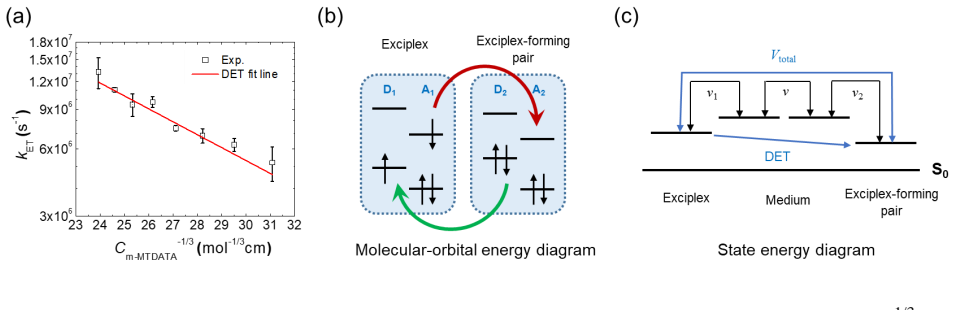
The energy transfer takes place dominantly via the Dexter-type exchange mechanism, from the exponential decrease of the ET rate constant with separation between exciplexes.
What carries the argument
Dexter-type exchange mechanism, identified as dominant because the ET rate constant decreases exponentially with the separation distance between exciplexes.
If this is right
- Exciplex diffusion in organic devices proceeds through this Dexter energy transfer pathway.
- The charge-transfer absorption of the exciplex state enables diffusion by supporting the observed energy transfer.
- ET rate constants can be predicted from the separation between exciplexes using the exponential dependence.
- Device performance improvements can be guided by controlling molecular separations that govern the Dexter process.
Where Pith is reading between the lines
- Materials engineered for specific intermolecular distances could tune exciplex diffusion rates in devices.
- Similar distance-dependent measurements could test whether the Dexter conclusion holds in other charge-transfer complexes.
- Orientation effects might still modulate the rate in aligned molecular films even if the average dependence remains exponential.
Load-bearing premise
The exponential dependence of the ET rate constant on separation distance is interpreted as diagnostic of the Dexter mechanism without significant contributions from other processes such as orientation effects or competing pathways.
What would settle it
A measurement showing the ET rate constant does not decrease exponentially with separation distance, for example following an inverse sixth-power law instead, would falsify the claim of Dexter dominance.
Figures
read the original abstract
Excited-state charge-transfer complexes (exciplexes) have been actively exploited in organic optoelectronic devices to improve performance; however, diffusion of exciplexes has not been actively studied despite its influence on performance due to the lack of apparent charge-transfer absorption. In the preceding paper, we studied the energy transfer (ET) from exciplexes to exciplex-forming pairs in relation to the charge-transfer absorption of the exciplex state, resulting in the exciplex diffusion. In this paper, we report that the ET takes place dominantly via the Dexter-type exchange mechanism, from the exponential decrease of the ET rate constant with separation between exciplexes.
Editorial analysis
A structured set of objections, weighed in public.
Referee Report
Summary. The manuscript claims that energy transfer (ET) from exciplexes to exciplex-forming pairs occurs dominantly via the Dexter-type exchange mechanism. This conclusion is drawn from the observed exponential decrease of the ET rate constant with increasing separation between exciplexes, presented as the second part of a study on exciplex diffusion in organic optoelectronic devices following a preceding paper on charge-transfer absorption.
Significance. If substantiated with rigorous exclusion of alternatives, the result would clarify the mechanism underlying exciplex diffusion and its impact on device performance. The experimental focus on rate vs. distance is a standard diagnostic approach in the field, and the absence of free parameters or invented entities in the reported claim is a positive feature.
major comments (1)
- [Abstract] Abstract: the conclusion that the mechanism is 'dominantly' Dexter-type rests on interpreting the exponential distance dependence as a unique signature. This interpretive step does not include explicit tests (e.g., Dexter overlap integrals, Förster-rate upper bounds at the accessed distances, or orientation-averaged simulations) to exclude contributions from orientation effects, local-environment variations, or minor longer-range processes that could produce similar behavior over the experimental window.
Simulated Author's Rebuttal
We thank the referee for the detailed comment on our manuscript. The concern centers on whether the exponential distance dependence alone suffices to establish dominance of the Dexter mechanism without additional explicit checks against alternatives. We respond to this point directly below.
read point-by-point responses
-
Referee: [Abstract] Abstract: the conclusion that the mechanism is 'dominantly' Dexter-type rests on interpreting the exponential distance dependence as a unique signature. This interpretive step does not include explicit tests (e.g., Dexter overlap integrals, Förster-rate upper bounds at the accessed distances, or orientation-averaged simulations) to exclude contributions from orientation effects, local-environment variations, or minor longer-range processes that could produce similar behavior over the experimental window.
Authors: The exponential decay of the ET rate constant with separation is the established experimental signature of Dexter exchange transfer, while Förster transfer follows a distinctly different r^{-6} dependence. Our data exhibit a clean exponential form over the full accessed separation range with no systematic deviation that would indicate a significant longer-range component. Orientation effects and local-environment variations are already averaged in the experimental design (multiple host matrices and random molecular orientations), and any such fluctuations would broaden rather than produce the observed sharp exponential. We did not compute Dexter overlap integrals or explicit Förster upper bounds in the original manuscript because the functional form of the distance dependence itself rules out Förster dominance within the measured window; however, we agree that adding a quantitative bound on possible Förster contributions would strengthen the presentation and will include this in the revised version. revision: partial
Circularity Check
No significant circularity; claim rests on experimental distance dependence
full rationale
The paper's central claim—that energy transfer occurs dominantly via Dexter exchange—is presented as following directly from the observed exponential decrease of the ET rate constant with exciplex separation. This is an interpretive inference from measured data trends rather than any self-definitional loop, fitted parameter renamed as prediction, or load-bearing self-citation that reduces the result to its own inputs. The preceding paper is referenced only for context on exciplex diffusion and does not supply the distance-dependence result itself. No equations or uniqueness theorems are invoked that collapse the conclusion by construction. The derivation is therefore self-contained against external benchmarks of mechanism assignment via functional form of rate vs. distance.
Axiom & Free-Parameter Ledger
axioms (1)
- domain assumption Exponential dependence of energy transfer rate on donor-acceptor separation is diagnostic of Dexter exchange mechanism
Reference graph
Works this paper leans on
-
[1]
T. Strobel, C. Deibel, and V. Dyakonov, Role of polaron pair diffusion and surface losses in organic semiconductor devices, Phys. Rev. Lett. 105, 1 (2010)
work page 2010
-
[2]
P. B. Deotare, W. Chang, E. Hontz, D. N. Congreve, L. Shi, P. D. Reusswig, B. Modtland, M. E. Bahlke, C. K. Lee, A. P. Willard, V. Bulović, T. Van Voorhis, and M. A. Baldo, Nanoscale transport of charge-transfer states in organic donor-acceptor blends., Nat. Mater. 14, 1130 (2015)
work page 2015
-
[3]
S. Speiser, Photophysics and Mechanisms of Intramolecular Electronic Energy Transfer in Bichromophoric Molecular Systems : Solution and Supersonic Jet Studies Photophysics and Mechanisms of Intramolecular Electronic Energy Transfer in Bichromophoric Molecular Systems, Chem. Rev. 96, 1953 (1996)
work page 1953
-
[5]
Y. Zhang and S. R. Forrest, Triplet diffusion leads to triplet–triplet annihilation in organic phosphorescent emitters, Chem. Phys. Lett. 590, 106 (2013)
work page 2013
-
[6]
B. Albinsson and J. Martensson, Excitation energy transfer in donor–bridge–acceptor systems, Phys. Chem. Chem. Phys. 12, 7338 (2010)
work page 2010
- [7]
-
[8]
J. K. Klosterman, M. Iwamura, T. Tahara, and M. Fujita, Energy transfer in a mechanically trapped exciplex, J. Am. Chem. Soc. 131, 9478 (2009)
work page 2009
-
[9]
T. M. Clarke and J. R. Durrant, Charge photogeneration in organic solar cells, Chem. Rev. 110, 6736 (2010)
work page 2010
-
[10]
Förster, Zwischenmolekulare energiewanderung und fluoreszenz, Ann
T. Förster, Zwischenmolekulare energiewanderung und fluoreszenz, Ann. Phys. 437, 55 (1948)
work page 1948
- [11]
-
[12]
K. Vandewal, A. Gadisa, W. D. Oosterbaan, S. Bertho, F. Banishoeib, I. Van Severen, L. Lutsen, T. J. Cleij, D. Vanderzande, and J. V. Manca, The relation between open-circuit voltage and the onset of photocurrent generation by charge-transfer absorption in polymer: Fullerene bulk heterojunction solar cells, Adv. Funct. Mater. 18, 2064 (2008)
work page 2064
-
[13]
K. Vandewal, S. Albrecht, E. T. Hoke, K. R. Graham, J. Widmer, J. D. Douglas, M. Schubert, W. R. Mateker, J. T. Bloking, G. F. Burkhard, A. Sellinger, J. M. J. Fréchet, A. Amassian, M. K. Riede, M. D. McGehee, D. Neher, and A. Salleo, Efficient charge generation by relaxed charge-transfer states at organic interfaces, Nat. Mater. 13, 63 (2014)
work page 2014
-
[14]
J. M. Szarko, J. Guo, Y. Liang, B. Lee, B. S. Rolczynski, J. Strzalka, T. Xu, S. Loser, T. J. Marks, L. Yu, and L. X. Chen, When function follows form: Effects of donor copolymer side chains on film morphology and BHJ solar cell performance, Adv. Mater. 22, 5468 (2010)
work page 2010
-
[15]
J. M. Szarko, J. Guo, B. S. Rolczynski, and L. X. Chen, Current trends in the optimization of low band gap polymers in bulk heterojunction photovoltaic devices, J. Mater. Chem. 21, 7849 (2011)
work page 2011
- [16]
-
[17]
D. L. Dexter, A Theory of Sensitized Luminescence in Solids, J. Chem. Phys. 21, 836 (1953)
work page 1953
-
[18]
N. W. Ashcroft and N. D. Mermin, Solid State Physics, Holt, Rinehart and Winston (1976)
work page 1976
-
[19]
H. M. McConnell, Intramolecular charge transfer in aromatic free radicals, J. Chem. Phys. 35, 508 (1961)
work page 1961
-
[20]
M. P. Eng and B. Albinsson, Non-exponential distance dependence of bridge-mediated electronic coupling, Angew. Chemie - Int. Ed. 45, 5626 (2006)
work page 2006
-
[21]
B. Albinsson, M. P. Eng, K. Pettersson, and M. U. Winters, Electron and energy transfer in donor–acceptor systems with conjugated molecular bridges, Phys. Chem. Chem. Phys. 9, 5847 (2007)
work page 2007
-
[22]
A. Harriman, A. Khatyr, R. Ziessel, and A. C. Benniston, An unusually shallow distance- dependence for triplet-energy transfer, Angew. Chemie - Int. Ed. 39, 4287 (2000)
work page 2000
-
[23]
N. J. Turro, Modern Molecular Photochemistry, University Science Books (1991)
work page 1991
-
[24]
S. Pillai and P. C. Van der Vliet, FRET and FLIM Techniques, Elsevier, UK (2009)
work page 2009
-
[25]
H.-B. Kim and J.-J. Kim, A simple method to measure intermolecular charge-transfer absorption of organic films, Org. Electron. physics, Mater. Appl. 62, 511 (2018)
work page 2018
-
[26]
M. Kuik, L. J. A. Koster, G. A. H. Wetzelaer, and P. W. M. Blom, Trap-assisted recombination in disordered organic semiconductors, Phys. Rev. Lett. 107, 256805 (2011)
work page 2011
-
[27]
W. Y. Hung, G. C. Fang, S. W. Lin, S. H. Cheng, K. T. Wong, T. Y. Kuo, and P. T. Chou, The first tandem, all-exciplex-based WOLED, Sci. Rep. 4, 1 (2014)
work page 2014
- [28]
-
[29]
I. R. Gould, N. J. Turro, and M. B. Zimmt, Magnetic field and magnetic isotope effects on the products of organic reactions, Adv. Phys. Org. Chem. 20, 1 (1984)
work page 1984
- [30]
-
[31]
R. Geng, T. T. Daugherty, K. Do, H. M. Luong, and T. D. Nguyen, A review on organic spintronic materials and devices: I. Magnetic field effect on organic light emitting diodes, J. Sci. Adv. Mater. Devices 1, 128 (2016)
work page 2016
-
[32]
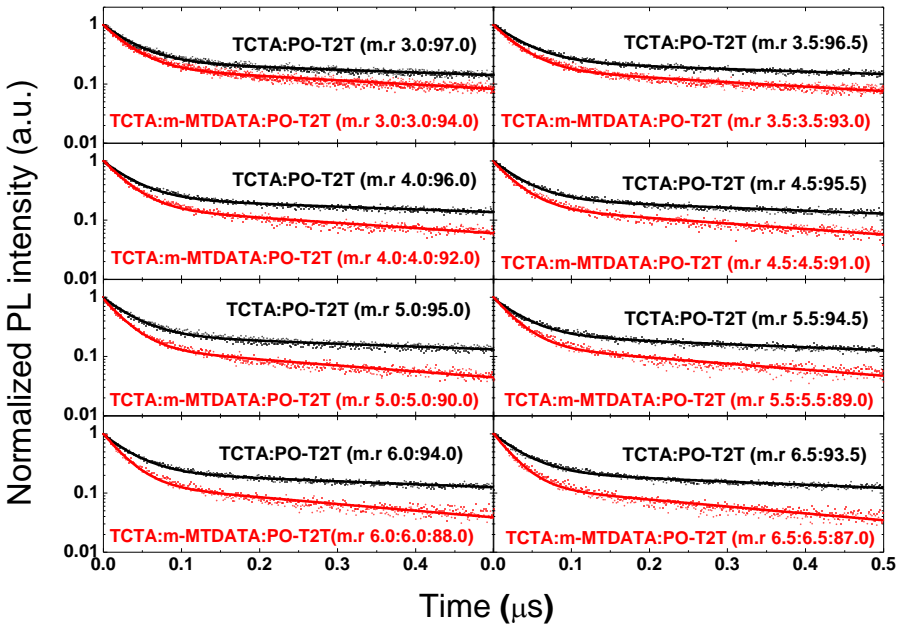
Y. Wang, K. Sahin-Tiras, N. J. Harmon, M. Wohlgenannt, and M. E. Flatté, Immense magnetic response of exciplex light emission due to correlated spin-charge dynamics, Phys. Rev. X 6, 011011 (2016). FIG. 1. Normalized transient PL intensities in the wavelength range 510 to 530 nm, where the PL of the TCTA:PO-T2T exciplex is dominant in TCTA:PO-T2T films and...
work page 2016
discussion (0)
Sign in with ORCID, Apple, or X to comment. Anyone can read and Pith papers without signing in.