Efficient interpolation and evolution of parton distribution functions
Pith reviewed 2026-05-25 17:23 UTC · model grok-4.3
The pith
Chebyshev interpolation solves DGLAP equations for PDFs with higher accuracy using fewer grid points.
A machine-rendered reading of the paper's core claim, the machinery that carries it, and where it could break.
Core claim
The central claim is that Chebyshev interpolation of PDFs and DPDs on a suitably transformed grid provides an efficient numerical solution of the DGLAP equations. For PDF evolution this yields higher accuracy with a considerably smaller number of grid points compared to other methods. The DPD evolution uses an affordable number of points and permits two independent renormalization scales for the two partons. Both implementations include NNLO DGLAP kernels and flavor matching.
What carries the argument
Chebyshev interpolation of the parton distribution functions on a suitably transformed grid, which preserves accuracy when solving the DGLAP integro-differential equations numerically.
If this is right
- PDF evolution achieves higher accuracy with a considerably smaller number of grid points.
- DPD evolution becomes feasible with an affordable number of grid points while allowing two independent renormalization scales.
- Both single and double parton distribution evolution support NNLO DGLAP kernels and flavor matching at thresholds.
Where Pith is reading between the lines
- The smaller grid requirement could reduce the computational expense of repeated evolutions inside global PDF fits.
- The interpolation scheme might extend to other integro-differential equations appearing in QCD resummation.
- Higher numerical precision at modest cost could tighten theoretical error bands on collider observables that depend on evolved distributions.
Load-bearing premise
Chebyshev interpolation of the parton distribution functions on a suitably transformed grid preserves the required accuracy when solving the DGLAP integro-differential equations numerically.
What would settle it
A direct numerical comparison at fixed small grid size between this method and a standard evolution code against a high-resolution reference solution, checking whether the error for the Chebyshev approach is demonstrably smaller.
Figures


read the original abstract
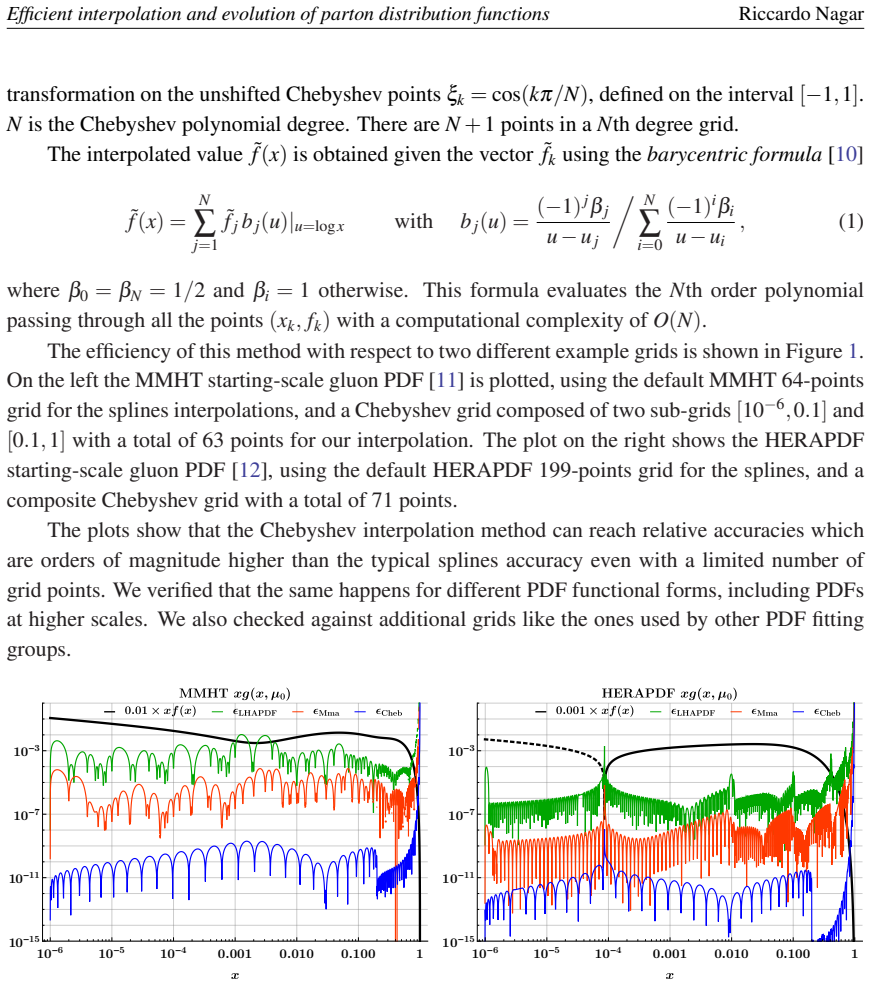
We present an efficient numerical solution of the DGLAP equations for single and double parton distribution functions (PDFs and DPDs), based on the Chebyshev interpolation of these functions. For PDF evolution, our method allows for a higher numerical accuracy using a considerably smaller number of grid points compared to other methods. The DPD evolution is realized using an affordable number of grid points, and allows for two independent renormalization scales for the two partons. Both methods include NNLO DGLAP kernels and flavor matching.
Editorial analysis
A structured set of objections, weighed in public.
Referee Report
Summary. The manuscript presents a numerical method for solving the DGLAP evolution equations for parton distribution functions (PDFs) and double parton distribution functions (DPDs) that relies on Chebyshev interpolation on a transformed grid. The central claims are that the approach achieves higher numerical accuracy for PDF evolution using considerably fewer grid points than existing methods, while remaining computationally affordable for DPD evolution with two independent renormalization scales; both implementations incorporate NNLO kernels and flavor matching.
Significance. If the numerical performance claims are substantiated, the method would represent a practical advance in the efficiency of PDF and DPD evolution, which underpins a wide range of collider phenomenology calculations. The extension to DPDs with independent scales addresses a recognized computational bottleneck, and the reliance on standard properties of Chebyshev interpolation and DGLAP kernels avoids circularity.
major comments (2)
- [Abstract, §1] Abstract and §1: the central claim of 'higher numerical accuracy using a considerably smaller number of grid points' is stated without any quantitative benchmarks, error measures, or direct comparisons to other evolution codes; the soundness of the efficiency result therefore cannot be assessed from the provided information.
- [§3 (method description)] The weakest assumption—that Chebyshev interpolation on the transformed grid preserves the required accuracy for the DGLAP integro-differential equations—is presented without explicit convergence tests, error bounds, or validation against known analytic limits or high-precision reference solutions.
minor comments (2)
- Figure captions and axis labels should explicitly state the grid sizes, polynomial orders, and accuracy metrics used in each panel to allow direct comparison with the text claims.
- Notation for the transformed variable and the precise definition of the Chebyshev nodes should be introduced once and used consistently throughout the evolution and interpolation sections.
Simulated Author's Rebuttal
We thank the referee for the careful reading of our manuscript and the constructive comments. We address the two major comments below and will revise the manuscript to provide the requested quantitative support and validation.
read point-by-point responses
-
Referee: [Abstract, §1] Abstract and §1: the central claim of 'higher numerical accuracy using a considerably smaller number of grid points' is stated without any quantitative benchmarks, error measures, or direct comparisons to other evolution codes; the soundness of the efficiency result therefore cannot be assessed from the provided information.
Authors: We agree that the abstract and introduction state the efficiency claim without accompanying numerical data. In the revised version we will add explicit quantitative benchmarks to both the abstract and §1, including relative error measures for evolved PDFs at specific scales and direct comparisons (at equal grid sizes) to established codes such as APFEL and HOPPET, thereby substantiating the reduction in required grid points. revision: yes
-
Referee: [§3 (method description)] The weakest assumption—that Chebyshev interpolation on the transformed grid preserves the required accuracy for the DGLAP integro-differential equations—is presented without explicit convergence tests, error bounds, or validation against known analytic limits or high-precision reference solutions.
Authors: We acknowledge that §3 relies on the standard convergence properties of Chebyshev interpolation without providing dedicated numerical tests for the DGLAP application. We will add a new subsection containing (i) convergence plots of the evolution error versus number of Chebyshev nodes, (ii) a priori error bounds based on the analytic properties of the kernels, and (iii) validation against both analytic LO solutions and high-precision reference runs for selected initial distributions. revision: yes
Circularity Check
No significant circularity
full rationale
The paper describes a numerical technique for DGLAP evolution of PDFs and DPDs that relies on Chebyshev interpolation over a transformed grid. All load-bearing steps invoke standard mathematical properties of Chebyshev polynomials and the external DGLAP kernels (including NNLO terms and flavor matching), none of which are defined in terms of the method's own outputs. No self-definitional relations, fitted parameters renamed as predictions, or load-bearing self-citations appear in the derivation chain. The efficiency result follows from direct numerical comparison against other grids and is therefore falsifiable independently of the paper's own definitions.
Axiom & Free-Parameter Ledger
Reference graph
Works this paper leans on
-
[1]
APFEL: A PDF Evolution Library with QED corrections
V . Bertone, S. Carrazza and J. Rojo, APFEL: A PDF Evolution Library with QED corrections, Comput. Phys. Commun. 185 (2014) 1647 [1310.1394]. 4 Efficient interpolation and evolution of parton distribution functions Riccardo Nagar 10-5 0.001 0.100 10-10 10-8 10-6 10-4 10-6 10-5 10-4 0.001 0.010 0.100 10-10 10-8 10-6 10-4 Figure 4: Relative accuracies in the...
work page internal anchor Pith review Pith/arXiv arXiv 2014
-
[2]
G. P. Salam and J. Rojo, A Higher Order Perturbative Parton Evolution Toolkit (HOPPET), Comput. Phys. Commun. 180 (2009) 120 [0804.3755]
work page internal anchor Pith review Pith/arXiv arXiv 2009
-
[3]
QCDNUM: Fast QCD Evolution and Convolution
M. Botje, QCDNUM: Fast QCD Evolution and Convolution, Comput. Phys. Commun. 182 (2011) 490 [1005.1481]
work page internal anchor Pith review Pith/arXiv arXiv 2011
-
[4]
LHAPDF6: parton density access in the LHC precision era
A. Buckley, J. Ferrando, S. Lloyd, K. Nordström, B. Page, M. Rüfenacht et al., LHAPDF6: parton density access in the LHC precision era, Eur. Phys. J. C75 (2015) 132 [1412.7420]
work page internal anchor Pith review Pith/arXiv arXiv 2015
-
[5]
Differential Higgs production at N3LO beyond threshold
F. Dulat, B. Mistlberger and A. Pelloni, Differential Higgs production at N3LO beyond threshold, JHEP 01 (2018) 145 [1710.03016]
work page internal anchor Pith review Pith/arXiv arXiv 2018
-
[6]
Elements of a theory for multiparton interactions in QCD
M. Diehl, D. Ostermeier and A. Schäfer, Elements of a theory for multiparton interactions in QCD, JHEP 03 (2012) 089 [1111.0910]
work page internal anchor Pith review Pith/arXiv arXiv 2012
-
[7]
J. R. Gaunt and W. J. Stirling, Double Parton Distributions Incorporating Perturbative QCD Evolution and Momentum and Quark Number Sum Rules, JHEP 03 (2010) 005 [0910.4347]
work page internal anchor Pith review Pith/arXiv arXiv 2010
-
[8]
Numerical analysis of the unintegrated double gluon distribution
E. Elias, K. Golec-Biernat and A. M. Sta ´sto, Numerical analysis of the unintegrated double gluon distribution, JHEP 01 (2018) 141 [1801.00018]
work page internal anchor Pith review Pith/arXiv arXiv 2018
- [9]
-
[10]
L. N. Trefethen, Approximation theory and approximation practice. Society for Industrial and Applied Mathematics, 2013
work page 2013
-
[11]
L. A. Harland-Lang, A. D. Martin, P. Motylinski and R. S. Thorne, Parton distributions in the LHC era: MMHT 2014 PDFs, Eur. Phys. J. C75 (2015) 204 [1412.3989]
work page internal anchor Pith review Pith/arXiv arXiv 2014
-
[12]
H1, ZEUS collaboration, HERA Inclusive Neutral and Charged Current Cross Sections and a New PDF Fit, HERAPDF 2.0, Acta Phys. Polon. Supp. 8 (2015) 957 [1511.05402]
work page internal anchor Pith review Pith/arXiv arXiv 2015
-
[13]
The QCD/SM Working Group: Summary Report
W. Giele et al., The QCD / SM working group: Summary report, in Physics at TeV colliders. Proceedings, Euro Summer School, Les Houches, France, May 21-June 1, 2001, 2002, hep-ph/0204316
work page internal anchor Pith review Pith/arXiv arXiv 2001
-
[14]
Parton Distributions: Summary Report
M. Dittmar et al., Working Group I: Parton distributions: Summary report for the HERA LHC Workshop Proceedings, hep-ph/0511119. 5
work page internal anchor Pith review Pith/arXiv arXiv
discussion (0)
Sign in with ORCID, Apple, or X to comment. Anyone can read and Pith papers without signing in.