Machine learning methods in quantum computing theory
Pith reviewed 2026-05-25 19:02 UTC · model grok-4.3
The pith
Neural networks can reconstruct quantum states from measurement data while excluding noise influence.
A machine-rendered reading of the paper's core claim, the machinery that carries it, and where it could break.
Core claim
The authors show that neural networks trained on quantum measurement outcomes can predict the underlying quantum state while excluding noise influence, and that a multiclass tree tensor network algorithm can be implemented and tested on quantum processors for classification tasks.
What carries the argument
Neural network trained to separate true quantum state signal from noise in measurement outcomes.
If this is right
- The tomography method can be applied in various experiments to reveal latent dependence between input data and output measurement results.
- Hybrid classical-quantum methods can analyze quantum states directly rather than classical data alone.
- Tree tensor network algorithms enable multiclass classification tasks on available quantum processors.
Where Pith is reading between the lines
- Noise-excluding tomography may allow more accurate state reconstruction on noisy intermediate-scale devices without requiring full noise model calibration.
- The hybrid approach could extend to other quantum tasks such as parameter estimation or circuit optimization under realistic noise.
- Demonstration on IBM hardware indicates these methods are feasible on current cloud-accessible quantum computers.
Load-bearing premise
The neural network can be trained to separate the true quantum state signal from noise in measurement outcomes without the separation relying on post-hoc data selection or assumptions about the noise model that are not independently validated.
What would settle it
Prepare known quantum states on hardware, add controlled noise with independently measured parameters, feed the outcomes to the trained network, and check whether the output states match the known inputs when noise strength or type is varied.
Figures




read the original abstract
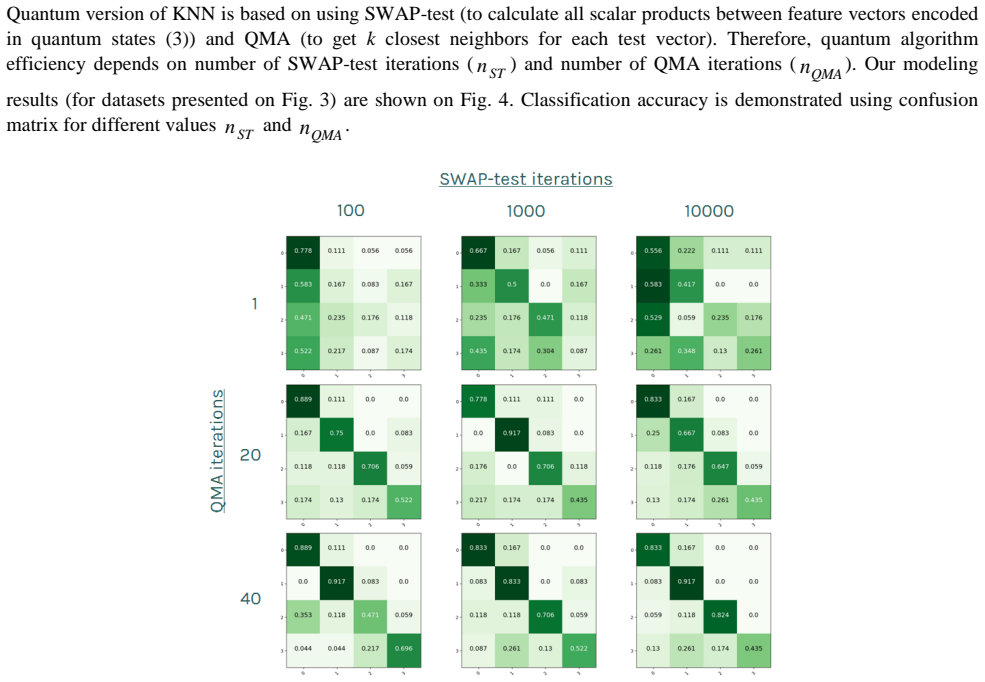
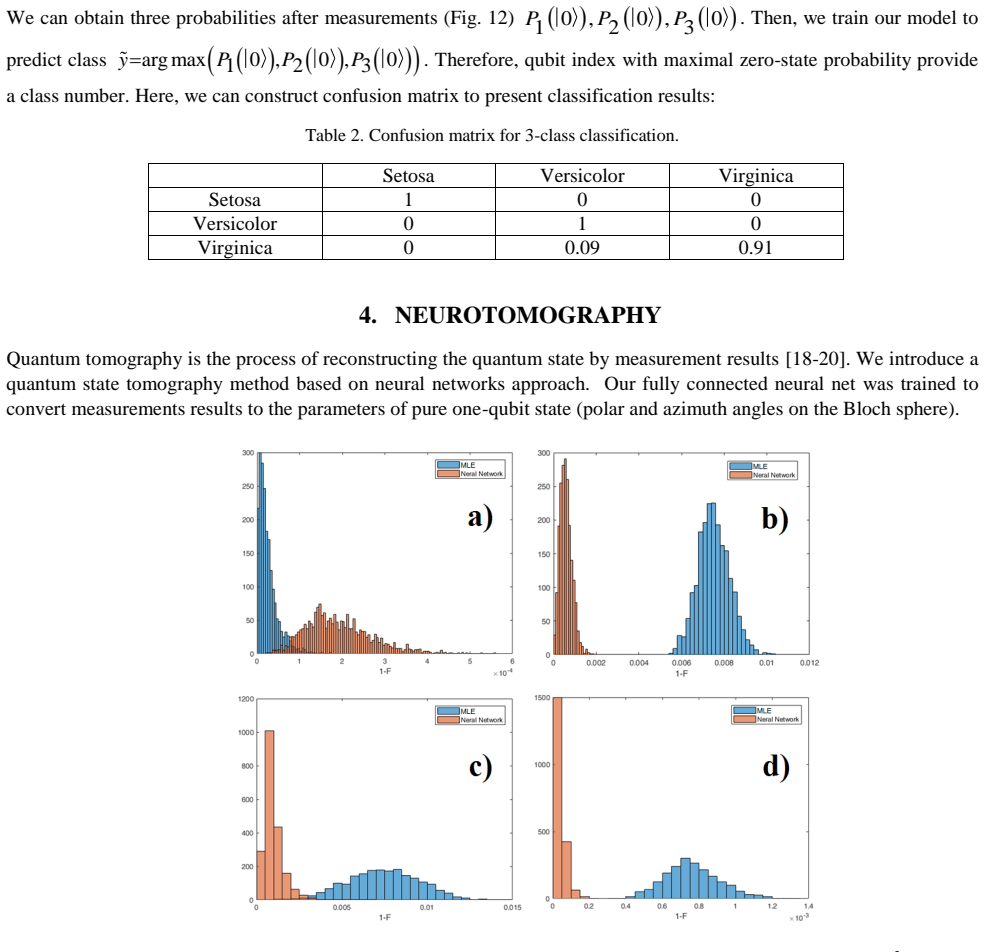
Classical machine learning theory and theory of quantum computations are among of the most rapidly developing scientific areas in our days. In recent years, researchers investigated if quantum computing can help to improve classical machine learning algorithms. The quantum machine learning includes hybrid methods that involve both classical and quantum algorithms. Quantum approaches can be used to analyze quantum states instead of classical data. On other side, quantum algorithms can exponentially improve classical data science algorithm. Here, we show basic ideas of quantum machine learning. We present several new methods that combine classical machine learning algorithms and quantum computing methods. We demonstrate multiclass tree tensor network algorithm, and its approbation on IBM quantum processor. Also, we introduce neural networks approach to quantum tomography problem. Our tomography method allows us to predict quantum state excluding noise influence. Such classical-quantum approach can be applied in various experiments to reveal latent dependence between input data and output measurement results.
Editorial analysis
A structured set of objections, weighed in public.
Referee Report
Summary. The manuscript surveys intersections between classical machine learning and quantum computing, outlines basic ideas of quantum machine learning, presents a multiclass tree tensor network algorithm with an experimental demonstration on an IBM quantum processor, and introduces a neural-network approach to quantum state tomography that is claimed to predict the underlying quantum state while excluding the influence of noise.
Significance. If the neural-network tomography method can be shown to separate signal from noise without relying on post-hoc selection or unvalidated noise-model assumptions, the result would be of interest for practical quantum state reconstruction on noisy hardware; the tree-tensor-network demonstration on IBM hardware is a standard but useful benchmark exercise. The manuscript does not supply the technical detail needed to evaluate either claim.
major comments (2)
- [Abstract] Abstract: the central claim that the neural-network tomography method 'allows us to predict quantum state excluding noise influence' is presented without any description of training-data construction (e.g., whether paired noisy/noiseless measurements are used), loss function, network architecture, or any test that the learned mapping remains accurate under noise statistics different from the training distribution. This leaves the claimed noise-exclusion capability unassessable.
- [Abstract] Abstract / methods: no equations, dataset sizes, error bars, or comparison baselines are supplied for either the tree-tensor-network multiclass algorithm or the tomography network, making it impossible to verify the reported IBM-hardware demonstration or the tomography performance.
minor comments (1)
- [Abstract] Abstract contains several grammatical issues ('among of the most', 'On other side') that should be corrected for clarity.
Simulated Author's Rebuttal
We thank the referee for the detailed comments. We address each major point below and will revise the manuscript to supply the requested technical details.
read point-by-point responses
-
Referee: [Abstract] Abstract: the central claim that the neural-network tomography method 'allows us to predict quantum state excluding noise influence' is presented without any description of training-data construction (e.g., whether paired noisy/noiseless measurements are used), loss function, network architecture, or any test that the learned mapping remains accurate under noise statistics different from the training distribution. This leaves the claimed noise-exclusion capability unassessable.
Authors: We agree that the abstract lacks these specifics. In revision we will expand both the abstract and main text to describe the training-data construction (paired noisy and noiseless measurement sets), the loss function, network architecture, and explicit tests of generalization to unseen noise distributions, thereby making the noise-exclusion claim assessable. revision: yes
-
Referee: [Abstract] Abstract / methods: no equations, dataset sizes, error bars, or comparison baselines are supplied for either the tree-tensor-network multiclass algorithm or the tomography network, making it impossible to verify the reported IBM-hardware demonstration or the tomography performance.
Authors: We acknowledge that the submitted version omits these quantitative elements. The revised manuscript will include the defining equations for both the multiclass tree-tensor-network algorithm and the neural-network tomography method, together with dataset sizes, error bars on the IBM-processor results, and baseline comparisons to permit verification. revision: yes
Circularity Check
No circularity in derivation chain; claims rest on empirical NN performance without self-referential reduction
full rationale
The paper introduces a neural-network tomography method claimed to predict quantum states while excluding noise, along with a tree tensor network algorithm tested on IBM hardware. No equations, parameter-fitting procedures, or derivation steps are exhibited that reduce a 'prediction' to a fitted input by construction. No self-citations, uniqueness theorems, or ansatzes imported from prior author work appear in the provided text. The central claim is an empirical assertion about NN training outcomes rather than a mathematical derivation that collapses to its own inputs; therefore the work is self-contained against external benchmarks and receives the default non-circularity finding.
Axiom & Free-Parameter Ledger
Reference graph
Works this paper leans on
-
[1]
Bishop, C.M., [Pattern recognition and machine learning], Springer, 738 (2006)
work page 2006
-
[2]
and Courville, A., [Deep learning], The MIT Press, 800 (2016)
Goodfellow, I., Bengio, Y. and Courville, A., [Deep learning], The MIT Press, 800 (2016)
work page 2016
-
[3]
Mitchell, T.M., [Machine learning], McGraw‐Hill, 432 (1997)
work page 1997
-
[4]
Mosca, M., "Quantum algorithms", arXiv:0808.0369, 1-71 (2008)
work page internal anchor Pith review Pith/arXiv arXiv 2008
-
[5]
Quantum Algorithm Implementations for Beginners
Coles, P.J., Eidenbenz, S., Pakin, S. et al. "Quantum Algorithm Implementations for Beginners ", arXiv:1804.03719, 1-76 (2018)
-
[6]
An introduction to quantum machine learning
Schuld, M., Sinayskiy, I. and Petruccione, F. , "An introduction to quantum machine learning ", Contemp. Phys., 56(2), 172-185 (2015)
work page 2015
-
[7]
Entanglement- Based Machine Learning on a Quantum Computer
Cai, X.-D., Wu, D., Su, Z.-E., Chen, M.-C., Wang, X.-L., Li, L., Liu, N.-L., Lu, C.-Y. and Pan, J.-W. "Entanglement- Based Machine Learning on a Quantum Computer", Phys. Rev. Lett., 114(2), 110504 (2015)
work page 2015
-
[8]
Advances in quantum machine learning
Adcock, J.C., Allen, E., Day, M. et al. "Advances in quantum machine learning", arXiv:1512.02900, 1-38 (2015)
work page internal anchor Pith review Pith/arXiv arXiv 2015
-
[9]
Quantum machine learning for data scientists
Kopczyk, D., "Quantum machine learning for data scientists", arXiv:1804.10068, 1-46 (2018)
work page internal anchor Pith review Pith/arXiv arXiv 2018
-
[10]
Kendall, M.G. and Stuart, A. [The advanced theory of statistics, volume 3: Design and analysis and time -series] Charles Griffin & Company, 567, (1968)
work page 1968
-
[11]
Algebras and systems for science and engineering], Springer, 236, (1995)
Hart, G.W., [Multidimensional analysis. Algebras and systems for science and engineering], Springer, 236, (1995)
work page 1995
-
[12]
Sammut, C. and Webb, G.I. [Encyclopedia of machine learning and data mining], Springer US, 1335 (2017)
work page 2017
-
[13]
Machine learning in a quantum world
Aumeur, E., Brassard, G. and Gambs, S., "Machine learning in a quantum world", Proc. Conference of the Canadian Society for Computational Studies of Intelligence, 431-442 (2006)
work page 2006
-
[14]
Transformation of quantum states using uniformly controlled rotations
Vartiainen, J.J., Bergholm, V. and Salomaa, M.M. "Transformation of quantum states using uniformly controlled rotations", Quant. Inf. Comp., 5, 467 (2005)
work page 2005
-
[15]
Quantum algorithms for supervised and unsupervised machine learning
Lloyd, S., Mohseni, M. and Rebentrost, P., "Quantum algorithms for supervised and unsupervised machine learning", arXiv:1307.0411, 1–11 (2013)
work page internal anchor Pith review Pith/arXiv arXiv 2013
-
[16]
A Quantum Algorithm for Finding the Minimum
Christoph, D. and Hoyer, P. "A quantum algorithm for finding the minimum", arXiv:quant-ph/9607014, 1-2, (1996)
work page internal anchor Pith review Pith/arXiv arXiv 1996
-
[17]
Classical simulation of quantum many -body systems with a tree tensor network
Shi, Y., Duan, L. and Vidal , G., "Classical simulation of quantum many -body systems with a tree tensor network", Phys. Rev. A., 74, 022320 (2006)
work page 2006
-
[18]
Rehacek, J., Englert, B.-G. and Kaszlikowski, D., "Minimal qubit tomography", Phys. Rev. A., 70, 052321 (2004)
work page 2004
-
[19]
Choice of Measurement Sets in Qubit Tomography
Burgh, M.D., "Choice of Measurement Sets in Qubit Tomography", Phys. Rev. A., 78, 052122 (2007)
work page 2007
-
[20]
D’Ariano, G.M., Paris, M.G.A. and Sacchi, M.F., "Quantum Tomography ", Adv. Imaging Electron Phys., 128, 205–308 (2003)
work page 2003
-
[21]
Statistical estimation of the quality of quantum-tomography protocols
Bogdanov, Yu.I., Brida, G., Genovese, M., Kulik, S.P., Moreva, E.V. and Shurupov, A.P. "Statistical estimation of the quality of quantum-tomography protocols", Phys. Rev. A - At. Mol. Opt. Phys, 84(4), 1–19 (2011)
work page 2011
-
[22]
Quantum states tomography with noisy measurements channels
Bogdanov, Yu.I., Bantysh, B.I., Bogdanova, N.A., Kvasnyy, A.B. and Lukichev, V.F., "Quantum states tomography with noisy measurements channels", Proc. SPIE, 10224 (2016)
work page 2016
discussion (0)
Sign in with ORCID, Apple, or X to comment. Anyone can read and Pith papers without signing in.