Structural and electronic properties of the incommensurate host-guest Bi-III phase
Pith reviewed 2026-05-25 15:51 UTC · model grok-4.3
The pith
Large commensurate approximants reproduce the equation of state and stability range of bismuth's incommensurate Bi-III phase in agreement with experiment.
A machine-rendered reading of the paper's core claim, the machinery that carries it, and where it could break.
Core claim
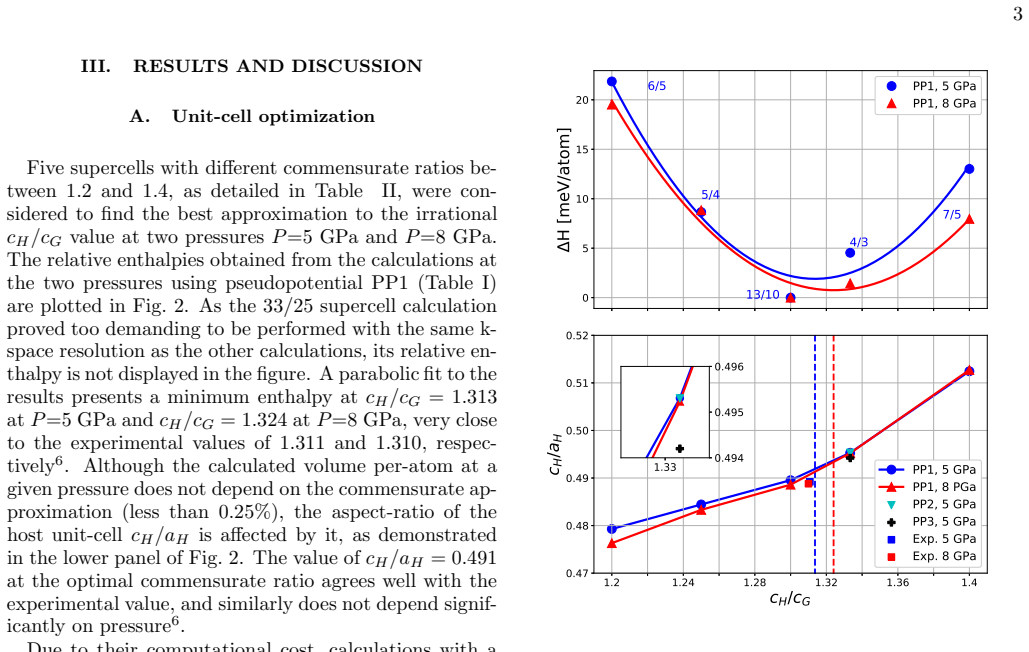
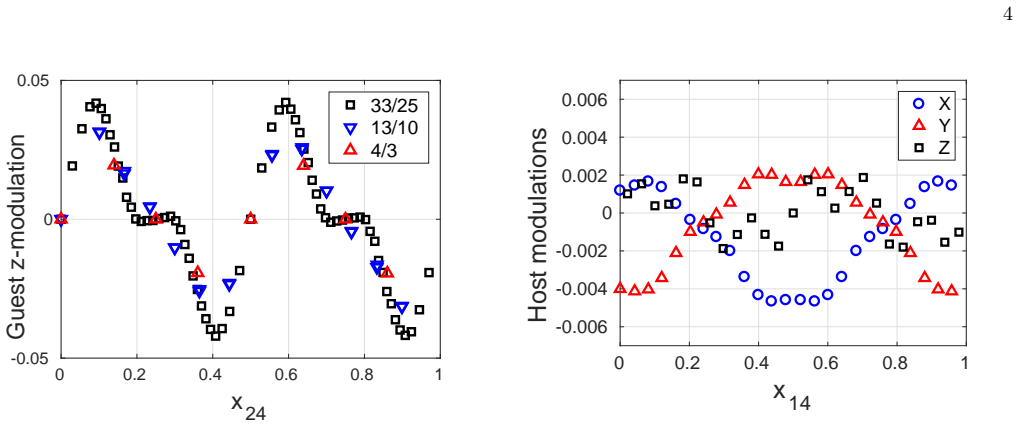
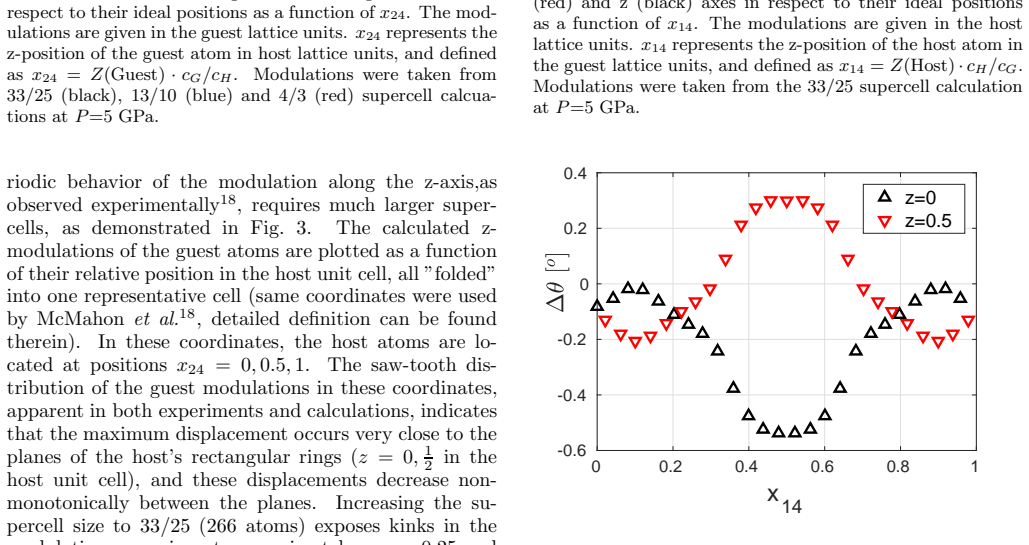
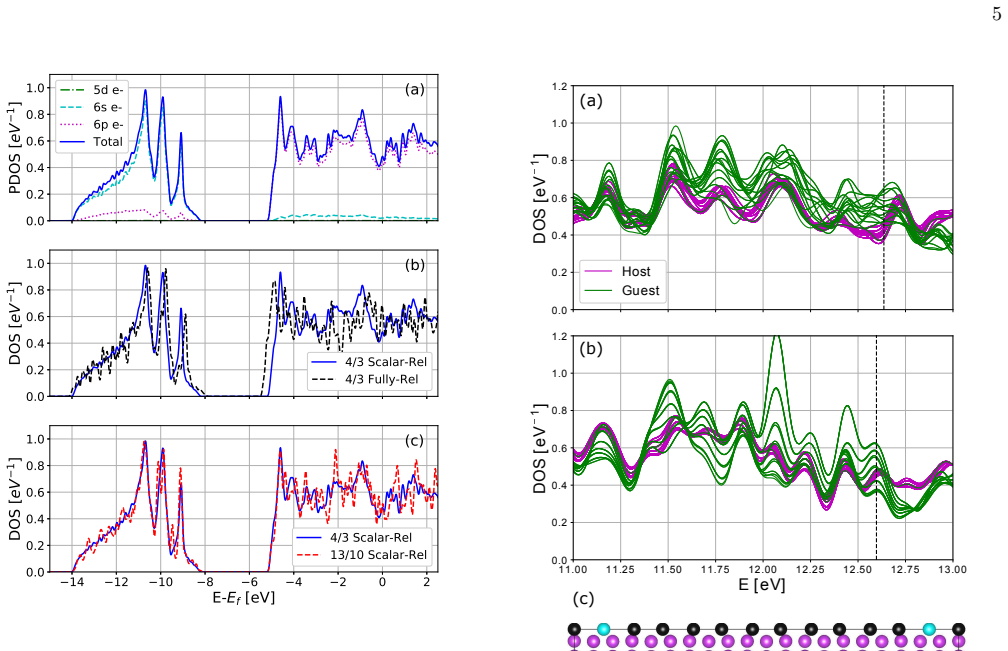
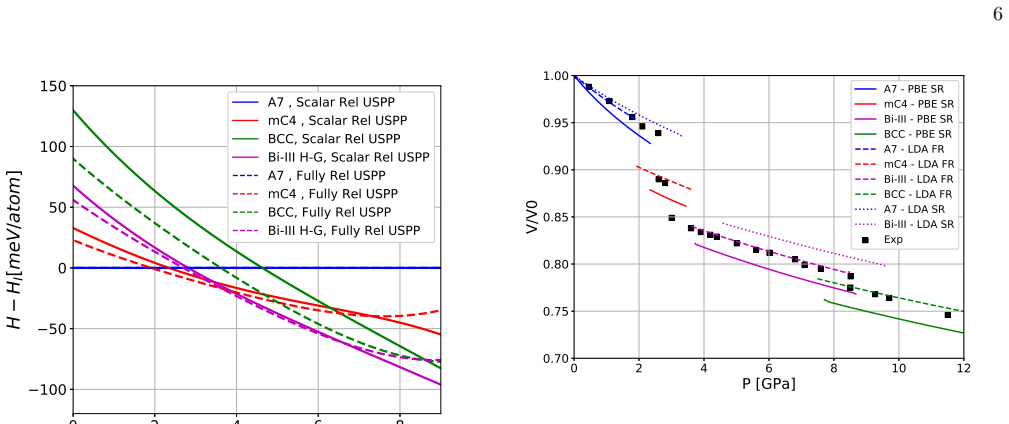
Atomic modulations away from the ideal host-guest positions inside large commensurate approximants strongly reshape the electronic structure of Bi-III, and only when these modulations are retained together with a fully relativistic model does the calculated equation of state and pressure range of stability agree quantitatively with experiment.
What carries the argument
Large commensurate approximants that embed the incommensurate host-guest modulations of the Bi-III lattice.
If this is right
- The pressure range of stability for Bi-III can be predicted accurately once the atomic displacements are included.
- Electronic properties of the phase are controlled by the geometric modulations rather than by the average lattice parameters alone.
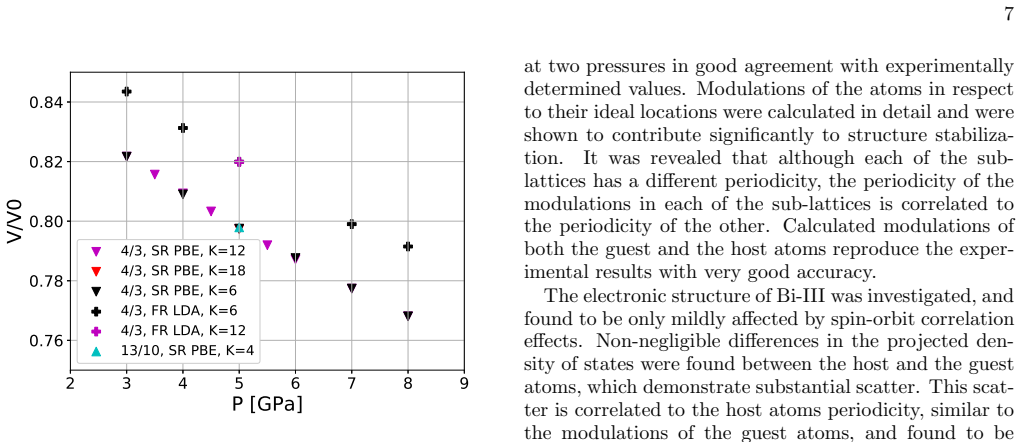
- Cell size has a larger effect on the description of the modulations and electronic structure than on the overall equation of state.
- A fully relativistic treatment is required for quantitative agreement with measured stability boundaries.
Where Pith is reading between the lines
- The same large-cell approximant strategy could be tested on other high-pressure incommensurate phases whose stability windows are narrow.
- If the modulations prove essential, smaller models may systematically misplace phase boundaries in elements that adopt host-guest structures.
- The separation between geometric sensitivity and pseudopotential sensitivity suggests that hybrid approaches could be efficient for screening additional incommensurate candidates.
Load-bearing premise
Large commensurate approximants capture the geometric and electronic effects of the true incommensurate modulations without introducing artifacts that change the predicted stability range.
What would settle it
A calculation performed on a substantially larger approximant or by a method that directly treats the incommensurate modulation that produces a stability window differing by more than a few GPa from the values obtained here.
Figures

read the original abstract
At high pressure, bismuth acquires a complex incommensurate host-guest structure, only recently discovered. Characterizing the structure and properties of this incommensurate phase from first principles is challenging owing to its non-periodic nature. In this study we use large scale DFT calculations to model commensurate approximants to the Bi-III phase, and in particular to describe the atomic modulations with respect to their ideal positions, shown here to strongly affect the electronic structure of the lattice and its stability. The equation of state and range of stability of Bi-III are reproduced in excellent agreement with experiment using a fully relativistic model. We demonstrate the importance of employing large unit-cells for the accurate description of the geometric and electronic configuration of Bi-III. In contrast, accurate description of the equation of state of bismuth is found to be primarily sensitive to the choice of pseudopotential and exchange-correlation function, while almost completely insensitive to the commensurate approximation.
Editorial analysis
A structured set of objections, weighed in public.
Referee Report
Summary. The manuscript uses large-scale DFT calculations on commensurate approximants to model the incommensurate host-guest Bi-III phase of bismuth. It reports that atomic modulations strongly influence the electronic structure and stability, and that the equation of state and pressure range of stability are reproduced in excellent agreement with experiment using a fully relativistic model. The EOS is found to be insensitive to the choice of commensurate approximant but sensitive to pseudopotential and exchange-correlation functional, while accurate description of stability requires large unit cells.
Significance. If the central results hold, the work establishes a practical first-principles route to incommensurate host-guest phases that are otherwise inaccessible to periodic DFT, with the reported experimental agreement for both EOS and stability range providing a useful benchmark for high-pressure materials. The distinction drawn between the sensitivities of EOS versus stability to cell size is a concrete methodological insight.
major comments (2)
- [Abstract] Abstract: The headline claim that 'the equation of state and range of stability of Bi-III are reproduced in excellent agreement with experiment' is load-bearing, yet the text explicitly states that stability is sensitive to cell size and modulations while providing no explicit convergence test (different rational approximations to the incommensurability ratio or alternative supercell choices) to demonstrate that the reported stability window is free of periodic artifacts from the chosen approximants.
- [Abstract] Abstract: The claim of 'excellent agreement' for the stability range lacks any reported error bars or quantitative measure of deviation from experiment, which is required to assess whether the agreement is robust given the noted sensitivity to the commensurate approximation.
minor comments (2)
- [Abstract] Abstract: The choice of pseudopotential and exchange-correlation functional is described as post-hoc without an a-priori justification or systematic comparison table.
- The manuscript would benefit from a dedicated subsection or table quantifying the convergence of enthalpy differences with approximant size, as this directly supports the claim that large cells are necessary.
Simulated Author's Rebuttal
We thank the referee for their careful reading of the manuscript and for highlighting these points about the abstract. We address each comment below and propose revisions where appropriate to strengthen the presentation of our results on the Bi-III phase.
read point-by-point responses
-
Referee: [Abstract] Abstract: The headline claim that 'the equation of state and range of stability of Bi-III are reproduced in excellent agreement with experiment' is load-bearing, yet the text explicitly states that stability is sensitive to cell size and modulations while providing no explicit convergence test (different rational approximations to the incommensurability ratio or alternative supercell choices) to demonstrate that the reported stability window is free of periodic artifacts from the chosen approximants.
Authors: The manuscript text already emphasizes that stability requires large unit cells while the EOS is largely insensitive to the specific commensurate approximation. The approximants employed are standard large supercells that incorporate the key atomic modulations, and the reported stability range is obtained from those calculations. We acknowledge that an explicit comparison across multiple distinct rational approximations (beyond the sizes already tested for convergence with cell size) is not presented. We will revise the abstract to temper the headline phrasing and add a short clarifying sentence in the main text referencing the specific approximants and the demonstrated cell-size sensitivity. revision: partial
-
Referee: [Abstract] Abstract: The claim of 'excellent agreement' for the stability range lacks any reported error bars or quantitative measure of deviation from experiment, which is required to assess whether the agreement is robust given the noted sensitivity to the commensurate approximation.
Authors: The description of 'excellent agreement' is based on the reproduced pressure window and EOS matching the experimental data points within the resolution of the calculations. We agree that a quantitative metric would improve clarity. In revision we will include a brief quantitative comparison (e.g., deviation in transition pressure or volume) both in the abstract and in the results section. revision: yes
Circularity Check
No circularity; external experimental benchmarks anchor all claims
full rationale
The paper performs standard DFT on large commensurate approximants, computes EOS and relative enthalpies, and directly compares both to independent experimental data. No parameter is fitted to a target quantity and then relabeled as a prediction. No self-citation supplies a uniqueness theorem or ansatz that the present work then treats as given. The stability-range result is obtained by explicit enthalpy minimization over the chosen cells and is reported as agreeing with (not derived from) measured pressures. The text explicitly notes sensitivity to cell size yet still validates against external EOS data, satisfying the self-contained criterion.
Axiom & Free-Parameter Ledger
free parameters (2)
- exchange-correlation functional
- pseudopotential
axioms (2)
- domain assumption Density functional theory with chosen functional and pseudopotential yields accurate structural and electronic properties for bismuth under pressure.
- domain assumption Commensurate approximants with sufficiently large cells reproduce the essential physics of the incommensurate Bi-III structure.
Lean theorems connected to this paper
-
IndisputableMonolith/Foundation/AlexanderDuality.leanalexander_duality_circle_linking unclear?
unclearRelation between the paper passage and the cited Recognition theorem.
We use large scale DFT calculations to model commensurate approximants to the Bi-III phase... equation of state and range of stability... fully relativistic model.
-
IndisputableMonolith/Foundation/ArithmeticFromLogic.leanembed_strictMono_of_one_lt unclear?
unclearRelation between the paper passage and the cited Recognition theorem.
The modulations... strongly affect the electronic structure... stability... insensitive to the commensurate approximation.
What do these tags mean?
- matches
- The paper's claim is directly supported by a theorem in the formal canon.
- supports
- The theorem supports part of the paper's argument, but the paper may add assumptions or extra steps.
- extends
- The paper goes beyond the formal theorem; the theorem is a base layer rather than the whole result.
- uses
- The paper appears to rely on the theorem as machinery.
- contradicts
- The paper's claim conflicts with a theorem or certificate in the canon.
- unclear
- Pith found a possible connection, but the passage is too broad, indirect, or ambiguous to say the theorem truly supports the claim.
Reference graph
Works this paper leans on
-
[1]
author author R. J. \ Nelmes , author D. R. \ Allan , author M. I. \ McMahon , \ and\ author S. A. \ Belmonte ,\ @noop journal journal Phys. Rev. Lett. \ volume 83 ,\ pages 4081 ( year 1999 ) NoStop
work page 1999
-
[2]
Heine ,\ @noop journal journal Nature \ volume 403 ,\ pages 836 ( year 2000 ) NoStop
author author V. Heine ,\ @noop journal journal Nature \ volume 403 ,\ pages 836 ( year 2000 ) NoStop
work page 2000
-
[3]
author author O. Degtyareva ,\ @noop journal journal High Pressure Research \ volume 30 ,\ pages 343 ( year 2010 ) NoStop
work page 2010
-
[4]
author author P. Brown , author K. Semeniuk , author D. Wang , author B. Monserrat , author C. J. \ Pickard , \ and\ author F. M. \ Grosche ,\ @noop journal journal Science Advances \ volume 4 ( year 2018 ) NoStop
work page 2018
-
[5]
author author G. Woolman , author V. Naden Robinson , author M. Marqu\'es , author I. Loa , author G. J. \ Ackland , \ and\ author A. Hermann ,\ @noop journal journal Phys. Rev. Materials \ volume 2 ,\ pages 053604 ( year 2018 ) NoStop
work page 2018
-
[6]
author author O. Degtyareva , author M. MCMahon , \ and\ author R. Nelmes ,\ @noop journal journal High Pressure Research \ volume 24 ,\ pages 319 ( year 2004 ) NoStop
work page 2004
-
[7]
author author P. W. \ Bridgman ,\ @noop journal journal Phys. Rev. \ volume 48 ,\ pages 893 ( year 1935 ) NoStop
work page 1935
-
[8]
author author F. P. \ Bundy ,\ @noop journal journal Phys. Rev. \ volume 110 ,\ pages 314 ( year 1958 ) NoStop
work page 1958
-
[9]
author author W. Klement , author A. Jayaraman , \ and\ author G. C. \ Kennedy ,\ @noop journal journal Phys. Rev. \ volume 131 ,\ pages 632 ( year 1963 ) NoStop
work page 1963
-
[10]
author author R. Brugger , author R. Bennion , \ and\ author T. Worlton ,\ @noop journal journal Physics Letters A \ volume 24 ,\ pages 714 ( year 1967 ) NoStop
work page 1967
-
[11]
author author C. G. \ Homan ,\ @noop journal journal Journal of Physics and Chemistry of Solids \ volume 36 ,\ pages 1249 ( year 1975 ) NoStop
work page 1975
-
[12]
author author J. H. \ Chen , author H. Iwasaki , \ and\ author T. Ktkegawa ,\ @noop journal journal High Pressure Research \ volume 15 ,\ pages 143 ( year 1996 ) NoStop
work page 1996
-
[13]
author author M. McMahon , author O. Degtyareva , \ and\ author R. Nelmes ,\ @noop journal journal Phys. Rev. Lett. \ volume 85 ,\ pages 4896 ( year 2000 ) NoStop
work page 2000
-
[14]
author author S. V. \ Smaalen ,\ @noop journal journal Crystallography Reviews \ volume 4 ,\ pages 79 ( year 1995 ) NoStop
work page 1995
-
[15]
author author U. H\"aussermann , author K. S\"oderberg , \ and\ author R. Norrestam ,\ @noop journal journal Journal of the American Chemical Society \ volume 124 ,\ pages 15359 ( year 2002 ) NoStop
work page 2002
-
[16]
author author R. Khasanov , author H. Luetkens , author E. Morenzoni , author G. Simutis , author S. Schönecker , author A. Östlin , author L. Chioncel , \ and\ author A. Amato ,\ @noop journal journal Phys. Rev. B \ volume 98 ,\ pages 140504 ( year 2018 ) NoStop
work page 2018
-
[17]
author author I. Rodr \'i guez , author D. Hinojosa-Romero , author A. Valladares , author R. M. \ Valladares , \ and\ author A. A. \ Valladares ,\ @noop journal journal Scientific Reports \ volume 9 ,\ pages 5256 ( year 2019 ) NoStop
work page 2019
-
[18]
author author M. McMahon , author O. Degtyareva , author R. Nelmes , author S. van Smaalen , \ and\ author L. Palatinus ,\ @noop journal journal Phys. Rev. B \ volume 75 ,\ pages 184114 ( year 2007 ) NoStop
work page 2007
-
[19]
author author X. Gonze , author J.-P. \ Michenaud , \ and\ author J.-P. \ Vigneron ,\ @noop journal journal Physica Scripta \ volume 37 ,\ pages 785 ( year 1988 ) NoStop
work page 1988
-
[20]
author author L. E. \ D\' az-S\'anchez , author A. H. \ Romero , \ and\ author X. Gonze ,\ @noop journal journal Phys. Rev. B \ volume 76 ,\ pages 104302 ( year 2007 a ) NoStop
work page 2007
-
[21]
author author L. E. \ D\' az-S\'anchez , author A. H. \ Romero , author M. Cardona , author R. K. \ Kremer , \ and\ author X. Gonze ,\ @noop journal journal Phys. Rev. Lett. \ volume 99 ,\ pages 165504 ( year 2007 b ) NoStop
work page 2007
-
[22]
author author C. Y. \ Wu , author J. C. \ Han , author L. Sun , author H. R. \ Gong , \ and\ author C. P. \ Liang ,\ @noop journal journal Journal of Physics: Condensed Matter \ volume 30 ,\ pages 285504 ( year 2018 ) NoStop
work page 2018
-
[23]
author author P. Giannozzi , author S. Baroni , author N. Bonini , author M. Calandra , author R. Car , author C. Cavazzoni , author D. Ceresoli , author G. L. \ Chiarotti , author M. Cococcioni , author I. Dabo , author A. D. \ Corso , author S. Fabris , author G. Fratesi , author S. de Gironcoli , author R. Gebauer , author U. Gerstmann , author C. Goug...
work page 2009
-
[24]
author author H. Monkhorst \ and\ author J. Pack ,\ @noop journal journal Phys. Rev. B \ volume 13 ,\ pages 5188 ( year 1976 ) NoStop
work page 1976
-
[25]
Garrity , author J.W.Bennett , author K.M.Rabe , \ and\ author D
author author K. Garrity , author J.W.Bennett , author K.M.Rabe , \ and\ author D. Vanderbilt ,\ @noop journal journal Computational Materials Science \ volume 81 ,\ pages 446 ( year 2014 ) NoStop
work page 2014
-
[26]
author author A. D. \ Corso ,\ @noop journal journal Computational Materials Science \ volume 95 ,\ pages 337 ( year 2014 ) NoStop
work page 2014
-
[27]
author author Y. Akahama , author H. Kawamura , \ and\ author A. K. \ Singh ,\ @noop journal journal Journal of Applied Physics \ volume 92 ,\ pages 5892 ( year 2002 ) NoStop
work page 2002
-
[28]
author author R. Fletcher ,\ @noop title Practical methods of optimization \ ( publisher Wiley, New-York ,\ year 1987 ) NoStop
work page 1987
-
[29]
Birch ,\ @noop journal journal Phys
author author F. Birch ,\ @noop journal journal Phys. Rev. \ volume 71 ,\ pages 809 ( year 1947 ) NoStop
work page 1947
-
[30]
author author B. Toudic , author P. Garcia , author C. Odin , author P. Rabiller , author C. Ecolivet , author E. Collet , author P. Bourges , author G. J. \ McIntyre , author M. D. \ Hollingsworth , \ and\ author T. Breczewski ,\ @noop journal journal Science \ volume 319 ,\ pages 69 ( year 2008 ) NoStop
work page 2008
-
[31]
aussermann , author O. Degtyareva , author A. S. \ Mikhaylushkin , author K. S\
author author U. H\"aussermann , author O. Degtyareva , author A. S. \ Mikhaylushkin , author K. S\"oderberg , author S. I. \ Simak , author M. I. \ McMahon , author R. J. \ Nelmes , \ and\ author R. Norrestam ,\ @noop journal journal Phys. Rev. B \ volume 69 ,\ pages 134203 ( year 2004 ) NoStop
work page 2004
-
[32]
author author H.-Y. \ Chen , author S.-K. \ Xiang , author X.-Z. \ Yan , author L.-R. \ Zheng , author Y. Zhang , author S.-G. \ Liu , \ and\ author Y. Bi ,\ @noop journal journal Chinese Physics B \ volume 25 ,\ pages 108103 ( year 2016 ) NoStop
work page 2016
-
[33]
author author P. Cucka \ and\ author C. S. \ Barrett ,\ @noop journal journal Acta Crystallographica \ volume 15 ,\ pages 865 ( year 1962 ) NoStop
work page 1962
-
[34]
author author E. M. \ Compy ,\ @noop journal journal Journal of Applied Physics \ volume 41 ,\ pages 2014 ( year 1970 ) NoStop
work page 2014
-
[35]
author author N. Mori , author S. Yomo , \ and\ author T. Mitsui ,\ @noop journal journal Physics Letters A \ volume 34 ,\ pages 190 ( year 1971 ) NoStop
work page 1971
-
[36]
author author K. Aoki , author S. Fujiwara , \ and\ author M. Kusakabe ,\ @noop journal journal Journal of the Physical Society of Japan \ volume 51 ,\ pages 3826 ( year 1982 ) NoStop
work page 1982
-
[37]
author author P. Haas , author F. Tran , \ and\ author P. Blaha ,\ @noop journal journal Phys. Rev. B \ volume 79 ,\ pages 085104 ( year 2009 ) NoStop
work page 2009
-
[38]
@noop title NegevHPC Project , \ howpublished www.negevhpc.com ,\ note [Online] NoStop
discussion (0)
Sign in with ORCID, Apple, or X to comment. Anyone can read and Pith papers without signing in.