Linearized 3-D Electromagnetic Contrast Source Inversion and Its Applications to Half-space Configurations
Pith reviewed 2026-05-25 15:30 UTC · model grok-4.3
The pith
Linearizing the 3-D electromagnetic inverse scattering problem into two functionals lets total fields be computed only once while preserving reconstruction accuracy.
A machine-rendered reading of the paper's core claim, the machinery that carries it, and where it could break.
Core claim
The 3-D electromagnetic inverse scattering problem is discretized in finite-difference frequency-domain and linearized into a cascade of two linear functionals. Nonuniqueness is addressed by sum-of-l1-norm optimization on contrast sources with cross-validation. Total fields in the inversion domain are computed once and then used to reconstruct the contrast via minimization of a cost functional combining data and state errors.
What carries the argument
Cascade of two linear functionals combined with sum-of-l1-norm optimization on the joint structure of contrast sources.
If this is right
- Total fields in the inversion domain are computed only once instead of at every iteration.
- Quality and accuracy of the obtained reconstructions are maintained.
- The procedure applies directly to ground-penetrating radar imaging in half-space configurations.
- The procedure applies directly to through-the-wall imaging in half-space configurations.
Where Pith is reading between the lines
- The single field computation step could lower the overall cost enough to enable larger 3-D domains or finer grids on the same hardware.
- Cross-validation inside the contrast-source step offers an internal accuracy check that might transfer to other sparsity-driven inversion schemes.
- Because the linearization separates the field solve from the contrast recovery, the same cascade structure could be tested on other frequency-domain wave problems that currently iterate on both fields and contrasts.
Load-bearing premise
The nonuniqueness of the inverse problem can be effectively resolved by exploiting the joint structure of the contrast sources with a sum-of-l1-norm optimization scheme.
What would settle it
A numerical test in which the sum-of-l1-norm scheme produces inaccurate contrast sources and the resulting single-field reconstructions visibly degrade compared with a conventional iterative solver.
Figures




read the original abstract
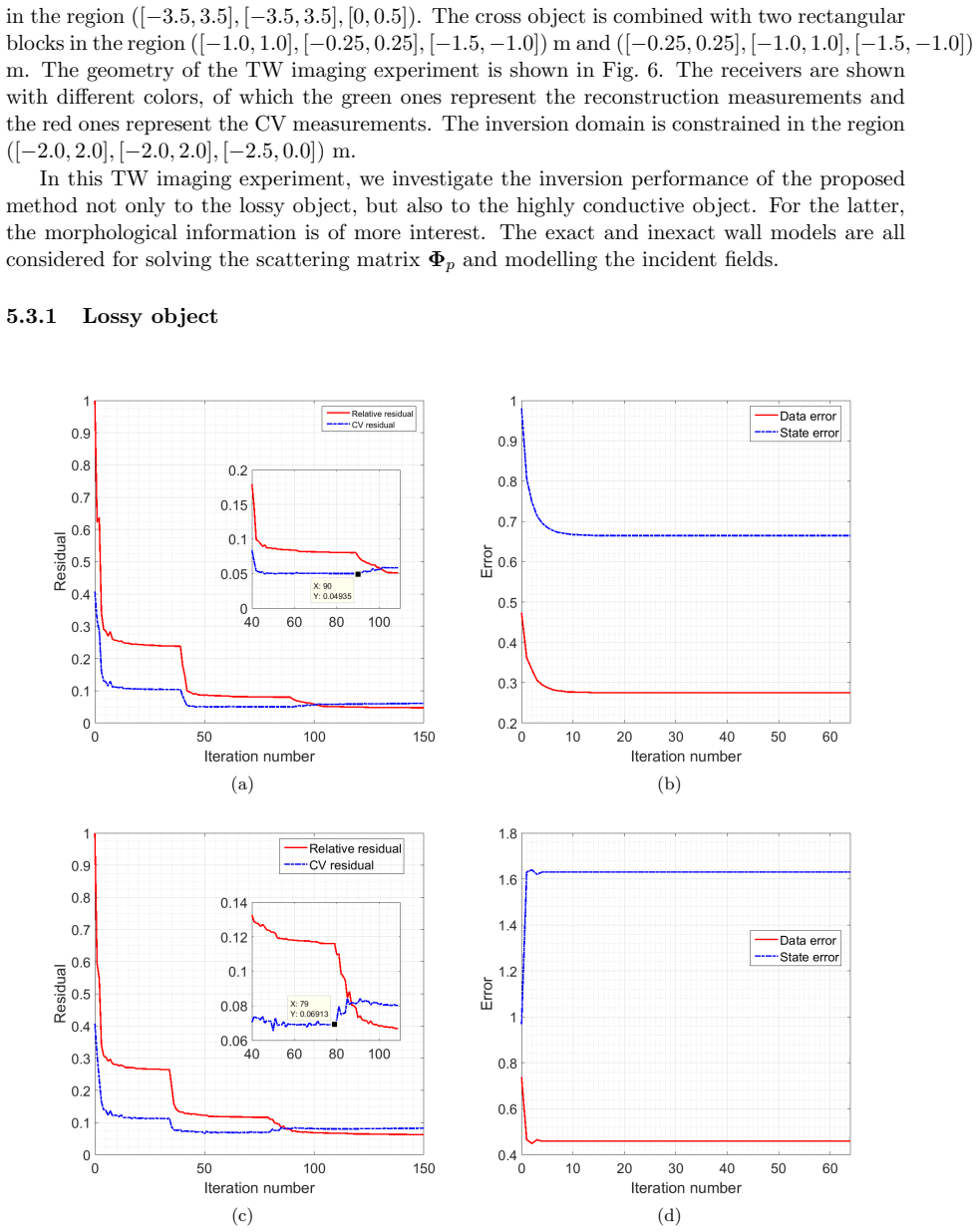
One of the main computational drawbacks in the application of 3-D iterative inversion techniques is the requirement of solving the field quantities for the updated contrast in every iteration. In this paper, the 3-D electromagnetic inverse scattering problem is put into a discretized finite-difference frequency-domain scheme and linearized into a cascade of two linear functionals. To deal with the nonuniqueness effectively, the joint structure of the contrast sources is exploited using a sum-of-$\ell_1$-norm optimization scheme. A cross-validation technique is used to check whether the optimization process is accurate enough. The total fields are, then, calculated and used to reconstruct the contrast by minimizing a cost functional defined as the sum of the data error and state error. In this procedure, the total fields in the inversion domain are computed only once, while the quality and accuracy of the obtained reconstructions are maintained. The novel method is applied to ground-penetrating radar imaging and through-the-wall imaging, in which the validity and efficiency of the method is demonstrated.
Editorial analysis
A structured set of objections, weighed in public.
Referee Report
Summary. The paper presents a linearized 3-D electromagnetic contrast source inversion method for half-space configurations (GPR and TWI). The forward problem is discretized via finite-difference frequency-domain, then cast as a cascade of two linear functionals. Nonuniqueness of contrast sources is addressed by a sum-of-ℓ1-norm optimization that exploits their joint structure; cross-validation checks optimization accuracy. Total fields inside the inversion domain are computed only once and inserted into a data-error plus state-error cost functional whose minimization yields the contrast.
Significance. If the central efficiency claim holds, the method removes the dominant computational cost of repeated forward solves in iterative 3-D EM inversion while preserving reconstruction quality. This would be a practical advance for subsurface and through-wall imaging. The sum-of-ℓ1-norm treatment of joint contrast-source structure is a technically interesting device for mitigating nonuniqueness.
major comments (2)
- [Abstract] Abstract (central claim paragraph): the assertion that 'the total fields in the inversion domain are computed only once, while the quality and accuracy of the obtained reconstructions are maintained' is the load-bearing efficiency result. No quantitative evidence is supplied that the sum-of-ℓ1-norm step leaves a state error small enough for a single subsequent field evaluation to remain consistent with the recovered contrast; a direct comparison of state-error norms or reconstruction fidelity against a conventional multi-iteration solver is required.
- [Method] Method description (linearized cascade and cross-validation step): it is not shown how the cross-validation threshold guarantees that residual non-uniqueness after the ℓ1 step is negligible relative to the linearization error; without an a-posteriori bound or numerical test relating the two error sources, the single-field-computation premise remains unverified.
minor comments (1)
- [Notation] Notation for contrast sources and total fields should be introduced once and used uniformly; several symbols appear to be redefined between the linearized functionals and the final cost functional.
Simulated Author's Rebuttal
We thank the referee for the constructive comments. We address each major comment below and agree that strengthening the quantitative support for the efficiency claim will improve the manuscript.
read point-by-point responses
-
Referee: [Abstract] Abstract (central claim paragraph): the assertion that 'the total fields in the inversion domain are computed only once, while the quality and accuracy of the obtained reconstructions are maintained' is the load-bearing efficiency result. No quantitative evidence is supplied that the sum-of-ℓ1-norm step leaves a state error small enough for a single subsequent field evaluation to remain consistent with the recovered contrast; a direct comparison of state-error norms or reconstruction fidelity against a conventional multi-iteration solver is required.
Authors: We agree that the abstract claim requires supporting quantitative evidence. The manuscript demonstrates validity through GPR and TWI examples, but does not include a head-to-head comparison against a conventional multi-iteration solver. In the revision we will add such a comparison, reporting relative state-error norms and reconstruction fidelity metrics (e.g., correlation coefficient or RMSE) between the single-field linearized result and a standard iterative contrast-source inversion that recomputes fields at each step. revision: yes
-
Referee: [Method] Method description (linearized cascade and cross-validation step): it is not shown how the cross-validation threshold guarantees that residual non-uniqueness after the ℓ1 step is negligible relative to the linearization error; without an a-posteriori bound or numerical test relating the two error sources, the single-field-computation premise remains unverified.
Authors: The cross-validation step is used only to confirm that the sum-of-ℓ1 optimization has converged to a stable contrast-source estimate. We acknowledge that no explicit a-posteriori bound or numerical test relating residual non-uniqueness to the linearization error is currently provided. In the revision we will insert a short numerical study that quantifies both error sources on the same test cases and shows that the non-uniqueness residual remains below the linearization error level, thereby supporting the single-field premise. revision: yes
Circularity Check
No circularity: linearized cascade and single-field computation are independent of fitted outputs
full rationale
The derivation proceeds by discretizing the forward problem, linearizing the inverse scattering relation into a cascade of two explicit linear functionals, applying an l1-norm joint-structure penalty whose objective is stated separately from the final contrast reconstruction, and using cross-validation on the contrast-source step before a single total-field solve. None of these steps defines a quantity in terms of its own output or renames a fitted parameter as a prediction. The single total-field computation is justified by the claim that the preceding optimization keeps state error small, but this is an empirical assertion rather than a definitional reduction. No self-citation is invoked as a uniqueness theorem or load-bearing premise. The procedure therefore remains self-contained against external benchmarks and receives score 0.
Axiom & Free-Parameter Ledger
axioms (2)
- domain assumption The 3-D electromagnetic inverse scattering problem can be discretized into a finite-difference frequency-domain scheme and linearized into a cascade of two linear functionals.
- domain assumption The joint structure of the contrast sources can be exploited using a sum-of-l1-norm optimization scheme to deal with nonuniqueness effectively.
Lean theorems connected to this paper
-
IndisputableMonolith/Cost/FunctionalEquation.leanwashburn_uniqueness_aczel unclear?
unclearRelation between the paper passage and the cited Recognition theorem.
the total fields in the inversion domain are computed only once, while the quality and accuracy of the obtained reconstructions are maintained... sum-of-ℓ1-norm optimization scheme
-
IndisputableMonolith/Foundation/AlphaCoordinateFixation.leanJ_uniquely_calibrated_via_higher_derivative unclear?
unclearRelation between the paper passage and the cited Recognition theorem.
minimizing a cost functional defined as the sum of the data error and state error
What do these tags mean?
- matches
- The paper's claim is directly supported by a theorem in the formal canon.
- supports
- The theorem supports part of the paper's argument, but the paper may add assumptions or extra steps.
- extends
- The paper goes beyond the formal theorem; the theorem is a base layer rather than the whole result.
- uses
- The paper appears to rely on the theorem as machinery.
- contradicts
- The paper's claim conflicts with a theorem or certificate in the canon.
- unclear
- Pith found a possible connection, but the passage is too broad, indirect, or ambiguous to say the theorem truly supports the claim.
Reference graph
Works this paper leans on
-
[1]
D. Colton and R. Kress, Inverse acoustic and electromagnetic scattering theory. New York: Springer, 2013, vol. 93. 21
work page 2013
-
[2]
Full-waveform inversion algorithm for interpreting crosshole radar data: A theoretical approach,
S. Kuroda, M. Takeuchi, and H. J. Kim, “Full-waveform inversion algorithm for interpreting crosshole radar data: A theoretical approach,” Geosciences Journal, vol. 11, no. 3, pp. 211– 217, 2007
work page 2007
-
[3]
J. R. Ernst, H. Maurer, A. G. Green, and K. Holliger, “Full-waveform inversion of crosshole radar data based on 2-D finite-difference time-domain solutions of maxwell’s equations,” IEEE Transactions on Geoscience and Remote Sensing, vol. 45, no. 9, pp. 2807–2828, 2007
work page 2007
-
[4]
An overview of full-waveform inversion in exploration geo- physics,
J. Virieux and S. Operto, “An overview of full-waveform inversion in exploration geo- physics,” Geophysics, vol. 74, no. 6, pp. WCC1–WCC26, 2009
work page 2009
-
[5]
N. Bleistein, J. K. Cohen, W. John Jr et al. , Mathematics of multidimensional seismic imaging, migration, and inversion . New York: Springer, 2013, vol. 13
work page 2013
-
[6]
Microwave biomedical data inversion using the finite-difference contrast source inversion method,
C. Gilmore, A. Abubakar, W. Hu, T. M. Habashy, and P. M. Van Den Berg, “Microwave biomedical data inversion using the finite-difference contrast source inversion method,” IEEE Transactions on Antennas and Propagation , vol. 57, no. 5, pp. 1528–1538, 2009
work page 2009
-
[7]
Compressive diffuse optical tomography: non- iterative exact reconstruction using joint sparsity,
O. Lee, J. M. Kim, Y. Bresler, and J. C. Ye, “Compressive diffuse optical tomography: non- iterative exact reconstruction using joint sparsity,” IEEE transactions on medical imaging, vol. 30, no. 5, pp. 1129–1142, 2011
work page 2011
-
[8]
Acoustic inversion in optoacoustic to- mography: A review,
A. Rosenthal, V. Ntziachristos, and D. Razansky, “Acoustic inversion in optoacoustic to- mography: A review,” Current medical imaging reviews, vol. 9, no. 4, pp. 318–336, 2013
work page 2013
-
[9]
Hadamard, Lectures on Cauchy’s problem in linear partial differential equations
J. Hadamard, Lectures on Cauchy’s problem in linear partial differential equations . Mi- neola, New York: Dover Publications, Inc., 2014
work page 2014
-
[10]
A modified gradient method for two-dimensional problems in tomography,
R. Kleinman and P. Van den Berg, “A modified gradient method for two-dimensional problems in tomography,” Journal of Computational and Applied Mathematics , vol. 42, no. 1, pp. 17–35, 1992
work page 1992
-
[11]
An extended range-modified gradient technique for profile inversion,
R. E. Kleinman and P. den Berg, “An extended range-modified gradient technique for profile inversion,” Radio Science, vol. 28, no. 5, pp. 877–884, 1993
work page 1993
-
[12]
Two-dimensional location and shape reconstruction,
R. Kleinman and P. den Berg, “Two-dimensional location and shape reconstruction,” Radio Science, vol. 29, no. 4, pp. 1157–1169, 1994
work page 1994
-
[13]
A contrast source inversion method,
P. M. Van Den Berg and R. E. Kleinman, “A contrast source inversion method,” Inverse problems, vol. 13, no. 6, p. 1607, 1997
work page 1997
-
[14]
Nonlinear inversion of a buried object in transverse electric scattering,
B. Kooij, M. Lambert, and D. Lesselier, “Nonlinear inversion of a buried object in transverse electric scattering,” Radio Science, vol. 34, no. 6, pp. 1361–1371, 1999
work page 1999
-
[15]
O. F´ eron, B. Duchˆ ene, and A. Mohammad-Djafari, “Microwave imaging of inhomogeneous objects made of a finite number of dielectric and conductive materials from experimental data,” Inverse Problems, vol. 21, no. 6, p. S95, 2005
work page 2005
-
[16]
Inversion of multi-frequency experimental data for imaging complex objects by a DTA–CSI method,
C. Yu, L.-P. Song, and Q. H. Liu, “Inversion of multi-frequency experimental data for imaging complex objects by a DTA–CSI method,” Inverse Problems , vol. 21, no. 6, p. S165, 2005
work page 2005
-
[17]
An iterative solution of the two-dimensional electromagnetic inverse scattering problem,
Y. Wang and W. C. Chew, “An iterative solution of the two-dimensional electromagnetic inverse scattering problem,” International Journal of Imaging Systems and Technology , vol. 1, no. 1, pp. 100–108, 1989. 22
work page 1989
-
[18]
W. C. Chew and Y.-M. Wang, “Reconstruction of two-dimensional permittivity distribution using the distorted Born iterative method,” IEEE transactions on medical imaging , vol. 9, no. 2, pp. 218–225, 1990
work page 1990
-
[19]
F. Li, Q. H. Liu, and L.-p. Song, “Three-dimensional reconstruction of objects buried in layered media using Born and distorted Born iterative methods,” IEEE geoscience and remote sensing letters , vol. 1, no. 2, pp. 107–111, 2004
work page 2004
-
[20]
C. Gilmore, P. Mojabi, and J. LoVetri, “Comparison of an enhanced distorted Born iter- ative method and the multiplicative-regularized contrast source inversion method,” IEEE Transactions on Antennas and Propagation , vol. 57, no. 8, pp. 2341–2351, 2009
work page 2009
-
[21]
Fast spectral methods for the shape identification problem of a perfectly conducting obstacle,
F. L. Lou¨ er, “Fast spectral methods for the shape identification problem of a perfectly conducting obstacle,” in The open archive HAL , 2013, pp. 1–16
work page 2013
-
[22]
A. Qing, “Electromagnetic inverse scattering of multiple two-dimensional perfectly con- ducting objects by the differential evolution strategy,” IEEE Transactions on Antennas and Propagation, vol. 51, no. 6, pp. 1251–1262, 2003
work page 2003
-
[23]
——, “Electromagnetic inverse scattering of multiple perfectly conducting cylinders by differential evolution strategy with individuals in groups (GDES),” IEEE Transactions on Antennas and Propagation, vol. 52, no. 5, pp. 1223–1229, 2004
work page 2004
-
[24]
A simple method for solving inverse scattering problems in the resonance region,
D. Colton and A. Kirsch, “A simple method for solving inverse scattering problems in the resonance region,” Inverse problems, vol. 12, no. 4, p. 383, 1996
work page 1996
-
[25]
A simple method using Morozov’s discrepancy principle for solving inverse scattering problems,
D. Colton, M. Piana, and R. Potthast, “A simple method using Morozov’s discrepancy principle for solving inverse scattering problems,” Inverse Problems, vol. 13, no. 6, p. 1477, 1997
work page 1997
-
[26]
A linear sampling method for near-field inverse problems in elastodynamics,
S. N. Fata and B. B. Guzina, “A linear sampling method for near-field inverse problems in elastodynamics,” Inverse problems, vol. 20, no. 3, p. 713, 2004
work page 2004
-
[27]
On the feasibility of the linear sampling method for 3D GPR surveys,
I. Catapano, F. Soldovieri, and L. Crocco, “On the feasibility of the linear sampling method for 3D GPR surveys,” Progress In Electromagnetics Research, vol. 118, pp. 185–203, July 2011
work page 2011
-
[28]
T. Arens, “Why linear sampling works,” Inverse Problems, vol. 20, no. 1, p. 163, 2003
work page 2003
-
[29]
M. R. Eskandari, R. Safian, and M. Dehmollaian, “Three-dimensional near-field microwave imaging using hybrid linear sampling and level set methods in a medium with compact support,” IEEE Transactions on Antennas and Propagation , vol. 62, no. 10, pp. 5117– 5125, 2014
work page 2014
-
[30]
D. J. Daniels, Ground penetrating radar. Wiley Online Library, 2005
work page 2005
-
[31]
M. G. Amin, Through-the-wall radar imaging . CRC press, 2016
work page 2016
-
[32]
A tomographic formulation of spotlight- mode synthetic aperture radar,
D. C. Munson, J. D. O’Brien, and W. K. Jenkins, “A tomographic formulation of spotlight- mode synthetic aperture radar,” Proceedings of the IEEE, vol. 71, no. 8, pp. 917–925, 1983
work page 1983
-
[33]
M. Fink, “Time-reversal mirrors,” Journal of Physics D: Applied Physics , vol. 26, no. 9, p. 1333, 1993
work page 1993
-
[34]
M. Fink, D. Cassereau, A. Derode, C. Prada, P. Roux, M. Tanter, J.-L. Thomas, and F. Wu, “Time-reversed acoustics,” Reports on progress in Physics, vol. 63, no. 12, p. 1933, 2000. 23
work page 1933
-
[35]
Dort method as applied to electromagnetic subsurface sens- ing,
G. Micolau and M. Saillard, “Dort method as applied to electromagnetic subsurface sens- ing,” Radio Science, vol. 38, no. 3, 2003
work page 2003
-
[36]
Frequency dispersion compensation in time reversal techniques for UWB electromagnetic waves,
M. E. Yavuz and F. L. Teixeira, “Frequency dispersion compensation in time reversal techniques for UWB electromagnetic waves,” IEEE Geoscience and Remote sensing letters, vol. 2, no. 2, pp. 233–237, 2005
work page 2005
-
[37]
Electromagnetic target detection in uncertain media: Time-reversal and minimum-variance algorithms,
D. Liu, J. Krolik, and L. Carin, “Electromagnetic target detection in uncertain media: Time-reversal and minimum-variance algorithms,” IEEE Transactions on Geoscience and Remote Sensing, vol. 45, no. 4, pp. 934–944, 2007
work page 2007
-
[38]
Space–frequency ultrawideband time-reversal imaging,
M. E. Yavuz and F. L. Teixeira, “Space–frequency ultrawideband time-reversal imaging,” IEEE Transactions on Geoscience and Remote Sensing, vol. 46, no. 4, pp. 1115–1124, 2008
work page 2008
-
[39]
Imaging and tracking of targets in clutter using differential time-reversal techniques,
A. E. Fouda and F. L. Teixeira, “Imaging and tracking of targets in clutter using differential time-reversal techniques,” Waves in Random and Complex Media , vol. 22, no. 1, pp. 66– 108, 2012
work page 2012
-
[40]
Ultrawideband time-reversal imaging with frequency domain sampling,
S. Bahrami, A. Cheldavi, and A. Abdolali, “Ultrawideband time-reversal imaging with frequency domain sampling,” IEEE Geoscience and Remote Sensing Letters, vol. 11, no. 3, pp. 597–601, 2014
work page 2014
-
[41]
Statistical stability of ultrawideband time-reversal imaging in random media,
A. E. Fouda and F. L. Teixeira, “Statistical stability of ultrawideband time-reversal imaging in random media,” IEEE Transactions on Geoscience and Remote Sensing , vol. 52, no. 2, pp. 870–879, 2014
work page 2014
-
[42]
Time reversal imaging of obscured targets from multistatic data,
A. Devaney, “Time reversal imaging of obscured targets from multistatic data,” IEEE Transactions on Antennas and Propagation , vol. 53, no. 5, pp. 1600–1610, 2005
work page 2005
-
[43]
Subspace-based localization and inverse scattering of multiply scattering point targets,
E. A. Marengo and F. K. Gruber, “Subspace-based localization and inverse scattering of multiply scattering point targets,” EURASIP Journal on Advances in Signal Processing , vol. 2007, no. 1, pp. 1–16, 2006
work page 2007
-
[44]
Time-reversal MUSIC imaging of ex- tended targets,
E. A. Marengo, F. K. Gruber, and F. Simonetti, “Time-reversal MUSIC imaging of ex- tended targets,” IEEE Transactions on image processing , vol. 16, no. 8, pp. 1967–1984, 2007
work page 1967
-
[45]
Performance analysis of time-reversal MUSIC,
D. Ciuonzo, G. Romano, and R. Solimene, “Performance analysis of time-reversal MUSIC,” IEEE Transactions on Signal Processing , vol. 63, no. 10, pp. 2650–2662, 2015
work page 2015
-
[46]
GPR imaging via qualitative and quantitative approaches,
I. Catapano, A. Randazzo, E. Slob, and R. Solimene, “GPR imaging via qualitative and quantitative approaches,” in Civil Engineering Applications of Ground Penetrating Radar . New York: Springer, 2015, pp. 239–280
work page 2015
-
[47]
Comments on the filtered backprojection algorithm, range conditions, and the pseudoinverse solution,
M. A. Anastasio, X. Pan, and E. Clarkson, “Comments on the filtered backprojection algorithm, range conditions, and the pseudoinverse solution,”IEEE transactions on medical imaging, vol. 20, no. 6, pp. 539–542, 2001
work page 2001
-
[48]
P. Zhang, X. Zhang, and G. Fang, “Comparison of the imaging resolutions of time reversal and back-projection algorithms in EM inverse scattering,” IEEE Geoscience and Remote Sensing Letters, vol. 10, no. 2, pp. 357–361, 2013
work page 2013
-
[49]
On simple methods for shape reconstruction of unknown scatterers,
I. Catapano, L. Crocco, and T. Isernia, “On simple methods for shape reconstruction of unknown scatterers,” IEEE transactions on antennas and propagation , vol. 55, no. 5, pp. 1431–1436, 2007. 24
work page 2007
-
[50]
The linear sampling method as a way to quantitative inverse scattering,
L. Crocco, I. Catapano, L. Di Donato, and T. Isernia, “The linear sampling method as a way to quantitative inverse scattering,” IEEE Transactions on Antennas and Propagation, vol. 60, no. 4, pp. 1844–1853, 2012
work page 2012
-
[51]
Inverse scattering via vir- tual experiments and contrast source regularization,
L. Di Donato, M. T. Bevacqua, L. Crocco, and T. Isernia, “Inverse scattering via vir- tual experiments and contrast source regularization,” IEEE Transactions on Antennas and Propagation, vol. 63, no. 4, pp. 1669–1677, 2015
work page 2015
-
[52]
Model-based quantitative cross-borehole GPR imaging via virtual experiments,
L. Di Donato and L. Crocco, “Model-based quantitative cross-borehole GPR imaging via virtual experiments,” IEEE Transactions on Geoscience and Remote Sensing, vol. 53, no. 8, pp. 4178–4185, 2015
work page 2015
-
[53]
A hybrid quantitative method for inverse scattering of multiple dielectric objects,
M. Rabbani, A. Tavakoli, and M. Dehmollaian, “A hybrid quantitative method for inverse scattering of multiple dielectric objects,” IEEE Transactions on Antennas and Propagation, vol. 64, no. 3, pp. 977–987, 2016
work page 2016
-
[54]
L.-P. Song and Q. H. Liu, “Fast three-dimensional electromagnetic nonlinear inversion in layered media with a novel scattering approximation,” Inverse Problems, vol. 20, no. 6, p. S171, 2004
work page 2004
-
[55]
3D finite-difference frequency-domain method for plasmonics and nanophoton- ics,
W. Shin, “3D finite-difference frequency-domain method for plasmonics and nanophoton- ics,” Ph.D. dissertation, Stanford University, The Department of Electrical Engineering, USA, 2013
work page 2013
-
[56]
A Bayesian-compressive-sampling-based inversion for imaging sparse scatterers,
G. Oliveri, P. Rocca, and A. Massa, “A Bayesian-compressive-sampling-based inversion for imaging sparse scatterers,” IEEE Transactions on Geoscience and Remote Sensing, vol. 49, no. 10, pp. 3993–4006, 2011
work page 2011
-
[57]
Distributed compressed sensing of jointly sparse signals,
S. Sarvotham, D. Baron, M. Wakin, M. F. Duarte, and R. G. Baraniuk, “Distributed compressed sensing of jointly sparse signals,” in Asilomar conference on signals, systems, and computers, 2005, pp. 1537–1541
work page 2005
-
[58]
Theoretical results on sparse representations of multiple- measurement vectors,
J. Chen and X. Huo, “Theoretical results on sparse representations of multiple- measurement vectors,” IEEE Transactions on Signal Processing, vol. 54, no. 12, pp. 4634– 4643, 2006
work page 2006
-
[59]
Theoretical and empirical results for recovery from multiple measurements,
E. Van Den Berg and M. P. Friedlander, “Theoretical and empirical results for recovery from multiple measurements,” IEEE Transactions on Information Theory , vol. 56, no. 5, pp. 2516–2527, 2010
work page 2010
-
[60]
Probing the Pareto frontier for basis pursuit solutions,
E. van den Berg and M. P. Friedlander, “Probing the Pareto frontier for basis pursuit solutions,” SIAM Journal on Scientific Computing , vol. 31, no. 2, pp. 890–912, 2008
work page 2008
-
[61]
Sparse optimization with least-squares con- straints,
E. Van den Berg and M. P. Friedlander, “Sparse optimization with least-squares con- straints,” SIAM Journal on Optimization , vol. 21, no. 4, pp. 1201–1229, 2011
work page 2011
-
[62]
Compressed sensing with cross validation,
R. Ward, “Compressed sensing with cross validation,” IEEE Transactions on Information Theory, vol. 55, no. 12, pp. 5773–5782, 2009
work page 2009
-
[63]
Cross Validation in Compressive Sensing and its Application of OMP-CV Algorithm
J. Zhang, L. Chen, P. T. Boufounos, and Y. Gu, “Cross validation in compressive sensing and its application of OMP-CV algorithm,” arXiv preprint arXiv:1602.06373 , 2016
work page internal anchor Pith review Pith/arXiv arXiv 2016
-
[64]
W. Shin. (2015) MaxwellFDFD Webpage. https://github.com/wsshin/maxwellfdfd
work page 2015
-
[65]
R. P. Brent, Algorithms for minimization without derivatives . New Jersey: Englewood Cliffs, 1973. 25
work page 1973
-
[66]
G. E. Forsythe, M. A. Malcolm, and C. B. Moler, Computer Methods for Mathematical Computations. Prentice-Hall, 1976
work page 1976
-
[67]
Multiplicative regularization for contrast profile inversion,
P. M. van den Berg, A. Abubakar, and J. T. Fokkema, “Multiplicative regularization for contrast profile inversion,” Radio Science, vol. 38, no. 2, pp. 1–10, 2003. 26
work page 2003
discussion (0)
Sign in with ORCID, Apple, or X to comment. Anyone can read and Pith papers without signing in.