Injection of Deformable Capsules in a Reservoir, a Systematic Analysis
Pith reviewed 2026-05-25 15:50 UTC · model grok-4.3
The pith
Capsule interactions and deformability govern velocity fields and accelerate the leading particle during channel-to-reservoir ejection.
A machine-rendered reading of the paper's core claim, the machinery that carries it, and where it could break.
Core claim
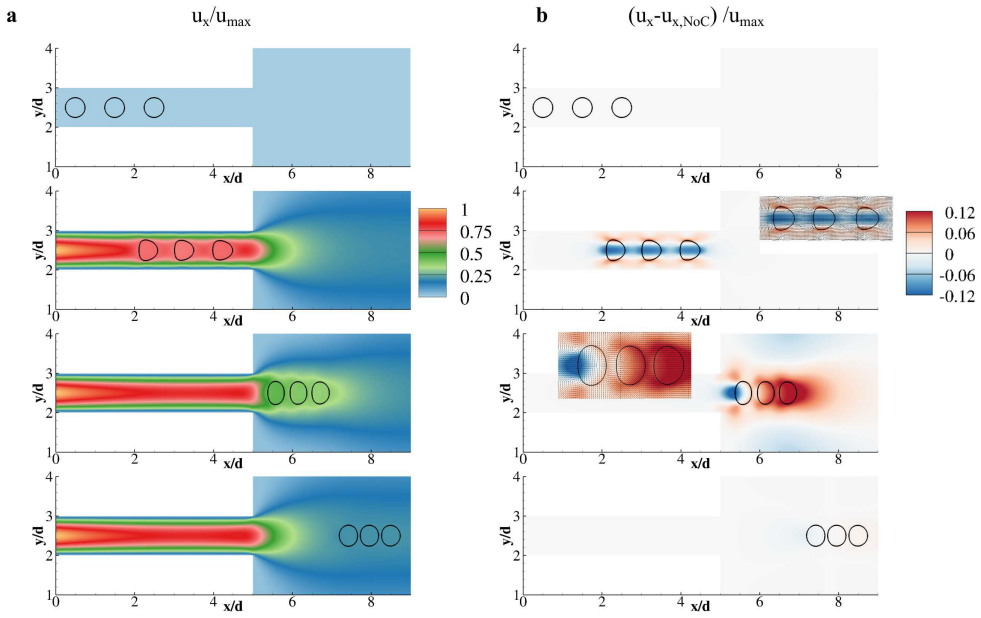
In this computational study, the interactions between the capsules affect the local velocity field significantly and are responsible for the dynamics observed. Capsule membrane deformability is also seen to affect inter-capsule interaction, and we observe that the train of three particles locally homogenizes the velocity field and the leading capsule travels faster than the other two trailing capsules. On the contrary, variations in size of the reservoir do not seem to be relevant, while the ratio of capsule diameter with respect to channel diameter plays a major role as well as the ratio of capsule diameter to inter-capsule spacing.
What carries the argument
Mass-spring membrane model coupled to an Immersed Boundary Lattice Boltzmann solver that resolves capsule deformation together with the induced fluid velocity field during ejection.
If this is right
- Capsule-to-capsule interactions dominate the flow response over changes in reservoir geometry.
- Membrane deformability alters how particles influence one another's hydrodynamic environment.
- Diameter-to-channel and diameter-to-spacing ratios determine whether a leading capsule accelerates ahead of trailing ones.
- A three-capsule train produces more uniform local flows than single-particle ejection.
Where Pith is reading between the lines
- The identified ratio dependencies suggest that capsule spacing could be tuned to control delivery timing in microfluidic channels.
- The homogenization effect may reduce shear-induced damage to fragile payloads carried inside the capsules.
- Repeating the simulations with varied fluid viscosities would test whether the leading-capsule acceleration persists outside the Newtonian regime examined here.
Load-bearing premise
The mass spring membrane model coupled to the Immersed Boundary Lattice Boltzmann solver produces physically realistic capsule deformation and fluid response for the range of sizes and spacings examined.
What would settle it
High-speed experimental imaging of physical capsule trains ejected into a reservoir that measures whether the leading capsule indeed travels faster and whether the velocity field is measurably more uniform than for isolated capsules.
Figures





read the original abstract
A computational study of capsule ejection from a narrow channel into a reservoir is undertaken for a combination of varying deformable capsule sizes and channel dimensions. A mass spring membrane model is coupled to an Immersed Boundary Lattice Boltzmann model solver. The aim of the present work is the description of the capsules motion, deformation and the response of the fluid due to the complex particle dynamics. The interactions between the capsules affect the local velocity field significantly and are responsible for the dynamics observed. Capsule membrane deformability is also seen to affect inter capsule interaction, and we observe that the train of three particles locally homogenizes the velocity field and the leading capsule travels faster than the other two trailing capsules. On the contrary, variations in size of the reservoir do not seem to be relevant, while the ratio of capsule diameter with respect to channel diameter plays a major role as well as the ratio of capsule diameter to inter capsule spacing. This flow set up has not been covered in the literature, and consequently we focus on describing capsule motion, membrane deformation and fluid dynamics, as a preliminary investigation in this field.
Editorial analysis
A structured set of objections, weighed in public.
Referee Report
Summary. The manuscript reports a computational study of deformable capsules ejected from a narrow channel into a reservoir, using a mass-spring membrane model coupled to an immersed-boundary lattice-Boltzmann solver. It varies capsule and channel dimensions and describes the resulting capsule motion, membrane deformation, and fluid response, with the central claims being that inter-capsule interactions dominate the local velocity field, that membrane deformability modulates those interactions, and that a three-capsule train locally homogenizes the velocity field while the leading capsule travels faster than the two trailing ones; reservoir size is reported as irrelevant while capsule-to-channel diameter ratio and inter-capsule spacing are key.
Significance. If the numerical results are reliable, the work supplies the first qualitative description of multi-capsule dynamics in a channel-to-reservoir geometry that has not been treated in the literature. The direct numerical exploration of geometric ratios is a positive feature, but the absence of quantitative metrics or validation limits the strength of the conclusions.
major comments (2)
- [Abstract] Abstract: the headline observations (velocity homogenization by a three-capsule train and leading-capsule speed ordering) are stated as qualitative results with no accompanying quantitative measures, error bars, or direct comparison to single- or two-capsule reference simulations, so the magnitude and robustness of the reported effects cannot be assessed.
- [Methods] Methods section: the mass-spring membrane model coupled to the IB-LBM solver is described without any grid-convergence study, reproduction of a known single-capsule benchmark (e.g., deformation index versus capillary number in tube flow), or validation for the multi-capsule reservoir configuration; because every dynamical claim rests on the fidelity of this solver, the lack of such tests is load-bearing.
minor comments (1)
- [Abstract] The abstract would be clearer if it stated the specific ranges of the diameter ratios and spacings that were varied.
Simulated Author's Rebuttal
We thank the referee for their constructive comments on our manuscript. We address each of the major comments below and will revise the manuscript accordingly to strengthen the quantitative presentation and validation of the numerical methods.
read point-by-point responses
-
Referee: [Abstract] Abstract: the headline observations (velocity homogenization by a three-capsule train and leading-capsule speed ordering) are stated as qualitative results with no accompanying quantitative measures, error bars, or direct comparison to single- or two-capsule reference simulations, so the magnitude and robustness of the reported effects cannot be assessed.
Authors: We agree that the abstract would benefit from quantitative support. In the revised manuscript, we will include quantitative measures of the velocity homogenization (e.g., reduction in velocity variance) and the leading capsule's speed advantage, along with explicit comparisons to single- and two-capsule reference cases. These will be added both to the abstract and the results section to allow assessment of the effect magnitudes. revision: yes
-
Referee: [Methods] Methods section: the mass-spring membrane model coupled to the IB-LBM solver is described without any grid-convergence study, reproduction of a known single-capsule benchmark (e.g., deformation index versus capillary number in tube flow), or validation for the multi-capsule reservoir configuration; because every dynamical claim rests on the fidelity of this solver, the lack of such tests is load-bearing.
Authors: This is a valid concern. We will expand the Methods section to include a grid-convergence study confirming that the spatial and temporal resolutions used are adequate for the reported quantities. We will also present a benchmark reproduction of the single-capsule deformation index as a function of capillary number in tube flow, comparing our results to literature values. This will provide the necessary validation for the solver's application to the multi-capsule cases. revision: yes
Circularity Check
No circularity: purely numerical parametric study with no derivation or fitted predictions
full rationale
The paper describes a computational study using a mass-spring membrane model coupled to an Immersed Boundary Lattice Boltzmann solver. It varies geometric ratios (capsule size, channel dimensions, spacing) and reports observed dynamics such as velocity field homogenization and capsule speed ordering. No analytic derivations, parameter fitting to data, or predictions that reduce to inputs by construction are present. The abstract explicitly notes the configuration is absent from the literature, and the work is framed as a preliminary description rather than a derivation. No self-citations are invoked as load-bearing for any uniqueness theorem or ansatz. This matches the default case of a self-contained numerical exploration with no reduction to its own inputs.
Axiom & Free-Parameter Ledger
axioms (1)
- domain assumption The mass-spring membrane model coupled to the immersed-boundary lattice-Boltzmann solver accurately captures capsule deformation and fluid-particle interaction for the examined parameter ranges.
Lean theorems connected to this paper
-
IndisputableMonolith/Cost/FunctionalEquation.leanwashburn_uniqueness_aczel unclear?
unclearRelation between the paper passage and the cited Recognition theorem.
A mass spring membrane model is coupled to an Immersed Boundary Lattice Boltzmann model solver... The interactions between the capsules affect the local velocity field significantly...
-
IndisputableMonolith/Foundation/RealityFromDistinction.leanreality_from_one_distinction unclear?
unclearRelation between the paper passage and the cited Recognition theorem.
The ratio of capsule diameter with respect to channel diameter plays a major role as well as the ratio of capsule diameter to inter capsule spacing.
What do these tags mean?
- matches
- The paper's claim is directly supported by a theorem in the formal canon.
- supports
- The theorem supports part of the paper's argument, but the paper may add assumptions or extra steps.
- extends
- The paper goes beyond the formal theorem; the theorem is a base layer rather than the whole result.
- uses
- The paper appears to rely on the theorem as machinery.
- contradicts
- The paper's claim conflicts with a theorem or certificate in the canon.
- unclear
- Pith found a possible connection, but the passage is too broad, indirect, or ambiguous to say the theorem truly supports the claim.
Reference graph
Works this paper leans on
-
[1]
Anne M Robertson, Ad ´elia Sequeira, and Marina V Kameneva. Hemorheology. In Hemodynamical flows, pages 63–120. Springer, 2008
work page 2008
-
[2]
Anne M Robertson, Ad ´elia Sequeira, and Robert G Owens. Rheological models for blood. In Cardiovascular mathematics, pages 211–241. Springer, 2009
work page 2009
-
[3]
Red cell motions and wall interactions in tube flow
HL Goldsmith. Red cell motions and wall interactions in tube flow. In Federation proceedings, volume 30, pages 1578–1590, 1971
work page 1971
-
[4]
Finite deformation of liquid capsules enclosed by elastic membranes in simple shear flow
C Pozrikidis. Finite deformation of liquid capsules enclosed by elastic membranes in simple shear flow. Journal of Fluid Mechanics, 297: 123–152, 1995
work page 1995
-
[5]
Rheology of a dense suspension of spherical capsules under simple shear flow
D Matsunaga, Y Imai, T Yamaguchi, and T Ishikawa. Rheology of a dense suspension of spherical capsules under simple shear flow. Journal of Fluid Mechanics, 786:110–127, 2016
work page 2016
-
[6]
Ken-ichi Tsubota and Shigeo Wada. Effect of the natural state of an elastic cellular membrane on tank-treading and tumbling motions of a single red blood cell. Physical Review E, 81(1):011910, 2010
work page 2010
-
[7]
S Nix, Y Imai, D Matsunaga, T Yamaguchi, and T Ishikawa. Lateral migration of a spherical capsule near a plane wall in stokes flow.Physical Review E, 90(4):043009, 2014
work page 2014
-
[8]
Reorientation of a nonspherical capsule in creeping shear flow
Toshihiro Omori, Yohsuke Imai, Takami Yamaguchi, and Takuji Ishikawa. Reorientation of a nonspherical capsule in creeping shear flow. Physical review letters, 108(13):138102, 2012
work page 2012
-
[9]
Deformation of a spherical capsule under oscillating shear flow
D Matsunaga, Y Imai, T Yamaguchi, and T Ishikawa. Deformation of a spherical capsule under oscillating shear flow. Journal of Fluid Mechanics, 762:288–301, 2015
work page 2015
-
[10]
Multiscale modeling of red blood cell mechanics and blood flow in malaria
Dmitry A Fedosov, Huan Lei, Bruce Caswell, Subra Suresh, and George E Karniadakis. Multiscale modeling of red blood cell mechanics and blood flow in malaria. PLoS computational biology, 7(12):e1002270, 2011
work page 2011
-
[11]
Multiscale modeling of blood flow: from single cells to blood rheology
Dmitry A Fedosov, Hiroshi Noguchi, and Gerhard Gompper. Multiscale modeling of blood flow: from single cells to blood rheology. Biomechanics and modeling in mechanobiology, 13(2):239–258, 2014
work page 2014
-
[12]
Geometrical focusing of cells in a microfluidic device: an approach to separate blood plasma
Magalie Faivre, Manouk Abkarian, Kimberly Bickraj, and Howard A Stone. Geometrical focusing of cells in a microfluidic device: an approach to separate blood plasma. Biorheology, 43(2):147–159, 2006
work page 2006
-
[13]
Tomoko Yaginuma, M ´onica SN Oliveira, Rui Lima, Takuji Ishikawa, and Takami Yamaguchi. Human red blood cell behavior under homo- geneous extensional flow in a hyperbolic-shaped microchannel. Biomicrofluidics, 7(5):054110, 2013. 17
work page 2013
-
[14]
Biomedical microfluidic devices by using low-cost fabrication techniques: A review
Vera Faustino, Susana O Catarino, Rui Lima, and Grac ¸a Minas. Biomedical microfluidic devices by using low-cost fabrication techniques: A review. Journal of biomechanics, 49(11):2280–2292, 2016
work page 2016
-
[15]
In vitro blood flow and cell-free layer in hyperbolic microchannels: Visualizations and measurements
Raquel O Rodrigues, Raquel Lopes, Diana Pinho, Ana I Pereira, Valdemar Garcia, Stefan Gassmann, Patr ´ıcia C Sousa, and Rui Lima. In vitro blood flow and cell-free layer in hyperbolic microchannels: Visualizations and measurements. BioChip Journal, 10(1):9–15, 2016
work page 2016
-
[16]
Continuous inertial focusing, ordering, and separation of particles in microchannels
Dino Di Carlo, Daniel Irimia, Ronald G Tompkins, and Mehmet Toner. Continuous inertial focusing, ordering, and separation of particles in microchannels. Proceedings of the National Academy of Sciences, 104(48):18892–18897, 2007
work page 2007
-
[17]
Microvortex for focusing, guiding and sorting of particles
Chia-Hsien Hsu, Dino Di Carlo, Chihchen Chen, Daniel Irimia, and Mehmet Toner. Microvortex for focusing, guiding and sorting of particles. Lab on a Chip, 8(12):2128–2134, 2008
work page 2008
-
[18]
Sep- aration of cancer cells from a red blood cell suspension using inertial force
Tatsuya Tanaka, Takuji Ishikawa, Keiko Numayama-Tsuruta, Yohsuke Imai, Hironori Ueno, Noriaki Matsuki, and Takami Yamaguchi. Sep- aration of cancer cells from a red blood cell suspension using inertial force. Lab on a Chip, 12(21):4336–4343, 2012
work page 2012
-
[19]
Hemodynamics in the microcirculation and in microfluidics
Toshihiro Omori, Yohsuke Imai, Kenji Kikuchi, Takuji Ishikawa, and Takami Yamaguchi. Hemodynamics in the microcirculation and in microfluidics. Annals of biomedical engineering, 43(1):238–257, 2015
work page 2015
-
[20]
A microfluidic device for partial cell separation and deformability assessment
Diana Pinho, Tomoko Yaginuma, and Rui Lima. A microfluidic device for partial cell separation and deformability assessment. BioChip Journal, 7(4):367–374, 2013
work page 2013
-
[21]
David Bento, Raquel Rodrigues, Vera Faustino, Diana Pinho, Carla Fernandes, Ana Pereira, Valdemar Garcia, Jo ˜ao Miranda, and Rui Lima. Deformation of red blood cells, air bubbles, and droplets in microfluidic devices: Flow visualizations and measurements. Micromachines, 9 (4):151, 2018
work page 2018
-
[22]
Dong Hyun Yoon, Jin Bong Ha, Yoen Kyung Bahk, Takahiro Arakawa, Shuichi Shoji, and Jeung Sang Go. Size-selective separation of micro beads by utilizing secondary flow in a curved rectangular microchannel. Lab on a Chip, 9(1):87–90, 2009
work page 2009
-
[23]
Inertial focusing dynamics in spiral microchannels
Joseph M Martel and Mehmet Toner. Inertial focusing dynamics in spiral microchannels. physics of fluids, 24(3):032001, 2012
work page 2012
-
[24]
Migration velocity of red blood cells in microchannels
Sylvain Losserand, Gwennou Coupier, and Thomas Podgorski. Migration velocity of red blood cells in microchannels. Microvascular research, 2019
work page 2019
-
[25]
T. Omori, T. Ishikawa, D. Barth `es-Biesel, A.-V . Salsac, Y . Imai, and T. Yamaguchi. Tension of red blood cell membrane in simple shear flow. Phys. Rev. E, 86:056321, Nov 2012. doi: 10.1103/PhysRevE.86.056321. URL https://link.aps.org/doi/10.1103/PhysRevE.86. 056321
-
[26]
Arjun P Sudarsan and Victor M Ugaz. Multivortex micromixing. Proceedings of the National Academy of Sciences, 103(19):7228–7233, 2006
work page 2006
-
[28]
A. Coclite, H. Mollica, S. Ranaldo, G. Pascazio, M. D. de Tullio, and P. Decuzzi. Predicting different adhesive regimens of circulating particles at blood capillary walls. Microfluidics and Nanofluidics, 21(11):168, 2017. ISSN 1613-4990. doi: 10.1007/s10404-017-2003-7. URL https://doi.org/10.1007/s10404-017-2003-7
-
[29]
Hilaria Mollica, Alessandro Coclite, Marco E. Miali, Rui C. Pereira, Laura Paleari, Chiara Manneschi, Andrea DeCensi, and Paolo Decuzzi. Deciphering the relative contribution of vascular inflammation and blood rheology in metastatic spreading. Biomicrofluidics, 12(4):042205,
-
[30]
URL https://doi.org/10.1063/1.5022879
doi: 10.1063/1.5022879. URL https://doi.org/10.1063/1.5022879
-
[31]
Size and shape effects in the biodistribution of intravascularly injected particles
P Decuzzi, B Godin, T Tanaka, S-Y Lee, C Chiappini, X Liu, and M Ferrari. Size and shape effects in the biodistribution of intravascularly injected particles. Journal of Controlled Release, 141(3):320–327, 2010
work page 2010
-
[32]
Flow structures and red blood cell dynamics in arteriole of dilated or constricted cross section
Alberto M Gambaruto. Flow structures and red blood cell dynamics in arteriole of dilated or constricted cross section. Journal of 18 biomechanics, 49(11):2229–2240, 2016
work page 2016
-
[33]
The deformation behavior of multiple red blood cells in a capillary vessel
Xiaobo Gong, Kazuyasu Sugiyama, Shu Takagi, and Yoichiro Matsumoto. The deformation behavior of multiple red blood cells in a capillary vessel. Journal of biomechanical engineering, 131(7):074504, 2009
work page 2009
-
[34]
Numerical modelling of cell distribution in blood flow
N Bessonov, Evgenia Babushkina, SF Golovashchenko, Alen Tosenberger, F Ataullakhanov, M Panteleev, A Tokarev, and Vitaly V olpert. Numerical modelling of cell distribution in blood flow. Mathematical Modelling of Natural Phenomena, 9(6):69–84, 2014
work page 2014
-
[35]
Flow of red blood cells in stenosed microvessels
Koohyar Vahidkhah, Peter Balogh, and Prosenjit Bagchi. Flow of red blood cells in stenosed microvessels. Scientificreports, 6:28194, 2016
work page 2016
-
[36]
Chenghai Sun and Lance L Munn. Influence of erythrocyte aggregation on leukocyte margination in postcapillary expansions: a lattice boltzmann analysis. Physica A: Statistical Mechanics and its Applications, 362(1):191–196, 2006
work page 2006
-
[37]
Wenjuan Xiong and Junfeng Zhang. Shear stress variation induced by red blood cell motion in microvessel.Annals of Biomedical engineering, 38(8):2649–2659, 2010
work page 2010
-
[38]
The wall-stress footprint of blood cells flowing in microvessels
Jonathan B Freund and Julien Vermot. The wall-stress footprint of blood cells flowing in microvessels. Biophysical journal, 106(3):752–762, 2014
work page 2014
-
[39]
Cell adhesion during bullet motion in capillaries
Naoki Takeishi, Yohsuke Imai, Shunichi Ishida, Toshihiro Omori, Roger D Kamm, and Takuji Ishikawa. Cell adhesion during bullet motion in capillaries. American Journal of Physiology-Heart and Circulatory Physiology, 311(2):H395–H403, 2016
work page 2016
-
[40]
Leukocyte margination at arteriole shear rate
Naoki Takeishi, Yohsuke Imai, Keita Nakaaki, Takami Yamaguchi, and Takuji Ishikawa. Leukocyte margination at arteriole shear rate. Physiological reports, 2(6), 2014
work page 2014
-
[41]
K. Muller, D.A. Fedosov, and G. Gompper. Margination of micro- and nano-particles in blood flow and its effect on drug delivery. Scientific Reports, 4, 2014. doi: 10.1038/srep04871
-
[42]
Capture of microparticles by bolus flow of red blood cells in capillaries
Naoki Takeishi and Yohsuke Imai. Capture of microparticles by bolus flow of red blood cells in capillaries. Scientificreports, 7(1):5381, 2017
work page 2017
-
[43]
Computational haemodynamics of small vessels using the moving particle semi-implicit (mps) method
Alberto M Gambaruto. Computational haemodynamics of small vessels using the moving particle semi-implicit (mps) method. Journal of Computational Physics, 302:68–96, 2015
work page 2015
-
[44]
Quantification of red blood cell deformation at high-hematocrit blood flow in microvessels
Davod Alizadehrad, Yohsuke Imai, Keita Nakaaki, Takuji Ishikawa, and Takami Yamaguchi. Quantification of red blood cell deformation at high-hematocrit blood flow in microvessels. Journal of biomechanics, 45(15):2684–2689, 2012
work page 2012
-
[45]
Microscopic-scale simulation of blood flow using sph method
Nobuatsu Tanaka and Tatsuo Takano. Microscopic-scale simulation of blood flow using sph method. International Journal of Computational Methods, 2(04):555–568, 2005
work page 2005
-
[46]
Swinging and tumbling of fluid vesicles in shear flow
Hiroshi Noguchi and Gerhard Gompper. Swinging and tumbling of fluid vesicles in shear flow. Physical review letters, 98(12):128103, 2007
work page 2007
-
[47]
P. L. Bhatnagar, E. P. Gross, and M. Krook. A model for collision processes in gases. i. small amplitude processes in charged and neutral one-component systems. Phys. Rev., 94:511–525, May 1954. doi: 10.1103/PhysRev.94.511
-
[48]
Lattice bgk models for navier-stokes equation
Yue-Hong Qian, Dominique d’Humi `eres, and Pierre Lallemand. Lattice bgk models for navier-stokes equation. EPL (Europhysics Letters), 17(6):479, 1992
work page 1992
-
[49]
Kinetic theory representation of hydrodynamics: a way beyond the navierstokes equation
Xiaowen Shan, Xue-Feng Yuan, and Hudong Chen. Kinetic theory representation of hydrodynamics: a way beyond the navierstokes equation. Journal of Fluid Mechanics, 550:413–441, 3 2006. ISSN 1469-7645. doi: 10.1017/S0022112005008153
-
[50]
Effect of membrane bending stiffness on the deformation of capsules in simple shear flow
C Pozrikidis. Effect of membrane bending stiffness on the deformation of capsules in simple shear flow. Journal of Fluid Mechanics, 440: 269–291, 2001
work page 2001
-
[51]
Strain energy function of red blood cell membranes
R Skalak, A Tozeren, RP Zarda, and S Chien. Strain energy function of red blood cell membranes. Biophysical Journal, 13(3):245–264, 1973
work page 1973
-
[52]
Heinrich Kr ¨uger. Computer simulation study of collective phenomena in dense suspensions of red blood cells under shear. Springer Science & Business Media, 2012. 19
work page 2012
-
[53]
Molecularly based analysis of deformation of spectrin network and human erythrocyte
M Dao, J Li, and S Suresh. Molecularly based analysis of deformation of spectrin network and human erythrocyte. Materials Science and Engineering: C, 26(8):1232–1244, 2006
work page 2006
-
[54]
Spring-network-based model of a red blood cell for simulating mesoscopic blood flow
Masanori Nakamura, Sadao Bessho, and Shigeo Wada. Spring-network-based model of a red blood cell for simulating mesoscopic blood flow. International journal for numerical methods in biomedical engineering, 29(1):114–128, 2013
work page 2013
-
[55]
Swe Soe Ye, Yan Cheng Ng, Justin Tan, Hwa Liang Leo, and Sangho Kim. Two-dimensional strain-hardening membrane model for large deformation behavior of multiple red blood cells in high shear conditions. Theoretical Biology and Medical Modelling, 11(1):19, 2014
work page 2014
-
[56]
Force imbalance in lattice boltzmann equation for two-phase flows
Zhaoli Guo, Chuguang Zheng, and Baochang Shi. Force imbalance in lattice boltzmann equation for two-phase flows. Phys. Rev. E, 83: 036707, Mar 2011. doi: 10.1103/PhysRevE.83.036707
-
[57]
Alessandro De Rosis, Stefano Ubertini, and Francesco Ubertini. A comparison between the interpolated bounce-back scheme and the immersed boundary method to treat solid boundary conditions for laminar flows in the lattice boltzmann framework. Journal of ScientificComputing, 61(3):477–489, 2014. ISSN 1573-7691. doi: 10.1007/s10915-014-9834-0. URL http://dx.do...
-
[58]
Alessandro De Rosis, Stefano Ubertini, and Francesco Ubertini. A partitioned approach for two-dimensional fluid-structure interaction problems by a coupled lattice boltzmann-finite element method with immersed boundary. Journal of Fluids and Structures, 45:202 – 215,
-
[60]
K. Suzuki, K. Minami, and T. Inamuro. Lift and thrust generation by a butterfly-like flapping wing-body model: Immersed boundary-lattice boltzmann simulations. Journal of Fluid Mechanics, 767:659–695, 2015. doi: 10.1017/jfm.2015.57
-
[61]
Y . Wang, C. Shu, C.J. Teo, and J. Wu. An immersed boundary-lattice boltzmann flux solver and its applications to fluid-structure interaction problems. Journal of Fluids and Structures, 54:440 – 465, 2015. ISSN 0889-9746. doi: http://dx.doi.org/10.1016/j.jfluidstructs.2014.12.003
work page doi:10.1016/j.j 2015
-
[62]
On pressure and velocity boundary conditions for the lattice boltzmann bgk model
Qisu Zou and Xiaoyi He. On pressure and velocity boundary conditions for the lattice boltzmann bgk model. Physics of Fluids, 9(6): 1591–1598, 1997. doi: http://dx.doi.org/10.1063/1.869307
-
[63]
A. Coclite, M. D. de Tullio, G. Pascazio, and P. Decuzzi. A combined lattice boltzmann and immersed boundary approach for predicting the vascular transport of differently shaped particles. Computers & Fluids, 136:260 – 271, 2016. ISSN 0045-7930. doi: http://dx.doi.org/10. 1016/j.compfluid.2016.06.014
work page 2016
-
[64]
A. Coclite, S. Ranaldo, M.D. de Tullio, P. Decuzzi, and G. Pascazio. Kinematic and dynamic forcing strategies for predicting the trans- port of inertial capsules via a combined lattice boltzmann immersed boundary method. Computers & Fluids, 180:41–53, 2019. ISSN 0045-7930. doi: https://doi.org/10.1016/j.compfluid.2018.12.014. URL http://www.sciencedirect.c...
-
[65]
A moving-least-squares reconstruction for embedded-boundary formulations
Marcos Vanella and Elias Balaras. A moving-least-squares reconstruction for embedded-boundary formulations. Journal of Computational Physics, 228(18):6617 – 6628, 2009. ISSN 0021-9991. doi: http://dx.doi.org/10.1016/j.jcp.2009.06.003
-
[66]
J. Favier, A. Revell, and A. Pinelli. A lattice boltzmann-immersed boundary method to simulate the fluid interaction with moving and slender flexible objects. Journal of Computational Physics, 261:145–161, 2014. doi: 10.1016/j.jcp.2013.12.052
-
[67]
Marco D de Tullio and Giuseppe Pascazio. A moving-least-squares immersed boundary method for simulating the fluid–structure interaction of elastic bodies with arbitrary thickness. Journal of Computational Physics, 325:201–225, 2016
work page 2016
-
[68]
Lattice boltzmann outflow treatments: Convective conditions and others
Zhaoxia Yang. Lattice boltzmann outflow treatments: Convective conditions and others. Computers & Mathematics with Applications, 65 (2):160–171, 2013. 20
work page 2013
-
[69]
a Contour of the longitudinal component of the velocity field
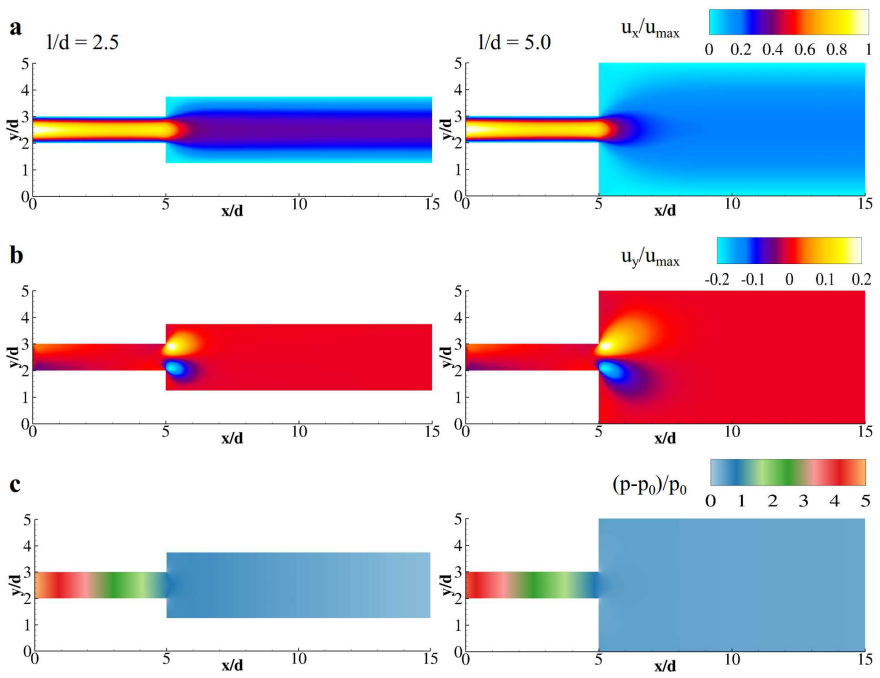
Supplementary Figures Figure 7: Flow patterns in the l/slash.leftd = 1 micro-channel. a Contour of the longitudinal component of the velocity field. b Contour of the vertical component of the velocity field.c Relative pressure distribution in the computational flow field (p0 is the outlet section pressure). 21 Figure 8: Transport of three aligned capsules ( l...
discussion (0)
Sign in with ORCID, Apple, or X to comment. Anyone can read and Pith papers without signing in.