Effect of electron correlations on attosecond photoionization delays in the vicinity of the Cooper minima of argon
Pith reviewed 2026-05-25 11:03 UTC · model grok-4.3
The pith
Electron correlations in argon produce photoionization delays up to 430 attoseconds near a Cooper-like minimum.
A machine-rendered reading of the paper's core claim, the machinery that carries it, and where it could break.
Core claim
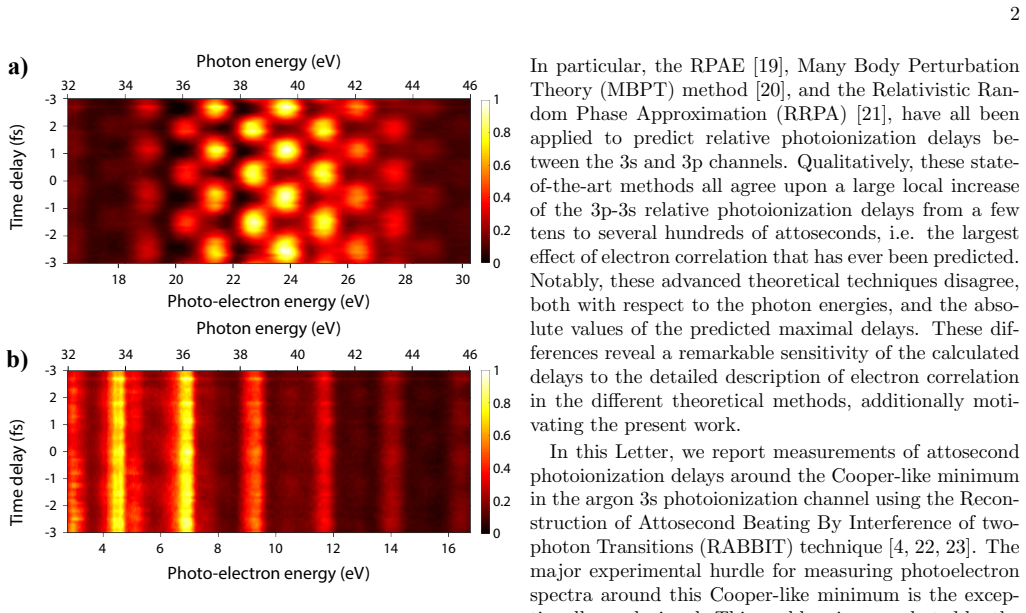
The 3s photoionization channel of argon exhibits a Cooper-like minimum around 42 eV that arises exclusively from inter-electronic correlations with the 3p shell; experimental measurement with a 100 kHz laser system yields relative photoionization delays up to 430 plus or minus 20 as in this region, in partial agreement with state-of-the-art theory.
What carries the argument
The Cooper-like minimum in the 3s photoionization cross section, produced solely by correlations with the 3p shell, which amplifies the observed attosecond delays.
If this is right
- Photoionization delays in atoms can be governed by electron correlations rather than independent-particle motion.
- High-repetition-rate sources enable access to low-cross-section channels for attosecond timing measurements.
- Theoretical models of photoionization must incorporate inter-channel correlations to predict delays near such minima.
- Attosecond delay measurements can serve as a direct experimental signature of many-body electron effects.
Where Pith is reading between the lines
- Analogous correlation minima may appear in other noble gases and could be mapped with similar techniques.
- Large correlation-driven delays imply that photoionization timing offers a sensitive test of many-electron dynamics.
- Extending the measurements to neighboring energies or different atoms would test how general the effect is.
Load-bearing premise
The measured delays arise exclusively from the correlation-induced Cooper-like minimum in the 3s channel, and the experiment isolates this channel accurately even though its cross section is very low.
What would settle it
A measurement finding delays near 42 eV that match single-particle predictions or fall well below 400 as would show the large delays are not produced by the reported correlation effect.
Figures



read the original abstract
Attosecond photoionization delays have mostly been interpreted within the single-particle approximation of multi-electron systems. The strong electron correlation between the photoionization channels associated with the 3p and 3s orbitals of argon presents an interesting arena where this single-particle approximation breaks down. Around photon energies of 42~eV, the 3s photoionization channel of argon experiences a ``Cooper-like" minimum, which is exclusively the result of inter-electronic correlations with the 3p shell. Photoionization delays around this ``Cooper-like" minimum have been predicted theoretically, but experimental verification has remained a challenge since the associated photoionization cross section is inherently very low. Here, we report the measurement of photoionization delays around the Cooper-like minimum that were acquired with the 100~kHz High-Repetition 1 laser system at the ELI-ALPS facility. We report relative photoionization delays reaching up to unprecedented values of 430 +/- 20~as, as a result of electron correlation. Our experimental results are in partial agreement with state-of-the-art theoretical results, but also demonstrate the need for additional theoretical developments.
Editorial analysis
A structured set of objections, weighed in public.
Referee Report
Summary. The manuscript reports experimental measurements of attosecond photoionization delays in argon near the correlation-induced Cooper-like minimum (~42 eV) in the 3s channel. Using a 100 kHz high-repetition-rate laser at ELI-ALPS, relative delays reaching 430 ± 20 as are extracted and compared to state-of-the-art theory, with partial agreement noted; the work emphasizes the breakdown of the single-particle picture due to 3s-3p interchannel coupling.
Significance. If the channel isolation and background subtraction are robust, the result supplies a valuable experimental benchmark for many-electron effects on photoionization delays in a low-cross-section regime that has been theoretically predicted but experimentally elusive. The high-repetition-rate approach addresses the signal challenge and could stimulate further theory development.
major comments (1)
- [Results / Methods] The central attribution of the 430 ± 20 as delays exclusively to the 3s Cooper-like minimum (abstract) rests on the assumption that the recorded signal is free of contamination from the dominant 3p channel or background. Given the explicitly low cross section at the minimum, the manuscript must provide quantitative evidence (e.g., channel-resolved yields, subtraction residuals, or SNR metrics) that residual 3p contributions cannot produce spurious phase shifts of this magnitude; without it the experimental isolation remains insecure.
minor comments (1)
- [Abstract] The abstract states 'partial agreement' with theory; a brief enumeration of which delay features agree or disagree (energy dependence, magnitude at specific points) would improve clarity.
Simulated Author's Rebuttal
We thank the referee for their careful reading of the manuscript and for highlighting the need to strengthen the evidence for channel isolation. We address the single major comment below.
read point-by-point responses
-
Referee: [Results / Methods] The central attribution of the 430 ± 20 as delays exclusively to the 3s Cooper-like minimum (abstract) rests on the assumption that the recorded signal is free of contamination from the dominant 3p channel or background. Given the explicitly low cross section at the minimum, the manuscript must provide quantitative evidence (e.g., channel-resolved yields, subtraction residuals, or SNR metrics) that residual 3p contributions cannot produce spurious phase shifts of this magnitude; without it the experimental isolation remains insecure.
Authors: We agree that explicit quantitative metrics are required to confirm that the measured delays can be attributed to the 3s channel without significant 3p contamination. The original manuscript describes the use of the 100 kHz high-repetition-rate source to overcome the low cross-section and outlines the background-subtraction procedure, but does not include the requested numerical benchmarks. In the revised manuscript we will add these data (channel-resolved yields, subtraction residuals, and SNR values) in the Methods or a supplementary section to show that any residual 3p contribution lies well below the level that could generate phase shifts of the observed size. revision: yes
Circularity Check
No circularity: experimental measurement stands independent of any derivation chain
full rationale
The paper's central result is a direct experimental measurement of relative photoionization delays (up to 430 ± 20 as) obtained with a 100 kHz laser system at ELI-ALPS. No derivation, ansatz, or first-principles calculation is presented whose output reduces to its inputs by construction. Theoretical comparisons are external (state-of-the-art calculations) and only partially agree; the paper does not invoke self-citations to justify uniqueness or smuggle in fitted parameters renamed as predictions. The acknowledged low cross-section at the Cooper-like minimum is an experimental limitation, not a circularity issue. The result is therefore self-contained against external benchmarks.
Axiom & Free-Parameter Ledger
Lean theorems connected to this paper
-
IndisputableMonolith/Cost/FunctionalEquation.leanwashburn_uniqueness_aczel unclear?
unclearRelation between the paper passage and the cited Recognition theorem.
Around photon energies of 42 eV, the 3s photoionization channel of argon experiences a 'Cooper-like' minimum, which is exclusively the result of inter-electronic correlations with the 3p shell.
-
IndisputableMonolith/Foundation/AlexanderDuality.leanalexander_duality_circle_linking unclear?
unclearRelation between the paper passage and the cited Recognition theorem.
Comparison with state-of-the-art calculations has revealed that electron correlation is the main source of these remarkably large delays.
What do these tags mean?
- matches
- The paper's claim is directly supported by a theorem in the formal canon.
- supports
- The theorem supports part of the paper's argument, but the paper may add assumptions or extra steps.
- extends
- The paper goes beyond the formal theorem; the theorem is a base layer rather than the whole result.
- uses
- The paper appears to rely on the theorem as machinery.
- contradicts
- The paper's claim conflicts with a theorem or certificate in the canon.
- unclear
- Pith found a possible connection, but the passage is too broad, indirect, or ambiguous to say the theorem truly supports the claim.
Reference graph
Works this paper leans on
-
[1]
John W. Cooper. Photoionization from outer atomic sub- shells. a model study. Physical Review, 128(2):681–693,
-
[2]
ISSN 0031899X. doi:10.1103/PhysRev.128.681
-
[3]
M. Ya Amusia, V. K. Ivanov, N. A. Cherepkov, and L. V. Chernysheva. Interference effects in photoionization of noble gas atoms outer s-subshells. Physics Letters A , 40 (5):361–362, 1972. ISSN 03759601. doi:10.1016/0375- 9601(72)90531-2
-
[4]
Kienberger, U Kleineberg, E Gouliel- makis, F Krausz, and V S Yakovlev
M Schultze, N Karpowicz, J Gagnon, M Korbman, M Hofstetter, S Neppl, A L Cavalieri, Y Komninos, C A Nicolaides, R Pazourek, S Nagele, J Feist, A M Azzeer, R Ernstorfer, R. Kienberger, U Kleineberg, E Gouliel- makis, F Krausz, and V S Yakovlev. Delay in Photoe- mission. Science, 328(June):1658–1662, 2010
work page 2010
-
[5]
K. Kl¨ under, J. M. Dahlstr¨ om, M. Gisselbrecht, T. Fordell, M. Swoboda, D. Gu´ enot, P. Johnsson, J. Caillat, J. Mauritsson, A. Maquet, R. Ta¨ ıeb, and A. L’Huillier. Probing single-photon ioniza- tion on the attosecond time scale. Physical Review Letters, 106(14):1–4, 2011. ISSN 00319007. doi: 10.1103/PhysRevLett.106.143002
-
[6]
Thermal conductivity of superconducting MgB 2
Renate Pazourek, Stefan Nagele, and Joachim Burgd¨ orfer. Probing time-ordering in two-photon double ionization of helium on the attosecond time scale. Journal of Physics B: Atomic, Molecular and Optical Physics, 48(6), 2015. ISSN 13616455. doi:10.1088/0953- 4075/48/6/061002
-
[7]
A. S. Kheifets. Time delay in valence-shell photoioniza- tion of noble-gas atoms. Physical Review A - Atomic, Molecular, and Optical Physics , 87(6):1–9, 2013. ISSN 10502947. doi:10.1103/PhysRevA.87.063404
-
[8]
D. Gu´ enot, D. Kroon, E. Balogh, E. W. Larsen, M. Ko- tur, M. Miranda, T. Fordell, P. Johnsson, J. Mauritsson, M. Gisselbrecht, K. Varj´ u, C. L. Arnold, T. Carette, A. S. Kheifets, E. Lindroth, A. Lhuillier, and J. M. Dahlstr¨ om. 5 Measurements of relative photoemission time delays in noble gas atoms. Journal of Physics B: Atomic, Molec- ular and Optic...
-
[9]
Caryn Palatchi, J. M. Dahlstr¨ om, A. S. Kheifets, I. A. Ivanov, D. M. Canaday, P. Agostini, and L. F. Di- mauro. Atomic delay in helium, neon, argon and kryp- ton. Journal of Physics B: Atomic, Molecular and Optical Physics , 47(24):245003, 2014. ISSN 13616455. doi:10.1088/0953-4075/47/24/245003. URL http://dx. doi.org/10.1088/0953-4075/47/24/245003
-
[10]
I. Jordan, M. Huppert, S. Pabst, A. S. Kheifets, D. Baykusheva, and H. J. W¨ orner. Spin-orbit delays in photoemission. Physical Review A, 95(1):1–7, 2017. ISSN 24699934. doi:10.1103/PhysRevA.95.013404
-
[12]
Theory of Attosecond Delays in Molecular Photoionization.Journal of Chemical Physics , 146(9), 2017
Denitsa Baykusheva and Hans Jakob W¨ orner. Theory of Attosecond Delays in Molecular Photoionization.Journal of Chemical Physics , 146(9), 2017. ISSN 10797114. doi: 10.1103/PhysRevLett.117.093001
-
[13]
J. Vos, L. Cattaneo, S. Patchkovskii, T. Zimmermann, C. Cirelli, M. Lucchini, A. S. Kheifets, A. S. Landsman, and U. Keller. Orientation-dependent stereo Wigner time delay and electron localization in a small molecule. Sci- ence, 360(6395):1326–1330, 2018. ISSN 10959203. doi: 10.1126/science.aao4731
-
[14]
L. Cattaneo, J. Vos, R. Y. Bello, A. Palacios, S. Heuser, L. Pedrelli, M. Lucchini, C. Cirelli, F. Mart´ ın, and U. Keller. Attosecond coupled electron and nuclear dynamics in dissociative ionization of H 2. Nature Physics, 14(7):733–739, 2018. ISSN 17452481. doi: 10.1038/s41567-018-0103-2. URL http://dx.doi.org/ 10.1038/s41567-018-0103-2
-
[15]
P. Sali` eres V. Gruson, L. Barreau, ´A. Jim´ enez-Gal´ an, F. Risoud, J. Caillat, A. Maquet, B. Carr´ e, F. Lepetit, J-F. Hergott, T. Ruchon, L. Argenti, R. Ta¨ ıeb, F. Mart´ ın. At- tosecond dynamics through a Fano resonance: Monitor- ing the birth of a photoelectron. Science, 354(Basalt 1): 16, 2014. ISSN 10959203. doi:10.1126/science.1252826
-
[16]
Claudio Cirelli, Carlos Marante, Sebastian Heuser, C. L.M. Petersson, ´Alvaro Jim´ enez Gal´ an, Luca Argenti, Shiyang Zhong, David Busto, Marcus Isinger, Saikat Nandi, Sylvain MacLot, Linnea Rading, Per Johnsson, Mathieu Gisselbrecht, Matteo Lucchini, Lukas Gallmann, J. Marcus Dahlstr¨ om, Eva Lindroth, Anne L’Huillier, Fernando Mart´ ın, and Ursula Kell...
-
[17]
Sourav Banerjee, Pranawa C. Deshmukh, Valeriy K. Dol- matov, Steven T. Manson, and A. S. Kheifets. Strong dependence of photoionization time delay on energy and angle in the neighborhood of Fano resonances. Physi- cal Review A , 99(1):13416, 2019. ISSN 24699934. doi: 10.1103/PhysRevA.99.013416. URL https://doi.org/ 10.1103/PhysRevA.99.013416
-
[18]
M. Ossiander, F. Siegrist, V. Shirvanyan, R. Pazourek, A. Sommer, T. Latka, A. Guggenmos, S. Nagele, J. Feist, J. Burgd¨ orfer, R. Kienberger, and M. Schultze. Attosec- ond correlation dynamics. Nature Physics , 13(3):280– 285, 2017. ISSN 17452481. doi:10.1038/nphys3941
-
[19]
M. Isinger, R. J. Squibb, D. Busto, S. Zhong, A. Harth, D. Kroon, S. Nandi, C. L. Arnold, M. Miranda, J. M. Dahlstr¨ om, E. Lindroth, R. Feifel, M. Gisselbrecht, and A. L’Huillier. Photoionization in the time and fre- quency domain. Science, 358(6365):893–896, 2017. ISSN 10959203. doi:10.1126/science.aao7043
-
[20]
D. Gu´ enot, K. Kl¨ under, C. L. Arnold, D. Kroon, J. M. Dahlstr¨ om, M. Miranda, T. Fordell, M. Gis- selbrecht, P. Johnsson, J. Mauritsson, E. Lindroth, A. Maquet, R. Ta¨ ıeb, A. L’Huillier, and A. S. Kheifets. Photoemission-time-delay measurements and calcula- tions close to the 3s-ionization-cross-section minimum in Ar. Physical Review A - Atomic, Mole...
-
[21]
J. M. Dahlstr¨ om, T. Carette, and E. Lindroth. Dia- grammatic approach to attosecond delays in photoion- ization. Physical Review A - Atomic, Molecular, and Optical Physics , 86(6):1–4, 2012. ISSN 10502947. doi: 10.1103/PhysRevA.86.061402
-
[22]
Soumyajit Saha, Ankur Mandal, Jobin Jose, Hari R. Varma, P. C. Deshmukh, A. S. Kheifets, V. K. Dolma- tov, and S. T. Manson. Relativistic effects in photoion- ization time delay near the Cooper minimum of noble- gas atoms. Physical Review A - Atomic, Molecular, and Optical Physics , 90(5):1–7, 2014. ISSN 10941622. doi: 10.1103/PhysRevA.90.053406
-
[23]
Observation of a Train of Attosecond Pulses from High Harmonic Generation
Paul, P M., Toma, E S., Breger, P., Mullot, G., Auge, F., Balcou, Muller, H G., and Agostini. Observation of a Train of Attosecond Pulses from High Harmonic Generation. Science, 292(5522):1689–1692, 2001. doi: 10.1126/science.1059413
-
[24]
H. G. Muller. Reconstruction of attosecond harmonic beating by interference of two-photon transitions. Ap- plied Physics B: Lasers and Optics , 74(SUPPL.):17–21,
-
[25]
ISSN 09462171. doi:10.1007/s00340-002-0894-8
-
[26]
The ELI-ALPS facility : the next generation of attosecond sources
Sergei K¨ uhn, Mathieu Dumergue, Subhendu Kahaly, Sudipta Mondal, Francesca Calegari, Giuseppe San- sone, Salvatore Stagira, Steffen H¨ adrich, Jan Rothhardt, Manuel Krebs, Derryck T Reid, Christoph M Heyl, and Robert R Thomson. The ELI-ALPS facility : the next generation of attosecond sources. Journal of Physics B: Atomic, Molecular and Optical Physics , 50, 2017
work page 2017
-
[27]
D. Hammerland, P. Zhang, S. Kuehn, P. Jojart, I. Seres, V. Zuba, Z. Varallyay, K. Osvay, T. T. Luu, and H. J. Woerner. Reconstruction of attosecond pulses in the pres- ence of interfering dressing fields using the 100 kHz ELI- ALPS HR-1 laser system. Arxiv, pages 1–7, 2019. URL http://arxiv.org/abs/1906.07059
-
[28]
Alexander W. Bray, Faiza Naseem, and A. S. Kheifets. Simulation of angular-resolved RABBITT measurements in noble-gas atoms. Physical Review A, 97(6):1–12, 2018. ISSN 24699934. doi:10.1103/PhysRevA.97.063404
-
[29]
Inga Jordan, Arohi Jain, Thomas Gaumnitz, Jun Ma, and Hans Jakob W¨ orner. Photoelectron spectrometer for liquid and gas-phase attosecond spectroscopy with field-free and magnetic bottle operation modes. Review of Scientific Instruments , 89(5), 2018. ISSN 10897623. doi:10.1063/1.5011657
-
[30]
Hans Jakob W¨ orner, Hiromichi Niikura, Julien B. Bertrand, P. B. Corkum, and D. M. Villeneuve. Obser- vation of electronic structure minima in high-harmonic generation. Physical Review Letters , 102(10):1–4, 2009. ISSN 00319007. doi:10.1103/PhysRevLett.102.103901. 6
-
[31]
iSURF : a family of in fi nite-time surface fl ux methods
F Morales, T BRedtmann, and S Patckovskii. iSURF : a family of in fi nite-time surface fl ux methods. Journal of Physics B: Atomic, Molecular and Optical Physics , 49,
-
[32]
doi:doi:10.1088/0953-4075/49/24/245001
discussion (0)
Sign in with ORCID, Apple, or X to comment. Anyone can read and Pith papers without signing in.