Lepton (non-) unversality in (flavor changing) neutral current B decays
Pith reviewed 2026-05-25 10:50 UTC · model grok-4.3
The pith
Deviations in B to K(*) muon versus electron decay ratios indicate lepton non-universality in flavor changing neutral currents.
A machine-rendered reading of the paper's core claim, the machinery that carries it, and where it could break.
Core claim
The ratios B→K(*)μμ/B→K(*)ee show deviations from standard model predictions, hinting at lepton non-universality in flavor changing neutral current B decays. The paper presents this as evidence that new physics may be at work in these transitions, with the anomalies providing a window into flavor structure beyond the standard model.
What carries the argument
The lepton universality ratios R_K and R_K* comparing muon and electron channels in b to s ll transitions.
If this is right
- New physics must contribute to the effective operators governing b to s transitions with flavor-dependent lepton couplings.
- Models such as leptoquarks or Z prime bosons with non-universal couplings become favored explanations.
- Related observables in other decay channels and at higher energies should exhibit correlated deviations.
- Collider searches gain motivation for particles that couple differently to muons and electrons.
Where Pith is reading between the lines
- The pattern of deviations could help distinguish among different new physics models if more channels are measured precisely.
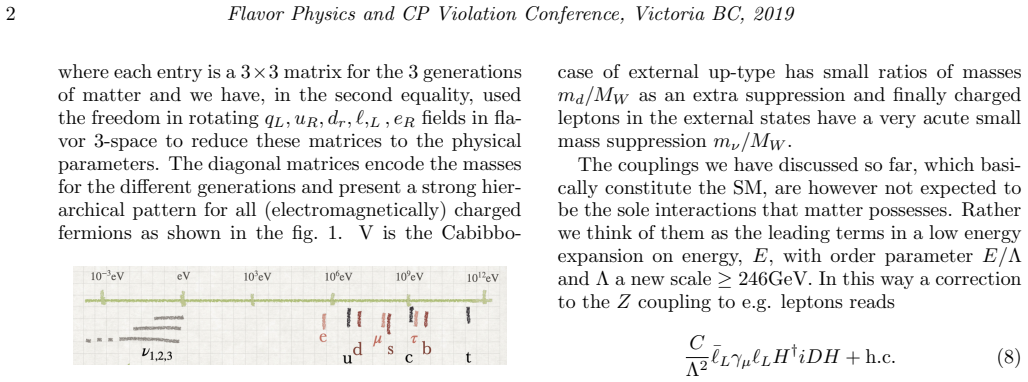
- This non-universality might link to broader flavor problems such as the hierarchy in quark and lepton masses.
- If real, the effect would motivate dedicated searches in related processes like rare tau decays.
Load-bearing premise
The observed deviations in the decay ratios are caused by new physics rather than experimental systematics, hadronic uncertainties, or standard model calculation errors.
What would settle it
A future measurement showing the ratios consistent with standard model expectations within uncertainties would disprove the new physics interpretation.
Figures


read the original abstract
The following proceedings contain a theory perspective on the flavor changing neutral current anomalies reported by LHCb on the ratios $B\to K^{(*)} \mu\mu/B\to K^{(*)} ee$
Editorial analysis
A structured set of objections, weighed in public.
Referee Report
Summary. The manuscript is a theory perspective summarizing the LHCb-reported anomalies in the lepton non-universality ratios R_K and R_K* for the decays B→K(*)μμ over B→K(*)ee, discussing their implications for flavor-changing neutral current processes.
Significance. As a perspective piece rather than a new derivation or model, the paper's value is in contextualizing existing experimental hints of lepton non-universality in b→sℓℓ transitions. If the deviations hold, they would point to new physics, but the manuscript advances no quantitative predictions or parameter-free results.
minor comments (1)
- The abstract and title use non-standard spacing and punctuation (e.g., 'Lepton (non-) unversality'); a light copy-edit would improve readability.
Simulated Author's Rebuttal
We thank the referee for their positive assessment of our perspective manuscript and for recommending acceptance. We appreciate the recognition that the work contextualizes the LHCb-reported anomalies in R_K and R_K* without claiming new quantitative predictions, consistent with its nature as a theory overview rather than an original model-building paper.
Circularity Check
No derivation chain; perspective summarizing experimental anomalies
full rationale
The manuscript is explicitly a theory perspective on LHCb-reported anomalies in the ratios R_K and R_K*. It advances no new model, derivation, equations, or fitted parameters. The central claim is a summary of existing experimental results rather than a prediction derived from internal assumptions. No self-citations, ansatze, or renamings are load-bearing because no quantitative derivation exists to reduce to its inputs. This matches the reader's assessment of circularity score 0.0.
Axiom & Free-Parameter Ledger
Reference graph
Works this paper leans on
-
[1]
S. L. Glashow, J. Iliopoulos and L. Maiani, Phys. Rev. D 2 (1970) 1285. doi:10.1103/PhysRevD.2.1285
-
[2]
Search for lepton-universality violation in $B^+\to K^+\ell^+\ell^-$ decays
R. Aaij et al. [LHCb Collaboration], Phys. Rev. Lett. 122 (2019) no.19, 191801 doi:10.1103/PhysRevLett.122.191801 [arXiv:1903.09252 [hep-ex]]
work page internal anchor Pith review Pith/arXiv arXiv doi:10.1103/physrevlett.122.191801 2019
-
[3]
Test of lepton universality with $B^{0} \rightarrow K^{*0}\ell^{+}\ell^{-}$ decays
R. Aaij et al. [LHCb Collaboration], JHEP 1708 (2017) 055 doi:10.1007/JHEP08(2017)055 [arXiv:1705.05802 [hep-ex]]
work page internal anchor Pith review Pith/arXiv arXiv doi:10.1007/jhep08(2017)055 2017
-
[4]
A. Abdesselam et al. [Belle Collaboration], arXiv:1904.02440 [hep-ex]
-
[5]
On the Standard Model predictions for $R_K$ and $R_{K^*}$
M. Bordone, G. Isidori and A. Pattori, Eur. Phys. J. C 76 (2016) no.8, 440 doi:10.1140/epjc/s10052-016- 4274-7 [arXiv:1605.07633 [hep-ph]]
work page internal anchor Pith review Pith/arXiv arXiv doi:10.1140/epjc/s10052-016- 2016
-
[6]
Angular Distributions of B -> K ll Decays
C. Bobeth, G. Hiller and G. Piranishvili, JHEP 0712 (2007) 040 doi:10.1088/1126-6708/2007/12/040 [arXiv:0709.4174 [hep-ph]]
work page internal anchor Pith review Pith/arXiv arXiv doi:10.1088/1126-6708/2007/12/040 2007
-
[7]
$SU(2)\times U(1)$ gauge invariance and the shape of new physics in rare $B$ decays
R. Alonso, B. Grinstein and J. Martin Camalich, Phys. Rev. Lett. 113 (2014) 241802 doi:10.1103/PhysRevLett.113.241802 [arXiv:1407.7044 [hep-ph]]
work page internal anchor Pith review Pith/arXiv arXiv doi:10.1103/physrevlett.113.241802 2014
-
[8]
L. S. Geng, B. Grinstein, S. Jger, J. Martin Ca- malich, X. L. Ren and R. X. Shi, Phys. Rev. D 96 (2017) no.9, 093006 doi:10.1103/PhysRevD.96.093006 [arXiv:1704.05446 [hep-ph]]
-
[9]
Flavour anomalies after the $R_{K^*}$ measurement
G. D’Amico, M. Nardecchia, P. Panci, F. San- nino, A. Strumia, R. Torre and A. Urbano, JHEP 1709 (2017) 010 doi:10.1007/JHEP09(2017)010 [arXiv:1704.05438 [hep-ph]]
work page internal anchor Pith review Pith/arXiv arXiv doi:10.1007/jhep09(2017)010 2017
-
[10]
J. Aebischer, W. Altmannshofer, D. Guadag- noli, M. Reboud, P. Stangl and D. M. Straub, arXiv:1903.10434 [hep-ph]
-
[11]
Opportunities in Flavour Physics at the HL-LHC and HE-LHC
A. Cerri et al. , arXiv:1812.07638 [hep-ph]
work page internal anchor Pith review Pith/arXiv arXiv
-
[12]
A. J. Buras, J. Girrbach-Noe, C. Niehoff and D. M. Straub, JHEP 1502 (2015) 184 doi:10.1007/JHEP02(2015)184 [arXiv:1409.4557 [hep-ph]]
work page internal anchor Pith review Pith/arXiv arXiv doi:10.1007/jhep02(2015)184 2015
-
[13]
On the Importance of Electroweak Corrections for B Anomalies
F. Feruglio, P. Paradisi and A. Pattori, JHEP 1709 (2017) 061 doi:10.1007/JHEP09(2017)061 [arXiv:1705.00929 [hep-ph]]
work page internal anchor Pith review Pith/arXiv arXiv doi:10.1007/jhep09(2017)061 2017
-
[14]
S. L. Glashow, D. Guadagnoli and K. Lane, Phys. Rev. Lett. 114 (2015) 091801 doi:10.1103/PhysRevLett.114.091801 [arXiv:1411.0565 [hep-ph]]
work page internal anchor Pith review Pith/arXiv arXiv doi:10.1103/physrevlett.114.091801 2015
-
[15]
Lepton universality violation and lepton flavor conservation in $B$-meson decays
R. Alonso, B. Grinstein and J. Mar- tin Camalich, JHEP 1510 (2015) 184 doi:10.1007/JHEP10(2015)184 [arXiv:1505.05164 [hep-ph]]. MonB1400
work page internal anchor Pith review Pith/arXiv arXiv doi:10.1007/jhep10(2015)184 2015
discussion (0)
Sign in with ORCID, Apple, or X to comment. Anyone can read and Pith papers without signing in.