Lepton Flavor Universality tests through angular observables of overline{B}to D^((ast))elloverline{ν} decay modes
Pith reviewed 2026-05-25 09:27 UTC · model grok-4.3
The pith
Angular observables in B to D(*) lepton neutrino decays can reveal new physics even when R(D(*)) ratios match the Standard Model.
A machine-rendered reading of the paper's core claim, the machinery that carries it, and where it could break.
Core claim
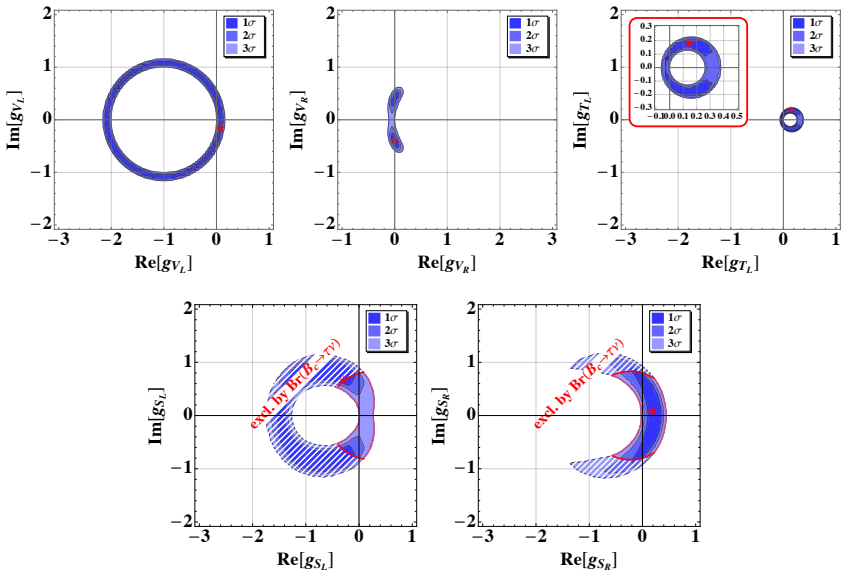
When the Wilson coefficients of vector, scalar, pseudoscalar, and tensor operators are determined exclusively by fitting to the experimental R(D(*)) values, the angular observables extracted from the differential decay rate still exhibit measurable deviations from their Standard Model predictions, allowing the Lorentz structure of any new physics to be distinguished even if the ratios R(D(*)) are later found to agree with the Standard Model.
What carries the argument
The full set of angular observables obtained from the four-fold differential decay distribution in the effective Hamiltonian that includes all Lorentz structures, with coefficients fixed by the R(D(*)) data.
If this is right
- Different Lorentz structures produce distinct patterns across the angular observables.
- Even a partial set of measured angles can separate scalar, tensor, and vector new physics scenarios.
- The observables remain sensitive to new physics size after the ratios become Standard Model-like.
- Comparison of data with Standard Model angular predictions supplies independent constraints on the coefficients.
Where Pith is reading between the lines
- Experiments at B factories could prioritize angular measurements to close loopholes left by ratio-only tests.
- Absence of deviations in the angles would tighten bounds on allowed new physics models more than ratios alone.
- Similar angular analyses might apply to related semileptonic modes to cross-check the same operators.
Load-bearing premise
New physics contributions to these decays are fully captured by the low-energy effective operators whose strengths are fixed only by the R(D(*)) ratios, without extra effects from higher-dimensional operators or unrelated processes.
What would settle it
A measurement of the angular observables that agrees with Standard Model predictions for every combination of Wilson coefficients that reproduces the measured R(D(*)) values within their uncertainties.
Figures



read the original abstract
We discuss the possibility of using the observables deduced from the angular distribution of the $B\to D^{(\ast)} \ell\bar{\nu}$ decays to test the effects of lepton flavor universality violation (LFUV). We show that the measurement of even a subset of these observables could be very helpful in distinguishing the Lorentz structure of the New Physics contributions to these decays. To do so we use the low energy effective theory in which besides the Standard Model contribution we add all possible Lorentz structures with the couplings (Wilson coefficients) that are determined by matching theory with the measured ratios $R{(D^{(\ast)})}^\mathrm{exp}$. We argue that even in the situation in which the measured $R{(D^{(\ast)})}^\mathrm{exp}$ becomes fully compatible with the Standard Model, one can still have significant New Physics contributions the size of which could be probed by measuring the observables discussed in this paper and comparing them with their Standard Model predictions.
Editorial analysis
A structured set of objections, weighed in public.
Referee Report
Summary. The paper claims that angular observables extracted from the differential distributions of B̄ → D(*) ℓ ν̄ decays can distinguish the Lorentz structure of New Physics contributions to b → c τ ν transitions. Wilson coefficients of all possible operators (vector, scalar, tensor) are fitted to the measured R(D(*)) ratios; the resulting parameter space is then used to predict angular observables, with the central assertion that significant NP effects remain detectable in the angular distributions even in the limit where R(D(*)) becomes fully compatible with the Standard Model.
Significance. If the explicit calculations confirm that flat directions in the multi-operator fit produce observable deviations in angular observables while preserving R(D(*)) ≈ R(D(*))_SM, the work would supply a concrete, falsifiable roadmap for future Belle II and LHCb measurements to resolve the operator structure of any LFUV. The use of the complete low-energy effective Lagrangian is a strength, as is the emphasis on observables that are in principle accessible with current detector capabilities.
major comments (2)
- [§3 (fitting procedure) and §4 (angular predictions)] The central claim (abstract and §4) that non-zero Wilson coefficients can reproduce R(D(*)) ≈ SM while generating large angular deviations rests on the existence of allowed directions in the multi-dimensional WC space. With five independent coefficients for the τ mode and only two integrated constraints, the fit necessarily admits flat directions; the manuscript must explicitly map those directions, quantify the size of the resulting angular deviations (e.g., in the forward-backward asymmetry or the D* polarization observables), and demonstrate that they exceed experimental precision. Without this mapping the claim that angular observables remain sensitive when R(D(*)) matches the SM is not yet load-bearing.
- [§3] The paper fits exclusively to R(D) and R(D*), which are ratios of integrated rates. It is not shown whether additional theoretical constraints (perturbative unitarity, matching to a UV completion, or bounds from other b → c ℓ ν observables) further restrict the degenerate directions that would otherwise produce large angular effects. If those directions are excluded by such constraints, the phenomenological reach of the angular observables is reduced.
minor comments (2)
- [§2] Notation for the Wilson coefficients (C_V, C_S, C_T, …) should be defined once in a table with explicit normalization conventions relative to the SM operator.
- [§4] The SM predictions for the angular observables are stated but the numerical values and their theoretical uncertainties (form-factor errors, etc.) should be collected in a dedicated table for direct comparison with the NP scenarios.
Simulated Author's Rebuttal
We thank the referee for the careful reading and constructive comments on our manuscript. We address the major comments point by point below. Where the referee correctly identifies gaps in the explicit demonstration of flat directions, we will revise the manuscript to incorporate the requested mapping and quantification.
read point-by-point responses
-
Referee: [§3 (fitting procedure) and §4 (angular predictions)] The central claim (abstract and §4) that non-zero Wilson coefficients can reproduce R(D(*)) ≈ SM while generating large angular deviations rests on the existence of allowed directions in the multi-dimensional WC space. With five independent coefficients for the τ mode and only two integrated constraints, the fit necessarily admits flat directions; the manuscript must explicitly map those directions, quantify the size of the resulting angular deviations (e.g., in the forward-backward asymmetry or the D* polarization observables), and demonstrate that they exceed experimental precision. Without this mapping the claim that angular observables remain sensitive when R(D(*)) matches the SM is not yet load-bearing.
Authors: We agree that the central claim would be strengthened by an explicit mapping of the flat directions. The manuscript currently illustrates the effect via benchmark points in the WC space that keep R(D(*)) near SM values while shifting angular observables, but does not systematically chart the degenerate directions or compare deviations to projected experimental precision. In the revised version we will add this analysis, identifying the allowed ranges in the five-dimensional WC space (for τ modes) consistent with R(D(*)) within current uncertainties and quantifying the resulting shifts in A_FB, F_L^{D*}, and related observables against Belle II/LHCb sensitivities. revision: yes
-
Referee: [§3] The paper fits exclusively to R(D) and R(D*), which are ratios of integrated rates. It is not shown whether additional theoretical constraints (perturbative unitarity, matching to a UV completion, or bounds from other b → c ℓ ν observables) further restrict the degenerate directions that would otherwise produce large angular effects. If those directions are excluded by such constraints, the phenomenological reach of the angular observables is reduced.
Authors: The work is performed in the general low-energy EFT, where the only data-driven constraints used are the measured R(D(*)) ratios; additional restrictions from perturbative unitarity, UV matching, or other b→cℓν observables are model-dependent and therefore omitted. We will add a short discussion noting that specific UV completions may further restrict the flat directions, but the EFT analysis demonstrates the discriminating power of angular observables in the most general case allowed by existing R(D(*)) data. revision: partial
Circularity Check
No significant circularity; derivation remains self-contained
full rationale
The paper defines an EFT framework that includes all Lorentz structures, fits the associated Wilson coefficients exclusively to the two integrated ratios R(D(*)), and then computes angular observables as functions of those coefficients. The angular distributions are independent observables not entering the fit, so their expressions are not equivalent to the input ratios by construction. The central argument—that angular observables can still reveal NP even if future R(D(*)) measurements become SM-compatible—rests on the structure of the multi-operator EFT rather than a tautological re-derivation of the fitted values. No self-definitional steps, load-bearing self-citations, or renaming of known results appear in the provided text.
Axiom & Free-Parameter Ledger
free parameters (1)
- Wilson coefficients for each Lorentz structure
axioms (2)
- domain assumption Low-energy effective field theory with all possible Lorentz structures is sufficient to describe the decays
- domain assumption No significant contributions from operators outside the considered set or from other decay modes
Lean theorems connected to this paper
-
IndisputableMonolith/Cost/FunctionalEquationwashburn_uniqueness_aczel unclear?
unclearRelation between the paper passage and the cited Recognition theorem.
Heff = √2 GF Vcb [(1+gV)(cγμb)(ℓLγμνL) + … + gT(cσμνb)(ℓRσμννL) + …]
-
IndisputableMonolith/Foundation/RealityFromDistinctionreality_from_one_distinction unclear?
unclearRelation between the paper passage and the cited Recognition theorem.
R(Oi) ≡ ⟨Oτi⟩ / ½(⟨Oei⟩ + ⟨Oμi⟩) and D(A7,8,9) defined from angular coefficients Ii(q²)
What do these tags mean?
- matches
- The paper's claim is directly supported by a theorem in the formal canon.
- supports
- The theorem supports part of the paper's argument, but the paper may add assumptions or extra steps.
- extends
- The paper goes beyond the formal theorem; the theorem is a base layer rather than the whole result.
- uses
- The paper appears to rely on the theorem as machinery.
- contradicts
- The paper's claim conflicts with a theorem or certificate in the canon.
- unclear
- Pith found a possible connection, but the passage is too broad, indirect, or ambiguous to say the theorem truly supports the claim.
Forward citations
Cited by 1 Pith paper
-
New physics searches via angular distributions of $ \bar{B} \to D^* (\to D \pi) \tau (\to \ell \nu_\tau \bar{\nu}_\ell) \bar{\nu}_\tau$ decays
Introduces a reconstructible angular distribution for B to D* tau nu decays via tau to lepton chain to extract new physics parameters, projecting 5-6% sensitivities from simulation and lattice form factors.
Reference graph
Works this paper leans on
-
[1]
Observation of the Semileptonic Decays B --> D* tau nubar and Evidence for B --> D tau nubar
BaBar Collaboration, B. Aubert et al. , “Observation of the semileptonic decays B→ D∗τ−¯ν( τ ) and evidence for B→ Dτ−¯ν( τ )”, Phys. Rev. Lett. 100 (2008) 021801, arXiv:0709.1698 [hep-ex]
work page internal anchor Pith review Pith/arXiv arXiv 2008
-
[2]
Evidence for an excess of B -> D(*) Tau Nu decays
BaBar Collaboration, J. P. Lees et al. , “Evidence for an excess of ¯B→ D(∗)τ−¯ντ decays”, Phys. Rev. Lett. 109 (2012) 101802, arXiv:1205.5442 [hep-ex]
work page internal anchor Pith review Pith/arXiv arXiv 2012
-
[3]
Belle Collaboration, M. Huschle et al. , “Measurement of the branching ratio of ¯B→ D(∗)τ−¯ντ relative to ¯B→ D(∗)ℓ−¯νℓ decays with hadronic tagging at Belle”, Phys. Rev. D92 (2015) no. 7, 072014, arXiv:1507.03233 [hep-ex]
work page internal anchor Pith review Pith/arXiv arXiv 2015
-
[4]
Belle Collaboration, Y. Sato et al. , “Measurement of the branching ratio of ¯B0→ D∗+τ−¯ντ relative to ¯B0→ D∗+ℓ−¯νℓ decays with a semileptonic tagging method”, Phys. Rev. D94 (2016) no. 7, 072007, arXiv:1607.07923 [hep-ex]
work page internal anchor Pith review Pith/arXiv arXiv 2016
-
[5]
LHCb Collaboration, R. Aaij et al. , “Measurement of the ratio of branching fractionsB( ¯B0→ D∗+τ−¯ντ)/B( ¯B0→ D∗+µ−¯νµ)”, Phys. Rev. Lett. 115 (2015) no. 11, 111803, arXiv:1506.08614 [hep-ex] . [Erratum: Phys. Rev. Lett.115,no.15,159901(2015)]
-
[6]
LHCb Collaboration, R. Aaij et al. , “Measurement of the ratio of the B0→ D∗−τ +ντ and B0→ D∗−µ+νµ branching fractions using three-prong τ-lepton decays”, Phys. Rev. Lett. 120 (2018) no. 17, 171802, arXiv:1708.08856 [hep-ex]
work page internal anchor Pith review Pith/arXiv arXiv 2018
-
[7]
On the B to D* tau nu Sensitivity to New Physics
S. Fajfer, J. F. Kamenik, and I. Nisandzic, “On the B→ D∗τ ¯ντ Sensitivity to New Physics”, Phys. Rev. D85 (2012) 094025, arXiv:1203.2654 [hep-ph]
work page internal anchor Pith review Pith/arXiv arXiv 2012
-
[8]
F. U. Bernlochner, Z. Ligeti, M. Papucci, and D. J. Robinson, “Combined analysis of semileptonic B decays to D and D∗: R(D(∗)),|Vcb|, and new physics”, Phys. Rev. D95 (2017) no. 11, 115008, arXiv:1703.05330 [hep-ph] . [Erratum: Phys. Rev.D97,no.5,059902(2018)]
work page internal anchor Pith review Pith/arXiv arXiv 2017
-
[9]
S. Jaiswal, S. Nandi, and S. K. Patra, “Extraction of |Vcb| from B→ D(∗)ℓνℓ and the Standard Model predictions of R(D(∗))”, JHEP 12 (2017) 060, arXiv:1707.09977 [hep-ph]
work page internal anchor Pith review Pith/arXiv arXiv 2017
-
[10]
The $V_{cb}$ puzzle: an update
P. Gambino, M. Jung, and S. Schacht, “The Vcb puzzle: an update”, arXiv:1905.08209 [hep-ph]
work page internal anchor Pith review Pith/arXiv arXiv 1905
-
[11]
Revisiting the new-physics interpretation of the b→ cτ ν data
R.-X. Shi, L.-S. Geng, B. Grinstein, S. J¨ ager, and J. Martin Camalich, “Revisiting the new-physics interpretation of the b→ cτ ν data”, arXiv:1905.08498 [hep-ph] . 36
- [12]
-
[13]
Global fit to b→ cτ ν transitions
C. Murgui, A. Pe˜ nuelas, M. Jung, and A. Pich, “Global fit to b→ cτ ν transitions”, arXiv:1904.09311 [hep-ph]
-
[14]
R2 as a single leptoquark solution to RD(∗) and RK(∗)
O. Popov, M. A. Schmidt, and G. White, “ R2 as a single leptoquark solution to RD(∗) and RK(∗)”, arXiv:1905.06339 [hep-ph]
-
[15]
Revisiting the vector leptoquark explanation of the B-physics anomalies
C. Cornella, J. Fuentes-Martin, and G. Isidori, “Revisiting the vector leptoquark explanation of the B-physics anomalies”, arXiv:1903.11517 [hep-ph]
-
[16]
Impact of D∗ polarization measurement on solutions to RD-RD∗ anomalies
A. K. Alok, D. Kumar, S. Kumbhakar, and S. Uma Sankar, “Impact of D∗ polarization measurement on solutions to RD-RD∗ anomalies”, arXiv:1903.10486 [hep-ph]
-
[17]
M. Blanke, A. Crivellin, S. de Boer, T. Kitahara, M. Moscati, U. Nierste, and I. Niˇ sandˇ zi´ c, “Impact of polarization observables andBc→ τ ν on new physics explanations of the b→ cτ ν anomaly”, Phys. Rev. D99 (2019) no. 7, 075006, arXiv:1811.09603 [hep-ph]
work page internal anchor Pith review Pith/arXiv arXiv 2019
-
[18]
$D^{\ast}$ polarization vs. $R_{D^{(\ast)}}$ anomalies in the leptoquark models
S. Iguro, T. Kitahara, Y. Omura, R. Watanabe, and K. Yamamoto, “D ∗ polarization vs. RD(∗) anomalies in the leptoquark models”, JHEP 02 (2019) 194, arXiv:1811.08899 [hep-ph]
work page internal anchor Pith review Pith/arXiv arXiv 2019
-
[19]
A Global Likelihood for Precision Constraints and Flavour Anomalies
J. Aebischer, J. Kumar, P. Stangl, and D. M. Straub, “A Global Likelihood for Precision Constraints and Flavour Anomalies”, arXiv:1810.07698 [hep-ph]
work page internal anchor Pith review Pith/arXiv arXiv
-
[20]
$b\to c\tau\nu$ Transitions in the Standard Model Effective Field Theory
Q.-Y. Hu, X.-Q. Li, and Y.-D. Yang, “ b→ cτ ν transitions in the standard model effective field theory”, Eur. Phys. J. C79 (2019) no. 3, 264, arXiv:1810.04939 [hep-ph]
work page internal anchor Pith review Pith/arXiv arXiv 2019
-
[21]
Closing the window on single leptoquark solutions to the $B$-physics anomalies
A. Angelescu, D. Becirevic, D. A. Faroughy, and O. Sumensari, “Closing the window on single leptoquark solutions to the B-physics anomalies”, JHEP 10 (2018) 183, arXiv:1808.08179 [hep-ph]
work page internal anchor Pith review Pith/arXiv arXiv 2018
-
[22]
Pati-Salam explanations of the B-meson anomalies
J. Heeck and D. Teresi, “Pati-Salam explanations of the B-meson anomalies”, JHEP 12 (2018) 103, arXiv:1808.07492 [hep-ph]
work page internal anchor Pith review Pith/arXiv arXiv 2018
-
[23]
A unified leptoquark model confronted with lepton non-universality in B-meson decays
T. Faber, M. Hudec, M. Malinsk´ y, P. Meinzinger, W. Porod, and F. Staub, “A unified leptoquark model confronted with lepton non-universality in B-meson decays”, Phys. Lett. B787 (2018) 159–166, arXiv:1808.05511 [hep-ph] . 37
-
[24]
Footprints of New Physics in $b\to c\tau\nu$ Transitions
Z.-R. Huang, Y. Li, C.-D. Lu, M. A. Paracha, and C. Wang, “Footprints of New Physics in b→ cτ ν Transitions”, Phys. Rev. D98 (2018) no. 9, 095018, arXiv:1808.03565 [hep-ph]
work page internal anchor Pith review Pith/arXiv arXiv 2018
-
[25]
Implications of scalar and tensor explanations of $R_{D^{(\ast)}}$
F. Feruglio, P. Paradisi, and O. Sumensari, “Implications of scalar and tensor explanations of RD(∗)”, JHEP 11 (2018) 191, arXiv:1806.10155 [hep-ph]
work page internal anchor Pith review Pith/arXiv arXiv 2018
-
[26]
Scalar leptoquarks from GUT to accommodate the $B$-physics anomalies
D. Becirevic, I. Dorˇ sner, S. Fajfer, N. Koˇ snik, D. A. Faroughy, and O. Sumensari, “Scalar leptoquarks from grand unified theories to accommodate the B-physics anomalies”, Phys. Rev. D98 (2018) no. 5, 055003, arXiv:1806.05689 [hep-ph]
work page internal anchor Pith review Pith/arXiv arXiv 2018
-
[27]
Low-energy signatures of the $\mathrm{PS}^3$ model: from $B$-physics anomalies to LFV
M. Bordone, C. Cornella, J. Fuentes-Mart´ ın, and G. Isidori, “Low-energy signatures of the PS 3 model: from B-physics anomalies to LFV”, JHEP 10 (2018) 148, arXiv:1805.09328 [hep-ph]
work page internal anchor Pith review Pith/arXiv arXiv 2018
-
[28]
Anatomy of $b \to c \, \tau \, \nu$ anomalies
A. Azatov, D. Bardhan, D. Ghosh, F. Sgarlata, and E. Venturini, “Anatomy of b→ cτ ν anomalies”, JHEP 11 (2018) 187, arXiv:1805.03209 [hep-ph]
work page internal anchor Pith review Pith/arXiv arXiv 2018
-
[29]
Resolution of $R_D$/$R_{D^*}$ puzzle
A. K. Alok, D. Kumar, S. Kumbhakar, and S. Uma Sankar, “Resolution of RD/RD∗ puzzle”, Phys. Lett. B784 (2018) 16–20, arXiv:1804.08078 [hep-ph]
work page internal anchor Pith review Pith/arXiv arXiv 2018
-
[30]
Addressing the B-physics anomalies in a fundamental Composite Higgs Model
D. Marzocca, “Addressing the B-physics anomalies in a fundamental Composite Higgs Model”, JHEP 07 (2018) 121, arXiv:1803.10972 [hep-ph]
work page internal anchor Pith review Pith/arXiv arXiv 2018
-
[31]
$B$ Meson Anomalies in a Pati-Salam Model within the Randall-Sundrum Background
M. Blanke and A. Crivellin, “ B Meson Anomalies in a Pati-Salam Model within the Randall-Sundrum Background”, Phys. Rev. Lett. 121 (2018) no. 1, 011801, arXiv:1801.07256 [hep-ph]
work page internal anchor Pith review Pith/arXiv arXiv 2018
-
[32]
Constraining new physics in $b\to c\ell\nu$ transitions
M. Jung and D. M. Straub, “Constraining new physics in b→ cℓν transitions”, JHEP 01 (2019) 009, arXiv:1801.01112 [hep-ph]
work page internal anchor Pith review Pith/arXiv arXiv 2019
-
[33]
New physics solutions for $R_D$ and $R_{D^*}$
A. K. Alok, D. Kumar, J. Kumar, S. Kumbhakar, and S. U. Sankar, “New physics solutions for RD and RD∗”, JHEP 09 (2018) 152, arXiv:1710.04127 [hep-ph]
work page internal anchor Pith review Pith/arXiv arXiv 2018
-
[34]
B-physics anomalies: a guide to combined explanations
D. Buttazzo, A. Greljo, G. Isidori, and D. Marzocca, “B-physics anomalies: a guide to combined explanations”, JHEP 11 (2017) 044, arXiv:1706.07808 [hep-ph]
work page internal anchor Pith review Pith/arXiv arXiv 2017
-
[35]
$R_{D^{(*)}}$ anomaly: A possible hint for natural supersymmetry with $R$-parity violation
W. Altmannshofer, P. S. Bhupal Dev, and A. Soni, “ RD(∗) anomaly: A possible hint for natural supersymmetry with R-parity violation”, Phys. Rev. D96 (2017) no. 9, 095010, arXiv:1704.06659 [hep-ph]
work page internal anchor Pith review Pith/arXiv arXiv 2017
-
[36]
A. Crivellin, D. M¨ uller, and T. Ota, “Simultaneous explanation of R(D(∗)) and b→ sµ+µ−: the last scalar leptoquarks standing”, JHEP 09 (2017) 040, arXiv:1703.09226 [hep-ph] . 38
work page internal anchor Pith review Pith/arXiv arXiv 2017
-
[37]
Scalar contributions to $b\to c (u) \tau \nu$ transitions
A. Celis, M. Jung, X.-Q. Li, and A. Pich, “Scalar contributions to b→ c(u)τ ν transitions”, Phys. Lett. B771 (2017) 168–179, arXiv:1612.07757 [hep-ph]
work page internal anchor Pith review Pith/arXiv arXiv 2017
-
[38]
R. Alonso, A. Kobach, and J. Martin Camalich, “New physics in the kinematic distributions of ¯B→ D(∗)τ−(→ ℓ−¯νℓντ)¯ντ”, Phys. Rev. D94 (2016) no. 9, 094021, arXiv:1602.07671 [hep-ph]
work page internal anchor Pith review Pith/arXiv arXiv 2016
-
[39]
Flavor models for $\bar{B} \to D^{(*)} \tau \bar{\nu}$
M. Freytsis, Z. Ligeti, and J. T. Ruderman, “Flavor models for ¯B→ D(∗)τ ¯ν”, Phys. Rev. D92 (2015) no. 5, 054018, arXiv:1506.08896 [hep-ph]
work page internal anchor Pith review Pith/arXiv arXiv 2015
-
[40]
Sterile neutrinos in leptonic and semileptonic decays
A. Abada, A. M. Teixeira, A. Vicente, and C. Weiland, “Sterile neutrinos in leptonic and semileptonic decays”, JHEP 02 (2014) 091, arXiv:1311.2830 [hep-ph]
work page internal anchor Pith review Pith/arXiv arXiv 2014
-
[41]
New physics in the weak interaction of $\bar B\to D^{(*)}\tau\bar\nu$
M. Tanaka and R. Watanabe, “New physics in the weak interaction of ¯B→ D(∗)τ ¯ν”, Phys. Rev. D87 (2013) no. 3, 034028, arXiv:1212.1878 [hep-ph]
work page internal anchor Pith review Pith/arXiv arXiv 2013
-
[42]
B-physics anomalies: The bridge between R-parity violating Supersymmetry and flavoured Dark Matter
S. Trifinopoulos, “B-physics anomalies: The bridge between R-parity violating Supersymmetry and flavoured Dark Matter”, arXiv:1904.12940 [hep-ph]
-
[43]
Measurement of $\mathcal{R}(D)$ and $\mathcal{R}(D^{\ast})$ with a semileptonic tagging method
Belle Collaboration, A. Abdesselam et al. , “Measurement ofR(D) andR(D∗) with a semileptonic tagging method”, arXiv:1904.08794 [hep-ex]
work page internal anchor Pith review Pith/arXiv arXiv 1904
-
[44]
Averages of $b$-hadron, $c$-hadron, and $\tau$-lepton properties as of summer 2016
HFLAV Collaboration, Y. Amhis et al. , “Averages of b-hadron, c-hadron, and τ-lepton properties as of summer 2016”, Eur. Phys. J. C77 (2017) no. 12, 895, arXiv:1612.07233 [hep-ex]
work page internal anchor Pith review Pith/arXiv arXiv 2016
-
[45]
$B\to D^\ast\ell\nu$ at non-zero recoil
A. V. Avil´ es-Casco, C. DeTar, A. X. El-Khadra, A. S. Kronfeld, J. Laiho, and R. S. Van de Water, “B→ D∗ℓν at non-zero recoil”, PoS LATTICE2018 (2019) 282, arXiv:1901.00216 [hep-lat]
work page internal anchor Pith review Pith/arXiv arXiv 2019
-
[46]
$B\to D^\ast\ell\nu$ at non-zero recoil
A. Vaquero, C. DeTar, A. X. El-Khadra, A. S. Kronfeld, J. Laiho, and R. S. Van de Water, “B→ D∗ℓν at non-zero recoil”, in 17th Conference on Flavor Physics and CP Violation (FPCP 2019) Victoria, BC, Canada, May 6-10, 2019 . 2019. arXiv:1906.01019 [hep-lat]
work page internal anchor Pith review Pith/arXiv arXiv 2019
-
[47]
The $B \to D \ell \nu$ form factors at nonzero recoil and $|V_{cb}|$ from $2+1$-flavor lattice QCD
MILC Collaboration, J. A. Bailey et al. , “B→ Dℓν form factors at nonzero recoil and|Vcb| from 2+1-flavor lattice QCD”, Phys. Rev. D92 (2015) no. 3, 034506, arXiv:1503.07237 [hep-lat]
work page internal anchor Pith review Pith/arXiv arXiv 2015
-
[48]
HPQCD Collaboration, J. Harrison, C. Davies, and M. Wingate, “Lattice QCD calculation of the B(s)→ D∗ (s)ℓν form factors at zero recoil and implications for |Vcb|”, Phys. Rev. D97 (2018) no. 5, 054502, arXiv:1711.11013 [hep-lat]
work page internal anchor Pith review Pith/arXiv arXiv 2018
-
[49]
'Bs --> Ds l nu' near zero recoil in and beyond the Standard Model
M. Atoui, V. Mor´ enas, D. Beˇ cirevi´ c, and F. Sanfilippo, “Bs→ Dsℓνℓ near zero recoil in and beyond the Standard Model”, Eur. Phys. J. C74 (2014) no. 5, 2861, arXiv:1310.5238 [hep-lat] . 39
work page internal anchor Pith review Pith/arXiv arXiv 2014
-
[50]
S. de Boer, T. Kitahara, and I. Nisandzic, “Soft-Photon Corrections to ¯B→ Dτ−¯ντ Relative to ¯B→ Dµ−¯νµ”, Phys. Rev. Lett. 120 (2018) no. 26, 261804, arXiv:1803.05881 [hep-ph]
work page internal anchor Pith review Pith/arXiv arXiv 2018
-
[51]
Soft photons in semileptonic B \to D decays
D. Becirevic and N. Kosnik, “Soft photons in semileptonic B→ D decays”, Acta Phys. Polon. Supp. 3 (2010) 207–214, arXiv:0910.5031 [hep-ph]
work page internal anchor Pith review Pith/arXiv arXiv 2010
-
[52]
LHCb Collaboration, R. Aaij et al. , “Measurement of the ratio of branching fractionsB(B+ c → J/ψτ +ντ)/B(B+ c → J/ψµ+νµ)”, Phys. Rev. Lett. 120 (2018) no. 12, 121801, arXiv:1711.05623 [hep-ex]
work page internal anchor Pith review Pith/arXiv arXiv 2018
-
[53]
P. Colangelo and F. De Fazio, “Scrutinizing B→ D∗ (Dπ) ℓ−νℓ and B→ D∗ (Dγ) ℓ−νℓ in search of new physics footprints”, JHEP 06 (2018) 082, arXiv:1801.10468 [hep-ph]
work page internal anchor Pith review Pith/arXiv arXiv 2018
-
[54]
On the anomalous enhancement observed in $B \to D^{(*)} \, \tau \, {\bar \nu}_\tau $ decays
P. Biancofiore, P. Colangelo, and F. De Fazio, “On the anomalous enhancement observed in B→ D(∗)τ ¯ντ decays”, Phys. Rev. D87 (2013) no. 7, 074010, arXiv:1302.1042 [hep-ph]
work page internal anchor Pith review Pith/arXiv arXiv 2013
-
[55]
Limits on New Physics from exclusive $B \to D^{(*)}\ell \bar\nu$ Decays
S. Faller, T. Mannel, and S. Turczyk, “Limits on New Physics from exclusive B→ D(∗)ℓ¯ν Decays”, Phys. Rev. D84 (2011) 014022, arXiv:1105.3679 [hep-ph]
work page internal anchor Pith review Pith/arXiv arXiv 2011
-
[56]
Angular distributions of $\bar B \to D^{(\ast)}\ell\bar \nu_\ell$ decays and search of New Physics
D. Becirevic, S. Fajfer, I. Nisandzic, and A. Tayduganov, “Angular distributions of ¯B→ D(∗)ℓ¯νℓ decays and search of New Physics”, arXiv:1602.03030 [hep-ph]
work page internal anchor Pith review Pith/arXiv arXiv
-
[57]
Optimal-observable analysis of possible new physics in $B\to D^{(\ast)}\tau\nu_{\tau}$
S. Bhattacharya, S. Nandi, and S. K. Patra, “Optimal-observable analysis of possible new physics in B→ D(∗)τ ντ”, Phys. Rev. D93 (2016) no. 3, 034011, arXiv:1509.07259 [hep-ph]
work page internal anchor Pith review Pith/arXiv arXiv 2016
-
[58]
M. A. Ivanov, J. G. K¨ orner, and C. T. Tran, “Exclusive decays B→ ℓ−¯ν and B→ D(∗)ℓ−¯ν in the covariant quark model”, Phys. Rev. D92 (2015) no. 11, 114022, arXiv:1508.02678 [hep-ph]
work page internal anchor Pith review Pith/arXiv arXiv 2015
-
[59]
Probing New Physics with $q^2$ distributions in $\bar{B} \to D^{(*)} \tau \bar\nu$
Y. Sakaki, M. Tanaka, A. Tayduganov, and R. Watanabe, “Probing New Physics with q2 distributions in ¯B→ D(∗)τ ¯ν”, Phys. Rev. D91 (2015) no. 11, 114028, arXiv:1412.3761 [hep-ph]
work page internal anchor Pith review Pith/arXiv arXiv 2015
-
[60]
Testing leptoquark models in $\bar B \to D^{(*)} \tau \bar\nu$
Y. Sakaki, M. Tanaka, A. Tayduganov, and R. Watanabe, “Testing leptoquark models in ¯B→ D(∗)τ ¯ν”, Phys. Rev. D88 (2013) no. 9, 094012, arXiv:1309.0301 [hep-ph]
work page internal anchor Pith review Pith/arXiv arXiv 2013
-
[61]
T. D. Cohen, H. Lamm, and R. F. Lebed, “Tests of the standard model in B→ Dℓνℓ , B→ D∗ℓνℓ and Bc→ J/Ψℓνℓ”, Phys. Rev. D98 (2018) no. 3, 034022, arXiv:1807.00256 [hep-ph] . 40
work page internal anchor Pith review Pith/arXiv arXiv 2018
-
[62]
Hepfit, a tool to combine indirect and direct constraints on high energy physics
“Hepfit, a tool to combine indirect and direct constraints on high energy physics.” http://hepfit.roma1.infn.it/
-
[63]
Weak form factors for heavy meson decays: an update
D. Melikhov and B. Stech, “Weak form-factors for heavy meson decays: An Update”, Phys.Rev. D62 (2000) 014006, arXiv:hep-ph/0001113 [hep-ph]
work page internal anchor Pith review Pith/arXiv arXiv 2000
-
[64]
Dispersive Bounds on the Shape of B -> D^(*) l nu Form Factors
I. Caprini, L. Lellouch, and M. Neubert, “Dispersive bounds on the shape of B→ D(∗)ℓν form-factors”, Nucl.Phys. B530 (1998) 153–181, arXiv:hep-ph/9712417 [hep-ph]
work page internal anchor Pith review Pith/arXiv arXiv 1998
-
[65]
Precision Corrections to Dispersive Bounds on Form Factors
C. G. Boyd, B. Grinstein, and R. F. Lebed, “Precision corrections to dispersive bounds on form-factors”, Phys. Rev. D56 (1997) 6895–6911, arXiv:hep-ph/9705252 [hep-ph]
work page internal anchor Pith review Pith/arXiv arXiv 1997
-
[66]
A fresh look at the determination of |V_cb| from B-> D^* l nu
D. Bigi, P. Gambino, and S. Schacht, “A fresh look at the determination of |Vcb| from B→ D∗ℓν”, Phys. Lett. B769 (2017) 441–445, arXiv:1703.06124 [hep-ph]
work page internal anchor Pith review Pith/arXiv arXiv 2017
-
[67]
Belle Collaboration, A. Abdesselam et al. , “Measurement of CKM Matrix Element |Vcb| from ¯B→ D∗+ℓ−¯νℓ”, arXiv:1809.03290 [hep-ex]
-
[68]
Flavour Lattice Averaging Group Collaboration, S. Aoki et al. , “FLAG Review 2019”, arXiv:1902.08191 [hep-lat]
-
[69]
X.-Q. Li, Y.-D. Yang, and X. Zhang, “Revisiting the one leptoquark solution to the R(D(∗)) anomalies and its phenomenological implications”, JHEP 08 (2016) 054, arXiv:1605.09308 [hep-ph]
work page internal anchor Pith review Pith/arXiv arXiv 2016
-
[70]
The lifetime of the $B_c^-$ meson and the anomalies in $B\to D^{(*)}\tau\nu$
R. Alonso, B. Grinstein, and J. Martin Camalich, “Lifetime of B− c Constrains Explanations for Anomalies in B→ D(∗)τ ν”, Phys. Rev. Lett. 118 (2017) no. 8, 081802, arXiv:1611.06676 [hep-ph]
work page internal anchor Pith review Pith/arXiv arXiv 2017
-
[71]
Heavy meson masses and decay constants from relativistic heavy quarks in full lattice QCD
C. McNeile, C. T. H. Davies, E. Follana, K. Hornbostel, and G. P. Lepage, “Heavy meson masses and decay constants from relativistic heavy quarks in full lattice QCD”, Phys. Rev. D86 (2012) 074503, arXiv:1207.0994 [hep-lat]
work page internal anchor Pith review Pith/arXiv arXiv 2012
-
[72]
Measurement of the $D^{\ast-}$ polarization in the decay $B^0 \to D^{\ast -}\tau^+\nu_{\tau}$
Belle Collaboration, A. Abdesselam et al. , “Measurement of the D∗− polarization in the decay B0→ D∗−τ +ντ”, in 10th International Workshop on the CKM Unitarity Triangle (CKM 2018) Heidelberg, Germany, September 17-21, 2018 . 2019. arXiv:1903.03102 [hep-ex]
work page internal anchor Pith review Pith/arXiv arXiv 2018
-
[73]
Palatable Leptoquark Scenarios for Lepton Flavor Violation in Exclusive $b\to s\ell_1\ell_2$ modes
D. Beˇ cirevi´ c, N. Koˇ snik, O. Sumensari, and R. Zukanovich Funchal, “Palatable Leptoquark Scenarios for Lepton Flavor Violation in Exclusive b→ sℓ1ℓ2 modes”, JHEP 11 (2016) 035, arXiv:1608.07583 [hep-ph] . 41
work page internal anchor Pith review Pith/arXiv arXiv 2016
-
[74]
Exclusive semileptonic B meson decays
K. Hagiwara, A. D. Martin, and M. F. Wade, “Exclusive semileptonic B meson decays”, Nucl. Phys. B327 (1989) 569–594
work page 1989
-
[75]
Exclusive Semileptonic Heavy Meson Decays Including Lepton Mass Effects
J. G. Korner and G. A. Schuler, “Exclusive Semileptonic Heavy Meson Decays Including Lepton Mass Effects”, Z. Phys. C46 (1990) 93. 42
work page 1990
discussion (0)
Sign in with ORCID, Apple, or X to comment. Anyone can read and Pith papers without signing in.