Dark Matter Energy Deposition and Production from the Table-Top to the Cosmos
Pith reviewed 2026-05-25 00:17 UTC · model grok-4.3
The pith
Nongravitational interactions between dark matter and the Standard Model would reshape its production in the early universe and collider experiments while enabling unexpected energy deposition into ordinary matter.
A machine-rendered reading of the paper's core claim, the machinery that carries it, and where it could break.
Core claim
If such an interaction exists, it would have profound implications on how dark matter is produced in both the early universe and in collider experiments. In addition, it would also allow dark matter to deposit energy into Standard Model particles in unexpected ways. This thesis details some recent progress made in understanding these implications, including a new freezeout mechanism for thermal dark matter dominated by a 3-to-2 process within a vector portal dark sector model, a study of how the existence of dark sector bound states can influence collider, direct and indirect searches for dark matter, a new axion dark matter interferometric search using a cavity that is sensitive to the axon
What carries the argument
Nongravitational interactions between dark matter and the Standard Model, which enable altered production mechanisms such as 3-to-2 freezeout and new energy deposition pathways tracked by the DarkHistory code.
If this is right
- A 3-to-2 annihilation process can dominate thermal dark matter freezeout in vector portal dark sector models.
- Dark sector bound states can influence signals in collider, direct detection, and indirect detection experiments.
- An interferometric cavity setup provides a new search channel for axion dark matter via rotation of linearly polarized light.
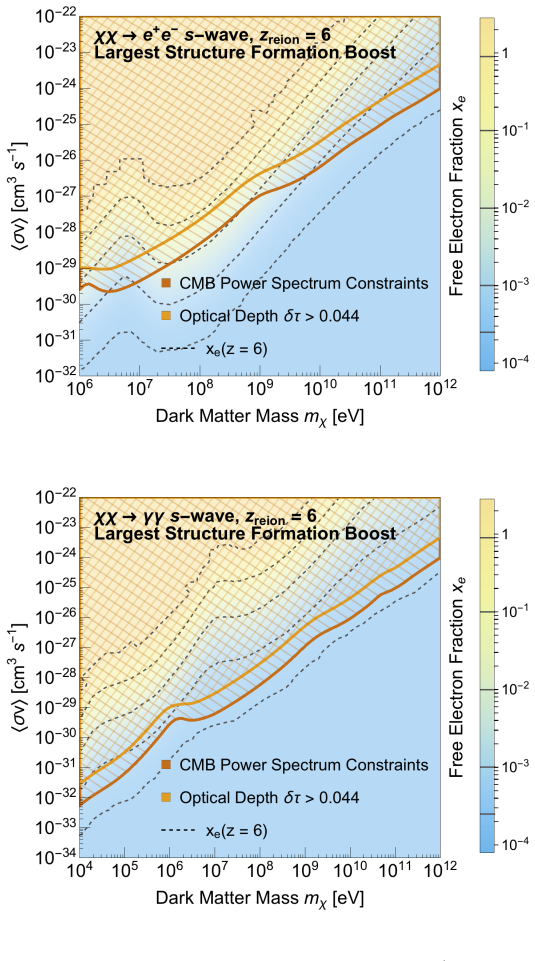
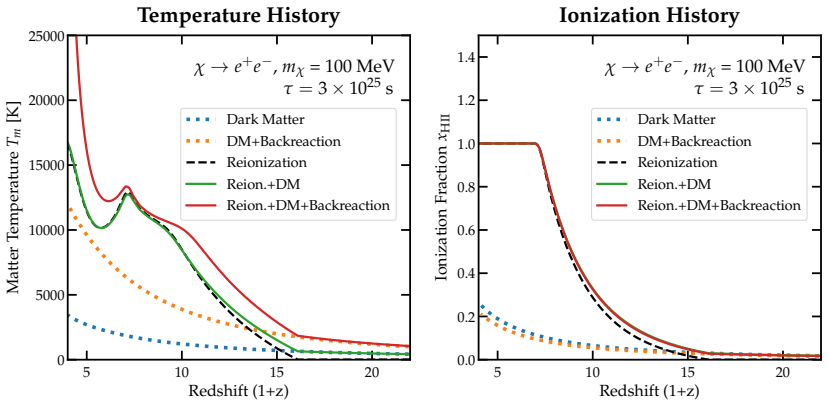
- Dark matter annihilation and decay can contribute to cosmic reionization.
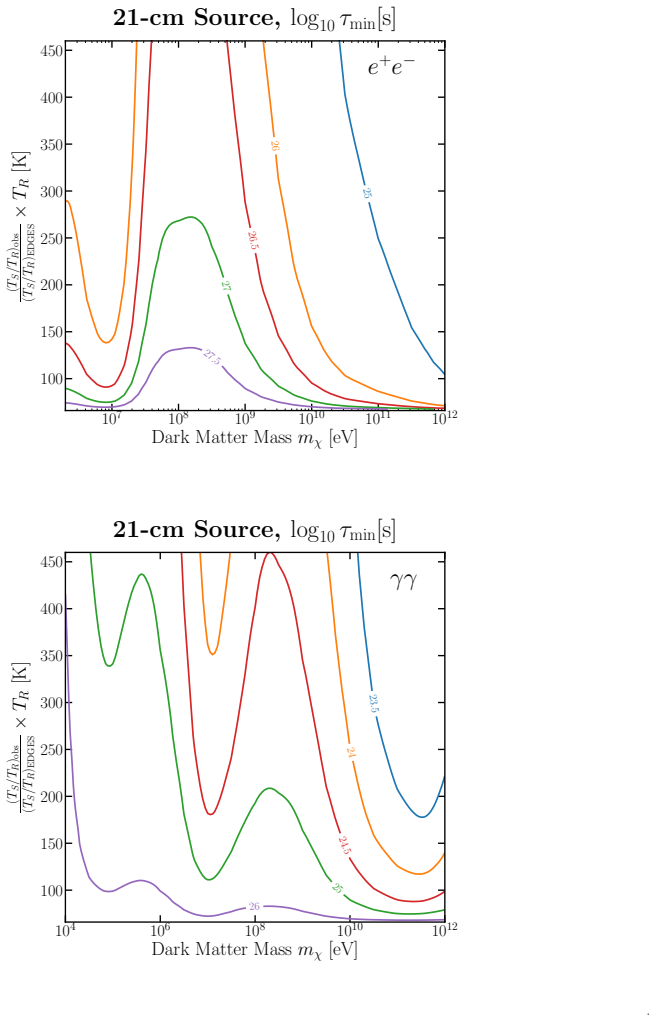
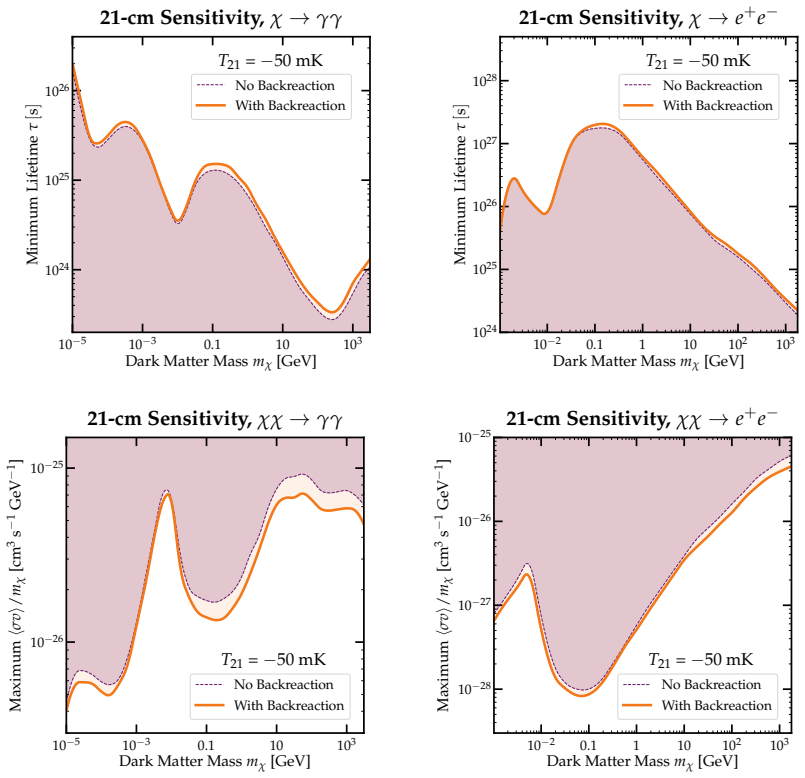
- 21-cm cosmology yields new constraints on dark matter annihilation rates and decay lifetimes.
Where Pith is reading between the lines
- The 3-to-2 freezeout mechanism could produce relic densities that differ from standard 2-to-2 calculations and might be tested against future collider data.
- Improved energy deposition tracking may alter how potential anomalies in cosmic microwave background spectra are interpreted.
- The axion cavity search and 21-cm limits could be combined to cross-check interaction strengths for different dark matter candidates.
- These results point toward opportunities for linking laboratory experiments directly to early-universe observables through shared interaction parameters.
Load-bearing premise
Dark matter possesses nongravitational interactions with the Standard Model.
What would settle it
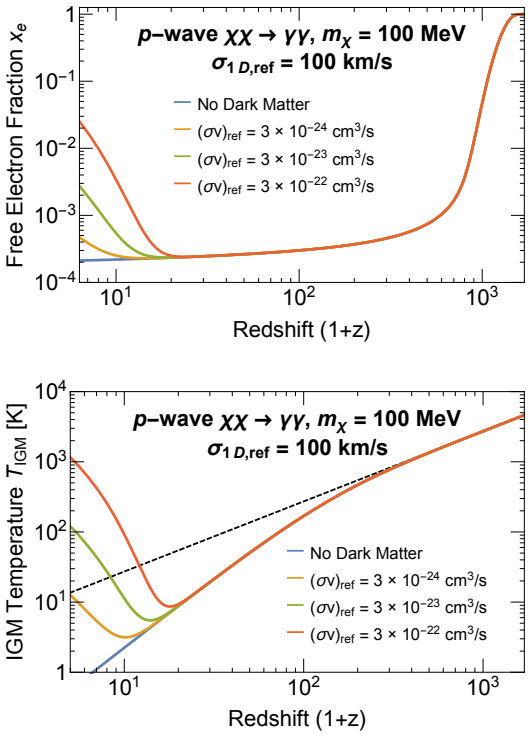
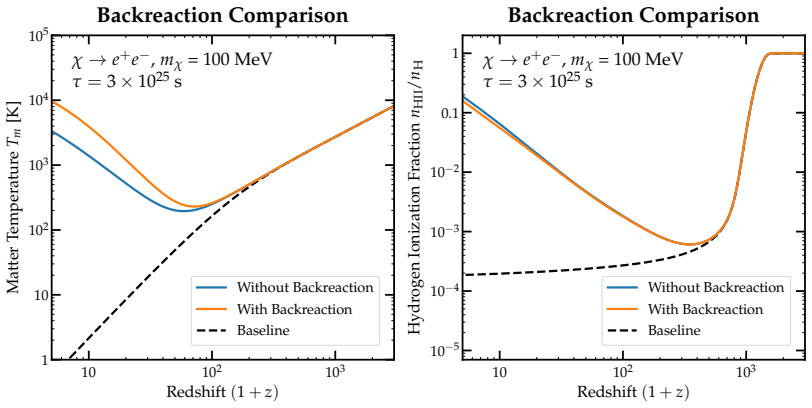
A measurement of the cosmic ionization and thermal history that shows no deviation from standard recombination calculations, even after applying the improved DarkHistory treatment of exotic energy injection, would indicate that the proposed deposition effects are absent or negligible.
Figures















read the original abstract
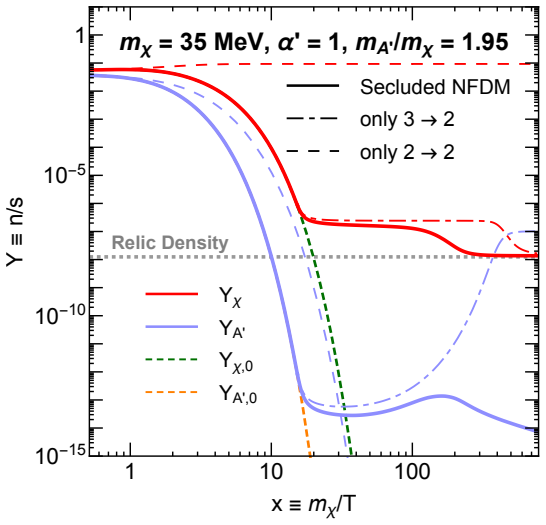
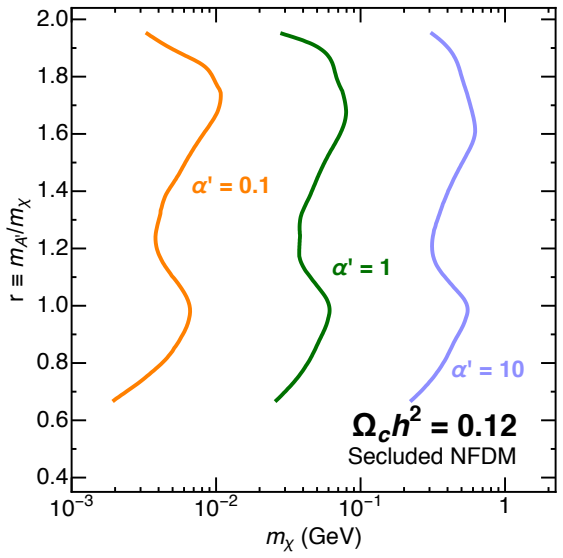
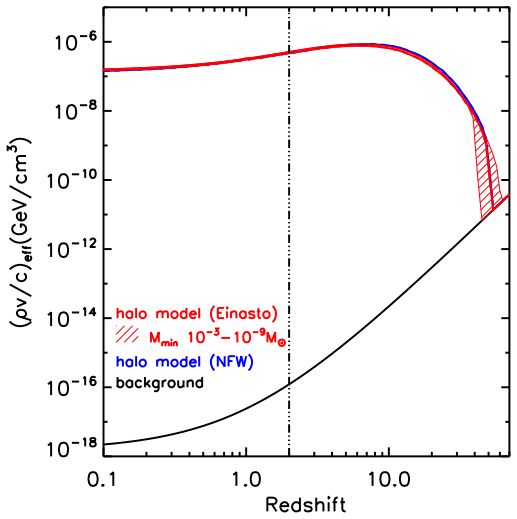
The discovery of nongravitational interactions between dark matter and the Standard Model would be an important step in unraveling the nature of dark matter. If such an interaction exists, it would have profound implications on how dark matter is produced in both the early universe and in collider experiments. In addition, it would also allow dark matter to deposit energy into Standard Model particles in unexpected ways. This thesis details some recent progress made in understanding these implications, including (i) a new freezeout mechanism for thermal dark matter dominated by a 3-to-2 process within a vector portal dark sector model; (ii) a study of how the existence of dark sector bound states can influence collider, direct and indirect searches for dark matter; (iii) a new axion dark matter interferometric search using a cavity that is sensitive to the axion-induced rotation of linearly polarized light; (iv) a definitive assessment of the potential contribution of dark matter annihilation and decay to cosmic reionization; (v) new constraints on dark matter annihilation rates and decay lifetimes from 21-cm cosmology, and (vi) a new numerical code, DarkHistory, which significantly improves the computation of the ionization and thermal histories of the universe in the presence of exotic sources of energy injection. These novel ideas span length scales ranging from table-top experiments to the entire cosmos, and represent just a few of the myriad of ways in which dark matter may yet surprise us.
Editorial analysis
A structured set of objections, weighed in public.
Referee Report
Summary. This PhD thesis compiles six self-contained studies exploring the implications of possible nongravitational dark matter-Standard Model interactions. The contributions include a new 3-to-2 freezeout mechanism in a vector portal model, analysis of dark sector bound states on collider/direct/indirect searches, a cavity-based axion interferometric search via polarization rotation, an assessment of dark matter annihilation/decay contributions to reionization, new 21-cm constraints on annihilation rates and decay lifetimes, and the DarkHistory code for improved computation of ionization and thermal histories with exotic energy injection.
Significance. If the individual results hold, the thesis advances dark matter phenomenology by providing new production mechanisms, experimental search strategies, and computational tools spanning collider to cosmological scales. The explicitly conditional framing strengthens the work by making each contribution independently falsifiable and useful even in the absence of confirmed interactions.
minor comments (2)
- The abstract and structure indicate each study is self-contained; for journal submission of individual chapters, add explicit cross-references between related sections (e.g., linking the 3-to-2 freezeout to bound-state effects) to improve readability.
- Ensure that the DarkHistory code release includes example input files and validation against existing codes (e.g., for standard recombination) to facilitate reproducibility, as this is listed as a central contribution.
Simulated Author's Rebuttal
We thank the referee for their positive summary of the thesis, recognition of its significance across multiple scales, and recommendation for minor revision. No specific major comments were listed in the report.
Circularity Check
No significant circularity
full rationale
The thesis presents six independent implication studies (new freezeout mechanism, bound-state effects, axion interferometry, reionization assessment, 21-cm constraints, and DarkHistory code) all explicitly conditional on the existence of nongravitational DM-SM interactions. No derivation chain, equation, or quantitative claim is presented as an unconditional prediction that reduces by construction to a fitted parameter, self-defined quantity, or load-bearing self-citation within the work. Each result is framed as a conditional consequence whose internal logic stands independently of whether the motivating interactions are realized, making the document self-contained against external benchmarks with no circular steps.
Axiom & Free-Parameter Ledger
Reference graph
Works this paper leans on
-
[1]
Planck 2018 results. VI. Cosmological parameters
N.Aghanim et al.(Planck),“Planck2018results.VI.Cosmologicalparameters,” (2018), arXiv:1807.06209 [astro-ph.CO]
work page internal anchor Pith review Pith/arXiv arXiv 2018
-
[2]
Direct Detection of WIMP Dark Matter: Concepts and Status,
M. Schumann, “Direct Detection of WIMP Dark Matter: Concepts and Status,” (2019), arXiv:1903.03026 [astro-ph.CO]
-
[3]
The 3-D power spectrum of galaxies from the SDSS,
M. Tegmark et al. (SDSS), “The 3-D power spectrum of galaxies from the SDSS,” Astrophys. J.606, 702–740 (2004), arXiv:astro-ph/0310725 [astro-ph]
-
[4]
V. IrÅąiÄŊet al., “New Constraints on the free-streaming of warm dark mat- ter from intermediate and small scale Lyman-𝛼 forest data,” Phys. Rev.D96, 023522 (2017), arXiv:1702.01764 [astro-ph.CO]
work page internal anchor Pith review Pith/arXiv arXiv 2017
-
[5]
Small scale problems of the $\Lambda$CDM model: a short review
A. Del Popolo and M. Le Delliou, “Small scale problems of theΛCDM model: a short review,” Galaxies5, 17 (2017), arXiv:1606.07790 [astro-ph.CO]
work page internal anchor Pith review Pith/arXiv arXiv 2017
-
[6]
Dark Matter Search Results from a One Tonne$\times$Year Exposure of XENON1T
E. Aprile et al. (XENON), “Dark Matter Search Results from a One Ton-Year Exposure of XENON1T,” Phys. Rev. Lett. 121, 111302 (2018), arXiv:1805.12562 [astro-ph.CO]
work page internal anchor Pith review Pith/arXiv arXiv 2018
-
[7]
First Dark Matter Constraints from a Super- CDMS Single-Charge Sensitive Detector,
R. Agneseet al.(SuperCDMS), “First Dark Matter Constraints from a Super- CDMS Single-Charge Sensitive Detector,” Phys. Rev. Lett.121, 051301 (2018), [Erratum: Phys. Rev. Lett.122,no.6,069901(2019)], arXiv:1804.10697 [hep-ex]
-
[8]
O. Abramoffet al.(SENSEI), “SENSEI: Direct-Detection Constraints on Sub- GeV Dark Matter from a Shallow Underground Run Using a Prototype Skipper- CCD,” Phys. Rev. Lett.122, 161801 (2019), arXiv:1901.10478 [hep-ex]
work page internal anchor Pith review Pith/arXiv arXiv 2019
-
[9]
Dark Matter Results From 54-Ton-Day Exposure of PandaX-II Experiment
X. Cuiet al.(PandaX-II), “Dark Matter Results From 54-Ton-Day Exposure of PandaX-IIExperiment,” Phys.Rev.Lett.119,181302(2017),arXiv:1708.06917 [astro-ph.CO]
work page internal anchor Pith review Pith/arXiv arXiv 2017
-
[10]
Results from a search for dark matter in the complete LUX exposure
D.S.Akerib et al.(LUX),“Resultsfromasearchfordarkmatterinthecomplete LUX exposure,” Phys. Rev. Lett.118, 021303 (2017), arXiv:1608.07648 [astro- ph.CO]
work page internal anchor Pith review Pith/arXiv arXiv 2017
-
[11]
Results on light dark matter particles with a low-threshold CRESST-II detector
G.Angloher et al.(CRESST),“Resultsonlightdarkmatterparticleswithalow- thresholdCRESST-IIdetector,” Eur.Phys.J. C76,25(2016),arXiv:1509.01515 [astro-ph.CO] . 357
work page internal anchor Pith review Pith/arXiv arXiv 2016
-
[12]
WIMP-Search Results from the Second CDMSlite Run
R. Agnese et al. (SuperCDMS), “New Results from the Search for Low-Mass Weakly Interacting Massive Particles with the CDMS Low Ionization Threshold Experiment,” Phys. Rev. Lett.116, 071301 (2016), arXiv:1509.02448 [astro- ph.CO]
work page internal anchor Pith review Pith/arXiv arXiv 2016
-
[13]
M. Aaboud et al. (ATLAS), “Constraints on mediator-based dark matter and scalar dark energy models using√𝑠 = 13 TeV 𝑝𝑝 collision data collected by the ATLAS detector,” (2019), arXiv:1903.01400 [hep-ex]
work page internal anchor Pith review Pith/arXiv arXiv 2019
-
[14]
A. M. Sirunyanet al.(CMS), “Search for dijet resonances in protonâĂŞproton collisions at √𝑠 = 13 TeV and constraints on dark matter and other mod- els,” Phys. Lett.B769, 520–542 (2017), [Erratum: Phys. Lett.B772,882(2017)], arXiv:1611.03568 [hep-ex]
work page internal anchor Pith review Pith/arXiv arXiv 2017
-
[15]
A. M. Sirunyanet al.(CMS), “Search for dark matter produced with an ener- getic jet or a hadronically decaying W or Z boson at√𝑠 = 13 TeV,” (2017), arXiv:1703.01651 [hep-ex]
work page internal anchor Pith review Pith/arXiv arXiv 2017
-
[16]
A. M. Sirunyanet al.(CMS), “Search for new physics in final states with an en- ergetic jet or a hadronically decaying𝑊 or 𝑍 boson and transverse momentum imbalance at√𝑠 = 13 TeV ,” Phys. Rev.D97, 092005 (2018), arXiv:1712.02345 [hep-ex]
work page internal anchor Pith review Pith/arXiv arXiv 2018
-
[17]
A. M. Sirunyanet al.(CMS), “Search for dark matter produced in association with a single top quark or a top quark pair in proton-proton collisions at√𝑠 = 13 TeV,” JHEP03, 141 (2019), arXiv:1901.01553 [hep-ex]
work page internal anchor Pith review Pith/arXiv arXiv 2019
-
[18]
Search for dark photons produced in 13 TeV $pp$ collisions
R. Aaijet al.(LHCb), “Search for Dark Photons Produced in 13 TeV𝑝𝑝 Colli- sions,” Phys. Rev. Lett.120, 061801 (2018), arXiv:1710.02867 [hep-ex]
work page internal anchor Pith review Pith/arXiv arXiv 2018
-
[19]
The Spectrum of Diffuse Cosmic Hard X-Rays Measured with HEAO-1
D. E. Gruber, J. L. Matteson, L. E. Peterson, and G. V. Jung, “The spectrum of diffuse cosmic hard x-rays measured with heao-1,” Astrophys. J.520, 124 (1999), arXiv:astro-ph/9903492 [astro-ph]
work page internal anchor Pith review Pith/arXiv arXiv 1999
-
[20]
INTEGRAL SPI All-Sky View in Soft Gamma Rays: Study of Point Source and Galactic Diffuse Emissions
L. Bouchet, E. Jourdain, J. P. Roques, A. Strong, R. Diehl, F. Lebrun, and R. Terrier, “INTEGRAL SPI All-Sky View in Soft Gamma Rays: Study of Point Source and Galactic Diffuse Emissions,” Astrophys. J.679, 1315 (2008), arXiv:0801.2086 [astro-ph]
work page internal anchor Pith review Pith/arXiv arXiv 2008
-
[21]
S. C. Kappadath,Measurement of the Cosmic Diffuse Gamma-Ray Spectrum from 800 keV to 30 MeV, Ph.D. thesis, University of New Hampshire, USA (1998)
work page 1998
-
[22]
Gamma-ray continuum emission from the inner Galactic region as observed with INTEGRAL/SPI,
A. Strong, R. Diehl, H. Halloin, V. Schönfelder, L. Bouchet, P. Mandrou, F. Le- brun, and R. Terrier, “Gamma-ray continuum emission from the inner Galactic region as observed with INTEGRAL/SPI,” Astronomy and Astrophysics444, 495–503 (2005). 358
work page 2005
-
[23]
A Search for Dark Matter in the Galactic Halo with HAWC
A. U. Abeysekaraet al. (HAWC), “A Search for Dark Matter in the Galactic Halo with HAWC,” JCAP1802, 049 (2018), arXiv:1710.10288 [astro-ph.HE]
work page internal anchor Pith review Pith/arXiv arXiv 2018
-
[24]
Search for gamma-ray emission from $p$-wave dark matter annihilation in the Galactic Center
C. Johnson, R. Caputo, C. Karwin, S. Murgia, S. Ritz, and J. Shelton, “Search for gamma-ray emission from𝑝-wave dark matter annihilation in the Galactic Center,” (2019), arXiv:1904.06261 [astro-ph.HE]
work page internal anchor Pith review Pith/arXiv arXiv 2019
-
[25]
Fermi-LAT Observations of High-Energy Gamma-Ray Emission Toward the Galactic Center
M. Ajello et al. (Fermi-LAT), “Fermi-LAT Observations of High-Energy𝛾- Ray Emission Toward the Galactic Center,” Astrophys. J.819, 44 (2016), arXiv:1511.02938 [astro-ph.HE]
work page internal anchor Pith review Pith/arXiv arXiv 2016
-
[26]
Searching for Dark Matter Annihilation in Recently Discovered Milky Way Satellites with Fermi-LAT
A. Albert et al. (Fermi-LAT, DES), “Searching for Dark Matter Annihilation in Recently Discovered Milky Way Satellites with Fermi-LAT,” Astrophys. J. 834, 110 (2017), arXiv:1611.03184 [astro-ph.HE]
work page internal anchor Pith review Pith/arXiv arXiv 2017
-
[27]
The Fermi Galactic Center GeV Excess and Implications for Dark Matter
M. Ackermannet al.(Fermi-LAT), “The Fermi Galactic Center GeV Excess and Implications for Dark Matter,” Astrophys. J.840, 43 (2017), arXiv:1704.03910 [astro-ph.HE]
work page internal anchor Pith review Pith/arXiv arXiv 2017
-
[28]
Latest results on dark matter searches with H.E.S.S
L. Rinchiuso (H.E.S.S.), “Latest results on dark matter searches with H.E.S.S,” in 7th Roma International Conference on Astroparticle Physic (RICAP18) Rome, Italy, September 4-7, 2018(2019) arXiv:1901.05299 [astro-ph.HE]
work page internal anchor Pith review Pith/arXiv arXiv 2018
-
[29]
Dark Matter Constraints from a Joint Analysis of Dwarf Spheroidal Galaxy Observations with VERITAS
S.Archambault et al.(VERITAS),“DarkMatterConstraintsfromaJointAnal- ysis of Dwarf Spheroidal Galaxy Observations with VERITAS,” Phys. Rev. D95, 082001 (2017), arXiv:1703.04937 [astro-ph.HE]
work page internal anchor Pith review Pith/arXiv arXiv 2017
-
[30]
Search for annihilating dark matter in the Sun with 3 years of IceCube data
M. G. Aartsenet al.(IceCube), “Search for annihilating dark matter in the Sun with 3 years of IceCube data,” Eur. Phys. J.C77, 146 (2017), [Erratum: Eur. Phys. J.C79,no.3,214(2019)], arXiv:1612.05949 [astro-ph.HE]
work page internal anchor Pith review Pith/arXiv arXiv 2017
-
[31]
Search for Dark Matter Annihilation in the Earth using the ANTARES Neutrino Telescope
A.Albert et al.(ANTARES),“SearchforDarkMatterAnnihilationintheEarth using the ANTARES Neutrino Telescope,” Phys. Dark Univ.16, 41–48 (2017), arXiv:1612.06792 [hep-ex]
work page internal anchor Pith review Pith/arXiv arXiv 2017
-
[32]
Search for neutrinos from decaying dark matter with IceCube
M. G. Aartsenet al.(IceCube), “Search for neutrinos from decaying dark matter with IceCube,” Eur. Phys. J.C78, 831 (2018), arXiv:1804.03848 [astro-ph.HE]
work page internal anchor Pith review Pith/arXiv arXiv 2018
-
[33]
V. Barger, W. Y. Keung, D. Marfatia, and G. Shaughnessy, “PAMELA and dark matter,” (2008), arXiv:arXiv:0809.0162 [hep-ph] [hep-ph]
work page internal anchor Pith review Pith/arXiv arXiv 2008
-
[34]
Possible dark matter annihilation signal in the AMS-02 antiproton data
M.-Y. Cui, Q. Yuan, Y.-L. S. Tsai, and Y.-Z. Fan, “Possible dark matter anni- hilation signal in the AMS-02 antiproton data,” Phys. Rev. Lett.118, 191101 (2017), arXiv:1610.03840 [astro-ph.HE]
work page internal anchor Pith review Pith/arXiv arXiv 2017
-
[35]
Novel dark matter constraints from antiprotons in the light of AMS-02
A. Cuoco, M. KrÃďmer, and M. Korsmeier, “Novel Dark Matter Constraints from Antiprotons in Light of AMS-02,” Phys. Rev. Lett.118, 191102 (2017), arXiv:1610.03071 [astro-ph.HE] . 359
work page internal anchor Pith review Pith/arXiv arXiv 2017
-
[36]
Q. Yuan and L. Feng, “Dark Matter Particle Explorer observations of high- energy cosmic ray electrons plus positrons and their physical implications,” Sci. China Phys. Mech. Astron.61, 101002 (2018), arXiv:1807.11638 [astro-ph.HE]
work page internal anchor Pith review Pith/arXiv arXiv 2018
-
[37]
GAPS - Dark matter search with low-energy cosmic-ray antideuterons and antiprotons
P. von Doetinchem, T. Aramaki, S. Boggs, H. Fuke, C. Hailey, I. Mognet, R. A. Ong, K. Perez, and J. Zweerink (GAPS), “GAPS - Dark matter search with low-energy cosmic-ray antideuterons and antiprotons,”Proceedings, 34th International Cosmic Ray Conference (ICRC 2015): The Hague, The Nether- lands, July 30-August 6, 2015, PoSICRC2015, 1219 (2016), [34,1218...
work page internal anchor Pith review Pith/arXiv arXiv 2015
-
[38]
Cosmological Lower Bound on Heavy Neutrino Masses,
B. W. Lee and S. Weinberg, “Cosmological Lower Bound on Heavy Neutrino Masses,” Phys. Rev. Lett.39, 165–168 (1977), [,183(1977)]
work page 1977
-
[39]
Precise Relic WIMP Abundance and its Impact on Searches for Dark Matter Annihilation
G. Steigman, B. Dasgupta, and J. F. Beacom, “Precise Relic WIMP Abundance and its Impact on Searches for Dark Matter Annihilation,” Phys. Rev.D86, 23506 (2012), arXiv:1204.3622 [hep-ph]
work page internal anchor Pith review Pith/arXiv arXiv 2012
-
[40]
Three exceptions in the calculation of relic abun- dances,
K. Griest and D. Seckel, “Three exceptions in the calculation of relic abun- dances,” Phys. Rev.D43, 3191–3203 (1991)
work page 1991
-
[43]
Y. Hochberg, E. Kuflik, T. Volansky, and J. G. Wacker, “Mechanism for Ther- mal Relic Dark Matter of Strongly Interacting Massive Particles,” Phys. Rev. Lett. 113, 171301 (2014), arXiv:1402.5143 [hep-ph]
work page internal anchor Pith review Pith/arXiv arXiv 2014
-
[44]
Elastically Decoupling Dark Matter
E. Kuflik, M. Perelstein, N. R.-L. Lorier, and Y.-D. Tsai, “Elastically Decou- pling Dark Matter,” Phys. Rev. Lett.116, 221302 (2016), arXiv:1512.04545 [hep-ph]
work page internal anchor Pith review Pith/arXiv arXiv 2016
-
[45]
Phenomenology of ELDER Dark Matter
E. Kuflik, M. Perelstein, N. R.-L. Lorier, and Y.-D. Tsai, “Phenomenology of ELDER Dark Matter,” JHEP08, 078 (2017), arXiv:1706.05381 [hep-ph]
work page internal anchor Pith review Pith/arXiv arXiv 2017
-
[46]
First Dark Matter Search Results from the XENON1T Experiment
E. Aprile et al. (XENON), “First Dark Matter Search Results from the XENON1T Experiment,” Phys. Rev. Lett. 119, 181301 (2017), arXiv:1705.06655 [astro-ph.CO]
work page internal anchor Pith review Pith/arXiv arXiv 2017
-
[47]
M. Rocha, A. H. G. Peter, J. S. Bullock, M. Kaplinghat, S. Garrison- Kimmel, J. Onorbe, and L. A. Moustakas, “Cosmological Simulations with Self- Interacting Dark Matter I: Constant Density Cores and Substructure,” Mon. Not. Roy. Astron. Soc.430, 81–104 (2013), arXiv:1208.3025 [astro-ph.CO] . 360
work page internal anchor Pith review Pith/arXiv arXiv 2013
-
[48]
Observational evidence for selfinteract- ing cold dark matter,
D. N. Spergel and P. J. Steinhardt, “Observational evidence for selfinteract- ing cold dark matter,” Phys. Rev. Lett.84, 3760–3763 (2000), arXiv:astro- ph/9909386 [astro-ph]
-
[49]
Constraining Self-Interacting Dark Matter with the Milky Way's dwarf spheroidals
J. Zavala, M. Vogelsberger, and M. G. Walker, “Constraining Self-Interacting Dark Matter with the Milky Way’s dwarf spheroidals,” Monthly Notices of the Royal Astronomical Society: Letters 431, L20–L24 (2013), arXiv:1211.6426 [astro-ph.CO]
work page internal anchor Pith review Pith/arXiv arXiv 2013
-
[50]
Y. Hochberg, E. Kuflik, H. Murayama, T. Volansky, and J. G. Wacker, “Model for Thermal Relic Dark Matter of Strongly Interacting Massive Particles,” Phys. Rev. Lett.115, 021301 (2015), arXiv:1411.3727 [hep-ph]
work page internal anchor Pith review Pith/arXiv arXiv 2015
-
[51]
S.-M. Choi and H. M. Lee, “Resonant SIMP dark matter,” Phys. Lett.B758, 47–53 (2016), arXiv:1601.03566 [hep-ph]
work page internal anchor Pith review Pith/arXiv arXiv 2016
-
[52]
SIMP dark matter with gauged $Z_3$ symmetry
S.-M. Choi and H. M. Lee, “SIMP dark matter with gauged Z3 symmetry,” JHEP 09, 063 (2015), arXiv:1505.00960 [hep-ph]
work page internal anchor Pith review Pith/arXiv arXiv 2015
-
[53]
Enabling Forbidden Dark Matter
J.M.Cline, H.Liu, T.Slatyer, andW.Xue,“EnablingForbiddenDarkMatter,” Phys. Rev.D96, 083521 (2017), arXiv:1702.07716 [hep-ph]
work page internal anchor Pith review Pith/arXiv arXiv 2017
-
[54]
Bound eigenstates of the static screened coulomb potential,
F. J. Rogers, H. C. Graboske, and D. J. Harwood, “Bound eigenstates of the static screened coulomb potential,” Phys. Rev. A1, 1577–1586 (1970)
work page 1970
-
[55]
M. E. Peskin and D. V. Schroeder,An Introduction to Quantum Field Theory (Westview Press, 1995)
work page 1995
-
[56]
Higgs-Stoponium Mixing Near the Stop-Antistop Threshold
G. T. Bodwin, H. S. Chung, and C. E. M. Wagner, “Higgs-Stoponium Mixing Near the Stop-Antistop Threshold,” Phys. Rev.D95, 015013 (2017), arXiv:1609.04831 [hep-ph]
work page internal anchor Pith review Pith/arXiv arXiv 2017
-
[57]
Representation-independent manipulations with Dirac matrices and spinors
P. B. Pal, “Representation-independent manipulations with Dirac spinors,” (2007), arXiv:physics/0703214 [physics.ed-ph]
work page internal anchor Pith review Pith/arXiv arXiv 2007
-
[58]
B. Guberina, J. H. Kuhn, R. D. Peccei, and R. Ruckl, “Rare Decays of the Z0,” Nucl. Phys.B174, 317–334 (1980)
work page 1980
-
[59]
NLO Production and Decay of Quarkonium
A. Petrelli, M. Cacciari, M. Greco, F. Maltoni, and M. L. Mangano, “NLO production and decay of quarkonium,” Nucl. Phys.B514, 245–309 (1998), arXiv:hep-ph/9707223 [hep-ph]
work page internal anchor Pith review Pith/arXiv arXiv 1998
-
[60]
Experimental Observation of a Heavy Particle𝐽,
J. J. Aubertet al.(E598), “Experimental Observation of a Heavy Particle𝐽,” Phys. Rev. Lett.33, 1404–1406 (1974)
work page 1974
-
[61]
Discovery of a Narrow Resonance in 𝑒+𝑒− Annihilation,
J. E. Augustin et al. (SLAC-SP-017), “Discovery of a Narrow Resonance in 𝑒+𝑒− Annihilation,” Phys. Rev. Lett.33, 1406–1408 (1974), [Adv. Exp. Phys.5,141(1976)]. 361
work page 1974
-
[62]
Search for Dimuon Decays of a Light Scalar Boson in Radiative Transitions Upsilon -> gamma A0
B. Aubertet al.(BaBar), “Search for Dimuon Decays of a Light Scalar Boson in Radiative Transitions Upsilon —> gamma A0,” Phys. Rev. Lett.103, 081803 (2009), arXiv:0905.4539 [hep-ex]
work page internal anchor Pith review Pith/arXiv arXiv 2009
-
[63]
Simplified Models for Dark Matter and Missing Energy Searches at the LHC
J. Abdallah et al., “Simplified Models for Dark Matter and Missing Energy Searches at the LHC,” (2014), arXiv:1409.2893 [hep-ph]
work page internal anchor Pith review Pith/arXiv arXiv 2014
-
[64]
Simplified Models for Dark Matter Searches at the LHC
J. Abdallah et al., “Simplified Models for Dark Matter Searches at the LHC,” Phys. Dark Univ.9-10, 8–23 (2015), arXiv:1506.03116 [hep-ph]
work page internal anchor Pith review Pith/arXiv arXiv 2015
-
[65]
Complementarity for Dark Sector Bound States
G. Elor, H. Liu, T. R. Slatyer, and Y. Soreq, “Complementarity for Dark Sector Bound States,” Phys. Rev.D98, 036015 (2018), arXiv:1801.07723 [hep-ph]
work page internal anchor Pith review Pith/arXiv arXiv 2018
-
[66]
CP Conservation in the Presence of Instantons,
R. D. Peccei and H. R. Quinn, “CP Conservation in the Presence of Instantons,” Phys. Rev. Lett.38, 1440–1443 (1977)
work page 1977
-
[67]
Constraints Imposed by CP Conservation in the Presence of Instantons,
R. D. Peccei and H. R. Quinn, “Constraints Imposed by CP Conservation in the Presence of Instantons,” Phys. Rev.D16, 1791–1797 (1977)
work page 1977
-
[68]
S. Weinberg, “A New Light Boson?” Phys. Rev. Lett.40, 223–226 (1978)
work page 1978
-
[69]
Problem of Strong p and t Invariance in the Presence of Instan- tons,
F. Wilczek, “Problem of Strong p and t Invariance in the Presence of Instan- tons,” Phys. Rev. Lett.40, 279–282 (1978)
work page 1978
-
[70]
Cosmology of the Invisible Axion,
J. Preskill, M. B. Wise, and F. Wilczek, “Cosmology of the Invisible Axion,” Phys. Lett.B120, 127–132 (1983)
work page 1983
-
[71]
A Cosmological Bound on the Invisible Axion,
L. F. Abbott and P. Sikivie, “A Cosmological Bound on the Invisible Axion,” Phys. Lett.B120, 133–136 (1983)
work page 1983
-
[72]
M. Dine and W. Fischler, “The Not So Harmless Axion,” Phys. Lett.B120, 137–141 (1983)
work page 1983
-
[73]
Experimental Searches for the Axion and Axion-like Particles
P. W. Graham, I. G. Irastorza, S. K. Lamoreaux, A. Lindner, and K. A. van Bibber, “Experimental Searches for the Axion and Axion-Like Particles,” Ann. Rev. Nucl. Part. Sci.65, 485–514 (2015), arXiv:1602.00039 [hep-ex]
work page internal anchor Pith review Pith/arXiv arXiv 2015
-
[74]
The Low-Energy Frontier of Particle Physics
J. Jaeckel and A. Ringwald, “The Low-Energy Frontier of Particle Physics,” Ann. Rev. Nucl. Part. Sci.60, 405–437 (2010), arXiv:1002.0329 [hep-ph]
work page internal anchor Pith review Pith/arXiv arXiv 2010
-
[75]
P. Svrcek and E. Witten, “Axions In String Theory,” JHEP06, 051 (2006), arXiv:hep-th/0605206 [hep-th]
work page internal anchor Pith review Pith/arXiv arXiv 2006
-
[76]
A. Arvanitaki, S. Dimopoulos, S. Dubovsky, N. Kaloper, and J. March-Russell, “String Axiverse,” Phys. Rev.D81, 123530 (2010), arXiv:0905.4720 [hep-th]
work page internal anchor Pith review Pith/arXiv arXiv 2010
-
[77]
An M Theory Solution to the Strong CP Problem and Constraints on the Axiverse
B. S. Acharya, K. Bobkov, and P. Kumar, “An M Theory Solution to the Strong CP Problem and Constraints on the Axiverse,” JHEP11, 105 (2010), arXiv:1004.5138 [hep-th] . 362
work page internal anchor Pith review Pith/arXiv arXiv 2010
-
[78]
The type IIB string axiverse and its low-energy phenomenology
M. Cicoli, M. Goodsell, and A. Ringwald, “The type IIB string axiverse and its low-energy phenomenology,” JHEP10, 146 (2012), arXiv:1206.0819 [hep-th]
work page internal anchor Pith review Pith/arXiv arXiv 2012
-
[79]
Experimental Tests of the Invisible Axion,
P. Sikivie, “Experimental Tests of the Invisible Axion,”Particle physics and cosmology: Dark matter, Phys. Rev. Lett.51, 1415–1417 (1983)
work page 1983
-
[80]
Two Applications of Axion Electrodynamics,
F. Wilczek, “Two Applications of Axion Electrodynamics,” Phys. Rev. Lett.58, 1799 (1987)
work page 1987
-
[81]
Search for nearly massless, weakly coupled particles by optical techniques,
R. Cameron et al., “Search for nearly massless, weakly coupled particles by optical techniques,” Phys. Rev.D47, 3707–3725 (1993)
work page 1993
-
[82]
Production and Detection of Axion-like Particles by Interferometry
H. Tam and Q. Yang, “Production and Detection of Axion-like Particles by Interferometry,” Phys. Lett.B716, 435–440 (2012), arXiv:1107.1712 [hep-ph]
work page internal anchor Pith review Pith/arXiv arXiv 2012
discussion (0)
Sign in with ORCID, Apple, or X to comment. Anyone can read and Pith papers without signing in.