Inside astronomically realistic black holes
Pith reviewed 2026-05-24 22:55 UTC · model grok-4.3
The pith
Inside a realistic rotating black hole, spacetime terminates at a strong spacelike singularity after mass inflation at the inner horizon.
A machine-rendered reading of the paper's core claim, the machinery that carries it, and where it could break.
Core claim
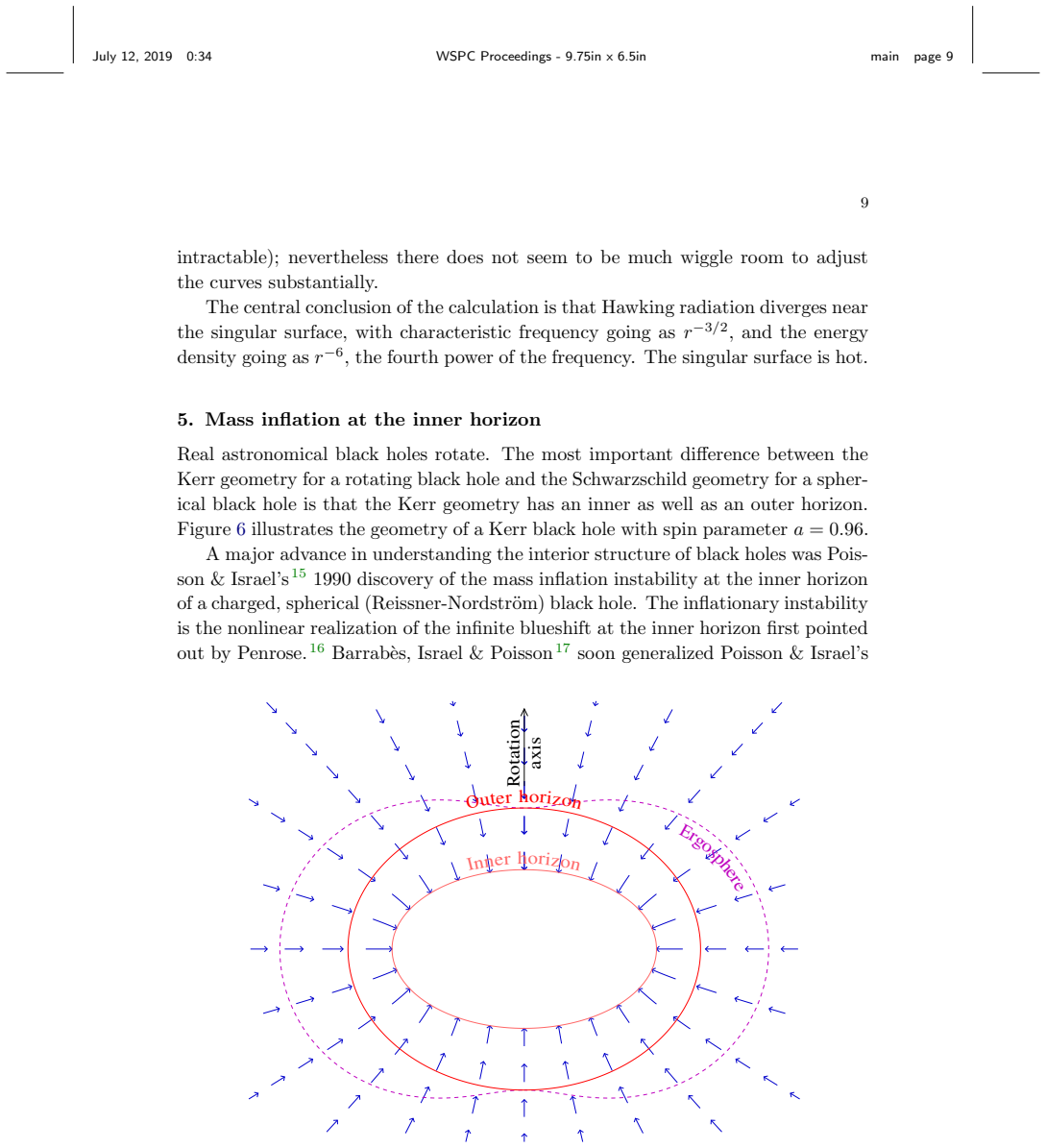
The singularity of a spherical black hole is a surface, not a point. A freely-falling, non-rotating observer sees Hawking radiation with energy density diverging with radius as ρ ∝ r^{-6} near the Schwarzschild singular surface. Spacetime inside a rotating black hole terminates at the inner horizon because of the Poisson-Israel mass inflation instability. If the black hole is accreting, as all realistic black holes do, then generically inflation gives way to Belinski-Khalatnikov-Lifshitz oscillatory collapse to a strong, spacelike singular surface.
What carries the argument
The Poisson-Israel mass inflation instability at the inner horizon, which drives termination of spacetime and, under accretion, triggers Belinski-Khalatnikov-Lifshitz oscillatory collapse to a spacelike singularity.
If this is right
- The Schwarzschild singularity appears to an infalling observer as a surface at which Hawking radiation energy density diverges as ρ ∝ r^{-6}.
- Spacetime inside a rotating black hole ends at the inner horizon due to the Poisson-Israel mass inflation instability.
- Accretion replaces mass inflation with Belinski-Khalatnikov-Lifshitz oscillatory collapse that produces a strong spacelike singular surface.
- All astronomically realistic black holes therefore possess strong spacelike singularities rather than traversable inner horizons.
Where Pith is reading between the lines
- The description applies only when accretion is present; non-accreting idealized solutions may retain different interior structures.
- The predicted divergence of Hawking radiation implies that semiclassical effects become dominant at radii where quantum gravity is usually expected to intervene.
- Numerical evolution of accreting Kerr interiors could confirm or refute the transition from inflation to BKL collapse.
Load-bearing premise
The semiclassical treatment of Hawking radiation remains valid arbitrarily close to the singular surface without back-reaction or full quantum gravity corrections altering the divergence or the onset of inflation.
What would settle it
A calculation or simulation showing that the energy density of Hawking radiation does not diverge proportionally to r to the minus six, or that mass inflation fails to destroy the inner horizon when realistic accretion is included.
Figures

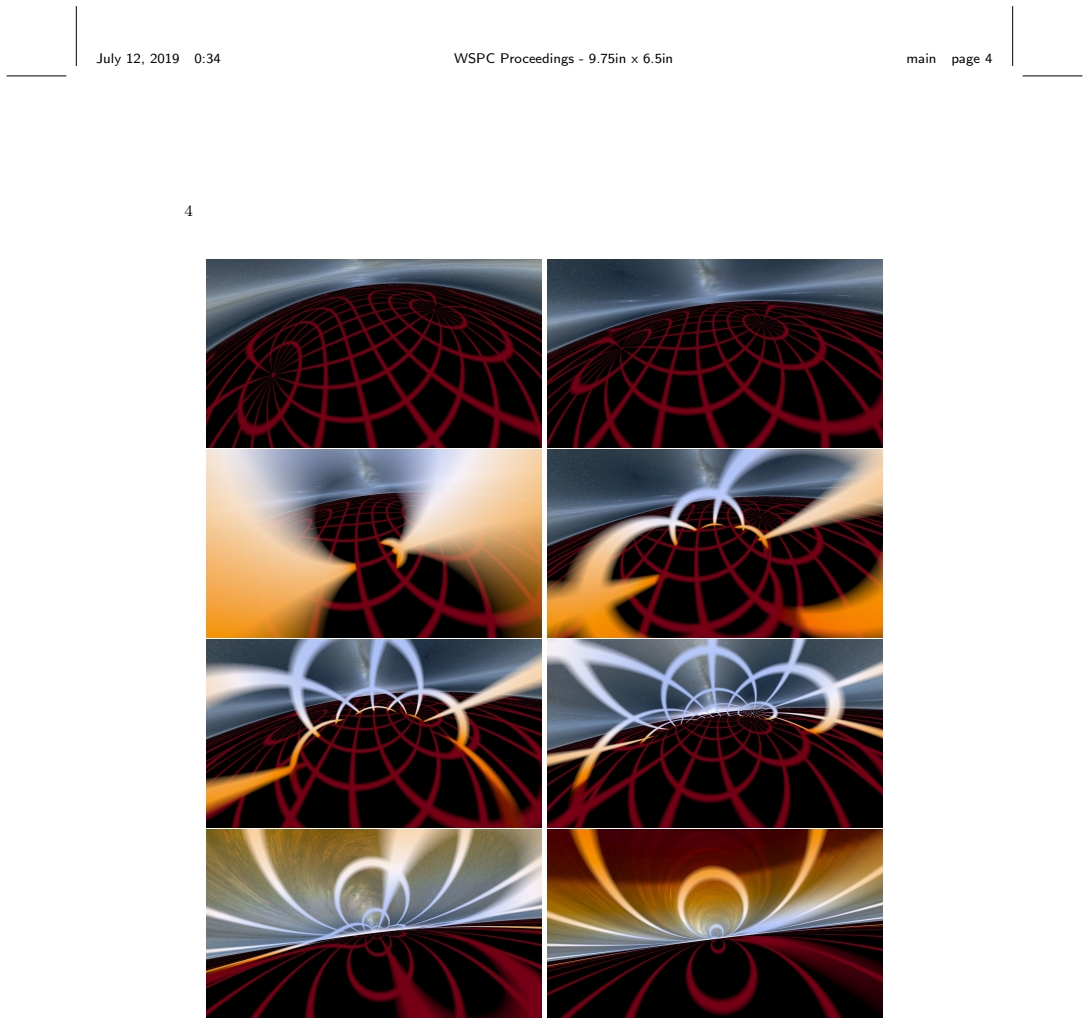



read the original abstract
The singularity of a spherical (Schwarzschild) black hole is a surface, not a point. A freely-falling, non-rotating observer sees Hawking radiation with energy density diverging with radius as $\rho \propto r^{-6}$ near the Schwarzschild singular surface. Spacetime inside a rotating (Kerr) black hole terminates at the inner horizon because of the Poisson-Israel mass inflation instability. If the black hole is accreting, as all realistic black holes do, then generically inflation gives way to Belinski-Khalatnikov-Lifshitz oscillatory collapse to a strong, spacelike singular surface.
Editorial analysis
A structured set of objections, weighed in public.
Referee Report
Summary. The manuscript claims that the Schwarzschild singularity is a surface (not a point) at which a freely falling non-rotating observer measures a Hawking-radiation energy density diverging as ρ ∝ r^{-6}. It further asserts that inside a Kerr black hole spacetime ends at the inner horizon via the Poisson-Israel mass-inflation instability and that, for accreting black holes, this instability is superseded by Belinski-Khalatnikov-Lifshitz oscillatory collapse to a strong spacelike singularity.
Significance. If the semiclassical treatment remains valid, the work synthesizes standard results on Hawking radiation, mass inflation and BKL singularities into a coherent picture of the interior of astronomically realistic black holes. The explicit scaling ρ ∝ r^{-6} for an infalling observer and the distinction between non-accreting and accreting cases are potentially useful reference points for subsequent studies of black-hole interiors.
major comments (2)
- [Abstract] Abstract: the central claim that a freely falling observer measures ρ ∝ r^{-6} is stated without derivation, without an estimate of the radius at which curvature invariants reach the Planck scale, and without an explicit check that back-reaction remains negligible inside the semiclassical domain; this assumption is load-bearing for the assertion that the singularity is a surface.
- [Abstract] Abstract, paragraph 2: the statement that mass inflation gives way to BKL collapse in accreting black holes presupposes that classical or semiclassical evolution persists all the way to the inner horizon; no quantitative criterion is supplied for when the growing curvature or flux invalidates this continuation.
Simulated Author's Rebuttal
We thank the referee for their careful reading of the manuscript and for the constructive comments. We respond to each major comment below.
read point-by-point responses
-
Referee: [Abstract] Abstract: the central claim that a freely falling observer measures ρ ∝ r^{-6} is stated without derivation, without an estimate of the radius at which curvature invariants reach the Planck scale, and without an explicit check that back-reaction remains negligible inside the semiclassical domain; this assumption is load-bearing for the assertion that the singularity is a surface.
Authors: The abstract is intended as a concise summary. The explicit derivation of the ρ ∝ r^{-6} scaling appears in Section 3, where the semiclassical stress-energy tensor in the Unruh state is contracted with the four-velocity of a radially infalling geodesic observer. Section 4 contains the estimate that curvature invariants reach the Planck scale near r ∼ (l_P² M)^{1/3} for astrophysical masses and argues that the total integrated energy flux remains sub-Planckian until that radius, keeping back-reaction small. We will revise the abstract to include a parenthetical reference to these sections so that the load-bearing assumptions are more clearly signposted. revision: partial
-
Referee: [Abstract] Abstract, paragraph 2: the statement that mass inflation gives way to BKL collapse in accreting black holes presupposes that classical or semiclassical evolution persists all the way to the inner horizon; no quantitative criterion is supplied for when the growing curvature or flux invalidates this continuation.
Authors: Section 5 shows that the exponential growth of curvature during Poisson-Israel inflation reaches Planckian values on a timescale short compared with the remaining proper time to the inner horizon, at which point the BKL oscillatory regime is expected to dominate. The argument relies on the known analytic timescales of mass inflation and the standard BKL analysis rather than a new numerical threshold. A precise quantitative criterion for the breakdown of the semiclassical approximation would require a fully coupled numerical simulation that incorporates quantum-gravity effects; such a calculation lies beyond the scope of the present work. revision: no
Circularity Check
No circularity: claims rest on standard GR + semiclassical QFT without self-referential reduction
full rationale
The paper's central claims (ρ ∝ r^{-6} Hawking radiation for infalling observers and Poisson-Israel mass inflation leading to BKL collapse) are presented as consequences of established general relativity and semiclassical quantum field theory on a fixed classical background. No equations, fitted parameters, or self-citations are exhibited that reduce these results to the paper's own inputs by construction. The derivation chain is self-contained against external benchmarks, with the semiclassical validity assumption stated explicitly rather than smuggled in via self-reference or renaming.
Axiom & Free-Parameter Ledger
axioms (2)
- domain assumption Semiclassical quantum field theory on a fixed classical background remains valid arbitrarily close to the singular surface.
- domain assumption The Poisson-Israel mass inflation instability and subsequent BKL oscillatory collapse apply to generic accreting Kerr geometries.
Lean theorems connected to this paper
-
IndisputableMonolith/Foundation/RealityFromDistinction.leanreality_from_one_distinction unclear?
unclearRelation between the paper passage and the cited Recognition theorem.
Spacetime inside a rotating (Kerr) black hole terminates at the inner horizon because of the Poisson-Israel mass inflation instability... BKL oscillatory collapse
What do these tags mean?
- matches
- The paper's claim is directly supported by a theorem in the formal canon.
- supports
- The theorem supports part of the paper's argument, but the paper may add assumptions or extra steps.
- extends
- The paper goes beyond the formal theorem; the theorem is a base layer rather than the whole result.
- uses
- The paper appears to rely on the theorem as machinery.
- contradicts
- The paper's claim conflicts with a theorem or certificate in the canon.
- unclear
- Pith found a possible connection, but the passage is too broad, indirect, or ambiguous to say the theorem truly supports the claim.
Reference graph
Works this paper leans on
-
[1]
Greene, The Fabric of the Cosmos (Alfred A
B. Greene, The Fabric of the Cosmos (Alfred A. Knopf, New York, 2004)
work page 2004
-
[2]
A. J. S. Hamilton and J. P. Lisle, arXiv:gr-qc/0411060, Am. J. Phys. 76, 519–532 (2008)
work page internal anchor Pith review Pith/arXiv arXiv 2008
- [3]
-
[4]
Black Holes: Complementarity or Firewalls?
A. Almheiri, D. Marolf, J. Polchinski, and J. Sully, arXiv:hep-th/1207.3123, JHEP 02, 062 (2013)
work page internal anchor Pith review Pith/arXiv arXiv 2013
-
[5]
A. J. S. Hamilton and G. Polhemus, arXiv:gr-qc/1012.4043, New J. Phys. 12, 123027 (2010)
work page internal anchor Pith review Pith/arXiv arXiv 2010
- [6]
-
[7]
S. W. Hawking, Nature 248, 30–31 (1974)
work page 1974
-
[8]
N. D. Birrell and P. C. W. Davies, Quantum fields in curved space (Cambridge University Press, 1982)
work page 1982
-
[9]
W. G. Unruh, Phys. Rev. D 14, 870–892 (1976)
work page 1976
-
[10]
M. J. Duff, arXiv:hep-th/9308075, Class. Quant. Grav. 11, 1387–1404 (1994)
work page internal anchor Pith review Pith/arXiv arXiv 1994
-
[11]
S. M. Christensen and S. A. Fulling, Phys. Rev. D 15, 2088–2104 (1977)
work page 2088
-
[12]
A. J. S. Hamilton, arXiv:gr-qc/1611.05524, Gen. Rel. Grav. 50, 50 (2018)
work page internal anchor Pith review Pith/arXiv arXiv 2018
-
[13]
P. C. W. Davies, S. A. Fulling, and W. G. Unruh, Phys. Rev. D 13, 2720–2723 (1976)
work page 1976
-
[14]
A new form of the Kerr solution
C. Doran, arXiv:gr-qc/9910099, Phys. Rev. D 61, 067503 (2000)
work page internal anchor Pith review Pith/arXiv arXiv 2000
- [15]
-
[16]
Penrose, in Battelle Rencontres: 1967 lectures in mathematics and physics , 121–235 (W
R. Penrose, in Battelle Rencontres: 1967 lectures in mathematics and physics , 121–235 (W. A. Benjamin, New York, 1968). July 12, 2019 0:34 WSPC Proceedings - 9.75in x 6.5in main page 18 18
work page 1967
-
[17]
C. Barrab` es, W. Israel, and E. Poisson, Class. Quant. Grav. 7, L273–L278 (1990)
work page 1990
-
[18]
A. J. S. Hamilton and P. P. Avelino, arXiv:gr-qc/0811.1926, Phys. Rept. 495, 1–32 (2010)
work page internal anchor Pith review Pith/arXiv arXiv 1926
- [19]
-
[20]
A. J. S. Hamilton and G. Polhemus, arXiv:gr-qc/1010.1269, Phys. Rev. D 84, 124055 (2011); A. J. S. Hamilton, arXiv:gr-qc/1010.1271, Phys. Rev. D 84, 124056 (2011); A. J. S. Hamilton, arXiv:gr-qc/1010.1272, Phys. Rev. D 84, 124057 (2011)
work page internal anchor Pith review Pith/arXiv arXiv 2011
-
[21]
V. A. Belinskii, I. M. Khalatnikov, and E. M. Lifshitz, Advances in Physics 19, 525–573 (1970); V. A. Belinskii and I. M. Khalatnikov, Sov. Phys. JETP 32, 169–172 (1971); V. A. Belinskii, I. M. Khalatnikov, and E. M. Lifshitz, Sov. Phys. JETP 35, 838–841 (1972); V. A. Belinskii, I. M. Khalatnikov, and E. M. Lifshitz, Advances in Physics 31, 639–667 (1982)
work page 1970
-
[22]
V. A. Belinskii, arXiv:gr-qc/1404.3864, in Proc. XIII Marcel Grossmann Meet- ing, Stockholm 2012 (2014)
work page internal anchor Pith review Pith/arXiv arXiv 2012
- [23]
-
[24]
A. J. S. Hamilton, arXiv:gr-qc/1611.05523, Phys. Rev. D 96, 124027 (2017)
work page internal anchor Pith review Pith/arXiv arXiv 2017
discussion (0)
Sign in with ORCID, Apple, or X to comment. Anyone can read and Pith papers without signing in.