REVIEW 2 major objections 1 minor 1 cited by
The effect of a graft transformation on distance signless Laplacian spectral radius of the graphs
T0 review · 2 major / 1 minor · reviewed 2026-05-24 · grok-4.3
Pith's one-line read Graft transformations characterize the minimum and maximum distance signless Laplacian spectral radii among non-starlike and non-caterpillar trees.
desk verdict The paper applies standard graft transformations to the distance signless Laplacian on non-starlike non-caterpillar trees but does not address whether the operations stay inside that class. read the letter →
The pith
A machine-rendered reading of the paper's core claim, the machinery that carries it, and where it could break.
The reading
What carries the argument
Graft transformations, which relocate a branch or subtree from one vertex to another while keeping the graph connected and altering the transmission vector and distance matrix in a predictable way.
What would settle it
A counterexample would be any non-starlike or non-caterpillar tree on which a stated graft transformation leaves the distance signless Laplacian spectral radius unchanged or moves it in the opposite direction from the claimed effect.
Extended reading notes
Core claim
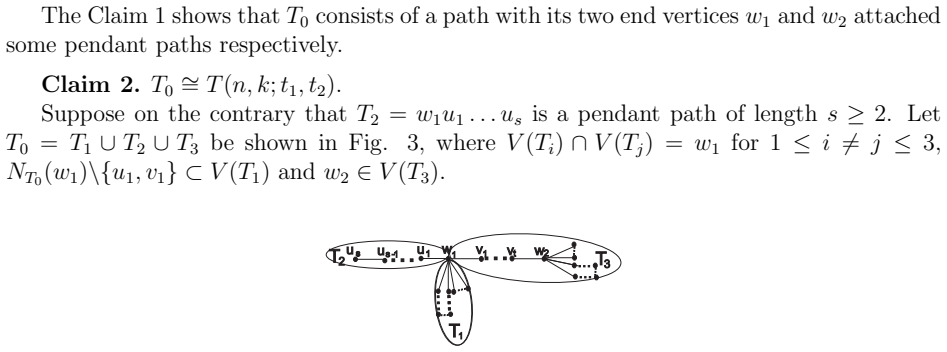
We give some graft transformations on distance signless Laplacian spectral radius of the graphs and use them to characterize the graphs with the minimum and maximal distance signless Laplacian spectral radius among non-starlike and non-caterpillar trees.
Load-bearing premise
The graft transformations can be applied to every tree in the target classes and always produce a strict monotonic change in the spectral radius.
Editorial analysis
A structured set of objections, weighed in public.
Referee Report
Summary. The manuscript defines graft transformations on connected graphs and analyzes their effect on the distance signless Laplacian spectral radius (the largest eigenvalue of Q_D(G) = Tr(G) + D(G)). It then applies these transformations to characterize the non-starlike, non-caterpillar trees that attain the minimum and maximum values of this radius.
Significance. If the transformations can be shown to be strictly monotonic in the spectral radius and to map the target class to itself, the results would supply a concrete reduction technique for extremal problems on distance signless Laplacians of trees, extending standard matrix-based spectral graph theory without introducing free parameters or circular definitions.
major comments (2)
- [Sections introducing the graft transformations and the main characterization theorems] The central claim requires that admissible grafts on non-starlike non-caterpillar trees remain inside this class while strictly increasing or decreasing the spectral radius. The skeptic correctly notes that relocating a branch can shorten the diameter or eliminate the unique vertex at distance 2 from a diametral path, producing a caterpillar; the manuscript must therefore contain an explicit preservation argument (with case analysis on the possible graft sites) before the repeated-application characterization is valid.
- [Abstract and the sections stating the main results] No explicit definitions of the graft operations, nor verification that they cover all trees in the class without exiting it, appear in the abstract; if the full text likewise omits a self-contained proof that every sequence of grafts stays within the non-starlike non-caterpillar family until the claimed extremal graphs are reached, the derivation gap is load-bearing for the characterization.
minor comments (1)
- [Abstract] The phrasing in the abstract ('give some graft transformations on distance signless Laplacian spectral radius of the graphs') is grammatically awkward and should be revised for clarity.
Simulated Author's Rebuttal
We thank the referee for the careful reading and for identifying the need for explicit verification that the graft transformations preserve the class of non-starlike non-caterpillar trees. We address the two major comments below and will incorporate the required arguments in the revision.
read point-by-point responses
-
Referee: [Sections introducing the graft transformations and the main characterization theorems] The central claim requires that admissible grafts on non-starlike non-caterpillar trees remain inside this class while strictly increasing or decreasing the spectral radius. The skeptic correctly notes that relocating a branch can shorten the diameter or eliminate the unique vertex at distance 2 from a diametral path, producing a caterpillar; the manuscript must therefore contain an explicit preservation argument (with case analysis on the possible graft sites) before the repeated-application characterization is valid.
Authors: We agree that an explicit preservation argument with case analysis is required to validate the repeated-application characterization. In the revised manuscript we will add a new lemma that performs a case-by-case analysis of admissible graft sites. The lemma will show that, under the conditions used in the paper, the resulting graph remains non-starlike and non-caterpillar while the distance signless Laplacian spectral radius changes strictly monotonically. This directly addresses the possibility that a graft could produce a caterpillar. revision: yes
-
Referee: [Abstract and the sections stating the main results] No explicit definitions of the graft operations, nor verification that they cover all trees in the class without exiting it, appear in the abstract; if the full text likewise omits a self-contained proof that every sequence of grafts stays within the non-starlike non-caterpillar family until the claimed extremal graphs are reached, the derivation gap is load-bearing for the characterization.
Authors: The abstract is deliberately concise and refers readers to the definitions and proofs in the body. Nevertheless, we accept that the preservation property should be stated more prominently. We will revise the abstract to note that the grafts preserve the class, and we will add a dedicated subsection (or strengthen the existing one) that supplies a self-contained argument showing that every admissible sequence of grafts remains inside the non-starlike non-caterpillar family until an extremal tree is reached. This will eliminate the derivation gap. revision: yes
Circularity Check
No circularity: derivation rests on independent monotonicity proofs for grafts
full rationale
The paper defines the distance signless Laplacian matrix Q_D(G) = Tr(G) + D(G) from standard distance sums, introduces graft transformations as operations that relocate branches, and claims to prove their effect on the largest eigenvalue. It then applies repeated transformations to reach extremal non-starlike non-caterpillar trees. No equation equates a derived quantity to a fitted parameter by construction, no uniqueness theorem is imported from self-citation, and no ansatz is smuggled via prior work. The characterization is obtained by showing strict monotonicity under admissible grafts that remain inside the target class; this is an independent combinatorial argument rather than a definitional reduction. The skeptic concern about class preservation is a potential proof gap but does not constitute circularity.
Assumptions & free parameters
assumptions (2)
- standard math Graphs under consideration are finite, undirected, and connected.
- standard math The largest eigenvalue of the symmetric matrix Q_D(G) exists and is real.
Cite this review
Pith. "Pith review of The effect of a graft transformation on distance signless Laplacian spectral radius of the graphs." pith.science (2026). https://pith.science/paper/RMALGTLS
@misc{pith2026190705719,
  author       = {Pith},
  title        = {Pith review of: The effect of a graft transformation on distance signless Laplacian spectral radius of the graphs},
  year         = {2026},
  howpublished = {\url{https://pith.science/paper/RMALGTLS}},
  note         = {Machine review of arXiv:1907.05719}
}
abstract
Suppose that the vertex set of a connected graph $G$ is $V(G)=\{v_1,\cdots,v_n\}$. Then we denote by $Tr_{G}(v_i)$ the sum of distances between $v_i$ and all other vertices of $G$. Let $Tr(G)$ be the $n\times n$ diagonal matrix with its $(i,i)$-entry equal to $Tr_{G}(v_{i})$ and $D(G)$ be the distance matrix of $G$. Then $Q_{D}(G)=Tr(G)+D(G)$ is the distance signless Laplacian matrix of $G$. The largest eigenvalues of $Q_D(G)$ is called distance signless Laplacian spectral radius of $G$. In this paper we give some graft transformations on distance signless Laplacian spectral radius of the graphs and use them to characterize the graphs with the minimum and maximal distance signless Laplacian spectral radius among non-starlike and non-caterpillar trees.
Figures


Forward citations
Cited by 1 Pith paper
-
Hybrid(Transformer+CNN)-based Polyp Segmentation
A Swin Transformer plus CNN decoder reports 0.9555 recall and 0.9849 accuracy on Kvasir-SEG, but lower F1 and precision than DUCK-Net, with claimed attention innovations absent from the architecture.
Reference graph
Works this paper leans on
-
[1]
M. Aouchiche, P. Hansen, Two Laplacians for the distance matrix of a graph, Linear Algebra Appl. 439 (2013) 21-33
work page 2013
-
[2]
M. Aouchiche, P. Hansen, Some properties of the distance Lapla cian eigenvalues of a graph, Les Cahiers du GERAD, G-2013-28
work page 2013
-
[3]
M. Aouchiche, P. Hansen, The distance spectra of a graphs: A s urvey, Linear Algebra Appl. 458 (2014) 301-386
work page 2014
-
[4]
S. Bose, M. Nath, S. Paul, On the maximal distance spectral rad ius of graphs without a pendant vertex, Linear Algebra Appl. 438 (2013) 4260-4278
work page 2013
-
[5]
Ili´ c, Distance spetral radius of trees with given matching nu mber, Discrete Appl
A. Ili´ c, Distance spetral radius of trees with given matching nu mber, Discrete Appl. Math. 158 (2010) 1799-1806
work page 2010
-
[6]
H. Liu, M. Lu, Bounds on the distance signless Laplacian spectral radius in terms of clique number, Linear and Multilinaer Algebra 63 (2015) 1750-1759
work page 2015
-
[7]
H. Liu, B. Zhou, On the distance Laplacian spectral radius of gra phs, Linear Algebra Appl. 475 (2015) 265-275
work page 2015
- [8]
Show all 17 references
-
[9]
M. Nath, S. Paul, On the distance Laplacian spectra of graphs, L inear Algebra Appl. 460 (2014) 97-110
2014
-
[10]
W. Ning, L. Ouyang, M. Lu, Distance spectral radius of trees w ith fixed number of pendant vertices, Linear Algebra Appl. 439 (2013) 2240-2249
2013
-
[11]
A. Niu, D. Fan and G. Wang, On the distance Laplacian spectra of bipartite graphs, Discrete Appl. Math. 186 (2015) 207-213
2015
-
[12]
Stevanovi´ c, A
D. Stevanovi´ c, A. Ili´ c, Spectral properties of distance matrix of graphs, in: I. Gutman, B. Furtula (Eds), Distance in Molecular graphs Theory, in: Math. Ch em. Monogr., Vol. 12, University of Kragujevac, 2010, pp. 139-176
2010
-
[13]
R. Xing, B. Zhou, On the distance and distance signless Laplacian spectral radii of bicyclic graphs, Linear Algebra Appl. 439 (2013) 3955-3963. 9
2013
-
[14]
R. Xing, B. Zhou, J. Li, On the distance signless Laplacian spectr al radius of graphs, Linear and Multilinear Algebra 62 (2014) 1377-1387
2014
-
[15]
R. Xing, B. Zhou, F. Dong, The effect of a graft transformatio n on distance spectral radius, Linear Algebra Appl. 457 (2014) 261-275
2014
-
[16]
G. Yu, H. Jia, H. Zhang, J. Shu, Some graft transformations a nd its applications on the distance spectral radius of a graph, Appl. Math. Letters 25 (201 2) 315-319
-
[17]
G. Yu, Y. Wu, Y. Zhang, J. Shu, Some graft transformations a nd its application on a distance spectrum, Discrete Math. 311 (2011) 2117-2123. 10
2011
Reviewed May 24, 2026 · model on record in the stance chip above.
Discussion (0). Continue with ORCID to comment.