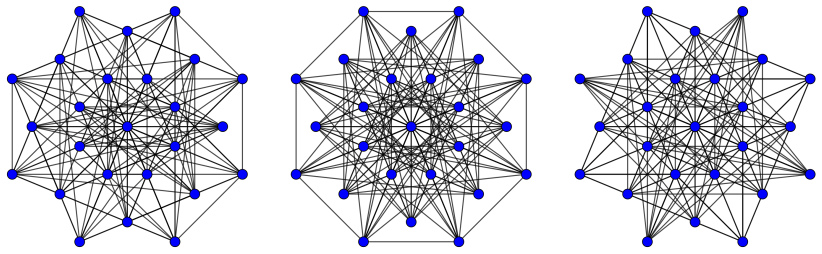
The count rises to 72 pairs on 96 vertices and 27 triples on 81 vertices under the same enumeration method.
abstractclick to expand
This study is the $5^{th}$ part of a detailed study on Type-2 isomorphic circulant graphs having ten parts \cite{v2-1}-\cite{v2-10} and is a continuation of Part 4. Here, we study Type-2 isomorphic circulant graphs of $C_{48}(r_1,r_2,r_3)$, $C_{81}(r_1,r_2,r_3)$ and $C_{96}(r_1,r_2,r_3,r_4)$. We find that the total number of pairs of isomorphic circulant graphs of Type-2 w.r.t. $m$ = 2 of the forms $C_{n}(r_1,r_2,r_3)$ and $C_{n}(s_1,s_2,s_3)$ are 18 and 72 for $n$ = 48, 96, respectively and the total number of triples of isomorphic circulant graphs of Type-2 w.r.t. $m$ = 3 of the form $C_{81}(x_1,x_2,x_3)$, $C_{81}(y_1,y_2,y_3)$ and $C_{81}(z_1,z_2,z_3)$ are 27.
We give explicit recursive constructions for the polytope of all matroids $\Omega_{r,n}$ in ranks 2 and 3 for all ground set sizes. This polytope was introduced in recent work by Ferroni and Fink as a tool for checking positivity conjectures for valuative invariants. We supplement our theoretical construction by an implementation, which allows for the computation of $\Omega_{2,n}$ for $n\leq 33$ and $\Omega_{3,n}$ for $n\leq 10$. Further, we compute Schubert expansions for all isomorphism classes of matroids of rank $2$ up to $n = 80$, and for rank $3$ up to $n = 11$.
For any fixed p the largest q-colored k-uniform hypergraph avoiding a p-colored tight monotone path of length n is at least a tower of size
abstractclick to expand
For positive integers $n, k, q, p$, let $A_k(n; q, p)$ be the largest integer $N$ such that there exists an edge coloring of $K_N^{(k)}$ with $q$ colors that does not contain a tight monotone path of length $n$ that consists of at most $p$ colors. In the case $p = 1$, this coincides with the ordinary Ramsey number of a tight monotone path, and it is known that $A_k(n; q, 1) = T_{k-2}(n^{\Theta(q)})$, proved by Moshkovitz and Shapira. Recently, Mulrenin, Pohoata, and Zakharov showed that whenever $p > \frac{q}{2}$, an improved upper bound $A_k(n; q, p) \leq T_{k-3}(n^{O(q)})$ holds, without any accompanying lower bounds.
In this paper, we obtain the first non-trivial lower bound by developing a novel variant of the classical stepping-up lemma applicable to an Erd\H{o}s--Szekeres-type problem in which one seeks a tight monotone path spanning at most $p$ colors. In particular, we show that for any fixed $p \geq 1$, there exists a constant $C_p > 0$ that only depends on $p$ such that
$$
A_{k}(n; q, p) \geq T_{\lfloor k/ C_p \rfloor}\left(n^{\omega_q(1)}\right)
$$ holds for all sufficiently large $n, k, q$ compared with $p$, that is, a tower function whose height grows linearly in $k$. A key ingredient in our proof is establishing a finite analogue of the celebrated Morse--Hedlund theorem, which may be of independent interest.
The ranks coincide for the one-dimensional Gabidulin code from finite field multiplication, via reformulation as spanning by rank-one forms.
abstractclick to expand
We study the symmetric tensor rank of multiplication over finite field extensions using linearized polynomials. Via field trace, symmetric linearized polynomials are identified with symmetric bilinear forms and symmetric matrices, allowing symmetric tensor decompositions to be reformulated as spanning problems by rank-one symmetric linearized polynomials. We translate these spanning conditions into explicit linear systems over finite fields and use the Frobenius automorphism to obtain computationally effective criteria. As applications, we recover known values of the symmetric bilinear complexity for small extension degrees and obtain explicit symmetric decompositions for several parameters. We also introduce the symmetric tensor-rank of a symmetric rank-metric code and show that, for the natural one-dimensional Gabidulin code associated with finite field multiplication, this invariant coincides with the symmetric tensor rank of the multiplication map.
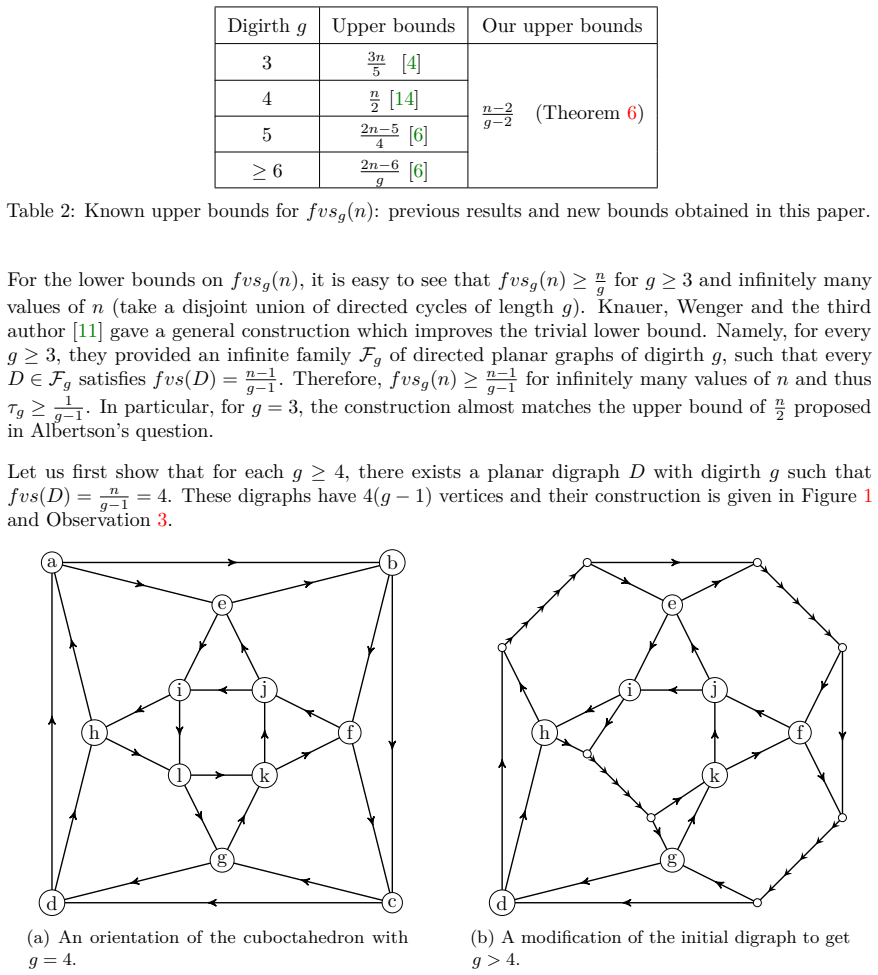
Let $fvs(G)$ denote the size of a minimum feedback vertex set of a digraph $G$. We study $fvs_g(n)$, which is the maximum $fvs(G)$ over all $n$-vertex planar digraphs $G$ of digirth $g$. It is known in the literature that $\lfloor\frac{n-1}{g-1}\rfloor \le fvs_g(n)$ and $fvs_3(n)\le \frac{3n}{5}$, $fvs_4(n)\le \frac{n}{2}$, $fvs_5(n)\le \frac{2n-5}{4}$ and $\lfloor\frac{n-1}{g-1}\rfloor \le fvs_g(n) \le \frac{2n-6}{g}$ for $g \ge 6$. In particular for $g \ge 6$, $\frac{1}{g-1}\le \sup_{n \ge 1} \frac{fvs_g(n)}{n} \le \frac{2}{g}$.
We improve all lower and upper bounds starting with digirth 4. Namely, we show that $fvs_g(n)\le \frac{n-2}{g-2}$ for all $g\geq 3$, by proving that the minimum feedback vertex set is at most the maximum packing of a special type of directed cycles. This last result is a planar-digraph analogue of the celebrated Lucchesi-Younger theorem and is of independent interest. On the other hand, we develop a new tool to construct planar digraphs of fixed digirth and large $fvs$ by connecting arc-disjoint directed cycles. Using it, we provide constructions of infinite families of planar digraphs of digirth $g\ge 4$ and large $fvs$. These constructions together with our upper bound show that $\frac{g+2}{g^2} \le \sup_{n \ge 1} \frac{fvs_g(n)}{n} \le \frac{1}{g-2}$ for all values $g \ge 6$, except $g =7$, for which the lower bound is different. We thus decrease the gap between the lower and the upper bound for $\sup_{n \ge 1} \frac{fvs_g(n)}{n}$ from $\frac{g-2}{g(g-1)}$ to $\frac{4}{g^2(g-2)}$. For $g = 7$ this gap goes from $\frac{5}{42}$ to $\frac{1}{55}$. For digirth 4 and 5, both improvements are by an additive constant.
The result holds even when crossings between curves are bounded; ordered C3-C5-free graphs remain polynomial-time decidable via one avoided
abstractclick to expand
An \emph{outer-string representation} of a graph $G$ is an intersection representation of $G$ where vertices are represented by curves (strings) inside the unit disk and each curve has exactly one endpoint on the boundary of the unit disk (the anchor of the curve). Additionally, if each two curves are allowed to cross at most once, we call this an \emph{outer-$1$-string representation} of $G$. If we impose a cyclic ordering on the vertices of $G$ and require the cyclic order of the anchors to respect this cyclic order, such a representation is called a \emph{constrained outer-string representation}. In this paper, we present two results about graphs admitting outer-string representations.
Firstly, we show that for a bipartite graph $G$ (and, more generally, for any $\{C_3,C_5\}$-free graph $G$) with a given cyclic order of vertices, we can decide in polynomial time whether $G$ admits a constrained outer-string representation. Our algorithm follows from a characterization by a single forbidden configuration, similar to that of Biedl et al. [GD 2024] for chordal graphs. Secondly, we answer an open question from the same authors and show that determining whether a given graph admits an outer-1-string representation is NP-hard. More generally, we show that it is NP-hard to determine if a given graph $G$ admits an outer-$k$-string representation for any fixed $k\ge1$.
Earlier general-position constructions contain set-like sunflowers under the weaker kernel definition; a controlled adjustment of lifting ev
abstractclick to expand
The Erd\H{o}s--Rado sunflower problem admits two natural analogues in finite vector spaces, corresponding to two different ways of generalising the set-theoretic notion of a sunflower. The first, used by Ihringer and Kupavskii [FFA 110 (2026) 102746], requires the petals to be in general position over the kernel; the second, used in the subspace codes literature (cf.\ Etzion--Raviv [DAM 186 (2015) 87-97], Blokhuis--De Boeck--D'haeseleer [DCC 90 (2022) 2101-2111]), requires only that the kernel equals the pairwise intersection of distinct petals. We refer to the second version as a \emph{set-like sunflower}, following Ihringer and Kupavskii.
In this note, we focus on the set-like setting. We observe that the constructions of Ihringer--Kupavskii, although correct under their (stronger) definition, do not yield set-like sunflower-free families: we exhibit explicit set-like sunflowers inside their Example~3.1. We then present a construction of set-like $s$-sunflower-free families of $k$-spaces, based on a manipulated version of the lifting construction. To our knowledge, this is the first systematic construction tailored to this setting.
A \emph{square} is a word of the form $uu$, where $u$ is a nonempty finite word. Given a finite word $w$ of length $n$, let $[w]$ denote the corresponding \emph{circular word}, i.e., the set of all cyclic rotations of $w$. We study the number of distinct square factors of the elements of $[w]$. Amit and Gawrychowski first showed that this number is upper bounded by $3.14n$. In a recent article, Charalampopoulos et al. improved this upper bound to $1.8n$ and conjectured that the sharp upper bound is $1.5n$. In this note, we improve this upper bound to $\frac{5}{3}n$.
Elementary combinatorial counts supply full expressions for 1-perfect, extended, nearly perfect covering, and diamond codes.
abstractclick to expand
Perfect codes are arguably the most fascinating structures in combinatorial coding theory, and their classification and weight distribution are of considerable interest. This classification also involves the analysis of some related structures. This paper considers five closely related structures, but all of them have never been tied together before. These structures are 1-perfect codes, extended 1-perfect codes, nearly perfect 1-covering codes, extended nearly perfect 1-covering codes, and one family of completely regular codes (to be called diamond codes). The current work concentrates on the weight distributions of these five families of codes. In the past, some of these weight distributions were not computed, some required heavy tools, and for some only the weight enumerator was presented. We provide complete weight distributions for all five families using some methods that do not require any heavy tools.
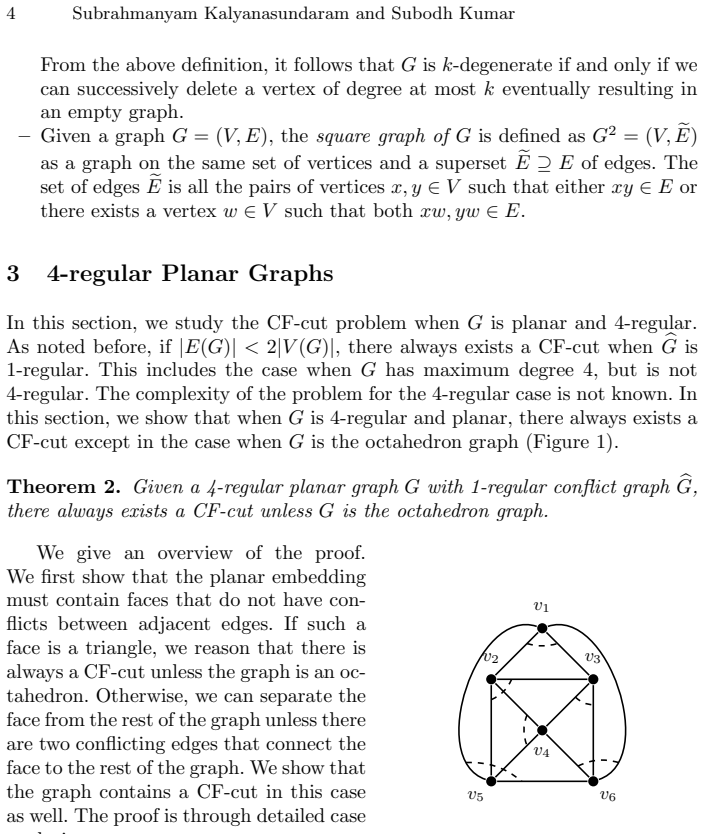
A conflict-free cut $F$ on a simple connected graph $G = (V, E)$ is defined as a set of edges $F \subseteq E$ such that $G-F$ is disconnected, and no two edges in $F$ are conflicting. The notion of conflicting edges is represented using an associated conflict graph $\widehat{G} = (\widehat{V}, \widehat{E})$ where $\widehat{V} = E$. Deciding if a given planar graph $G$, with an associated conflict graph $\widehat{G}$, has a conflict-free cut is known to be NP-complete, when $G$ has maximum degree four and $\widehat{G}$ is a line graph of $G$ [Bonsma, JGT 2009].
In this paper, we prove the following for the case when $\widehat{G}$ is 1-regular.
* We completely resolve the complexity of the decision problem when $G$ is planar. Towards this end, we show that (a) there always exists a conflict-free cut when the graph is planar and 4-regular unless it is the octahedron graph and (b) the decision problem is NP-complete, even in the case when $G$ is planar with maximum degree 5.
* We also show that the decision problem is NP-complete when $G$ is a 3-degenerate graph with maximum degree 5. This completely resolves the complexity status of the problem when $G$ is 3-degenerate.
* We construct families of graphs with 1-regular conflict graphs that do not have a conflict-free cut.
Our results answer the questions posed in [Rauch, Rautenbach and Souza, IPL 2025].
An elementary matching theorem in symmetric designs shows the two quantities are identical for any such plane.
abstractclick to expand
Let $D=(\mathcal{P},\mathcal{B})$ be a symmetric $(v,k,\lambda)$-design and let $(X,Y)$ be an equinumerous incidence-free pair, with $X\subseteq \mathcal{P}$ and $Y\subseteq \mathcal{B}$. In this note, we give an elementary proof which shows the existence of a perfect matching between $\mathcal{P} \setminus X$ and $\mathcal{B}\setminus Y$ in the incidence graph of $D$. This recovers a result of Spiro, Adriaensen and Mattheus, who already showed this using different arguments for $k\geq 36$. We use this to connect some dots in the literature and prove that finding the chromatic number of the Kneser graph on chambers of a projective plane is equivalent to finding the incidence-free number of the incidence graph of the plane.
The maximum edge count is pinned down up to lower-order terms, extending the only two cases previously known.
abstractclick to expand
An $r$-uniform hypergraph is called $t$-union-free if any two distinct subsets of at most $t$ edges have distinct union. The study of union-free hypergraphs has multiple origins and a long history, dating back to the works of Kautz and Singleton (1964) in coding theory, Bollob\'as and Erd\H{o}s (1976) in combinatorics, and Hwang and S\'os (1987) in group testing. Let $U_t(n,r)$ denote the maximum number of edges in an $n$-vertex $t$-union-free $r$-uniform hypergraph. In this paper, we determine the asymptotic behavior of $U_t(n,r)$, up to a lower order term, for almost all $t\ge 3$ and $r\ge 3$. This significantly advances the understanding of this extremal function, as previously, only the asymptotics of $U_2(n,3)$ and $U_2(n,4)$ were known. As a key ingredient of our proof, we establish the existence of near-optimal locally sparse induced hypergraph packings, which is of independent interest.
Unimodular classes are parametrized by strict divisor chains of v plus recursive data, so the count depends only on the divisor lattice.
abstractclick to expand
Hibi, Yoshida, and the author classified Gorenstein simplices which are not lattice pyramids and whose \(h^*\)-polynomials are of the form \(1+t^k+t^{2k}+\cdots+t^{(v-1)k}\) when \(v\) is a prime number or the product of two prime numbers. They also conjectured that, for general \(v\), the number of unimodular equivalence classes of such simplices depends only on the divisor lattice of \(v\). This paper proves the conjecture by giving a constructive classification of Gorenstein simplices whose \(h^*\)-polynomials are of this form. More precisely, their unimodular equivalence classes are shown to be parametrized by strict divisor chains in the divisor lattice of \(v\) together with certain recursive combinatorial data. As a consequence, an explicit formula for the number of equivalence classes in terms of the divisor lattice of \(v\) is obtained.
For any given vertices $u$ and $v$ in a graph, the hitting time of a random walk on a finite graph is the number of steps it takes for a random walk to reach vertex $v$ starting at vertex $u$. The expected value of the hitting time is the average hitting time. In this paper, we present an algebraic-combinatorial method for calculating the average hitting time between vertices of finite graphs exhibiting high regularity, along with its applications to multiple graph classes. Our approach exploits a novel connection between maximal-entropy random walks and weight-equitable partitions, providing a unifying framework that strengthens and extends several known results, including Rao's method [Statistics \& Probability Letters, 2013] for computing the hitting time from a vertex to a neighbor under certain symmetries of the starting vertex.
Let $f(d)$ be the smallest value for which every bridgeless graph $G$ with diameter $d$ admits a strong orientation $\overrightarrow{G}$ such that the diameter of $\overrightarrow{G}$ is at most $f(d)$. Chv\'atal and Thomassen (1978) established general bounds for $f(d)$ which implies $f(4)\geq 12$, and proved $f(2)=6$. Kwok et al. (2010) proved that $9\leq f(3)\leq 11$. Wang and Chen (2022) determined $f(3)=9$. Babu et al. (2021) showed $f(4)\leq 21$. In this paper, we improve the upper bound of $ f(4) $ to $18$.
Complete list obtained by exhaustive checking of all connection sets for this fixed order.
abstractclick to expand
This study is the $3^{rd}$ part of a detailed study on Type-2 isomorphic circulant graphs having ten parts \cite{v2-1}-\cite{v2-10} and is a continuation of Part 2. Here, we obtain all the 384 pairs of Type-2 isomorphic circulant graphs of order 32.
This paper presents a generalization of the Kostant game, a combinatorial framework originally for generating positive roots in Lie algebras. By introducing an arbitrary multi-vertex modification, we prove that the resulting game configurations naturally biject with the minimal length representatives of parabolic quotients W/W_J. This yields a dynamical and algorithmic perspective on reduced words. Finally, we apply this framework to derive a novel root counting identity, formalize the Coxeter-theoretic foundation for combinatorial approaches to the Mukai conjecture, establish the regularity of reduced word languages via finite state automata, and dynamically construct Standard Young Tableaux.
This implies the share of irreducible polynomials of fixed degree grows with field size and log-convexity holds only above 8 colors.
abstractclick to expand
The necklace polynomials \[ M_n(x)=\frac1n\sum_{d\mid n}\mu(d)x^{n/d} \] play a central role in discrete mathematics: they count aperiodic necklaces, enumerate monic irreducible polynomials over finite fields, and give the dimensions of homogeneous components of free Lie algebras. Despite their inherently discrete origins, we show that treating $M_n(x)$ as a function of a real variable $x$ unlocks surprising structural properties that answer natural enumerative questions. In this paper, we study $M_n(x)$ as a real-variable function and establish several new analytical and monotonicity properties. We prove that the normalized functions $M_n(x)/x^n$ and their higher normalized derivatives are strictly increasing on $[1,\infty)$. As a consequence, we show that the proportion of irreducible polynomials of fixed degree over $\mathbf F_q$ increases with $q$. We also establish strict growth with respect to the degree $n$ for $x\ge2$. In addition, we determine a sharp threshold for log-convexity: the sequence $\{M_n(x)\}_{n\ge2}$ is uniformly log-convex if and only if $x>8$. These results reveal unexpected analytic structure underlying necklace polynomials and show how real-variable methods can yield new information about discrete enumeration problems. For instance, it is shown that adding one more bead to a sufficiently long necklace will approximately increase the total number of primitive, rotationally distinct configurations by a factor of the number of available colors.
This study is the first part of a detailed study on Type-2 isomorphic circulant graphs having ten parts \cite{v2-1}-\cite{v2-10}. Circulant graphs $C_n(R)$ and $C_n(S)$ are said to be \emph{Adam's isomorphic} if there exist some $a\in \mathbb{Z}_n^*$ such that $S = a R$ under arithmetic reflexive modulo $n$ \cite{ad67}. In this paper, the author modified his earlier definition \cite{v96} of Type-2 isomorphism w.r.t. $m$ such that $m$ and $m^3$ are divisors of $\gcd(n, r)$ and $n$, respectively, and $r\in R$. Using the modified definition, we present our study on Type-2 isomorphism of circulant graphs $C_n(R)$ w.r.t. $m$ = 2. We prove that $(i)$ $C_{16}(1,2,7)$ and $C_{16}(2,3,5)$ are Type-2 isomorphic w.r.t. $m$ = 2; $(ii)$ For $n \geq 2$, $k \geq 3$, $1 \leq 2s-1 \leq 2n-1$, $n \neq 2s-1$, $R$ = $\{2, 2s-1, 4n-(2s-1)\}$ and $S$ = $\{2, 2n-(2s-1), 2n+2s-1\}$, $C_{8n}(R)$ and $C_{8n}(S)$ are Type-2 isomorphic w.r.t. $m$ = 2, $n,s\in\mathbb{N}$; and $(iii)$ For $n \geq 2$, $1 \leq 2s-1 < 2s'-1 \leq [\frac{n}{2}]$, $0 \leq t \leq [\frac{n}{2}]$, $R$ = $\{2,2s-1, 2s'-1\}$ and $n,s,s'\in \mathbb{N}$, if $\theta_{n,2,t}(C_n(R))$ and $C_n(R)$ are isomorphic circulant graphs of Type-2 w.r.t. $m$ = 2 for some $t$, then $n \equiv 0~(mod ~ 8)$, $2s-1+2s'-1$ = $\frac{n}{2}$, $2s-1 \neq \frac{n}{8}$, $t$ = $\frac{n}{8}$ or $\frac{3n}{8}$, $1 \leq 2s-1 \leq \frac{n}{4}$ and $n \geq 16$ where $\theta_{n,m,t}$ is a transformation used to define Type-2 isomorphism of a circulant graph. At the end, we present a VB program POLY215.EXE which shows how Type-2 isomorphism w.r.t. $m$ = 2 of $C_{8n}(R)$ takes place for $R = \{2, 2s-1, 4n-(2s-1)\}$, $n \geq 2$ and $n,s\in {\mathbb N}$.
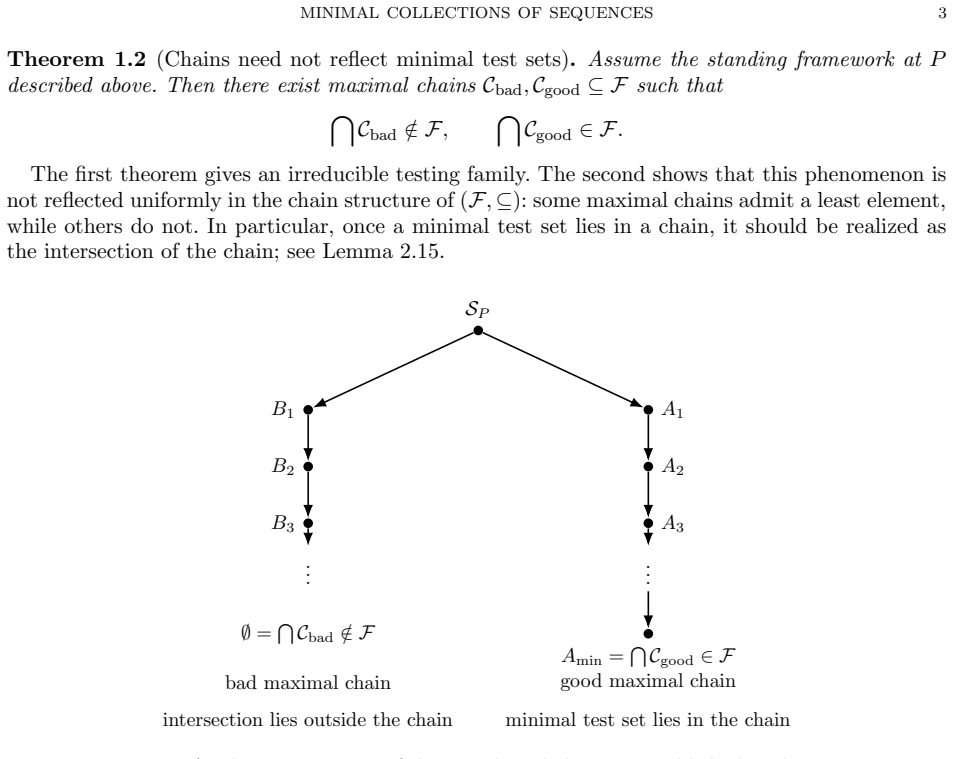
We study test sets: subfamilies of sequences converging to a point P that still suffice to detect every discontinuity of real-valued functions at P. Ordered by inclusion, these test sets form a poset. Under natural hypotheses at P, we prove that this poset has a minimal element. We also analyze its maximal chains, showing that some have a least element, while others do not. Finally, on the sequential fan we give a concrete realization in which the minimal test set produced by our construction has strictly smaller cardinality than the full family of convergent sequences.
Substitution reduces the conjectured relation to a coefficient that cancels to zero using shifts of H_n.
abstractclick to expand
For the OEIS sequence A001711, contributed by N. J. A. Sloane long before the on-line era and identified there as the diagonal $T(n+4, 4)$ of a generalized-Stirling triangle, R. J. Mathar contributed in February 2020 the conjectured order-2 P-recursive recurrence \[ a(n) - (2n+5)\,a(n-1) + (n+2)^{2}\,a(n-2) \;=\; 0,\qquad n \ge 2. \] We give a one-page proof. Detlefs's harmonic-number closed form $a(n) = \tfrac{1}{4}(n+3)!\,(2 H_{n+3} - 3)$ collapses the left-hand side, after dividing through by $(n+1)!/4$, to a polynomial identity of $n$ with coefficient $H_{n+2}$. The harmonic-number coefficient simplifies to $(n+3) - (2n+5) + (n+2) = 0$ (using $H_{n+3} = H_{n+2} + \tfrac{1}{n+3}$ and $H_{n+1} = H_{n+2} - \tfrac{1}{n+2}$); the constant remainder is $-3 \cdot 0 = 0$ for the same reason. The supplementary archive contains a SymPy script verifying both pieces symbolically, the e.g.f.\ expansion against the harmonic closed form, and Mathar's recurrence numerically for $n = 2, \ldots, 5000$.
Let $k\geq 2$. We show that, for a sufficiently small $\varepsilon>0$, any sufficiently large $n$-vertex Hamiltonian graph of minimum degree at least $n^{1-\varepsilon}$ contains a $2$-factor consisting of exactly $k$ cycles. This is the first minimum-degree condition which is polynomially smaller than linear. Our methods yield an analogous result when the host graph is not required to contain a Hamilton cycle, but only a $2$-factor consisting of at most $k$ cycles; this answers a question of Buci\'c, Jahn, Pokrovskiy and Sudakov.
We introduce a family of averaged meta-Fibonacci recursions $$ Q_{\alpha,m}(n) = 1+ \left\lfloor \alpha \frac1m \sum_{j=1}^m Q_{\alpha,m}(n-Q_{\alpha,m}(n-j)) \right\rfloor , $$ with initial conditions $$ Q_{\alpha,m}(1)=\cdots=Q_{\alpha,m}(m)=1. $$ Unlike classical Hofstadter-type recursions, the averaging mechanism produces highly regular large-scale behavior. For the critical parameter value $\alpha=1$, we prove global well-definedness for all $m\ge1$, establish an exact triangular block structure, and show that the value $k$ occurs exactly $k$ consecutive times. As a consequence, $$ Q_{1,m}(n)\sim \sqrt{2n}. $$ For the supercritical regime $\alpha>1$, we derive an asymptotic slope constraint showing that any positive linear growth rate, if it exists, must equal $$ 1-\alpha^{-1}. $$ Numerical experiments support the existence of a linear-growth phase and suggest a broader universality phenomenon for generalized averaging operators, including positive-power $L^p$-means. These results indicate that averaging induces a robust regularization mechanism for self-referential recursive systems, leading to stable slow-growth dynamics and nontrivial phase structure.
We prove several types of Courant nodal domain theorems for generalized Laplacians on graphs, based on an invariant introduced by Urschel, which we call the "Urschel number", denoted ${\rm UN}({\bf f})$, of an eigenvector ${\bf f}$. We refine Urschel's invariant, and use perturbation techniques to obtain some new results. First, we show the existence of mutually orthogonal eigenvectors, such that if the $k$-th eigenvalue has multiplicity $m$, then for $0\le j\le m-1$, ${\rm UN}({\bf f}_{k+j})\le k+\min(j,(m-1)-j)$. Second, for a simple $k$-th eigenvalue, we classify the zeroes of ${\bf f}_k$ as either "shallow or "deep"; we obtain a number of results that say, roughly speaking, the more shallow vertices ${\bf f}_k$ has, the more control we have over our new invariants based on Urschel's.
Our new invariants of an eigenvector, ${\bf f}_k$, are a sequence of integers whose minimum value is ${\rm UN}({\bf f}_k)$ and whose maximum, denoted ${\rm UN}_{\max{}}({\bf f}_k)$, is the maximum number of nodal domains of any possible positive/negative signing or "charge" of the zeroes of ${\bf f}_k$. An example of our second type of result is that if ${\bf f}_k$ has no deep vertices, then ${\rm UN}_{\max{}}({\bf f}_k)\le k$.
We provide a number of examples to illustrate our main results, and how they differ from the situation in analysis. We also describe a minor improvement of the Gladwell-Zhu theorem for an orthonormal eigenbasis in the presence of eigenvalues of sufficient multiplicity.
For 2p operators each of order p the output is const(p) times the weights' Wronskian, with a formula via late-growing permutations and vals.
abstractclick to expand
The alternated composition of $N=2p$ differential operators $ w_j(x)\,\partial_x^p$ of strict order $p$ on the line $\mathbb{R}\ni x$ is again a differential operator of strict order $p$; its coefficient is the constant $\mathrm{const}(p)$, depending only on the arity $N$, times the Wronskian determinant of the originally taken coefficients $w_1$, $\ldots$, $w_N$. The case $p=1$ of the Lie bracket for two vector fields fixes $\mathrm{const}(1)=1$. When $p=2$, finding $\mathrm{const}(2)=2$ is easy; we obtain $\mathrm{const}(3)=90$. The problem is to know $\mathrm{const}(p\geqslant 4)$. We express the formula of $\mathrm{const}(p)$ in terms of the sum with signs over the much smaller set of 'late-growing' permutations, thus reaching the exact values $c(p=4)= 586\,656$, $c(p=5)\approx 1.9\cdot 10^{12}$, and $c(p=6)\approx 7.9\cdot 10^{21}$; the positive integer sequence $\mathrm{const}(p)$ seems to be new.
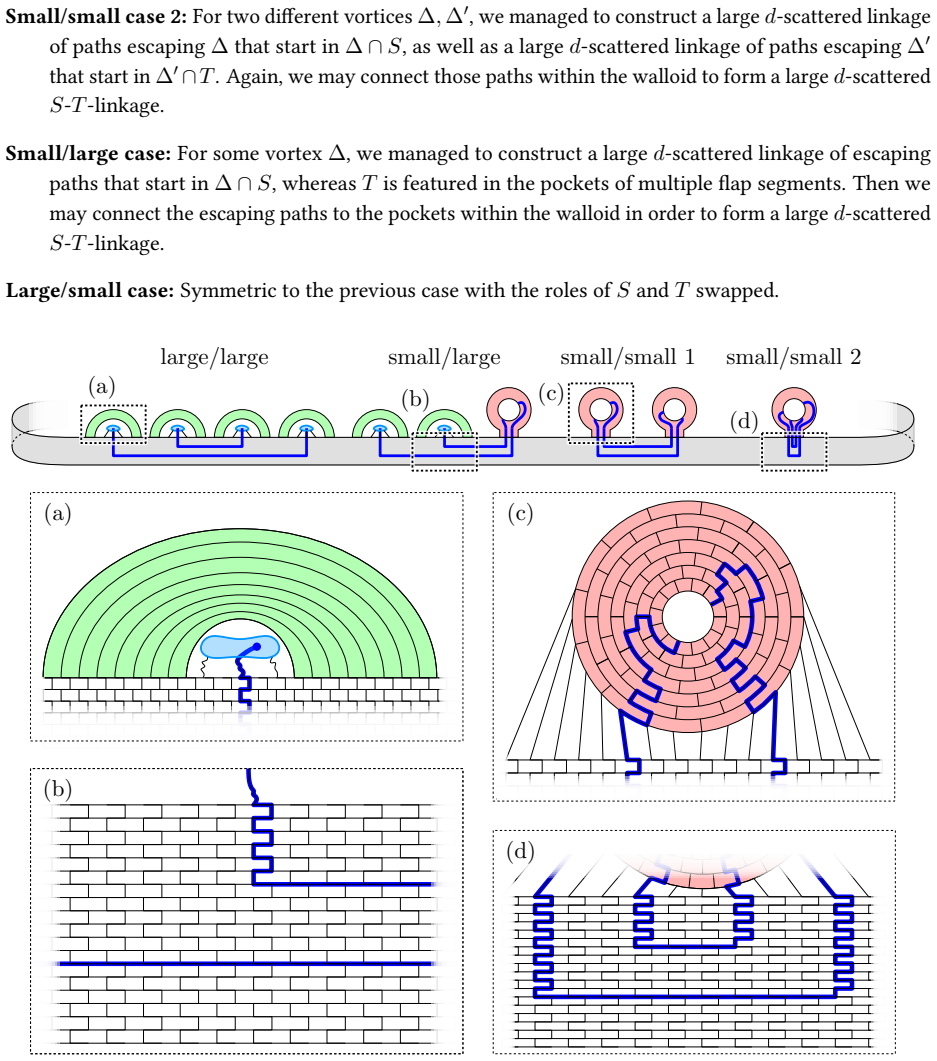
Menger's Theorem is a fundamental result in graph theory. It states that if in a graph $G$ with distinguished sets of terminal vertices $S$ and $T$ there are no $k$ pairwise vertex-disjoint $S$-$T$ paths, then there is a set of less than $k$ vertices that intersects every $S$-$T$ path. In this work, we give a coarse variant of this result for planar and bounded genus graphs. Precisely, we prove that for every surface $\Sigma$ there is a function $f\colon \mathbb{N}\times \mathbb{N}\to \mathbb{N}$ such that for every pair of integers $d,k\in \mathbb{N}$ and a $\Sigma$-embeddable graph $G$ with distinguished sets of terminal vertices $S$ and $T$, if $G$ does not contain a family of $k$ $S$-$T$ paths that are pairwise at distance larger than $d$, then there is a set $X$ consisting of at most $f(d,k)$ vertices of $G$ such that every $S$-$T$ path is at distance at most $d$ from a vertex of $X$. This partially answers questions of Nguyen, Scott, and Seymour [arXiv:2508.14332], who proved that such a result cannot hold in general graphs.
A key ingredient of our proof is a structure theorem from the developing ''colorful'' graph minor theory, where the focus is on studying the structure in a graph relative to some fixed subsets of annotated vertices. In our case, these annotated vertices are $S$ and $T$.
We study the enumeration of spinal tree-child phylogenetic networks, a rigid family of tree-child networks in which all internal vertices lie on a single root--to--leaf path. We provide two complementary combinatorial frameworks. First, we introduce a word model: unlabeled spinal networks correspond to a suitable class of restricted words with fixed multiplicities, taken modulo a simple relabeling equivalence, which yields an explicit closed enumeration. Second, we develop a symbolic-method approach based on a marked version of trees that admits a clean recursive specification; its boxed-product translation leads to a solvable bivariate generating function and a direct derivation of the coefficients.
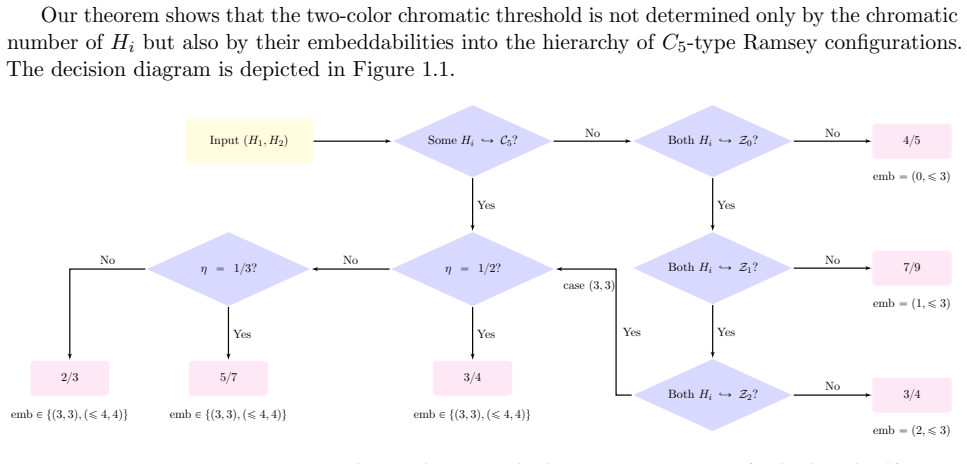
The chromatic threshold of a graph $H$ is the minimum-degree density above which every $H$-free graph has bounded chromatic number. We study a two-color Ramsey analogue: for graphs $H_1$ and $H_2$, we ask for the minimum-degree density above which every graph that admits a red-blue edge-coloring with no red copy of $H_1$ and no blue copy of $H_2$ has bounded chromatic number. We give a complete answer when both $H_1$ and $H_2$ are 3-chromatic. The threshold takes exactly one of the five values \[ \frac23,\quad \frac57,\quad \frac34,\quad \frac79,\quad \frac45, \] and we characterize precisely which pairs $(H_1,H_2)$ give each value. The classification is determined by the ordinary chromatic thresholds of $H_1$ and $H_2$ and by their embeddability into a hierarchy of $C_5$-type Ramsey configurations.
P_ℓ(G,m) equals P(G,m) for all m precisely on the theta graphs identified via DP-coloring.
abstractclick to expand
Chromatic choosability is a notion of fundamental importance in list coloring. A graph $G$ is chromatic-choosable when its chromatic number, $\chi(G)$, is equal to its list chromatic number $\chi_{\ell}(G)$. In 1990, Kostochka and Sidorenko introduced the list color function of a graph $G$, denoted $P_{\ell}(G,m)$, which is the list analogue of the chromatic polynomial of $G$, $P(G,m)$. A graph $G$ is said to be enumeratively chromatic-choosable when $P_{\ell}(G,m)=P(G,m)$ for every $m \in \mathbb{N}$. Theta graphs and their generalizations have played an important role in graph coloring problems over the years; for example, they appear in the characterization of chromatic-choosable graphs with chromatic number 2. In this paper we characterize the enumeratively chromatic-choosable theta graphs. Our proof utilizes ideas from DP-coloring (a.k.a. correspondence coloring), providing yet another example of how the more general setting of DP-coloring can be leveraged to attack a problem in list coloring.
Folding subgroups give a way to realize non-simply-laced Coxeter groups as subgroups of simply-laced Coxeter groups. In this paper, we study how folding subgroups of finite and affine type are distributed length-wise by calculating the length generating function of the subgroup with respect the length of the ambient group. These generating functions have surprisingly nice formulas in terms of $q$-integers and give rise to interesting combinatorial identities on polynomials involving length statistics of both the ambient group and folding subgroup.
For uniformly bounded degree graphings, distributions of colored stars or even cherries induce the same topology as full neighborhoods.
abstractclick to expand
Similarity metrics are central in the theory of large networks and graph limits. For bounded-degree graphs, the Benjamini--Schramm metric records the distribution of rooted neighbourhoods, while the stronger colored-neighbourhood metric gives rise to local-global convergence. In this paper we show that this intricate topology is already determined by much smaller observations. For technical convenience and greater generality, we work with graphings, which are measurable generalizations of finite graphs and include all finite graphs as special cases. We prove that, for graphings of uniformly bounded degree, convergence of all colored degree distributions, or equivalently of all colored star statistics, is equivalent to local-global convergence. We also introduce an even more economical sampling procedure, the colored cherry metric, in which one observes only the root and two randomly chosen neighbours, and prove that it induces the same topology. Thus the full local-global structure can be reconstructed, at the level of topology, from families of very small colored observations. Our star-observation theorem was previously announced in the work of Backhausz and the author as an important ingredient in the proof that the so-called action convergence unifies dense graph limit theory with local-global convergence, thereby providing a general graph limit theory for sparse, dense, and intermediate-density graphs.
The conflict-free closed neighborhood (CFCN$^*$) chromatic number of a graph $G = (V,E)$ is the smallest positive integer $k$ for which there exists a coloring of a subset of vertices using $k$ colors such that, for every vertex in $V$, there exists a color that appears exactly once in its closed neighborhood. The conflict-free open neighborhood (CFON$^*$) chromatic number is defined analogously. In this paper, we study `list variants' of the above-mentioned coloring parameters. The conflict-free closed neighborhood (CFCN$^*$) choice number of a graph $G = (V,E)$ is the smallest positive integer $k$ such that for every assignment of lists of size $k$ to its vertices, there exists a coloring of a subset of vertices, say $V'$, in which (i) every vertex in $V'$ receives a color from its list, and (ii) for every vertex in $V$ there exists some color that appears exactly once in its closed neighborhood. The conflict-free open neighborhood (CFON$^*$) choice number is defined analogously.
D\k{e}bski and Przyby\l o [Journal of Graph Theory, 2022] showed that for any graph $G$ with maximum degree $\Delta$, the CFCN$^*$ chromatic number of its line graph is $O(\ln \Delta)$. This result was later extended to claw-free graphs by Bhyravarapu et al. [Journal of Graph Theory, 2025], who proved that every $K_{1,k}$-free graph $G$ admits a CFCN$^*$ coloring using $O(k\ln \Delta)$ colors. In this paper, we generalize this result to the list setting and show that every $K_{1,k}$-free graph $G$ has a CFCN$^*$ choice number of $O(k\ln \Delta)$. Further, we answer some questions concerning the hardness of computing CFCN$^*$/CFON$^*$ choice numbers posed by Gupta and Mathew [SOFSEM, 2026]; in particular, we show that it is NP-hard to determine whether the CFCN$^*$/CFON$^*$ choice number a graph is equal to $k$, for $k=1,2$.
When S+S lies inside A+B and |A| ≤ n-t, any basis S requires |B| ≥ n + binom(t+1,2), and the bound is sharp.
abstractclick to expand
Motivated by the change-of-domain problem for additive bases, Bukh, van Hintum and Keevash conjectured that if \(A,B\subseteq \mathbb{Q}^{n}\) and \(\{\boldsymbol{e}_i+\boldsymbol{e}_j:1\le i\le j\le n\}\subseteq A+B,\) then \(|A|+|B|\ge 2n\). They further proposed the strengthened conjecture: if \(|A|=n-t\), then \(|B|\ge n+\binom{t+1}{2}.\) Bukh also explicitly asked whether the same bounds hold for \(A,B\subseteq \mathbb{R}^{n}\) and an arbitrary basis \(S\) of \(\mathbb{R}^{n}\), under the assumption \(S+S\subseteq A+B\).
We prove the full strengthened statement over \(\mathbb{R}^{n}\): if \(S+S\subseteq A+B\) and \(|A|\le n-t\) with \(0\le t\le n-1\), then \(|B|\ge n+\binom{t+1}{2},\) which is sharp for every basis \(S\) and every \(0\le t\le n-1.\) The proof is short, using edge contractions in a graph-theoretical framework and a new coloring lemma over \(\mathbb F_2^n\).
Solutions to Mx = diag(M) also satisfy a rank parity congruence, extending graph odd-domination results to arbitrary symmetric matrices and
abstractclick to expand
Let $G$ be a finite simple graph with adjacency matrix $A(G)$ over $\mathbb F_2$. The closed neighborhood matrix $A(G)+I$ is central in the theory of odd domination. Sutner proved that every graph has an odd dominating set, equivalently $\mathbf 1$ lies in the range of $A(G)+I$, and Batal proved that every such set has cardinality congruent to $\rank(A(G)+I)$ modulo $2$. We extend this parity phenomenon from closed neighborhood matrices to partially looped graph matrices $A(G)+D$, where $D$ is an arbitrary diagonal matrix over $\mathbb F_2$. Equivalently, we work with arbitrary symmetric matrices $M$ over $\mathbb F_2$ and the natural right-hand side $\diag(M)$. We include a self-contained proof, attributed by Filmus to Alon, that $\diag(M)\in\Img(M)$, and we prove that every solution of $Mx=\diag(M)$ satisfies \[ \diag(M)^\top x\equiv \rank(M)\pmod 2. \] We also give a complete rank and nullity formula for rank-one diagonal perturbations $M\mapsto M+uu^\top$, which in the graph setting describes exactly how toggling loops changes the associated solution spaces. Finally, for rooted trees with arbitrary diagonal labels, we develop a finite-state boundary recursion that counts all solutions of $M(T,\varepsilon)x=\varepsilon+\alpha e_r$ with prescribed root value, and we derive explicit nullity formulas for complete rooted $d$-ary trees. For $d\ge2$, we also prove an eventual-periodicity theorem for complete rooted $d$-ary trees with depth-dependent eventually periodic diagonal labels.
The excess is at least as large as almost all middle-rank sparse paving matroids, showing they are numerous at log scale
abstractclick to expand
The Mayhew--Newman--Welsh--Whittle conjecture predicts that asymptotically almost all matroids are sparse paving. We study the gap between paving and sparse paving matroids at the logarithmic scale. Let \(p_n\) be the number of paving matroids on \([n]\), let \(sp_n\) be the number of sparse paving matroids on \([n]\), and let \(sp_{n,r}\) be the number of rank-\(r\) sparse paving matroids on \([n]\). We prove that \[
p_n-sp_n\ge sp_{n,\lfloor n/2\rfloor}^{1-o(1)}. \] Thus the paving matroids that are not sparse paving are themselves logarithmically large. The construction prescribes one hyperplane larger than the rank and then counts stable sets in an induced subgraph of a Johnson graph. We also give amplified versions obtained by varying the large hyperplane and by prescribing distance-six families of large hyperplanes.
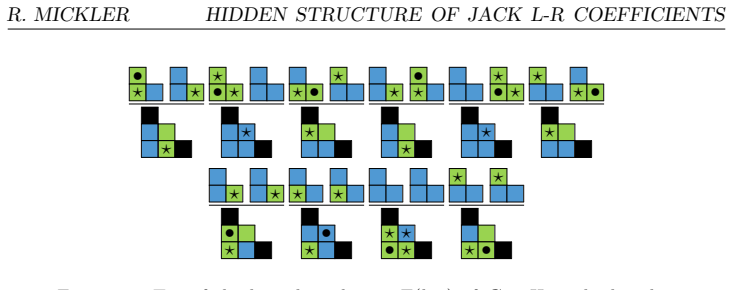
We argue that Jack Littlewood-Richardson coefficients $g_{\mu\nu}^{\lambda}(\alpha)$ are specialisations of certain novel polynomials. For the triple of partitions $(\mu,\nu,\lambda)=(21,21,321)$, we prove the corresponding polynomial is invariant under $S_6 \times \mathbb{Z}_2$, which is identified as the automorphism group of the Johnson graph $J(6,3)$. We conjecture that these polynomials exhibit a factorization property on certain hyperplanes, which is a consequence of compatibility relations between polynomials associated to adjacent triples in the Young graph. As a consequence of this, we conjecture that the difference of adjacent Jack Littlewood-Richardson coefficients is divisible by the shared hook length.
Closes quadratic gap to averaging bound up to constant factor when t-1 is a prime power.
abstractclick to expand
Motivated by the Erd\H{o}s--S\'{o}s bipartite link conjecture, F\"{u}redi (Oberwolfach, 2004) asked for the asymptotic maximum edge density $\pi_{\mathrm{link}}(t)$ of $3$-graphs in which the link graph of every vertex is $t$-partite. Goldwasser's recursive blow-up construction based on projective planes gives the lower bound $\pi_{\mathrm{link}}(t)\ge 1-t^{-1}-(2+o_t(1))t^{-2}$ whenever $t-1$ is a prime power. In this note, we prove the upper bound $\pi_{\mathrm{link}}(t)\le 1-t^{-1}-t^{-2}/12$ for every $t \ge 2$. Together with Goldwasser's construction, this determines, up to a constant factor, the correct order of the gap between $\pi_{\mathrm{link}}(t)$ and the trivial averaging upper bound $1-t^{-1}$ for all prime-power values of $t-1$.
In fact, our argument applies in the more general setting of $3$-graphs with no generalized daisies, equivalently, $3$-graphs in which the link graph of every vertex is $K_{t+1}$-free. We also establish an analogous upper bound for the positive $(r-1)$-codegree Tur\'an density of generalized daisies.
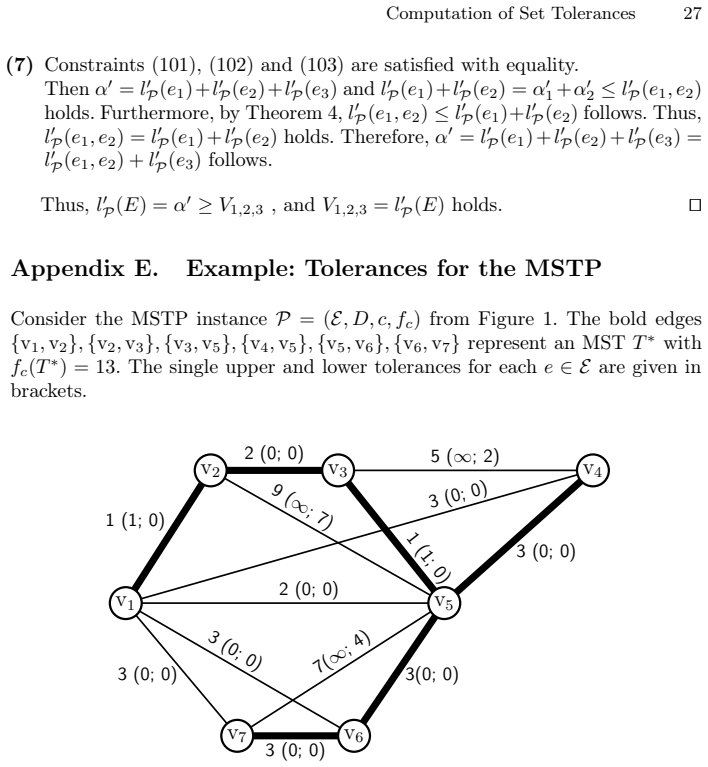
The regular set tolerance is an important term in sensitivity analysis. For combinatorial sum problems, e.g., the Traveling Salesman Problem, Shortest Path Problem and Minimum Spanning Tree Problem, it determines how much the sum of the costs of the elements of a set can be increased while ensuring that all current optimal solutions remain optimal. The regular set lower tolerance determines how much the sum of the costs of the elements of a set can be decreased while ensuring that the objective value of the optimal solution is not changed. We investigate a general method for computing regular (upper and lower) set tolerances in combinatorial sum problems. For the upper tolerance, we present a linear programming approach, and for the lower tolerances, three linear programming approaches, where the last two are novel and lead to recursive procedures for computation of the lower tolerances of all subsets of the given ground set. Furthermore, we give new upper bounds for set lower tolerances. For both upper and lower tolerances, we give an exact formula for sets of cardinality 2 and 3. Finally, we consider the computation of tolerances for the Minimum Spanning Tree Problem, give a formula for single tolerances, a lower bound for regular set upper tolerances and an exact formula for regular set lower tolerances.
L(P,t) for real t decomposes as a sum of periodic coefficients times powers of t, with explicit vertex formulas for simplices and the usual
abstractclick to expand
This paper is to study the Ehrhart function $L(P,t)$ of a rational $n$-polytope $P$, defined as the number of lattice points of dilated polytopes $tP$ with real numbers $t\geq 0$. It turns out that $L(P,t)$ is a quasi-polynomial of real variable $t$ in the sense that \[ L(P,t)=\sum_{k=0}^{n} c_k(P,t)t^k, \quad t\geq 0, \] where $c_k(P,t)$ are periodic piecewise polynomials of degree $n-k$ if ${\rm aff}\,P$ contains the origin, and are periodic functions vanishing almost everywhere otherwise. When $P$ is a rational simplex $\sigma$, the coefficient functions $c_k(\sigma,t)$ are given explicitly in terms of vertex information of the simplex $\sigma$. Moreover, the reciprocity law still holds.
Given a graph $G=(V,E)$, a vertex $u \in V$ {\em ve-dominates} all edges incident to any vertex of $N_G[u]$. A set $S \subseteq V$ is a {\em ve-dominating set} if for all edges $e\in E$, there exists a vertex $u\in S$ such that $u$ ve-dominates $e$. The minimum cardinality among all ve-dominating sets is known as the \textit{vertex-edge domination number} (or simply ve-domination number) and denoted by $\gamma_{ve}(G)$. Finding a minimum ve-dominating set was proved to be NP-complete. Restricted to trees, the problem admits a linear-time algorithm. Treewidth is a commonly used parameter for solving NP-hard problems. In this paper, we present a polynomial-time algorithm for finding a minimum ve-dominating set on graphs with bounded treewidth. Moreover, we show that the treewidth of a planar graph $G$ with ve-domination number $\gamma_{ve}(G)$ is $O(\sqrt{\gamma_{ve}(G)})$ and present an $O(c^{\sqrt{k}}|V(G)|)$-time algorithm for the $k$-ve-domination problem on planar graphs.
Motivated by Stanley's ``Schubert shenanigans'' paper, commendable attempts have been made to understand the principal specializations of Schubert or Grothendieck polynomials. In this paper, we prove that when a permutation $w$ does not contain the $1423$ pattern, the principal specialization of the corresponding $\beta$-Grothendieck polynomial can be expressed nonnegatively in terms of the occurrences of patterns in $w$. Using an inverse conservation principle, we further obtain the nonnegativity expansion for permutations avoiding the $1342$ pattern. Our results partially resolve conjectures raised respectively by Gao (independently observed by Gaetz), Me\'sz\'aros--Tanjaya, and Dennin. The proofs are achieved based upon a reduction algorithm performing on the classic pipe dream model of $\beta$-Grothendieck polynomials.
The sequence A176677 in the Encyclopedia of Integer Sequences enumerates Motzkin paths where two types of horizontal steps may occur, but only on odd indexed levels. We show how to perform the enumeration, also dealing with partial such Motzkin paths leading to a particular level or to any level (open paths). The method is the kernel method where functional equations are manipulated in a suitable way. The coefficients of sequence A176677 satisfy a holonomic recursion that was recently discussed on the arxiv. We show how this can be established in an (almost) automatic fashion. Eventually we switch the roles of `odd' and `even'. One could also allow more versions of horizontal steps but we leave this to the interested readers.
A "dominating $K_t$-model" in a graph $G$ is a sequence $(T_1,\dots,T_t)$ of pairwise vertex-disjoint connected subgraphs of $G$, such that whenever $1\leq i<j\leq t$ every vertex in $T_j$ has a neighbour in $T_i$. Replacing "every vertex in $T_j$" by "some vertex in $T_j$" retrieves the standard definition of $K_t$-model, which is equivalent to a $K_t$-minor in $G$. We prove that every graph with no dominating $K_5$-model is $4$-colourable. This generalises and is significantly stronger than the 4-colour theorem for planar graphs or for graphs with no $K_5$-minor. It also makes progress towards Haj\'{o}s' conjecture on $K_5$-subdivisions in $5$-chromatic graphs.
The construction yields a uniform upper bound better than the prior L^{1/3} result that holds for every bounded convex domain in the plane.
abstractclick to expand
Let $\Omega \subset \mathbb{R}^2$ be a bounded convex domain. Steinerberger (2026) introduced the Buffon discrepancy problem: given length $L$, construct a one-dimensional set $S\subset\Omega$ such that the number of intersections of $S$ with a line $\ell$ approximates the Crofton-normalized chord length $$ \frac{2L}{\pi|\Omega|}\cdot\mathcal{H}^1(\ell\cap\Omega).$$ Steinerberger proved a universal upper bound of order $L^{1/3}$ using a Steinhaus longimeter construction, and showed that the disk admits bounded discrepancy. We prove that a randomly shifted Steinhaus construction improves the order of the universal upper bound to $L^{1/5}(\log L)^{2/5}$.
Either k paths at distance r apart exist or at most f(k) balls of radius linear in r hit every path between two vertex sets.
abstractclick to expand
Menger's theorem is an important building block of numerous results in the study of graph structure. We consider a variant in terms of coarse geometry. We say that a set of graphs has the weak coarse Menger property if there exist functions $f$ and $g$ such that for any graph $G$ in this set, subsets $X$ and $Y$ of vertices of $G$, and positive integers $k$ and $r$, either there exist $k$ paths between $X$ and $Y$ pairwise at distance at least $r$, or there exists a union of at most $f(k,r)$ balls of radius at most $g(k,r)$ intersecting all paths between $X$ and $Y$. Nguyen, Scott and Seymour proved that the set of all graphs does not have the weak coarse Menger property and asked whether every proper minor-closed family of finite graphs has it.
In this paper, we provide a positive answer to this question in a stronger form: it is true for the set of locally finite graphs with an excluded finite minor, and the functions $f$ and $g$ can be chosen so that $f$ only depends on the number $k$ of the paths in the packing and the function $g$ is a linear function of the distance threshold $r$ and is independent of $k$, which is optimal up to a constant factor. Our result extends to every length space quasi-isometric to a locally finite graph or metric graph with an excluded finite minor, such as complete Riemannian surfaces of finite Euler genus, string graphs, and Cayley graphs of finitely generated minor-excluded groups.
In this paper, we provide a simple criterion for the Schubitope $\mathcal{S}_{D}$ associated to a diagram $D$ to be lattice-free. We further show that $\mathcal{S}_{D}$ is lattice-free if and only if its Ehrhart polynomial is equal to the product of Ehrhart polynomials of the Schubert matroid polytopes corresponding to each column of $D$. As applications, we obtain that the Newton polytopes of the Schubert polynomial $\mathfrak{S}_w(x)$ and the Grothendieck polynomial $\mathfrak{G}_w(x)$ are lattice-free if and only if $w$ avoids the patterns 1423, 1432, 13254, and confirm several conjectures by M\'esz\'aros, Setiabrata, and St.Dizier on the support of Grothendieck polynomials for this class of permutations.
Augmenting C4-free graphs with triple-monomial squares improves lower bounds to 10 for 5x3 and 16 for 6x4 and 5x5.
abstractclick to expand
The limited augmented Zarankiewicz number $z_L(m,n)$ corresponds to 2-edges $(i,j;k,l)$ in a $C_4$-free bipartite graph, each representing a square $(x_i y_j + x_k y_l)^2$. We introduce \emph{3-edges} $(i,j;k,l;p,q)$ representing $(x_i y_j + x_k y_l + x_p y_q)^2$, and define the numbers $z_{3L}(m,n)$ and $z_{3A}(m,n)$ by forbidding generalized $C_4$ cycles. We prove that for any 3-edge-augmented graph without such cycles, the corresponding doubly simple biquadratic form has SOS rank equal to the total number of edge contributions. As applications, we show $z_{3L}(5, 3) = 10$, $z_{3L}(6,4) \ge 16$ and $z_{3L}(5,5) \ge 16$, improving the known bounds $z_L(5, 3) = 9$, $z_L(6,4)=14$ and $z_L(5,5)=14$. The constructions in the $5 \times 5$ and $6 \times 4$ cases are naturally explained as 3-edges, providing a unified combinatorial framework for SOS rank lower bounds beyond the limited augmented Zarankiewicz number.
With m edges and exactly k paths of length l, only one attachment pattern achieves the largest or smallest eigenvalue of the distance matrix
abstractclick to expand
The distance spectral radius of a connected hypergraph is the largest eigenvalue of the distance matrix of the hypergraph. A pendant path of length l with l greater than or equal to 1 in a hypergraph G at vertex v sub l plus 1 is a path consisting of vertices and edges v1 e1 v2 up to vl el v(l+1). The vertex v(l+1) has degree at least 2, vertex v1 has degree 1, and each vertex vi has degree 2 for i from 2 to l. Every vertex belonging to edge ei except vi and v(i+1) has degree 1 for all i from 1 to l. We find the unique hypertree that maximizes or minimizes the distance spectral radius among all r-th power hypertrees with m edges and k pendant paths of length l, where r is no less than 3, k and l are no less than 1, and the product of k and l is smaller than m.
Woldar's 1995 conjecture is proved: these are the only finite abelian groups that possess a subset S where M times S covers all nonzero el
abstractclick to expand
A set $M$ of nonzero integers is said to split a finite abelian group $G$ if there exists a subset $S\subseteq G$ such that $M\cdot S = G\setminus\{0\}$. Such a splitting is called purely singular if every prime divisor of $|G|$ divides some element of $M$. In 1995, Woldar \cite{W1995} conjectured that the finite abelian groups admitting a purely singular splitting by the set $\{1,2,\dots,k\}$ are precisely the cyclic groups of orders $1$, $k+1$, and $2k+1$. In this paper, we prove this conjecture.
Short proof settles the asymptotic density needed to guarantee an ℓ-path between same-degree vertices, tight for odd ℓ.
abstractclick to expand
Addressing a question posed by Chen and Ma from an asymptotic point of view, we present a short proof for the edge density needed to guarantee that two vertices of the same degree are connected by a path of a fixed length. In particular, we show that for any sufficiently large graph, a density of at least $1/2+o(1)$ enforces the existence of two such vertices. This bound is tight for paths of odd length.
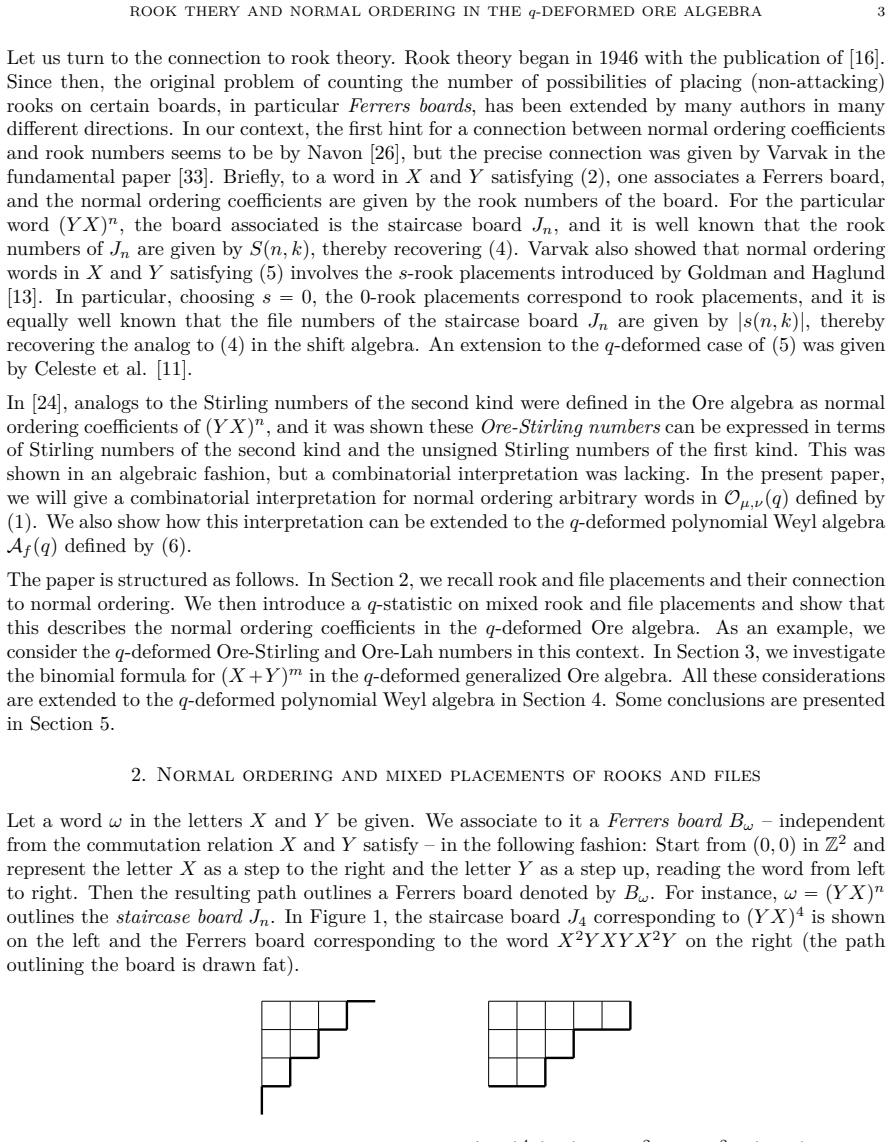
For words in the variables $X$ and $Y$ satisfying the commutation relation of the $q$-deformed generalized Ore algebra, $XY-qYX= \mu I + \nu Y$, we show that the corresponding normal ordering coefficients can be given an interpretation in terms of mixed placements of rooks and files. In particular, the associated $q$-deformed Ore-Stirling and Ore-Lah numbers are treated in detail. We show that the $q$-deformed Ore-Stirling numbers (resp., $q$-deformed Ore-Lah numbers) are given as mixed placement numbers of rooks and files on the staircase board (resp., Laguerre board). Using this combinatorial interpretation, their recurrence relations are derived. In addition, the normal ordered form of the binomial $(X+Y)^m$ in the $q$-deformed generalized Ore algebra is determined. These considerations are then extended to the $q$-deformed polynomial Weyl algebra generated by $X$ and $Y$ satisfying $XY-qYX=f(Y)$ for some polynomial $f\in \mathbb{C}[Y]$. In particular, associated $q$-deformed polynomial Stirling and Lah numbers are introduced and their properties studied. The normal ordered form of the binomial is also extended to the $q$-deformed polynomial Weyl algebra.
This paper presents a novel construction method for symmetric Sudoku-type games based on Lee distance perfect codes and diameter perfect codes. The proposed method utilizes the tiling property of these codes to define the structure of the subgrid constraints of Sudoku-type games. In this way, our games inherit the symmetric properties of Sudoku. We provide a detailed analysis of two small cases: a $5 \times 5$ Sudoku in $\mathbb{Z}_5^2$, and an $8 \times 8$ Sudoku in $\mathbb{Z}_8^2$. By defining equivalence relations via rigid motions, we provide a complete enumeration of valid grids, identifying 17 inequivalent solutions for $5\times 5$ Sudoku. For two different types of $8\times 8$ Sudoku, we characterize 232,735 and 304,014 inequivalent solutions, respectively. Furthermore, to verify practical playability, we implement a human-like solver that assesses the difficulty of the generated games. The analysis confirms that our $5\times5$ Sudoku games offer a balanced distribution of difficulty levels, ranging from Easy to Hard, making them a viable alternative to traditional $9 \times 9$ Sudoku.
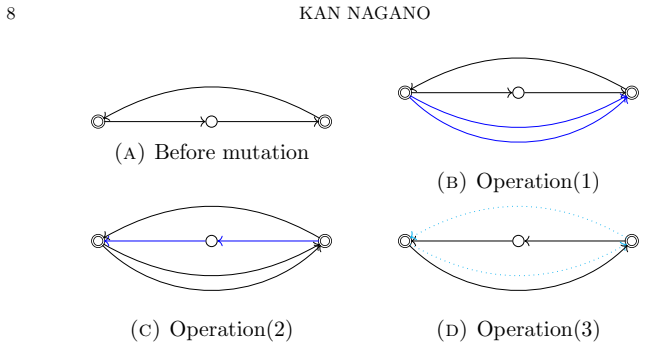
In this paper, we introduce a new combinatorial operation, called a flip, on arbitrary partially ordered sets. We define a mutation to be a flip that maps a lattice to a lattice. We study properties of flips, and give a necessary and sufficient condition for a flip to be a mutation. We introduce locally mutable lattices and mutable lattices in terms of flips, and prove that mutable lattices are semidistributive. We show that type-A and type-B Cambrian lattices are locally mutable, and those associated with the finite-type Coxeter quivers with different orientations are related also by the sequence of mutations. Finally we introduce a new class of lattices, called Ordovician lattices, as the lattices obtained from Cambrian lattices by iterated mutations. We provide conjectures on the structure of Ordovician lattices and on the compatibility between our mutation and the mutation in the theory of cluster algebras.
When n meets the threshold (2k-t+1)(t+1)+(k-t+1)k'+k+2ℓ-1, |F|·|G| is at most the product of two Gaussian binomials.
abstractclick to expand
Let $[n]$ (resp. $V$) be an $n$-element set (resp. $n$-dimensional vector space over the finite field $\mathbb{F}_{q}$), and $\binom{[n]}{k}$ (resp. $\genfrac{[}{]}{0pt}{}{V}{k}$) denote the set of all $k$-subsets of $[n]$ (resp. $k$-dimensional subspaces of $V$). We say that $\mathcal{F}\subseteq\binom{[n]}{k}$ (resp. $\mathcal{F}\subseteq\genfrac{[}{]}{0pt}{}{V}{k}$) and $\mathcal{G}\subseteq\binom{[n]}{k'}$ (resp. $\mathcal{G}\subseteq \genfrac{[}{]}{0pt}{}{V}{k'}$) are $\ell$-weakly cross $t$-intersecting if $\sum_{1\le i,j\le \ell}|F_i\cap G_j|\geq \ell^{2}t-\ell+1$ (resp. $\sum_{1\le i,j\le \ell}\dim(F_i\cap G_j)\geq \ell^{2}t-\ell+1$) for all distinct $F_1,\ldots,F_{\ell}\in\mathcal{F}$ and $G_1,\ldots,G_{\ell}\in\mathcal{G}$. In this paper, we provide an alternative proof of the set version of the $\ell$-weakly cross $t$-intersecting theorem and an explicit lower bound for $n$. Moreover, we prove that if $\mathcal{F}$ and $\mathcal{G}$ are $\ell$-weakly cross $t$-intersecting subspace families, then \[ |\mathcal{F}| \cdot |\mathcal{G}| \leq\genfrac{[}{]}{0pt}{}{n-t}{k-t}\genfrac{[}{]}{0pt}{}{n-t}{k'-t} \] holds, provided that $n\geq (2k-t+1)(t+1)+(k-t+1)k'+k+2\ell-1$. This extends the theorem of Cao, Lu, Lv and Wang [J. Combin. Theory Ser. A 193 (2023), 105688], who established the upper bound for the product of the sizes of cross $t$-intersecting subspace families.
The construction of all large sets plus m-subsets of an (mℓ-1)-set is optimal when c is between s to the (m-1)/m and a constant fraction of
abstractclick to expand
For integers $n\ge s\ge2$, let $e(n,s)$ denote the maximum size of a family $\F\subseteq2^{[n]}$ with no $s$ pairwise disjoint members. The problem of determining $e(n,s)$, now called the Erd\H{o}s--Kleitman problem, is the non-uniform analogue of the Erd\H{o}s matching problem. Fix $m\ge3$ and write $n=sm+c$, $\ell=s-c$. We prove that for every fixed $m\ge3$, there exists constants $\beta_m$ and $\delta_m$ such that for sufficiently large $s$, the extremal families for $e(sm+c,s)$ are $P'(m,s,\ell;L')\coloneqq \binom{L'}m\cup\binom{[sm+c]}{\ge m+1}$ for some $L'$ with $|L'|=m\ell-1$ when $\beta_m s^{(m-1)/m}\le c\le \delta_m s$. For $m=3$, we determine the asymptotic range of $\ell$ for which $P'(3,s,\ell;L')$ is extremal.
When n=sm+c and c lies between β s^{(m-1)/m} and δ s, the largest family without s disjoint members is a specific mix of small m-sets and n+
abstractclick to expand
For integers $n\ge s\ge2$, let $e(n,s)$ denote the maximum size of a family $\F\subseteq2^{[n]}$ with no $s$ pairwise disjoint members. The problem of determining $e(n,s)$, now called the Erd\H{o}s--Kleitman problem, is the non-uniform analogue of the Erd\H{o}s matching problem. Fix $m\ge3$ and write $n=sm+c$, $\ell=s-c$. We prove that for every fixed $m\ge3$, there exists constants $\beta_m$ and $\delta_m$ such that for sufficiently large $s$, the extremal families for $e(sm+c,s)$ are $P'(m,s,\ell;L')\coloneqq \binom{L'}m\cup\binom{[sm+c]}{\ge m+1}$ for some $L'$ with $|L'|=m\ell-1$ when $\beta_m s^{(m-1)/m}\le c\le \delta_m s$. For $m=3$, we determine the asymptotic range of $\ell$ for which $P'(3,s,\ell;L')$ is extremal.
A permutation sign mismatch blocks 3^n-cycles when n is even and extends the obstruction to all odd m ≡ 3 mod 4.
abstractclick to expand
We resolve exercise 7.2.2.4--224 of Knuth's Pre-Fascicle 8a (10 April 2026 draft, rated [46]): the digraph $\mathit{SB}(3,n)$ has no Hamiltonian cycle when $n$ is even. The argument is a sign-of-permutation obstruction. Writing the successor map of a candidate Hamiltonian cycle as $f_S = A_b \circ \sigma$, $\operatorname{sgn}(A_b)=+1$ when $m$ is odd, so $\operatorname{sgn}(f_S)=\operatorname{sgn}(\sigma)$ for every choice set $S$. A short dihedral Burnside computation shows $\operatorname{sgn}(\sigma)=-1$ on $\Sigma_3^n$ for even $n$, contradicting the sign $+1$ required of a single $3^n$-cycle. The same argument gives the stronger statement that $\mathit{SB}(m,n)$ has no Hamiltonian cycle whenever $m$ is odd with $m\equiv 3\pmod 4$ and $n$ is even; this restricts the residue classes in which Knuth's hint to Ex.~225 (existence of Hamiltonian cycles in $\mathit{SB}(m,n)$ for all $m>3$ and $n>2$) can hold.
When the complementary 1-factor contains exactly three spokes, the graph satisfies the 7/5-conjecture of Alon and Tarsi.
abstractclick to expand
Let $G$ be a cubic graph admitting a $2$-factor consisting of exactly two odd circuits, and let the complementary $1$-factor contain precisely three spokes (along with an arbitrary number of chords). We show that four perfect matchings can cover $G$. As a consequence, $G$ fulfils the 7/5-Conjecture of Alon and Tarsi.
An intermediate lattice isometric to the rescaled cubic lattice decomposes shells into W(B8) orbits and allows recovery of the full E8 via (
abstractclick to expand
Integral systems in real composition algebras give rise to finite metric configurations whose geometry is linked to both regular polytopes and root-systems. In this work we investigate, to our knowledge for the first time in this form, the shell polytopes obtained by fixing the integral norm and taking the convex hull of the corresponding integral elements. The first shells recover the familiar root-polytopal configurations attached to the classical Hurwitz systems, while the Okubo algebra gives a quite different behaviour. The Okubo integral closure does not recover the Gosset polytope directly: it selects a two-adic hierarchy whose first visible layers are a cross-polytope and a \(D_8\) root polytope. We further show that the natural intermediate lattice is isometric to the rescaled cubic lattice; consequently every shell decomposes into explicit orbits of the hyperoctahedral group \(W(B_8)\), and the higher Okubo shells admit a complete combinatorial description in cubic-lattice coordinates. The full \(E_8\) Gosset polytope is then recovered from the intermediate lattice by maximal-isotropic gluing along \((\ZZ/2)^4\). This gives an interplay between non-unital composition, integral lattice shadows, and the geometry of \(E_8\).
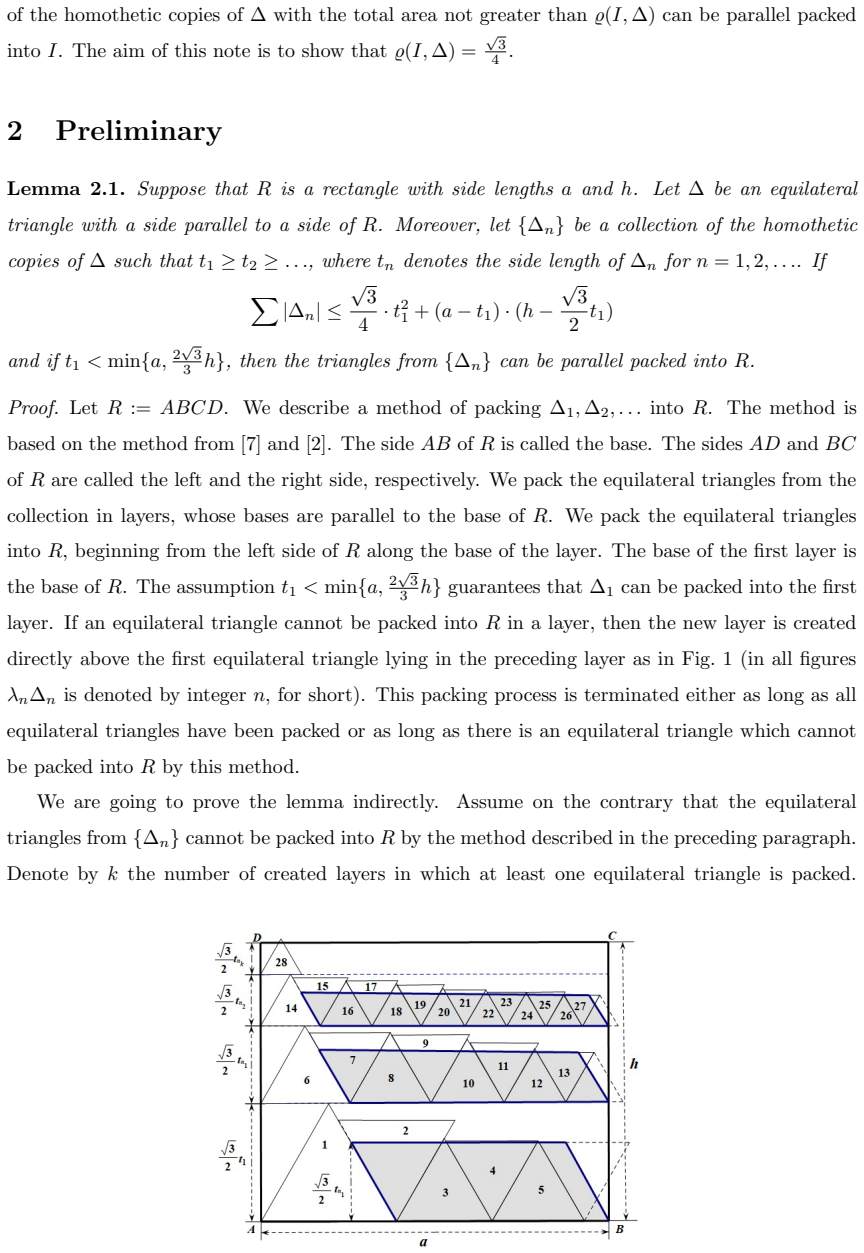
Suppose that $I$ is a unit square and that $\Delta$ is an equilateral triangle with a side parallel to a side of $I$. In this note, we prove that any collection of triangles homothetic to $\Delta$, whose total area does not exceed $\frac{\sqrt{3}}{4}$, can be parallel packed into $I$. The upper bound of $\frac{\sqrt{3}}{4}$ is tight.
Even-hole-free graphs are confirmed 3-divisible, yielding χ ≤ 3^{ω−1} while the α ≤ 3 case fails the perfect-divisibility partition.
abstractclick to expand
A graph $G$ is said to be perfectly divisible if for every induced subgraph $H$ of $G$ with at least one edge, the vertex set $V(H)$ can be partitioned into two sets $A, B$ such that $H[A]$ is perfect and $\omega(B) < \omega(H)$. It is easy to see that the chromatic number of a perfectly divisible graph is at most $\binom{\omega(G)+1}{2}$. Ho\`ang conjectured that every graph $G$ with $\alpha(G) \le 3$ is perfectly divisible. We disprove this conjecture.
In the same vein, a graph $G$ with at least one edge is $k$-divisible if for every induced subgraph $H$ of $G$ with at least one edge, the vertex set $V(H)$ can be partitioned into $k$ sets, none of which contains a largest clique of $H$. It is easy to see that the chromatic number of a $k$-divisible graph is at most $k^{\omega-1}$. Ho\`ang conjectured that every even-hole-free graph is 3-divisible. We confirm this conjecture.
The size product is at most the square of the classic non-trivial intersecting family bound when n is at least 2k+1.
abstractclick to expand
Two families $\mathcal{F},\mathcal{G}$ of $k$-subsets of $\{1,2,\ldots,n\}$ are called {\it non-trivial cross-intersecting} if $F\cap G\neq \emptyset$ for all $F\in \mathcal{F}, G\in \mathcal{G}$ and $\cap \{F\colon F\in \mathcal{F}\}=\emptyset=\cap \{G\colon G\in\mathcal{G}\}$. In this note, we establish the product version of the Hilton-Milner Theorem for $k\geq 8$ in the full range. That is, if $\mathcal{F},\mathcal{G}\subset \binom{[n]}{k}$ are non-trivial cross-intersecting, $n\geq 2k+1$ and $k\geq 8$, then \[ |\mathcal{F}||\mathcal{G}|\leq \left(\binom{n-1}{k-1}- \binom{n-k-1}{k-1} +1\right)^2. \]
Laplacian factorization yields explicit formulas that also give resistances and spanning-tree counts on C_N^k.
abstractclick to expand
We investigate the average hitting times of simple random walks on the $k$-th power graph $C_N^k$ of the cycle graph $C_N$. First, we show that the average hitting times are characterized by a difference equation corresponding to the graph Laplacian. Next, by using the cyclic symmetry of $C_N^k$, we derive a spectral representation via Fourier analysis. Furthermore, by applying factorization and partial fraction decomposition of the corresponding difference operator, we obtain an explicit formula for the average hitting times consisting of a quadratic term and finitely many correction terms. These correction terms are described by second-order linear recurrence sequences associated with the characteristic polynomials, and can be regarded as natural generalizations of Fibonacci-type sequences. As a consequence, our formulas recover the known results for cycle graphs and squares of cycle graphs in a unified way. Moreover, from the formulas obtained for average hitting times, we derive explicit formulas for the effective resistances, the numbers of spanning trees, the numbers of two-component spanning forests, and the numbers of spanning trees of vertex-identified graphs. In particular, for the third power graph $C_N^3$ of the cycle graph, all of these quantities are written explicitly in terms of complex conjugate Fibonacci-type sequences. Our results clarify structural relations between random walk quantities and combinatorial quantities on cycle power graphs.
The same closed forms also supply exact counts of spanning trees and effective resistances on these graphs.
abstractclick to expand
We investigate the average hitting times of simple random walks on the $k$-th power graph $C_N^k$ of the cycle graph $C_N$. First, we show that the average hitting times are characterized by a difference equation corresponding to the graph Laplacian. Next, by using the cyclic symmetry of $C_N^k$, we derive a spectral representation via Fourier analysis. Furthermore, by applying factorization and partial fraction decomposition of the corresponding difference operator, we obtain an explicit formula for the average hitting times consisting of a quadratic term and finitely many correction terms. These correction terms are described by second-order linear recurrence sequences associated with the characteristic polynomials, and can be regarded as natural generalizations of Fibonacci-type sequences. As a consequence, our formulas recover the known results for cycle graphs and squares of cycle graphs in a unified way. Moreover, from the formulas obtained for average hitting times, we derive explicit formulas for the effective resistances, the numbers of spanning trees, the numbers of two-component spanning forests, and the numbers of spanning trees of vertex-identified graphs. In particular, for the third power graph $C_N^3$ of the cycle graph, all of these quantities are written explicitly in terms of complex conjugate Fibonacci-type sequences. Our results clarify structural relations between random walk quantities and combinatorial quantities on cycle power graphs.
The classical no-three-in-line problem asks for the largest number (D(n)) of points that can be chosen from an (n \times n) grid with no three collinear. We study the checkerboard-restricted variant in which all chosen points lie in one fixed parity class of (x+y \pmod 2). Let (D_{\mathrm{mono}}(n)) be the corresponding optimum. The slope-(\pm1) diagonals give the elementary bound (D_{\mathrm{mono}}(n) \le 2n-2).
The main tool is a four-direction linear-programming relaxation on a fixed parity class, using rows, columns, and the two diagonal families of slopes (\pm1). For the ordinary square-grid problem this relaxation is trivial, but on the checkerboard it gives substantially tighter finite bounds. After symmetry reduction, the dual relaxation has three one-dimensional forms, according to the parity of (n) and the chosen colour class.
The main rigorous result is an exact continuum dual certificate for the formal continuum problem associated with the scaled odd-fat case. We construct explicit nonnegative functions satisfying the continuum obstacle inequalities and having objective value (\alpha), where (401\alpha^3-1744\alpha^2+2240\alpha-768=0) and (\alpha) is the middle real root. This proves the upper bound (\Lambda_{\mathrm{fat}}\le\alpha) for the odd-fat continuum relaxation. Finite LP computations are consistent with (\alpha) as a limiting slope, and exact small-(n) data suggest the same scale for the original checkerboard optimum.
This paper proves four conjectured generating series, due to Chapoton, which concern invariants of posets and polytopes associated with a specific sequence of arbors. Two of these conjectures provide closed-form formulas for the generating series of the Zeta polynomial and the generating series of the M-triangle of the poset, respectively. The remaining two conjectures pertain, respectively, to the Ehrhart polynomial and the Laplace transform of the volume function of the associated arbor polytope.
Isomorphism to the r=1 case converts spectral sums into exponentials whose spanning-tree count approaches e^{-2} times that of K_N.
abstractclick to expand
In this paper, we consider circulant graphs obtained from the complete graph $K_N$ by deleting all edges belonging to a prescribed distance class. We study, in a unified manner, the effective resistance, the expected hitting time, the number of spanning trees, and the number of two-component spanning forests of these graphs. For general distance-class deletions, these quantities admit natural spectral representations in terms of the Laplacian eigenvalues. However, such representations typically remain at the level of finite Fourier sums, and concise closed forms are not expected in general. We focus on the case of a single deleted distance class. When the number of vertices $N$ is odd and $\gcd(r,N)=1$, the graph $G_{N,r}$ is isomorphic to $G_{N,1}$. In this setting, we derive explicit exponential-type formulas for the effective resistance and the number of spanning trees, and obtain corresponding closed expressions for two-component spanning forests and expected hitting times. Our results show that the case $r=2$ is not essentially new, but follows from a general isomorphism structure underlying distance-class deletions. We also clarify the relation of our formulas to earlier results on the complete graph with a Hamiltonian cycle removed, and provide a unified derivation within a spectral framework. Moreover, by asymptotic analysis, we show that the ratio $\tau(G_{N,1})/\tau(K_N)$ converges to $e^{-2}$ as $N \to \infty$.
We prove that for every path $P$, the class of graphs with no induced $P$ and no induced four-cycle $C_4$ is linearly $\chi$-bounded. More generally, we ask for which pairs $\{T,H\}$ where $T$ is a forest and $H$ is a complete multipartite graph, every graph $G$ with no induced $T$ and no induced $H$ has chromatic number at most $C \cdot R(\alpha(H),\omega(G)+1)$ for some constant $C$ depending only on $T$ and $H$, where $R(\cdot,\cdot)$ denotes the usual Ramsey numbers. We show that this holds in the following two instances, which strengthen the case $T=P$ and $H=C_4$ mentioned above:
(1) every component of $T$ is a broom and $H$ is complete multipartite; or
(2) $T$ is a forest and $H$ is complete bipartite.
These two unify and substantially extend a number of previous results on linear and polynomial $\chi$-boundedness for various graph classes.
For case (2), we also provide a new proof (with better bounds) of a recent result of Fox, Nenadov, and Pham on the existence of an induced copy of a fixed tree in a graph satisfying certain sparsity conditions.
Near-optimal extremal results for moonflower-free families reduce block-length overhead from polylog to log, with a matching lower bound.
abstractclick to expand
We introduce \emph{moonflowers}, a weaker analogue of sunflowers. A family of sets $S_1,\ldots,S_k$ is a $k$-moonflower if each set $S_i$ contains at least one element that is absent from all the others. We study the extremal problem of determining the largest possible size of a family of sets of size at most $w$ that avoids a $k$-moonflower, and obtain near-optimal bounds.
As an application, we revisit the code sparsification problem studied by Brakensiek and Guruswami (STOC 2025) and improve the bounds to near optimal. Concretely, we improve the dependence on the block length from poly-logarithmic to logarithmic, and show that such a dependence is necessary.
Exhaustive search classifies near Williamson matrices for odd orders to 35 and supplies constructions to 63, producing the new example.
abstractclick to expand
In this article, we consider a special class of Williamson type matrices which we call them near Williamson matrices. They are in fact four $n\times n$ $(-1, 1)$-matrices $A, B, C, D$ so that $A$ is circulant, $B,C,D$ are symmetric circulant, and they satisfy $AA^\top+BB^\top+CC^\top+DD^\top=4nI$. Using a computer search, we find all inequivalent near Williamson matrices for all odd orders at most $35$. We also show that such matrices exist for all odd orders up to $63$. As a consequence, we find the first known example of a quaternary Hadamard matrix of order $118$.
Multipliers attached to Singer quadrangles yield a contradiction for one O'Nan-Scott type, resolving a listed open question.
abstractclick to expand
A finite generalized quadrangle $\cS$ is a Singer quadrangle if it has an automorphism group that acts sharply transitively on its points. In this paper, we introduce the notion of multipliers for a Singer quadrangle and study their basic properties. As an application, we show that a point-primitive automorphism group of a thick generalized quadrangle cannot have O'Nan-Scott type HS (holomorph simple), which answers an open problem in \cite{Bamberg 2019}.
A family $\mathcal{F}\subset \binom{[n]}{k}$ is called intersecting if $F\cap F'\neq \emptyset$ for all $F,F'\in \mathcal{F}$. The covering number of a family $\mathcal{F}$ is defined as the minimum size of $T\subset [n]$ such that $T\cap F\neq \emptyset$ for all $F\in \mathcal{F}$. In 1980, the first author proved that for sufficiently large $n$, any intersecting $k$-graph $\mathcal{F}$ with covering number at least three, satisfies $|\mathcal{F}|\leq \binom{n-1}{k-1}-\binom{n-k}{k-1}-\binom{n-k-1}{k-1}+\binom{n-2k}{k-1}+\binom{n-k-2}{k-3}+3$. There was very little progress during more than forty years but recently (cf. \cite{FW25}) with a completely
different approach we proved the same result for the full range $n\geq 2k$ and $k\geq 7$. In this short paper we prove the same inequality for all the remaining cases.
We introduce and study a generalization of conformal rigidity for graphs. A graph is $k$-conformally rigid if the uniform edge weights simultaneously maximize the sum of the $k$ smallest nontrivial Laplacian eigenvalues and minimize the sum of the $k$ largest, over all normalized non-negative weight assignments. A graph that is $k$-conformally rigid for every $k$ is called totally conformally rigid. Our main result is a complete characterization: a graph is totally conformally rigid if and only if it is edge-rigid, meaning every canonical spectral embedding onto a Laplacian eigenspace is edge-isometric. We further show this is equivalent to all edges of the graph being pairwise Laplacian-cospectral, that is, the removal of any single edge yields a graph with the same Laplacian characteristic polynomial. Using semidefinite programming duality, we establish this equivalence and derive a polynomial-time algorithm for deciding edge-rigidity using only integer arithmetic. We provide a combinatorial characterization of edge-rigidity in terms of Laplacian walks and connect it to the walk-regularity of signed line graphs. We show that a graph is edge-rigid if and only if it is either $1$-walk-regular or $1$-walk-biregular, and we finally show an equivalence based on monotone gauges and gauge duality. As an application, we derive two non-trivial combinatorial consequences of total conformal rigidity, relating it to the number of spanning trees and the Kirchhoff index of the graph.
The order-two relation is obtained by equating coefficients in the first-order ODE satisfied by the explicit exponential generating function
abstractclick to expand
For the OEIS sequence A025166, defined by $a(n) = -n!\,2^{n}\,L_{n}(1/2)$ where $L_{n}$ is the Laguerre polynomial of degree $n$, R.~J.~Mathar contributed in February 2013 the conjectured order-2 P-recursive recurrence \[ a(n) + (-4n+3)\, a(n-1) + 4(n-1)^{2}\, a(n-2) \;=\; 0, \qquad n \ge 2. \] We give a one-page proof. The exponential generating function $F(x) = -\exp\!\big(-x/(1-2x)\big)/(1-2x)$ satisfies the first-order linear ODE $(1-2x)^{2} F'(x) = (1-4x)\, F(x)$, and Mathar's recurrence then falls out by reading off the coefficient of $x^{n}/n!$. Both steps are short. The supplementary archive includes a SymPy script which checks the ODE identically and the recurrence numerically up to $n = 5000$.
Let $\mathrm{Mac}(W)$ be the MacNeille completion of the Bruhat order of a Coxeter group $W$. We introduce an action of the $0$-Hecke monoid of type $W$ on $\mathrm{Mac}(W)$, which allows us to define a weak order and a descent set statistic on $\mathrm{Mac}(W)$. When $W$ is of type $A$, we recover constructions of Hamaker and Reiner, which were originally formulated in terms of monotone triangles and alternating sign matrices. Using this action, we prove that certain unions of Knutson--Miller subword complexes are vertex-decomposable. By specializing to type $A$, we prove a conjecture of Escobar, Klein, and Weigandt regarding Cohen--Macaulay ASM varieties. Along the way, we also exhibit a counterexample to a conjecture of Hamaker and Reiner regarding the poset topology of intervals in the ASM weak order. Finally, when $W$ is finite and irreducible, we use our $0$-Hecke action to introduce a noninvertible dynamical system on $\mathrm{Mac}(W)$ that we call the MacNeille pop-stack operator, and we prove that the maximum number of iterations of this operator needed to reach the bottom state is $h-1$, where $h$ is the Coxeter number of $W$.
This article is meant to serve as a case study in using large language models to automate the workflow of mathematical research. The proof of the conjecture of Escobar--Klein--Weigandt and the disproof of the conjecture of Hamaker--Reiner were obtained autonomously by ChatGPT 5.4 Pro. Other aspects of the paper were obtained mostly by the author, but ChatGPT expedited the process. We provide a detailed account of this interaction, and we speculate on what allowed the model to be successful.
Realizing them as giant components in a tuned larger configuration model plus switching gives the leading term.
abstractclick to expand
We study connected graphs with a fixed degree sequence, in the sparse setting where the number of edges grows linearly in the number of vertices. Using the relation to the configuration model, we identify the number of such connected graphs up to the exponential order. We do this by viewing a connected graph with a given degree distribution as the realization of the giant component in a larger configuration model, and carefully choosing the degree distribution of the larger graph so that it is likely that its giant component has the required degree distribution. To ensure that the connected graph has exactly the correct degrees, we use a switching argument. Additionally, we obtain results on rare event probabilities and describe the local structure of a uniform connected graph with a fixed degree sequence.
Necessary and sufficient condition derived for rank-5 imprimitive symmetric schemes that possess exactly two nontrivial parabolics.
abstractclick to expand
An imprimitive symmetric indecomposable association scheme of rank $5$ is said to be Higmanian. In the present paper, we prove a necessary and sufficient condition for a Higmanian association scheme with two nontrivial parabolics to be uniform. We also provide examples of uniform Higmanian Cayley schemes.
Every scheme from a symmetric bilinear form on 2D vector classes is determined up to isomorphism by its 2-dimensional data.
abstractclick to expand
A Tatra association scheme is an association scheme arising from a symmetric bilinear form defined on the equivalence classes of nonzero $2$-dimensional vectors modulo some subgroup of the multiplicative group of a finite field. In the present paper, we prove that every such association scheme is $2$-separable, i.e. it is determined up to isomorphism by the tensor of its $2$-dimensional intersection numbers.
In this paper, we study the asymptotic behaviour of the number of subtrees and the subtree density for a sequence of trees that converges in the Benjamini-Schramm sense. Benjamini-Schramm convergence, also called local weak convergence, describes the local behaviour of a sequence of graphs. Here we show that for a Benjamini-Schramm-convergent sequence of trees, the subtree entropy, i.e., the logarithm of the number of subtrees divided by the order, converges to a constant depending only on the limit. The same holds true for the subtree density, i.e., the probability of a uniformly random vertex being contained in a uniformly random subtree, provided that long paths are ruled out in the limit. Related to this, we show that the subtree density and the average subtree entropy are dense in different parts of the unit interval $[0,1]$ for both general trees and series-reduced trees.
The construction yields recurrences, closed forms, and Beta(2,1) and Beta(1,2) limits for structural parameters when k=1.
abstractclick to expand
Tree-child networks are an important class of phylogenetic network used to model reticulate evolutionary processes. These networks have attracted increasing attention from researchers with interests in both combinatorics and algorithms. A fundamental open problem posed by Pons and Batle asks whether the number $TC_{n,k}$ of bicombining tree-child networks with $n$ leaves and $k$ reticulation nodes equals the number of certain constrained words, now called Pons-Batle words. In this paper, we confirm the conjecture for tree-child networks with a bounded number of reticulation nodes.
Our approach is combinatorial and analytic. We introduce families of Young tableaux with walls and holes and construct explicit bijections with Pons-Batle words, yielding a direct combinatorial explanation of the identities. These tableaux encode structural features of the underlying networks, including the placement of reticulation nodes. By projecting them to decorated Dyck paths, we obtain algebraic generating functions with differential operators encoding step weights, leading to explicit recurrence relations and closed-form formulas for $TC_{n,k}$.
Beyond finite verification for moderate $k$, the framework reveals an underlying probabilistic structure. For $k=1$, natural structural parameters, such as the position and value of distinguished cells, converge, after rescaling, to $\mathrm{Beta}(2,1)$, $\mathrm{Beta}(1,2)$, and Uniform (i.e., $\mathrm{Beta}(1,1)$) distributions. These limit laws arise from a coalescence of singularities at the dominant square-root singularity, producing a non-analytic transition in the local expansion.
Overall, our results provide both combinatorial insight and a unified analytic perspective on the asymptotic behavior of tree-child networks, showing how algebraic generating functions with interacting singularities systematically produce Beta limit laws.