REVIEW 3 minor 48 references
A Causal Bayesian Networks Viewpoint on Fairness
T0 review · 0 major / 3 minor · reviewed 2026-05-24 · grok-4.3
Pith's one-line read Unfairness in a dataset appears as the presence of an unfair causal path in the causal Bayesian network representing the data-generation mechanism.
desk verdict The paper maps unfairness to unfair causal paths in a data-generating CBN and revisits COMPAS, but adds no new theorems or empirical results. read the letter →
The pith
A machine-rendered reading of the paper's core claim, the machinery that carries it, and where it could break.
The reading
What carries the argument
The causal Bayesian network representing the data-generation mechanism, where designated unfair causal paths serve as the graphical signature of unfairness.
What would settle it
A concrete dataset in which two standard fairness definitions assign incompatible sets of paths as the unfair ones inside the same causal Bayesian network.
Extended reading notes
Core claim
Unfairness in a dataset can be interpreted as the presence of an unfair causal path in the causal Bayesian network representing the data-generation mechanism. This viewpoint allows careful consideration of the patterns of unfairness underlying the training data when evaluating fairness in a model, and supplies a tool both to measure unfairness in a dataset and to design fair models in complex unfairness scenarios.
Load-bearing premise
A causal Bayesian network that accurately represents the data-generation process can be constructed and paths inside it can be labeled unfair in a way that remains stable across different fairness definitions.
Editorial extensions
If this is right
- Evaluating fairness of a model requires explicit attention to the patterns of unfairness already embedded in its training data.
- Causal Bayesian networks can be used to measure the degree of unfairness present in a given dataset.
- The same networks support the design of fair models even when multiple, overlapping sources of unfairness are present.
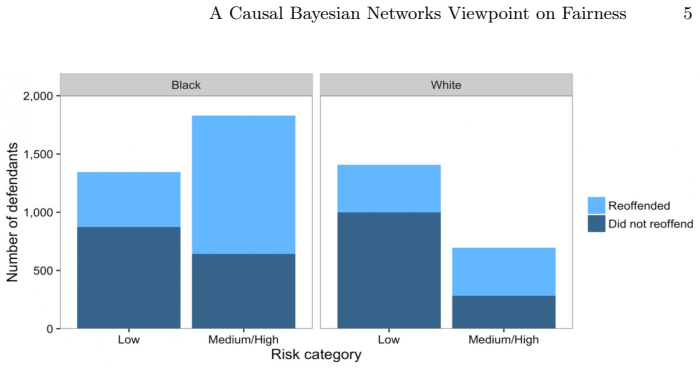
- Re-examination of tools such as COMPAS reveals how the underlying causal paths determine which fairness interventions are appropriate.
Reading between the lines
- The approach could enable interventions that block only the labeled unfair paths while leaving other causal routes intact.
- Different fairness criteria might be compared by checking whether they consistently identify the same paths as unfair inside one network.
- The viewpoint suggests a route for auditing deployed systems by recovering their implicit data-generation network and inspecting its paths.
Editorial analysis
A structured set of objections, weighed in public.
Referee Report
Summary. The manuscript offers a graphical interpretation of unfairness in a dataset as the presence of an unfair causal path in the causal Bayesian network representing the data-generation mechanism. It revisits the COMPAS pretrial risk assessment debate and argues that causal Bayesian networks provide a tool to measure unfairness in datasets and design fair models in complex scenarios.
Significance. If the interpretive mapping holds, the paper supplies a causal-graphical lens for diagnosing patterns of unfairness in training data and for reconciling conflicting fairness criteria. This pragmatic viewpoint may aid practitioners in complex settings where purely statistical fairness metrics are insufficient, though the contribution is conceptual rather than deductive or empirical.
minor comments (3)
- The abstract and introduction repeatedly use the phrase 'unfair causal path' without an explicit operational definition or procedure for labeling paths as unfair; a dedicated subsection clarifying the labeling criteria (even if context-dependent) would strengthen the central claim.
- No concrete algorithm, pseudocode, or worked numerical example is referenced for 'measuring unfairness' with CBNs; adding a small illustrative computation on a toy graph would make the measurement claim more tangible.
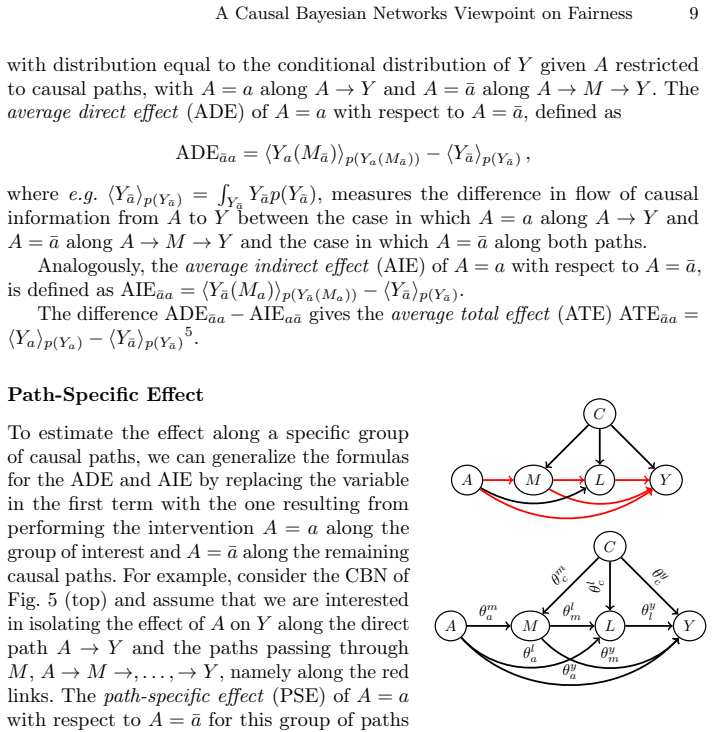
- The discussion of COMPAS would benefit from an explicit causal diagram (even if schematic) showing the designated unfair paths, rather than relying solely on textual description.
Simulated Author's Rebuttal
We thank the referee for their positive summary of the manuscript and the recommendation for minor revision. The report accurately reflects our contribution as a graphical interpretation of unfairness through causal paths in Bayesian networks, with application to the COMPAS case and complex fairness scenarios. No specific major comments were listed in the report.
Circularity Check
No significant circularity
full rationale
The paper advances an interpretive viewpoint that unfairness corresponds to designated unfair causal paths in a causal Bayesian network modeling the data-generating process. No equations, quantitative predictions, fitted parameters, or formal derivations appear in the provided text. The central claim is a graphical re-description of existing fairness concepts rather than a result obtained by construction from inputs or self-citations. Standard causal modeling assumptions are invoked without self-referential definitions or load-bearing self-citation chains that would force the conclusion.
Assumptions & free parameters
assumptions (1)
- domain assumption A causal Bayesian network can represent the data-generation mechanism
Cite this review
Pith. "Pith review of A Causal Bayesian Networks Viewpoint on Fairness." pith.science (2026). https://pith.science/paper/SV7KOJ62
@misc{pith2026190706430,
  author       = {Pith},
  title        = {Pith review of: A Causal Bayesian Networks Viewpoint on Fairness},
  year         = {2026},
  howpublished = {\url{https://pith.science/paper/SV7KOJ62}},
  note         = {Machine review of arXiv:1907.06430}
}
read the original abstract
We offer a graphical interpretation of unfairness in a dataset as the presence of an unfair causal path in the causal Bayesian network representing the data-generation mechanism. We use this viewpoint to revisit the recent debate surrounding the COMPAS pretrial risk assessment tool and, more generally, to point out that fairness evaluation on a model requires careful considerations on the patterns of unfairness underlying the training data. We show that causal Bayesian networks provide us with a powerful tool to measure unfairness in a dataset and to design fair models in complex unfairness scenarios.
Figures


Figures from the paper (5 more)



Lean theorems connected to this paper
-
IndisputableMonolith/Foundation/RealityFromDistinction.leanreality_from_one_distinction unclear?
unclearRelation between the paper passage and the cited Recognition theorem.
unfairness in a dataset as the presence of an unfair causal path in the causal Bayesian network
-
IndisputableMonolith/Cost/FunctionalEquation.leanwashburn_uniqueness_aczel unclear?
unclearRelation between the paper passage and the cited Recognition theorem.
path-specific effect (PSE) ... average direct effect (ADE)
What do these tags mean?
- matches
- The paper's claim is directly supported by a theorem in the formal canon.
- supports
- The theorem supports part of the paper's argument, but the paper may add assumptions or extra steps.
- extends
- The paper goes beyond the formal theorem; the theorem is a base layer rather than the whole result.
- uses
- The paper appears to rely on the theorem as machinery.
- contradicts
- The paper's claim conflicts with a theorem or certificate in the canon.
- unclear
- Pith found a possible connection, but the passage is too broad, indirect, or ambiguous to say the theorem truly supports the claim.
Reference graph
Works this paper leans on
-
[1]
Litigating algorithms: Challenging government use of algorithmic decision systems, 2018
AI Now Institute. Litigating algorithms: Challenging government use of algorithmic decision systems, 2018
work page 2018
-
[2]
Alexander.The New Jim Crow: Mass Incarceration in the Age of Colorblindness
M. Alexander.The New Jim Crow: Mass Incarceration in the Age of Colorblindness. The New Press, 2012. A Causal Bayesian Networks Viewpoint on Fairness 17
work page 2012
-
[3]
D. A. Andrews and J. Bonta.Level of Service Inventory – Revised. Multi-Health Systems Toronto, 2000
work page 2000
-
[4]
D. A. Andrews, J. Bonta, and J. S. Wormith. The recent past and near future of risk and/or need assessment.Crime & Delinquency, 52(1):7–27, 2006
work page 2006
- [5]
- [6]
-
[7]
R. Berk, H. Heidari, S. Jabbari, M. Kearns, and A. Roth. Fairness in criminal justice risk assessments: The state of the art.Sociological Methods & Research, 2018
work page 2018
-
[8]
M. Bogen and A. Rieke. Help wanted: An examination of hiring algorithms, equity, and bias. Technical report, Upturn, 2018
work page 2018
Show all 48 references
-
[9]
Brennan, W
T. Brennan, W. Dieterich, and B. Ehret. Evaluating the predictive validity of the COMPAS risk and needs assessment system.Criminal Justice and Behavior, 36(1):21–40, 2009
2009
-
[10]
Byanjankar, M
A. Byanjankar, M. Heikkilä, and J. Mezei. Predicting credit risk in peer-to-peer lending: A neural network approach. InIEEE Symposium Series on Computational Intelligence, pages 719–725, 2015
2015
-
[11]
S. Chiappa. Path-specific counterfactual fairness. InThirty-Third AAAI Conference on Artificial Intelligence, 2019
2019
-
[12]
Chiappa and W
S. Chiappa and W. S. Isaac. A causal Bayesian networks viewpoint on fairness. In E. Kosta, J. Pierson, D. Slamanig, S. Fischer-Hübner, S. Krenn (eds) Privacy and Identity Management. Fairness, Accountability, and Transparency in the Age of Big Data. Privacy and Identity 2018. ...
2018
-
[13]
Fairpredictionwithdisparateimpact:Astudyofbiasinrecidivism prediction instruments.Big data, 5(2):153–163, 2017
A.Chouldechova. Fairpredictionwithdisparateimpact:Astudyofbiasinrecidivism prediction instruments.Big data, 5(2):153–163, 2017
2017
-
[14]
Chouldechova, E
A. Chouldechova, E. Putnam-Hornstein, D. Benavides-Prado, O. Fialko, and R. Vaithianathan. A case study of algorithm-assisted decision making in child mal- treatment hotline screening decisions.Proceedings of Machine Learning Research, 81:134–148, 2018
2018
-
[15]
Corbett-Davies, E
S. Corbett-Davies, E. Pierson, A. Feller, S. Goel, and A. Huq. A computer program used for bail and sentencing decisions was labeled biased against blacks. It’s actually not that clear., October 2016.https://www.washingtonpost.com/news/ monkey-cage/wp/2016/10/17/can-an-algorit...
2016
-
[16]
Corbett-Davies, E
S. Corbett-Davies, E. Pierson, A. Feller, S. Goel, and A. Huq. Algorithmic deci- sion making and the cost of fairness. InProceedings of the 23rd ACM SIGKDD International Conference on Knowledge Discovery and Data Mining, page 797–806, 2017
2017
-
[17]
Corbett-Davies and S.Goel
S. Corbett-Davies and S.Goel. The measure and mismeasure of fairness: A critical review of fair machine learning.CoRR, abs/1808.00023, 2018
2018
-
[18]
P. Dawid. Fundamentals of statistical causality. Technical report, University College London, 2007
2007
-
[19]
De Fauw, J
J. De Fauw, J. R. Ledsam, B. Romera-Paredes, S. Nikolov, N. Tomasev, S. Black- well, H. Askham, X. Glorot, B. O’Donoghue, D. Visentin, G. van den Driessche, B. Lakshminarayanan, C. Meyer, F. Mackinder, S. Bouton, K. Ayoub, R. Chopra, 18 S. Chiappa and W. S. Isaac D. King, A. K...
2018
-
[20]
Dieterich, C
W. Dieterich, C. Mendoza, and T. Brennan. COMPAS risk scales: Demonstrating accuracy equity and predictive parity, 2016
2016
-
[21]
Dwork, M
C. Dwork, M. Hardt, T. Pitassi, O. Reingold, and R. Zemel. Fairness through awareness. InProceedings of the 3rd Innovations in Theoretical Computer Science Conference, pages 214–226, 2012
2012
-
[22]
Eckhouse, K
L. Eckhouse, K. Lum, C. Conti-Cook, and J. Ciccolini. Layers of bias: A unified approach for understanding problems with risk assessment.Criminal Justice and Behavior, 46:185–209, 2018
2018
-
[23]
V. Eubanks. Automating Inequality: How High-Tech Tools Profile, Police, and Punish the Poor. St. Martin’s Press, 2018
2018
-
[24]
Feldman, S
M. Feldman, S. A. Friedler, J. Moeller, C. Scheidegger, and S. Venkatasubramanian. Certifying and removing disparate impact. InProceedings of the 21th ACM SIGKDD International Conference on Knowledge Discovery and Data Mining, pages 259–268, 2015
2015
-
[25]
Machine Bias: There’s software used across the country to predict future criminals. And it’s biased against blacks
A. W. Flores, K. Bechtel, and C. T. Lowenkamp. False positives, false negatives, and false analyses: A rejoinder to "Machine Bias: There’s software used across the country to predict future criminals. And it’s biased against blacks.".Federal Probation, 80(2):38–46, 2016
2016
-
[26]
Note: Bail reform and risk assessment: The cautionary tale of federal sentencing.Harvard Law Review, 131(4):1125–1146, 2018
Harvard Law School. Note: Bail reform and risk assessment: The cautionary tale of federal sentencing.Harvard Law Review, 131(4):1125–1146, 2018
2018
-
[27]
X. He, J. Pan, O. Jin, T. Xu, B. Liu, T. Xu, Y. Shi, A. Atallah, R. Herbrich, S. Bowers, et al. Practical lessons from predicting clicks on ads at facebook. In Proceedings of the Eighth International Workshop on Data Mining for Online Advertising, pages 1–9, 2014
2014
-
[28]
Hoffman, L
M. Hoffman, L. B. Kahn, and D. Li. Discretion in hiring.The Quarterly Journal of Economics, 133(2):765–800, 2018
2018
-
[29]
W. S. Isaac. Hope, hype, and fear: The promise and potential pitfalls of artificial intelligence in criminal justice.Ohio State Journal of Criminal Law, 15(2):543–558, 2017
2017
-
[30]
Kleinberg, S
J. Kleinberg, S. Mullainathan, and M. Raghavan. Inherent trade-offs in the fair determination of risk scores. In8th Innovations in Theoretical Computer Science Conference, pages 43:1–43:23, 2016
2016
-
[31]
J. L. Koepke and D. G. Robinson. Danger ahead: Risk assessment and the future of bail reform.Washington Law Review, 93:1725–1807, 2017
2017
-
[32]
Kourou, T
K. Kourou, T. P. Exarchos, K. P. Exarchos, M. V. Karamouzis, and D. I. Fotiadis. Machine learning applications in cancer prognosis and prediction.Computational and Structural Biotechnology Journal, 13:8–17, 2015
2015
-
[33]
M. J. Kusner, J. R. Loftus, C. Russell, and R. Silva. Counterfactual fairness. In Advances in Neural Information Processing Systems 30, pages 4069–4079, 2017
2017
-
[34]
K. Lum. Limitations of mitigating judicial bias with machine learning.Nature Human Behaviour, 1(7):1, 2017
2017
-
[35]
Lum and W
K. Lum and W. Isaac. To predict and serve?Significance, 13(5):14–19, 2016
2016
-
[36]
Malekipirbazari and V
M. Malekipirbazari and V. Aksakalli. Risk assessment in social lending via random forests. Expert Systems with Applications, 42(10):4621–4631, 2015
2015
-
[37]
S. G. Mayson. Bias in, bias out.Yale Law School Journal, 128, 2019. A Causal Bayesian Networks Viewpoint on Fairness 19
2019
-
[38]
Mitchell, E
S. Mitchell, E. Potash, and S. Barocas. Prediction-based decisions and fairness: A catalogue of choices, assumptions, and definitions, 2018
2018
-
[39]
Pearl.Causality: Models, Reasoning, and Inference
J. Pearl.Causality: Models, Reasoning, and Inference. Cambridge University Press, 2000
2000
-
[40]
Pearl, M
J. Pearl, M. Glymour, and N. P. Jewell.Causal Inference in Statistics: A Primer. Wiley, 2016
2016
-
[41]
Perlich, B
C. Perlich, B. Dalessandro, T. Raeder, O. Stitelman, and F. Provost. Machine learning for targeted display advertising: Transfer learning in action.Machine learning, 95(1):103–127, 2014
2014
-
[42]
Peters, D
J. Peters, D. Janzing, and B. Schölkopf.Elements of Causal Inference: Foundations and Learning Algorithms. MIT Press, 2017
2017
-
[43]
Rosenberg and R
M. Rosenberg and R. Levinson. Trump’s catch-and-detain policy snares many who call the U.S. home. https://www.reuters.com/investigates/special-report/ usa-immigration-court, June 2018
2018
-
[44]
A. D. Selbst. Disparate impact in big data policing.Georgia Law Review, 52:109–195, 2017
2017
-
[45]
Spirtes, C
P. Spirtes, C. N. Glymour, R. Scheines, D. Heckerman, C. Meek, G. Cooper, and T. Richardson.Causation, Prediction, and Search. MIT Press, 2000
2000
-
[46]
M. T. Stevenson. Assessing risk assessment in action.Minnesota Law Review, 103, 2017
2017
-
[47]
Vaithianathan, T
R. Vaithianathan, T. Maloney, E. Putnam-Hornstein, and N. Jiang. Children in the public benefit system at risk of maltreatment: Identification via predictive modeling. American Journal of Preventive Medicine, 45(3):354–359, 2013
2013
-
[48]
Zhang and E
J. Zhang and E. Bareinboim. Fairness in decision-making – the causal explanation formula. In Proceedings of the 32nd AAAI Conference on Artificial Intelligence, 2018
2018
Reviewed May 24, 2026 · model on record in the stance chip above.
Discussion (0). Continue with ORCID to comment.