pith. machine review for the scientific record. sign in

stat.ML

Machine Learning

Covers machine learning papers (supervised, unsupervised, semi-supervised learning, graphical models, reinforcement learning, bandits, high dimensional inference, etc.) with a statistical or theoretical grounding

0
stat.ML 2026-05-13 Recognition

Bootstrap yields valid CIs for offline RL value functions

Model-based Bootstrap of Controlled Markov Chains

New resampling scheme for Markov transition kernels attains nominal coverage at small samples where plug-in and episodic baselines fail.

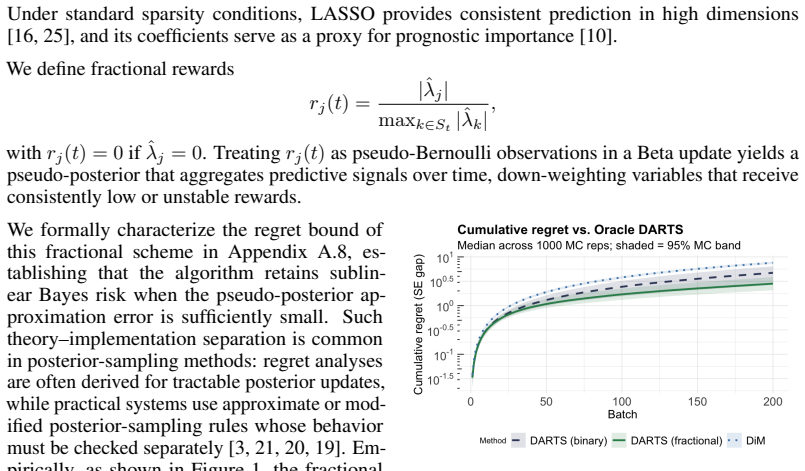
Figure from the paper full image
abstract click to expand
We propose and analyze a model-based bootstrap for transition kernels in finite controlled Markov chains (CMCs) with possibly nonstationary or history-dependent control policies, a setting that arises naturally in offline reinforcement learning (RL) when the behavior policy generating the data is unknown. We establish distributional consistency of the bootstrap transition estimator in both a single long-chain regime and the episodic offline RL regime. The key technical tools are a novel bootstrap law of large numbers (LLN) for the visitation counts and a novel use of the martingale central limit theorem (CLT) for the bootstrap transition increments. We extend bootstrap distributional consistency to the downstream targets of offline policy evaluation (OPE) and optimal policy recovery (OPR) via the delta method by verifying Hadamard differentiability of the Bellman operators, yielding asymptotically valid confidence intervals for value and $Q$-functions. Experiments on the RiverSwim problem show that the proposed bootstrap confidence intervals (CIs), especially the percentile CIs, outperform the episodic bootstrap and plug-in CLT CIs, and are often close to nominal ($50\%$, $90\%$, $95\%$) coverage, while the baselines are poorly calibrated at small sample sizes and short episode lengths.
0
0
stat.ML 2026-05-13 2 theorems

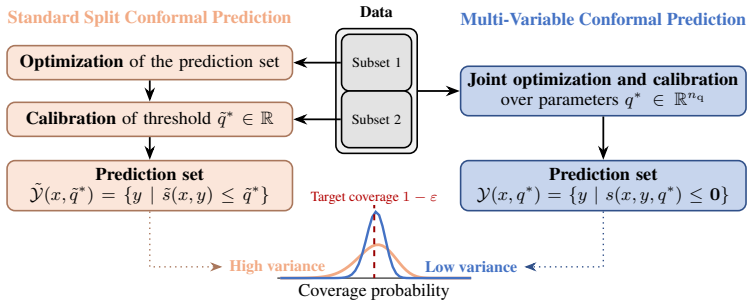
Conformal prediction optimizes sets without data splits

Multi-Variable Conformal Prediction: Optimizing Prediction Sets without Data Splitting

Joint design and calibration via multiple variables keeps coverage guarantees while using every sample

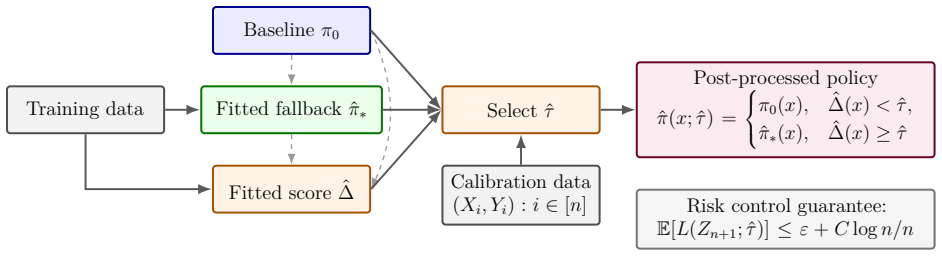
Figure from the paper full image
abstract click to expand
Conformal prediction constructs prediction sets with finite-sample coverage guarantees, but its calibration stage is structurally constrained to a scalar score function and a single threshold variable - forcing shapes of prediction sets to be fixed before calibration, typically through data splitting. We introduce multi-variable conformal prediction (MCP), a framework that extends conformal prediction to vector-valued score functions with multiple simultaneous calibration variables. Building on scenario theory as a principled framework for certifying data-driven decisions, MCP unifies prediction set design and calibration into a single optimization problem, eliminating data splitting without sacrificing coverage guarantees. We propose two computationally efficient variants: RemMCP, grounded in constrained optimization with constraint removal, which admits a clean generalization of split conformal prediction; and RelMCP, based on iterative optimization with constraint relaxation, which supports non-convex score functions at the cost of possibly greater conservatism. Through numerical experiments on ellipsoidal and multi-modal prediction sets, we demonstrate that RemMCP and RelMCP consistently meet the target coverage with prediction set sizes smaller than or comparable to those of baselines with data split, while considerably reducing variance across calibration runs - a direct consequence of using all available data for shape optimization and calibration simultaneously.
0
0
stat.ML 2026-05-13 Recognition

Online deferral algorithm manages varying experts with sublinear regret

Online Learning-to-Defer with Varying Experts

First method for streaming multiclass tasks routes to changing experts and bounds regret at O(T^{2/3}) or better under low noise.

Figure from the paper full image
abstract click to expand
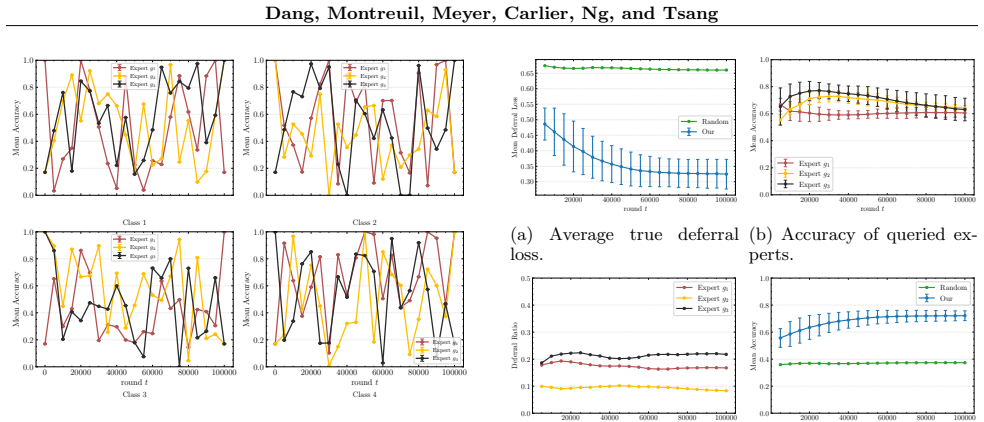
Learning-to-Defer (L2D) methods route each query either to a predictive model or to external experts. While existing work studies this problem in batch settings, real-world deployments require handling streaming data, changing expert availability, and shifting expert distribution. We introduce the first online L2D algorithm for multiclass classification with bandit feedback and a dynamically varying pool of experts. Our method achieves regret guarantees of $O((n+n_e)T^{2/3})$ in general and $O((n+n_e)\sqrt{T})$ under a low-noise condition, where $T$ is the time horizon, $n$ is the number of labels, and $n_e$ is the number of distinct experts observed across rounds. The analysis builds on novel $\mathcal{H}$-consistency bounds for the online framework, combined with first-order methods for online convex optimization. Experiments on synthetic and real-world datasets demonstrate that our approach effectively extends standard Learning-to-Defer to settings with varying expert availability and reliability.
0
0
stat.ML 2026-05-13 Recognition

Budget-coverage policy learning reduces to affine threshold rule

Optimal Policy Learning under Budget and Coverage Constraints

The LP relaxation has an O(1) gap and is asymptotically equivalent to the optimal discrete allocation, with greedy methods near-optimal in 0

Figure from the paper full image
abstract click to expand
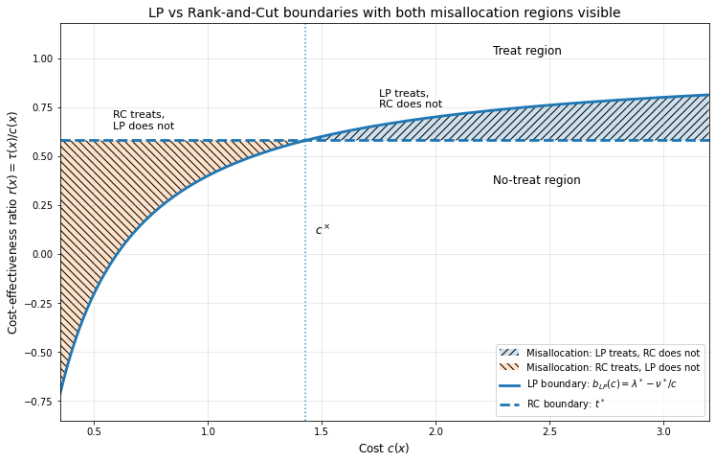
We study optimal policy learning under combined budget and minimum coverage constraints. We show that the problem admits a knapsack-type structure and that the optimal policy can be characterized by an affine threshold rule involving both budget and coverage shadow prices. We establish that the linear programming relaxation of the combinatorial solution has an O(1) integrality gap, implying asymptotic equivalence with the optimal discrete allocation. Building on this result, we analyze two implementable approaches: a Greedy-Lagrangian (GLC) and a rank-and-cut (RC) algorithm. We show that the GLC closely approximates the optimal solution and achieves near-optimal performance in finite samples. By contrast, RC is approximately optimal whenever the coverage constraint is slack or costs are homogeneous, while misallocation arises only when cost heterogeneity interacts with a binding coverage constraint. Monte Carlo evidence supports these findings.
0
0
stat.ML 2026-05-13 2 theorems

Self-predicted data calibrates Bayesian regression better than Laplace

Self-Supervised Laplace Approximation for Bayesian Uncertainty Quantification

Refitting on model outputs approximates the posterior predictive directly, yielding improved calibration without sampling or full posterior

Figure from the paper full image
abstract click to expand
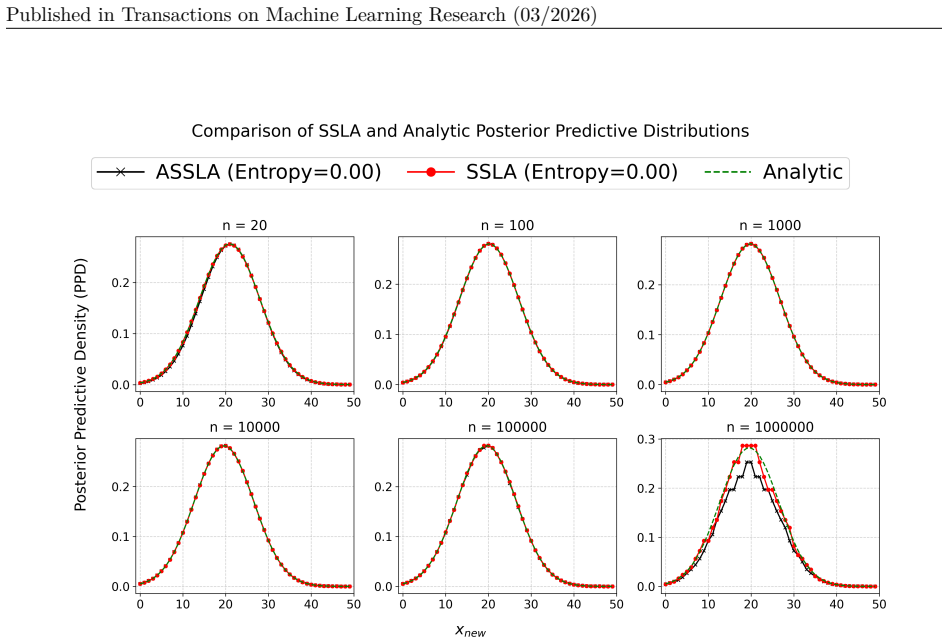
Approximate Bayesian inference typically revolves around computing the posterior parameter distribution. In practice, however, the main object of interest is often a model's predictions rather than its parameters. In this work, we propose to bypass the parameter posterior and focus directly on approximating the posterior predictive distribution. We achieve this by drawing inspiration from self-training within self-supervised and semi-supervised learning. Essentially, we quantify a Bayesian model's predictive uncertainty by refitting on self-predicted data. The idea is strikingly simple: If a model assigns high likelihood to self-predicted data, these predictions are of low uncertainty, and vice versa. This yields a deterministic, sampling-free approximation of the posterior predictive. The modular structure of our Self-Supervised Laplace Approximation (SSLA) further allows us to plug in different prior specifications, enabling classical Bayesian sensitivity (w.r.t. prior choice) analysis. In order to bypass expensive refitting, we further introduce an approximate version of SSLA, called ASSLA. We study (A)SSLA both theoretically and empirically in regression models ranging from Bayesian linear models to Bayesian neural networks. Across a wide array of regression tasks with simulated and real-world datasets, our methods outperform classical Laplace approximations in predictive calibration while remaining computationally efficient.
0
0
stat.ML 2026-05-13 2 theorems

Sequential CMI bounds adaptive generalization gaps

Information-Theoretic Generalization Bounds for Sequential Decision Making

New supersample framework sums round-wise information terms to control the gap under exchangeability assumption.

abstract click to expand
Information-theoretic generalization bounds based on the supersample construction are a central tool for algorithm-dependent generalization analysis in the batch i.i.d.~setting. However, existing supersample conditional mutual information (CMI) bounds do not directly apply to sequential decision-making problems such as online learning, streaming active learning, and bandits, where data are revealed adaptively and the learner evolves along a causal trajectory. To address this limitation, we develop a sequential supersample framework that separates the learner filtration from a proof-side enlargement used for ghost-coordinate comparisons. Under a row-wise exchangeability assumption, the sequential generalization gap is controlled by sequential CMI, a sum of roundwise selector--loss information terms. We also establish a Bernstein-type refinement that yields faster rates under suitable variance conditions. The selector-SCMI proof strategy applies to online learning, streaming active learning with importance weighting, and stochastic multi-armed bandits.
0
0
stat.ML 2026-05-13 2 theorems

Score gradients cut simulation needs for neural surrogates

Keeping Score: Efficiency Improvements in Neural Likelihood Surrogate Training via Score-Augmented Loss Functions

Augmenting the loss with exact scores matches inference quality from ten times more data at minimal extra training cost.

Figure from the paper full image
abstract click to expand
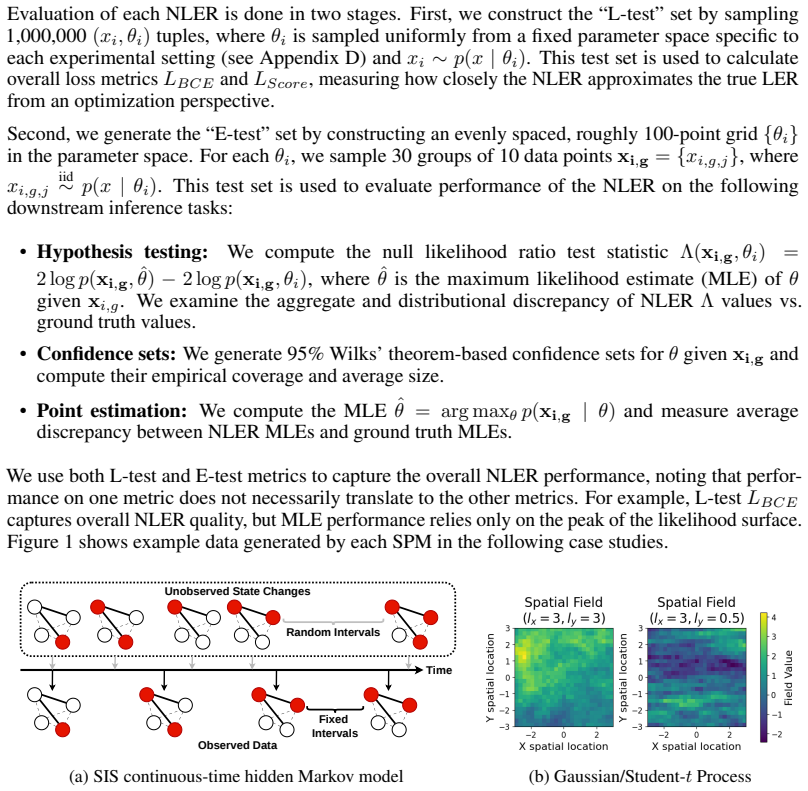
For stochastic process models, parameter inference is often severely bottlenecked by computationally expensive likelihood functions. Simulation-based inference (SBI) bypasses this restriction by constructing amortized surrogate likelihoods, but most SBI methods assume a black-box data generating process. While these surrogates are exact in the limit of infinite training data, practical scenarios force a strict tradeoff between model quality and simulation cost. In this work, we loosen the black-box assumption of SBI to improve this tradeoff for structured stochastic process models. Specifically, for neural network likelihood surrogates trained via probabilistic classification, we propose to augment the standard binary cross-entropy loss with exact score information $\nabla_\theta \log p(x \mid \theta)$ and adaptive weighting based on loss gradients. We evaluate our approach on case studies involving network dynamics and spatial processes, demonstrating that our method improves surrogate quality at a drastically lower computational cost than generating more training data. Notably, in some cases, our approach achieves downstream inference performance equivalent to a 10x increase in training data with less than a 1.1x increase in training time.
0
0
stat.ML 2026-05-13 2 theorems

Two anchors make reward variance identifiable from preferences

Variance-aware Reward Modeling with Anchor Guidance

Coarse response labels break non-identifiability so Gaussian models can capture human disagreement and strengthen RLHF.

Figure from the paper full image
abstract click to expand
Standard Bradley--Terry (BT) reward models are limited when human preferences are pluralistic. Although soft preference labels preserve disagreement information, BT can only express it by shrinking reward margins. Gaussian reward models provide an alternative by jointly predicting a reward mean and a reward variance, but suffer from a fundamental non-identifiability from pairwise preferences alone. We propose Anchor-guided Variance-aware Reward Modeling, a framework that resolves this non-identifiability by augmenting preference data with two coarse response-level anchor labels. Building on this, we prove that two anchors are sufficient for identification, develop a joint training objective and establish a non-asymptotic convergence rate for both the estimated reward mean and variance functions. Across simulation studies and four real-world diverging-preference datasets, our method consistently improves reward modeling performance and downstream RLHF, including PPO training and best-of-$N$ selection.
0
0
stat.ML 2026-05-13 2 theorems

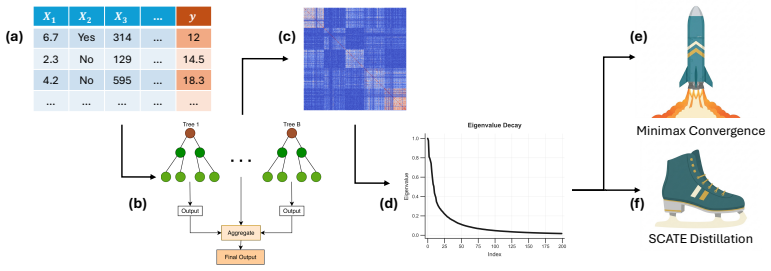
Kernel eigenvalue decay determines random forest rates

Minimax Rates and Spectral Distillation for Tree Ensembles

This also allows spectral distillation to produce much smaller models that match full performance.

Figure from the paper full image
abstract click to expand
Tree ensembles such as random forests (RFs) and gradient boosting machines (GBMs) are among the most widely used supervised learners, yet their theoretical properties remain incompletely understood. We adopt a spectral perspective on these algorithms, with two main contributions. First, we derive minimax-optimal convergence for RF regression, showing that, under mild regularity conditions on tree growth, the eigenvalue decay of the induced kernel operator governs the statistical rate. Second, we exploit this spectral viewpoint to develop compression schemes for tree ensembles. For RFs, leading eigenfunctions of the kernel operator capture the dominant predictive directions; for GBMs, leading singular vectors of the smoother matrix play an analogous role. Learning nonlinear maps for these spectral representations yields distilled models that are orders of magnitude smaller than the originals while maintaining competitive predictive performance. Our methods compare favorably to state of the art algorithms for forest pruning and rule extraction, with applications to resource constrained computing.
0
0
stat.ML 2026-05-13 2 theorems

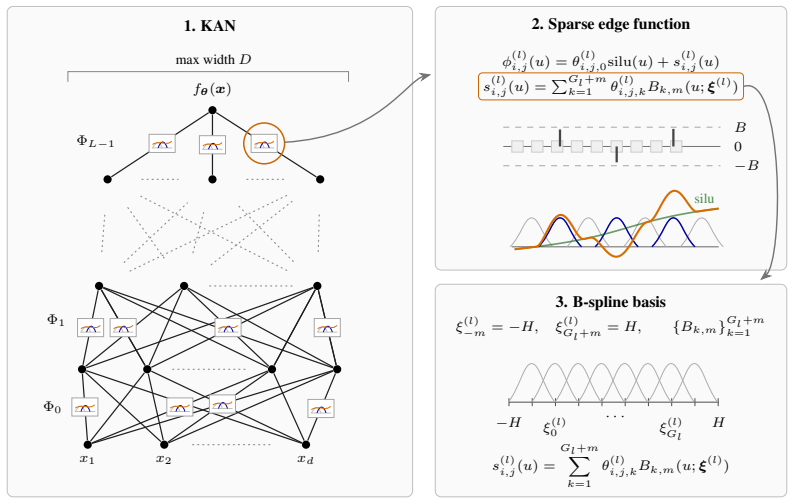
Sparse Bayesian KANs achieve near-minimax contraction

Posterior Contraction Rates for Sparse Kolmogorov-Arnold Networks in Anisotropic Besov Spaces

With a hyperprior on model size they adapt to unknown anisotropic smoothness at fixed depth.

Figure from the paper full image
abstract click to expand
We study posterior contraction rates for sparse Bayesian Kolmogorov-Arnold networks (KANs) over anisotropic Besov spaces, providing a statistical foundation of KANs from a Bayesian point of view. We show that sparse Bayesian KANs equipped with spike-and-slab-type sparsity priors attain the near-minimax posterior contraction. In particular, the contraction rate depends on the intrinsic anisotropic smoothness of the underlying function. Moreover, by placing a hyperprior on a single model-size parameter, the resulting posterior adapts to unknown anisotropic smoothness and still achieves the corresponding near-minimax rate. A distinctive feature of our results, compared with those for standard sparse MLP-based models, is that the KAN depth can be kept fixed: owing to the flexibility of learnable spline edge functions, the required approximation complexity is controlled through the network width, spline-grid range and size, and parameter sparsity. Our analysis develops theoretical tools tailored to sparse spline-edge architectures, including approximation and complexity bounds for Bayesian KANs. We then extend to compositional Besov spaces and show that the contraction rates depend on layerwise smoothness and effective dimension of the underlying compositional structure, thereby effectively avoiding the curse of dimensionality. Together, the developed tools and findings advance the theoretical understanding of Bayesian neural networks and provide rigorous statistical foundations for KANs.
0
0
stat.ML 2026-05-13 1 theorem

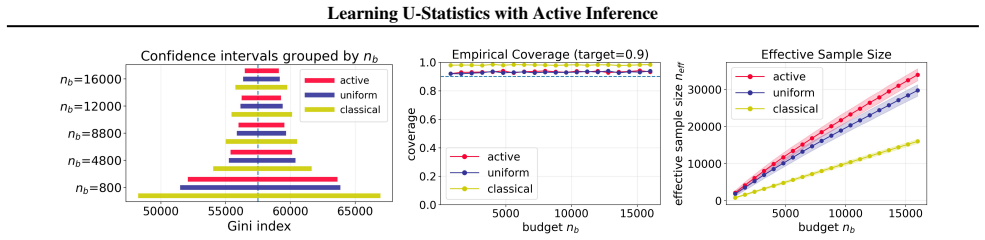
Active label queries cut U-statistic variance with fixed budget

Learning U-Statistics with Active Inference

An augmented weighting scheme uses machine learning predictions to select informative samples while keeping asymptotic normality and valid p

Figure from the paper full image
abstract click to expand
$U$-statistics play a central role in statistical inference. In many modern applications, however, acquiring the labels required for $U$-statistics is costly. Motivated by recent advances in active inference, we develop an active inference framework for $U$-statistics that selectively queries informative labels to improve estimation efficiency under a fixed labeling budget, while preserving valid statistical inference. Our approach is built on the augmented inverse probability weighting $U$-statistic, which is designed to incorporate the sampling rule and machine learning predictions. We characterize the optimal sampling rule that minimizes its variance and design practical sampling strategies. We further extend the framework to $U$-statistic-based empirical risk minimization. Experiments on real datasets demonstrate substantial gains in estimation efficiency over baseline methods, while maintaining target coverage.
0
0
stat.ML 2026-05-13 2 theorems

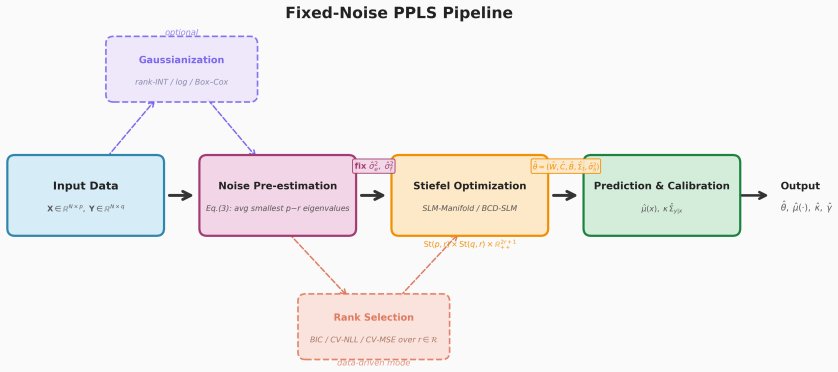
Noise-subspace estimator matches minimax rate for probabilistic PLS

Exact Stiefel Optimization for Probabilistic PLS: Closed-Form Updates, Error Bounds, and Calibrated Uncertainty

Exact Stiefel optimization yields closed-form updates and signal-independent error bounds while full-spectrum estimation is inconsistent.

Figure from the paper full image
abstract click to expand
Probabilistic partial least squares (PPLS) is a central likelihood-based model for two-view learning when one needs both interpretable latent factors and calibrated uncertainty. Building on the identifiable parameterization of Bouhaddani et al.\ (2018), existing fitting pipelines still face two practical bottlenecks: noise--signal coupling under joint EM/ECM updates and nontrivial handling of orthogonality constraints. Following the fixed-noise scalar-likelihood line of Hu et al.\ (2025), we develop an end-to-end framework that combines noise pre-estimation, constrained likelihood optimization, and prediction calibration in one pipeline. Relative to Hu et al.\ (2025), we replace full-spectrum noise averaging with noise-subspace estimation and replace interior-point penalty handling with exact Stiefel-manifold optimization. The noise-subspace estimator attains a signal-strength-independent leading finite-sample rate and matches a minimax lower bound, while the full-spectrum estimator is shown to be inconsistent under the same model. We further extend the framework to sub-Gaussian settings via optional Gaussianization and provide closed-form standard errors through a block-structured Fisher analysis. Across synthetic high-noise settings and two multi-omics benchmarks (TCGA-BRCA and PBMC CITE-seq), the method achieves near-nominal coverage without post-hoc recalibration, reaches Ridge-level point accuracy on TCGA-BRCA at rank $r=3$, matches or exceeds PO2PLS on cross-view prediction while providing native calibrated uncertainty, and improves stability of parameter recovery.
0
0
stat.ML 2026-05-13 2 theorems

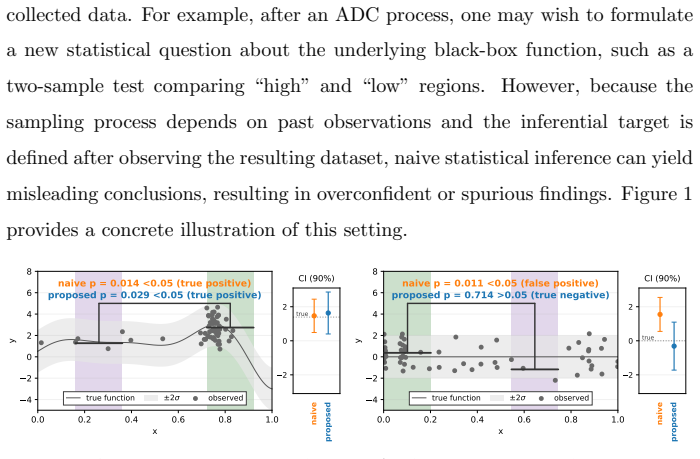
Post-ADC inference restores valid stats after adaptive sampling

Post-ADC Inference: Valid Inference After Active Data Collection

The framework adjusts for biases in both collection and target choice using only noise assumptions, with checks on GP-UCB and TPE.

Figure from the paper full image
abstract click to expand
The validity of statistical inference depends critically on how data are collected. When data gathered through active data collection (ADC) are reused for a post-hoc inferential task, conventional inference can fail because the sampling is adaptively biased toward regions favored by the collection strategy. This issue is especially pronounced in black-box optimization, where sequential model-based optimization (SMBO) methods such as the tree-structured Parzen estimator (TPE) and Gaussian process upper confidence bound (GP-UCB) preferentially concentrate evaluations in promising regions. We study statistical inference on actively collected data when the inferential target is constructed in a data-dependent manner after data collection. To enable valid inference in this setting, we propose post-ADC inference, a framework that accounts for the biases arising from both the active data collection process and the subsequent data-driven target construction. Our method builds on selective inference and provides valid $p$-values and confidence intervals that correct for both sources of bias. The framework applies to a broad class of ADC processes by imposing only assumptions on the observation noise, without requiring any assumptions on the underlying black-box function or the surrogate model used by the SMBO algorithm. Empirical results also show that post-ADC inference provides valid inference for data collected by GP-UCB and TPE.
0
0
stat.ML 2026-05-13 1 theorem

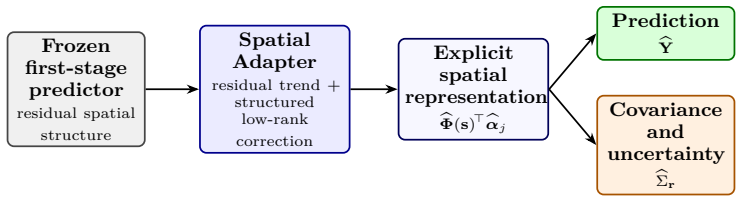
Adapter adds closed-form spatial covariance to frozen predictors

Spatial Adapter: Structured Spatial Decomposition and Closed-Form Covariance for Frozen Predictors

A post-hoc layer decomposes residuals into a regularized basis for kriging-style prediction at new locations without retraining the original

Figure from the paper full image
abstract click to expand
We present the Spatial Adapter, a parameter-efficient post-hoc layer that equips any frozen first-stage predictor with a structured spatial representation of its residual field and an induced closed-form spatial covariance. The adapter operates as a cascade second stage on residuals, jointly learning a spatially regularized orthonormal basis and per-sample scores via a tractable mini-batch ADMM procedure, without modifying any first-stage parameter. Because the first-stage parameters are frozen, the adapter does not retrain the backbone; its role is to supply a compressed distributional summary of the residual field. Smoothness, sparsity, and orthogonality together turn a generic low-rank factorization into an identifiable spatial representation whose induced residual covariance admits a closed-form low-rank-plus-noise estimator; the effective rank is determined data-adaptively by spectral thresholding, while the nominal rank K is an optimization-side upper bound only. This covariance enables kriging-style spatial prediction at unobserved locations, with plug-in uncertainty quantification as a secondary downstream use. Across synthetic data, Weather2K for spatial-holdout prediction, and GWHD patch grids as a basis-transferability diagnostic, the adapter recovers residual spatial structure when paired with frozen first stages from linear models to deep spatiotemporal and vision backbones; the added representation uses fewer than K(N+T) parameters alongside a compact residual-trend network.
0
0
stat.ML 2026-05-12 Recognition

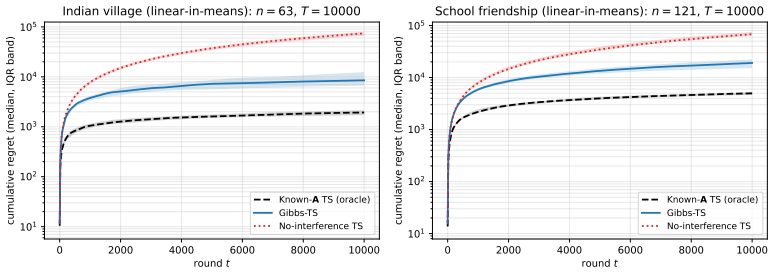
Thompson sampling learns unknown networks while optimizing treatments

Adaptive Policy Learning Under Unknown Network Interference

Joint discovery of interference structure and individual allocations yields sublinear regret and downstream effect estimates.

Figure from the paper full image
abstract click to expand
Adaptive experimentation under unknown network interference requires solving two coupled problems: (i) learning the underlying dynamics of interference among units and (ii) using these dynamics to inform treatment allocation in order to maximize a cumulative outcome of interest (e.g. revenue). Existing adaptive experimentation methods either assume the interference network is fully known or bypass the network by operating on coarse cluster-level randomizations. We develop a Thompson sampling algorithm that jointly learns the interference network and adaptively optimizes individual-level treatment allocations via a Gibbs sampler. The algorithm returns both an optimized treatment policy and an estimate of the interference network; the latter supports downstream causal analyses such as estimation of direct, indirect, and total treatment effects. For additive spillover models, we show that total reward is linear in the treatment vector with coefficients given by an $n$-dimensional latent score. We prove a Bayesian regret bound of order $\sqrt{nT \cdot B \log(en/B)}$ for exact posterior sampling; empirically, our Gibbs-based approximate sampler achieves regret consistent with this rate and remains sublinear when the additive spillovers assumption is violated. For general Neighborhood Interference, where this reduction is unavailable, we analyze an explore-then-commit variant with $O(n^2 \log T)$ graph-discovery cost. An information-theoretic $\Omega(n \log T)$ lower bound complements both results. Empirically, our method achieves more than an order-of-magnitude reduction in regret in head-to-head comparisons. On two real-world networks, the algorithm achieves sublinear regret and yields downstream effect estimates with small RMSE relative to the truth.
0
0
stat.ML 2026-05-12 2 theorems

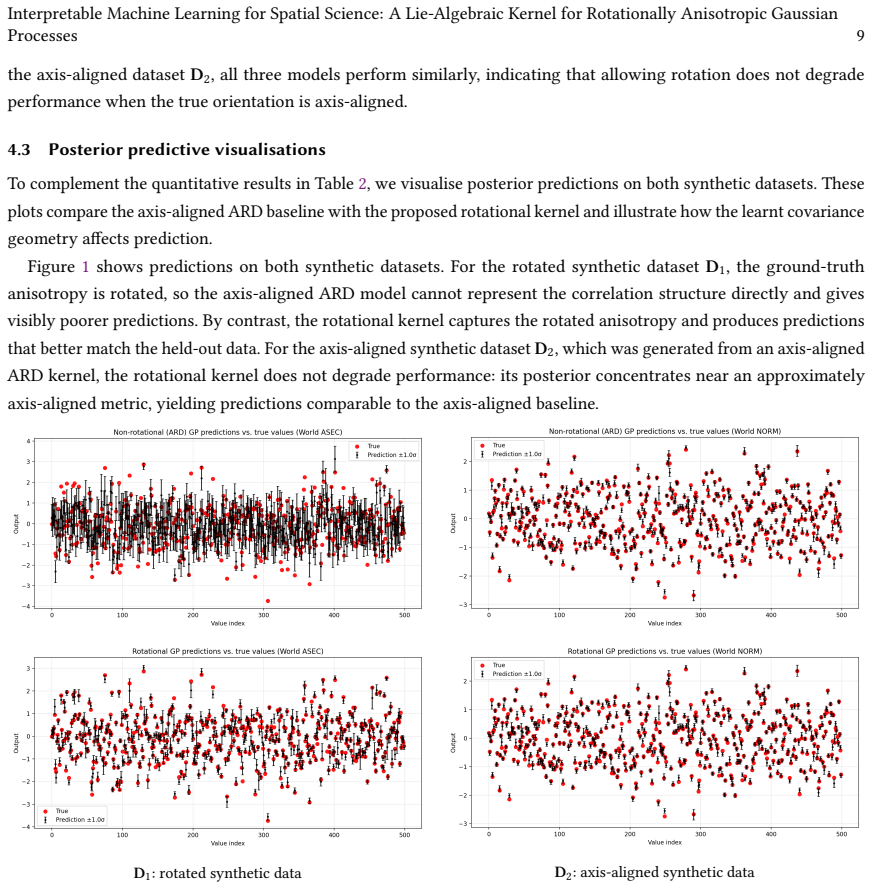
Kernel makes rotated 3D anisotropy explicit in Gaussian processes

Interpretable Machine Learning for Spatial Science: A Lie-Algebraic Kernel for Rotationally Anisotropic Gaussian Processes

Axis-angle vectors plus three length scales allow direct priors and summaries while spanning all valid metrics.

Figure from the paper full image
abstract click to expand
Many three-dimensional spatial fields are anisotropic, with directions of rapid and slow variation that need not align with the coordinate axes. Standard Gaussian process kernels with Automatic Relevance Determination (ARD) capture only axis-aligned anisotropy, while generic full symmetric positive definite (SPD) metrics can represent rotated anisotropy but do not parameterise principal length-scales and directions directly. We introduce an interpretable rotationally anisotropic GP kernel that parameterises a three-dimensional SPD covariance metric using three principal length-scales and an explicit SO(3) rotation. The rotation is represented by an axis-angle vector and mapped to SO(3) via the Lie-algebra exponential map, giving unconstrained Euclidean coordinates for inference while always inducing a valid SPD metric. The construction spans the same family of three-dimensional SPD covariance metrics as a generic full-SPD parameterisation, but exposes the geometry differently: length-scales and orientation are explicit, interpretable, and directly available for prior specification and posterior summaries. We perform Bayesian inference on these quantities using Markov Chain Monte Carlo (MCMC), and characterise the resulting symmetries and weakly identified regimes. On synthetic data with rotated anisotropy, the posterior recovers the generating metric and improves prediction relative to an axis-aligned ARD baseline, while matching the predictive performance of a generic full SPD baseline. When the ground truth is axis-aligned, posterior mass concentrates near the identity rotation and predictive performance matches ARD. On a material-density dataset from a laboratory-fabricated nano-brick, the inferred metric reveals rotated anisotropy that is not captured by axis-aligned kernels.
0
0
stat.ML 2026-05-12 2 theorems

Transformer states converge uniformly to ODEs at rate O(1/L + 1/(L^{1/3} sqrt(H)))

Uniform Scaling Limits in AdamW-Trained Transformers

The joint hidden-state and back-propagated dynamics approach a continuous forward-backward system whose error shrinks with depth and head ,

abstract click to expand
We study the large-depth limit of transformers trained with AdamW, by modelling the hidden-state dynamics as an interacting particle system (IPS) coupled through the attention mechanism. Under appropriate scaling of the attention heads, we prove that the joint dynamics of the hidden states and backpropagated variables converge in $L^2$, uniformly over the initial condition, to the solution of a forward--backward system of ODEs at rate $\mathcal O(L^{-1}+L^{-1/3}H^{-1/2})$. Here, $L$ and $H$ denote the depth and number of heads of the transformer, respectively. The limiting system of ODEs can be identified with a McKean--Vlasov ODE (MVODE) when the attention heads do not incorporate causal masking. By using the flow maps associated with this MVODE and applying concentration of measure techniques, we obtain bounds on the difference between the discrete and continuous models that are uniform over compact sets of initial conditions. As this is achieved without resorting to a covering argument, the constants in our bounds are independent of the number of tokens. Furthermore, under a suitable adaptation to AdamW, the bounds become independent of the token embedding dimension.
0
0
stat.ML 2026-05-12 2 theorems

Linear networks store facts up to p log p = dยฒ/2

Factual recall in linear associative memories: sharp asymptotics and mechanistic insights

Decoupled model gives exact capacity for keeping each input-output pair separated from all other targets.

Figure from the paper full image
abstract click to expand
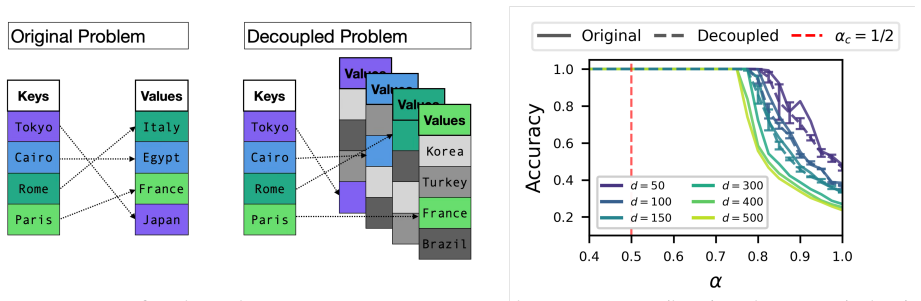
Large language models demonstrate remarkable ability in factual recall, yet the fundamental limits of storing and retrieving input--output associations with neural networks remain unclear. We study these limits in a minimal setting: a linear associative memory that maps $p$ input embeddings in $\mathbb{R}^d$ to their corresponding~$d$-dimensional targets via a single layer, requiring each mapped input to be well separated from all other targets. Unlike in supervised classification, this strict separation induces~$p$ constraints per association and produces strong correlations between constraints that make a direct characterisation of the storage capacity difficult. Here, we provide a precise characterisation of this capacity in the following way. We first introduce a decoupled model in which each input has its own independent set of competing outputs, and provide numerical and analytical evidence that this decoupled model is equivalent to the original model in terms of storage capacity, spectra of the learnt weights, and storage mechanism. Using tools from statistical physics, we show that the decoupled model can store up to $p_c \log p_c / d^2 = 1 / 2$ associations, and generalise the computation of $p_c$ to linear two-layer architectures. Our analysis also gives mechanistic insight into how the optimal solution improves over a na\"ive Hebbian learning rule: rather than boosting input-output alignments with broad fluctuations, the optimal solution raises the correct scores just above the extreme-value threshold set by the competing outputs. These findings give a sharp statistical-physics characterisation of factual storage in linear networks and provide a baseline for understanding the memory capacity of more realistic neural architectures.
0
0
stat.ML 2026-05-12 2 theorems

LASSO matches homogeneous threshold for mixed-quality sparse data

Price of Quality: Sufficient Conditions for Sparse Recovery using Mixed-Quality Data

One high-quality sample replaces at most two low-quality ones when the decoder is unaware of quality differences.

abstract click to expand
We study sparse recovery when observations come from mixed-quality sources: a small collection of high-quality measurements with small noise variance and a larger collection of lower-quality measurements with higher variance. For this heterogeneous-noise setting, we establish sample-size conditions for information-theoretic and algorithmic recovery. On the information-theoretic side, we show that it is sufficient for $(n_1, n_2)$ to satisfy a linear trade-off defining the Price of Quality: the number of low-quality samples needed to replace one high-quality sample. In the agnostic setting, where the decoder is completely agnostic to the quality of the data, it is uniformly bounded, and in particular one high-quality sample is never worth more than two low-quality samples for this sufficient condition to hold. In the informed setting, where the decoder is informed of per-sample variances, the price of quality can grow arbitrarily large. On the algorithmic side, we analyze the LASSO in the agnostic setting and show that the recovery threshold matches the homogeneous-noise case and only depends on the average noise level, revealing a striking robustness of computational recovery to data heterogeneity. Together, these results give the first conditions for sparse recovery with mixed-quality data and expose a fundamental difference between how the information-theoretic and algorithmic thresholds adapt to changes in data quality.
0
0
stat.ML 2026-05-12 2 theorems

Amortized networks speed up causal sensitivity bounds by orders of magnitude

Amortizing Causal Sensitivity Analysis via Prior Data-Fitted Networks

Prior-data fitted networks learn to output bounds on causal effects under confounding without per-query recomputation.

Figure from the paper full image
abstract click to expand
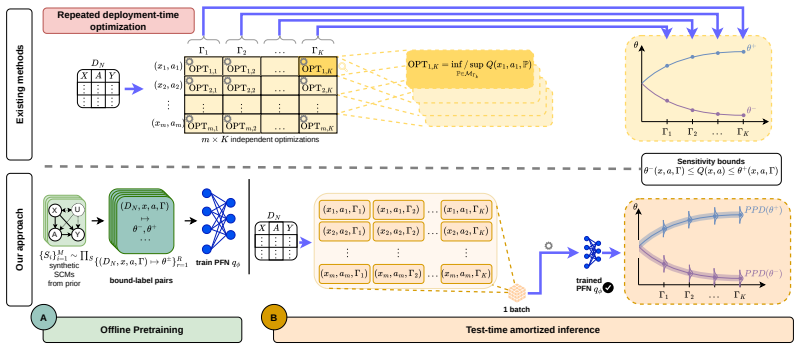
Causal sensitivity analysis aims to provide bounds for causal effect estimates in the presence of unobserved confounding. However, existing methods for causal sensitivity analysis are per-instance procedures, meaning that changes to the dataset, causal query, sensitivity level, or treatment require new computation. Here, we instead present an in-context learning approach. Specifically, we propose an amortized approach to causal sensitivity analysis based on prior-data fitted networks. A key challenge is that the sensitivity bounds are not directly available when sampling training data. To address this, we develop a general prior-data construction that is applicable across the class of generalized treatment sensitivity models. Our construction involves a Lagrangian scalarization of the objective to generate training labels for the bounds through a tradeoff between causal effect min/max-imization and sensitivity model violation, which avoids model-specific analytical derivations. We further show that, under standard convexity and linearity conditions, our objective recovers the full Pareto frontier of solutions. Empirically, we demonstrate our amortized approach across various datasets, causal queries, and sensitivity levels, where our approach achieves a test-time computation that is orders of magnitude faster than per-instance methods. To the best of our knowledge, ours is the first foundation model for in-context learning for causal sensitivity analysis.
0
0
stat.ML 2026-05-12 Recognition

Bayesian linear solvers are special cases of affine PIMs

Affine Tracing: A New Paradigm for Probabilistic Linear Solvers

The unification proves all realistic affine versions are calibrated and supplies an automatic tracing tool to build them from ordinary code.

Figure from the paper full image
abstract click to expand
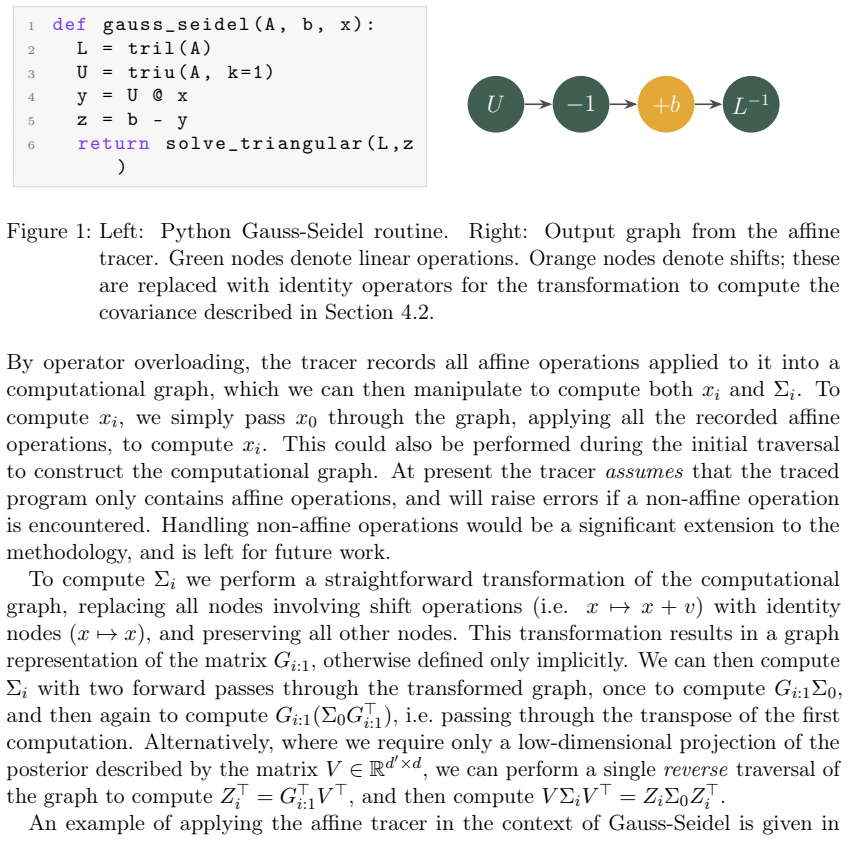
Probabilistic linear solvers (PLSs) return probability distributions that quantify uncertainty due to limited computation in the solution of linear systems. The literature has traditionally distinguished between Bayesian PLSs, which condition a prior on information obtained from projections of the linear system, and probabilistic iterative methods (PIMs), which lift classical iterative solvers to probability space. In this work we show this dichotomy to be false: Bayesian PLSs are a special case of non-stationary affine PIMs. In addition, we prove that any realistic affine PIM is calibrated. These results motivate a focus on (non-stationary) affine PIMs, but their practical adoption has been limited by the significant manual effort required to implement them. To address this, we introduce affine tracing, an algorithmic framework that automatically constructs a PIM from a standard implementation of an affine iterative method by passing symbolic tracers through the computation to build an affine computational graph. We show how this graph can be transformed to compute posterior covariances, and how equality saturation can be used to perform algebraic simplifications required for computation under specific prior choices. We demonstrate the framework by automatically generating a probabilistic multigrid solver and evaluate its performance in the context of Gaussian process approximation.
0
0
stat.ML 2026-05-12 2 theorems

Sharp jumps in feature overlap set optimal neural scaling laws

Sharp feature-learning transitions and Bayes-optimal neural scaling laws in extensive-width networks

Effective width k_c unifies feature-learning and refinement regimes into error scaling ฮ˜(k_c d / n) for hierarchical teacher networks.

Figure from the paper full image
abstract click to expand
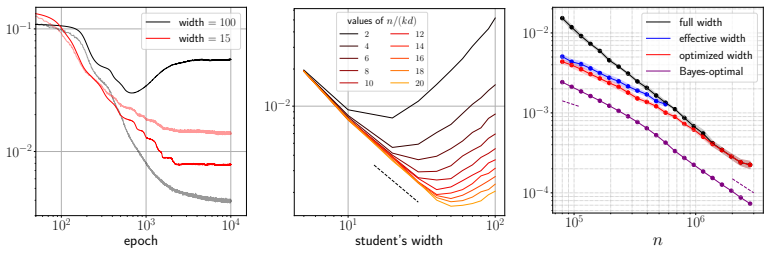
We study the information-theoretic limits of learning a one-hidden-layer teacher network with hierarchical features from noisy queries, in the context of knowledge transfer to a smaller student model. We work in the high-dimensional regime where the teacher width $k$ scales linearly with the input dimension $d$ -- a setting that captures large-but-finite-width networks and has only recently become analytically tractable. Using a heuristic leave-one-out decoupling argument, validated numerically throughout, we derive asymptotically sharp characterizations of the Bayes-optimal generalization error and individual feature overlaps via a system of closed fixed-point equations. These equations reveal that feature learnability is governed by a sequence of sharp phase transitions: as data grows, teacher features become recoverable sequentially, each through a discontinuous jump in overlap. This sequential acquisition underlies a precise notion of \textit{effective width} $k_c$ -- the number of learnable features at a given data budget $n$ -- which unifies two distinct scaling regimes: a feature-learning regime in which the Bayes-optimal generalization error $\varepsilon^{\rm BO}$ scales as $ n^{1/(2\beta)-1}$, and a refinement regime in which it scales as $n^{-1}$, where $\beta>1/2$ is the exponent of the power-law feature hierarchy. Both laws collapse to the single relation $\varepsilon^{\rm BO}=\Theta(k_c d/n)$. We further show empirically that a student trained with \textsc{Adam} near the effective width $k_c$ achieves these optimal scaling laws (up to a small algorithmic gap), and provide an information-theoretic account of the associated scaling in model size.
0
0
stat.ML 2026-05-12 2 theorems

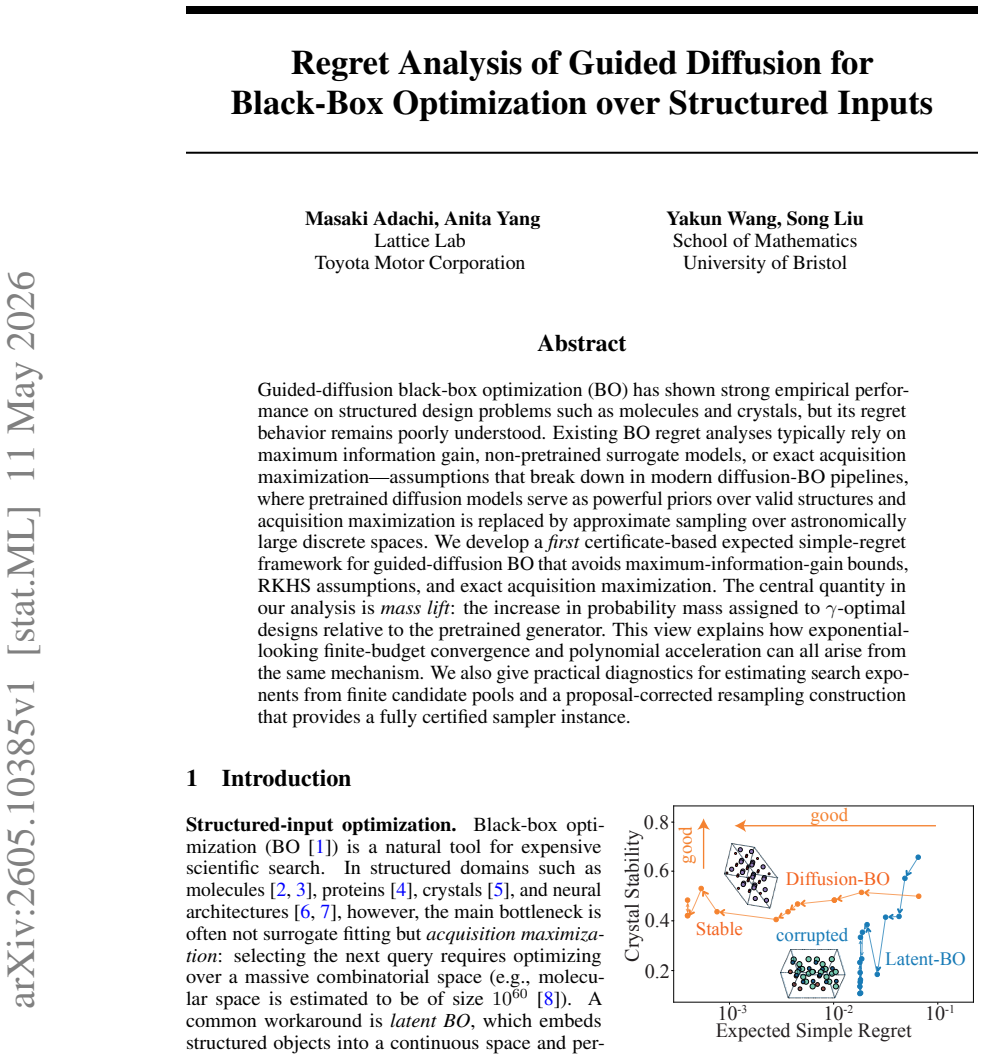
Mass lift certifies regret in guided diffusion optimization

Regret Analysis of Guided Diffusion for Black-Box Optimization over Structured Inputs

The probability shift toward near-optimal designs explains convergence without information-gain or kernel assumptions.

Figure from the paper full image
abstract click to expand
Guided-diffusion black-box optimization (BO) has shown strong empirical performance on structured design problems such as molecules and crystals, but its regret behavior remains poorly understood. Existing BO regret analyses typically rely on maximum information gain, non-pretrained surrogate models, or exact acquisition maximization -- assumptions that break down in modern diffusion -- BO pipelines, where pretrained diffusion models serve as powerful priors over valid structures and acquisition maximization is replaced by approximate sampling over astronomically large discrete spaces. We develop a first certificate-based expected simple-regret framework for guided-diffusion BO that avoids maximum-information-gain bounds, RKHS assumptions, and exact acquisition maximization. The central quantity in our analysis is mass lift: the increase in probability mass assigned to near-optimal designs relative to the pretrained generator. This view explains how exponential-looking finite-budget convergence and polynomial acceleration can all arise from the same mechanism. We also give practical diagnostics for estimating search exponents from finite candidate pools and a proposal-corrected resampling construction that provides a fully certified sampler instance.
0
0
stat.ML 2026-05-12 2 theorems

Low-fidelity data yields kernels for high-fidelity PDE solving

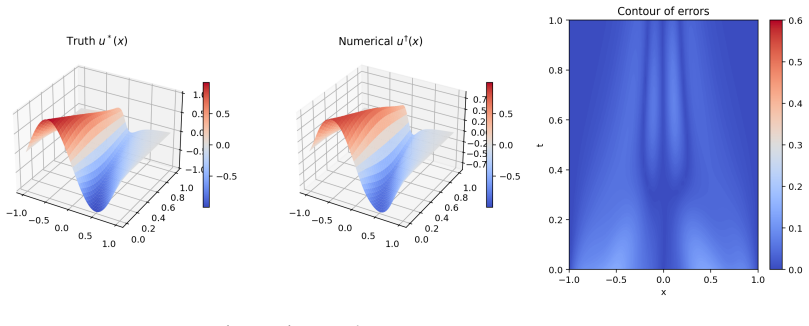
Multifidelity Gaussian process regression for solving nonlinear partial differential equations

Cokriging fits non-stationary kernels to cheap simulations and derives high-fidelity means for Gaussian process regression on nonlinear PDEs

Figure from the paper full image
abstract click to expand
Solving nonlinear partial differential equations (PDEs) using kernel methods offers a compelling alternative to traditional numerical solvers. However, the performance of these methods strongly depends on the choice of kernel. In this work, as the available information is inherently multifidelity, we propose a kernel learning approach based on cokriging, leveraging empirical information from multifidelity simulations. In the first step, we fit a differentiable non-stationary kernel to an empirical kernel obtained from low-fidelity simulations. In the second step, we derive a high-fidelity kernel with estimated hyperparameters, and construct a corresponding high-fidelity mean using the multifidelity framework. These components can then be used within a Gaussian process framework for solving PDEs. Finally, we demonstrate the performance of the proposed physics-informed method on the Burgers' equation.
0
0
stat.ML 2026-05-12 Recognition

Unified taxonomy clarifies ML uncertainty for physics

Uncertainty in Physics and AI: Taxonomy, Quantification, and Validation

It organizes predictive and inference uncertainties in frequentist and Bayesian views and supplies validation tools such as calibration and

Figure from the paper full image
abstract click to expand
Reliable uncertainty quantification is essential for the use of machine learning in physics, where scientific discoveries depend on validated probabilistic statements. We provide a structured overview of uncertainty quantification in ML for physics, introducing a unified taxonomy of uncertainty and clarifying the interpretation of predictive and inference uncertainties across frequentist and Bayesian frameworks. We discuss principled validation tools, including coverage, calibration, bias tests, and proper scoring rules, and illustrate them with simple regression and classification examples.
0
0
stat.ML 2026-05-12 Recognition

Expert losses cut MoE training time for time series

Fast Training of Mixture-of-Experts for Time Series Forecasting via Expert Loss Integration

Adding per-expert prediction errors to the objective and using partial online updates yields better forecasts than full retraining or heavy

Figure from the paper full image
abstract click to expand
We propose a novel adaptive Mixture-of-Experts (MoE) framework for time series forecasting that enhances expert specialization by incorporating expert-specific loss information directly into the training process. Notably, the overall objective comprises the base forecasting loss and expert-specific losses, allowing expert-level prediction errors to jointly shape training alongside the global forecasting loss. This framework is further combined with a partial online learning strategy, enabling incremental updates of both the gating mechanism and expert parameters. This approach significantly reduces computational cost by eliminating the need for repeated full model retraining. By integrating expert-level loss awareness with efficient online optimization, the proposed method achieves improved learning efficiency while maintaining strong predictive performance. Empirical results across economic, tourism, and energy datasets with varying frequencies demonstrate that the proposed approach generally outperforms both statistical methods and state-of-the-art neural network models, such as Transformers and WaveNet, in forecasting accuracy and computational efficiency. Furthermore, ablation studies confirm the effectiveness of the expert-specific loss integration strategy, highlighting its contribution to enhancing predictive performance.
0
0
stat.ML 2026-05-12 Recognition

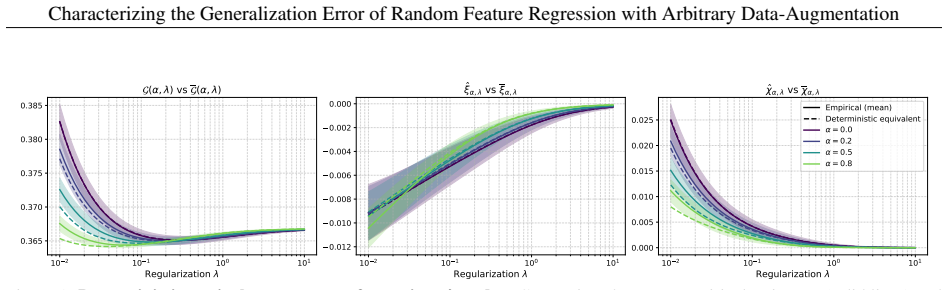
Test error in augmented random features depends only on data and augmentation moments

Characterizing the Generalization Error of Random Feature Regression with Arbitrary Data-Augmentation

In the proportional regime the asymptotic mean squared error reduces to population quantities of the data and the first two moments of the,

Figure from the paper full image
abstract click to expand
This paper aims at analyzing the regularization effect that data augmentation induces on supervised regression methods in the proportional regime, where the number of covariates grows proportionally to the number of samples. We provide a tight characterization of the test error, measured in mean squared error, in terms only of the population quantities of the true data, as well as first and second order statistics of the augmentation scheme. Our results are valid under misspecified feature maps, and for any network architecture where only the last readout layer is trained, and the rest of the network is either frozen or randomly initialized. We specify our results in the case of Gaussian data, and show that our asymptotic characterization is tight in this setting.
0
0
stat.ML 2026-05-12 Recognition

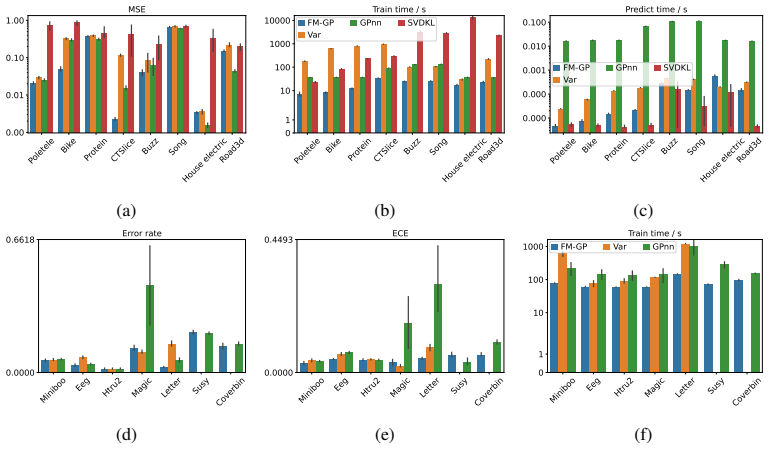
Neural feature maps scale exact GP inference

Scalable Gaussian process inference via neural feature maps

Learned maps approximate kernels to deliver fast, accurate predictions on tabular and image data for regression and classification.

Figure from the paper full image
abstract click to expand
We present a theoretically grounded Gaussian process framework that leverages neural feature maps to construct expressive kernels. We show that the learned feature map can be interpreted as an optimal low-rank approximation to a Gram matrix derived from an implied RKHS, from which we establish consistency of the GP posterior. We further analyse the spectral properties of the induced kernels and introduce product feature-map kernels to address oversmoothing. This simple yet powerful approach enables fast, scalable, and accurate exact GP inference with minimal upfront work. The flexibility of kernel design supports seamless application to both regression and classification tasks across diverse data modalities, including tabular inputs and structured domains such as images. On benchmark datasets, this approach surpasses pre-existing methods in terms of accuracy and training and prediction efficiency.
0
0
stat.ML 2026-05-12 Recognition

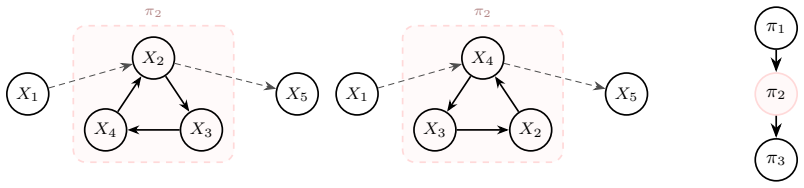
Cyclic LiNG models coarsen to identifiable low-dimensional DAGs

Coarsening Linear Non-Gaussian Causal Models with Cycles

The resulting DAG stays fixed across all cycle-reversed equivalents and can be learned in cubic time with sample bounds.

Figure from the paper full image
abstract click to expand
Recent work on causal abstraction, in particular graphical approaches focusing on causal structure between clusters of variables, aims to summarize a high-dimensional causal structure in terms of a low-dimensional one. Existing methods for learning such summaries from data assume that both the high- and low-dimensional structures are acyclic, which is helpful for causal effect identification and reasoning but excludes many high-dimensional models and thus limits applicability. We show that in the linear non-Gaussian (LiNG) setting, the high-dimensional acyclicity assumption can be relaxed while still allowing recovery of a low-dimensional causal directed acyclic graph (DAG). We further connect identifiability of this low-dimensional DAG to existing results: LiNG models with cycles are observationally identifiable only up to an equivalence class whose members differ by reversals of directed cycles; our low-dimensional DAG, which is invariant across all members of a given equivalence class, thus forms a natural representative of the class. While existing approaches for learning this observational equivalence class over high-dimensional variables have exponential time complexity, our low-dimensional summary is learned in worst-case cubic time and comes with explicit bounds on the sample complexity. We provide open source code and experiments on synthetic data to corroborate our theoretical results.
0
0
stat.ML 2026-05-12 2 theorems

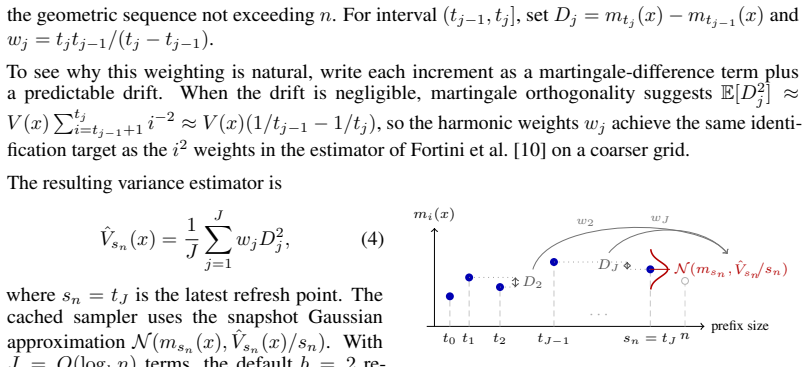
Subsampled CLT turns PFN predictions into valid Thompson samples

PFN-TS: Thompson Sampling for Contextual Bandits via Prior-Data Fitted Networks

The method reuses cached representations, proves consistency of its variance estimator, and decomposes regret into exact posterior-samplingๆ‚”

Figure from the paper full image
abstract click to expand
Thompson sampling is a widely used strategy for contextual bandits: at each round, it samples a reward function from a Bayesian posterior and acts greedily under that sample. Prior-data fitted networks (PFNs), such as TabPFN v2+ and TabICL v2, are attractive candidates for this purpose because they approximate Bayesian posterior predictive distributions in a single forward pass. However, PFNs predict noisy future rewards, while Thompson sampling requires uncertainty over the latent mean reward function. We propose PFN-TS, a Thompson sampling algorithm that converts PFN posterior predictives into mean-reward samples using a subsampled predictive central limit theorem. The method estimates posterior variance from a geometric grid of $O(\log n)$ dataset prefixes rather than the full $O(n)$ predictive sequence used in previous predictive-sequence approaches, and reuses TabICL's cached representations across rounds. We prove consistency of the subsampled variance estimator and give a Bayesian regret bound that decomposes PFN-TS regret into exact posterior-sampling regret under the PFN prior plus approximation terms. Empirically, PFN-TS achieves the best average rank across nonlinear synthetic and OpenML classification-to-bandit benchmarks, remains competitive on linear and BART-generated rewards, and attains the highest estimated policy value in an offline mobile-health evaluation. Code is available at https://anonymous.4open.science/r/PFN_TS-36ED/.
0
0
stat.ML 2026-05-12 2 theorems

Wasserstein projection gives optimal private sampling

Differentially Private Sampling from Distributions via Wasserstein Projection

The mechanism projects distributions to meet privacy rules while using geometry-aware distance, unlike KL methods that ignore shape and fail

Figure from the paper full image
abstract click to expand
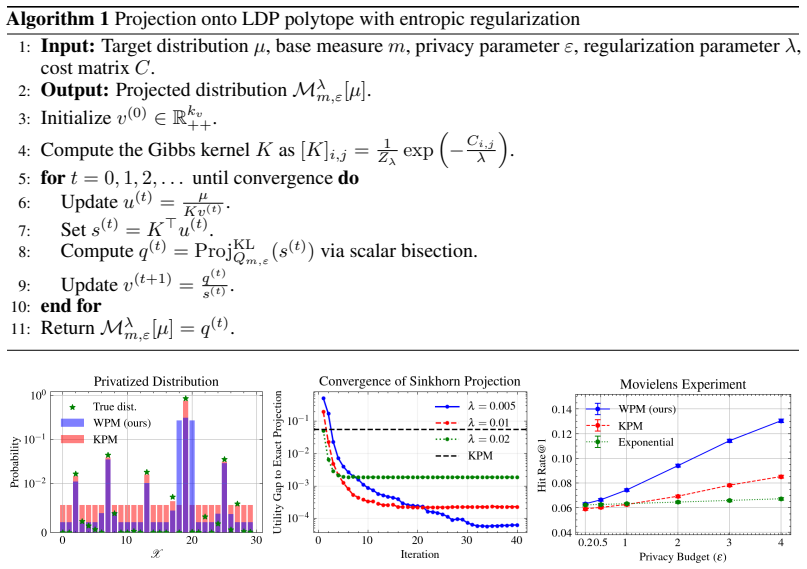
In this paper, we study the problem of sampling from a distribution under the constraint of differential privacy (DP). Prior works measure the utility of DP sampling with density ratio-based measures such as KL divergence. However, such formulations suffer from two key limitations: 1) they fail to capture the geometric structure of the support, and 2) they are not applicable when the supports of the distributions differ. To deal with these issues, we develop a novel framework for DP sampling with Wasserstein distance as the utility measure. In this formulation, we propose Wasserstein Projection Mechanism (WPM), a minimax optimal mechanism based on Wasserstein projection. Furthermore, we develop efficient algorithms for computing the proposed mechanisms approximately and provide convergence guarantees.
0
0
stat.ML 2026-05-12 2 theorems

Federated LLMs keep explicit consistency and coverage under bandwidth budgets

Federated Language Models Under Bandwidth Budgets: Distillation Rates and Conformal Coverage

KL rates for distillation and a novel retrieval-bandwidth slack for conformal RAG both improve predictably with more nodes.

Figure from the paper full image
abstract click to expand
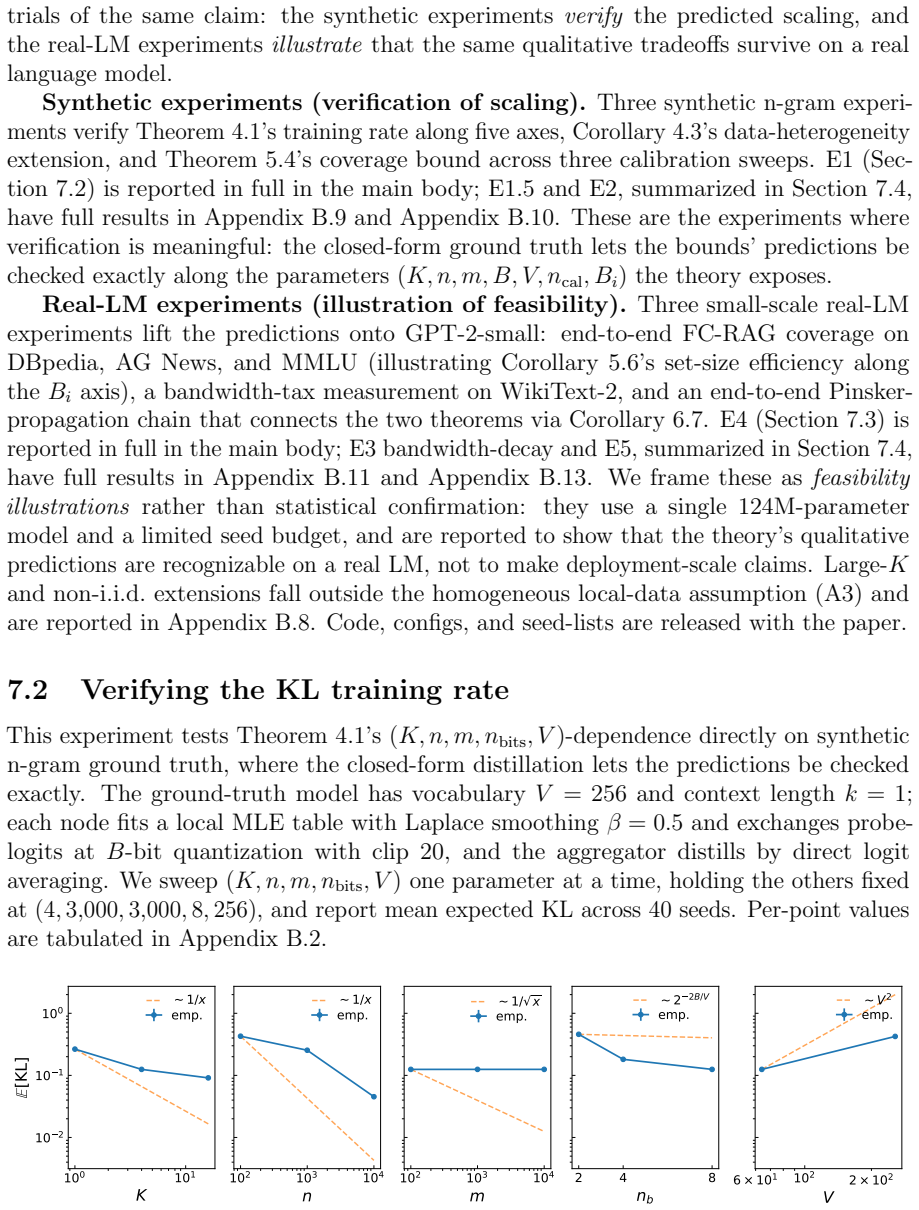
Training a language model on data scattered across bandwidth-limited nodes that cannot be centralized is a setting that arises in clinical networks, enterprise knowledge bases, and scientific consortia. We study the regime in which data must remain distributed across nodes, and ask what statistical guarantees are in principle achievable under explicit bandwidth budgets; we aim to characterize what is provably possible, not to demonstrate a deployment-ready system. Existing theory treats either training-time consistency or inference-time calibration in isolation, and none makes bandwidth a first-class statistical parameter. We analyze two protocols, Federated Probe-Logit Distillation (FPLD) for training and Federated Conformal RAG (FC-RAG) for inference, as the analytical vehicles for our results. Our first main result is an explicit high-probability KL-consistency rate for FPLD with simultaneous dependence on node count $K$, per-node sample size $n$, quantization budget $B$, probe-set size $m$, and vocabulary size $V$; bandwidth enters only through an exponentially vanishing quantization term. Our second main result is a distribution-free marginal-coverage bound for FC-RAG, whose novel retrieval-bandwidth slack $\Delta_{\mathrm{RAG}} = f_{\max}\sqrt{K^{-2}\sum_i v(B_i)}$ makes per-node retrieval bandwidth a first-class statistical parameter, with arithmetic aggregation across $K$ nodes shrinking the slack as $K^{-1/2}$ in the per-node-uniform regime. A Pinsker-type corollary composes the two bounds into an end-to-end coverage guarantee. Synthetic experiments verify the predicted scaling along the bounds' parameters; small-scale experiments on a GPT-2 testbed illustrate that the qualitative bandwidth-accuracy tradeoff survives on a real language model. A deployment-scale empirical evaluation is out of scope.
0
0
stat.ML 2026-05-12 2 theorems

Multicalibration corrected without clean labels using contamination matrices

Unified Approach for Weakly Supervised Multicalibration

Risk rewrites and witness constraints yield finite-sample guarantees for calibration moments under positive-unlabeled and related regimes.

Figure from the paper full image
abstract click to expand
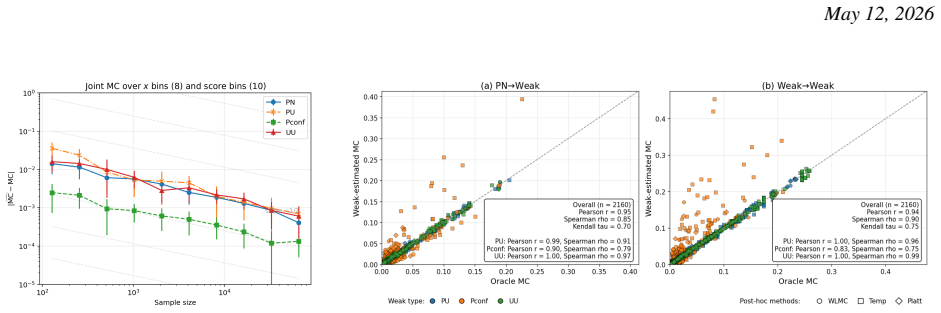
Multicalibration requires predicted scores to agree with label probabilities across rich families of subgroups and score-dependent tests, but existing methods require clean input-label pairs for evaluation and post-processing. This assumption fails in weakly supervised learning (WSL) regimes -- including positive-unlabeled, unlabeled-unlabeled, and positive-confidence learning -- where clean labels are costly or unavailable even though reliable uncertainty estimates may be crucial. We address this gap by developing estimators of multicalibration error and post-hoc correction methods for WSL settings in which clean input-label pairs are unavailable. We propose a unified framework for estimating and correcting multicalibration under weak supervision by combining contamination-matrix risk rewrites with witness-based calibration constraints, yielding corrected multicalibration moments with finite-sample guarantees. We further propose weak-label multicalibration boost (WLMC), a generic post-hoc recalibration algorithm under weak supervision. Finally, we conduct experiments across multiple weak-supervision settings to evaluate multicalibration behavior and offer empirical insight into uncertainty estimation under weak supervision.
0
0
stat.ML 2026-05-12 2 theorems

Rectified AI laws cut bias in Bayesian priors from limited data

Supercharging Bayesian Inference with Reliable AI-Informed Priors

Correcting the distribution that generates synthetic data before prior construction improves interval coverage and reliability when data are

Figure from the paper full image
abstract click to expand
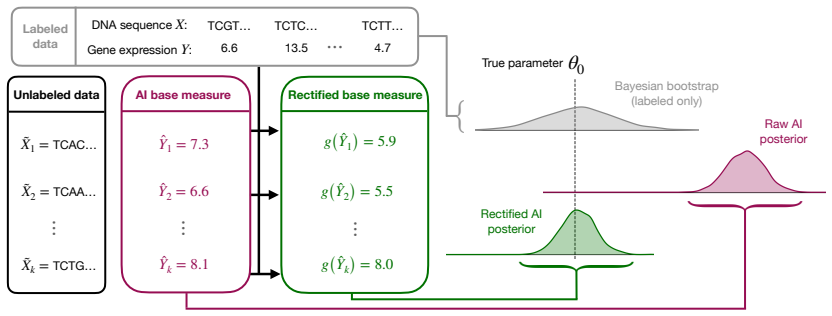
Modern predictive systems encode beliefs that can act as useful prior information for statistical inference in data-limited settings. Using them for prior construction introduces a tradeoff: an informative prior built from a predictive model can sharpen inference from limited data, but also risks propagating error from the model into the posterior. We propose a framework for AI-informed prior elicitation that mitigates this tension by rectifying the AI-induced law that generates synthetic data before using it to inform a prior. The rectified law can be embedded into synthetic data-driven prior elicitation techniques, including as a base measure in a Dirichlet process (DP) prior on the data-generating process. We refer to the resulting prior and corresponding posterior as the rectified AI prior and rectified AI posterior. We establish Gaussian asymptotics for the rectified AI posterior under non-vanishing prior strength and derive a first-order expression for its centering bias. Our rectified AI priors substantially reduce bias compared to standard approaches, improve the coverage of credible intervals, and make AI-powered prior information more reliable. We additionally apply the rectified AI prior to a real skin disease classification task and show that it can meaningfully boost predictive performance.
0
0
stat.ML 2026-05-11 2 theorems

Normalizing flows recover fast equilibrium from slow data alone

Learning stochastic multiscale models through normalizing flows

The flow is trained end-to-end on one observed trajectory to parameterize the hidden invariant density and produce a reduced stochastic slow

Figure from the paper full image
abstract click to expand
Many systems in physics, engineering, and biology exhibit multiscale stochastic dynamics, where low-dimensional slow variables evolve under the influence of high-dimensional fast processes. In practice, observations are often limited to a single trajectory of the slow component, while the fast dynamics remain unobserved, making statistical learning challenging. Approaches based on partial differential equations (PDE), such as Fokker-Planck formulations, aim to characterize the evolution of probability densities, typically requiring dense space-time data or grid-based solvers. In contrast, we adopt a trajectory-based perspective and develop a data-driven framework for learning effective stochastic dynamics from a single observed path. We model the dynamics by coupled multiscale stochastic differential equations (SDEs) and first obtain a principled model reduction through stochastic averaging. Unlike generic model reduction techniques such as PCA, this respects the dynamical structure of the original system and explicitly incorporates the interaction between slow and fast scales. A central challenge, however, is that the reduced model depends on the invariant distribution of the fast process, which is a solution to an intractable and often unknown PDE. We introduce a novel learning framework that parameterizes the invariant distribution using normalizing flows, enabling expressive density modeling in the latent fast-variable space. The flow is trained end-to-end by optimizing a penalized likelihood objective induced by the reduced stochastic dynamics. Furthermore, we develop a Bayesian variational inference procedure for uncertainty quantification, employing a second normalizing flow to approximate the posterior distribution over model parameters. This yields a scalable approach to capturing epistemic uncertainty in multiscale systems.
0
0
stat.ML 2026-05-11 2 theorems

Metropolis-Hastings steps fix discretization bias in diffusion correctors

Metropolis-Adjusted Diffusion Models

Exact and approximate methods using only the score function yield better FID scores on images while keeping computation low.

Figure from the paper full image
abstract click to expand
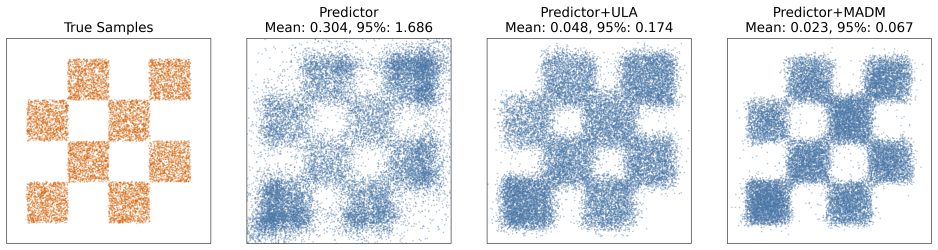
Sampling from score-based diffusion models incurs bias due to both time discretisation and the approximation of the score function. A common strategy for reducing this bias is to apply corrector steps based on the unadjusted Langevin algorithm (ULA) at each noise level within a predictor-corrector framework. However, ULA is itself a biased sampler, as it discretises a continuous diffusion process. In this work, we consider adjusted Langevin correctors that employ Metropolis--Hastings (MH) or Barker's accept-reject steps to correct for this bias. Since the target density ratio typically required by MH-based algorithms is unavailable, we propose methods that instead utilise the score function to compute the correct acceptance probability. We introduce the first exact method for adjusting Langevin corrections in diffusion models, based on a two-coin Bernoulli factory algorithm. We also propose an efficient approximation based on Simpson's rule that achieves accuracy of order $5/2$ in the step size at near-zero marginal cost. We demonstrate that these procedures improve sample quality on both synthetic and image datasets, yielding consistent gains in Fr\'echet Inception Distance (FID) on the latter.
0
0
stat.ML 2026-05-11 2 theorems

Empirical Bayes shrinkage completes 1-bit matrices with balanced accuracy and calibration

Empirical Bayes 1-bit matrix completion

Adapting the Efron-Morris estimator to binary observations exploits low-rank structure for predictions and uncertainty estimates.

Figure from the paper full image
abstract click to expand
The problem of predicting unobserved entries in a binary matrix, known as 1-bit matrix completion, has found diverse applications in fields such as recommendation systems. In this study, we develop an empirical Bayes method for 1-bit matrix completion motivated by the Efron--Morris estimator, a matrix generalization of the James--Stein estimator that shrinks singular values toward zero. The proposed method exploits the underlying low-rank structure of binary matrices, drawing parallels with multidimensional item response theory. Simulation studies and real-data applications demonstrate that the proposed method achieves a superior balance of predictive accuracy, calibration reliability (uncertainty quantification), and computational efficiency compared to existing methods.
0
0
stat.ML 2026-05-11 Recognition

Mean-field SVGD converges in L2 at explicit polynomial rates

Quantitative Local Convergence of Mean-Field Stein Variational Gradient Flow

Rates depend on dimension and regularity when initial and target densities are smooth and close in L2 on the torus

Figure from the paper full image
abstract click to expand
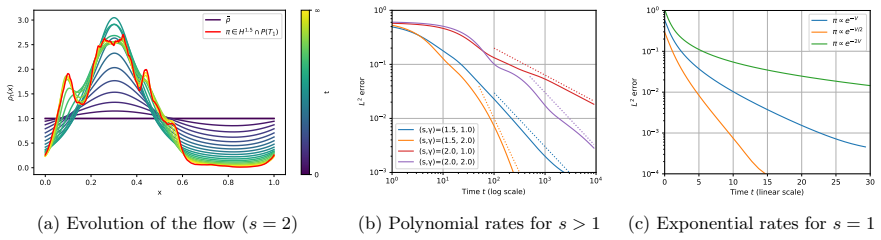
Stein Variational Gradient Descent (SVGD) is a deterministic interacting-particle method for sampling from a target probability measure given access to its score function. In the mean-field and continuous-time limit, it is known that the flow converges weakly toward the target, but no quantitative rate is known for the last iterate. In this paper, we establish quantitative local convergence in strong norms for this dynamics, when the interaction kernel is of Riesz type on the $d$-dimensional torus. Specifically, assuming that the initial density and the target are smooth and close in $L^2$-norm, we obtain explicit polynomial convergence rates in $L^2$-norm that depend on the dimension and on the regularity parameters of the kernel, the initialization and the target. We further show that these rates are sharp in certain regimes, and support the theory with numerical experiments. In the edge case of kernels with a Coulomb singularity, we recover the global exponential convergence result established in prior work. Our analysis is inspired by recent results on Wasserstein gradient flows of kernel mean discrepancies.
0
0
stat.ML 2026-05-11 2 theorems

Single-index bandits admit optimal regret of order T to the two-thirds

Optimal Regret for Single Index Bandits

A Stein estimator finds the projection direction, discretization reduces to one dimension, and UCB delivers the tight rate.

Figure from the paper full image
abstract click to expand
We study the $\textit{single-index bandit}$ problem, where rewards depend on an unknown one-dimensional projection of high-dimensional contexts through an unknown reward function. This model extends linear and generalized linear bandits to a nonparametric setting, and is particularly relevant when the reward function is not known in advance. While optimal regret guarantees are known for monotone reward functions, the general non-monotone case remains poorly understood, with the best known bound being $\tilde{\mathcal{O}}(T^{3/4})$ (under standard boundedness and Lipschitz assumptions on the reward function [Kang et al., 2025]). We close this gap by establishing the optimal regret for general single-index bandits. We propose a simple two-phase algorithm, namely, Zoomed Single Index Bandit with Upper Confidence Bound ($\texttt{ZoomSIB-UCB}$), that first estimates the projection direction via a normalized Stein estimator, and then reduces the problem to a one-dimensional bandit using discretization and finally use UCB. This approach achieves a regret of $\tilde{\mathcal{O}}(T^{2/3})$, and improves significantly upon prior work without any additional assumptions. We also prove a matching minimax lower bound of $\tilde{\Omega}(T^{2/3})$, showing that the upper bound is essentially tight. Our upper and lower bounds together provide a sharp characterization of the regret in single-index bandits. Moreover, the empirical results further demonstrate the effectiveness and robustness of our approach.
0
0
stat.ML 2026-05-11 2 theorems

Sub-network Laplace approximations underestimate predictive variance

Optimality of Sub-network Laplace Approximations: New Results and Methods

The bias shrinks monotonically with larger sub-matrices and is reduced further by gradient- or interaction-based parameter selection.

Figure from the paper full image
abstract click to expand
Although the Laplace approximation offers a simple route to uncertainty quantification in deep neural networks, its reliance on inverting large Hessian matrices has motivated a range of computationally feasible low-dimensional or sparse approximations. A prominent class of such methods - sub-network Laplace approximations, constructs surrogates by restricting attention to a small subset of parameters. Existing approaches in this family typically rely on diagonal, layer-wise, or other architectural heuristics for subset selection, which ignore cross-parameter interactions and lack formal optimality guarantees. In this paper, we provide a rigorous theoretical analysis of the sub-network Laplace paradigm. We prove that all sub-network Laplace methods systematically underestimate the predictive variance of the full Laplace posterior, and that this bias decreases monotonically as the retained sub-matrix expands. Leveraging this insight, we propose two principled, analytically grounded sub-network Hessian approximations: \textit{Gradient-Laplace} selects parameters with the largest average squared gradients of the model output with respect to the parameters over a reference dataset; while \textit{Greedy-Laplace} iteratively refines this selection by accounting for off-diagonal interactions in the precision matrix. We establish theoretical guarantees characterizing their optimality properties and show that Gradient-Laplace provably outperforms existing heuristic approaches. Extensive numerical studies across diverse settings indicate that these methods perform strongly relative to existing benchmarks.
0
0
stat.ML 2026-05-11 2 theorems

Nine-step guideline corrects bias in ML on health surveys

Survey-aware Machine Learning: A Guideline for Valid Population Health Inference based on Scoping Review

Incorporating sampling design into every modeling stage produces representative estimates and valid fairness checks from complex survey data

Figure from the paper full image
abstract click to expand
Machine Learning (ML) models trained on complex health surveys such as the National Health and Nutrition Examination Survey (NHANES) often ignore primary sampling units, stratification variables, and sampling weights. This practice violates the independence assumptions of standard evaluation methods. As a result, estimates become biased, uncertainty is underestimated, and fairness assessments fail to reflect population-level disparities. We propose Survey-aware Machine Learning (SaML), a nine-step guideline that incorporates survey design metadata across the ML lifecycle. Through a scoping review of 16 methodological papers, we summarize existing work on weighted model training, design-based cross-validation, and survey-adjusted performance evaluation. We also identify gaps in hyperparameter tuning and deployment. We provide task-specific guidance that clarifies which steps are required for different analytical objectives. SaML provides a checklist for valid population inference from survey data.
0
0
stat.ML 2026-05-11 2 theorems

Noiseless inverse optimization has tight O(d/T) generalization

Tight Generalization Bounds for Noiseless Inverse Optimization

The high-probability bound is optimal for consistent estimators and produces regret matching adversarial settings.

Figure from the paper full image
abstract click to expand
Inverse optimization (IO) seeks to infer the parameters of a decision-maker's objective from observed context--action data. We study noiseless IO, where demonstrations are generated by a ground-truth objective. We provide a high-probability ${O}(\frac{d}{T})$ generalization bound for the induced action set, where $d$ is the number of unknown parameters and $T$ is the size of the training dataset. We strengthen these guarantees under additional conditions that ensure uniqueness of the chosen action, bringing our IO guarantees in line with best-arm identification results in the bandit literature. We further show that the ${O}(\frac{d}{T})$ rate is tight over all consistent estimators considered here, and extend the result to both instantaneous and cumulative regret. Notably, the resulting regret lower bound matches the corresponding upper bounds in the adversarial setting, indicating that the stochastic IO setting is effectively adversarial for the class of estimators studied here. Finally, we propose a parameter-free algorithm with lower per-iteration complexity than generic solvers. Experiments validate the predicted rates and illustrate the tightness of our bounds.
0
0
stat.ML 2026-05-11 2 theorems

Two encoder blocks suffice for optimal Transformer approximation

Learning Theory of Transformers: Local-to-Global Approximation via Softmax Partition of Unity

Softmax aggregates local approximations into a global fit for Hรถlder functions, leading to near-minimax rates in generalization.

Figure from the paper full image
abstract click to expand
This paper investigates the learning theory of Transformer networks for regression tasks on the compact Euclidean domain $[0,1]^d$ and $d$-dimensional compact Riemannian manifolds. We propose a novel constructive approximation framework for Transformers that builds local approximations of the target function and aggregates them into a global approximation via softmax partition of unity. This approach leverages the attention mechanism to achieve spatial localization through affine transformations of the input. The softmax activation plays a crucial role in aggregating local approximations to a global output. From an approximation perspective, we prove that a dense Transformer equipped with only two encoder blocks and standard single-hidden-layer point-wise feed-forward networks can achieve a uniform $\varepsilon$-approximation error for $\alpha$-H\"older continuous functions with $\alpha \in (0,1]$ using $\mathcal{O}(\varepsilon^{-d/\alpha})$ total parameters. Building upon this approximation guarantee, we establish a near minimax-optimal generalization error bound of order $\mathcal{O}\big(n^{-\frac{2\alpha}{2\alpha+d}} \log n\big)$ for the empirical risk minimizer, where $n$ is the training data size. The Transformer architecture studied in this paper is dense, shallow and wide, and employs softmax activation and sinusoidal positional encodings, closely reflecting practical implementations.
0
0
stat.ML 2026-05-11 Recognition

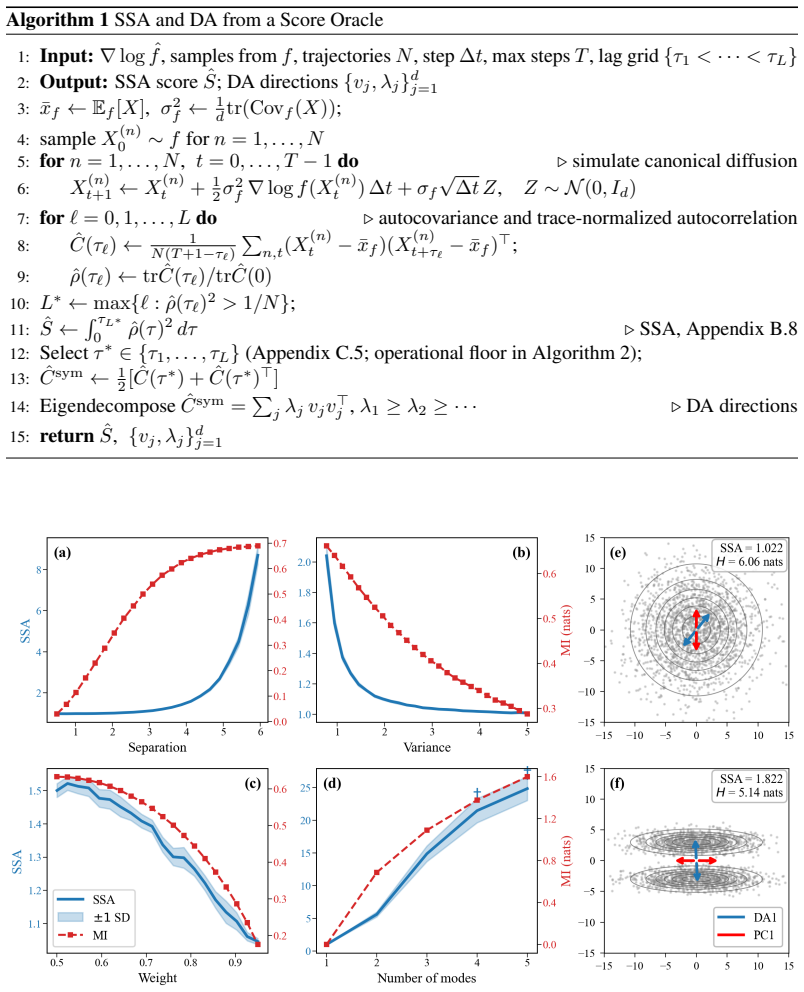
Canonical diffusion isolates mode barriers from samples and scores

Measuring and Decomposing Mode Separation via the Canonical Diffusion

SSA scalar and DA directions extracted from one reversible process track fragmentation better than entropy or PCA in mixtures, images, andMD

Figure from the paper full image
abstract click to expand
Mode separation, namely how sharply a distribution fragments into barrier-separated clusters, is a fundamental geometric property of densities, difficult to quantify in high dimensions. It is structurally distinct from dispersion, yet existing tools fall short: differential entropy rises with spread regardless of fragmentation, PCA orders directions by variance regardless of barriers, and mutual information requires a mixture decomposition one usually does not have. We measure mode separation through a single stochastic process intrinsic to the density: a unique reversible diffusion with $f$ as its stationary distribution and constant scalar diffusion coefficient. We extract two readouts from its autocovariance matrix: SSA (Sum of Squared Autocorrelations), a scalar barrier-sensitive measure; and DA (Dominant Autocorrelation directions), linear projections ordered by metastability rather than variance. Under an isotropic-Gaussian null, we derive a closed-form spectrum for the empirical autocovariance that generalizes Marchenko--Pastur, with an analytic upper edge that selects the lag at which DA is read off. Both readouts use only samples and a score function, scaling to high dimensions through pretrained score-based generative models via Tweedie's identity. We apply our framework to three settings: (i) synthetic Gaussian mixtures, where SSA tracks mutual information; (ii) SDXL text-to-image generations, where SSA and DA capture structure that entropy and PCA miss; and (iii) molecular dynamics of alanine dipeptide, where DA recovers the known slow backbone dihedrals from static samples alone.
0
0
stat.ML 2026-05-11 Recognition

Core-halo split removes bias in decentralized fixed-point solving

Core-Halo Decomposition: Decentralizing Large-Scale Fixed-Point Problems

Agents keep disjoint write cores but read overlapping halos to match the original operator exactly where strict blocks cannot.

Figure from the paper full image
abstract click to expand
We study solving large-scale fixed-point equation \(x^\star=\bar F(x^\star)\) with decomposition. Standard strict decomposition assigns each agent a disjoint block and evaluates updates using only owned coordinates. For most operators, however, a block update may depend on variables outside the block. Truncating these dependencies by strict decomposition changes the mean operator and creates structural bias that cannot be removed by more samples, smaller stepsizes, or additional consensus. We therefore propose Core-Halo decomposition, which separates write ownership from read-only evaluation context: each agent updates its own core and reads from an overlapping halo. By aligning the Core-Halo decomposition with the block-dependence structure of $\bar F$, the original fixed-point problem can be implemented faithfully in a decentralized multi-agent system. We further characterize the fundamental obstruction faced by strict decomposition through a Bellman closure condition and a blockwise bias lower bound, showing that local-only updates can alter the original fixed-point operator. Finally, we conduct extensive experiments across a range of application settings, and demonstrate that Core-Halo achieves near-centralized performance while retaining the parallelism benefits of decentralization.
0
0
stat.ML 2026-05-11 3 theorems

Normalizing flows sharpen conformal prediction regions in multiple dimensions

CONTRA: Conformal Prediction Region via Normalizing Flow Transformation

Latent-space distance scores map high-density latent balls into compact guaranteed-coverage regions that beat rectangles and ellipses.

Figure from the paper full image
abstract click to expand
Density estimation and reliable prediction regions for outputs are crucial in supervised and unsupervised learning. While conformal prediction effectively generates coverage-guaranteed regions, it struggles with multi-dimensional outputs due to reliance on one-dimensional nonconformity scores. To address this, we introduce CONTRA: CONformal prediction region via normalizing flow TRAnsformation. CONTRA utilizes the latent spaces of normalizing flows to define nonconformity scores based on distances from the center. This allows for the mapping of high-density regions in latent space to sharp prediction regions in the output space, surpassing traditional hyperrectangular or elliptical conformal regions. Further, for scenarios where other predictive models are favored over flow-based models, we extend CONTRA to enhance any such model with a reliable prediction region by training a simple normalizing flow on the residuals. We demonstrate that both CONTRA and its extension maintain guaranteed coverage probability and outperform existing methods in generating accurate prediction regions across various datasets. We conclude that CONTRA is an effective tool for (conditional) density estimation, addressing the under-explored challenge of delivering multi-dimensional prediction regions.
0
0
stat.ML 2026-05-11 Recognition

Multi-component ICA splits into decoupled and competition phases

Learnability and Competition in High-Dimensional Multi-Component ICA

A mean-field ODE for the overlap matrix supplies explicit conditions on step size and initialization that govern which components are learn

Figure from the paper full image
abstract click to expand
Independent Component Analysis (ICA) is a foundational tool for unsupervised representation learning, yet its high-dimensional theory remains largely limited to single-component recovery. We develop an asymptotically exact mean-field theory for multi-component online ICA, capturing the coupling induced by simultaneous learning and orthogonalization. In the high-dimensional limit, the joint empirical distribution of learned estimates and ground-truth components converges to a deterministic process, yielding a closed ODE system for the overlap matrix between learned directions and true components. This characterization reveals a genuinely multi-component, initialization-driven phase structure: a decoupled regime, where estimates align with distinct components and evolve nearly independently, and a competition regime, where overlapping initializations induce orthogonality-driven conflicts, slow reorientation, and delayed convergence. Our steady-state analysis gives explicit learnability boundaries and competition conditions linking step size, data moments, and initialization. These conditions show that larger higher-order moments and competition shrink the stable learning-rate window, increase convergence times, and predict a staircase phenomenon in which the number of recoverable components changes discretely with the learning rate. Experiments on synthetic data and hyperspectral remote sensing data validate the predicted trajectories and phase behavior.
0
0
stat.ML 2026-05-11 2 theorems

Sliced inner-product GW distance aligns high-dim data scalably

Sliced Inner Product Gromov-Wasserstein Distances

Projecting onto random lines yields closed-form one-dimensional solutions and rotational invariance for matching dataset geometries.

Figure from the paper full image
abstract click to expand
The Gromov-Wasserstein (GW) problem provides a framework for aligning heterogeneous datasets by matching their intrinsic geometry, but its statistical and computational scaling remains an issue for high-dimensional problems. Slicing techniques offer an appealing route to scalability, but, unlike Wasserstein distances, GW problems do not generally admit closed-form solutions in one-dimension. We resolve this problem for the GW problem with inner product cost (IGW), propose a sliced IGW distance that enjoys a natural rotational invariance property, and comprehensively study its structural and computational properties. Numerical experiments validating our theory are presented, followed by applications to heterogeneous clustering of text data and language model representation comparison.
0
0
stat.ML 2026-05-11 2 theorems

Sinkhorn divergence tests full distributional treatment effects

Sinkhorn Treatment Effects: A Causal Optimal Transport Measure

Debiased estimators based on entropic transport between counterfactual distributions yield asymptotically valid tests at fixed and multiple

Figure from the paper full image
abstract click to expand
We introduce the Sinkhorn treatment effect, an entropic optimal transport measure of divergence between counterfactual distributions. Unlike classical quantities such as the average treatment effect, this measure captures differences across entire distributions. We analyze this divergence as a statistical functional and show it can be written as a smooth transformation of counterfactual mean embeddings with an appropriate kernel. This characterization allows us to establish first-order pathwise differentiability in general, and second-order pathwise differentiability under the null hypothesis of equal counterfactual distributions. Leveraging this smoothness, we construct debiased estimators and use them to obtain asymptotically valid tests for distributional treatment effects with a fixed entropic regularization parameter. Because the power of the test depends on this unknown parameter, we further propose an aggregated test that combines evidence across a grid of regularization choices. Experiments on simulated and image data demonstrate the practical advantages of our estimator and testing procedure.
0
0
stat.ML 2026-05-11 Recognition

AM-PPI narrows CIs 10-40% by routing cases to right predictor

Active Multiple-Prediction-Powered Inference

Adaptive choice of model subset and uncertainty-driven label sampling cuts variance under fixed budget for healthcare monitoring.

Figure from the paper full image
abstract click to expand
Post-deployment monitoring of healthcare AI requires statistically valid, label-efficient methods, but gold-standard labels from clinician chart review are expensive. Prediction-powered inference (PPI) and active statistical inference (ASI) reduce label cost by combining a small labeled sample with abundant model predictions, but both are restricted to a single predictor, a poor fit for modern clinical pipelines that have multiple predictors of differing cost and accuracy available at inference time. We propose Active Multiple-Prediction-Powered Inference (AM-PPI), which routes each instance to a cost-appropriate predictor subset, samples gold-standard labels in proportion to the chosen subset's residual uncertainty, and reweights predictions to minimize estimator variance, all under a single deployment-time budget. AM-PPI generalizes ASI to leverage multiple predictors and extends Multiple-PPI from global per-predictor allocation to per-instance adaptive routing. We derive closed-form Karush-Kuhn-Tucker (KKT) conditions for all three decisions and prove, via biconvexity and strong duality, that the resulting fixed point is a global optimum despite the joint problem being non-jointly-convex. We establish asymptotic normality with valid coverage, minimum-variance unbiasedness within the linear-prediction augmented inverse propensity weighted (AIPW) class, and a closed-form criterion identifying when multiple predictors help. On synthetic data and three healthcare monitoring tasks, AM-PPI produces 10 to 40 percent narrower confidence intervals (CIs) than single-predictor ASI in the budget regime where routing matters, and matches the better baseline elsewhere.
0
0
stat.ML 2026-05-11 2 theorems

Bounded Gaussian surface area allows non-negative L1 approximations

A Note on Non-Negative Lโ‚-Approximating Polynomials

Indicator functions of sets with GSA Gamma admit epsilon L1 approximation by non-negative polynomials of degree O~(Gamma^2/eps^2) under the

abstract click to expand
$L_1$-Approximating polynomials, i.e., polynomials that approximate indicator functions in $L_1$-norm under certain distributions, are widely used in computational learning theory. We study the existence of \textit{non-negative} $L_1$-approximating polynomials with respect to Gaussian distributions. This is a stronger requirement than $L_1$-approximation but weaker than sandwiching polynomials (which themselves have many applications). These non-negative approximating polynomials have recently found uses in smoothed learning from positive-only examples. In this short note, we prove that every class of sets with Gaussian surface area (GSA) at most $\Gamma$ under the standard Gaussian admits degree-$k$ non-negative polynomials that $\eps$-approximate its indicator functions in $L_1$-norm, for $k=\tilde{O}(\Gamma^2/\varepsilon^2)$. Equivalently, finite GSA implies $L_1$-approximation with the stronger pointwise guarantee that the approximating polynomial has range contained in $[0,\infty)$. Up to a constant-factor, this matches the degree of the best currently known Gaussian $L_1$-approximation degree bound without the non-negativity constraint.
0
0
stat.ML 2026-05-11 2 theorems

Test pinpoints locations where treatments alter outcome distributions

Semiparametric Efficient Test for Interpretable Distributional Treatment Effects

DR-ME learns finite points to deliver interpretable, doubly robust causal discrepancy tests from observational data.

Figure from the paper full image
abstract click to expand
Distributional treatment effects can be invisible to means: a treatment may preserve average outcomes while changing tails, modes, dispersion, or rare-event probabilities. Kernel tests can detect discrepancies between interventional outcome laws, but global tests do not reveal where the laws differ. We propose DR-ME, to our knowledge the first semiparametrically efficient finite-location test for interpretable distributional treatment effects. DR-ME evaluates an interventional kernel witness at learned outcome locations, returning causal-discrepancy coordinates rather than only a global rejection. From observational data, we derive orthogonal doubly robust kernel features whose centered oracle form is the canonical gradient of this finite witness. For fixed locations, we characterize the local testing limit: DR-ME is chi-square calibrated under the null, has noncentral chi-square local power, and uses the covariance whitening that optimizes local signal-to-noise for discrepancies visible through the selected coordinates. This efficient local-power geometry yields a principled location-learning criterion, with sample splitting preserving post-selection validity. Experiments show near-nominal type-I error, competitive power against global doubly robust kernel tests, and interpretable learned locations that localize distributional effects in a semi-synthetic medical-imaging study.
0
0
stat.ML 2026-05-11 Recognition

Bayes-assisted sequences match oracle efficiency for bounded means

Asymptotically Log-Optimal Bayes-Assisted Confidence Sequences for Bounded Means

When the predictive distribution is Wasserstein-consistent, they achieve the same log-growth rate as an oracle while remaining valid under a

abstract click to expand
Confidence sequences based on test martingales provide time-uniform uncertainty quantification for the mean of bounded IID observations without parametric distributional assumptions. Their practical efficiency, however, depends strongly on the choice of martingale updates, and many existing constructions do not exploit prior information about plausible data-generating distributions or mean values. We propose a Bayes-assisted framework that uses a Bayesian working predictive model to adaptively construct confidence sequences. For each candidate mean and time point, the predictive distribution selects, among valid one-step martingale factors, the update maximising predictive expected log-growth; validity is therefore preserved even when the prior or working model is misspecified. We prove that if the predictive distribution is Wasserstein-consistent, the resulting procedure is asymptotically log-optimal, matching the per-sample log-growth of an oracle procedure with access to the true distribution. We instantiate the framework using robust predictives based on Dirichlet-process mixtures and Bayesian exponentially tilted empirical likelihood. Experiments on synthetic data, sequential best-arm identification for LLM evaluation, and prediction-powered inference show that informative priors can substantially reduce confidence-sequence width and sampling effort while retaining anytime-valid coverage.
0
0
stat.ML 2026-05-11 2 theorems

Bayes predictives make confidence sequences asymptotically log-optimal

Asymptotically Log-Optimal Bayes-Assisted Confidence Sequences for Bounded Means

Selecting the best valid martingale factor under a Wasserstein-consistent predictive matches oracle growth rate while preserving exact anyt

abstract click to expand
Confidence sequences based on test martingales provide time-uniform uncertainty quantification for the mean of bounded IID observations without parametric distributional assumptions. Their practical efficiency, however, depends strongly on the choice of martingale updates, and many existing constructions do not exploit prior information about plausible data-generating distributions or mean values. We propose a Bayes-assisted framework that uses a Bayesian working predictive model to adaptively construct confidence sequences. For each candidate mean and time point, the predictive distribution selects, among valid one-step martingale factors, the update maximising predictive expected log-growth; validity is therefore preserved even when the prior or working model is misspecified. We prove that if the predictive distribution is Wasserstein-consistent, the resulting procedure is asymptotically log-optimal, matching the per-sample log-growth of an oracle procedure with access to the true distribution. We instantiate the framework using robust predictives based on Dirichlet-process mixtures and Bayesian exponentially tilted empirical likelihood. Experiments on synthetic data, sequential best-arm identification for LLM evaluation, and prediction-powered inference show that informative priors can substantially reduce confidence-sequence width and sampling effort while retaining anytime-valid coverage.
0
0
stat.ML 2026-05-11 2 theorems

Single gradient flow solves inverse problems at low cost

Consistency Regularised Gradient Flows for Inverse Problems

A unified Euclidean-Wasserstein flow in latent space aligns priors with data, enabling few-step inference without autoencoder backprop.

Figure from the paper full image
abstract click to expand
Vision-Language Latent Diffusion Models (LDMs) (Rombach et al., 2022) provide powerful generative priors for inverse problems. However, existing LDM-based inverse solvers typically require a large number of neural function evaluations (NFEs) and backpropagation through large pretrained components, leading to substantial computational costs and, in some cases, degraded reconstruction quality. We propose a unified Euclidean-Wasserstein-2 gradient-flow framework that jointly performs posterior sampling and prompt optimization in the latent space through a single flow that aligns the prior and posterior with the observed data. Combined with few-step latent text-to-image models, this formulation enables low-NFE inference without backpropagation through autoencoders. Experiments across several canonical imaging inverse problems show that our method achieves state-of-the-art performance with significantly reduced computational cost.
0
0
stat.ML 2026-05-11 2 theorems

Target correction equates online kernel regression to offline

Characterizing and Correcting Effective Target Shift in Online Learning

Deriving the shift in teaching signals for streaming data lets online learners recover exact offline predictors and improves continual image

Figure from the paper full image
abstract click to expand
Online learning from a stream of data is a defining feature of intelligence, yet modern machine learning systems often struggle in this setting, especially under distributional shift. To understand its basic properties, we study the relationship between online and offline learning in the context of kernel regression. We derive a closed-form expression for the function learned by online kernel regression, revealing that online kernel regression is equivalent to offline regression with shifted, inaccurate target outputs. Conversely, we show that by compensating for this effective shift in the teaching signal through target correction, online kernel-based learning can provably learn the same predictor as its offline counterpart. We derive both a closed-form expression for this target correction and an iterative form that can be applied sequentially. Applying this framework to image classification tasks on CIFAR-10 and CORe50, we show that online stochastic gradient descent with iteratively corrected targets outperforms learning with the true targets in continual learning settings. This work therefore provides a basic framework for analyzing and improving online learning in non-stationary environments.
0
0
stat.ML 2026-05-11 2 theorems

EM convergence governed by missing-information operator

Expectation-Maximization as a Spectrally Governed Relaxation Flow

The operator equals the missing-info ratio and likelihood Hessian, linking global descent to local spectral rate and optimal relaxation.

Figure from the paper full image
abstract click to expand
The expectation--maximization (EM) algorithm combines global monotonicity, local linear convergence, and strong practical robustness, but these features are usually analyzed separately. Global descent is nonlinear, whereas local convergence is governed by the spectrum of the linearized EM map. How these two levels fit into a single dynamical picture has remained less transparent. We make explicit the latent-variable operator that connects them. Along the EM trajectory, the likelihood increment admits a global energy decomposition in terms of posterior-relative entropy. Linearization at a nondegenerate maximizer $\theta^\ast$ then reveals the local operator \[ \mathcal G_{\theta^\ast}=I-DT(\theta^\ast), \] which coincides with both the missing-information ratio and the information-geometric Hessian of the observed likelihood. This operator provides a unified description of local contraction, posterior rigidity, and geometric curvature. Its spectrum yields a sharp characterization of local convergence and naturally leads to an optimal scalar relaxation rule for locally accelerated EM. These results place global descent, local spectral behavior, and optimal local relaxation within a common dynamical framework.
0
0
stat.ML 2026-05-11 Recognition

Flow matching on raw counts beats baselines with fewer parameters

Flow Matching for Count Data

Birth-death processes let the model stay in count space for scRNA-seq and spike-train generation, transport, and conditional tasks.

Figure from the paper full image
abstract click to expand
High-dimensional count data arise in applications such as single-cell RNA sequencing and neural spike trains, where mapping between distributions across successive batches or time points form critical components of data analysis. The recent success of diffusion- and flow-based deep generative models for images, video, and text motivates extending these ideas to count-valued settings, but many existing methods either treat each count as a categorical state or transform counts into a continuous space, neither of which is natural or efficient when the count range is large. We propose count-FM, a flow-matching framework for count data based on a continuous-time birth-death process with local unit jumps. Count-FM learns marginal transitions efficiently in count space through simulation-free training of conditional transition rates, allowing transport between arbitrary count-distributed source and target populations. In simulation, count-FM achieves better sample quality than representative baselines while using substantially fewer parameters. We further apply count-FM to scRNA-seq and neural spike-train data for unconditional generation, transport, and conditional generation. Across these tasks, count-FM yields improved sample quality, greater modeling efficiency, and interpretable transport paths.
0
0
stat.ML 2026-05-11 2 theorems

Learned topology maximizes Fisher information in lensing maps

TopoFisher: Learning Topological Summary Statistics by Maximizing Fisher Information

It approaches neural performance with 80 times fewer parameters and generalizes better across simulator changes.

Figure from the paper full image
abstract click to expand
Persistence diagrams provide stable, interpretable summaries of geometric and topological structure and are useful for simulation-based inference when low-order statistics miss key information. Yet persistence-based pipelines require hand-chosen filtrations, vectorizations, and compressors, typically without an objective tied to parameter uncertainty. We introduce \textbf{TopoFisher}, a differentiable persistent-homology pipeline that learns topological summaries by maximizing local Gaussian Fisher information. Using simulations near a fiducial parameter, TopoFisher optimizes trainable filtrations, diagram vectorizations, and compressors without posterior samples or supervised regression targets, while retaining stable topological inductive bias. We also give sufficient regularity conditions for the log-determinant Fisher loss to be locally Lipschitz in trainable parameters. Controlled experiments on noisy spirals and Gaussian random fields, where total Fisher information is known, show that TopoFisher recovers much of the available information and outperforms fixed topological vectorizations. Our main results are on weak gravitational lensing, a high-dimensional non-Gaussian cosmological field-inference problem. Learned topological summaries reach higher Fisher information than state-of-the-art cosmological summaries and approach an unconstrained Information Maximising Neural Network baseline with up to $\sim80\times$ fewer parameters. The learned filtrations also generalize better: under simulator shift from lognormal to LPT-based maps it retains most Fisher information, while the neural baseline drops, and in neural posterior estimation they give tighter constraints than the neural baseline, and of state-of-the-art cosmological summaries. These results support Fisher-based topological optimization as a robust, parameter-efficient front end for simulation-based inference.
0
0
stat.ML 2026-05-11 2 theorems

Counterfactuals generated as deconfounding flows from observations

Debiased Counterfactual Generation via Flow Matching from Observations

Flow matching exploits shared support and invariant features to learn counterfactual distributions more efficiently than independent models.

Figure from the paper full image
abstract click to expand
Estimating counterfactual distributions under interventions is central to treatment risk assessment and counterfactual generation tasks. Existing approaches model the counterfactual distribution as a standalone generative target, without exploiting its relationship to the observational data. In this work, we show that under standard assumptions, observational and counterfactual outcome distributions are tightly linked: they have identical support and tail behavior, remain statistically close under weak confounding, and share any features of high-dimensional outcomes which are invariant to confounders. These properties motivate learning counterfactual distributions not from scratch, but via a deconfounding flow from the observational distribution. We formulate this problem via flow-matching and derive a semiparametrically efficient estimator based on a novel efficient influence function correction. We subsequently extend our estimator to target minimal-energy flows in high-dimensions, which we show can be especially simple targets between observational and counterfactual distributions. In experiments, deconfounding flows outperform existing debiased counterfactual distribution estimators, while also mitigating known failure modes of flow-based methods.
0
0
stat.ML 2026-05-11 2 theorems

Prefix consistency weights CoT votes to match accuracy at 4.6x fewer tokens

Reliable Chain-of-Thought via Prefix Consistency

Correct traces reproduce answers more often from truncated prefixes, enabling reliable reweighting without log probabilities.

Figure from the paper full image
abstract click to expand
Large Language Models often improve accuracy on reasoning tasks by sampling multiple Chain-of-Thought (CoT) traces and aggregating them with majority voting (MV), a test-time technique called self-consistency. When we truncate a CoT partway through and regenerate the remainder, we observe that traces with correct answers reproduce their original answer more often than traces with wrong answers. We use this difference as a reliability signal, prefix consistency, that weights each candidate answer by how often it reappears under regeneration. It requires no access to token log-probabilities or self-rating prompts. Across five reasoning models and four math and science benchmarks, prefix consistency is the best correctness predictor in most settings, and reweighting votes by it reaches Standard MV plateau accuracy at up to 21x fewer tokens (median 4.6x). Our code is available at https://github.com/naoto-iwase/prefix-consistency.
0
0
stat.ML 2026-05-11 Recognition

Contrastive learning bounds scale only with number of classes

A Refined Generalization Analysis for Extreme Multi-class Supervised Contrastive Representation Learning

New estimator removes dependence on rarest class frequency and yields sample needs linear in class count for long-tailed data.

Figure from the paper full image
abstract click to expand
Contrastive Representation Learning (CRL) has achieved strong empirical success in multiple machine learning disciplines, yet its theoretical sample complexity remains poorly understood. Existing analyses usually assume that input tuples are identically and independently distributed, an assumption violated in most practical settings where contrastive tuples are constructed from a finite pool of labeled data, inducing dependencies among tuples. While one recent work analyzed this learning setting using U-Statistics to estimate the population risk, the techniques used therein require the risk of each class to concentrate uniformly, making excess risk bounds scale in the order of $\rho_{\min}^{-{1}/{2}}$ where $\rho_{\min}$ denotes the probability of the rarest class. Such a dependency can be overly pessimistic in the extreme multiclass settings where there are many tail classes which contribute minimally to the overall population risk. Our contributions are two-fold. Firstly, we improve upon the previous work and prove a bound with a sample complexity of the same order as the number of classes $R$, regardless of the distribution over classes. Furthermore, we formulate a different estimator that captures the concentration of the risk \textit{across classes}, enabling sharper bounds in extreme multi-class learning scenarios, especially where class distributions are long-tailed. Under mild assumptions on the class distributions, the resulting sample complexity is $\mathcal{{O}}(k)$ where $k$ is the number of samples per tuple.
0
0
stat.ML 2026-05-11 2 theorems

New bound makes contrastive learning scale with class count

A Refined Generalization Analysis for Extreme Multi-class Supervised Contrastive Representation Learning

Cross-class estimator removes pessimistic dependence on the smallest class probability and yields O(k) complexity under mild tail conditions

Figure from the paper full image
abstract click to expand
Contrastive Representation Learning (CRL) has achieved strong empirical success in multiple machine learning disciplines, yet its theoretical sample complexity remains poorly understood. Existing analyses usually assume that input tuples are identically and independently distributed, an assumption violated in most practical settings where contrastive tuples are constructed from a finite pool of labeled data, inducing dependencies among tuples. While one recent work analyzed this learning setting using U-Statistics to estimate the population risk, the techniques used therein require the risk of each class to concentrate uniformly, making excess risk bounds scale in the order of $\rho_{\min}^{-{1}/{2}}$ where $\rho_{\min}$ denotes the probability of the rarest class. Such a dependency can be overly pessimistic in the extreme multiclass settings where there are many tail classes which contribute minimally to the overall population risk. Our contributions are two-fold. Firstly, we improve upon the previous work and prove a bound with a sample complexity of the same order as the number of classes $R$, regardless of the distribution over classes. Furthermore, we formulate a different estimator that captures the concentration of the risk \textit{across classes}, enabling sharper bounds in extreme multi-class learning scenarios, especially where class distributions are long-tailed. Under mild assumptions on the class distributions, the resulting sample complexity is $\mathcal{{O}}(k)$ where $k$ is the number of samples per tuple.
0
0
stat.ML 2026-05-11 Recognition

Trained Transformers admit spectrum-adaptive generalization bounds

Spectrum-Adaptive Generalization Bounds for Trained Deep Transformers

Layerwise Schatten quantities chosen after training reduce depth and dimension penalties compared with fixed-norm bounds.

Figure from the paper full image
abstract click to expand
Understanding why trained Transformers generalize well is a fundamental problem in modern machine learning theory, and complexity-based generalization bounds provide a principled way to study this question. While existing norm-based bounds for Transformers remove the explicit polynomial dependence on the hidden dimension, they typically impose fixed norm constraints specified a priori and can exhibit unfavorable exponential dependence on depth. In this paper, we derive spectrum-adaptive post hoc generalization bounds for multi-layer Transformers. Under layerwise spectral norm control, the bounds are expressed in terms of layerwise Schatten quantities of the query-key, value, and feedforward weight matrices. Since the Schatten indices need not be fixed a priori and can instead be selected after training, separately for each matrix type and layer, the bounds adaptively trade off spectral complexity against the dimension- and depth-dependent factors according to the learned singular-value profiles. Empirical comparisons of BERT-adapted proxies for the leading complexity factors suggest that the proxies induced by our bounds grow more slowly with depth and hidden dimension than the corresponding norm-based proxies. Overall, our results provide a complexity-based perspective on how the spectral structure of trained Transformers is reflected in generalization analyses.
0
0
stat.ML 2026-05-11 2 theorems

Learned rule extends finite cluster trees to arbitrary depth

Classification Fields: Arbitrarily Fine Recursive Hierarchical Clustering From Few Examples

A predictor trained on a short prefix generates consistent finer Voronoi cells with exponential error decay and preserves child ordering.

Figure from the paper full image
abstract click to expand
Classical clustering methods usually return either a finite partition of the observed data or a finite dendrogram over it. This finite-sample view is inadequate when the hierarchy of interest is a recursive geometric object with fine-scale refinements that continue beyond the levels directly observed. We introduce classification fields: infinite-depth hierarchical cluster structures on $\mathbb{R}^d$ generated by a local parent-to-child refinement rule. A classification field generator maps each parent centre to an ordered, bounded, and separated tuple of child residuals. Together with a root and a scale factor, this rule recursively generates cluster centres, Voronoi cells, and a metric DAG encoding the hierarchy. Given only a finite prefix of such a hierarchy, we learn a classification field predictor that approximates the generator and can be rolled out to unseen depths. We prove exponential truncation convergence in the completed cell metric and ReLU realizability with width $O(\varepsilon^{-\gamma})$ and depth $\widetilde O(\varepsilon^{-3\gamma/2})$, where $\gamma=\log K/(-\log s)$, up to finite-window aspect-ratio factors. The approximation holds at the level of the induced compact metric structures, measured in the completed cell-metric Hausdorff distance. Experimental validation on matched CFG-generated hierarchies, IFS fractals, and image-induced recursive clustering hierarchies shows that learned predictors preserve ordered child slots, unordered geometry, and hierarchy-level path metrics under recursive rollout. These results support the claim that finite hierarchical observations can reveal local refinement rules capable of generating substantially deeper classification fields.
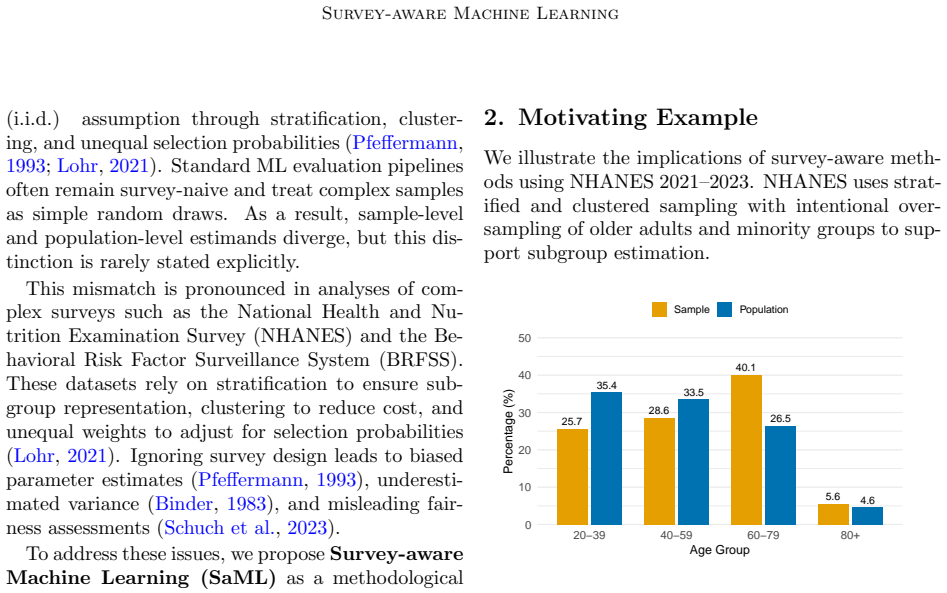
0
0
stat.ML 2026-05-11 2 theorems

Averaging trajectory errors calibrates conformal sets for diffusion models

TRACE: Transport Alignment Conformal Prediction via Diffusion and Flow Matching Models

Scalar transport-alignment scores deliver marginal coverage for complex high-dimensional outputs without likelihoods.

Figure from the paper full image
abstract click to expand
Constructing valid and informative conformal prediction regions for multi-dimensional outputs remains a fundamental challenge. While conformal prediction provides finite-sample, distribution-free coverage guarantees, its practical performance critically depends on the choice of nonconformity score. Existing approaches often rely on restrictive geometric assumptions or require explicit likelihood evaluation and invertible transformations, limiting their applicability in complex generative settings. In this work, we introduce TRACE (TRansport Alignment Conformal Estimation), a conformal prediction framework that defines nonconformity through transport alignment in diffusion and flow matching models. Rather than evaluating likelihoods, we measure how well a candidate output aligns with the learned generative dynamics by averaging denoising or velocity-matching errors along stochastic transport trajectories. The resulting transport-based scores are scalar-valued and can be calibrated using split conformal prediction, yielding valid marginal coverage under exchangeability. We further analyze the statistical properties of the proposed scores and their sensitivity to computational budget. Experiments on synthetic and real datasets demonstrate valid coverage and show that the resulting regions adapt naturally to multimodal and non-convex conditional distributions.
0
0
stat.ML 2026-05-11 Recognition

Fixed neural networks with definable layers have finite PAC sample complexity

Every Feedforward Neural Network Definable in an o-Minimal Structure Has Finite Sample Complexity

The property holds for MLPs, CNNs, GNNs and fixed-length transformers even with unbounded parameters, making learnability a baseline for

Figure from the paper full image
abstract click to expand
We show that, in a precise sense, a broad class of feedforward neural networks learn (have finite sample complexity) in the PAC model: every fixed finite feedforward architecture whose layers are definable in an o-minimal structure has finite sample complexity in the agnostic PAC setting, even with unbounded parameters. This covers standard fixed-size MLPs, CNNs, GNNs, and transformers with fixed sequence length, together with the operations and layers typically used in such architectures, including linear projections, residual connections, attention mechanisms, pooling layers, normalization layers, and admissible positional encodings. Hence, distribution-free learnability for modern non-recurrent architectures is not an exceptional property of particular activations or architecture-specific VC arguments, but a consequence of tame feedforward computation. Our results reposition finite-sample PAC learnability as a baseline rather than a differentiator: they shift the focus of architectural comparison toward inductive biases, symmetries and geometric priors, scalability, and optimization behaviour.
0
0
stat.ML 2026-05-11 Recognition

Neural method delivers valid bounds on individual causal effects

Causal EpiNets: Precision-corrected Bounds on Individual Treatment Effects using Epistemic Neural Networks

Anchored architectures and epistemic networks correct bias and constraint violations in PNS estimation from finite data.

Figure from the paper full image
abstract click to expand
Individual treatment effects are not point-identified from data. The Probability of Necessity and Sufficiency (PNS) circumvents this limitation by characterizing individual-level causality through intersection bounds derived from combined experimental and observational data. In finite samples, however, standard plug-in estimators systematically fail: they violate structural probability constraints and suffer from extremum bias induced by max-min operators, yielding spuriously narrow intervals. We propose a neural framework for finite-sample PNS estimation that resolves both pathologies. We introduce an anchored neural architecture that guarantees structural constraint satisfaction by construction. To correct extremum bias, we employ precision-corrected intersection-bound inference, leveraging Epistemic Neural Networks for scalable, high-dimensional uncertainty quantification. Empirical evaluations confirm that this approach maintains nominal coverage and exact constraint validity in high-dimensional regimes where standard estimators systematically undercover.
0
0
stat.ML 2026-05-08 2 theorems

Matrix factorization speeds LLM evaluation by orders of magnitude

An Interpretable and Scalable Framework for Evaluating Large Language Models

Reformulating item response theory as constrained subproblems yields stable estimates and item-level insights on real benchmarks.

Figure from the paper full image
abstract click to expand
Evaluation of large language models (LLMs) is increasingly critical, yet standard benchmarking methods rely on average accuracy, overlooking both the inherent stochasticity of LLM outputs and the heterogeneity of benchmark items. Item Response Theory (IRT) offers a principled framework for modeling latent model abilities and item characteristics, but conventional methods are computationally expensive and numerically unstable, limiting large-scale implementations. To address these challenges, we propose an interpretable and scalable framework for LLM evaluation based on the majorization-minimization principle. Our approach reformulates the problem as a sequence of constrained matrix factorization subproblems, enabling stable and efficient parameter estimation with theoretical guarantees for identifiability and convergence. Experiments on synthetic and real-world datasets, including MATH-500 and six Open LLM Leaderboard benchmarks, demonstrate that our method achieves superior scalability and interpretability. It delivers orders-of-magnitude speedups over competing methods while maintaining comparable or even higher estimation accuracy. Our results align with established scaling laws and offer insights into item difficulty and discrimination, informing more principled benchmark design.
0
0
stat.ML 2026-05-08 2 theorems

Quantized model swaps give agents global FDR control in novelty detection

Decentralized Conformal Novelty Detection via Quantized Model Exchange

Low-precision exchanges replace raw data sharing while preserving finite-sample conformal guarantees across heterogeneous distributions.

abstract click to expand
This work studies decentralized novelty detection with global false discovery rate (FDR) control across heterogeneous composite null distributions, without sharing the raw data due to privacy and bandwidth considerations. We propose a framework based on the exchange of quantized surrogate models, allowing independent agents to share low-precision representations of locally learned non-conformity score functions. We prove that evaluating data against these quantized composite scores preserves conditional exchangeability, providing rigorous finite-sample guarantees for global FDR control. Empirical studies on synthetic datasets confirm our theoretical results, demonstrating that the proposed approach maintains competitive statistical power while drastically reducing the communication cost.
0
0
stat.ML 2026-05-08 2 theorems

Latent model separates confounding for nonlinear IV with rich covariates

BGM-IV: an AI-powered Bayesian generative modeling approach for instrumental variable analysis

BGM-IV performs posterior inference over structured latents and uses an instrument-integrated pseudo-likelihood to correct endogeneity in a

Figure from the paper full image
abstract click to expand
Instrumental-variable (IV) regression enables causal estimation under endogeneity, but modern IV problems often involve nonlinear structural effects and high-dimensional covariates. Existing nonlinear IV methods directly learn the causal relation in observed feature space or rely on learned representations within two-stage or moment-based procedures, which can struggle when the causal information is embedded in a high-dimensional representation. We propose BGM-IV, a latent Bayesian generative modeling approach that reframes nonlinear IV regression as posterior inference in a causally structured latent space. BGM-IV infers latent components that separately capture shared confounding structure, outcome-specific variation, treatment-specific variation, and covariate-only nuisance information. To account for endogeneity, BGM-IV replaces the confounded outcome likelihood with an IV-integrated pseudo-likelihood that averages over instrument-induced treatment values within the latent model. Across various benchmark datasets, BGM-IV remains competitive in the classical low-dimensional regime and performs best in high-dimensional covariate regimes. Together, these results show that structured latent generative modeling provides a principled and effective strategy to nonlinear IV estimation with rich covariates. The code of BGM-IV is available at https://github.com/liuq-lab/BGM-IV.
0
0
stat.ML 2026-05-08 Recognition

Differentiable relaxation recovers latent partial orders from linear traces

A Differentiable Bayesian Relaxation for Latent Partial-Order Inference

Smooth surrogates for precedence and frontier checks enable gradient methods while converging to exact partial-order semantics.

Figure from the paper full image
abstract click to expand
Many ranking and agent trace datasets are recorded as linear orders even though their latent structure is only partially ordered. This is especially common in agent and workflow traces, where observed order may reflect arbitrary linearization rather than true prerequisites. We introduce a differentiable relaxation for latent partial-order inference from such traces. Starting from a hard frontier-constrained model of noisy linear extensions, we replace discontinuous product-order precedence and binary frontier feasibility with smooth surrogates, yielding a continuous posterior that preserves closure-level partial-order semantics and supports gradient-based MCMC and variational inference. We prove soft transitivity, sharp-limit frontier recovery, and convergence to the hard likelihood. Experiments on synthetic data, records of social dominance relations, and cloud-agent traces show close posterior fidelity to hard MCMC on small instances and improved runtime--accuracy trade-offs on larger problems.
0
0
stat.ML 2026-05-08 Recognition

ABGD recovers piecewise linear models with near-minimax samples

Locally Near Optimal Piecewise Linear Regression in High Dimensions via Difference of Max-Affine Functions

Linear convergence needs order d times (noise/epsilon)^2 samples under sub-Gaussian assumptions.

Figure from the paper full image
abstract click to expand
This paper presents a parametric solution to piecewise linear regression through the Adaptive Block Gradient Descent (ABGD) algorithm. The heart of the method is the parametrization of piecewise linear functions as the difference of max-affine (DoMA) functions. A non-asymptotic local convergence analysis for ABGD is provided under sub-Gaussian covariate and noise distributions. To initialize ABGD, we adapt a prior algorithm originally developed for the simpler setting of max-affine functions. When suitably initialized, ABGD converges linearly to an $\epsilon$-accurate estimate given $\tilde{\mathcal{O}}(d\max(\sigma_z/\epsilon,1)^2)$ observations where $\sigma_z^2$ denotes the noise variance. This implies exact recovery given $\tilde{\mathcal{O}}(d)$ samples in the noiseless case. Also, such a rate is shown to be minimax optimal up to logarithmic factors. Synthetic numerical results corroborate the theoretical guarantees for ABGD. We also observe competitive performance compared to the state-of-the-art methods on real-world datasets.
0
0
stat.ML 2026-05-08 2 theorems

Complexity penalty lets MMD tests optimize kernels without grids

Kernel Selection is Model Selection: A Unified Complexity-Penalized Approach for MMD Two-Sample Tests

CP-MMD absorbs optimization cost so the test can maximize power over continuous families including deep networks while keeping unconditional

Figure from the paper full image
abstract click to expand
The Maximum Mean Discrepancy (MMD) is a cornerstone statistic for nonparametric two-sample testing, but its test power is dictated entirely by the chosen kernel. Because any fixed kernel inherently fails to distinguish certain distributions, the kernel must be dynamically optimized. However, data-driven optimization violates the foundational i.i.d. assumption, forcing a strict trade-off in existing frameworks. Ratio criteria ignore this dependence, inducing overfitting and variance collapse on rich kernel classes. Conversely, aggregation methods bypass the dependence using finite grids, but this strategy cannot scale to continuous search spaces like deep kernels. To break this dichotomy, we establish data-driven kernel selection as a model selection problem. We propose Complexity-Penalized MMD (CP-MMD), a criterion derived by applying the two-sample uniform concentration inequality of preceding works to the post-optimization MMD problem. The resulting penalty bounds the empirical MMD by the complexity of the kernel search space, mathematically absorbing the cost of optimization, so that CP-MMD enables direct, grid-free maximization over continuous parametric classes, including scalar bandwidths, polynomial feature bandwidths, and deep network parameters. By formally accounting for optimization complexity, we prove that CP-MMD maximizes true test power while ensuring unconditional Type-I validity. Consequently, CP-MMD enables grid-free kernel selection across linear, polynomial-feature, and deep regimes, matching or exceeding state-of-the-art test power.
0
0
stat.ML 2026-05-08 2 theorems

Neural operators approximate conditioning for any joint density

One Operator for Many Densities: Amortized Approximation of Conditioning by Neural Operators

Continuity of the conditioning map lets one model handle many distributions, supporting general amortized Bayesian tools.

Figure from the paper full image
abstract click to expand
Probabilistic conditioning is concerned with the identification of a distribution of a random variable $X$ given a random variable $Y$. It is a cornerstone of scientific and engineering applications where modeling uncertainty is key. This problem has traditionally been addressed in machine learning by directly learning the conditional distribution of a fixed joint distribution. This paper introduces a novel perspective: we propose to solve the conditioning problem by identifying a single operator that maps any joint density to its conditional, thus amortizing over joint-conditional pairs. We establish that the conditioning operator can be approximated to arbitrary accuracy by neural operators. Our proof relies on new results establishing continuity of the conditioning operator over suitable classes of densities. Finally, we learn the conditioning map for a class of Gaussian mixtures using neural operators, illustrating the promise of our framework. This work provides the theoretical underpinnings for general-purpose, amortized methods for probabilistic conditioning, such as foundation models for Bayesian inference.
0
0
stat.ML 2026-05-08 Recognition

Neural operator approximates conditioning for any joint density

One Operator for Many Densities: Amortized Approximation of Conditioning by Neural Operators

Proves continuity of the map from joint to conditional densities to justify a single learned operator for many distributions

Figure from the paper full image
abstract click to expand
Probabilistic conditioning is concerned with the identification of a distribution of a random variable $X$ given a random variable $Y$. It is a cornerstone of scientific and engineering applications where modeling uncertainty is key. This problem has traditionally been addressed in machine learning by directly learning the conditional distribution of a fixed joint distribution. This paper introduces a novel perspective: we propose to solve the conditioning problem by identifying a single operator that maps any joint density to its conditional, thus amortizing over joint-conditional pairs. We establish that the conditioning operator can be approximated to arbitrary accuracy by neural operators. Our proof relies on new results establishing continuity of the conditioning operator over suitable classes of densities. Finally, we learn the conditioning map for a class of Gaussian mixtures using neural operators, illustrating the promise of our framework. This work provides the theoretical underpinnings for general-purpose, amortized methods for probabilistic conditioning, such as foundation models for Bayesian inference.
0
0
stat.ML 2026-05-08 Recognition

Attention weights follow top eigenvector of position matrix to maximize signal recovery

How Does Attention Help? Insights from Random Matrices on Signal Recovery from Sequence Models

High-dimensional analysis shows causal self-attention yields harmonic weights that beat mean pooling when early tokens hold more signal.

Figure from the paper full image
abstract click to expand
We study the spectral properties of sample covariance matrices constructed from pooled sequence representations, where token embeddings are drawn from a fixed two-class Gaussian mixture table and pooled via (fixed) attention weights. Working in the high-dimensional regime $d,V,N\to\infty$ with $d/V\to\delta$ and $d/N\to\gamma$, we derive exact characterizations of the limiting eigenvalue distribution, outlier eigenvalues, and eigenvector alignment with the hidden signal. The bulk spectrum follows a non-Marchenko--Pastur law given by the free multiplicative convolution $\kappa(MP_\delta\boxtimes MP_\gamma)$, reflecting the finite vocabulary structure. Signal recovery undergoes two successive BBP-type phase transitions characterized by the scalars: $\delta,\gamma,\alpha=w^{\top} R w$ and $\kappa=\|w\|^2$, where $w$ denotes the attention pooling weights and $R$ the positional correlation matrix. An aftermath of our analysis demonstrates that the optimal attention weights maximizing the signal-to-noise ratio $\alpha/\kappa$ are given by the (normalized) top eigenvector of $R$, and we show (as a particular case of our analysis) that parameter-free causal self-attention with $\tau/d$ score scaling yields deterministic harmonic weights that improve signal recovery over mean pooling whenever early tokens carry more signal. Extensive simulations confirm sharp agreement between theory and finite-dimensional experiments.
0
0
stat.ML 2026-05-08

Adaptive covariate selection preserves RCT validity under budget limits

DARTS: Targeting Prognostic Covariates in Budget-Constrained Sequential Experiments

DARTS uses Thompson sampling across batches to focus measurements on prognostic features while maintaining asymptotic coverage for treatment

Figure from the paper full image
abstract click to expand
Randomized controlled trials typically assume that prognostic covariates are known and available at no cost. In practice, obtaining high-dimensional pretreatment data is costly, forcing a trade-off between covariate-adaptive precision and a measurement budget. We introduce Dynamic Adaptive Rerandomization via Thompson Sampling (DARTS), which treats covariate acquisition as a sequential optimization problem embedded within a design-based causal inference task. A budgeted combinatorial Thompson sampler learns which covariates are most prognostic across successive batches; selected covariates then drive rerandomization and regression adjustment to reduce batch-level average treatment effect variance. Our primary theoretical contribution is a decoupling result: adaptive covariate selection based on past batches preserves batch-level randomization validity, and the cumulative inverse-variance weighted estimator achieves at least nominal asymptotic coverage. We further derive a Bayes risk bound for the acquisition layer that matches the minimax lower bound up to logarithmic factors. Empirically, DARTS systematically concentrates the budget on informative features, significantly closing the efficiency gap to oracle designs while maintaining strict inferential validity.
0
0
stat.ML 2026-05-08

Adaptive network targeting outperforms static methods via Ising-RL

Dynamic Treatment on Networks

Estimating adoption dynamics from one panel and learning policies offline produces regret bounds that separate error sources and capture how

Figure from the paper full image
abstract click to expand
In networks, effective dynamic treatment allocation requires deciding both whom to treat and also when, so as to amplify policy impact through spillovers. An early intervention at a well-connected node can trigger cascades that change which nodes are worth targeting in the next period. Existing treatment strategies under network interference are largely static while dynamic treatment frameworks typically ignore network structure altogether. We integrate these perspectives and propose Q-Ising, a three-stage pipeline that (i) estimates network adoption dynamics via a Bayesian dynamic Ising model from a single observed panel, (ii) augments treatment adoption histories with continuous posterior latent states, and (iii) learns a dynamic policy via offline reinforcement learning. The Bayesian mechanism enables uncertainty quantification over dynamic decisions, yielding posterior ensemble policies with interpretable spillover estimates. We provide a finite-sample regret upper bound that decomposes into standard offline-RL uncertainty, network abstraction error, and first stage error in Ising state estimation. We apply our method to data from Indian village microfinance networks and synthetic stochastic block models under simulated heterogeneous susceptible-infected-susceptible (SIS) dynamics and demonstrate that adaptive targeting outperforms static centrality benchmarks.
0
0
stat.ML 2026-05-08

Threshold post-processing meets risk constraints with minimal baseline change

Risk-Controlled Post-Processing of Decision Policies

The rule switches to fallback only where risk reduction is large, yielding O(log n/n) excess risk and exact control with safe fallbacks.

Figure from the paper full image
abstract click to expand
Predictive models are often deployed through existing decision policies that stakeholders are reluctant to change unless a risk constraint requires intervention. We study risk-controlled post-processing: given a deterministic baseline policy, choose a new policy that maximizes agreement with the baseline subject to a chance constraint on a user-specified loss. At the population level, we show that the optimal policy has a threshold structure: it follows the baseline except on contexts where switching to the oracle fallback policy yields a large reduction in conditional violation risk. At the finite-sample level, given a fitted fallback policy and score, we develop a post-processing algorithm that uses calibration data to select a threshold. Leveraging tools from algorithmic stability and stochastic processes, we show that under regularity conditions, in the i.i.d. setting, the expected excess risk of the post-processed policy is $O(\log n/n)$. In the special case when an exact-safe fallback policy is available, the algorithm achieves precise expected risk control under exchangeability. In this setting, we also give high-probability near-optimality guarantees on the post-processed policy. Experiments on a COVID-19 radiograph diagnosis task, an LLM routing problem, and a synthetic multiclass decision task show that targeted post-processing can meet or nearly meet risk budgets while preserving substantially more agreement with the baseline than score-blind random mixing.
0

browse all of stat.ML โ†’ full archive ยท search ยท sub-categories