Search of cluster structure in nuclei via analysis of bremsstrahlung emission
Pith reviewed 2026-05-24 19:40 UTC · model grok-4.3
The pith
Bremsstrahlung spectra in alpha-nucleus scattering yield inelastic amplitudes whose maxima mark energies of the most compact cluster states inside the target nuclei.
A machine-rendered reading of the paper's core claim, the machinery that carries it, and where it could break.
Core claim
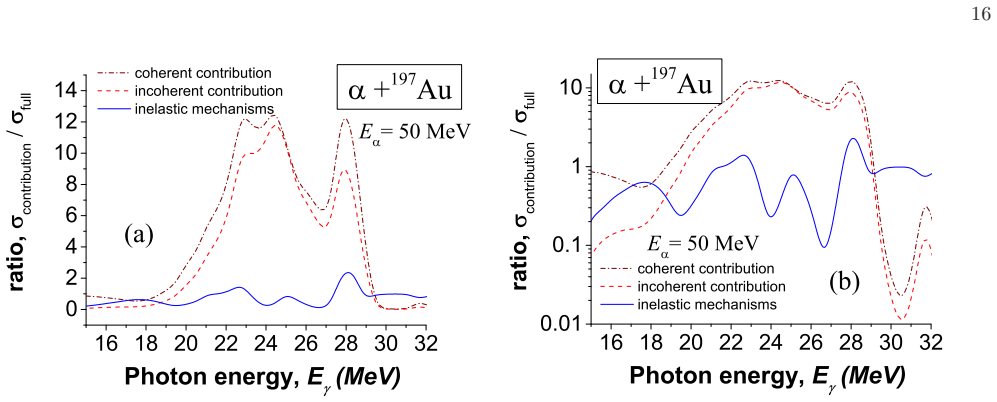
The amplitude of the new inelastic mechanisms, obtained by fitting the difference between measured bremsstrahlung spectra and the calculated elastic contribution, exhibits maxima at selected energies; these maxima are interpreted as direct evidence for the existence of states corresponding to the most compact cluster structures in the target nucleus.
What carries the argument
The added inelastic scattering mechanisms whose unknown amplitude is extracted from the residual between data and the coherent-plus-incoherent elastic bremsstrahlung calculation.
If this is right
- Oscillations observed in elastic bremsstrahlung spectra are produced by interference between coherent and incoherent photon emission amplitudes.
- For nuclei lighter than gold the elastic calculation already reproduces the full measured spectrum across the photon energy range.
- For gold the summed coherent, incoherent and inelastic contributions achieve only satisfactory agreement, indicating that further refinements of the inelastic terms are still needed.
- The positions of the amplitude maxima supply quantitative information on the excitation energies of the compact cluster states.
Where Pith is reading between the lines
- The method could be repeated on other alpha or heavy-ion scattering data sets to map cluster-state energies across the nuclear chart without requiring direct cluster-decay measurements.
- If the maxima correspond to specific cluster configurations, their energies should correlate with known alpha or deuteron separation energies in the same nuclei.
- The approach supplies an independent observable (bremsstrahlung amplitude) that can be combined with transfer-reaction or breakup data to constrain cluster wave functions.
Load-bearing premise
Any mismatch left after the elastic coherent and incoherent terms are subtracted is caused by cluster-related inelastic processes rather than by incompleteness in the elastic model itself.
What would settle it
Recompute the extracted inelastic amplitude using an independent elastic bremsstrahlung calculation that includes additional higher-order or relativistic corrections; if the maxima disappear or shift outside the reported energies, the cluster interpretation is falsified.
Figures




read the original abstract
We investigate emission of bremsstrahlung photons during scattering of $\alpha$-particles off nuclei. For that, we construct bremsstrahlung model for $\alpha$-nucleus scattering, where a new formalism for coherent and incoherent bremsstrahlung emissions in elastic scattering and mechanisms in inelastic scattering is added. Basing of this approach, we analyze experimental bremsstrahlung cross-sections in the scattering of $\alpha$-particles off the \isotope[59]{Co}, \isotope[116]{Sn}, \isotope[\rm nat]{Ag} and \isotope[197]{Au} nuclei at 50 MeV of $\alpha$-particles beam measured at the Variable Energy Cyclotron Centre, Calcutta. We observe oscillations in the calculated spectra for elastic scattering for each nucleus. But, for \isotope[59]{Co}, \isotope[116]{Sn} and \isotope[\rm nat]{Ag} we obtain good agreement between calculated coherent spectrum with incoherent contribution for elastic scattering with experimental data in the full photon energy region. For heavy nucleus \isotope[197]{Au} we find that (1) Oscillating behavior of the calculated spectrum of coherent emission in elastic scattering is in disagreement with experimental data, (2) Inclusion of incoherent emission improves description of the data, but summarized spectrum is in satisfactory agreement with the experimental data. To understand unknown modification of wave function for scattering, we add new mechanisms of inelastic scattering to calculations and extract information about unknown new amplitude of such mechanisms from experimental data analysis. This amplitude has maxima at some energies, that characterizes existence of states of the most compact structures (clusters) in nucleus-target. We explain origin of oscillations in the bremsstrahlung spectra for elastic scattering (at first time). New information about coherent and incoherent contributions is extracted for studied reactions.
Editorial analysis
A structured set of objections, weighed in public.
Referee Report
Summary. The manuscript develops a bremsstrahlung model for α-nucleus scattering that incorporates new formalisms for coherent and incoherent photon emission during elastic scattering together with additional mechanisms for inelastic scattering. Experimental bremsstrahlung cross sections are analyzed for α + 59Co, 116Sn, natAg and 197Au at 50 MeV. For the three lighter targets the coherent spectrum plus incoherent contribution reproduces the data across the full photon-energy range. For 197Au the coherent spectrum exhibits oscillations that disagree with experiment; inclusion of the incoherent term improves the description to a level described as satisfactory. Residual discrepancies are then attributed to new inelastic mechanisms whose energy-dependent amplitude is extracted by fitting to the data; maxima in this amplitude are interpreted as signatures of compact cluster states in the target nucleus. The origin of the oscillations in the elastic spectra is also explained.
Significance. If the extracted amplitude maxima can be shown to be robust and to align with independent cluster-structure calculations, the approach would supply a new experimental handle on nuclear clustering via bremsstrahlung. The separation of coherent and incoherent contributions and the account of spectral oscillations constitute concrete technical advances. At present, however, the central claim rests on a fitted amplitude whose features have not been tested for stability against variations in the base elastic model or confronted with external cluster predictions, limiting the immediate significance.
major comments (2)
- [197Au analysis] Abstract and § on 197Au results: the coherent spectrum for 197Au is stated to oscillate in disagreement with data; after the incoherent term is added the agreement is only 'satisfactory.' The residual is then used to determine the new inelastic amplitude whose maxima are interpreted as cluster signatures. No sensitivity study is reported that varies the coherent/incoherent parameters or formalism within their uncertainties to check whether the locations or widths of those maxima remain stable.
- [Amplitude extraction and interpretation] Interpretation of the new amplitude (abstract and concluding section): the maxima are said to 'characterize existence of states of the most compact structures (clusters).' No comparison is performed to any cluster-model calculation that would predict the energies or widths of such maxima, nor is any external experimental signature of clusters invoked. Because the amplitude is introduced as a free function adjusted directly to the same data set, the reported maxima are defined by the fit rather than by an a-priori derivation.
minor comments (2)
- [Abstract and elastic-scattering discussion] The abstract asserts that the origin of oscillations is explained 'at first time,' yet the main text would benefit from a dedicated subsection that isolates the physical mechanism responsible for the oscillations and contrasts it with earlier treatments.
- [Model description] Notation for the new inelastic amplitude is introduced without an explicit functional form or fitting procedure; a short appendix or paragraph detailing the parametrization and the χ² minimization would improve reproducibility.
Simulated Author's Rebuttal
We thank the referee for the thorough review and valuable comments on our manuscript. We address each major comment below.
read point-by-point responses
-
Referee: [197Au analysis] Abstract and § on 197Au results: the coherent spectrum for 197Au is stated to oscillate in disagreement with data; after the incoherent term is added the agreement is only 'satisfactory.' The residual is then used to determine the new inelastic amplitude whose maxima are interpreted as cluster signatures. No sensitivity study is reported that varies the coherent/incoherent parameters or formalism within their uncertainties to check whether the locations or widths of those maxima remain stable.
Authors: We acknowledge the absence of a sensitivity study in the original work. To address this, we will include in the revised manuscript a sensitivity analysis varying the coherent and incoherent parameters within their uncertainties. This will demonstrate the stability of the extracted amplitude maxima. revision: yes
-
Referee: [Amplitude extraction and interpretation] Interpretation of the new amplitude (abstract and concluding section): the maxima are said to 'characterize existence of states of the most compact structures (clusters).' No comparison is performed to any cluster-model calculation that would predict the energies or widths of such maxima, nor is any external experimental signature of clusters invoked. Because the amplitude is introduced as a free function adjusted directly to the same data set, the reported maxima are defined by the fit rather than by an a-priori derivation.
Authors: It is correct that the new amplitude is determined by fitting to the experimental data and that no comparison with cluster-model calculations is provided. The interpretation is based on the positions of the maxima in this fitted amplitude. We will revise the text to emphasize the phenomenological character of the extraction and to note that direct comparisons with theoretical predictions would be a valuable extension of this work. revision: partial
Circularity Check
Fitted inelastic amplitude maxima interpreted as cluster states without independent prediction
specific steps
-
fitted input called prediction
[Abstract]
"To understand unknown modification of wave function for scattering, we add new mechanisms of inelastic scattering to calculations and extract information about unknown new amplitude of such mechanisms from experimental data analysis. This amplitude has maxima at some energies, that characterizes existence of states of the most compact structures (clusters) in nucleus-target."
The new amplitude is extracted by fitting to the experimental bremsstrahlung data for the same reactions; its energy-dependent maxima are then presented as direct evidence for the existence of compact cluster states in the target nuclei, making the claimed cluster signature a constructed output of the fit rather than an independent prediction.
full rationale
The paper derives a bremsstrahlung model for elastic scattering (coherent + incoherent) and obtains reasonable agreement for lighter nuclei, with an explanation for oscillations. For 197Au the elastic calculation disagrees, so an additional inelastic amplitude is introduced as a free function and adjusted to the data. The maxima of this fitted amplitude are then stated to characterize compact cluster states. This interpretive step reduces directly to the fitting procedure on the target data rather than to an a priori cluster-model calculation or external benchmark, satisfying the fitted-input-called-prediction pattern. The elastic formalism itself does not appear circular, so the overall circularity is partial and limited to the cluster claim.
Axiom & Free-Parameter Ledger
free parameters (1)
- new inelastic amplitude
invented entities (1)
-
compact cluster states
no independent evidence
Reference graph
Works this paper leans on
-
[1]
In general, calculations of the coherent bremsstrahlung for th e elastic α-nucleus scattering at the different expansions of wave function of photons does not describe experim ental data well
-
[2]
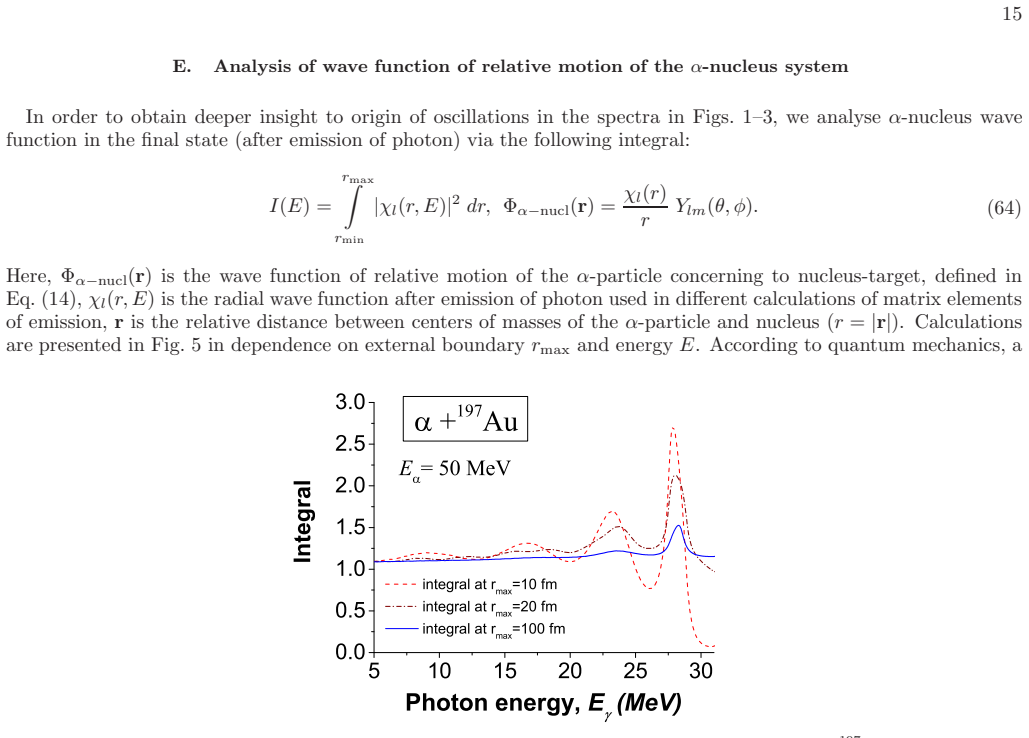
In the multipole approach we see clear existence of oscillations with maxima in the spectra. In order to under- stand why such maxima are appeared, we repeat calculations, using dipole approach (see also [107]) instead of multipole one. Such calculations are shown in Fig. 1 by the green dashe d line. Once again, we do not reach good description of the exp...
-
[3]
In calculations above, we normalized wave function for scatterin g in the state after emission of photons related to δ-function, as for scattering in quantum mechanics [see Eqs. (21.9) and (21.11) in Ref. [106], p. 89–90]. But, we can change this normalization, where we require that flux of the in cident α-particles on the barrier should be fixed (i.e. the ...
-
[4]
One can suppose that maximums in the spectra could reflect poss ible effects from resonant scattering. But, resonant and potential components of full scattering are include d to wave functions in our calculations. So, we have taken into account interference between such two effects a lso. But, it is not enough for good description of experimental data. We co...
work page 1993
-
[5]
To estimate coherent bremsstrahlung contribution in elastic sca ttering in description of experimental data
-
[6]
To add incoherent contribution in elastic scattering to calculation s, to find free parameter f1, at which agreement between calculated full spectrum and experimental data will be the best
-
[7]
We apply such a receipt for analysis of reaction with 197Au
To add inelastic mechanisms to calculations, to extract informatio n about them from analysis of experimental data. We apply such a receipt for analysis of reaction with 197Au. Results of such calculations for the elastic scattering of α-particles off the 197Au nuclei are presented in Fig. 3. Conclusion from analysis of such results is the following. Inclu...
work page 1993
-
[8]
We take into account that function ψα,s(βα) is dependent of variables ραn (i.e
Calculations for the matrix elements M∆E and M∆M We substitute explicit representation (B1) for wave function F (r, βA, βα) to the matrix elements M∆E and M∆M in form (B7) and (B8) and rewrite integration over variable r explicitly. We take into account that function ψα,s(βα) is dependent of variables ραn (i.e. it is not dependent on variables ρAm), as th...
-
[9]
Calculations for the matrix elements Mk For Mk we obtained solution (B6): Mk = i ¯h (2π)3δ(Kf − Ki − kph) · ∑ α=1,2 [ kph × e(α)] ∫ Φ∗ α− nucl,f(r) × × { e− i cA kphr Dα, k + ei cα kphr DA, k } ·Φα− nucl,i(r) dr, (C9) where Dα, k = 4∑ i=1 µ(an) i ⣨ ψα,f (βα) ⏐ ⏐ ⏐ e− i kphραi σ ⏐ ⏐ ⏐ ψα,i(βα) ⟩ , DA, k = A∑ j=1 µ(an) j ⣨ ψA,f (βA) ⏐ ⏐ ⏐ e− i kphρAj σ ⏐ ⏐ ...
-
[10]
Calculations for the matrix elements MP For MP we obtained solution (B10): MP = ¯h (2π)3δ(Kf − Ki − kph) · 1 mA + mα ∑ α=1,2 ∫ Φ∗ α− nucl,f(r) × × { 2 µN mp [ e− i cA kphrDα,P el + ei cα kphrDA,P el ] e(α) ·Ki+ + i [ e− i cA kphr Dα,P mag + ei cα kphr DA,P mag ] · [ Ki × e(α)]} ·Φα− nucl,i(r) dr, (C11) where Dα,P el = 4∑ i=1 zi ⣨ ψα,f (βα) ⏐ ⏐ ⏐ e− i kphρ...
-
[11]
Effective electric charge and effective magnetic moment of the full system Following to logics in Ref. [2], we introduce effective electric charge and effective magnetic moment of the full α-nucleus system [see Eqs. (30)–(35) in that paper] as Zeff (kph, r) = ei kphr [ e− i cAkphr mA mα + mA Fα, el − ei cαkphr mα mα + mA FA, el ] , Meff (kph, r) = ei kphr [ e− ...
-
[12]
For such solutions and taking into account e(α) ·kph = 0 (as ortogonality of vectors e(α) and kph), we obtain: e(α) ·Dα1, el = 0, e(α) ·DA1, el = 0. (F12)
-
[13]
(F13) Appendix G: Matrix elements on moments of nucleons of nucleu s
At tending energy of photon to zero DA1, el tends to zero (in contrast to ZA(kph = 0)): Dα1, el → 0, DA1, el → 0 at k → 0. (F13) Appendix G: Matrix elements on moments of nucleons of nucleu s. II Finally, we will find the second two matrix elements Dα2, el and DA2, el (C7), which include momenta of nucleons of the α-particle and nucleus: Dα2, el = 4∑ i=1 z...
-
[14]
S. P. Maydanyuk, P.-M. Zhang, and L.-P. Zou, Nucleon microscopy in proton-nucleus scattering via analy sis of bremsstrahlung emission, Phys. Rev. C 99 , 064602 (2019); arXiv:1812.07180
work page internal anchor Pith review Pith/arXiv arXiv 2019
-
[15]
X. Liu, S. P. Maydanyuk, P.-M. Zhang, and L. Liu, First investigation of hypernuclei in reactions via analys is of emitted bremsstrahlung photons, Phys. Rev. C 99 , 064614 (2019); arXiv:1810.11942
work page internal anchor Pith review Pith/arXiv arXiv 2019
-
[16]
P. Gl¨ assel, R. Schmidt-Fabian, D. Schwalm, D. Habs, and H. V. Helmdt, Nucl. Phys. A502, 315c (1989)
work page 1989
-
[17]
S. J. Luke, C. A. Gossett, and R. Vandenbosch, Search for high energy γ rays from spontaneos fission of 252Cf, Phys. Rev. C44 (4), 1548 (1991)
work page 1991
-
[18]
H. van der Ploeg, R. Postma, J. C. Bacelar, T. van den Berg, V. E. Iacob, J. R. Jongman, and A. van der Woude, Large gamma anisotropy observed in the 252Cf spontaneous-fission process, Phys. Rev. Lett. 68 (21), 3145 (1992). 30
work page 1992
-
[19]
D. J. Hofman, B. B. Back, C. P. Montoya, S. Schadmand, R. Va rma, and P. Paul, High energy γ rays from 252Cm spontaneos fission, Phys. Rev. C47 (3), 1103 (1993)
work page 1993
-
[20]
H. van der Ploeg, J. C. S. Bacelar, A. Buda, C. R. Laurens, a nd A. van der Woude, Emission of photons in spontaneous fission of 252Cf, Phys. Rev. C52 (4), 1915 (1995)
work page 1915
- [21]
-
[22]
Coherent bremsstrahlung and GDR width from 252Cf cold fission
D. Pandit, S. Mukhopadhyay, S. Bhattacharya, S. Pal, A. D e, and S. R. Banerjee, Coherent bremsstrahlung and GDR width from 252Cf cold fission, Phys. Lett. B 690 , 473–476 (2010); arXiv:0912.4578
work page internal anchor Pith review Pith/arXiv arXiv 2010
- [23]
-
[24]
V. A. Varlachev, G. N. Dudkin, V. N. Padalko, Bull. Russ. Acad. Sci.: Phys. 71 (11), 1635–1639 (2007)
work page 2007
-
[25]
N. V. Eremin, et al., Int. J. Mod. Phys. E 19, 1183 (2010)
work page 2010
- [26]
-
[27]
P. F. M. Koehler, K. W. Rothe, and E. H. Thorndike, Phys. R ev. Lett. 18, 933 (1967)
work page 1967
-
[28]
M. Kwato Njock, M. Maurel, H. Nifenecker, J. Pinston, F. Schussler, D. Barneoud, S. Drissi, J. Kern, and J. P. Vorlet, Phys. Lett. B207, 269 (1988)
work page 1988
-
[29]
J. A. Pinston, D. Barneoud, V. Bellini, S. Drissi, J. Gui llot, J. Julien, M. Kwato Njock, H. Nifenecker, M. Maurel, F. Schussler, and J. P. Vorlet, Phys. Lett. B 218 , 128 (1989)
work page 1989
-
[30]
J. A. Pinston, D. Barneoud, V. Bellini, S. Drissi, J. Gui llot, J. Julien, H. Nifenecker, and F. Schussler, Phys. Lett . B 249, 402 (1990)
work page 1990
-
[31]
J. Clayton, W. Benenson, M. Cronqvist, R. Fox, D. Krofch eck, R. Pfaff, M. F. Mohar, C. Bloch, D. E. Fields, Phys. Rev. C45, 1815 (1992)
work page 1992
-
[32]
V. A. Pluyko and V. A. Poyarkov, Bremsstrahlung in reactions induced by protons , Phys. Elem. Part. At. Nucl. 18 (2), 374–418 (1987)
work page 1987
-
[33]
V. V. Kamanin, A. Kugler, Yu. E. Penionzhkevich, I. S. Ba tkin, and I. V. Kopytin, High-energy gamma-ray emission in heavy-ion reactions at nonrelativistic energies , Phys. Elem. Part. At. Nucl. 20 (4), 741–829 (1989)
work page 1989
-
[34]
J. E. Clayton, High energy gamma ray production in proton induced reaction s at energies of 104, 145, and 195 MeV , PhD thesis (Michigan State University, 1991)
work page 1991
-
[35]
D. R. Chakrabarty, V. M. Datar, Y. K. Agarwal, C. V. K. Bab a, M. S. Samant, I. Mazumdar, A. K. Sinha, and P. Sugathan, Phys. Rev. C60, 024606 (1999)
work page 1999
-
[36]
M. J. van Goethem, L. Aphecetche, J. C. S. Bacelar, H. Del agrange, J. Diaz, D. d’Enterria, M. Hoefman, R. Holzmann, H. Huisman, N. Kalantar-Nayestanaki, A. Kugler, H. L¨ ohner , G. Martinez, J. G. Messchendorp, R. W. Ostendorf, S. Schadmand, R. H. Siemssen, R. S. Simon, Y. Schutz, R. Turri si, M. Volkerts, V. Wagner, and H. W. Wilschut, Suppresion of sof...
work page 2002
-
[37]
K. Nakayama, G. Bertsch, High energy photon production in nuclear collisions , Phys. Rev. C34 (6), 2190 (1986)
work page 1986
-
[38]
Nakayama, High-energy photons in neutron-proton and proton-nucleus collisions, Phys
K. Nakayama, High-energy photons in neutron-proton and proton-nucleus collisions, Phys. Rev. C39 (4), 1475–1487 (1989)
work page 1989
- [39]
- [40]
-
[41]
V. Herrmann, J. Speth, K. Nakayama, Nucleon-nucleon bremsstrahlung at intermediate energies , Phys. Rev. C43 (2), 394–415 (1991)
work page 1991
-
[42]
M. K. Liou, and Z. M. Ding, Phys. Rev. C35 (2), 651 (1987)
work page 1987
-
[43]
M. K. Liou, D. Lin, and B. F. Gibson, Phys. Rev. C47, 973 (1993)
work page 1993
-
[44]
M. K. Liou, R. Timmermans, and B. F. Gibson, Phys. Lett. B345, 372 (1995)
work page 1995
-
[45]
M. K. Liou, R. Timmermans, and B. F. Gibson, Phys. Lett. B355, 606(E) (1995)
work page 1995
-
[46]
M. K. Liou, R. Timmermans, and B. F. Gibson, Phys. Rev. C54 (4), 1574–1584 (1996)
work page 1996
-
[47]
Yi Li, M. K. Liou, and W. M. Schreiber, Phys. Rev. C57, 507 (1998)
work page 1998
-
[48]
Yi Li, M. K. Liou, R. Timmermans, and B. F. Gibson, Phys. R ev. C58, R1880 (1998)
work page 1998
-
[49]
R. G. E. Timmermans, B. F. Gibson, Yi Li, and M. K. Liou, Ph ys. Rev. C65, 014001 (2001) [15 p.]
work page 2001
-
[50]
M. K. Liou, T. D. Penninga, R. G. E. Timmermans, and B. F. G ibson, Phys. Rev. C69, 011001 (2004)
work page 2004
-
[51]
Y. Li, M. K. Liou, and W. M. Schreiber, Phys. Rev. C72, 024005 (2005)
work page 2005
-
[52]
R. G. E. Timmermans, T. D. Penninga, B. F. Gibson, and M. K . Liou, Phys. Rev. C73, 034006 (2006)
work page 2006
-
[53]
Yi Li, M. K. Liou, W. M. Schreiber, and B. F. Gibson, Phys. Rev. C84, 034007 (2011) [10 p.]
work page 2011
-
[54]
S. D. Kurgalin, Yu. M. Chuvilskiy, and T. A. Churakova, I zv. Acad. Nauk: Ser. Fiz. 65, 672 (2001) [in Russian]
work page 2001
-
[55]
B. Buck, A. C. Merchant, and S. M. Perez, Half-lives of favored alpha decays from nuclear ground stat es, Atom. Data Nucl. Data Tables 54 (1), 53–74 (1993)
work page 1993
-
[56]
Y. A. Akovali, Review of alpha-decay data from doubly-even nuclei , Nucl. Data Sheets 84 (1), 1–114 (1998)
work page 1998
-
[57]
S. B. Duarte, O. A. P. Tavares, F. Guzman, A. Dimarco, et a l., Half-lives of favored alpha decays from nuclear ground states, Atom. Data Nucl. Data Tables 80 (2), 235–299 (2002)
work page 2002
-
[58]
G. Audi, O. Bersillon, J. Blachot, and A. H. Wapstra, The NUBASE evaluation of nuclear and decay properties , Nucl. Phys. A 729 (1), 3–128 (2003)
work page 2003
-
[59]
N. Dasgupta-Schubert and M. A. Reyes, The generalized liquid drop model alpha-decay formula: Pre dictability analysis and superheavy element alpha half-lives , Atom. Data Nucl. Data Tables 93 (6), 907–930 (2007)
work page 2007
-
[60]
I. Silisteanu and A. I. Budaca, Structure and alpha-decay properties of the heaviest nucle i, Atom. Data Nucl. Data Tables 98 (6), 1096–1108 (2012). 31
work page 2012
-
[61]
R. G. Lovas, R. J. Liotta, A. Insolia, K. Varga, and D. S. D elion, Microscopic theory of cluster radioactivity , Phys. Rep. 294 (5), 265–362 (1998)
work page 1998
-
[62]
A. Sobiczewski and K. Pomorski, Description of structure and properties of superheavy nucl ei, Prog. Part. Nucl. Phys. 58, 292–349 (2007)
work page 2007
-
[63]
V. Yu. Denisov and A. A. Khudenko, α decay half-lives, α capture, and α nucleus potential , Atom. Data Nucl. Data Tables 95 (6), 815–835 (2009)
work page 2009
-
[64]
V. Yu. Denisov, O. I. Davidovskaya, and I. Yu. Sedykh, Improved parametrization of the unified model for α decay and α capture, Phys. Rev. C 92 , 014602 (2015)
work page 2015
-
[65]
T. L. Stewart, M. W. Kermode, D. J. Beachey, N. Rowley, I. S. Grant, A. T. Kruppa, Alpha-particle decay through a deformed barrier, Nucl. Phys. A 611 (2–3), 332–354 (1996)
work page 1996
-
[66]
C. Xu, Z. Ren, New deformed model of alpha-decay half-lives with a microsc opic potential, Phys. Rev. C 73 (4), 041301(R) (2006)
work page 2006
-
[67]
R. Id Betan and W. Nazarewicz, α Decay in the complex-energy shell model , Phys. Rev. C 86 , 034338 (2012)
work page 2012
-
[68]
D. S. Delion and R. J. Liotta, Shell-model representation to describe alpha emission , Phys. Rev. C 87 (4), 041302(R) (2013)
work page 2013
-
[69]
I. Silisteanu and C. I. Anghel, Alpha-decay and spontaneous fission half-lives of super-he avy nuclei around the double magic nucleus 270Hs, Rom. J. Phys. 60, 444–451 (2015)
work page 2015
-
[70]
C. I. Anghel and I. Silisteanu, α decay and spontaneous fission half-lives of nuclei around 270Hs, Phys. Rev. C95 (3), 034611 (2017)
work page 2017
-
[71]
http://www.nndc.bnl.gov, http://www-nds.iaea.org
-
[72]
A. I. Ahiezer and V. B. Berestetskii, Kvantovaya Elektrodinamika (Nauka, Mockva, 1981) p. 432 — [in Russian]
work page 1981
-
[73]
S. P. Maydanyuk and V. S. Olkhovsky, Does sub-barrier bremsstrahlung in α-decay of 210Po exist? Prog. Theor. Phys. 109 (2), 203–211 (2003); arXiv: nucl-th/0404090
work page internal anchor Pith review Pith/arXiv arXiv 2003
-
[74]
S. P. Maydanyuk and V. S. Olkhovsky, Angular analysis of bremsstrahlung in α-decay, Eur. Phys. Journ. A 28 (3), 283–294 (2006); arXiv:nucl-th/0408022
work page internal anchor Pith review Pith/arXiv arXiv 2006
-
[75]
G. Giardina, G. Fazio, G. Mandaglio, M. Manganaro, C. Sa cc´ a, N. V. Eremin, A. A. Paskhalov, D. A. Smirnov, S. P. May- danyuk, and V. S. Olkhovsky, Bremsstrahlung emission accompanying the α-decay of 214Po, Europ. Phys. Journ. A36 (1), 31–36 (2008)
work page 2008
-
[76]
Bremsstrahlung emission during $\alpha$-decay of $^{226}{\rm Ra}$
G. Giardina, G. Fazio, G. Mandaglio, M. Manganaro, S. P. Maydanyuk, V. S. Olkhovsky, N. V. Eremin, A. A. Paskhalov, D. A. Smirnov, and C. Sacc´ a, Bremsstrahlung emission during α-decay of 226Ra, Mod. Phys. Lett. A 23 (31), 2651–2663 (2008); arxiv: 0804.2640
work page internal anchor Pith review Pith/arXiv arXiv 2008
-
[77]
S. P. Maydanyuk, A multipolar approach for the description of bremsstrahlun g during α-decay, Jour. Phys. Study. 13 (3), 3201 (2009)
work page 2009
-
[78]
S. P. Maydanyuk, Multipolar approach for description of bremsstrahlung dur ing α-decay and unified formula of the bremsstrahlung probability, Open Nucl. Part. Phys. J. 2, 17–33 (2009)
work page 2009
-
[79]
S. P. Maydanyuk, V. S. Olkhovsky, G. Giardina, G. Fazio, G. Mandaglio, and M. Manganaro, Bremsstrahlung emission accompanying α-decay of deformed nuclei , Nucl. Phys. A 823, 38–46 (2009)
work page 2009
-
[80]
S. P. Maydanyuk, V. S. Olkhovsky, G. Mandaglio, M. Manga naro, G. Fazio, and G. Giardina, Bremsstrahlung emission of high energy accompanying spontaneous fission of 252Cf, Phys. Rev. C82, 014602 (2010)
work page 2010
discussion (0)
Sign in with ORCID, Apple, or X to comment. Anyone can read and Pith papers without signing in.