Spreading on viscoelastic solids: Are contact angles selected by Neumann's law?
Pith reviewed 2026-05-24 19:24 UTC · model grok-4.3
The pith
The wetting ridge rotates to match the dynamic liquid contact angle exactly, proving Neumann's law applies during spreading on soft solids.
A machine-rendered reading of the paper's core claim, the machinery that carries it, and where it could break.
Core claim
The wetting ridge exhibits a rotation that follows exactly the dynamic liquid contact angle, proving that the wetting ridge is still governed by Neumann's law despite contact line motion. The theory incorporating surface strain confirms the Neumann balance through boundary conditions and dissipation analysis.
What carries the argument
The rotation of the dynamic wetting ridge, which enforces the Neumann balance of surface tensions at the three-phase contact line.
If this is right
- The Neumann law can be used to describe the geometry of moving wetting ridges on soft solids.
- Surface tension of the substrate varies with strain during spreading.
- The new theory provides a framework for predicting contact line dynamics including viscoelastic effects and the Shuttleworth effect.
- Dissipation in the solid does not invalidate the Neumann condition at the contact line.
Where Pith is reading between the lines
- If the ridge rotation is general, it could simplify models of soft wetting in applications like coatings or biomedical devices.
- Similar effects might be testable in other systems with moving three-phase lines on deformable surfaces.
- Accounting for variable surface tension could resolve discrepancies in previous soft wetting experiments.
Load-bearing premise
The measured rotation of the wetting ridge results solely from the Neumann force balance at the contact line and is not an artifact of other viscoelastic deformations or surface effects.
What would settle it
High-resolution imaging showing that the ridge rotation angle differs from the independently measured dynamic contact angle in a regime where strain effects are controlled would falsify the central claim.
Figures




read the original abstract
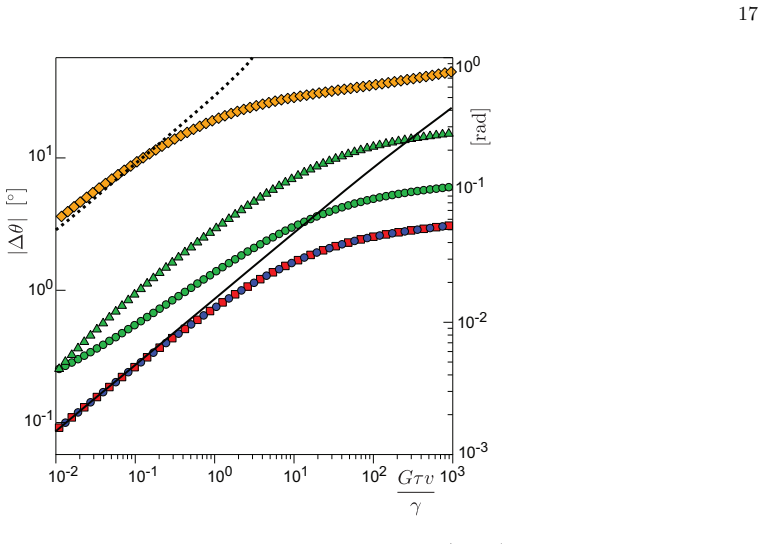
The spreading of liquid drops on soft substrates is extremely slow, owing to strong viscoelastic dissipation inside the solid. A detailed understanding of the spreading dynamics has remained elusive, partly owing to the difficulty in quantifying the strong viscoelastic deformations below the contact line that determine the shape of moving wetting ridges. Here we present direct experimental visualisations of the dynamic wetting ridge, complemented with measurements of the liquid contact angle. It is observed that the wetting ridge exhibits a rotation that follows exactly the dynamic liquid contact angle -- as was previously hypothesized [Karpitschka \emph{et al.} Nature Communications \textbf{6}, 7891 (2015)]. This experimentally proves that, despite the contact line motion, the wetting ridge is still governed by Neumann's law. Furthermore, our experiments suggest that moving contact lines lead to a variable surface tension of the substrate. We therefore set up a new theory that incorporates the influence of surface strain, for the first time including the so-called Shuttleworth effect into the dynamical theory for soft wetting. It includes a detailed analysis of the boundary conditions at the contact line, complemented by a dissipation analysis, which shows, again, the validity of Neumann's balance.
Editorial analysis
A structured set of objections, weighed in public.
Referee Report
Summary. The manuscript reports direct experimental visualizations of dynamic wetting ridges during liquid drop spreading on viscoelastic solids. It observes that the ridge rotates exactly in accordance with the dynamic liquid contact angle, which is taken as proof that Neumann's law continues to govern the ridge geometry despite contact-line motion. A new theoretical framework is introduced that incorporates the Shuttleworth effect (strain-dependent substrate surface tension) into the dynamical description, together with an analysis of contact-line boundary conditions and viscoelastic dissipation that is said to confirm the Neumann balance.
Significance. If the central experimental observation is robust, the work supplies direct evidence resolving a long-standing question in soft wetting about whether local three-phase force balance survives at moving contact lines. The explicit inclusion of the Shuttleworth effect in a dynamical model, combined with the dissipation analysis, represents a concrete advance over prior hypotheses. These elements would strengthen predictive modeling of slow spreading on soft substrates.
major comments (2)
- [Experimental results] Experimental visualizations and contact-angle measurements: the manuscript states that the ridge rotation 'follows exactly' the dynamic liquid contact angle, yet no quantitative error bars, statistical measures of agreement, or controls for alternative mechanisms (strain-dependent surface tension or distributed viscoelastic relaxation) are reported. This leaves open whether the observed rotation isolates the local Neumann vector balance or could arise from the distributed effects already included in the theory.
- [Theory] Theory section on boundary conditions and Shuttleworth effect: the model introduces strain-dependent surface tension, which modifies the effective tensions entering the Neumann balance. The text does not derive or show explicitly how the modified tensions still produce a rotation that matches the liquid angle solely through the standard three-vector closure rather than through the additional strain or dissipation terms; without this step the claim that Neumann's law is validated remains circular with the model's own constitutive assumptions.
minor comments (2)
- Notation for surface strains and tensions is introduced without a dedicated table or consistent symbol list, making it difficult to track which quantities are strain-dependent versus constant across the boundary-condition analysis.
- [Dissipation analysis] The dissipation analysis is summarized but lacks an explicit comparison (e.g., an equation or plot) between the full model and a reduced model that omits the local Neumann condition, which would help readers assess its independent contribution.
Simulated Author's Rebuttal
We thank the referee for their thoughtful review and positive evaluation of the significance of our work. We address each of the major comments below.
read point-by-point responses
-
Referee: [Experimental results] Experimental visualizations and contact-angle measurements: the manuscript states that the ridge rotation 'follows exactly' the dynamic liquid contact angle, yet no quantitative error bars, statistical measures of agreement, or controls for alternative mechanisms (strain-dependent surface tension or distributed viscoelastic relaxation) are reported. This leaves open whether the observed rotation isolates the local Neumann vector balance or could arise from the distributed effects already included in the theory.
Authors: We agree that the experimental section would benefit from quantitative measures. In the revised manuscript, we will include error bars derived from multiple independent measurements of the ridge rotation and contact angles to quantify the agreement. Concerning controls for alternative mechanisms, the theory section already incorporates the strain-dependent surface tension via the Shuttleworth effect and analyzes the dissipation, showing that the local balance is necessary for the exact matching observed. Distributed effects alone would not lead to the precise rotation with the liquid angle without the Neumann condition. We will add a brief discussion clarifying this distinction. revision: yes
-
Referee: [Theory] Theory section on boundary conditions and Shuttleworth effect: the model introduces strain-dependent surface tension, which modifies the effective tensions entering the Neumann balance. The text does not derive or show explicitly how the modified tensions still produce a rotation that matches the liquid angle solely through the standard three-vector closure rather than through the additional strain or dissipation terms; without this step the claim that Neumann's law is validated remains circular with the model's own constitutive assumptions.
Authors: We acknowledge that an explicit derivation of this point would improve clarity. Although the manuscript includes the boundary conditions and dissipation analysis leading to the validity of Neumann's balance, we will revise the theory section to provide a step-by-step derivation demonstrating how the strain-modified tensions enforce the three-vector closure independently of the dissipation terms. This will address any potential concern of circularity by separating the geometric balance from the dynamical contributions. revision: yes
Circularity Check
Experimental ridge rotation observation provides independent data; minor self-citation to co-author hypothesis does not reduce central claim
specific steps
-
self citation load bearing
[Abstract]
"It is observed that the wetting ridge exhibits a rotation that follows exactly the dynamic liquid contact angle -- as was previously hypothesized [Karpitschka et al. Nature Communications 6, 7891 (2015)]. This experimentally proves that, despite the contact line motion, the wetting ridge is still governed by Neumann's law."
The claim that the observed rotation 'proves' Neumann's law at the moving contact line is justified by matching a behavior hypothesized in prior work by an overlapping author; while the experiment supplies new data, the load-bearing interpretive step that equates the geometric match specifically to the standard three-tension Neumann balance (rather than distributed strain or viscoelastic effects) imports its justification from the self-citation.
full rationale
The paper's strongest claim rests on direct experimental visualizations showing that wetting ridge rotation matches the dynamic liquid contact angle. This match is interpreted as proving Neumann's law governs the ridge despite motion, referencing a prior hypothesis by co-author Karpitschka. However, the new data and the introduced theory (incorporating Shuttleworth effect and viscoelastic dissipation) do not reduce the reported observation or boundary-condition analysis to a fitted parameter or self-defined input by construction. The self-citation is present but not load-bearing for the experimental result itself, which remains falsifiable against external benchmarks. No equations or derivations in the provided text exhibit self-definitional closure or renaming of known results.
Axiom & Free-Parameter Ledger
axioms (1)
- domain assumption Neumann's law applies at the moving contact line on a viscoelastic solid
Reference graph
Works this paper leans on
-
[1]
Low velocity. We define the low-velocity regime as v≪v∗, where v∗ = γ Gτ, (2) is the characteristic speed in the problem. This velocity compares the elastocapillary length γ/G to the timescale τ of the gel defined in (1) (see Appendix A for details on the rheology of the gel). For the PDMS and PVS substrates, we find v∗ of the order of 1 mm/s. In figure 6 the...
-
[2]
Large velocity. Clearly, the experimental data in figure 6 show that a new regime appears when approaching v∗∼ 1 mm/s. First, the power-law regime is no longer followed but gives way to a saturation of ∆ θ. More strikingly, however, the angles ∆θ and ϕ no longer take on the same value. To interpret these findings, we present the measurement of θS versus ins...
-
[3]
moving contact line singularity
Boundary condition on φ: When is Neumann ’s law valid? From a theoretical point of view, we can now proceed along two distinct routes, that lead to the same result. In the first route, we represent the capillary action of the liquid-vapor interface as a highly localised traction, pulling with a tension γ along the direction ⃗tLV of the liquid-vapor interfa...
-
[4]
Boundary condition on ϵ. The boundary condition on the surface strain originates from exchange of material across the contact line, induced by a change of the Lagrangian contact line position R. For homogeneous elastic media without any pinning sites, 13 such a change of contact line position should be neutral with respect to the total energy of the syste...
-
[5]
Ridge shape In the absence of a Shuttleworth effect and for small deformation, the normal and tangential forcing decouple to leading order. Hence, the ridge shape h(x,t ) = uy(x,t ) follows purely from the normal stress ⃗ σ·⃗ ey, so that (20) combined with (10) becomes Kyφ⊗φ =φ′Υs +γ sinθδ(x). (B1) Here, the discontinuity inφ at the contact line is imposed...
-
[6]
Neumann’s law and ridge rotation The analytical solution (B3) has two important features. First, we verify that we recover the boundary condition in the form of a discontinuity of the slope at the contact line. This follows from the large- q asymptotics of (B3). Noting 20 that k(q)∼ 1/|q| and assuming that at large frequency µ(ω)≪ ω, we find the dominant b...
-
[7]
Consistency check: Dissipation approach. As a consistency check, we now perform an alternative calculation of the liquid contact angle. We follow the dissipation approach as originally proposed by Long, Ajdari & Leibler [13], and reused recently by Zhao et al. [15]. The analysis builds on a balance of the work per unit time performed by the capillary forc...
-
[8]
R. W. Style, A. Jagota, C.-Y. Hui, and E. R. Dufresne, Annual Review of Condensed Matter Physics 8, 99 (2017)
work page 2017
- [9]
- [10]
- [11]
-
[12]
B. Andreotti and J. H. Snoeijer, Annual Review of Fluid Mechanics (2020)
work page 2020
-
[13]
Q. Xu, K. E. Jensen, R. Boltyanskiy, R. Sarfati, R. W. Style, and E. R. Dufresne, Nat Commun 8, 555 (2017)
work page 2017
-
[14]
R. D. Schulman, M. Trejo, T. Salez, E. Rapha¨ el, and K. Dalnoki-Veress, Nat Commun 9, 982 (2018)
work page 2018
-
[15]
J. H. Snoeijer, E. Rolley, and B. Andreotti, Physical Review Letters 121, 068003 (2018)
work page 2018
-
[16]
Q. Xu, R. W. Style, and E. R. Dufresne, Soft Matter 14, 916 (2018)
work page 2018
-
[17]
M. E. Shanahan and A. Carre, Langmuir 10, 1647 (1994)
work page 1994
-
[18]
A. Carr´ e, J.-C. Gastel, and M. E. R. Shanahan, Nature 379, 432 (1996)
work page 1996
-
[19]
D. Long, A. Ajdari, and L. Leibler, Langmuir 12, 1675 (1996)
work page 1996
-
[20]
D. Long, A. Ajdari, and L. Leibler, Langmuir 12, 5221 (1996)
work page 1996
-
[21]
S. Karpitschka, S. Das, M. van Gorcum, H. Perrin, B. Andreotti, and J. H. Snoeijer, Nat Commun 6, 7891 (2015)
work page 2015
-
[22]
M. Zhao, J. Dervaux, T. Narita, F. Lequeux, L. Limat, and M. Roch´ e, Proceedings of the National Academy of Sciences 115, 1748 (2018)
work page 2018
-
[23]
R. Lhermerout, H. Perrin, E. Rolley, B. Andreotti, and K. Davitt, Nat Commun 7, 12545 (2016)
work page 2016
-
[24]
P.-G. de Gennes, F. Brochart-Wyart, and D. Qu´ er´ e,Capillarity and Wetting Phenomena: Drops, Bubbles, Pearls, Waves (Belin, 2002)
work page 2002
-
[25]
D. Bonn, J. Eggers, J. Indekeu, J. Meunier, and E. Rolley, Reviews of Modern Physics 81, 739 (2009)
work page 2009
-
[26]
J. H. Snoeijer and B. Andreotti, Annu. Rev. Fluid Mech. 45, 269 (2013)
work page 2013
-
[27]
O. V. Voinov, Fluid Dynamics 11, 714 (1976)
work page 1976
-
[28]
R. G. Cox, J. Fluid Mech. 168, 169 (1986)
work page 1986
-
[29]
Tanner, Journal of Physics D: Applied Physics 12, 1473 (1979)
L. Tanner, Journal of Physics D: Applied Physics 12, 1473 (1979)
work page 1979
- [30]
- [31]
-
[32]
M. E. R. Shanahan and A. Carr´ e, Colloids Surf., A 206, 115 (2002)
work page 2002
-
[33]
J. Bico, E. Reyssant, and B. Roman, Annual Review of Fluid Mechanics 50, 629 (2018)
work page 2018
-
[34]
R. Pericet-Camara, A. Best, H. J. Butt, and E. Bonaccurso, Langmuir 24, 10565 (2008)
work page 2008
-
[35]
S. Park, B. Weon, J. Lee, J. Lee, J. Kim, and J. Je, Nat Commun 5, 4369 (2014)
work page 2014
-
[36]
E. R. Jerison, Y. Xu, L. A. Wilen, and E. R. Dufresne, Phys. Rev. Lett. 106, 186103 (2011)
work page 2011
-
[37]
R. W. Style, R. Boltyanskiy, Y. Che, J. S. Wettlaufer, L. A. Wilen, and E. R. Dufresne, Phys. Rev. Lett. 110, 066103 (2013)
work page 2013
-
[38]
M. van Gorcum, B. Andreotti, J. H. Snoeijer, and S. Karpitschka, Physical review letters 121, 208003 (2018)
work page 2018
- [39]
-
[40]
R. W. Style and E. R. Dufresne, Soft Matter 8, 7177 (2012)
work page 2012
-
[41]
A. Marchand, S. Das, J. H. Snoeijer, and B. Andreotti, Phys. Rev. Lett. 109, 236101 (2012)
work page 2012
- [42]
-
[43]
L. A. Lubbers, J. H. Weijs, L. Botto, S. Das, B. Andreotti, and J. H. Snoeijer, J. Fluid Mech. Rapids 747, R1 (2014)
work page 2014
-
[44]
R. Masurel, M. Roch´ e, L. Limat, I. Ionescu, and J. Dervaux, Phys. Rev. Lett. 122, 248004 (2019)
work page 2019
-
[45]
S. Karpitschka, S. Das, M. van Gorcum, H. Perrin, B. Andreotti, and J. H. Snoeijer, Proceedings of the National Academy of Sciences 115, E7233 (2018)
work page 2018
-
[46]
Nonlinear force balance at moving contact lines
M. Roch´ e, L. Limat, and J. Dervaux, arXiv , arXiv:1904.08226 (2019)
work page internal anchor Pith review Pith/arXiv arXiv 1904
- [47]
-
[48]
S. J. Park, J. B. Bostwick, V. De Andrade, and J. H. Je, Soft Matter 13, 8331 (2017)
work page 2017
- [49]
- [50]
-
[51]
M. Zhao, F. Lequeux, T. Narita, M. Roch´ e, L. Limat, and J. Dervaux, Soft matter 14, 61 (2018)
work page 2018
-
[52]
J. D. Berman, M. Randeria, R. W. Style, Q. Xu, J. R. Nichols, A. J. Duncan, M. Loewenberg, E. R. Dufresne, and K. E. Jensen, Soft matter 15, 1327 (2019)
work page 2019
-
[53]
J. H. Snoeijer, E. Rolley, and B. Andreotti, Physical Review Letters 121, 068003 (2018). 23
work page 2018
-
[54]
Dissipative interfacial mechanics can be captured by surface-constitutive relation, similar to bulk viscoelasticity. Then, one needs to take into account also the surface rate of strain, ˙ϵ or, more generally, a functional dependence on the surface strain history. Such a situation could, for instance, arise in presence of brush-like surface layers that ex...
- [55]
-
[56]
K. L. Johnson, Contact mechanics (Cambridge University Press, 1985)
work page 1985
-
[57]
M. Singh and A. C. Pipkin, Zeitschrift fr angewandte Mathematik und Physik ZAMP 16, 706 (1965)
work page 1965
-
[58]
J. D. Eshelby, Journal of Elasticity 5, 321 (1975)
work page 1975
- [59]
-
[60]
J. H. Weijs, B. Andreotti, and J. H. Snoeijer, Soft Matter 9, 8494 (2013)
work page 2013
discussion (0)
Sign in with ORCID, Apple, or X to comment. Anyone can read and Pith papers without signing in.