Quantum synchronization in dimer atomic lattices
Pith reviewed 2026-05-24 19:45 UTC · model grok-4.3
The pith
A dimer lattice of trapped atoms with staggered local losses produces quantum synchronization through local dissipation.
A machine-rendered reading of the paper's core claim, the machinery that carries it, and where it could break.
Core claim
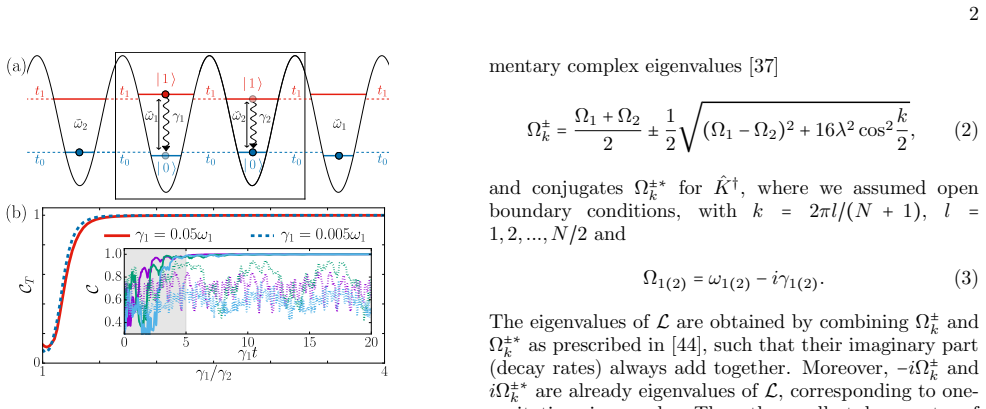
We propose a dimer lattice of trapped atoms realizing a dissipative spin model where quantum synchronization occurs in presence of local dissipation. Atoms synchronization is enabled by the inhomogeneity of staggered local losses in the lattice and is favored by an increase of spins detuning. A comprehensive approach to quantum synchronization based on different measures considered in the literature allows to identify the main features of different synchronization regimes.
What carries the argument
The dimer lattice with staggered local losses, realized as an open quantum spin model whose dynamics are solved via the Lindblad master equation and diagnosed with several synchronization quantifiers.
If this is right
- Synchronization appears even when every atom decays independently, provided the decay rates are staggered.
- Larger detuning between the two atoms in each dimer strengthens the synchronized state.
- Multiple independent synchronization quantifiers converge on the same regime boundaries.
- The lattice geometry allows synchronization without requiring a shared bath or collective jump operators.
Where Pith is reading between the lines
- Similar staggered-loss patterns could be engineered in other platforms such as superconducting circuits or trapped ions to test whether local dissipation alone suffices for quantum synchronization.
- The dependence on detuning suggests that frequency mismatch can be turned from a hindrance into a resource for locking in driven-dissipative systems.
- If the model holds, one could search for synchronization signatures in naturally inhomogeneous loss environments such as disordered optical lattices.
Load-bearing premise
The trapped-atom dimer lattice can be faithfully described by a Markovian dissipative spin model in which existing synchronization measures correctly distinguish the intended regimes.
What would settle it
Prepare two atomic dimers with alternating loss rates and tunable detuning; if the measured phase-locking indicators or coherence functions fail to rise with increasing detuning as predicted by the staggered-loss master equation, the synchronization claim is refuted.
Figures


read the original abstract
Synchronization phenomena have been recently reported in the quantum realm at atomic level due to collective dissipation. In this work we propose a dimer lattice of trapped atoms realizing a dissipative spin model where quantum synchronization occurs instead in presence of local dissipation. Atoms synchronization is enabled by the inhomogeneity of staggered local losses in the lattice and is favored by an increase of spins detuning. A comprehensive approach to quantum synchronization based on different measures considered in the literature allows to identify the main features of different synchronization regimes.
Editorial analysis
A structured set of objections, weighed in public.
Referee Report
Summary. The manuscript proposes a dimer lattice of trapped atoms realizing a dissipative spin model in which quantum synchronization arises from local (rather than collective) dissipation. Synchronization is enabled by the spatial inhomogeneity of staggered local losses and is enhanced by increasing spin detuning; multiple synchronization measures drawn from the literature are used to distinguish regimes.
Significance. If the central mapping and numerical results are robust, the work supplies a concrete, experimentally accessible platform for studying quantum synchronization driven purely by local dissipation, extending recent atomic-level examples that relied on collective effects. The multi-measure characterization is a methodological strength.
major comments (2)
- [Model section / dissipative spin mapping] The reduction of the full atomic master equation to the closed dissipative spin model is load-bearing for the claim that staggered local losses alone suffice. The manuscript must explicitly bound or numerically test the neglected terms (virtual photon exchange, position-dependent couplings) to confirm they do not generate the observed phase locking.
- [Results / synchronization measures] No quantitative validation (e.g., fidelity between full atomic and spin-model trajectories, or error bars on synchronization measures) is supplied to show that the staggered-loss pattern produces genuine collective coherence rather than an artifact of the approximation.
minor comments (1)
- Notation for the staggered loss rates and detuning parameters should be introduced with a single consistent symbol table to avoid ambiguity when comparing different synchronization measures.
Simulated Author's Rebuttal
We thank the referee for the careful reading and constructive comments on our manuscript. We address each major comment below and will incorporate revisions to strengthen the validation of our results.
read point-by-point responses
-
Referee: [Model section / dissipative spin mapping] The reduction of the full atomic master equation to the closed dissipative spin model is load-bearing for the claim that staggered local losses alone suffice. The manuscript must explicitly bound or numerically test the neglected terms (virtual photon exchange, position-dependent couplings) to confirm they do not generate the observed phase locking.
Authors: We agree that the validity of the mapping is central to our claim. The derivation relies on the large-detuning regime where virtual photon exchange is suppressed by the atomic detuning relative to the dipole couplings. To address the concern directly, we will add an appendix providing analytical bounds on the neglected terms (using the Born-Markov and rotating-wave approximations) together with numerical comparisons of the full atomic master equation versus the effective spin model for small lattices (N=2–4 dimers). These will confirm that the observed phase locking is driven by the staggered local losses rather than the omitted processes. revision: yes
-
Referee: [Results / synchronization measures] No quantitative validation (e.g., fidelity between full atomic and spin-model trajectories, or error bars on synchronization measures) is supplied to show that the staggered-loss pattern produces genuine collective coherence rather than an artifact of the approximation.
Authors: We acknowledge that quantitative validation of the approximation and error estimates on the synchronization measures are currently absent. In the revised version we will include (i) fidelity between full atomic and spin-model trajectories for representative parameters and (ii) statistical error bars on all synchronization measures (Kuramoto order parameter, mutual information, etc.) obtained from ensemble averages. This will demonstrate that the collective coherence arises from the staggered-loss pattern and is robust within the reported regimes. revision: yes
Circularity Check
No circularity: model proposal and synchronization analysis are self-contained
full rationale
The paper proposes a dimer lattice realizing a dissipative spin model with staggered local losses and analyzes synchronization via standard literature measures. No load-bearing step reduces by construction to a fitted parameter, self-definition, or self-citation chain; the central claim that inhomogeneity enables synchronization is presented as an emergent feature of the proposed Hamiltonian and Lindblad operators, not derived from prior author results or renamed empirical patterns. The derivation remains independent of the target result.
Axiom & Free-Parameter Ledger
Lean theorems connected to this paper
-
IndisputableMonolith/Cost/FunctionalEquation.leanwashburn_uniqueness_aczel unclear?
unclearRelation between the paper passage and the cited Recognition theorem.
Atoms synchronization is enabled by the inhomogeneity of staggered local losses in the lattice
-
IndisputableMonolith/Foundation/RealityFromDistinction.leanreality_from_one_distinction unclear?
unclearRelation between the paper passage and the cited Recognition theorem.
Diagonalization of K via Jordan-Wigner transformation and Fourier transform leads to the two-band elementary complex eigenvalues Ω±_k
What do these tags mean?
- matches
- The paper's claim is directly supported by a theorem in the formal canon.
- supports
- The theorem supports part of the paper's argument, but the paper may add assumptions or extra steps.
- extends
- The paper goes beyond the formal theorem; the theorem is a base layer rather than the whole result.
- uses
- The paper appears to rely on the theorem as machinery.
- contradicts
- The paper's claim conflicts with a theorem or certificate in the canon.
- unclear
- Pith found a possible connection, but the passage is too broad, indirect, or ambiguous to say the theorem truly supports the claim.
Reference graph
Works this paper leans on
-
[1]
A. Pikovsky, M. Rosenblum, and J. Kurths, Synchro- nization: A Universal Concept in Nonlinear Sciences , Cambride Nonlinear Science Series (Cambridge Univer- sity Press, Cambridge, 2003)
work page 2003
-
[2]
F. Galve, G L. Giorgi, and R. Zambrini, in Lectures on General Quantum Correlations and their Applica- tions (Eds.: F. Fanchini, D. Soares Pinto, G. Adesso), Springer, Cham, CH 2017, pp. 393-420
work page 2017
-
[3]
P. P. Orth, D. Roosen, W. Hofstetter, and K. Le Hur, Phys. Rev. B 82, 144423 (2010)
work page 2010
-
[4]
G. L. Giorgi, F. Galve, G. Manzano, P. Colet, and R. Zambrini, Phys. Rev. A 85, 052101 (2012); G. Manzano, F. Galve, and R. Zambrini, ibid. 87, 032114 (2013); C. Benedetti, F. Galve, A. Mandarino, M. G. A. Paris, and R. Zambrini, Phys. Rev. A 94, 052118 (2016)
work page 2012
-
[5]
G. L. Giorgi, F. Plastina, G. Francica, and R. Zambrini, Phys. Rev. A 88, 042115 (2013)
work page 2013
-
[6]
G. L. Giorgi, F. Galve, and R. Zambrini, Phys. Rev. A 94, 052121 (2016)
work page 2016
- [7]
- [8]
-
[9]
G. Manzano, F. Galve, G. L. Giorgi, E. Hernandez- Garcia, and R. Zambrini, Sci. Rep. 3, 1439 (2013)
work page 2013
-
[10]
B. Bellomo, G. L. Giorgi, G. M. Palma, and R. Zambrini, Phys. Rev. A 95, 043807 (2017)
work page 2017
-
[11]
M. R. Hush, W. Li, S. Genway, I. Lesanovsky, and A. D. Armour, Phys. Rev. A 91 061401(R) (2015)
work page 2015
-
[12]
A. Mari, A. Farace, N. Didier, V. Giovannetti, and R. Fazio, Phys. Rev. Lett. 111, 103605 (2013)
work page 2013
-
[13]
T. E. Lee and H. R. Sadeghpour, Phys. Rev. Lett. 111, 234101 (2013)
work page 2013
- [14]
- [15]
-
[16]
M. Xu, D. A. Tieri, E. C. Fine, J. K. Thompson, and M. J. Holland, Phys. Rev. Lett. 113, 154101 (2014)
work page 2014
-
[17]
B. Zhu, J. Schachenmayer, M. Xu, F. Herrera, J. G. Re- strepo, M. J. Holland, and A. M. Rey, New J. Phys. 17, 083063 (2015)
work page 2015
- [18]
-
[19]
B. Militello, H. Nakazato, and A. Napoli, Phys. Rev. A 96, 023862 (2017)
work page 2017
-
[20]
M. Xu, S. B. J¨ ager, S. Sch¨ utz, J. Cooper, G. Morigi, and M. J. Holland, Phys. Rev. Lett. 116, 153002 (2016)
work page 2016
-
[21]
J. M. Weiner, K. C. Cox, J. G. Bohnet, and J. K. Thomp- son, Phys. Rev. A 95, 033808 (2017)
work page 2017
-
[22]
S. Boccaletti, J. Kurths, G. Osipov, D.L. Valladares, C.S. Zhou, Phys. Rep. 366, 1 (2002)
work page 2002
- [23]
-
[24]
G. Heinrich, M. Ludwig, J. Qian, B. Kubala, and F. Mar- quardt, Phys. Rev. Lett. 107, 043603 (2011); A. Cabot, F. Galve, and R. Zambrini, New J. Phys 19, 113007 (2017)
work page 2011
- [25]
-
[26]
J. G. Bohnet, Z. Chen, J. M. Weiner, D. Meiser, M. J. Holland, and J. K. Thompson, Nature 484, 78 (2012)
work page 2012
-
[27]
A. Shankar, J. Cooper, J. G. Bohnet, J. J. Bollinger, and M. Holland, Phys. Rev. A 95, 033423 (2017)
work page 2017
- [28]
- [29]
-
[30]
N. L¨ orch, S. E. Nigg, A. Nunnenkamp, R. P. Tiwari, and C. Bruder Phys. Rev. Lett. 118, 243602 (2017)
work page 2017
- [31]
-
[32]
D. Porras and J. I. Cirac, Phys. Rev. Lett. 92 207901 (2004); J. Simon, W. S. Bakr, R. Ma, M. Eric Tai, P. M. Preiss, and M. Greiner, Nature 472, 307 (2011); H. Labuhn, D. Barredo, S. Ravets, S. de L´ es´ eleuc, T. Macr` ı, T. Lahaye, and A. Browaeys, Nature 534, 667 (2016)
work page 2004
-
[33]
G. Lindblad, Commun. Math. Phys. 48, 119 (1976). V. Gorini, A. Kossakowski, and E. C. G. Sudarshan, J. Math. Phys. 17 821 (1976)
work page 1976
-
[34]
I. Marzoli, J. I. Cirac, R. Blatt, and P. Zoller, Phys. Rev. A 49, 2771 (1994)
work page 1994
-
[35]
J. I. Cirac, R. Blatt, P. Zoller, and W. D. Phillips, Phys. Rev. A 46, 2668 (1992)
work page 1992
-
[36]
J. Sebby-Strabley, M. Anderlini, P. S. Jessen, and J. V. Porto, Phys. Rev. A 73, 033605 (2006); J. Sebby- Strabley, B. L. Brown, M. Anderlini, P. J. Lee, W. D. Phillips, J. V. Porto and P. R. Johnson, Phys. Rev. Lett. 98, 200405 (2007); S. F¨ olling, S. Trotzky, P. Cheinet, M. Feld, R. Saers, A. Widera, T. M¨ uller and I. Bloch, Nature 448, 1029 (2007); M...
work page 2006
-
[37]
See Supplemental Material (below this section) for details on the derivation of the results presented in the main text, which includes Refs. [38–43]
-
[38]
Cohen-Tannoudji et al , Atom-Photon Interactions (New York: Wiley, 1992) pp 38-48
C. Cohen-Tannoudji et al , Atom-Photon Interactions (New York: Wiley, 1992) pp 38-48
work page 1992
- [39]
-
[40]
L.-M. Duan, E. Demler, and M. D. Lukin, Phys. Rev. Lett. 91, 090402 (2003)
work page 2003
-
[41]
J. J. Garc´ ıa-Ripoll, and J. I. Cirac, New J. Phys. 5, 76 (2003)
work page 2003
- [42]
- [43]
-
[44]
J. M. Torres, Phys. Rev. A 89, 052133 (2014)
work page 2014
-
[45]
The eigenfrequencies (decay rates) given by (S19), are denoted byνl (Γl) withl∈ [1,N ]. The firstN/slash.left2 elements correspond to the band ’−’ with thek →l, while the next N/slash.left2 to the band ’+’ with k →l−N/slash.left2
- [46]
-
[47]
J. Gambetta, A. Blais, D. I. Schuster, A. Wallraff, L. Frunzio, J. Majer, M. H. Devoret, S. M. Girvin, and R. J. Schoelkopf, Phys. Rev. A 74, 042318 (2006)
work page 2006
-
[48]
H. J. Carmichael, Statistical Methods in Quantum Optics 1: Master Equations and Fokker-Planck Equations (The- oretical and Mathematical Physics) (Springer, Berlin,
-
[49]
6 Supplemental Material: ’Quantum synchronization in dimer atomic lattices’ S1
pp 19-28. 6 Supplemental Material: ’Quantum synchronization in dimer atomic lattices’ S1. DISSIPATIVE ATOMIC LATTICE In this section the main details on the physical imple- mentation of the dissipative spin chain are overviewed. In S1 A we present the Hamiltonian that models the atomic lattice. We follow in S1 B explaining how from this atomic lattice one...
-
[50]
Notice that the real part of this quantity is the same as (a)
(b) Imaginary part of /uni27E8ˆσ− 1(t)ˆσ+ 2(0)/uni27E9. Notice that the real part of this quantity is the same as (a). (c) /uni27E8ˆσx 1(t)ˆσx 2(t)/uni27E9, considering the initial condition /divides.alt0Ψ0/uni27E9= (/divides.alt00/uni27E9+/divides.alt0F2/uni27E9)/slash.left √ 2. S4. ADDITIONAL RESULTS ABOUT SYNCHRONIZATION We present further results that...
work page 1992
discussion (0)
Sign in with ORCID, Apple, or X to comment. Anyone can read and Pith papers without signing in.