Inclusive diffractive heavy quarkonium photoproduction in pp, pA and AA collisions
Pith reviewed 2026-05-24 18:20 UTC · model grok-4.3
The pith
Resolved photoproduction contributes up to 44% of inclusive diffractive Υ production in pp collisions at LHC energies.
A machine-rendered reading of the paper's core claim, the machinery that carries it, and where it could break.
Core claim
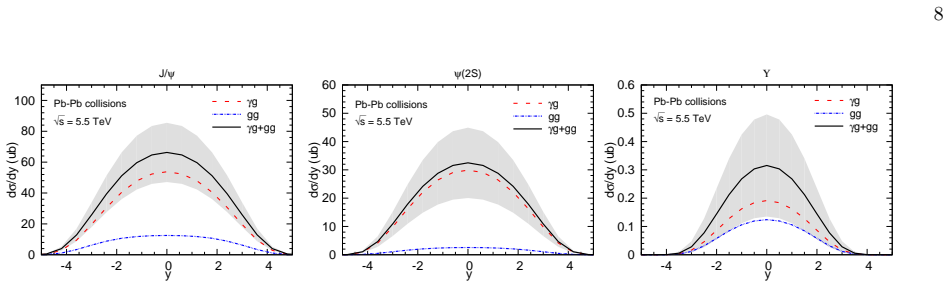
Inclusive diffractive heavy quarkonium photoproduction is computed in the resolved pomeron model by including both direct and resolved photoproduction channels within NRQCD factorization; the resolved channel supplies a substantial fraction of the cross section, largest in pp collisions.
What carries the argument
Resolved pomeron model with direct and resolved photoproduction processes inside NRQCD factorization.
If this is right
- Resolved photoproduction supplies 28% of the J/Ψ rapidity distribution in pp collisions.
- Resolved photoproduction supplies 13% of the Ψ(2S) rapidity distribution in pp collisions.
- Resolved photoproduction supplies 44% of the Υ rapidity distribution in pp collisions.
- The same framework yields smaller but non-negligible resolved contributions in pPb and PbPb collisions.
Where Pith is reading between the lines
- Measuring the ratio of resolved to direct components in pp data could constrain the parton content of the pomeron at LHC scales.
- Nuclear suppression factors extracted from pA and AA runs could test whether the pomeron flux itself is modified inside nuclei.
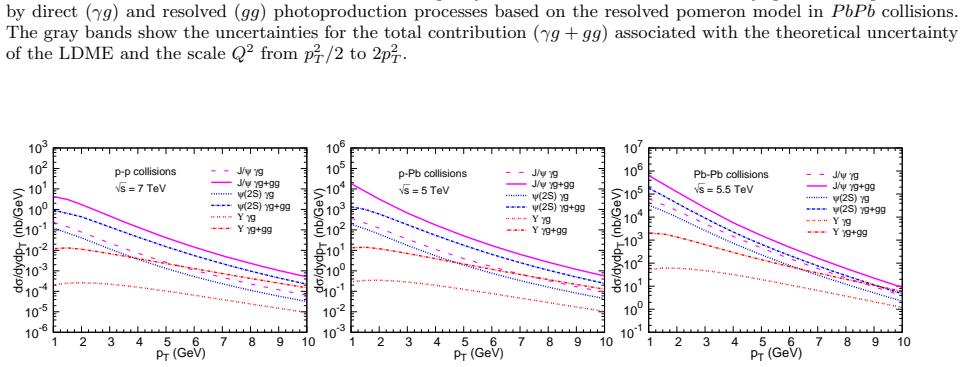
- The predicted pT spectra allow future experiments to separate resolved and direct contributions by exploiting their different transverse-momentum shapes.
Load-bearing premise
NRQCD long-distance matrix elements and pomeron flux parameters fitted at HERA remain valid at LHC energies and for nuclear targets without additional corrections.
What would settle it
A measurement at the LHC showing the resolved fraction of the J/Ψ rapidity distribution in pp collisions to be far from 28% would falsify the extrapolation.
Figures


read the original abstract
The inclusive $J/\Psi$ production by direct and resolved photoproduction in the $\gamma$p scattering is calculated based on the nonrelativistic quantum chromodynamics (NRQCD) factorization formalism, which is in good agreement with the experimental data of total cross section distribution of heavy quarkonium production at HERA. Then we extend the formalism including the direct and resolved photoproduction processes to resolved pomeron model to study the heavy quarkonium photoproduction at the LHC energies. We present the predictions of rapidity and transverse momentum distributions of the inclusive diffractive $J/\Psi$, $\Psi(2S)$ and $\Upsilon$ photoproduction in pp, pPb and PbPb collisions at the LHC energies. Our numerical results indicate that the resolved photoproduction processes play an important role in the heavy quarkonium production. Especially for pp collisions, the contribution of resolved photoproduction processes is the largest, which can reach to $28\%$, $13\%$ and $44\%$ for the rapidity distributions of $J/\Psi$, $\Psi(2S)$ and $\Upsilon$ inclusive diffractive photoproduction, respectively.
Editorial analysis
A structured set of objections, weighed in public.
Referee Report
Summary. The paper calculates inclusive J/Ψ photoproduction in γp scattering via direct and resolved processes in the NRQCD factorization framework and reports agreement with HERA total cross-section data. It then extends the formalism to the resolved-pomeron model to predict rapidity and transverse-momentum distributions for diffractive J/Ψ, Ψ(2S) and Υ production in pp, pPb and PbPb collisions at LHC energies, concluding that resolved photoproduction contributes substantially (up to 28 %, 13 % and 44 % in pp rapidity distributions).
Significance. If the HERA-to-LHC extrapolation is reliable, the results supply concrete, testable predictions for diffractive heavy-quarkonium rates at the LHC and quantify the relative importance of resolved versus direct channels, which could guide experimental analyses in pp and nuclear collisions.
major comments (2)
- [Abstract and numerical-results section] The central numerical claim—that resolved photoproduction reaches 28 %, 13 % and 44 % in the pp rapidity distributions—rests on the direct transfer of NRQCD long-distance matrix elements and pomeron flux parameters fitted at HERA energies without any additional nuclear-shadowing, energy-dependent intercept, or scale-variation corrections. No sensitivity study or cross-check against existing LHC diffractive data is presented to support this extrapolation.
- [Extension to resolved-pomeron model] The manuscript states that the NRQCD calculation reproduces HERA total cross sections, yet the LHC predictions are obtained by extending the same parameter set to the resolved-pomeron framework at √s = 13 TeV and nuclear targets. Because the relative resolved/direct fractions scale directly with these inputs, any shift in the LDMEs or pomeron distributions under LHC conditions would proportionally alter the quoted percentages that underpin the main conclusion.
minor comments (2)
- [Formalism] Notation for the pomeron flux and parton distributions inside the pomeron should be defined explicitly when first introduced, rather than assumed from prior literature.
- [Results] Figure captions for the LHC rapidity and pT distributions should state the precise center-of-mass energies and nuclear species used in each panel.
Simulated Author's Rebuttal
We thank the referee for the careful reading of our manuscript and the constructive comments. We address each major comment below, indicating where revisions will be made.
read point-by-point responses
-
Referee: [Abstract and numerical-results section] The central numerical claim—that resolved photoproduction reaches 28 %, 13 % and 44 % in the pp rapidity distributions—rests on the direct transfer of NRQCD long-distance matrix elements and pomeron flux parameters fitted at HERA energies without any additional nuclear-shadowing, energy-dependent intercept, or scale-variation corrections. No sensitivity study or cross-check against existing LHC diffractive data is presented to support this extrapolation.
Authors: The quoted percentages are obtained using the central values of the LDMEs and pomeron parameters determined from HERA data, as is conventional in NRQCD-based phenomenological extrapolations. We agree that no sensitivity study to parameter variations or energy-dependent effects is included in the present version. In the revised manuscript we will add a dedicated subsection quantifying the impact of varying the LDMEs within their uncertainties and the pomeron flux parameters, together with a brief discussion of possible scale choices. Regarding LHC data, to our knowledge no measurements of inclusive diffractive heavy-quarkonium photoproduction suitable for direct comparison existed at the time of submission; the results are therefore presented as predictions. revision: yes
-
Referee: [Extension to resolved-pomeron model] The manuscript states that the NRQCD calculation reproduces HERA total cross sections, yet the LHC predictions are obtained by extending the same parameter set to the resolved-pomeron framework at √s = 13 TeV and nuclear targets. Because the relative resolved/direct fractions scale directly with these inputs, any shift in the LDMEs or pomeron distributions under LHC conditions would proportionally alter the quoted percentages that underpin the main conclusion.
Authors: The HERA agreement validates the NRQCD LDMEs and the resolved-pomeron description at lower energies; the LHC results follow by applying the same factorization framework at higher energies and for nuclear targets. We acknowledge that the precise numerical fractions are sensitive to the input parameters. In the revision we will add an explicit statement clarifying this dependence and will include a short estimate of the variation in the resolved fractions under reasonable parameter shifts, while maintaining that the qualitative conclusion of a substantial resolved contribution remains within the model. revision: partial
Circularity Check
No significant circularity; HERA-validated NRQCD extension to LHC is independent extrapolation
full rationale
The paper first computes direct+resolved photoproduction in γp using NRQCD factorization and states agreement with HERA total cross-section data. It then extends the same formalism (with resolved-pomeron model) to predict rapidity and pT distributions at LHC energies in pp, pA, AA collisions. The quoted resolved fractions (28%/13%/44% in pp) are numerical outputs of this extension to new kinematics, targets, and energies. No equation reduces a prediction to a fit by construction, no self-citation chain carries the central claim, and no parameter is fitted to the LHC observables being predicted. The derivation therefore remains self-contained against external HERA benchmarks.
Axiom & Free-Parameter Ledger
free parameters (2)
- NRQCD long-distance matrix elements
- Pomeron flux and parton distributions
axioms (2)
- domain assumption NRQCD factorization holds for photoproduction of heavy quarkonia
- domain assumption Resolved pomeron model can be applied to nuclear targets at LHC energies
Lean theorems connected to this paper
-
IndisputableMonolith/Cost/FunctionalEquation.leanwashburn_uniqueness_aczel unclear?
unclearRelation between the paper passage and the cited Recognition theorem.
The inclusive J/Ψ production by direct and resolved photoproduction in the γp scattering is calculated based on the nonrelativistic quantum chromodynamics (NRQCD) factorization formalism... extend the formalism including the direct and resolved photoproduction processes to resolved pomeron model
-
IndisputableMonolith/Foundation/RealityFromDistinction.leanreality_from_one_distinction unclear?
unclearRelation between the paper passage and the cited Recognition theorem.
the contribution of resolved photoproduction processes is the largest, which can reach to 28%, 13% and 44% for the rapidity distributions of J/Ψ, Ψ(2S) and Υ
What do these tags mean?
- matches
- The paper's claim is directly supported by a theorem in the formal canon.
- supports
- The theorem supports part of the paper's argument, but the paper may add assumptions or extra steps.
- extends
- The paper goes beyond the formal theorem; the theorem is a base layer rather than the whole result.
- uses
- The paper appears to rely on the theorem as machinery.
- contradicts
- The paper's claim conflicts with a theorem or certificate in the canon.
- unclear
- Pith found a possible connection, but the passage is too broad, indirect, or ambiguous to say the theorem truly supports the claim.
Reference graph
Works this paper leans on
-
[1]
K. Aamodt et al. [ALICE Collaboration], Phys. Lett. B 704, 442 (2011) Erratum: [Phys. Lett. B 718, 692 (2012)]
work page 2011
-
[2]
CMS Collaboration, Eur. Phys. J. C 71, 1575 (2011)
work page 2011
-
[3]
R. Aaij et al (LHCb Coll.), Eur. Phys. J. C 71, 1645 (2011)
work page 2011
- [4]
- [5]
-
[6]
L. Frankfurt, V. Guzey, M. Strikman and M. Zhalov, Phys. Lett. B 752, 51 (2016)
work page 2016
- [7]
- [8]
- [9]
- [10]
-
[11]
V. D. Barger, W. Y. Keung and R. J. N. Phillips, Z. Phys. C 6, 169 (1980)
work page 1980
-
[12]
V. D. Barger, W. Y. Keung and R. J. N. Phillips, Phys. Lett. 91B, 253 (1980)
work page 1980
-
[13]
C. H. Chang, Nucl. Phys. B 172, 425 (1980)
work page 1980
- [14]
-
[15]
E. L. Berger and D. L. Jones, Phys. Rev. D 23, 1521 (1981)
work page 1981
- [16]
-
[17]
B. A. Thacker and G. P. Lepage, Phys. Rev. D 43, 196 (1991)
work page 1991
-
[18]
G. T. Bodwin, E. Braaten and G. P. Lepage, Phys. Rev. D 51, 1125 (1995) Erratum: [Phys. Rev. D 55, 5853 (1997)]
work page 1995
-
[19]
W. E. Caswell and G. P. Lepage, Phys. Lett. 167B, 437 (1986)
work page 1986
-
[20]
T. H. Bauer, R. D. Spital, D. R. Yennie and F. M. Pipkin, Rev. Mod. Phys. 50, 261 (1978) Erratum: [Rev. Mod. Phys. 51, 407 (1979)]
work page 1978
-
[21]
Y. Q. Ma and R. Vogt, Phys. Rev. D 94, no. 11, 114029 (2016)
work page 2016
-
[22]
G. A. Schuler, [hep-ph/9403387]
work page internal anchor Pith review Pith/arXiv arXiv
-
[23]
V. P. Goncalves and M. M. Machado, Eur. Phys. J. A 50, 72 (2014)
work page 2014
- [24]
- [25]
-
[26]
V. P. Goncalves and B. D. Moreira, Phys. Rev. D 97, no. 9, 094009 (2018)
work page 2018
-
[27]
S. R. Klein, Phys. Rev. D 98, no. 11, 118501 (2018)
work page 2018
-
[29]
Y. P. Fu and Y. D. Li, Phys. Rev. C 84, 044906 (2011)
work page 2011
-
[30]
S. R. Klein and J. Nystrand, Phys. Rev. Lett. 92, 142003 (2004)
work page 2004
-
[31]
Y. B. Cai, Y. Yang, D. C. Zhou and W. C. Xiang, Chin. Phys. Lett. 34, no. 12, 122501 (2017)
work page 2017
- [32]
-
[33]
V. P. Goncalves, Nucl. Phys. A 902, 32 (2013)
work page 2013
- [34]
-
[35]
V. P. Goncalves, G. Sampaio dos Santos and C. R. Sena, Nucl. Phys. A 976, 33 (2018)
work page 2018
-
[36]
P. Ko, J. Lee and H. S. Song, Phys. Rev. D 54, 4312 (1996) Erratum: [Phys. Rev. D 60, 119902 (1999)]
work page 1996
-
[37]
V. P. Goncalves, L. S. Martins and B. D. Moreira, Phys. Rev. D 96, no. 7, 074029 (2017)
work page 2017
- [38]
- [39]
- [40]
- [41]
-
[43]
F. D. Aaron et al. [H1 Collaboration], Eur. Phys. J. C 68, 401 (2010)
work page 2010
-
[44]
P. Artoisenet, J. M. Campbell, F. Maltoni and F. Tramontano, Phys. Rev. Lett. 102, 142001 (2009)
work page 2009
- [45]
-
[46]
G. M. Yu, Y. B. Cai, Y. D. Li and J. S. Wang, Phys. Rev. C 95, no. 1, 014905 (2017) Addendum: [Phys. Rev. C 95, no. 6, 069901 (2017)]
work page 2017
-
[47]
S. Chekanov et al. [ZEUS Collaboration], Eur. Phys. J. C 27, 173 (2003)
work page 2003
- [48]
-
[49]
J. Pumplin, D. R. Stump, J. Huston, H. L. Lai, P. M. Nadolsky and W. K. Tung, JHEP 0207, 012 (2002)
work page 2002
-
[50]
Y. P. Xie and X. Chen, Nucl. Phys. A 959, 56 (2017)
work page 2017
-
[51]
Dillenseger [ALICE Collaboration], Nucl
P. Dillenseger [ALICE Collaboration], Nucl. Phys. A 982, 703 (2019)
work page 2019
-
[52]
A. J. Baltz et al. , Phys. Rept. 458, 1 (2008)
work page 2008
- [53]
discussion (0)
Sign in with ORCID, Apple, or X to comment. Anyone can read and Pith papers without signing in.