Inclusive Jet Longitudinal Double-spin Asymmetry A_(LL) Measurements in 510 GeV Polarized pp Collisions at STAR
Pith reviewed 2026-05-24 16:48 UTC · model grok-4.3
The pith
The first inclusive jet A_LL measurement at 510 GeV in polarized pp collisions extends gluon polarization constraints to x approximately 0.02.
A machine-rendered reading of the paper's core claim, the machinery that carries it, and where it could break.
Core claim
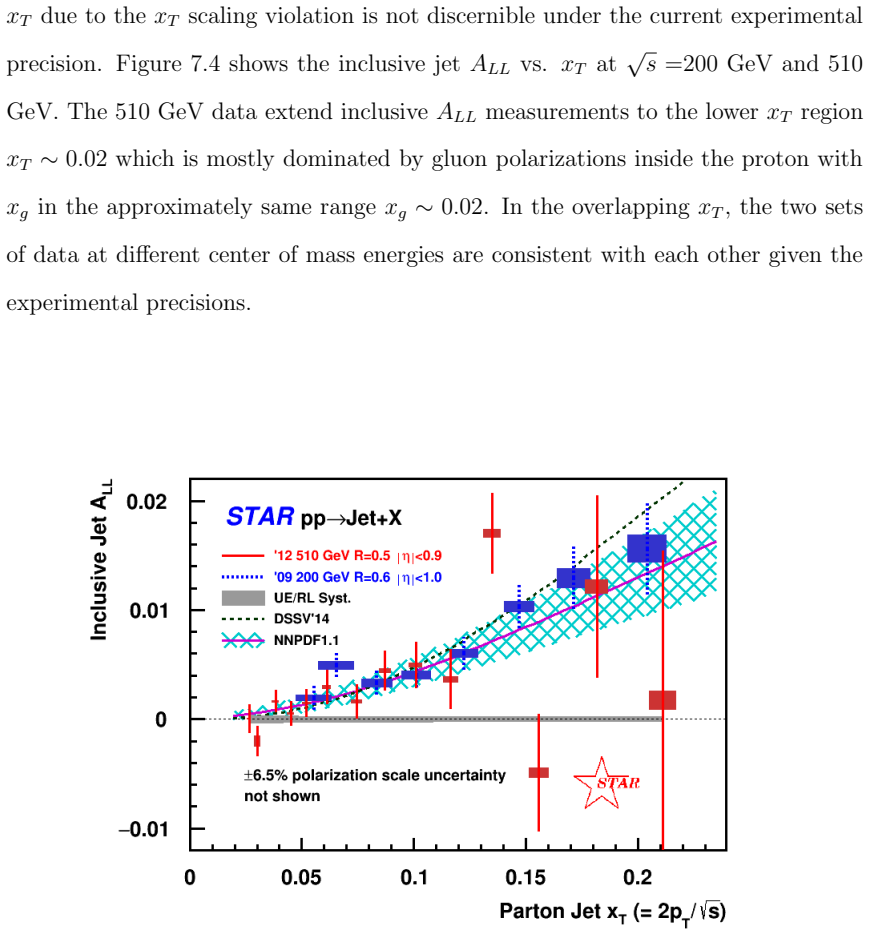
The results for inclusive jet A_LL versus jet p_T in 510 GeV pp collisions are consistent with predictions from recent global analyses of the polarized PDFs that included prior RHIC data in the fit and are also consistent with the previous STAR inclusive jet A_LL measurements at sqrt(s) = 200 GeV in the overlapping kinematic region, thereby providing new constraints on gluon polarization in the proton at x values below those sampled at 200 GeV.
What carries the argument
The longitudinal double-spin asymmetry A_LL extracted for inclusive jets, which directly probes the polarized gluon distribution Delta g(x) through the difference in cross sections for parallel versus antiparallel proton beam helicities.
If this is right
- The data will be included in future global fits of polarized parton distributions to refine the gluon polarization contribution at low x.
- Consistency with 200 GeV results in the overlap region supports the reliability of the asymmetry extraction across different beam energies.
- The improved analysis techniques reduce uncertainties and can be applied to higher-statistics datasets for greater precision.
- The measurement covers a kinematic range that fills a gap in existing constraints on Delta g(x) from RHIC experiments.
Where Pith is reading between the lines
- If the consistency persists under updated global fits, the gluon spin contribution at x below 0.02 is likely small or positive, narrowing the range of possible proton spin decompositions.
- The same jet reconstruction and bias-correction methods could be extended to other spin-dependent observables such as di-jet or photon-jet asymmetries at similar energies.
- A mismatch in future fits would point to either missing higher-order QCD effects or limitations in the current Monte Carlo modeling of polarized processes.
Load-bearing premise
The new analysis procedures including underlying event subtraction, trigger bias estimation, PYTHIA tune optimization, and tune-parameter uncertainty estimation correctly reduce systematic uncertainties without introducing new biases.
What would settle it
A statistically significant deviation between the measured A_LL points and the global polarized PDF predictions specifically in the newly accessed low-x region at 510 GeV would indicate that the consistency claim does not hold.
Figures



















read the original abstract
In this analysis, I perform the first ever measurement of \(A_{LL}\) for inclusive jet production in \(pp\) collisions at the higher beam energy of \(\sqrt{s}\) = 510 GeV, based on data that STAR recorded during 2012. The higher beam energy extends the sensitivity to gluon polarization down to \(x \sim 0.02\). The high statistics of the data set and the small size of the physics asymmetries, compared to the previous measurements at 200 GeV, required the development of several new or improved analysis procedures in order to minimize the systematic uncertainties. These include: the first implementation by STAR of an underlying event subtraction during jet reconstruction, a much improved technique to estimate the trigger and reconstruction bias effects, a detailed optimization of the PYTHIA tune that provides a much better match between the experimental data and simulated Monte Carlo events, and a new procedure to estimate the uncertainties associated with the PYTHIA tune parameters. The results for inclusive jet \(A_{LL}\) \textit{vs}.\@ jet \(p_T\) in 510 GeV \(pp\) collisions are presented. They are found to be consistent with predictions from recent global analyses of the polarized PDFs that included prior RHIC data in the fit. They are also consistent with the previous STAR inclusive jet \(A_{LL}\) measurements at \(\sqrt{s}\) = 200 GeV in the region where the kinematics for the two beam energies overlap. These results will provide important new constraints on the gluon polarization in the proton in the \(x\) region below that sampled in 200 GeV \(pp\) collisions.
Editorial analysis
A structured set of objections, weighed in public.
Referee Report
Summary. The manuscript reports the first measurement of the longitudinal double-spin asymmetry A_LL for inclusive jet production in 510 GeV polarized pp collisions using 2012 STAR data. It describes the development of four new or improved analysis procedures (underlying-event subtraction in jet reconstruction, trigger/reconstruction bias estimation, PYTHIA tune optimization, and tune-parameter uncertainty propagation) to handle the higher statistics and smaller asymmetries relative to prior 200 GeV measurements. The extracted A_LL vs. jet p_T results are stated to be consistent with recent global polarized-PDF fits that incorporate earlier RHIC data and with the previous STAR 200 GeV inclusive-jet A_LL measurements in the overlapping kinematic region, thereby extending constraints on gluon polarization to x ≲ 0.02.
Significance. If the measured A_LL values and their uncertainties are robust, the result supplies new experimental input on Δg(x) at low momentum fraction that was not accessible at 200 GeV, directly addressing a central goal of the RHIC spin program. The higher beam energy and increased luminosity make the data set a potentially valuable addition to global analyses of polarized parton distributions.
major comments (2)
- [Abstract] Abstract (paragraph on new procedures): The central consistency claim with global fits and with the 200 GeV data set rests on the assertion that the four new analysis steps reduce rather than shift the extracted A_LL. No quantitative demonstration (e.g., closure tests, data-MC comparisons before/after each correction, or bias-vs.-uncertainty tables) is referenced in the provided text; this validation is load-bearing for both the consistency statement and the claimed new constraint on Δg(x).
- [Analysis procedures] The manuscript must show that the PYTHIA tune optimization and its associated uncertainty propagation do not correlate with the A_LL extraction in a way that artificially improves agreement with the global fits; a dedicated section or appendix comparing A_LL obtained with the default versus optimized tune would be required.
minor comments (1)
- [Abstract] The abstract states that the results 'will provide important new constraints' but does not quantify the expected improvement in the uncertainty on the integrated gluon polarization; a brief statement of the projected impact on global-fit uncertainties would strengthen the significance paragraph.
Simulated Author's Rebuttal
We thank the referee for the careful review and constructive comments on our manuscript. We address the major comments point-by-point below and outline the revisions we will make to strengthen the presentation of the analysis validation.
read point-by-point responses
-
Referee: [Abstract] Abstract (paragraph on new procedures): The central consistency claim with global fits and with the 200 GeV data set rests on the assertion that the four new analysis steps reduce rather than shift the extracted A_LL. No quantitative demonstration (e.g., closure tests, data-MC comparisons before/after each correction, or bias-vs.-uncertainty tables) is referenced in the provided text; this validation is load-bearing for both the consistency statement and the claimed new constraint on Δg(x).
Authors: We agree that explicit quantitative validation of the new procedures is essential to support the consistency claims. While the full manuscript contains data-MC comparisons and uncertainty evaluations within the individual procedure sections, we acknowledge that a consolidated summary of closure tests and before/after effects is not sufficiently highlighted. In the revised version we will add a dedicated subsection (or appendix) that tabulates the impact of each correction on the extracted A_LL, including closure-test results and bias-versus-uncertainty comparisons. This will explicitly demonstrate that the procedures reduce systematic uncertainties without shifting the central values. revision: yes
-
Referee: [Analysis procedures] The manuscript must show that the PYTHIA tune optimization and its associated uncertainty propagation do not correlate with the A_LL extraction in a way that artificially improves agreement with the global fits; a dedicated section or appendix comparing A_LL obtained with the default versus optimized tune would be required.
Authors: We will add the requested comparison in a new appendix. The appendix will present the A_LL results obtained with both the default and optimized PYTHIA tunes, together with the associated systematic uncertainties from the tune parameters. The comparison shows that the central A_LL values remain consistent within the quoted uncertainties; the optimization improves the modeling of jet observables and underlying-event activity but does not shift the asymmetry in a manner that artificially enhances agreement with global polarized-PDF fits. The uncertainty propagation follows a conservative envelope approach that is independent of the global-fit procedure. revision: yes
Circularity Check
No circularity: pure experimental measurement with external comparisons only
full rationale
This is an experimental paper reporting direct measurements of inclusive jet A_LL at 510 GeV. The abstract and text describe data collection, new analysis procedures for uncertainty reduction, and consistency checks against external global polarized-PDF fits (which incorporate prior RHIC data) plus overlapping prior STAR 200 GeV results. No equations, ansatzes, or fitted parameters are presented as predictions that reduce to the measurement inputs by construction. Self-citations to prior STAR work are limited to kinematic overlap comparisons and do not bear the load of any derivation. The paper is self-contained against external benchmarks; no load-bearing step matches any enumerated circularity pattern.
Axiom & Free-Parameter Ledger
free parameters (1)
- PYTHIA tune parameters
axioms (1)
- domain assumption Underlying event subtraction and trigger/reconstruction bias corrections accurately remove experimental distortions.
Lean theorems connected to this paper
-
IndisputableMonolith/Cost/FunctionalEquation.leanwashburn_uniqueness_aczel unclear?
unclearRelation between the paper passage and the cited Recognition theorem.
The results for inclusive jet A_LL vs. jet p_T in 510 GeV pp collisions are found to be consistent with predictions from recent global analyses of the polarized PDFs...
-
IndisputableMonolith/Foundation/BranchSelection.leanbranch_selection unclear?
unclearRelation between the paper passage and the cited Recognition theorem.
a detailed optimization of the PYTHIA tune... new procedure to estimate the uncertainties associated with the PYTHIA tune parameters
What do these tags mean?
- matches
- The paper's claim is directly supported by a theorem in the formal canon.
- supports
- The theorem supports part of the paper's argument, but the paper may add assumptions or extra steps.
- extends
- The paper goes beyond the formal theorem; the theorem is a base layer rather than the whole result.
- uses
- The paper appears to rely on the theorem as machinery.
- contradicts
- The paper's claim conflicts with a theorem or certificate in the canon.
- unclear
- Pith found a possible connection, but the passage is too broad, indirect, or ambiguous to say the theorem truly supports the claim.
Reference graph
Works this paper leans on
- [1]
- [2]
- [3]
-
[4]
E. D. Bloom, D. H. Coward, H. DeStaebler, J. Drees, G. Miller, L. W. Mo, R. E. Taylor, M. Breidenbach, J. I. Friedman, G. C. Hartmann, and H. W. Kendall, Phys. Rev. Lett 23, 930 (1969)
work page 1969
-
[5]
M. Breidenbach, J. I. Friedman, H. W. Kendall, E. D. Bloom, D. H. Coward, H. DeStaebler, J. Drees, L. W. Mo, and R. E. Taylor, Phys. Rev. Lett 23, 935 (1969)
work page 1969
-
[6]
R. P. Feynman, Phys. Rev. Lett. 23, 1415 (1969)
work page 1969
-
[7]
J. D. Bjorken and E. A. Paschos, Phys. Rev. Lett. 185, 1975 (1969)
work page 1975
-
[8]
D. J. Gross and F. Wilczek, Phys. Rev. Lett. 30, 1343 (1973)
work page 1973
-
[9]
H. D. Politzer, Phys. Rev. Lett. 30, 1346 (1973)
work page 1973
-
[10]
V. N. Gribov and L. N. Lipatov, Sov. J. Nucl. Phys. 15, 438 (1972)
work page 1972
-
[11]
Y. L. Dokshitzer, Sov. Phys. JETP 46, 641 (1977)
work page 1977
- [12]
-
[13]
F. D. Aaron et al. (ZEUS and H1 Collaboration), 01, 109 (2010), arXiv:0911.0884 [hep-ex]
work page internal anchor Pith review Pith/arXiv arXiv 2010
-
[14]
T. Aaltonen et al. (CDF Collaboration), Phys. Rev. D 78, 052006 (2008)
work page 2008
-
[15]
V. M. Abazov et al. (D0 Collaboration), Phys. Rev. D 85, 052006 (2012)
work page 2012
- [16]
-
[17]
V. M. Abazov et al. (D0 Collaboration), Phys. Rev. Lett. 101, 211801 (2008)
work page 2008
-
[18]
T. Antero et al. (CDF Collaboration), Phys. Lett. B 692, 232 (2010). 165
work page 2010
-
[19]
V. M. Abazov et al. (D0 Collaboration), Phys. Rev. D 76, 012003 (2007)
work page 2007
-
[20]
R. S. Towell et al. (FNAL E866/NuSea Collaboration), Phys. Rev. D 64, 052002 (2001)
work page 2001
-
[21]
H. Abramowicz et al. (H1 and ZEUS Collaboration), Eur. Phys. J. C 75, 580 (2015)
work page 2015
-
[22]
J. Pumplin, D. R. Stump, J. Huston, H. L. Lai, P. M. Nadolsky, and W. K. Tung, JHEP 07, 012 (2002), arXiv:0201195 [hep-ph]
work page 2002
-
[23]
H.-L. Lai, M. Guzzi, J. Huston, Z. Li, P. M. Nadolsky, J. Pumplin, and C.-P. Yuan, Phys. Rev. D 82, 074024 (2010)
work page 2010
-
[24]
S. Dulat, T.-J. Hou, J. Gao, M. Guzzi, J. Huston, P. Nadolsky, J. Pumplin, C. Schmidt, D. Stump, and C.-P. Yuan, Phys. Rev. D 93, 033006 (2016)
work page 2016
-
[25]
A. D. Martin, W. J. Stirling, R. S. Thorne, and G. Watt, arXiv:0901.0002 [hep-th]
work page internal anchor Pith review Pith/arXiv arXiv
-
[26]
R. D. Ball et al. (NNPDF Collaboration), JHEP 04, 40 (2015)
work page 2015
-
[27]
R. L. Jaff and A. Manohar, Nucl. Phys. B. 337, 509
-
[28]
O. C. Allkofer et al. (EMC Collaboration), Nucl. Instr. and Meth. 179, 445 (1981)
work page 1981
-
[29]
J. D. Bjorken, Phys. Lett. D 1, 1376 (1970)
work page 1970
- [30]
- [31]
-
[32]
P. Abbon et al. (Compass Collaboration), Nucl. Instr. and Meth. A 577, 455 (2007)
work page 2007
-
[33]
M. G. Abbon et al. (Compass Collaboration), Phys. Lett. B 690, 466 (2010)
work page 2010
-
[34]
V. Y. Alexakhin et al. (Compass Collaboration), Phys. Lett. B 647, 8 (2007)
work page 2007
-
[35]
M. Alexakhin et al. (Compass Collaboration), Phys. Lett. B 693, 227 (2010)
work page 2010
-
[36]
M. Alexakhin et al. (Compass Collaboration), Phys. Lett. B 680, 217 (2009). 166
work page 2009
-
[37]
E. S. Ageev et al. (Compass Collaboration), Phys. Lett. B 633, 25 (2006)
work page 2006
-
[38]
M. Alekseev et al. (Compass Collaboration), Phys. Lett. B 676, 31 (2009)
work page 2009
-
[39]
C. Adolph et al. (Compass Collaboration), Phys. Rev. D 87, 052018 (2013)
work page 2013
- [40]
-
[41]
A. Airapetian et al. (HERMES Collaboration), Nucl. Instr. and Meth. A 540, 68 (2005)
work page 2005
-
[42]
A. Ackestaff et al. (HERMES Collaboration), Nucl. Instr. and Meth. A 417, 230 (1998)
work page 1998
-
[43]
A. Airapetian et al. (HERMES Collaboration), Phys. Rev. D 75, 012007 (2007)
work page 2007
-
[44]
A. Airapetian et al. (HERMES Collaboration), Phys. Rev. D 71, 012003 (2005)
work page 2005
- [45]
- [46]
- [47]
-
[48]
D. de Florian, R. Sassot, M. Stratmann, and W. Vogelsang, Phys. Rev. Lett. 101, 072001 (2008)
work page 2008
-
[49]
D. de Florian, R. Sassot, M. Stratmann, and W. Vogelsang, Phys. Rev. D. 80, 034030 (2009)
work page 2009
-
[50]
D. de Florian, R. Sassot, M. Stratmann, and W. Vogelsang, Phys. Rev. Lett. 113, 012001 (2014)
work page 2014
-
[51]
R. D. Ball et al. (NNPDF Collaboration), Nucl. Phys. B 887, 276 (2014)
work page 2014
-
[52]
R. D. Ball et al. (NNPDF Collaboration), Nucl. Phys. B 874, 36 (2013)
work page 2013
-
[53]
N. Sato, W. Melnitchouk, S. E. Kuhn, J. J. Eithier, and A. Accardi (Jefferson Lab Angular Momentum Collaboration), Phys. Rev. D 93, 074005 (2016)
work page 2016
-
[54]
G. C. Blazey, J. R. Dittmann, S. D. Ellis, V. D. Elvira, K. Frame, S. Grinstein, R. Hirosky, R. Piegaia, H. Schellman, R. Snihur, V.Sorin, and D. Zeppenfeld, 167 arXiv:0005012 [hep-ex]
- [55]
-
[56]
S. D. Ellis and D. E. Soper, Phys. Rev. D 48, 3160 (1993)
work page 1993
-
[57]
Y. L. Dokshitzer, G. D. Leder, S. Moretti, and B. R. Webber, JHEP 9708, 001 (1997)
work page 1997
- [58]
-
[59]
B. I. Abelev et al. (STAR Collaboration), Phys. Rev. Lett. 97, 252001 (2006)
work page 2006
-
[60]
B. I. Abelev et al. (STAR Collaboration), Phys. Rev. Lett. 100, 232003 (2008)
work page 2008
-
[61]
L. Adamczyk et al. (STAR Collaboration), Phys. Rev. D. 86, 032006 (2012)
work page 2012
-
[62]
T. Sakuma, Inclusive Jet and Dijet Production in Polarized proton-proton Col- lisions at √s =200 GeV at RHIC , Ph.D. thesis, Massachusetts Institute of Technology (2010)
work page 2010
- [63]
- [64]
- [65]
-
[66]
L. Adamczyk et al. (STAR Collaboration), Phys. Rev. Lett. 115, 092002 (2015)
work page 2015
-
[67]
M. Harrison, T. Ludlam, and S. Ozaki, Nucl. Instr. and Meth. A 499, 235 (2003)
work page 2003
-
[68]
H. Hahn, E. Forsyth, H. Foelsche, M. Harrison, J. Kewisch, G. Parzen, S. Peggs, E. Raka, A. Ruggiero, A. Stevens, S. Tepikian, P. Thieberger, D. Trbojevic, J. Wei, E. Willen, S. Ozaki, and S. Lee, Nucl. Instr. and Meth. A 499, 245 (2003)
work page 2003
-
[69]
I. Alekseev, C. Allgower, M. Bai, Y. Batygin, L. Bozano, K. Brown, G. Bunce, P. Cameron, E. Courant, S. Erin, et al. , Nucl. Instr. and Meth. A 499, 392 (2003). 168
work page 2003
- [70]
-
[71]
O.Jinnouchi, I.G.Alekseev, A.Bravar, G.Bunce, S.Dhawan, H.Huang, G.Igo, V.P.Kanavets, K.Kurita, H.Okada, et al. , arXiv:0412053 [nucl-ex]
-
[72]
K. Ackermann, N. Adams, C. Adler, Z. Ahammed, S. Ahmad, C. Allgower, J. Amonett, J. Amsbaugh, B. Anderson, M. Anderson, et al. , Nucl. Instr. and Meth. A 499, 624 (2003)
work page 2003
-
[73]
M. Anderson, J. Berkovitz, W. Betts, R. Bossingham, F. Bieser, R. Brown, M. Burks, M. C. de la Barca S´ anchez, D. Cebra, M. Cherney,et al., Nucl. Instr. and Meth. A 499, 659 (2003)
work page 2003
- [74]
-
[75]
C. Allgower, B. Anderson, A. Baldwin, J. Balewski, M. Belt-Tonjes, L. Bland, R. Brown, R. Cadman, W. Christie, I. Cyliax, et al. , Nucl. Instr. and Meth. A 499, 740 (2003)
work page 2003
- [76]
- [77]
-
[78]
The STAR Vertex Position Detector
W. Llope, J. Zhou, T. Nussbaum, G. Hoffmann, K. Asselta, J. Brandenburg, J. Butterworth, T. Camarda, W. Christie, H. Crawford, et al. , arXiv:1403.6855 [physics.ins-det]
work page internal anchor Pith review Pith/arXiv arXiv
-
[79]
The RHIC Polarimetry Group, http://public.bnl.gov/docs/cad/Documents/RHIC polarization for Runs 9-12.pdf (2013)
work page 2013
-
[80]
The RHIC Polarimetry Group, https://wiki.bnl.gov/rhicspin/Run 12 polarization (2012). 169
work page 2012
discussion (0)
Sign in with ORCID, Apple, or X to comment. Anyone can read and Pith papers without signing in.